❌

Reading view

There are new articles available, click to refresh the page.

Bitcoin Settles In Consolidation Zone – Levels To Watch

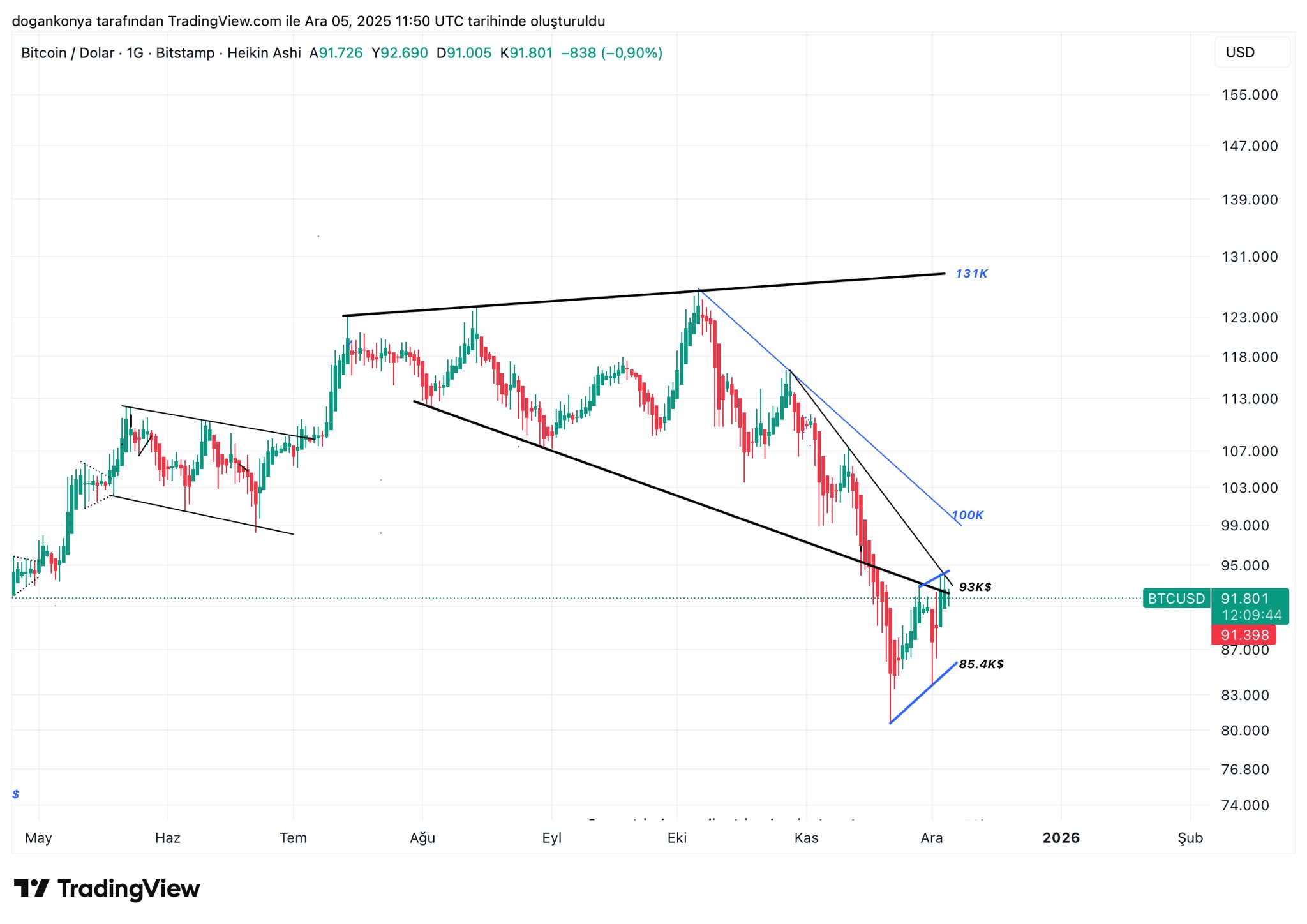
Bitcoin (BTC) trades just below $90,000 after a fluctuating week of price action resulted in a net loss of 1.8%. Despite initial hopes of a resurgence in late November, the premier cryptocurrency is now 29.16% away from its all-time high. Going by the price action, popular analyst with the X username PlanD postulates BTC is now in consolidation guided by two major price levels.

Bitcoin Moves In Key Range Between $85,000-$93,000, Market Breakout Awaits

In an X post on December 5, PlanD provides an update on a continued analysis of the Bitcoin market, stating the crypto market leader appears to be building momentum within a set price range. Notably, recent price action has pushed the flagship cryptocurrency below the lower boundary of a broadening ascending channel between $93,000 and $131,000, raising fears of a bear market. However, Bitcoin has repeatedly rebounded, forming a strong consolidation range between $85,400 and $93,000. PlanD defines the present market condition as Bitcoin being in a decision zone and needing a price breakout to determine its next major direction. The analyst states that if Bitcoin moves to overcome the price resistance at $93,000, its initial price target lies at $100,000. A successful reclaim of this psychological six-figure level would confirm renewed bullish intent and stronger potential for a full market revival.

Bitcoin

On the other hand, if Bitcoin breaks below the vital support zone at $85,300, investors should expect steeper losses. In this case, PlanD projects a price drop to around $72,000, representing a potential 19% decline from present market prices. Notably, considering the recent market volatility, the ongoing consolidation may close out sooner than expected, to establish a clear market direction.

Bitcoin Price Overview

According to data from CoinMarketCap, Bitcoin trades at $89,703, reflecting a price loss of 2.99%. Meanwhile, the daily trading volume is up by 4.56% and valued at $63.16 billion.

Following the turbulent price action of the last week, BTC’s price struggles in Q4 continue against previous popular predictions. Still, several bullish indicators could support a rebound before year-end. Key catalysts include a widely anticipated interest rate cut at the upcoming Federal Open Market Committee (FOMC) meeting on December 9–10.

In addition, market sentiment is benefiting from speculation that pro-crypto economist Kevin Hassett could succeed Jerome Powell as Federal Reserve Chair in 2026.

Bitcoin

How platformization is transforming cyber security

By: slandau

With more than 15 years of experience in cyber security, Manuel Rodriguez is currently the Security Engineering Manager for the North of Latin America at Check Point Software Technologies, where he leads a team of high-level professionals whose objective is to help organizations and businesses meet their cyber security needs. Manuel joined Check Point in 2015 and initially worked as a Security Engineer, covering Central America, where he participated in the development of important projects for multiple clients in the region. He had previously served in leadership roles for various cyber security solution providers in Colombia.

In this insightful Cyber Talk interview, Check Point expert Manuel Rodriguez discusses β€œPlatformization”, why cyber security consolidation matters, how platformization advances your security architecture and more. Don’t miss this!

The word β€œplatformization” has been thrown around a lot recently. Can you define the term for our readers?

Initially, a similar term was used in the Fintech industry. Ron Shevlin defined it as a plug and play business model that allows multiple participants to connect to it, interact with each other and exchange value.

Now, this model aligns with the needs of organizations in terms of having a cyber security platform that can offer the most comprehensive protection, with a consolidated operation and easy enablement of collaboration between different security controls in a plug and play model.

In summary, platformization can be defined as the moving from a product-based approach to a platform-based approach in cyber security.

How does platformization differ from the traditional way in which tech companies develop and sell products and services?

In 2001, in a Defense in Depth SANS whitepaper, Todd McGuiness said, β€œNo single security measure can adequately protect a network; there are simply too many methods available to an attacker for this to work.”

This is still true and demonstrates the need to have multiple security solutions for proper protection of different attack vectors.

The problem with this approach is that companies ended up with several technologies from different vendors, all of which work in silos. Although it might seem that these protections are aligned with the security strategy of the company, it generates a very complex environment. It’s very difficult to operate and monitor when lacking collaboration and automation between the different controls.

SIEM and similar products arrived to try to solve the problem of centralized visibility, but in most cases, added a new operative burden because they needed a lot of configurations and lacked automation and intelligence.

The solution to this is a unified platform, where users can add different capabilities, controls and even services, according to their specific needs, making it easy to implement, operate and monitor in a consolidated and collaborative way and in a way that leverages intelligence and automation.

My prediction is that organizations will start to change from a best-of-breed approach to a platform approach, where the selection factors will be more focused on the consolidation, collaboration, and automation aspects of security controls, rather than the specific characteristics of each of the individual controls.

From a B2B consumer perspective, what are the potential benefits of platformization (ex. Easier integration, access to a wider range of services…)?

For consumers, the main benefits of a cyber security platform will be a higher security posture and reduced TCO for cyber security. By reducing complexity and adding automation and collaboration, organizations will increase their abilities to prevent, detect, contain, and respond to cyber security incidents.

The platform also gives flexibility by allowing admins to easily add new security protections that are automatically integrated in the environment.

Are there any potential drawbacks for B2B consumers when companies move towards platform models?

I have heard concerns from some CISOs about putting all or most of their trust in a single security vendor. They have in-mind the recent critical vulnerabilities that affected some of the important players in the industry.

This is why platforms should also be capable of integration through open APIs, permitting organizations to be flexible in their journey to consolidation.

How might platformization change the way that B2B consumers interact with tech companies and their products (ex. Self-service options, subscription models)? What will the impact be like?

Organizations are also looking for new consumption models that are simple and predictable and that will deliver cost-savings. They are looking to be able to pay for what they use and for flexibility if they need to include or change products/services according to specific needs.

What are some of main features of a cyber security platform?

Some of the main features are consolidation, being able to integrate security monitoring and management into a single central solution; automation based on APIs, playbooks and scripts according to best practices; threat prevention, being able to identify and block or automatically contain attacks before they pose a significant risk for an organization…

A key component of consolidation is the use of AI and machine learning, which can process the data, identify the threats and generate the appropriate responses.

In terms of collaboration, the platform should facilitate collaboration between different elements; for example sharing threat intelligence or triggering automatic responses in the different regions of the platform.

In looking at platformization from a cyber security perspective, how can Check Point’s Infinity Platform benefit B2B consumers through platformization principles (ex. Easier integration with existing tools, all tools under one umbrella…etc)?

The Check Point Infinity platform is a comprehensive, consolidated, and collaborative cyber security platform that provides enterprise-grade security across several vectors as data centers, networks, clouds, branch offices, and remote users with unified management.

It is AI-powered, offering a 99.8% catch rate for zero day attacks. It offers consolidated security operations; this means lowering the TCO and increasing security operational efficiency. It offers collaborative security that automatically responds to threats using AI-powered engines, real-time threat intelligence, anomaly detection, automated response and orchestration, and API-based third-party integration. Further, it permits organizations to scale cyber security according to their needs anywhere across hybrid networks, workforces, and clouds.

Consolidation will also improve the security posture through a consistent policy that’s aligned with zero trust principles. Finally, there is also a flexible and predictable ELA model that can simplify the procurement process.

How does the Check Point Infinity Platform integrate with existing security tools and platforms that CISOs might already be using?

Check Point offers a variety of APIs that make it easy to integrate in any orchestration and automation ecosystem. There are also several native integrations with different security products. For example, the XDR/XPR component can integrate with different products, such as firewalls or endpoint solutions from other vendors.

To what extent can CISOs customize and configure the Check Point Infinity Platform to meet their organization’s specific security posture and compliance requirements?

Given the modular plug and play model, CISOs can define what products and services make sense for their specific requirements. If these requirements change over time, then different products can easily be included. The ELA consumption model gives even more flexibility to CISOs, as they can add or remove products and services as needed.

How can platformization (whether through Infinity or other platforms) help businesses achieve long-term goals? Does it provide a competitive advantage in terms of agility, innovation and cost-efficiency?

A proper cyber security platform will improve the security posture of the business, increasing the ability to prevent, detect, contain and respond to cyber security incidents in an effective manner. This means lower TCO with increased protection. It will also allow businesses to quickly adapt to new needs, giving them agility to develop and release new products and services.

Is there anything else that you would like to share with Check Point’s thought leadership audience?

Collaboration between security products and proper intelligence sharing and analysis are fundamental in responding to cyber threats. We’ve seen several security integration projects through platforms, such as SIEMs or SOARs, fail because of the added complexity of generating and configuring the different use cases.

A security platform should solve this complexity problem. It is also important to note that a security platform does not mean buying all products from a single vendor. If it is not solving the consolidation, collaboration problem, it will generate the same siloed effect as previously described.

The post How platformization is transforming cyber security appeared first on CyberTalk.

Unconsidered benefits of a consolidation strategy every CISO should know

By: slandau

Pete has 32 years of Security, Network, and MSSP experience and has been a hands-on CISO for the last 17 years and joined Check Point as Field CISO of the Americas. Pete’s cloud security deployments and designs have been rated by Garter as #1 and #2 in the world and he literally β€œwrote the book” and contributed to secure cloud reference designs as published in Intel Press: β€œBuilding the Infrastructure for Cloud Security: A Solutions View.” 

In this interview, Check Point’s Field CISO, Pete Nicoletti, shares insights into cyber security consolidation. Should your organization move ahead with a consolidated approach? Or maybe a workshop would be helpful. Don’t miss Pete Nicoletti’s perspectives.

What kinds of struggles and challenges are the organizational security leaders that you’re working with currently seeing?

Many! As members of the World Economic Forum Council for the Connected World, we drilled into this exact question and interviewed hundreds of executives and created a detailed report. The key findings are:Β  Economic Issues, IoT risks, increase in ransomware, and security personnel shortages all impacting budgets. Given these issues, our council recommended that security spend remain a priority, even in challenging times, since we all know that security incidents cost 10x to 100x verses budgeted expenditures.

How are CISOs currently building out or transitioning their information security programs? What kinds of results are they seeing?

In challenging times, CISO’s are looking hard at their tool set and seeing if there is overlap, or redundant tools, or underutilized tools. CISO’s are also evaluating their β€œplay-books” to ensure that the tools in-use are efficient and streamlined. CISO’s are also keen to negotiate ELA’s that give them lower costs with flexibility to choose from a suite of tools to support the β€œspeed of business.”

Security teams need to be trained and certified on their tools in use, and those budgets are under pressure. All these drivers lead to tool consolidation projects. Our customers are frequently very pleased with the normally mutually exclusive benefits: Costs Savings and better efficacy once a consolidation program is launched.

What are the key considerations for CISOs in deciding on whether or not to consolidate information security solutions? Can CISOs potentially lose capabilities when consolidating security and if so, how can this be addressed, if at all?

Losing features when consolidating is a valid concern, however, typically we find more advantages after consolidation: Lower training costs, higher staff satisfaction, fewer mistakes made, and the real gem: higher security program efficacy. We also see our customers leveraging the cloud and needing to extend their security protections quickly and easily, and our Check Point portfolio supports this using one console. With all the news of our peers experiencing exploited security vulnerabilities and other challenges, we are continuing to gain market share and happy customers.

How should CISOs go about deciding on whether or not to consolidate cyber security? Beyond cost, what should CISOs think about?

The number one consideration should be efficacy of the program. CISO’s are realizing that very small differences in efficacy lead to very large cost savings. The best security tool for the job should always be selected knowing this. An inventory of tools and the jobs they are doing should be created and maintained. Frequently, CISO’s find dozens of tools that are redundant, overlap with others, add unnecessary complexity, and that are poorly deployed or managed and not integrated into the program. Once the inventory is completed, work with your expert consultant or reseller to review and find redundancies or overlaps and kick-off a program to evaluate technical and cost benefits.

What can organizations achieve with a consolidated cyber security solution?

As mentioned previously, the number one goal of the program should be improving efficacy and our customers do report this. Efficacy lowers the number of false positives, lowers the number of real events and decreases overall risk. Other savings are found with lower training costs, faster run book execution, fewer mistakes and the ability to free up security analysts from wasting time on inefficient processes. Those analysts can now be leveraged into more productive efforts and ensure that the business growth and strategies are better supported.

As a seasoned professional, when you’ve worked with CISOs and security teams in moving to a consolidated solution, what’s gone right, what’s gone wrong, and what lessons can you share with newbie security leaders?

Any significant change in your tool set needs careful consideration and evaluation. Every new tool needs to be tested in lab and moved, as appropriate, into production. You need to find all the gotcha’s with any new tool going inline before they cost impact.

Don’t rush this testing step! Ensure that you have good measurements of your current program so you can easily determine improvements with new tools or consolidation efforts.

If CISOs decide against consolidation, how can they drive better value through existing solutions?

Ensure that the solutions you are using are fully deployed and optimized. We frequently uncover many tools that are underutilized and ineffective. Sit with your staff and watch their work. If they are cutting and pasting, logging into and out of multiple tools, not having the time to address every alert, or are making excessive mistakes, it may be time to have Check Point come in and do a workshop. Our very experienced team will review the current program and provide thoughts and ideas to improve the program. Even if consolidation is not selected, other findings may help improve the program!

Are there any other actionable insights that you would like to share with cyber security leaders?

Every security program is different, and your challenges are unique. But, you can’t know everything, so, consider working with your trusted partners and invite Check Point in to do a free discovery workshop. Cloud maturity, consolidation program consideration, Zero Trust program formulation, and many others are available. As a CISO, you may have some initiatives that need extra validation, and we are standing by to help propel your program.

And for an even stronger security strategy, be sure to attend Check Point’s upcoming CPX 360 event. Register here.

Lastly, to receive cutting-edge cyber security news, best practices and resources in your inbox each week, please sign up for theΒ CyberTalk.org newsletter.Β 

The post Unconsidered benefits of a consolidation strategy every CISO should know appeared first on CyberTalk.

❌