Reading view

There are new articles available, click to refresh the page.

Taiwan Eyes First Stablecoin Debut In 2026 As Regulatory Framework Advances

As the sector continues to gain global momentum, Taiwanese authorities have announced that a locally issued stablecoin could be launched next year, pending the imminent approval of the country’s regulatory crypto framework and related legislation.

First Local Stablecoin To Debut Next Year

On Wednesday, Taiwan’s Financial Supervisory Commission (FSC) Chairman Peng Jin-long revealed that the island’s first regulated stablecoin could debut in the latter half of 2026, local news outlet Focus Taiwan reported.

The FSC chair affirmed that the Virtual Assets Service Act (VASA), which incorporates stablecoin regulation, could be passed during its third hearing in the next legislative session, scheduled for this week, after clearing initial reviews with a “high level of consensus.”

After the framework’s approval, stablecoin-centered regulations would be developed within six months, setting the launch of a locally issued token pegged to the New Taiwan Dollar (NTD) or the US Dollar (USD) to the second half of the year.

The VASA supports the efforts by Taiwanese authorities to establish a comprehensive crypto framework that promotes industry growth and safeguards investors. Last year, the FSC announced an overhaul of the Anti-Money Laundering (AML) framework to include crypto businesses, introducing stricter AML guidelines for Virtual Asset Service Providers (VASPs) and requiring all crypto firms to complete the AML registration by September 2025.

In January, Peng stated that investors could have a “convenient” entrance to crypto assets in the future through stablecoins, which could serve as a bridge between the country’s legal tender and virtual currency.

In March, the FSC published the finalized draft of its landmark crypto legislation, which the VASA’s draft proposed authorizing banks to issue stablecoins pegged to the New Taiwan Dollar or the US Dollar.

Meanwhile, Premier Cho Jung-tai and Central Bank Governor Yang Chin-long recently expressed support for a formal Bitcoin (BTC) policy, pledging to study the flagship cryptocurrency as a strategic reserve asset, accelerate pro-BTC rulemaking, and pilot treasury exposure through government-seized assets.

Taiwan Sets Financial Institutions’ Role

At the legislative hearing, the FSC’s chair highlighted that the bill’s draft draws from the European Union (EU)’s Markets in Crypto-Assets Regulation (MiCA). He explained that the Virtual Assets Service Act doesn’t require stablecoins to be issued exclusively by financial institutions, which has been a divisive topic in other jurisdictions.

As reported by Bitcoinist, South Korea’s long-awaited stablecoin legislation could be delayed until next year as the Korean Financial Services Commission clashes with the Bank of Korea (BOK) over the role of banks in the sector.

A local news media outlet recently noted that the BOK and regulators agree that financial institutions must be involved in the issuance of won-pegged tokens, but differ on the extent of their role.

The central bank is pushing for a consortium of banks owning at least 51% of any stablecoin issuer seeking regulatory approval. Meanwhile, regulators are concerned that giving a majority stake to banks could reduce participation from tech companies and limit the market’s innovation. Earlier this week, authorities set December 10 as the deadline for the government to deliver a draft bill.

Unlike South Korea’s financial authorities, Focus Taiwan reported that the regulator and the central bank have agreed that only financial institutions will be allowed to issue stablecoins in the initial stage to reduce risk management, suggesting that companies could join at a later stage of the project.

stablecoin, bitcoin, btc, btcusdt

Hong Kong Stablecoin Hub Ambitions At Risk Following Beijing’s Latest Crypto Warning – Report

Hong Kong’s stablecoin hub dreams have reportedly taken a hit after the People’s Bank of China (PBOC) singled out the sector for the first time while reaffirming its long-standing position on the crypto industry.

Beijing’s Latest Warning Targets Stablecoins

Legal experts and analysts suggested that Beijing authorities have clouded Hong Kong’s ambitions to become a key regulated hub for stablecoins following the PBOC’s explicit crackdown on the sector last week.

As reported by Bitcoinist, the People’s Bank of China, alongside other top financial regulators, affirmed on Friday that stablecoins do not qualify as legal tender in the mainland, as they fail to meet regulatory requirements and pose a risk of being used for illegal activities.

“Virtual currency-related business activities constitute illegal financial activities. Stablecoins are a form of virtual currency, and currently cannot effectively meet requirements for customer identification and anti-money laundering, posing a risk of being used for illegal activities such as money laundering, fundraising fraud, and illegal cross-border fund transfers,” the PBOC stated.

According to the South China Morning Post (SCMP), the recent pronouncement sank previous hopes that Beijing might have softened its stance on cryptocurrencies amid the global regulatory shift toward the sector, led by the United States. Moreover, it could affect Hong Kong’s efforts to become a hub for the stablecoin sector, analysts recently stated.

In a blog post cited by SCMP, Liu Honglin, founder of Shanghai-based Mankun Law Firm, affirmed that “all the ambiguity, speculation and room for wishful thinking surrounding stablecoins over the past few years has vanished as of today.”

Similarly, Brian Tang, founding director of the Law, Innovation, Technology and Entrepreneurship Lab at the University of Hong Kong’s Faculty of Law, told the news media outlet that Beijing’s latest stance means that applicants for Hong Kong’s stablecoin licenses would need to “‘carefully reconsider’ whether the use cases they had submitted to the HKMA ‘touch mainland China issuers and users.’”

Hong Kong Licenses Approval Risks Delay

The statement also adds to the challenges that Hong Kong’s stablecoin push faces, the report noted. Earlier this year, the Hong Kong Monetary Authority (HKMA) enacted the Stablecoins Ordinance, which directs any individual or entity seeking to issue a fiat-referenced stablecoin (FRS) in the jurisdiction, or any Hong Kong Dollar (HKD)-pegged token, to obtain a license from the financial regulator.

Following the rollout, multiple companies have applied for the license, with more than 30 applications filed, according to SCMP, including logistics technology firm Reitar Logtech and the overseas arm of Chinese mainland financial technology giant Ant Group.

E-commerce giant JD.com, through its fintech arm JD Coinlink, started testing HKD-pegged tokens under the regulator’s sandbox program earlier this year. In August, Wang Hua, CFO and Board Secretary of PetroChina, also disclosed that the company is closely monitoring the latest developments regarding the HKMA Stablecoins Ordinance.

It’s worth noting that Hong Kong’s regulatory agency previously affirmed that the first batch of stablecoin issuer licenses would be approved at the start of 2026. However, some industry players told the news media outlet that the PBOC’s recent declarations could delay HKMA’s timeline.

An HKMA spokesperson stated that the regulator is currently reviewing the application and aims to begin with a few permits. Nonetheless, the spokesperson added that even if Hong Kong proceeds with the original schedule, projects involving the yuan or mainland Chinese institutions could be delayed.

“I do not think we will see offshore yuan stablecoin projects [in Hong Kong] within the next one or two years … as that conflicts with the current tone,” he said. Meanwhile, Syed Musheer Ahmed, founder of FinStep Asia, concluded that institutions from the mainland “will have to wait” before issuing stablecoins in the city.

stablecoin, bitcoin, btc, btcusdt

Banks Are Rushing Into Stablecoins in 2025, Despite Adoption Being Years Away

What began as a niche innovation within crypto markets is now shaping the future of payments. From major U.S. institutions to global players, banks are recognizing that stablecoins—blockchain-based tokens pegged to fiat currency—offer efficiency gains that legacy systems can’t match.

The GENIUS Act in the United States and the Markets in Crypto-Assets (MiCA) Regulation in Europe have further accelerated this trend. These regulatory frameworks define stablecoins and outline who may issue them, including insured depository institutions like banks and credit unions, as well as qualified nonbanks.

The GENIUS Act is getting signed today, bringing clear rules of the road for stablecoins.

Here's why stablecoins are better money, how they're better for people and businesses, and the mental models you can use to understand them.

My master thread on stablecoins.

👇 pic.twitter.com/qIV5DHpkJE

— Sam Broner (@SamBroner) July 18, 2025

Why Banks Are Exploring Stablecoin Adoption in 2025

“Payments are a huge part of banks’ business,” said Paul Brody, global blockchain lead at EY, in an interview with Cryptonews.

“Now that banks are authorized to enter the market, they can serve the consumer and enterprise users that are looking for much lower costs on their payments, especially cross-border payments,” Brody added.

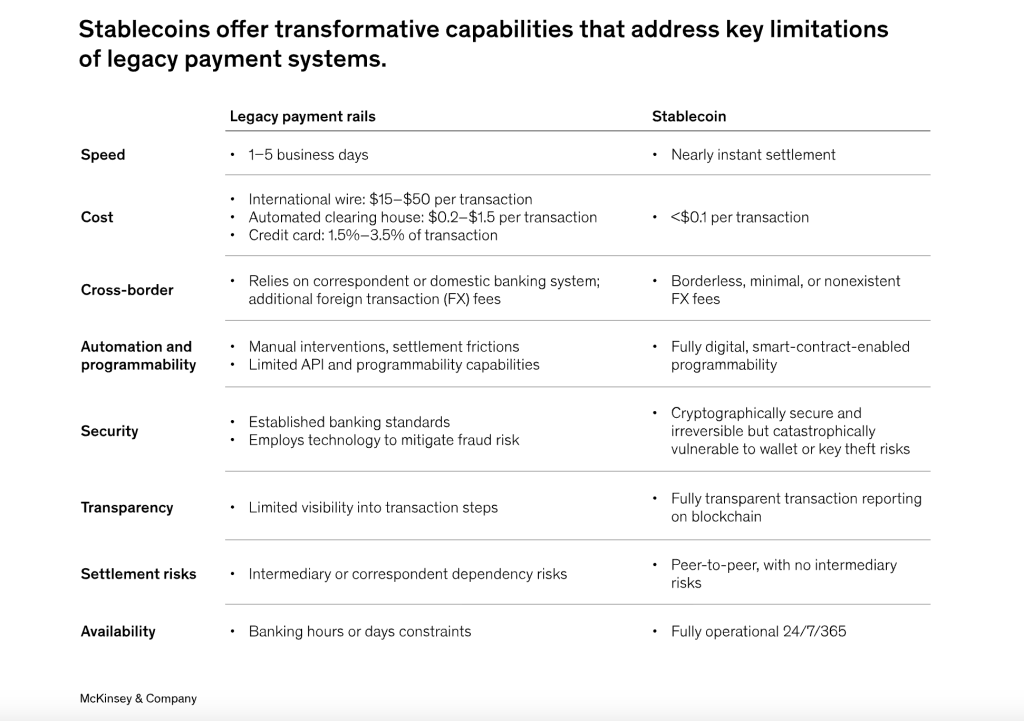
According to EY’s survey of over 250 financial services companies, reducing costs on cross-border transactions with partners and suppliers is the top priority. McKinsey & Company reports that stablecoin transactions can offer near-instant settlement, which has major implications for corporate treasury and global payments.

“Just over 50% of large financial institutions say they plan to be doing or testing this in some manner in the coming 12 months, which is an extraordinarily high rate of uptake,” Brody mentioned.

Source: McKinsey & Company

Banks Currently Looking at Stablecoin Implementation

Several banks are moving from exploration to action. On November 25, 2025, U.S. Bank announced a pilot issuing a custom stablecoin on the Stellar network in collaboration with PwC and the Stellar Development Foundation (SDF).

José Fernández da Ponte, president and chief growth officer at SDF, told Cryptonews that blockchain technology makes business sense for institutions like U.S. Bank. He explained that transactions that cost thousands of dollars on legacy rails cost just a fraction of that on Stellar.

“Settlement times are also cut from days to approximately five seconds, reducing counterparty risk and intermediary fees financial institutions have to pay to move money across the globe,” he added.

The Stellar network is already partnering with enterprise financial institutions like WisdomTree, Franklin Templeton, PayPal, and MoneyGram. Fernández da Ponte shared that next year, Stellar expects to see more growth in the ecosystem as institutions explore moving on-chain.

Other major banks, including Citi, Barclays, Bank of America, and more, have also announced plans to explore and potentially adopt their own stablecoins moving forward.

Beyond banks, Ripple announced that its USD-backed stablecoin RLUSD is now recognized as an Accepted Fiat-Referenced Token by Abu Dhabi’s Financial Services Regulatory Authority, allowing licensed companies to use it for permitted activities.

Compliance and trust are non-negotiables for institutional finance.

That's why $RLUSD has been greenlisted by Abu Dhabi’s FSRA, enabling its use as collateral on exchanges, for lending, and on prime brokerage platforms within @ADGlobalMarket—the international financial centre of…

— Ripple (@Ripple) November 27, 2025

Financial services giant Visa recently announced that it is expanding its stablecoin settlement capabilities across Central and Eastern Europe, the Middle East, and Africa (CEMEA) through a new partnership with digital assets platform Aquanow.

According to Visa, the integration of Aquanow’s digital asset infrastructure with Visa’s technology stack will allow issuers and acquirers across the CEMEA region to quickly settle transactions using approved stablecoins like USDC.

Adoption Takes Off, But Real Use Cases Years Away

Despite growing institutional interest, experts caution that mainstream adoption is still a few years away. Brody believes that it will take at least one to two years of network effects before banks and stablecoin usage increase.

“The benefits of stablecoins include speed, low cost, and full programmability,” he said. “But the biggest challenges are that there are still too few companies and countries connected to this expanding network and far too few foreign exchange currencies as well.”

Mike Villano, senior vice president of enterprise innovation at U.S. Bank, further noted that privacy remains a primary concern.

“One issue we hope to continue to work on with Stellar in future phases is privacy. One of the things a US Bank would expect when we deliver a product to market will be to maintain the privacy of some of the balances on a blockchain.”

November also marked a turning point for the overall stablecoin sector. A report from CoinDesk published on Nov. 26 found that the total market capitalization of stablecoins contracted 1.48% to $303 billion.

The report notes that this $4.54 billion contraction marks the steepest monthly decline since the collapse of FTX in November 2022. This demonstrates a combination of stablecoin outflows and weakening digital asset prices, suggesting a broader withdrawal of liquidity and capital from the crypto markets.

The Long-term Outlook

Industry leaders remain optimistic, though. Danny Lim, co-founder of Pundi X and Pundi AI, believes that stablecoin outflows will not impact real-world use cases. Lim told Cryptonews that bank-issued stablecoins are not meant to replace USDT or USDC, but rather to change who is willing to come on board.

“If banks issue stablecoins on public or permissioned chains, merchants get the same 24/7 settlement speed and on-chain finality as today’s public stablecoins, but with a known regulated counterparty, deposit protection, full AML/KYC, and clear domestic rules behind the token,” he said.

Lim added that in regions like Turkey and South Africa, where Pundi X has been active for years, consumers are using stablecoins like USDT and USDC for everyday remittances, savings, and protection against currency swings. He explained that a bank-issued stablecoin will likely push this further by adding regulated on and off ramps, local Know Your Customer (KYC,) and a sense of safety that appeals to more traditional families and small businesses.

The post Banks Are Rushing Into Stablecoins in 2025, Despite Adoption Being Years Away appeared first on Cryptonews.

❌