Day One Ventures' Masha Bucher doesn't just invest in startups — she also tells their stories. Her integrated model aligns incentives and proves conviction matters more than contracts.
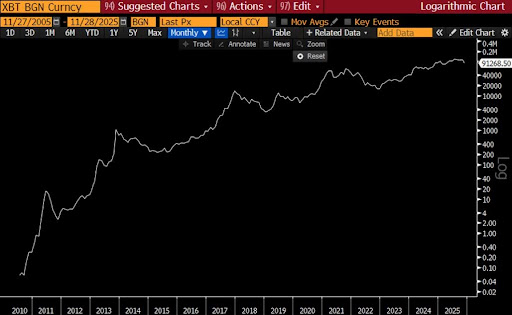
A leading finance expert believes that the current growth stage of the Bitcoin price mirrors Google’s expansion in 2017, suggesting that the network is yet to reach its true potential. The expert’s comparison positions Bitcoin as a maturing digital system that has established core utility, with a larger phase of value capture still ahead. His remarks about BTC come at a time when its price is navigating sharp downside risks and heightened market volatility
How The Bitcoin Price Compares To Google In 2017
Raoul Pal, the founder and Chief Executive Officer (CEO) of Real Vision, has highlighted a compelling connection between Bitcoin’s current price growth and Google’s early years. In an X post this week, Pal argued that digital assets clearly follow a network-driven growth model, comparing the sector to major technology giants that expanded rapidly as their user base increased.
The Real Vision founder emphasized that crypto behaves like a Metcalfe’s Law network, similar to Google, Amazon, Meta, and Tesla, where value scales with the number of participants rather than traditional financial metrics. He stated that attempting to value cryptocurrencies using cash flow models overlooks the essence of what makes a network valuable.
In his view, the structure of blockchain ecosystems means that their worth is tied to usage, adoption, and the network effects generated by millions of users. This unique framework underpins Pal’s belief that Bitcoin’s price growth today is a reflection of Google’s position in 2017. The financial expert supported his argument with a GOOGL US equity chart, showing its multi-year growth curve on a logarithmic scale. During 2017, Google was already dominant in areas like search, yet many of its long-term value drivers, such as cloud and Artificial Intelligence (AI), were still developing.
While the Bitcoin network is secure, widely adopted, and increasingly integrated into the global financial system, Pal’s view suggests that the cryptocurrency’s long-term development and true potential are still far from realized. He added that Ethereum may be even earlier in its growth curve, suggesting the second-largest cryptocurrency could follow a longer trajectory as its technology and applications evolve.
The True Value of Crypto Networks
Pal’s remarks on X, which compares Bitcoin to Google, were made in response to statements from Santiago Roel Santos, the founder and CEO of Inversion, a technology-first investment company. Santos initially argued that network effects in crypto have been overstated and are often misused to justify valuations resembling those of social networking companies.
Santos suggested that many cryptocurrencies have not demonstrated meaningful value capture and therefore resemble open source software systems like Linux rather than platforms such as Facebook, which benefit directly from rising user numbers. Pal challenged this view by insisting that crypto networks exhibit real and measurable network effects. His entire argument is built on the idea that user activity and transaction volume support the growing value of digital networks like Bitcoin.
Today, “equity” is a watchword in the cannabis legalization movement, as state and local governments try to craft models for an adult-use market designed to correct the social harms of prohibition and the War on Drugs. But this public consciousness is due to the work of many who pushed the issue long before doing so was entirely socially acceptable.
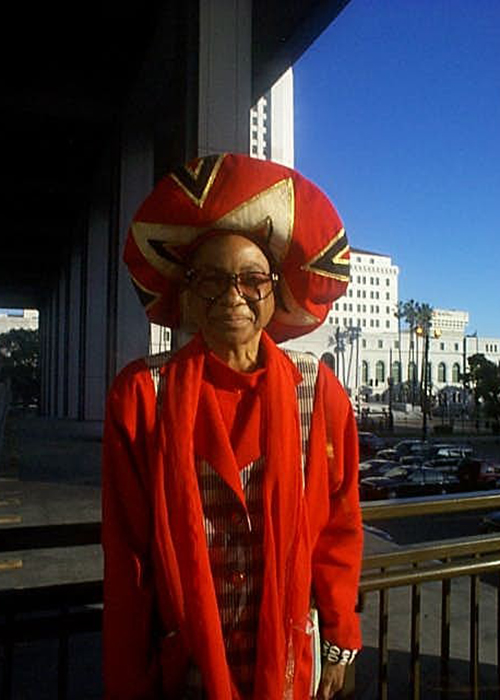
Sister Somayah Kambui, a veteran Black Panther turned cannabis advocate, was one of those who brought issues of racial justice to the forefront of the cannabis movement. And before her untimely death, she won a groundbreaking “jury nullification” victory, upholding her right to provide cannabis to treat sickle-cell anemia.
Sister Somayah, as she was ubiquitously known (she was born Renee Moore), used cannabis to treat sickle-cell anemia, under the terms of California’s Proposition 215 medical marijuana measure after its passage in 1996. But her vocal advocacy made her a target of the authorities — resulting in her unprecedented legal victory.
Sickle-cell anemia is a genetic blood anomaly that occurs in one in every 70,000 Americans, particularly those of African descent. It can cause debilitating pain, fatigue and swelling of the hands and feet. It took Kambui a while to figure out that cannabis was the most effective treatment for her.
Kambui was a veteran of the U.S. Air Force, where she served several years during the Vietnam era. At VA and public hospitals, she was given morphine for her pain from the disease.
“I couldn’t do anything on the morph,” she told High Times reporter Peter Gorman. “And neither can a million other people. That’s why you see so many middle aged and older black folk sitting on stoops looking like junkies. They are junkies. They’re U.S. government junkies.”
After finding that cannabis helped, and after the passage of Prop 215, she founded the Crescent Alliance Self Help for Sickle Cell collective, or “buyers’ club.” With a doctor’s recommendation, she began cultivating in her South Los Angeles backyard.
But the police raided her garden in October 2001 and confiscated, by their estimate, 200 pounds of cannabis plants.
The LAPD brought in a helicopter for the raid, menacing the block of single-family homes.
“I was sitting having a cup of coffee with a little hemp oil when they broke down the door,” Kambui told the Los Angeles Times. “I said, ‘I’m legal, I have a doctor’s note and I’m compliant with the law.'”
She said the officers told her she had too much for her personal use. “I said ‘OK, why don’t you take what you think I don’t need and leave me the rest?'” she recalled to the LA Times. “They took it all.”
She also disputed the police estimate of the haul. “That is 200 pounds wet, with dirt and stalks,” she said.
Kambui was arrested, spent 60 days in jail and was charged with multiple felonies including cultivation, sale and shipping marijuana out of state. Worse still, she was facing a life prison term under California’s “Three Strikes” law. Her two prior convictions, involving illegal firearms possession and explosives, stemmed from her work with the Black Panthers in the early 1970s. During her time as a legendary Panther, she was known as “Peaches,” and was a leader of the Southern California Chapter of the Black Panther Party, alongside Geronimo Pratt.
When she went before the judge at Los Angeles County Court in January 2002, Kambui said the cannabis was not for her use alone, but was to be shared with some dozen sickle-cell sufferers in her club. “They’re all mine,” she said, taking full responsibility for all the uprooted plants. She also admitted shipping to sufferers who were too far away to come see her.
And she asserted that her advocacy had made her a target, noting that she’d been similarly raided in 1998 — although the charges were dropped after she spent two weeks in jail.
Making a medical necessity defense, Kambui spoke to the court of the long centuries of medicinal cannabis use in African traditional healing. Using her own idiosyncratic lingo, she referred to the African continent as “Nigretia,” and to her cannabis as “Nigretian Kif.”
By the time of her court case, Kambui was already a leading figure in Southern California’s cannabis activist scene. She was the key mover behind the first Los Angeles Global Marijuana March in 1999, and all the subsequent ones until her death. And she was particularly aggressive in calling out the cannabis community one what she saw as its internal racism — for instance, in failing to emphasize sickle-cell anemia in medical marijuana advocacy, and failing to make the link between prohibition and militarized policing of black and brown communities.
But she bridged a cultural divide in 1997, when she teamed up with B.E. Smith, a brazen and police-defying cannabis grower of white redneck roots in the backwoods of Northern California’s Trinity Alps. Smith became “designated caregiver” for Kambui, among a handful of other medical users around the state. Alas, she never got to use B.E.’s bud, as his cultivation site was raided by federal agents that harvest season—resulting in his own landmark legal battle. Smith died earlier this year.
Unfortunately, Kambui’s run-ins with the law were not over after her court victory. In October 2003, her garden was again raided — this time by the DEA. A dozen plants were uprooted, although no charges were filed.
California NORML coordinator Dale Gieringer decried the raid as a “mean-spirited, gratuitous attack on a seriously ill woman who has been judged guiltless by her peers under California law. Like other victims of DEA’s medical marijuana raids, Somayah was targeted because she was a vocal, legal patient activist who was a thorn in the side of the law enforcement establishment.”
Like many front-line activists who put a commitment to community ahead of personal gain, Kambui received little material reward for her efforts. When she died on Thanksgiving 2008, at the age of 57, the website Time4Hemp wrote that economic hard times likely contributed to her demise: “Many close to her believe she died of a broken heart based on lack of financial support. All those dispensaries in Los Angeles and not one would help her save her home from foreclosure.”
Twelve years after her passing, Sister Somayah Kambui reminds us of the need to preserve the memory of those who sacrificed for such freedom and consciousness as we have now achieved. And more poignantly, of the need to honor and support our freedom fighters while they still walk among us.
Cannabis industry trailblazer Wanda James is making a bid to unseat longtime Congresswoman Diana DeGette, who has represented Colorado’s First Congressional District for nearly three decades.
The contentious issue of how to buy or sell marijuana social equity licenses is being pressed by a specific instance in Illinois involving Cookies-branded cannabis stores.
A Chicago alderman blocked a proposal from a business that includes former police officers from opening a marijuana dispensary on the city’s North Side.
According to CROO, the study “will collect and analyze data and report on whether discrimination exists in the Illinois cannabis industry,” CROO states on its website. “If there is a finding that discrimination exists, the Disparity Study will evaluate the impact of the discrimination on the State and its residents regarding entering and participating in the State’s cannabis industry. The Disparity Study will include recommendations for reducing or eliminating any identified barriers to entry.“
The study will examine laws and court cases that involve cannabis and cannabis and disparity studies, conduct interviews and create focus groups for public input, and compile data in relation to the state’s cannabis application process and business information.
A final report is required to be sent to the General Assembly and governor within 12 months, including any “potential remedies” to amend current cannabis regulation. “This effort is a vital assessment of the state’s cannabis social equity licensing system,” said Acting CROO Officer Erin Johnson. “We look forward to seeing a final report that truly incorporates the voices of Illinois social equity applicants and our new cannabis businesses.”
This comes nearly one year since the state issued a request to find someone to conduct the Disparity Study in Feb. 2022. This led to the hiring of the Nerevu Group, which is a minority- and women-owned contractor group based throughout Illinois, as well as some out-of-state locations.
“Along with our partners, Nerevu is honored to support CROO, IDFPR and IDOA in building an even more inclusive and equitable cannabis industry,” said Nerevu Group Founder and President Reuben Cummings. “This study is essential in identifying potential disparities and suitable remedies. We are excited to initiate this project and look forward to connecting with the greater cannabis community.”
Legal adult-use cannabis sales began in 2020, and in July 2022, Gov. J.B. Pritzker announced that 149 condition state licenses would be issued and available for social equity applicants. “Illinois is leading the way in addressing the War on Drugs as no state has before, and dispensary ownership that reflects our state’s diversity is a product of that commitment,” said Pritzker. “These licenses represent a significant step toward accountability for the decades of injustice preceding cannabis legalization. Illinois will continue to deliver on the promises of putting equity at the forefront of this process.”
According to Nigel Dandridge, the co-founder of Ivy Hall Damen, it’s taken a long time for his business to open up. “We’ve been working to get a seat at the table for a while now, and we’re finally able to do that,” said Dandridge. “When this industry first opened up, we didn’t see anyone in our community benefiting, or even being able to participate. So it was kind of hypocritical. I think it’s important that we can show you what we’re doing. We want everyone to benefit. Our staff’s been working hard, and we’re just excited to share it with everyone.”
Falling in line with other states in the U.S., Illinois Rep. La Shawn Ford recently introduced House Bill 1 to legalize psychedelics in January. Ford’s bill would allow residents 18 years and older to seek out supervised psychedelic therapy. “I want to be clear that this is a health measure. My proposal does not allow retail sales of psilocybin outside of a regulated therapeutic setting and ensures that medicines purchased for therapeutic use at a service center must be used under medical supervision, and cannot be taken home,” Ford said. “Only licensed facilitators will be allowed to provide treatment at closely regulated and licensed healing centers, approved health care facilities, in hospice, or at a pre-approved patient residence.”
Democratic lawmakers in Delaware last week performed what has become an annual legislative ritual by introducing measures that would legalize recreational marijuana.
And, as per recent tradition, their biggest obstacle remains the most senior member of their own state party.
The Delaware News Journal reports that members of the state House of Representatives introduced a pair of bills on Friday “to legalize and create a recreational marijuana industry in Delaware, setting up a likely fight within the Democratic Party this legislative session.”
The anticipated intra-party feud centers around Democratic Gov. John Carney, who has long been opposed to marijuana legalization and has stymied efforts by Democrats in the legislature to end the prohibition on pot.
Last year, Carney vetoed a bill that would have legalized recreational pot in the state.
Despite holding a majority in each chamber of the state General Assembly, Democratic lawmakers were unable to override Carney’s veto.
“[The legalization bill] would, among other things, remove all penalties for possession by a person 21 years of age or older of one ounce or less of marijuana and ensure that there are no criminal or civil penalties for transfers without remuneration of one ounce or less of marijuana between persons who are 21 years of age or older,” Carney said in a statement following his veto.
“I recognize the positive effect marijuana can have for people with certain health conditions, and for that reason, I continue to support the medical marijuana industry in Delaware,” he continued. “I supported decriminalization of marijuana because I agree that individuals should not be imprisoned solely for the possession and private use of a small amount of marijuana—and today, thanks to Delaware’s decriminalization law, they are not.”
“That said, I do not believe that promoting or expanding the use of recreational marijuana is in the best interests of the state of Delaware, especially our young people,” Carney added. “Questions about the long-term health and economic impacts of recreational marijuana use, as well as serious law enforcement concerns, remain unresolved.”
Democrats who are backing the two bills introduced in the state House last week are hopeful that Carney will eventually come around.
“My hope is that with continued open dialogue with the governor’s office, that will help alleviate a veto,” Democratic state House Rep. Ed Osienski, one of the sponsors of the legislation, told the Delaware News Journal. “I have more support from my members … for a veto override, but I’m hoping it doesn’t come to that.”
According to the outlet, a “Carney spokeswoman said Friday that the governor’s views on marijuana have not changed.”
According to the Delaware News Journal, the bill dedicated to removing all penalties for possession would “require a simple majority or 21 votes.”
The other bill “would create a framework to regulate the growth, sale and possession of weed,” essentially treating pot like alcohol, and would require “a three-fifths vote because it deals with revenue and taxation,” the Delaware News Journalreports.
The measures also include social equity provisions aimed at enhancing opportunities in the new marijuana industry to individuals from communities who have been historically targeted by anti-drug policies.
“Delawareans would buy marijuana from a licensed retail marijuana store. The bill would allow for up to 30 retail licenses to be distributed within 16 months of the legislation going into effect. The process will be competitive, with prospective retailers being rewarded for providing good salaries and benefits and hiring a diverse workforce.”

 Login
Login