Reading view

There are new articles available, click to refresh the page.

SEC Chair Paul Atkins Advocates For Modernizing Crypto Regulations– Here’s How

In remarks made on December 4, US Securities and Exchange Commission (SEC) Chair Paul Atkins expressed an optimistic outlook for the cryptocurrency industry. Atkins emphasized the SEC’s intent to modernize its rules to facilitate an on-chain market environment, leveraging distributed ledger technology and the tokenization of financial assets.

SEC Chair Advocates For Crypto Tokenization

Atkins highlighted the transformative potential of these technologies for the capital markets. He stressed that enhancing these markets is essential for US firms and investors to maintain their leadership on a global scale. 

The chair underscored that the advancements in blockchain technology could streamline not only trading processes but also the entire issuer-investor relationship, which would enable a more efficient and transparent financial ecosystem.

Tokenization, according to Atkins, goes beyond merely changing the mechanics of trading. He pointed out that it can foster direct connections for various important functions such as proxy voting, dividend payments, and shareholder communications, all while reducing the reliance on multiple intermediaries. 

In his address, Atkins acknowledged several innovative models that deserve consideration. He noted that some companies are directly issuing equity on public distributed ledgers in the form of programmable assets. 

These assets can integrate compliance features, voting rights, and governance capabilities, allowing investors to hold securities in a digital format that promotes transparency and reduces the number of intermediaries involved.

Additionally, he mentioned that third parties are engaging in the tokenization of equities by generating on-chain security entitlements that represent ownership stakes in traditional equities. 

The emergence of synthetic exposures—tokenized products designed to reflect the performance of public equities—was also highlighted. While many of these offerings are currently being developed offshore, they showcase the international interest in US market exposure supported by distributed ledger technology.

Atkins Critiques Past SEC Strategies

However, Atkins cautioned that transitioning to on-chain capital markets entails more than just issuance. He stated that it is essential to address various stages of the securities transaction lifecycle effectively. 

For instance, if tokenized shares cannot be traded competitively in liquid on-chain environments, they risk becoming little more than conceptual assets without practical utility. 

The chair also criticized the previous SEC’s approach toward the crypto industry under the agency’s former chair Gary Gensler, which attempted to adapt to on-chain markets through an expansive redefinition of “exchange.” 

This earlier strategy enforced a broad regulatory framework that ultimately created uncertainty and stifled innovation, Atkins stated. He said that it is vital to avoid repeating such mistakes in order to stimulate innovation, investment, and job creation in the United States.

To foster a conducive environment for growth, Atkins called for compliant pathways that can enable market participants to capitalize on the unique benefits of new technologies like crypto. 

In light of this conviction, he has instructed SEC staff to explore recommendations for utilizing the agency’s exemptive authorities, permitting on-chain innovations while the Commission works toward developing long-term, effective crypto regulatory frameworks.

Crypto

Featured image from DALL-E, chart from TradingView.com

Key Updates On The US Crypto Market Structure Bill: What You Need To Know

The anticipated crypto market structure bill, or namely the CLARITY Act, designed to provide essential regulatory clarity for digital assets in the United States, is approaching critical dates in the Senate. However, it faces significant complexities related to stablecoin yield, conflicts of interest, and decentralized finance (DeFi).

Senate Divided On Crypto Market Structure Bill

Legal expert and Chief Legal Officer of Variant Jake Chervinsky, reports that the Senate is divided into two committees: Banking, which is handling the securities law aspect, and Agriculture, responsible for the commodities law portion. 

Both committees have published drafts of their work this fall, with the next step being markup, a process where hearings will be held to vote on amendments before sending the bill to the Senate floor for a full vote.

However, both committees are cautious and are unlikely to proceed with markup until they resolve ongoing disputes. Among these, three significant issues stand out.

The first major concern involves stablecoin yield. In the GENIUS Act, banks lobbied for a prohibition on interest payments, meaning stablecoin issuers cannot offer holders any form of interest or yield. 

While the current prohibition prevents direct yield payments to holders, it does not address non-yield rewards or yield provided by third parties. Banks consider this gap a “loophole” and are advocating for broader restrictions to be included in the market structure bill. 

Conflicts Of Interest And DeFi Regulations Stall Progress

The second issue revolves around conflicts of interest. Some Democratic senators have indicated they would not support the market structure legislation unless it includes provisions that restrict the President’s family from conducting business in the crypto space. 

The third and perhaps most crucial issue pertains to DeFi. It is important to note that market structure legislation primarily addresses centralized platforms that exercise custody over user funds and transactions. 

Chervinsky believes the bill should primarily focus on protecting DeFi, but traditional finance (TradFi) stakeholders have been pushing Congress to categorize virtually all entities in the crypto sector—developers, validators, and others—as intermediaries. 

The expert emphasized that the success of any market structure bill hinges on ensuring robust protections for developers since the viability of the crypto industry relies on their contributions. 

Given the intricate nature of these issues and the swiftly approaching holiday break, Chervinsky noted that it is possible that discussions about market structure could extend into January. 

Senate Markup Set For December 17-18

Market analyst MartyParty provided another update on December 4, indicating that the bipartisan Digital Asset Market Structure Bill is gaining significant momentum in Congress, with a markup session in the Senate Banking Committee tentatively scheduled for December 17-18, just before the holiday recess

If successfully passed, he states that the bill could establish clearer pathways for tokenized real-world assets (RWAs) and mitigate “debanking” risks, paving the way for compliant exchanges and potentially stimulating market volumes following the Commodity Futures Trading Commission (CFTC) approvals for spot crypto trading. 

This “regulatory convergence” is seen as a catalyst that could drive liquidity and energize the next bull market, reinforcing President Trump’s vision for the US to emerge as the “crypto capital of the world.”

Crypto

Featured image from DALL-E, chart from TradingView.com 
Exposed: “Ramarxyz” Sniped 70% of $WET Presale With 1,000+ Wallets – Then Demanded Refund

A chaotic token launch on Solana has placed decentralized finance platform HumidiFi and Jupiter Exchange under intense scrutiny after blockchain investigators linked a single actor to the mass botting of the $WET public presale, capturing the majority of the allocation within seconds.

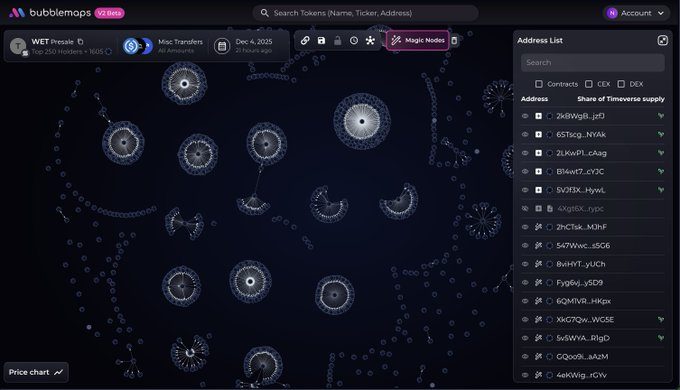
According to a detailed on-chain investigation published by Bubblemaps, one entity operating under the alias “Ramarxyz” used more than 1,000 wallets to claim roughly 70% of the $WET public presale allocation.

BREAKING: We found the identity of the $WET sniper

"Ramarxyz" claimed 70% of the @HumidiFi presale using 1,000+ wallets

Then dared to ask for a refund

🧵pic.twitter.com/YhWnOrZRNZ

— Bubblemaps (@bubblemaps) December 5, 2025

The sale, which took place through Jupiter’s Decentralized Token Formation (DTF) launchpad, sold out in just two seconds before most retail participants could interact.

HumidiFi Confirms Bot Attack as Blockchain Data Traces Sale to One Actor

HumidiFi later confirmed that a large bot farm had overwhelmed the public sale. Bubblemaps found that at least 1,100 of the 1,530 participating addresses were controlled by the same actor.

The wallets followed a repetitive funding pattern, with each receiving exactly 1,000 USDC from centralized exchanges shortly before the sale.

Source: Bubblemaps

One wallet allegedly broke the pattern by receiving funds from a private address that could be traced to the Twitter handle @ramarxyz through previous public blockchain activity.

Rather than acknowledging the activity, the individual later publicly suggested that HumidiFi should refund the sniper’s allocation, despite being linked to the exploit.

Shortly afterward, HumidiFi confirmed that all suspected bot allocations had been canceled and that legitimate presale participants would instead receive a prorated airdrop.

A separate on-chain analysis by trader Gautam Mgg showed that 4% of the public allocation went to just 10 wallets, with four wallets alone committing 40% of the entire public sale supply using bots.

🚨 $WET @humidifi : 4% Public Sale Supply went to just 10 wallets

Presale was completely botted, basically rugged And yes, @JupiterExchange is also at fault.

Here’s the proof: These 4 wallets alone committed 40% of the 4% public sale allocation using bots (finding more… pic.twitter.com/5dGz3bHwjZ

— Gautamgg 🕵 (@Gautamguptagg) December 4, 2025

The wallets were publicly listed using Solana explorers. Gautam also blamed Jupiter Exchange for failing to introduce basic bot protection measures, such as CAPTCHA or last-minute address rotation.

Jupiter had earlier announced that the $WET token sale was fully completed, raising $5.57 million across its Wetlist, JUP stakers, and public sale phases.

It’s official: Public sale phase for $WET has SOLD OUT!

The Decentralized Token Formation for @HumidiFi is now officially concluded, raising a grand total of $5.57m across the Wetlist, JUP stakers and public sale phases.$WET token for successful contributors will be claimable… pic.twitter.com/o5Hleg91z1

— Jupiter (🐱, 🐐) (@JupiterExchange) December 4, 2025

The public phase offered 30 million tokens at $0.069 per token, capped at $1,000 USDC per wallet. The token is scheduled to become claimable on December 9 alongside the launch of liquidity pools.

HumidiFi to Reissue Token After Aborting Disrupted $WET Launch

Following the incident, HumidiFi announced it would abandon the compromised launch and create a new token instead.

The protocol said all legitimate Wetlist and JUP staker participants would receive a pro-rata airdrop under a newly deployed contract that has been audited. A new public sale is now scheduled.

Some real dry shit happened today.

Humidifi started 6 months ago from nothing, straight from the trenches of DeFi 1.0.

In those 6 months, for SOL-USD, we started quoting tighter and doing more volume than Binance. We did not kiss any ass or bend the knee to anyone. We started…

— HumidiFi (@humidifi) December 5, 2025

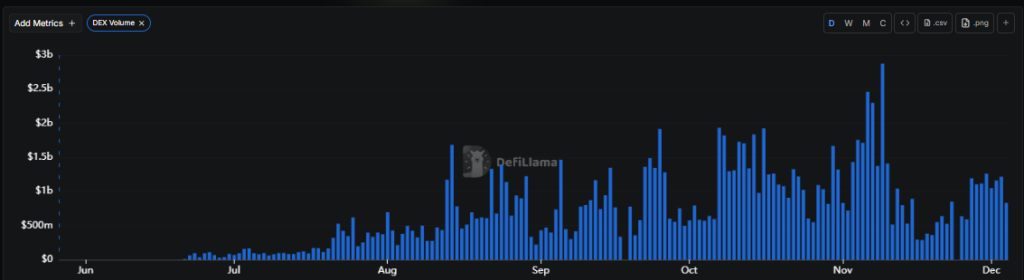
HumidiFi launched in mid-2025 and has grown into one of Solana’s most active decentralized exchanges, processing over $1 billion in daily trading volume and often accounting for more than one-third of all spot trading on the network.

According to DefiLlama, its Dex volume currently sits close to $30 billion over 30 days, while its cumulative volume sits at over $122 billion.

The $WET token was introduced as the protocol’s staking and fee-rebate asset and was promoted as a community-driven distribution using Jupiter’s DTF platform.

The incident has revived broader concerns over token distribution fairness across launchpads.

In September, Bubblemaps also flagged a separate Sybil attack linked to the MYX token airdrop, where roughly 100 newly created wallets claimed nearly $170 million in tokens after being funded simultaneously from OKX.

That case similarly raised questions about identity controls and launch design weaknesses.

Jupiter DTF was introduced as a transparent, trust-minimized alternative to traditional token launches, combining curation and on-chain verification. The $WET sale was its first live deployment, making the failure a major test for the model.

Neither Jupiter Exchange nor the individuals accused have issued a detailed technical breakdown of what failed at the infrastructure level.

The post Exposed: “Ramarxyz” Sniped 70% of $WET Presale With 1,000+ Wallets – Then Demanded Refund appeared first on Cryptonews.

Bitcoin’s four year myth meets its real master: liquidity

Ran Neuner argues bitcoin’s real market cycle is driven by global liquidity and PMI, not the four year halving myth traders still cling to. Bitcoin’s familiar four year rhythm is not broken, Ran Neuner argues, it was never the real…

💾

Ran Neuner argues Bitcoin's real market cycle is driven by global liquidity and PMI, not the four year halving myth traders still cling to

IMF warns dollar stablecoins risk eroding monetary sovereignty

The IMF says large dollar stablecoins can accelerate currency substitution, weaken monetary control in fragile economies, and require strict, globally coordinated regulation and reserves. The International Monetary Fund published a paper warning that large foreign-currency stablecoins can accelerate currency substitution…

Italy sets 2025 MiCA deadline for crypto provider Consob

Italy’s Consob says VASPs must obtain MiCA-compliant CASP authorization by Dec. 30, 2025, or cease Italian operations, return client assets, and clearly communicate exit or compliance plans. Italy’s financial market regulator has directed cryptocurrency providers to secure authorization under Europe’s…

Solana price targets bulls at $150, what is at play?

Solana’s price relating to upgrade stack, rising developer activity, and improving technicals could support a move toward the $150 resistance if network traction and trading volumes continue. Solana’s (SOL) price has drawn market attention following a series of network upgrades…

Tom Lee: Ethereum could hit $20K as tokenization booms

Tom Lee forecasts Ethereum at $20K, saying BTC’s old cycle is over and ETH will lead tokenized assets as its long consolidation breaks to the upside. Fundstrat Global Advisors co-founder Tom Lee projected Ethereum could reach $20,000 based on anticipated…

💾

Tom Lee forecasts Ethereum at $20K, saying BTC's old cycle is over and ETH will lead tokenized assets as its long consolidation breaks to the upside

BDACS brings KRW stablecoin KRW1 to Polygon

KRW1, a KRW-backed stablecoin from BDACS, has launched on Polygon with real-time bank-linked proof-of-reserves, targeting payments, remittances, and institutional use. BDACS has launched its KRW-backed stablecoin KRW1 on the Polygon network, the company announced, following a proof-of-concept that confirmed stable…

❌