Reading view

There are new articles available, click to refresh the page.

CDC tells staff telework reasonable accommodations ‘will be repealed,’ as HHS sets stricter rules

The Department of Health and Human Services is setting new restrictions on telework as a reasonable accommodation for employees with disabilities.

A new, departmentwide reasonable accommodation policy shared with employees this week states that all requests for telework, remote work, or reassignment must be reviewed and approved by an assistant secretary or a higher-level official — a decision that is likely to slow the approval process.

The new policy, as Federal News Network reported on Monday, generally restricts employees from using telework as an “interim accommodation,” while the agency processes their reasonable accommodation request.

“Telework is not appropriate for an interim accommodation, unless approved at the assistant secretary level or above,” the new policy states.

The updated reasonable accommodation policy, signed on Sept. 15 by HHS Chief Human Capital Officer and Deputy Assistant Secretary Thomas Nagy, Jr., replaces a more than decade-old policy, and applies to all HHS component agencies.

“This policy is effective immediately and must be followed by HHS component in accordance with applicable laws, regulations, and departmental policy,” the policy states.

It’s not clear how long it will take HHS to review each individual reasonable accommodation request. But HHS, which now handles all reasonable accommodation requests from its component agencies, faces a backlog of more than 3,000 cases — which it expects will take six to eight months to complete.

The new policy allows frontline supervisors to grant “simple, obvious requests” without consulting with an HHS reasonable accommodation coordinator, but prohibits them from granting telework or remote work.

“Telework and reassignment are not simple, obvious requests,” the policy states.

The policy also directs HHS to collect data on the “number of requests that involve telework or remote work, in whole or in part.”

A memo from the Centers for Disease Control and Prevention states that “all telework related to RAs will be repealed,” and that CDC leadership will no longer be allowed to approve telework as an interim accommodation.

“Staff currently on an agreement will need to report back to the worksite,” the memo states.

The CDC memo states employees can still request telework as a reasonable accommodation, but “until they are reviewed and approved by HHS they must report to the worksite.”

It also states that employees can request what was previously known as “medical telework,” which can be approved by the CDC chief operating officer for around six months in length.

According to the memo, CDC can temporarily grant medical telework to employees who are dealing with recovering from chemotherapy, hip replacement surgery or pregnancy complications.

If HHS rejects a reasonable accommodation, the CDC memo states an employee can challenge the decision before an appeal board. The CDC, however, expects that appeal will “also take months to process,” and that employees must continue to work from the office while the appeal is pending.

“We know this is going to be tough, especially on front-line supervisors,” the CDC memo states.

HHS Press Secretary Emily Hilliard said in a statement that the new reasonable accommodation policy “establishes department-wide procedures to ensure consistency with federal law.”

“Interim accommodations may be provided while cases move through the reasonable-accommodation process toward a final determination. The department remains committed to processing these requests as quickly as possible,” Hilliard said.

Jodi Hershey, a former FEMA reasonable accommodation specialist and the founder of EASE, LLC, a firm that helps employers and employees navigate workplace accessibility issues, said the new policy suggests HHS is “playing fast and loose with the Rehabilitation Act, and what’s required of them” under the legislation.

“This is the most inefficient way to handle reasonable accommodations possible. By centralizing reasonable accommodation-deciding officials, you’re removing the decision from the person who knows the most about the job. The immediate supervisor or manager knows what the job is, how the job is normally performed. They know the employee. When you remove that level of familiarity from the process, and you move it up the chain … that person has no idea what the job even is. They don’t know the person that they’re dealing with. They don’t know the office. They don’t know the particulars at all,” Hershey said.

In a message obtained by Federal News Network, Cheryl Prigodich, principal deputy director for the CDC’s Office of Safety, Security and Asset Management, told an HHS employee that because their one-year reasonable accommodation had expired, they needed to submit a new request for approval.

“The timeframe for approval on your request is not known at this time. In the interim, however, we are not allowed to approve telework as an interim accommodation for a reasonable accommodation,” Prigodich said.

Prigodich told the employee that, according to HHS, employees must either use annual leave, 80 hours of annual ad hoc telework available to each HHS employee, take leave under the Family and Medical Leave Act or report to the workplace “with the possibility of another acceptable accommodation (work tour, physical modifications to the workplace, etc).”

Prigodich directed the employee to submit their request to renew their reasonable accommodation request to the HHS assistant secretary for administration, but recommended that they “efficiently summarize your concern and request (with appropriate documentation) into no greater than a single-page memo.”

“The ASA will not want to comb through previous emails or too many attachments,” Prigodich said.

The one-page request, she added, should include “why no other alternative accommodation will work,” documentation of the disability, and records showing the previously approved reasonable accommodation.

“I know this is frustrating. We are certainly frustrated too — and this represents a significant policy change for a great number of people who rely on this type of accommodation for their personal health and needs,” Prigodich said.

The post CDC tells staff telework reasonable accommodations ‘will be repealed,’ as HHS sets stricter rules first appeared on Federal News Network.

© Federal News Network

HHS faces months-long backlog of reasonable accommodation requests from employees

The Department of Health and Human Services faces a months-long backlog of reasonable accommodation requests from its employees, as the department embarks on major changes to how it handles these requests.

HHS is preparing to roll out a new reasonable accommodation policy later this week. Several HHS components, however, recently set their own new policies, which more broadly cover telework and how often employees may work from home.

The new policy comes at a time when the Trump administration has called on the federal workforce to show up to the office full-time, and has rolled back options for some employees to work from home full-time or occasionally each two-week pay period.

Federal agencies are required under the Rehabilitation Act to provide reasonable accommodations to qualified employees with disabilities, as long as that accommodation does not result in an “undue hardship” for agencies.

The Centers for Disease Control and Prevention told employees in a memo last week that its Accommodation Tracking System (ATS) was shutting down, and that, effective immediately, reasonable accommodations will be “centralized at the HHS level.”

According to the memo obtained by Federal News Network, HHS will need to work through a backlog of about 3,330 of CDC’s pending reasonable accommodation requests.

It’s not clear how long it will take HHS to review each individual reasonable accommodation request, but according to the CDC memo, HHS expects it will take six to eight months to get through the backlog.

It’s not clear if other HHS components are also facing a backlog of reasonable accommodation requests.

The CDC memo states that its Office of Human Resources announced telework “should not be given as an interim accommodation,” while a reasonable accommodation request is under review.

“If the employee requests telework, the employee must still report into the office until a decision is made (or use leave),” the CDC memo states.

HHS Press Secretary Emily Hilliard told Federal News Network in a statement Monday that “HHS is centralizing reasonable accommodation requests in alignment with President Trump’s executive order on return to work.”

“The department remains committed to processing these requests as quickly as possible,” Hilliard said.

The CDC memo also states HHS is expected to release an updated reasonable accommodation policy later this week.

Several CDC employees told Federal News Network that the agency has recently unveiled a new telework policy, in which employees are limited to 80 hours of telework per year, and that reasonable accommodations cannot include regular/scheduled or full-time telework.

A CDC spokesperson said in a statement that “this shift aligns with President Trump’s executive order on returning federal employees to in-person work, ensuring the government is best positioned to deliver results for the American people.

In September, the CDC said it would stop approving telework requests for employees with reasonable accommodations, but temporarily reversed course on that decision, according to internal agency emails obtained by Federal News Network.

A separate email obtained by Federal News Network told HHS employees with pending reasonable accommodations that “all existing reasonable accommodation programs have been consolidated to form the HHS Reasonable Accommodation (RA) Taskforce, servicing the entire HHS workforce.”

The email, sent by an HHS reasonable accommodations coordinator, instructs employees with pending reasonable accommodation requests to complete a questionnaire within seven calendar days, and to submit medical documentation within 20 calendar days.

The email states that failure to submit the required medical documentation by this deadline will result in a “closure of your request.”

The American Federation of Government Employees Local 2883, which represents CDC headquarters employees in Atlanta, told members in an email on Nov. 26 that the agency is once again taking steps to end full-time telework for employees with reasonable accommodations.

AFGE Local 2883 wrote that on the first day back to work after the 43-day government shutdown ended, CDC employees were told that supervisors no longer have authority to approve temporary 90-day agreements for full-time telework, and that their temporary accommodations that expired over the shutdown could not be renewed.

“Some were told their current, non-expired RAs were cancelled outright. Still others were told telework is no longer a reasonable accommodation available to CDC staff. Scores of employees with disabilities were instructed to return to the office or take leave,” the union wrote.

AFGE Local 2883 told members that CDC’s actions stand in “direct defiance” of the return-to-office mandate that President Donald Trump signed on his first day in office, as well as follow-up guidance from the Office of Management and Budget and Office of Personnel Management.

“This harmful policy change keeps us from doing our jobs for the American people in the best way possible. It works against the safety and well-being of all of our colleagues, including many of whom were forced to return to a campus still marred by unrepaired bullet holes from the August shooting. And it violates our rights as federal workers. It’s against the law to mass-deny any type of reasonable accommodation for everyone in the agency,” the union wrote.

In August, a gunman fired more than 180 shots into the CDC’s headquarters, killing a police officer who responded to the scene.

According to the union, however, HHS reasonable accommodation coordinators have said “telework is still a reasonable accommodation at CDC,” and that existing temporary reasonable accommodations granted on or before Sept. 15 will continue and can be extended or modified as appropriate.

“CDC’s misrepresentation of HHS’s policy on reasonable accommodations terrorized both the supervisors who implemented it and the employees who suffered as a result,” the union wrote. “This is a confusing and stressful time for many of us, especially as there has been no clear guidance across offices for what comes next. We cannot let this chaos and uncertainty stand, and we will demand clear leadership and full transparency.”

Despite these restrictions on telework as reasonable accommodations, some parts of HHS are, more broadly, easing up on work-from-home restrictions.

At the Centers for Medicare and Medicaid Services, Administrator Mehmet Oz told staff in a Nov. 14 email that CMS employees will be able to take up to four telework days per month, “in recognition of the hard work that you all have put in this year.”

According to the email, employees who scored a 4.5 or higher on their most recent performance rating will be eligible to take two days of telework per two-week pay period. Employees who scored between 4.49 and 3.0 will be eligible to day a single telework day per pay period.

The new policy went into effect on Nov. 17. Oz told employees that these telework days would not count against the 80 hours of telework that all HHS employees can take each year. CMS did not respond to a request for comment.

Oz told CMS staff that any telework in excess of that 80-hour limit would require an office-level or center-level signoff, including by the political leadership for that component.

“Those requests must include a detailed writeup justifying the exception and need to then be sent forward to be approved by the COO for CMS,” Oz wrote. “All requests beyond the 80 hours will be sent to HHS for tracking and awareness.”

According to the email, new employees won’t be eligible for telework until they are at least six months into the job.

“Once they have completed their probationary period and received their first-year performance review then their telework status can reflect that performance rating,” Oz wrote.

The post HHS faces months-long backlog of reasonable accommodation requests from employees first appeared on Federal News Network.

© AP Photo/Alex Brandon, File

FILE - The Department of Health and Human Services building is seen in Washington, April 5, 2009.(AP Photo/Alex Brandon, File)

Education Dept soft-launches employee reassignments to other agencies, in latest step of closure plans

The Education Department, in the latest step of the Trump administration’s plan to dismantle the agency, has begun transferring its employees to other federal agencies.

The department said Tuesday that it signed six new interagency agreements to transfer some of its programs and employees to the departments of Labor, Interior, State and Health and Human Services, in order “to break up the federal education bureaucracy.”

Education Secretary Linda McMahon told employees in an all-hands meeting that the department is soft-launching plans to reassign its work to other parts of the federal government, before calling on Congress to permanently shutter the agency.

McMahon, in a transcript obtained by Federal News Network, told employees that Education is currently transferring its employees out to other agencies “on a temporary basis.”

That temporary reorganization, she said, will give the Education Department a proof-of-concept to show lawmakers. At that point, the Trump administration will call on Congress to pass legislation that will officially shut down the department and codify the reorganization.

The department, she added, has already transferred 13 employees to the Labor Department, “so that we can be more efficient and economical,” and that more interagency agreements will soon be signed to transfer other staff.

McMahon said the Education Department’s budget still covers those 13 detailed employees, and that the Education and Labor Departments are currently “co-managing” them.

McMahon told employees that she has spoken to members of Congress about this reorganization plan, and is planning to move programs out of the Education Department “on a temporary basis” for now. But in the end, she said the Trump administration’s goal is to find enough votes in Congress “to close the Department of Education.”

“If it has worked, and we have proven that this is the best way to do it, then we’ll ask Congress to codify this and make it a permanent move out of the Department of Education into whatever agency that program has gone into,” McMahon told employees.

President Donald Trump signed an executive order in March, calling for the dismantling of the Education Department. McMahon told lawmakers during her confirmation hearing that the Education Department is set up by Congress, and “it clearly cannot be shut down without it.”

The department, so far this year, has lost about half of its employees through mass layoffs and voluntary separation incentives.

McMahon didn’t mention immediate layoffs or workforce reductions as part of this phase of the reorganization plans, but acknowledged shutdown-era layoffs could return in early 2026.

McMahon said the Education Department has cancelled reduction-in-force notices it sent to about 20% of its remaining workforce during the 43-day government shutdown.

The continuing resolution passed by Congress and signed by Trump put those RIF notices on hold at least through Jan. 30, 2026.

But beyond that point, McMahon acknowledged that RIFs may return.

“Moving forward, that creates unrest. It creates uncertainty for all of you, and I understand that,” she told employees. “I know how difficult it is to make decisions that, from my perspective, are going to affect people’s lives and their livelihood and their teams and what they’re working on. And it is not an easy decision.”

McMahon said a majority of the public didn’t support plans to close the Education Department, when the Trump administration first announced its plans. However, she said the majority of the public does support shifting these programs to other agencies to make them more efficient.

“When the goal will be to have congressional votes to close the Department of Education, we are not closing education. We’re lifting education up, and each of us in this room has a chance to be part of history, and that this is part of our legacy,” she said.

The six interagency agreements will move billions of dollars in grant programs to other agencies. The Labor Department, in particular, will oversee much of the federal funding that will go to K-12 schools, including grants for schools serving low-income communities.

The department says states and schools shouldn’t expect any disruptions to their funding, except that federal funds will now come from the Labor Department.

“The funding will not change. That may flow through a different account or a different building,” McMahon told employees.

The reorganization would move two of the Education Department’s largest programs, the Office of Elementary and Secondary Education and Office of Postsecondary Education, to the Labor Department.

However, the Education Department will still retain student loan oversight and accreditation of colleges to ensure they are eligible to receive students’ federal financial aid.

Critics of the reorganization say that the agencies taking on Education programs and personnel don’t have expertise in these policy areas, and that the transfer could disrupt some of its essential programs.

“That national mission is weakened when its core functions are scattered across other federal or state agencies that are not equipped or positioned to provide the same support and services as ED staff,” AFGE Local 252 President Rachel Gittleman said.

The Associated Press contributed to this story

The post Education Dept soft-launches employee reassignments to other agencies, in latest step of closure plans first appeared on Federal News Network.

© AP Photo/Ben Curtis

FILE - Secretary of Education Linda McMahon speaks to reporters at the White House in Washington, Thursday, March 20, 2025. (AP Photo/Ben Curtis, File)

2026 Open Season Exchange: OPM’s Shane Stevens on big-picture plans for FEHB, PSHB


Participants in both the Federal Employees Health Benefits and Postal Service Health Benefits programs may have more incentive than usual to take advantage of Open Season, as premium costs continue to surge in yet another year of double-digit percentage increases.

For 2026, FEHB premiums are rising by an average of 12.3% for enrollees, while those in PSHB will see their premium costs rise by an average of 11.3%. It comes after premiums increased by about 13.5% and 11.1% for FEHB and PSHB respectively in 2025.

Shane Stevens, associate director of healthcare and insurance at the Office of Personnel Management, acknowledged what he said was a “frustrating environment” for insurance enrollees who are facing continually rising premium costs.

“Health care costs have become somewhat unsustainable,” Stevens said during Federal News Network’s 2026 Open Season Exchange. “I’ve watched employees have to get second jobs to get insurance and cover it. I’ve watched where they’ve reduced the amount of coverage in order to afford it. In some cases, they’ve gone completely without insurance.”

Combating federal health insurance premium cost increases

To try to combat rising premiums costs, Stevens said OPM’s strategy will revolve around reducing “fraud, waste and abuse” in the government’s insurance programs.

“We have a fiduciary responsibility to the taxpayers, to our plan participants, the retirees, the current federal workers. Yet we have very little insight into what we’re actually spending this coming year,” he said. “We’re working very hard to try and get all of this information, all of this data, to be able to make good decisions, which will help us to detect fraud, waste, abuse and overpayments.”

OPM is also on a one-year deadline to implement recently added requirements from the One Big, Beautiful Bill Act. One provision of the reconciliation bill, called the FEHB Protection Act, requires OPM to create a system for verifying the eligibility of FEHB enrollees. The bill also directs OPM to include eligibility audits in any fraud risk assessments of the program.

The push in Congress came after the Government Accountability Office in 2022 found that OPM may be spending up to $1 billion annually on ineligible FEHB enrollees. Removing ineligible members, however, would reduce costs to the government but not necessarily lower premiums for beneficiaries directly.

“If we get the data and the information we need, I’m convinced that we could save approximately 7% to 8% per year,” Stevens estimated.

Addressing staff needs, other challenges within OPM

OPM’s insurance programs are facing other major challenges as well. The platform for the PSHB program in particular is at risk of an operational failure, according to OPM’s inspector general office. An OIG report over the summer found that staffing shortages at OPM this year, coupled with funding issues, may negatively impact enrollees’ experience or ability to change enrollments during Open Season.

On top of that, GAO recently reported that the staffing shortages at OPM are hindering the agency’s ability to address risks of fraud in the FEHB program.

When asked how OPM has responded to the watchdog’s concerns, “We do believe our staff can work effectively through everything,” Stevens said, adding, “In the short run, we’ve improved our systems and our processes to where we’re not concerned about delays or challenges.”

Stevens added that he plans to roll out more artificial intelligence tools for participants to use in the enrollment process for future years of Open Season.

Emulating the ‘Make America Healthy Again’ agenda

In addition to addressing fraud and saving costs, Stevens also described his goal of shifting the government’s insurance programs toward what he described as a “well care model,” as opposed to what he describes currently as a “sick care model.”

“We want to move more toward a holistic approach and something to where we’re not doing a pharmaceutical-first type of intervention, or where we have faith-based behavioral health care to where they can give true solutions,” he said.

“If we get healthier and we start making better health decisions, then we’re going to be able to reduce the costs, the premiums,” Stevens added.

It’s not yet entirely clear what OPM may change in the FEHB or PSHB programs based on the big-picture priorities Stevens outlined during the interview.

But for 2026, OPM already made one distinct change: Carriers were required to end coverage of all gender-affirming care, in line with an executive order from President Donald Trump earlier this year.

Enrollees who are mid-treatment for gender-affirming care can still continue receiving coverage, according to OPM’s new requirements, but the definition of “mid-treatment” is determined individually by each health carrier. Federal health plan experts have recommended that those impacted by OPM’s change check their carrier’s plan brochure for more details.

Going forward though, Stevens also expressed interest in reconsidering coverage of GLP-1 medications, a class of drugs that are prescribed to treat diabetes and obesity.

“We want to look at utilizing these as a tool for weight loss or for treatment of diabetes,” Stevens said. “However, we don’t want it to be viewed as the end-all be-all of, ‘this is going to save me.’”

Currently, OPM requires all carriers to cover at least one type of GLP-1 for enrollees, prescribed for weight loss. It’s a requirement that health care experts have said is a positive development and ahead of the curve compared with the private sector.

But Stevens said he wants to encourage physical exercise and nutrition over GLP-1s, through the government’s insurance programs. That type of change, he said, may also lead to some cost savings.

“I want to try and move away from that, move more to incentivizing providers to have good health outcomes for their patients versus prescribed medications,” he said.

Stevens’ approach for what he sees for the future of FEHB and PSHB mirrors goals of the Trump administration’s larger push toward the “Make America Healthy Again” agenda.

Stevens, for instance, discussed what he views as a “broken” health care system that focuses on prescriptions first — emulating a sentiment that Health and Human Services Secretary Robert F. Kennedy Jr. has expressed and that has influenced some of the Trump administration’s major health initiatives.

RFK’s MAHA report from May outlined contentious views on vaccines, the nation’s food supply, pesticides and prescription drugs. The HHS report, parts of which have received strong criticism, additionally includes increased scrutiny of childhood vaccines and “fear-based” views on farming chemicals, while also blaming ultra-processed foods for unhealthy Americans.

“We truly have a secretary of health that’s fighting for the real overall well-being of health. We have a president that truly cares about it, and then we have a lot of appointees that are trying to make a big difference,” Stevens said. “It’s a massive shift in the paradigm of how we look at health care — really looking at outcomes versus prescriptions and a lot of the things that have made us an unhealthy population.”

Encouraging Open Season action

In the immediate term, Stevens encouraged participants in FEHB and PSHB over the next several weeks to take advantage of Open Season. Participants have until the enrollment window closes on Dec. 10 to spend time looking at plan brochures and comparing various insurance options that are available to them.

The push to take action during Open Season comes as relatively few insurance enrollees end up selecting a different plan each year.

“Change is tough, change is scary, and a lot of times I think people would just rather stick with their current plan and do the same, regardless of how much it could cost them more,” Stevens said. “It will surprise a lot of people in seeing that if they were to shift over to a different type of plan that they could save a substantial amount of money.”

For measuring this year’s Open Season success, Stevens said he will be looking for any potential shifts in the statistic that just 5% of enrollees change their plans each year.

“We encourage everybody to take the time — I’m talking maybe an hour of your time — to jump in and look at the different tools that we’ve created and make sure that you’re picking the plan that’s best for you,” he said. “We’ll take all of that in and see what we can do to improve our systems and processes to make it even better next year.”

Discover more articles and videos now on our 2026 Open Season Exchange event page.

The post 2026 Open Season Exchange: OPM’s Shane Stevens on big-picture plans for FEHB, PSHB first appeared on Federal News Network.

© Federal News Network

2026 Open Season Exchange (5)

Post-shutdown, here’s how soon federal employees can expect back pay

Following the longest shutdown in U.S. history, the federal workforce is now trying to get back to at least some sense of normalcy.

While federal employees who have been furloughed for the last 43 days return to work Thursday, the Office of Personnel Management is setting expectations for agencies as they begin to update pay, leave and benefits for those impacted by the lapse in appropriations.

In new guidance, OPM said it is “is committed to ensuring that retroactive pay is provided as soon as possible.” Compensation will be provided for both furloughed and excepted federal employees, as the spending agreement that was enacted Wednesday evening reaffirmed. A 2019 law previously called for retroactive compensation for all federal employees impacted by a shutdown.

A senior Trump administration official said the White House “has urged agencies to get employee paychecks out expeditiously and accurately to not leave anyone waiting longer than necessary.”

But the timing of employees receiving their back pay varies, depending on what payroll provider an agency uses, and the different pay schedules across the federal workforce.

Sending out retroactive payments to employees involves working across agency HR offices, federal payroll providers and shared service centers. Agency HR offices, for instance, have to submit timecards for federal employees, which are then processed by the government’s various payroll providers.

According to the senior administration official, employees from the General Services Administration and OPM will be among the first to receive their retroactive paychecks, with an expected deposit date set for Saturday.

Employees at the departments of Veterans Affairs, Energy, and Health and Human Services, as well as civilian employees from the Defense Department, will receive their deposits shortly after that — this Sunday.

On Monday, affected employees from the departments of Education, State, Interior and Transportation, as well as the Environmental Protection Agency, National Science Foundation, Nuclear Regulatory Commission, Social Security Administration and NASA, are all expected to receive their back pay.

Then on Wednesday, employees from the departments of Agriculture, Commerce, Treasury, Labor and Justice, along with the Department of Homeland Security, the Department of Housing and Urban Development and the Small Business Administration, are projected to get their paychecks. The timing of the retroactive payments for feds was first reported by Semafor.

The National Finance Center, a payroll provider housed under the Agriculture Department, confirmed that employees at agencies using NFC’s services should expect a payroll deposit by the middle of next week.

“In order to provide backpay for employees as quickly as possible, the National Finance Center will be expediting pay processing for pay period 22 and backpay for pay periods 19 (October 1-4), 20 (October 5-18), and 21 (October 19-November 1),” USDA wrote in an all-staff email Wednesday evening, obtained by Federal News Network.

Federal News Network has reached out to several other federal payroll providers requesting details on the timeline for processing retroactive payments.

The National Treasury Employees Union urged immediate back pay for all federal employees who have been going without compensation for the last six weeks.

“This is an emergency for federal employees across the country, and they should not have to wait another minute longer for the paychecks they lost during the longest government shutdown in history,” NTEU National President Doreen Greenwald said. “We call on all federal agencies to process the back pay immediately.”

In its new guidance, OPM also noted that to make payments as quickly as possible, payroll providers may need to “make some adjustments.” That could mean, for instance, that the initial retroactive payments employees receive might not reflect the exact calculations of their pay and leave hours.

“Payroll providers will work with agencies to make any necessary adjustments as soon as practicable,” OPM said.

Who receives back pay, and how much?

Furloughed employees will receive their “standard rate of pay” for the hours they would have worked if the government shutdown hadn’t occurred, OPM said in its guidance Wednesday evening.

But there are some exceptions to that. If a furloughed employee, for example, had been scheduled for overtime hours that would have occurred during the shutdown, OPM said they should be paid their premium rate for those hours.

Additionally, OPM said that allowances, differentials and other types of payments, like administratively uncontrollable overtime pay or law enforcement availability pay, should be paid as if the furloughed employee continued to work.

Although most employees impacted by the shutdown are ensured back pay, there are some smaller exceptions carved out where employees may not receive retroactive pay, OPM added.

If a furloughed employee was in a non-pay status before the shutdown began, for instance, then they are not entitled to receive back pay.

Excepted employees who were considered “absent without leave” (AWOL) — or in other words, took unapproved time off — will also not receive back pay for that time.

Guidance on leave, post-shutdown

Although excepted employees are not required to use paid leave for taking time off during the shutdown — and can instead enter a “furlough” period — there may still have been some instances where excepted employees took leave during the funding lapse, OPM wrote in its guidance.

In those cases, excepted employees who were approved to take paid leave during the shutdown will be charged for the hours from their leave bank, OPM said.

Agencies are also expected to begin adjusting leave accrual for furloughed employees. Now that the shutdown is over, furloughed employees should be placed in a “pay status” for the time they would have otherwise spent working during the funding lapse. That means accrual of annual and sick leave will be retroactively adjusted as if the employees were in a pay status, OPM said.

Excepted employees continued to accrue leave during the shutdown, which should be reflected in their leave banks, OPM said.

What happens to RIFs of federal employees?

On top of reaffirming back pay, the spending bill that was enacted Wednesday evening also rescinds the roughly 4,000 reductions in force that have occurred since Oct. 1. Federal employees will be temporarily protected from additional RIFs, at least until the end of January.

Agencies have five days to inform federal employees who received RIF notices in October that those actions are rescinded.

“Agencies should issue those notices and confirm to OPM the rescissions have been issued,” OPM’s guidance states.

At least 670,000 federal employees have been furloughed, and 730,000 employees have been working without pay during the shutdown. Agencies have been putting plans in the works to return all furloughed federal employees to their duties as of Thursday.

OPM also said agencies “may consider” providing flexibility for employees who might not be able to return to work immediately, such as by approving personal leave or adjusting individual work schedules.

The post Post-shutdown, here’s how soon federal employees can expect back pay first appeared on Federal News Network.

© AP Photo/Mark Schiefelbein

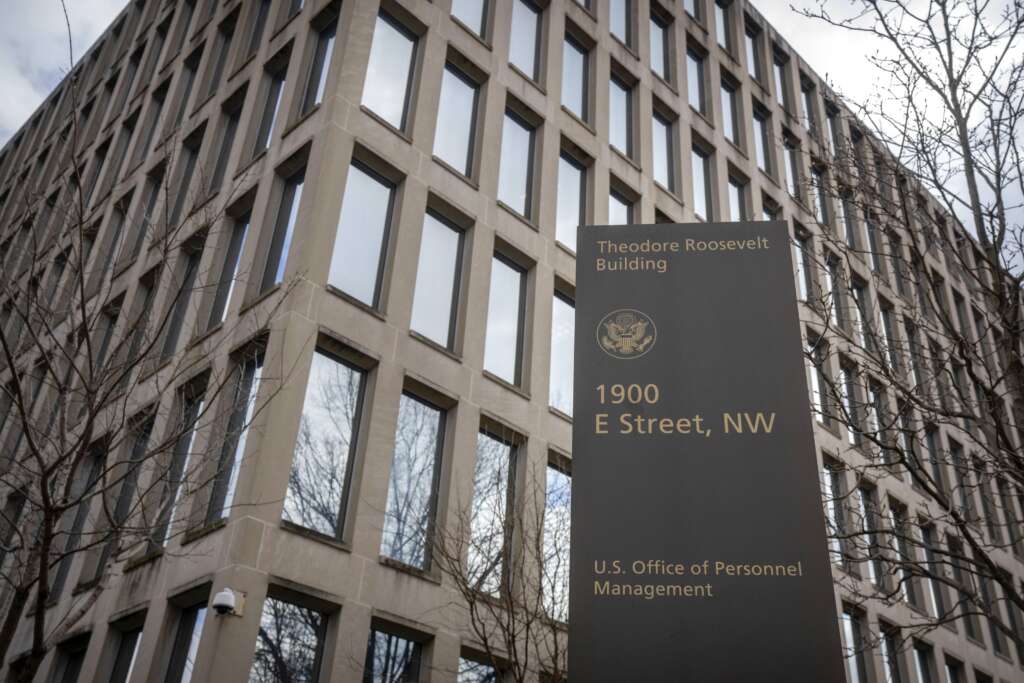
The Theodore Roosevelt Building, location of the U.S. Office of Personnel Management, on Tuesday, Feb. 13, 2024, in Washington. Former President Donald Trump has plans to radically reshape the federal government if he returns to the White House, from promising to deport millions of immigrants in the U.S. illegally to firing tens of thousands of government workers. (AP Photo/Mark Schiefelbein)

Agencies prepare to bring back furloughed staff, rescind layoffs as shutdown comes to an end

Agencies are telling furloughed federal employees that they’re expected to show up Thursday morning, now that House lawmakers have ended the longest government shutdown.

Many of these federal employees have been on furlough for the past six weeks, and face a considerable backlog of work upon their return.

At least 670,000 federal employees have been furloughed, and 730,000 employees have been working without pay during the shutdown.

The spending plan passed by the House on Wednesday evening includes back pay for furloughed federal employees and those who worked without pay during the shutdown.

The Senate passed the shutdown-ending spending plan on Monday. The spending package includes a continuing resolution that will keep many agencies funded at current spending levels until Jan. 30, 2026.

Lawmakers also approved FY 2026 funding for the Agriculture Department, the Department of Veterans Affairs, military construction and the legislative branch.

The deal also reserves layoffs for about 4,000 federal employees and protects employees from further layoffs through Jan. 30.

In response, the IRS is in the process of rescinding layoff notices that were sent to mostly human resources and IT employees last month.

The Department of Health and Human Services told employees in an email Wednesday evening that it is “hopeful that the Democrat-led government shutdown may conclude today.”

“Please monitor the news closely and be prepared to return to work if Congress passes the appropriations bill this evening, and President Trump subsequently signs the bill into law,” the HHS email states.

The email, obtained by Federal News Network, states that all HHS employees who were furloughed must report for duty at their official duty station on Nov. 13, if the bill is signed into law on Wednesday night or Thursday morning.

“We deeply appreciate your patience, cooperation, and resilience during this challenging time. Thank you and your teams for your dedication and continued service on behalf of the American people,” the email states.

The Census Bureau is also directing its employees to return to work.

“If you’ve been following, it seems like a return to work is in view,” a bureau manager told employees on Wednesday. “Even in the absence of an [Emergency Notification System] message, we should expect to go to work tomorrow, if the President signs off.”

Meanwhile, the IRS chief human capital office (CHCO) is in the process of rescinding reduction in force notices that were sent to employees on Oct. 10, according to two IRS employees.

An IRS program manager told employees on Wednesday that “when the government reopens, CHCO will be sending RIF recession letters.”

IRS employees told Federal News Network that the layoffs put additional stress on an already beleaguered agency, which is looking to hire and train a substantial number of employees ahead of next year’s filing season.

The IRS is in the middle of preparations for next year’s filing season, which involves more work than usual, because the agency must implement the One Big, Beautiful Bill Act that Congress passed this summer.

An IRS program manager told staff that they “should continue to monitor the news, as we know we are getting closer to reopening and transitioning into the reactivation phase.”

The IRS has already lost about 25% of its workforce so far this year, largely through voluntary incentives.

More than 4,000 federal employees across the government received RIF notices in mid-October, following guidance from the White House that encouraged agencies to move forward with layoffs in the event of a funding lapse.

But those RIF notices will be reversed, as part of the deal to end the government shutdown.

The bill states that between the date of enactment and Jan. 30, no federal funds may be used “to initiate, carry out, implement, or otherwise notice a reduction in force to reduce the number of employees within any department, agency, or office of the federal government.”

White House Press Secretary Karoline Leavitt told reporters on Wednesday that “President Trump looks forward to finally ending this devastating Democrat shutdown with his signature, and we hope that signing will take place later tonight.”

Even with the rollback of the shutdown layoffs, Leavitt said the Trump administration has still taken major steps to “reduce the size of our federal bureaucracy.”

The post Agencies prepare to bring back furloughed staff, rescind layoffs as shutdown comes to an end first appeared on Federal News Network.

© Jory Heckman/Federal News Network

Federal workforce rally

Shutdown-ending deal stops severance freeze for laid-off federal employees

A deal to end the longest government shutdown, expected to pass the House later today and head to President Donald Trump’s desk, rescinds layoff notices sent to thousands of federal employees in October.

The spending plan doesn’t bring back jobs for former federal employees who received reduction-in-force (RIF) notices earlier this year and who have officially separated from the government. But it does mean their severance payments, which have been on hold since the start of the shutdown, will resume.

Former federal employees say the nearly month-and-a-half freeze on severance payments has been a less visible part of the shutdown’s financial impact, and added to the emotional toll felt by those who lost their jobs under the Trump administration.

The severance payment freeze has had a major impact on former employees at the Department of Health and Human Services.

HHS sent RIF notices to 10,000 employees in April, and another 10,000 HHS employees left the department through voluntary separation incentives. Last month, HHS sought to lay off nearly 950 additional employees, but those RIF notices are expected to be rescinded.

Thomas Nagy, Jr, HHS chief human capital officer and deputy assistant secretary for human resources, told former employees in an email obtained by Federal News Network that, “due to the current lapse in appropriations, you will not be receiving any further severance payments until funding is restored.”

Nagy told laid-off workers that they may see a “temporary debt” on their leave and earnings statement, because severance payments have been stopped, retroactive to the beginning of the lapse in appropriations.

He added that the department’s payroll provider, the Defense Finance and Accounting Service, “will initiate no collections actions, and that no funds will be withdrawn from your bank account,” and that HHS will resume payments “as soon as it is legally and operationally possible to do so.”

‘There is nobody we can ask’ 

A laid-off HHS employee’s latest leave and earnings statement, shared with Federal News Network, does not include her severance payment. Instead, it shows that she owes the agency nearly $4,000.

The employee, who requested anonymity to avoid retaliation, said no funds had been withdrawn from her account, but said the notice raised more questions than it answered.

“I have no idea if this means this is actually going to be collected from me at some point, or if this is just an error,” she said.

Aside from boilerplate emails, the former HHS employee said she received no further communication from the department. She said she’s not sure who else to contact at HHS, because her entire supervisory chain also received RIF notices, or were reassigned to different agencies within HHS.

“I don’t actually know anybody who I can ask anymore,” the former employee said, “There is nobody we can ask. That’s really upsetting.”

Federal News Network has heard from several other former HHS employees who saw negative amounts on their latest leave and earnings statements. None received any notice asking them to repay any amount.

HHS Press Secretary Emily Hilliard told Federal News Network in a statement that “severance payments may only continue for employees in organizations exempt from furlough based on their funding source.”

To comply with the Anti-Deficiency Act, agencies have suspended severance payments for the duration of the shutdown. It’s not immediately clear how soon those severance payments will resume, once the shutdown ends.

The Office of Personnel Management, in updated guidance sent ahead of the shutdown, told agencies that “no funds may be authorized for severance payments for days during the lapse until an appropriation is enacted.”

A Nov. 5 memo from the HHS Office of Human Capital Management, sent to Food and Drug Administration managers and supervisors, states that HHS “has suspended all severance payments to former employees due to the current lapse in appropriations.”

The memo, obtained by Federal News Network, states that the suspension of severance payments started for the pay period ending Nov. 1, and “affects all HHS organizations.”

“Due to funding constraints across multiple HHS organizations, HHS Office of Human Resources directed a department-wide suspension of all severance payments through the end of the appropriations lapse,” the memo states. “Former employees will receive retroactive severance payments once the appropriations lapse ends.”

The memo directed human resources staff at other HHS components to notify all former employees about the hold on severance payments by Nov. 7.

More than 1.4 million federal employees missed two full paychecks, and received a partial paycheck during the 43-day government shutdown. The Congressional Budget Office estimates the shutdown will cost the federal government at least $7 billion, and up to $14 billion.

Shutdown RIFs will be rescinded

More than 4,000 federal employees across the government received RIF notices in mid-October, following guidance from the White House that encouraged agencies to move forward with layoffs in the event of a funding lapse. But those RIF notices will be reversed, as part of the deal to end the government shutdown.

The bill states that between the date of enactment and Jan. 30, no federal funds may be used “to initiate, carry out, implement, or otherwise notice a reduction in force to reduce the number of employees within any department, agency, or office of the federal government.”

The Senate passed the shutdown-ending spending plan on Monday, and the House is expected to pass the bill on Wednesday. The bill includes a continuing resolution that will keep many agencies funded at current spending levels until Jan. 30, 2026.

Most, but not all, of those RIF actions have been on hold because of a preliminary injunction granted by a district court judge last month. Federal unions sued the Trump administration over the layoffs, alleging that they violated the Administrative Procedure Act. Unlike most lawsuits, the Trump administration did not appeal the district court’s ruling.

White House Press Secretary Karoline Leavitt told reporters on Wednesday that the administration “is very hopeful that this shutdown is going to come to an end.”

“President Trump looks forward to finally ending this devastating Democrat shutdown with his signature, and we hope that signing will take place later tonight,” Leavitt said.

Even with the rollback of the shutdown layoffs, Leavitt said the Trump administration has still taken major steps to “reduce the size of our federal bureaucracy.”

The Partnership for Public Service estimates that more than 211,000 employees have left the federal workforce this year, either through layoffs or voluntary incentives

“We’ve done a lot of great work on that front, and we will continue to. But obviously, the President’s main priority was to reopen the federal government and get people back to work, and that’s what this deal accomplishes,” Leavitt said.

The post Shutdown-ending deal stops severance freeze for laid-off federal employees first appeared on Federal News Network.

© AP Photo/Alex Brandon

President Donald Trump speaks after signing an executive order regarding TikTok in the Oval Office at the White House, Thursday, Sept. 25, 2025, in Washington. (AP Photo/Alex Brandon)

MAHA-Approved Beef Tallow Is Nothing New to the Barbecue World

Beef Tallow IllustrationWhat makes brisket bark shimmer in the sun? Beef tallow. What drips from a freshly sliced beef rib held up for the camera? Beef tallow. What gushes forth from the cross section of a brisket being squeezed? Right again—beef tallow. (Actually, please don’t squeeze your brisket.) Some pitmasters pour beef tallow, or rendered beef fat, on their briskets to keep them juicy before wrapping them—that’s what you’re seeing on that soaked butcher paper blanket. It’s the byproduct most of us want with our smoked beef, but these days, it’s become a valuable commodity all its own. Beef tallow is hot now—especially when it’s chilled.Miller’s Smokehouse, in Belton, has been selling beef tallow to customers for about five years. Until recently, it charged $10 for a…

The post MAHA-Approved Beef Tallow Is Nothing New to the Barbecue World appeared first on Texas Monthly.

❌