Reading view

There are new articles available, click to refresh the page.

Indiana Bill Would Mandate Bitcoin in Pensions and Shield Self-Custody Rights

A newly introduced bill in Indiana would require public retirement programs to offer Bitcoin-related investment options and would also limit how much power local governments have to restrict the use of digital assets.

The proposal was filed on Thursday by State Representative Kyle Pierce, a Republican from Anderson. Known as House Bill 1042, the legislation was presented during a meeting of the House Financial Institutions Committee.

It focuses on giving public workers access to cryptocurrency investments while setting clear legal boundaries around digital asset use, custody, payments, and mining.

Indiana Targets First-in-the-Nation Mandate for Bitcoin in Public Pensions

Under the bill, administrators of several state-run retirement and savings plans would be required to include cryptocurrency exchange-traded funds as standard investment choices.

It would also permit certain public pension funds to invest directly in crypto-linked ETFs and give the state treasurer authority to place funds from specific accounts into stablecoin-based ETFs.

Pierce said the bill is designed to give Indiana residents more financial flexibility as digital assets become a larger part of the broader economy.

He added that the legislation is intended to balance investment choice with regulatory guardrails while allowing the state to explore potential government use of blockchain technology through pilot programs.

Source: Indiana House Republicans

The legislation goes beyond retirement investing and takes aim at local regulation. Cities and counties would be prohibited from passing rules that place “unreasonable” limits on digital assets if similar rules do not apply to traditional financial activity.

That protection would extend to crypto payments, private ownership of digital wallets, and mining operations.

The bill adds clear safeguards for self-custody. It states that private digital asset keys could only be demanded through a court order and only when no other legal method of access is available.

It would also prevent local governments from zoning out mining facilities from industrial zones and would protect properly zoned residential mining activity.

If enacted, Indiana would become the first state in the country to require publicly managed retirement programs to provide Bitcoin exposure as a standard option.

While some states permit limited crypto investment flexibility, none currently mandate it.

U.S. States Expand Crypto Access in Pensions, Payments, and Property Laws

Other states have taken related but narrower steps. Oklahoma passed a law in 2024 protecting residents’ right to hold crypto in self-custody wallets and blocking special taxes on Bitcoin transactions.

In 2025, Kentucky followed by formally recognizing self-custody as a protected property right. Wyoming has also approved laws that allow public pension funds to invest in digital assets.

Elsewhere, Arizona introduced legislation that would allow Bitcoin ETFs in retirement accounts, while Florida outlined legal pathways for holding digital assets through ETFs in certain state funds.

✅ Arizona’s push to integrate digital assets into state financial infrastructure is nearing a critical milestone. #Arizona #Bitcoinhttps://t.co/jNb7UnYvX1

— Cryptonews.com (@cryptonews) April 18, 2025

Indiana’s proposal stands apart by making crypto ETF access a requirement rather than a choice.

Momentum around crypto-linked retirement exposure continues to build nationwide. In August, Michigan’s state retirement system tripled its Bitcoin ETF holdings to 300,000 shares, valued at about $11.4 million, according to regulatory filings.

📈 The State of Michigan Retirement System has increased its exposure to Bitcoin, tripling its holdings in the @ARKInvest 21Shares Bitcoin ETF.#Michigan #Bitcoinhttps://t.co/lUxWycmp4A

— Cryptonews.com (@cryptonews) August 6, 2025

The fund also holds roughly $13.6 million in Ethereum through the Grayscale Ethereum Trust. Wisconsin’s state investment board has also disclosed more than $387 million in Bitcoin ETF exposure.

States are also widening their use of digital assets outside of investing. In September, Ohio finalized plans to accept Bitcoin and other cryptocurrencies for official state payments.

In October, California updated its Unclaimed Property Law to ensure dormant crypto is not automatically converted into cash when

transferred to state custody.

✅ California has become the first US state to formally protect unclaimed crypto from being forcibly converted to cash.#California #Bitcoinhttps://t.co/PoV40lmZi9

— Cryptonews.com (@cryptonews) October 14, 2025

New York City has taken its own steps by setting up a municipal Office of Digital Assets and Blockchain.

The move followed an executive order from Mayor Eric Adams aimed at coordinating crypto policy and encouraging blockchain development.

🗽 Bitcoin NYC Mayor Adams established the “nation’s first-ever” municipal office for crypto and blockchain to position the city as the global crypto hub.#EricAdams #NYCMayor #CryptoOfficehttps://t.co/oVEBRTRp5y

— Cryptonews.com (@cryptonews) October 15, 2025

At the federal level, broader regulatory efforts are also underway. Lawmakers are preparing new frameworks that could shape how states approach crypto policy, including updated guidance on 401(k) crypto exposure expected in 2026.

The post Indiana Bill Would Mandate Bitcoin in Pensions and Shield Self-Custody Rights appeared first on Cryptonews.


Crypto Gets Legal Recognition: UK Enacts Property Act 2025 For Digital Assets

The United Kingdom (UK) has reached a significant milestone in its approach to digital assets with the recent passage of the Property Act 2025, which now officially categorizes cryptocurrencies as legal property. 

UK’s New Law Sets Criteria For Digital Assets

The creation of this dedicated legal category for digital assets followed recommendations from the Law Commission, which advocated for a framework that acknowledges assets not fitting traditional definitions of personal property.

This legal evolution is seen as part of a broader strategy to position the UK as a leading digital finance hub, responding to experts’ calls for the country to align its regulatory environment with that of the United States in order to promote growth in the digital asset market. 

According to law firm Clyde & Co, a key provision in the law states that “a thing (including a thing that is digital or electronic in nature) is not prevented from being the object of personal property rights merely because it is neither (a) a thing in possession, nor (b) a thing in action.” 

This phrase confirms that digital assets can now be recognized as a third category of personal property, distinct from the traditional classifications of tangible and intangible assets.

However, the Act does not guarantee that any specific type of asset qualifies as personal property; rather, it aims to “unlock” the common law’s ability to adapt to technological advancements and new asset types, as outlined in the Explanatory Notes from Parliament. 

The interpretation of existing digital assets—such as cryptocurrencies and non-fungible tokens (NFTs)—as well as any emerging forms will ultimately depend on future court rulings. 

The law firm also noted that, under this new law, a digital asset must meet certain criteria to qualify as personal property: it must be definable and identifiable by third parties and capable of being assumed by them, as well as possess a degree of permanence.

Additionally, digital assets will be included in bankruptcy and insolvency proceedings, allowing them to be treated as part of the overall asset pool available to creditors and heirs. 

Government Moves To Ban Crypto Donations

While momentum continues for digital asset recognition, the UK government is also addressing concerns surrounding cryptocurrency in the political sphere. 

Ministers are reportedly working on legislation aimed at banning political donations made through digital currencies, although this crackdown may not be ready in time for the upcoming elections bill in the new year. 

Officials have raised alarms that cryptocurrency donations pose risks to the integrity of the electoral process, primarily due to their difficult-to-trace nature, which could open the door to exploitation by foreign entities or criminal organizations.

Crypto

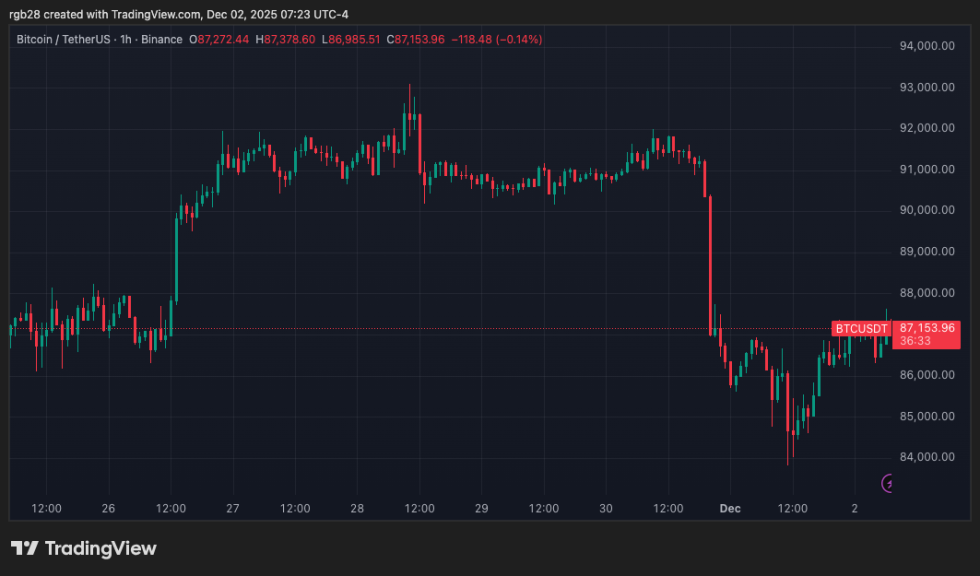
At the time of writing, the market’s leading cryptocurrency, Bitcoin, was trading at $92,180, surging 4% in the past 24 hours. 

Featured image from Shutterstock, chart from TradingView.com 

Poland’s President Vetoes Crypto Market Bill Due To ‘Overregulation’ Concerns

The President of Poland has vetoed a controversial bill that aimed to set strict rules on the crypto assets market, following multiple concerns of a startup exodus, “overregulation” of the sector, and stifling market innovation.

Poland’s President Vetoes Divisive Crypto Bill

On Monday, Poland’s President Karol Nawrocki refused to sign a crypto market legislation over concerns that it could pose a real threat to the freedoms of Poles, the stability of the state, and market innovation.

In an official statement, the president’s office announced Nawrocki’s decision to veto the Crypto-Asset Market Act, introduced in June, to prevent “overregulation” and abuse of the “legal mess” proposed by the Polish government.

As reported by Bitcoinist, Poland’s crypto community previously raised concerns about the legislation in September, noting that the bill exceeded the European Union (EU)’s minimum regulatory requirements and could drive small businesses and startups abroad.

Notably, the bill’s text required all Crypto Asset Service Providers to obtain a license from the Polish Financial Supervision Authority (KNF) to operate in the market. It also proposed heavy fines and potential prison time for participants who breached the law.

Rafal Leśkiewicz, Press Secretary of the President, listed on X three main reasons for Nawrocki’s decision to reject the bill. He asserted that the legislation risks power abuse and overreach, as some provisions allow the government to shut down websites of companies offering crypto services “with a single click.”

“This is unacceptable. Most European Union countries use a simple list of warnings that protects consumers without blocking entire websites,” he noted.

In addition, the regulation’s size and lack of transparency risked overregulation, noting that countries like the Czech Republic, Slovakia, and Hungary implemented concise and comprehensive frameworks. Meanwhile, Poland’s text surpasses the one-hundred-page mark.

He argued that “Overregulation is a straight path to driving companies abroad—to the Czech Republic, Lithuania, or Malta—instead of creating conditions for them to earn money and pay taxes in Poland.”

Lastly, the Press Secretary listed the amount of supervisory fees as an issue, affirming that the government set them at a level that would have prevented small businesses and startups from developing, favoring foreign corporations and banks. To him, “this is a reversal of logic, killing the competitive market and posing a serious threat to innovation.”

Community Praises The ‘Necessary Decision’

Leśkiewicz emphasized that regulation is necessary, but added that it must oversee the market in a way that’s “reasonable, proportionate, and safe” for users, rather than overreaching and potentially harming the Polish economy.

“The government had two years to prepare a bill in line with the European MiCA regulation on the crypto-asset market in the European Union. Instead, it produced a legal mess that hurts Poles and Polish companies,” he asserted. “The decision to veto was necessary and was made responsibly. The president will defend the economic security of Poles.”

Polish economist Krzysztof Piech praised the president’s decision to veto the crypto bill, affirming that it was “a very bad law” that “violated the Polish Constitution and was contrary to the EU regulation it was supposed to implement in Poland.”

Piech also refuted claims that Poland will become a “paradise” for criminals and fraudsters, who will “be grateful” to President Nawrocki for “a crypto market without state supervision.”

The economist asserted that the government’s version of the bill “did not provide for any assistance to victims of fraudsters,” adding that, “as of July 1, 2026, the entire Polish market will be regulated and supervised — even without any legislation. After all, we are in the EU.”

crypto, bitcoin, btc, btcusdt

❌