XRP price has tanked for three consecutive days, erasing the gains made earlier this week, even as the recently launched ETFs gained momentum. Ripple (XRP) token dropped to $2.03 today, Dec. 6, down by over 44% from its highest point…
MetaMask, the most widely used Ethereum wallet, is moving directly into the prediction market arena through a new integration with Polymarket, giving users the ability to trade event outcomes from inside their wallets.
Key Takeaways:
MetaMask has integrated Polymarket, allowing users to trade real-world event outcomes.
The integration adds one-tap funding from any EVM chain.
Polymarket’s rapid growth continues amid a potential $15 billion valuation.
“You can now trade on the future outcome of real world events inside your wallet,” Consensys’ Gabriela Helfet wrote, adding that users will also earn MetaMask Rewards points for every prediction placed.
MetaMask Becomes New Gateway to Polymarket With One-Tap Funding
The integration creates a new on-ramp for Polymarket and introduces “one tap funding,” allowing users to deposit with any token from any EVM-compatible chain.
The move further tightens the link between everyday crypto wallets and decentralized betting platforms, positioning MetaMask as a gateway not only to Web3 apps but also to real-world event speculation.
Polymarket has surged in popularity over the past year, fueled in part by heightened attention during the 2024 US election cycle.
Former President Donald Trump’s embrace of crypto and a more relaxed regulatory climate helped push the platform back into the US market.
The company is now reportedly exploring a valuation of up to $15 billion, following a $2 billion strategic investment from Intercontinental Exchange, the parent of the NYSE.
Predicting on MetaMask only takes a few seconds.
We've enabled 1-click funding with any EVM token, or you can get started instantly if you have an existing @polymarket account! pic.twitter.com/zZtrQPDu3m
For MetaMask, the move comes as the wallet expands beyond its Ethereum-focused roots. In October, it launched multichain accounts that support both EVM and non-EVM networks, including Solana.
The move comes as Polymarket is recruiting staff for an internal market-making team that would trade against its own customers, mirroring a controversial feature already used by rival Kalshi that has drawn criticism and legal challenges.
As reported, the New York-based prediction market startup has approached traders, including sports bettors, to join the new unit, people familiar with the matter said, requesting anonymity because the plans remain private.
Prediction Markets Hit $13B in Record Activity
Prediction markets have crossed $13 billion in cumulative trading volume, marking a record high even as broader crypto markets cool.
The surge has drawn in major players across tech and finance, including Fanatics, Coinbase, and MetaMask, all of which have recently launched or expanded event-trading platforms.
Against this backdrop, YZi Labs, the venture firm founded by Binance co-founder Changpeng “CZ” Zhao, has been intensifying its involvement in the sector.
YZi-backed Opinion has emerged as one of the most surprising breakout platforms. Launched on BNB Chain in October, it recorded nearly $1.5 billion in weekly trading volume within its first month, briefly overtaking established names such as Kalshi and Polymarket.
Meanwhile, prediction markets platform Kalshi has secured a major media breakthrough after signing a partnership with CNN, making the company the network’s official prediction markets partner while closing a $1 billion funding round at an $11 billion valuation.
The much-anticipated altcoin season remains elusive as the Crypto Fear and Greed Index remains in the fear zone and Bitcoin Dominance continues. Altcoin Season Index remains in the red CMC data shows that the closely-watched Altcoin Season Index has moved…
Zcash price has suffered a harsh reversal in the past few weeks, erasing most of the gains made during its recent bull run that pushed it from below $50 to $742. Zcash (ZEC) token was trading at $352 today, Dec.…
Polymarket is recruiting staff for an internal market-making team that would trade against its own customers, mirroring a controversial feature already used by rival Kalshi that has drawn criticism and legal challenges.
According to Bloomberg, the New York-based prediction market startup has approached traders, including sports bettors, to join the new unit, people familiar with the matter said, requesting anonymity because the plans remain private.
Polymarket declined to comment on the recruitment effort.
The move comes as the platform prepares its full U.S. relaunch after securing regulatory clearance from the Commodity Futures Trading Commission, having paid a $1.4 million penalty in 2022 for operating an unregistered derivatives exchange.
Kalshi’s Market-Making Unit Faces Legal Scrutiny
Kalshi already operates an in-house trading arm, Kalshi Trading, which places bids on the exchange and effectively takes opposing positions to customers’ bets.
Company executives have defended the unit as necessary to create liquidity and improve the user experience.
Still, critics argue it creates inherent conflicts of interest and makes Kalshi resemble a traditional sportsbook rather than a neutral peer-to-peer platform.
Some are now claiming that the company is a gambling company and not a prediction company.
“Let’s just call a spade a spade, it’s gambling, lots of things are gambling,” a X user said.
A proposed class action lawsuit filed last month alleges that Kalshi Trading sets betting lines that disadvantage customers, claiming “consumers place bets on Kalshi, they face off against money provided by a sophisticated market maker on the other side of the ledger.“
Kalshi co-founder Luana Lopes Lara dismissed the lawsuit as a “pure smear campaign” on social media.
She stated that Kalshi Trading operates unprofitably and receives “no preferential access or treatment.”
However, the legal challenge shows mounting concerns about whether prediction markets function as advertised, neutral platforms where users with differing opinions trade directly with each other.
1. Rebrand gambling as asset allocation 2. Rebrand sportsbook as truth engine 3. Rebrand bets as predictions 4. Spin up in-house market maker to c̶o̶m̶p̶e̶t̶e̶ collaborate with c̶u̶s̶t̶o̶m̶e̶r̶s̶ fellow investors for the greater good
The agency granted temporary relief from certain swap data reporting requirements, allowing the platform to operate within the same framework governing federally supervised U.S. trading venues.
Prediction market platform Polymarket says it has received an Amended Order of Designation from the CFTC.#Crypto#CFTChttps://t.co/H44tIIxPaz
Founder and CEO Shayne Coplan confirmed receiving “the green light to go live in the USA” and credited CFTC staff for completing the process in record time.
The regulatory clearance caps a lengthy journey that intensified in November 2024 when the FBI raided Coplan’s Manhattan residence and seized electronic devices as part of an investigation into whether Americans continued accessing the site through VPNs despite the 2022 ban.
Despite being barred from U.S. operations since 2022, Polymarket expanded aggressively overseas, recording roughly $6 billion in wagers during the first half of 2025 alone.
The platform gained global attention during the 2024 presidential election cycle, as its markets closely tracked Donald Trump’s odds of winning.
Market Makers and Growing Institutional Interest
Prediction markets rely heavily on market makers willing to take less popular trades, as the platforms match buyers with sellers on binary yes-or-no contracts.
Both Polymarket and Kalshi have offered incentives rewarding heavy users who provide liquidity, while a small number of traditional financial trading firms, including Susquehanna International Group and Jump Trading, have begun serving as external market makers on Kalshi.
The broader debate centers on whether prediction markets genuinely differ from traditional gambling operations.
During a public appearance last month, Coplan called conventional sportsbooks a “scam” that “rip off the consumer,” positioning Polymarket as a transparent alternative where users trade against each other rather than facing house odds designed to extract profits.
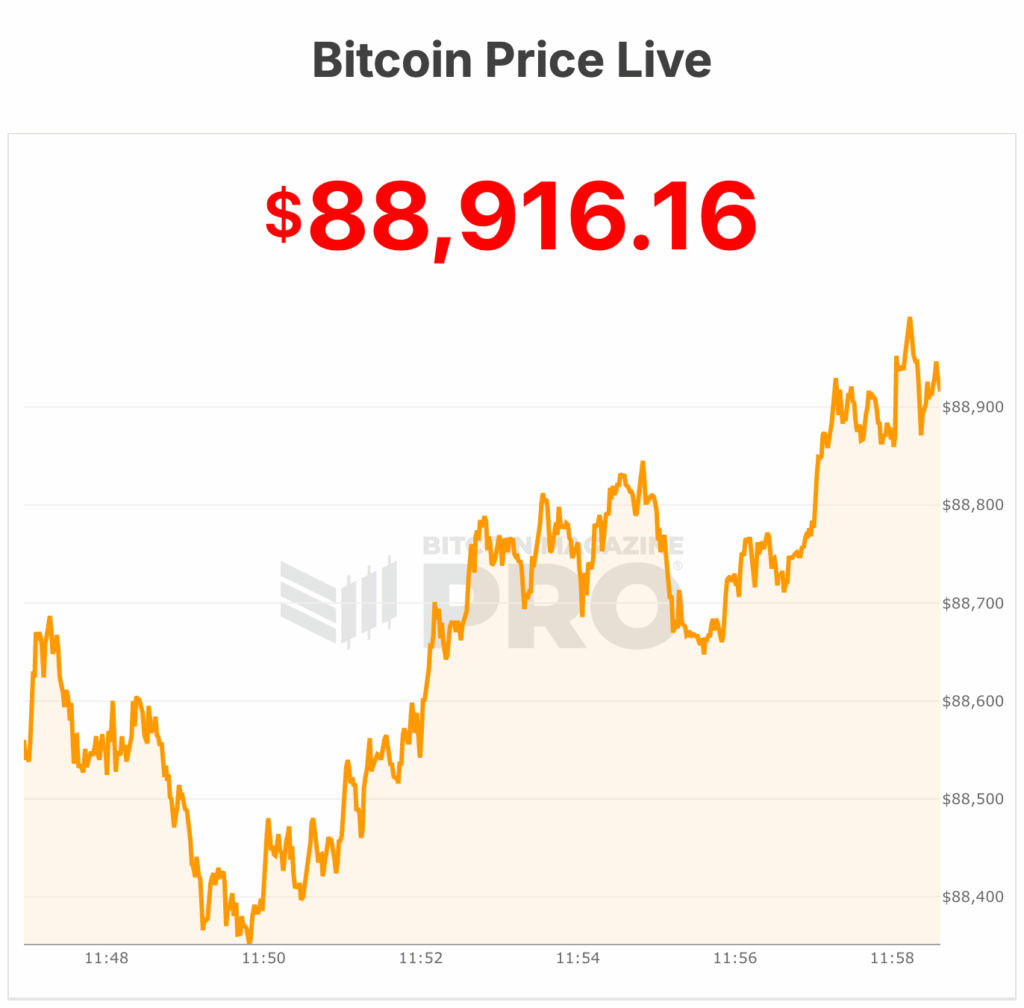
Bitcoin price plunged to $88,000s on Friday, down over 4% in the past 24 hours. The cryptocurrency is trading near its seven-day low of $88,091, and about 4% below its seven-day high of $92,805.
The global market capitalization for Bitcoin now stands at $1.77 trillion, with a 24-hour trading volume of $48 billion.
Despite the recent drop, Wall Street bank JPMorgan remains bullish on the Bitcoin price over the long term. The bank continues to maintain its gold-linked volatility-adjusted BTC target of $170,000 over the next six to twelve months.
Analysts say the model accounts for fluctuations in price and mining costs.
One key factor in the market is Strategy (MSTR), the largest corporate Bitcoin holder. The company owns 650,000 BTC. Its enterprise-value-to-Bitcoin-holdings ratio, known as mNAV, currently stands at 1.13.
JPMorgan analysts describe this as “encouraging.” A ratio above 1.0 indicates Strategy is unlikely to face forced sales of its Bitcoin.
JUST IN: JPMorgan says it is sticking to its Bitcoin vs gold model target, which would see BTC hit $170,000 over the next year pic.twitter.com/PNt9ojpBRv
Strategy has also built a $1.44 billion U.S. dollar reserve. The reserve is designed to cover dividend payments and interest obligations for at least 12 months. The company aims to extend coverage to 24 months.
Bitcoin mining pressure
Mining pressures continue to weigh on Bitcoin. The network’s hashrate and mining difficulty have fallen. High-cost miners outside China are retreating due to rising electricity costs and declining prices. Some miners have sold Bitcoin to remain solvent.
JPMorgan now estimates Bitcoin’s production cost at $90,000, down from $94,000 last month. Falling hashrates can push production costs lower, but the short-term effect is sustained selling pressure from miners.
Institutional investors also show caution. BlackRock’s iShares Bitcoin Trust, or IBIT, has recorded six consecutive weeks of net outflows. Investors pulled more than $2.8 billion from the ETF over this period, according to Bloomberg.
The withdrawals highlight subdued appetite among traditional investors, even as Bitcoin prices stabilize. Analysts note that the trend marks a reversal from the persistent inflows seen earlier in the year.
The broader market is still recovering from the October 10 liquidation event. That crash wiped out over $1 trillion in crypto market value and pushed Bitcoin into a bear market.
Although the Bitcoin price has recovered some ground this week, momentum remains fragile.
JPMorgan analysts now say Bitcoin’s next major move depends less on miner behavior. Instead, it depends on Strategy’s ability to hold its Bitcoin without selling. The mNAV ratio and reserve fund provide confidence that the company can weather market volatility.
Other potential catalysts remain. The MSCI index decision on January 15 could impact Strategy’s stock and, indirectly, Bitcoin. Analysts say a positive outcome could trigger a strong rally.
Last week, Strategy’s Michael Saylor disputed MSCI index disputes and clarified that Strategy is a publicly traded operating company with a $500 million software business and a treasury strategy using Bitcoin, not a fund, trust, or holding company.
He emphasized the firm’s recent activity, including five digital credit security offerings totaling over $7.7 billion in notional value.
Bitcoin price analysis
Bitcoin Magazine analysts believe that the bitcoin price correlation with Gold has recently strengthened mainly during market downturns, offering a clearer view of its purchasing power when analyzed against Gold instead of USD.
While USD charts show a 2025 peak, Bitcoin measured in Gold peaked in December 2024 and has fallen over 50%, suggesting a longer bear phase.
Historical Gold-based bear cycles indicate potential support zones approaching, with current declines at 51% over 350 days reflecting institutional adoption and constrained supply rather than cycle shifts.
Internet Computer (ICP) price has dropped 6% in the past 24 hours to under $3.50.
Recently, the altcoin pumped from lows of $2.80 to above $9.62.
Overall market weakness could see ICP price tank further, although an uptick for Bitcoin will boost altcoins.
The Internet Computer (ICP) token has endured a sharp downturn in the past month, culminating in a 24-hour dip of over 6% as the price broke below $3.50.
Losses for Internet Computer come amid a 29% decrease in trading volume, suggesting bulls could benefit from reduced selling pressure.
However, with ICP briefly rallying on hype around AI integrations like the Caffeine platform, only to reverse course, it may yet allow bears to strengthen the upper hand.
Internet Computer price slips to $3.50
The ICP project, launched by the DFINITY Foundation, is one of the top artificial intelligence-related coins.
DFINITY aims to revolutionize the internet by enabling fully on-chain applications, from decentralized finance to AI-driven services, without reliance on traditional cloud providers.
In early November, the DFINITY Foundation unveiled an update for its AI platform Caffeine DeAI.
The news saw the price of ICP surge sharply, with bulls eventually hitting highs of $9.62 on Nov. 8, 2025.
The uptick aligned with market cheer for an update that pushed the narrative of the Internet Computer as a key AI cloud engine.
As well as allowing users to create and deploy apps easily, Caffeine features an App Market and supports monetization.
DFINITY said Caffeine will help drive network usage and transition ICP to a deflationary asset, among other features.
However, the token’s price has tumbled since that November peak and hit $3.50 on December 5, 2025. That’s a 64% dump in the past month and reflects broader market pressure.
What could catalyze short-term losses for ICP?
Market analysts have attributed the sell-off pressure across crypto to a confluence of factors.
As well as macroeconomic headwinds, FUD around Tether and Strategy (MSTR) has dampened risk appetite for Bitcoin (BTC) and the speculative assets across altcoins.
These same aspects apply to ICP and the dip to $3.50, with intraday revisits of lower levels, strengthening the fragile outlook.
Adding to this is the overall sentiment around token dumps if BTC price tanks.
Recently, when Bitcoin dipped to near $80,000, the Internet Computer token plummeted from above $5 to below $4.2.
Price currently hovers around $3.51 as Bitcoin flirts with support near $90,500. If momentum escapes bulls further, sellers could eye the all-time lows of $1.98 reached in October 2025.
On the flipside, the altcoin could benefit from network upgrades and adoption trends.
This, amid a resurgence in AI tokens and tokenized Bitcoin demand, may help buyers. A shift in sentiment as the macro environment improves will be crucial to bulls.
LUNC price soared by 40% on Friday. And Do Kwon will be sentenced in the U.S. next week. Meanwhile, LUNC’s burn rate has jumped by 849 million in the last 7 days.
Chainlink price hovered near $14, down 2% in the past 24 hours.
LINK remained under pressure despite two key integrations on Solana.
Coinbase and Chainlink have launched a Base-Solana bridge.
Chainlink continues to play a key role in the blockchain interoperability and asset tokenisation space, and that shows in the two latest integrations.
As a pivotal oracle network bridging decentralised finance (DeFi) with traditional systems, Chainlink’s traction is forecast to be a major factor for the native token LINK.
On December 5, 2025, LINK traded around $14.
Bulls were under pressure but remained upbeat amid recent advancements. Among these is the collaboration with Coinbase on the Base-Solana bridge and the integration into a Solana-based RWA consortium.
Chainlink and Coinbase to power Base-Solana bridge
Three major industry players here: Coinbase, Chainlink and Solana. Industry reaction to their latest collaboration highlights the potential impact.
Simply, the launch of the Base-Solana bridge marks a significant milestone in multi-chain connectivity. Chainlink’s Cross-Chain Interoperability Protocol (CCIP) serves as the security backbone alongside Coinbase’s node operators.
As announced, this mainnet deployment enables seamless asset transfers between Base and Solana.
CCIP will help verify all messages, ensuring tamper-proof and reliable token movements on Solana. In this case, users can now deposit SOL into Base applications, import any Solana Program Library (SPL) token, and export Base assets back to Solana.
“The bridge is now live on mainnet and rolling out for anyone to use in apps including Zora, Aerodrome, Virtuals, Flaunch, and Relay,’ Base said in a blog post. “Users will be able to trade SOL, CHILLHOUSE, TRENCHER, and many more Solana assets on Base.”
The Base-Solana bridge is live
Secured by @Chainlink CCIP alongside Coinbase, the bridge unlocks new cross-chain experiences:
• Support Solana assets natively in Base apps • Enable users to trade & use assets across chains • Bridge assets and tap into both ecosystems
Another major development is news that Chainlink has joined the newly formed RWA Consortium on Solana. The initiative, led by Figure Technology Solutions in partnership with Kamino Finance, CASH, Raydium, Privy, and Gauntlet, was announced on December 4, 2025.
Experts say real-world assets onchain value will grow exponentially in the next five years.
Early adoption has virtually every RWA now onchain and Solana plays a key role in this space. Chainlink too.
The new alliance aims to democratize access to over $1 billion in monthly onchain loan originations. First to deploy is PRIME, a liquid staking token on the Hastra liquidity protocol.
“We’re democratizing access to institutional lending markets,” said Mike Cagney, founder and executive chairman of Figure. “For the first time, a DeFi user with $100 can participate in the same loan pools as major financial institutions, earning yields from real lending activity with full transparency and instant liquidity.”
LINK price forecast
Chainlink’s oracle infrastructure is central to this goal. Its technology will connect Solana’s developer-friendly environment with Figure’s $19 billion in tokenized loan originations.
These initiatives could further catalyse price appreciation for both LINK and SOL.
At the time of writing, LINK changed hands at $14 while Solana price hovered at $136. If prices rise further, the main short-term target will be highs above $26, last seen in August. SOL bulls will eye $200.
Other bullish catalysts will include crypto ETFs, regulatory clarity and a flip in global macroeconomic outlook.
XRP is consolidating into a triangle pattern. Major resistance sits at $2.20. Declining volume indicates compression, signalling a breakout is nearing.
Ethereum $ETH rose to a high of $3,247, its highest level since Nov. 14, and was about 20% above its November low. Here's why it may be on the verge of a 60% surge.

 Login
Login

 (@MetaMask)





 Prediction market platform Polymarket says it has received an Amended Order of Designation from the CFTC.