Reading view

There are new articles available, click to refresh the page.

Federal union sues OPM, seeking release of ‘Schedule Policy/Career’ records

The National Treasury Employees Union is suing the Trump administration in an attempt to gain records of career federal employee positions that may be targeted for removal of job protections.

NTEU’s lawsuit, filed last week against the Office of Personnel Management, alleged that OPM violated the Freedom of Information Act by not responding to the union’s FOIA request from August. The union had requested documentation of employees who will be potentially impacted by the Trump administration’s “Schedule Policy/Career” order, which seeks to make tens of thousands of career federal employees at-will workers and easier for agencies to fire.

“The government cannot hide information that is critical to safeguarding workplace rights and protections for frontline federal employees in multiple agencies across the country,” NTEU National President Doreen Greenwald said in a statement. “We expect OPM and the administration to identify as soon as possible which federal jobs are being targeted so we can do everything we can to stop the reclassifications.”

Under federal statute, agencies are required to respond to FOIA requests within 20 days. In “unusual circumstances,” that timeframe can be extended for an additional 10 days.

But NTEU said in its lawsuit that OPM has not responded to the FOIA request at all, and that the time period for responding has lapsed. NTEU submitted its initial FOIA request on Aug. 20.

“There is no legal basis for OPM’s failure to respond to NTEU’s request or for its failure to produce the requested records within the statutory time period,” NTEU wrote.

The federal union is arguing that OPM’s failure to respond to the FOIA request is unlawful, and calling for a release of the requested records.

An OPM spokesperson did not immediately respond to Federal News Network’s request for comment.

NTEU’s push for information comes after President Donald Trump in January signed an executive order to revive the federal employment classification previously known as “Schedule F.” Though it is now called “Schedule Policy/Career,” the effort mirrors a former executive order from Trump’s first term that sought to remove job protections from broad swaths of the career federal workforce.

OPM proposed regulations for implementing the new employment classification in April. Although the regulations are not yet finalized, they have been moved into the “final rule stage,” and are slated for possible publication by the end of November, according to the White House’s regulatory agenda.

The White House website states that the final rule will impact “policy-influencing positions” and that the rule’s implementation will “increase career employee accountability.”

All federal positions that are reclassified as “Schedule Policy/Career” will become at-will, and employees will no longer be able to appeal adverse actions against them.

“This will allow agencies to quickly remove employees from critical positions who engage in misconduct, perform poorly, or obstruct the democratic process by intentionally subverting Presidential directives,” OPM states in the regulatory agenda item.

The Trump administration has generally argued that the reclassifications will hold federal employees more accountable and provide more flexibility to agencies. But federal unions, as well as many lawmakers and workforce experts, have said reclassifying employees in this way will lead to politically motivated firings, and an erosion of the apolitical nature of the career civil service.

Earlier this year, OPM also published guidance to set initial expectations for agencies to implement the Schedule Policy/Career employment classification. The guidance targets a wide range of federal positions that may be subject to reclassification.

OPM has estimated that about 50,000 career federal employees in “confidential, policy-determining, policy-making, and policy-advocating” positions will be reclassified as a result of Trump’s order. But OPM’s latest estimate is on the lower end of the scale: Documents from Trump’s first term showed that around 200,000 career federal positions could have their job protections stripped.

NTEU previously sued the Trump administration in January after the initial Schedule Policy/Career executive order was released. The first lawsuit alleges that Trump’s order violates established federal hiring principles and the due process rights of federal employees.

Combined, Greenwald said the two lawsuits from NTEU “are about making sure that the American people have their government services delivered by federal employees who were hired based on merit and skill, not partisan affiliation.”

The post Federal union sues OPM, seeking release of ‘Schedule Policy/Career’ records first appeared on Federal News Network.

© Drew Friedman/FNN
Alexis Goldstein, a member of the Consumer Financial Protection Bureau’s chapter of the National Treasury Employees Union, speaks at a press conference outside the Supreme Court on Monday. Goldstein, in her personal capacity, joined several federal colleagues in urging Democrats to “say no to the bully.” The event, organized by the Civil Servants Coalition, criticized the Trump administration’s federal workforce overhauls this year.

House majority forces vote on bill to restore collective bargaining for most federal employees

A bipartisan bill that would end the Trump administration’s rollback of collective bargaining rights for most federal employees is guaranteed to get a full House vote, now that a majority of lawmakers support it.

As of Monday, 218 House lawmakers signed onto a discharge petition, forcing the House to vote on the Protect America’s Workforce Act.

The bill, led by Reps. Brian Fitzpatrick (R-Pa.) and Jared Golden (D-Maine) would restore collective bargaining rights for tens of thousands of federal employees, if approved by Congress.

President Donald Trump signed an executive order in March that barred unions from bargaining on behalf of federal employees at many agencies, on the grounds that those agencies work primarily in national security. In August, he signed another executive order that expanded the list of agencies barred from negotiations with federal employee unions.

Lawmakers estimate the executive order impacts about 67% of the federal workforce. The Trump administration’s policy has barred unions from representing employees at the departments of Defense, State, Veterans Affairs, Justice and Energy.

A group of six unions led by the American Federation of Government Employees sued the Trump administration over its rollback of collective bargaining rights, arguing that the administration has taken an overly broad view of agencies that work primarily in national security.

A federal judge blocked the administration from enforcing the executive order in April, but an appeals court stayed that decision this summer and allowed agencies to keep canceling collective bargaining agreements that cover broad swaths of the federal workforce. Since the appeals court’s ruling, several agencies have rescinded their collective bargaining rights with unions.

Reps. Mike Lawler (R-N.Y.) and Nick Lalota (R-N.Y.) contributed the last two signatures for the discharge petition on Monday. Lawler said in a statement that “restoring collective bargaining rights strengthens our federal workforce and helps deliver more effective, accountable service to the American people.”

“Every American deserves the right to have a voice in the workplace, including those who serve their country every single day. Supporting workers and ensuring good government are not opposing ideas. They go hand in hand,” Lawler said.

Everett Kelley, national president of the American Federation of Government Employees, applauded Republican lawmakers for supporting the bill, and called on the House to quickly vote on it.

Collective bargaining gives employees a fundamental voice in making the government work better for the American people, and we thank Congressman Lawler for recognizing that America functions best when labor and management cooperate toward common goals,” Kelley said.

AFGE’s National VA Council recently filed a lawsuit challenging the VA’s selective enforcement of the administration’s executive order. The complaint states that VA Secretary Doug Collins scrapped collective bargaining agreements with unions opposed to the Trump administration’s federal workforce polices, but spared labor contracts for unions that represent VA police, security guards and firefighters.

Meanwhile, another bipartisan group of lawmakers is also leading a bill that would restore collective bargaining rights for VA employees. Sens. Richard Blumenthal (D-Conn.), Lisa Murkowski (R-Alaska), Chuck Schumer (D-N.Y.), and Rep. Delia Ramirez (D-Ill.) are leading that bill.

The National Treasury Employees Union, as well as the National Weather Service Employees Organization and the Patent Office Professional Association, are also suing the Trump administration over its collective bargaining rollback.  Federal courts in D.C. will hold proceedings in both cases next month.

The post House majority forces vote on bill to restore collective bargaining for most federal employees first appeared on Federal News Network.

© AP Photo/J. Scott Applewhite

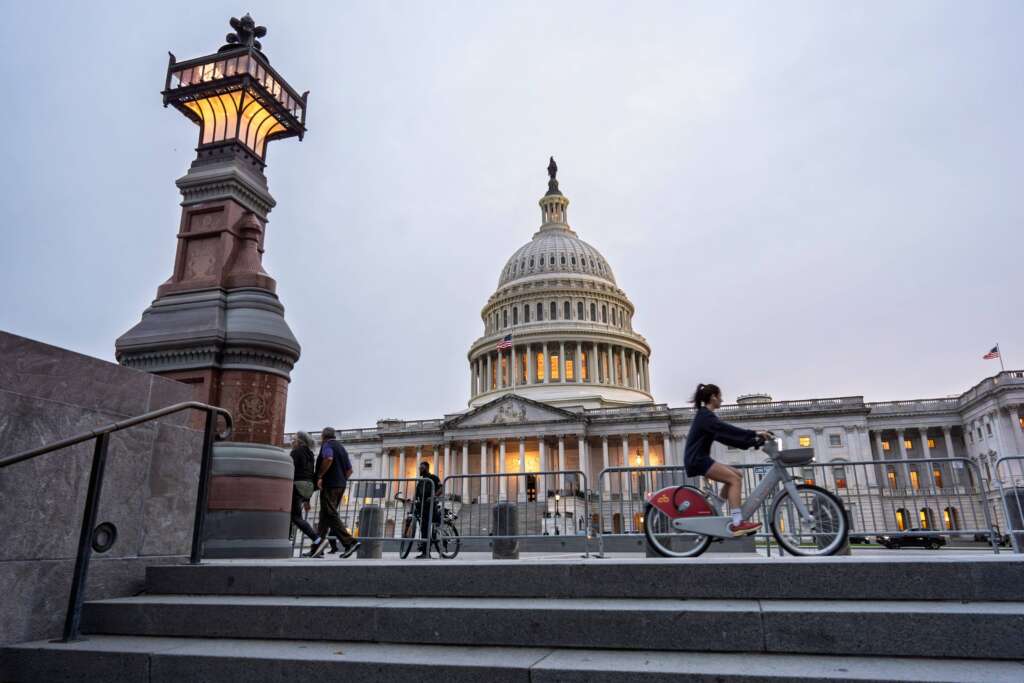
The Capitol is seen at dusk as Democrats and Republicans in Congress are angrily blaming each other and refusing to budge from their positions on funding the government, in Washington, Tuesday, Sept. 30, 2025. (AP Photo/J. Scott Applewhite)

National Treasury Employees Union sues Trump administration

  • A federal union is suing the Trump administration for not handing over a list of employees that agencies might be targeting to remove their job protections. The new lawsuit from the National Treasury Employees Union alleges that the Office of Personnel Management violated the Freedom of Information Act by not providing those details. The union’s legal action comes after the Trump administration earlier this year revived an effort to make large portions of the federal workforce at-will and easier to fire.
    (Lawsuit alleging FOIA violation by OPM - National Treasury Employees Union)
  • The Department of Homeland Security is giving bonuses to Transportation Security Administration employees who worked through the partial shutdown. More than 270 Transportation Security Officers at Logan airport in Boston are among the first TSA employees to receive a bonus from DHS for working without pay during the 43-day shutdown. DHS Secretary Kristi Noem awarded these TSOs a $10,000 bonus on Saturday in appreciation for their dedication and commitment over the last seven weeks. DHS said it is paying for these bonuses using carryover funds from fiscal 2025. Noem announced the administration's plan to give these bonuses on Friday.
  • About 4,000 federal employees who were previously told they were going to be laid off should be receiving a cancellation notice by the end of the day. The spending agreement Congress passed last week gave agencies five days to rescind all reductions-in-force that were announced during the shutdown. OPM said the cancellation notices to employees need to include how much back pay the workers will receive. The employees are owed payments equal to what they would have been paid, had they not been laid off in the first place.
    (RIF actions affected by continuing appropriations - Office of Personnel Management)
  • Defense Secretary Pete Hegseth’s acquisition system reforms could meaningfully reshape how the Pentagon does business, only if the department can avoid the mistakes of the past. Acquisition experts say the reforms could help to break down entrenched silos across the department’s acquisition enterprise and drive greater coordination and integration. But the success of Hegseth’s reforms will hinge on whether the department can change its culture and equip the workforce with the skills needed to operate differently. Otherwise, the system can quickly revert to its old ways. And whether the department has the workforce to support such a sweeping overhaul is unclear. DoD has already lost 5% to 8% of its civilian workforce since the start of the Trump administration.
  • SAIC continues its bloodletting, just three weeks after moving on from its CEO. The federal contractor parted ways with three more executives and consolidated business groups. The company said Josh Jackson, its executive vice president for the Army, David Ray, its space and intelligence EVP, and chief innovation officer Lauren Knausenberger will pursue other opportunities outside of the company. Additionally, SAIC will merge its Army and Navy business groups into one and bring its Air Force and Combatant Commands, and the Space and Intelligence business groups together to become the Air Force, Space and Intelligence Business Group.
  • Agencies are being reminded to patch unsecure devices that are being targeted by hackers. The Cybersecurity and Infrastructure Security Agency said some federal agencies haven’t fully patched vulnerable Cisco devices. CISA directed agencies to update that software back in a September emergency directive. But in new guidance last week, CISA said it’s aware of multiple organizations that haven’t updated to the minimum software version. The cyber agency warned that the vulnerable Cisco device software poses a significant risk to all organizations.
    (Updated implementation guidance for emergency directive on Cisco - Cybersecurity and Infrastructure Security Agency)
  • The Department of Homeland Security is facing calls to release an unclassified report on security flaws in U.S. telecommunications networks. Sens. Ron Wyden (D-Ore.) and Mark Warner (D-Va.) wrote Homeland Security Secretary Kristi Noem and Director of National Intelligence Tulsi Gabbard, urging them to publish the report from 2022. They say not publishing it undermines the public debate over how to best secure U.S. telecom networks. The lawmakers point to the recent "Salt Typhoon" campaign, in which suspected China-backed hackers successfully broke into American telecom systems and devices.
    (Wyden, Warner telecoms security letter - Sen. Ron Wyden (D-Ore.) )
  • The Department of the Navy’s new Innovation Adoption Kit lays out a unified framework for evaluating, implementing and scaling innovative technologies across the naval enterprise. The memo is designed to help commanders and program managers bridge the gap between emerging commercial solutions and mission-ready capabilities. It offers practical methods to accelerate the transition from pilot to program of record and tailor agile approaches to fit within the Navy’s operational and acquisition constraints. Officials say these tactics can be applied across a wide range of missions.

The post National Treasury Employees Union sues Trump administration first appeared on Federal News Network.

© AFP via Getty Images/MANDEL NGAN

Post-shutdown, here’s how soon federal employees can expect back pay

Following the longest shutdown in U.S. history, the federal workforce is now trying to get back to at least some sense of normalcy.

While federal employees who have been furloughed for the last 43 days return to work Thursday, the Office of Personnel Management is setting expectations for agencies as they begin to update pay, leave and benefits for those impacted by the lapse in appropriations.

In new guidance, OPM said it is “is committed to ensuring that retroactive pay is provided as soon as possible.” Compensation will be provided for both furloughed and excepted federal employees, as the spending agreement that was enacted Wednesday evening reaffirmed. A 2019 law previously called for retroactive compensation for all federal employees impacted by a shutdown.

A senior Trump administration official said the White House “has urged agencies to get employee paychecks out expeditiously and accurately to not leave anyone waiting longer than necessary.”

But the timing of employees receiving their back pay varies, depending on what payroll provider an agency uses, and the different pay schedules across the federal workforce.

Sending out retroactive payments to employees involves working across agency HR offices, federal payroll providers and shared service centers. Agency HR offices, for instance, have to submit timecards for federal employees, which are then processed by the government’s various payroll providers.

According to the senior administration official, employees from the General Services Administration and OPM will be among the first to receive their retroactive paychecks, with an expected deposit date set for Saturday.

Employees at the departments of Veterans Affairs, Energy, and Health and Human Services, as well as civilian employees from the Defense Department, will receive their deposits shortly after that — this Sunday.

On Monday, affected employees from the departments of Education, State, Interior and Transportation, as well as the Environmental Protection Agency, National Science Foundation, Nuclear Regulatory Commission, Social Security Administration and NASA, are all expected to receive their back pay.

Then on Wednesday, employees from the departments of Agriculture, Commerce, Treasury, Labor and Justice, along with the Department of Homeland Security, the Department of Housing and Urban Development and the Small Business Administration, are projected to get their paychecks. The timing of the retroactive payments for feds was first reported by Semafor.

The National Finance Center, a payroll provider housed under the Agriculture Department, confirmed that employees at agencies using NFC’s services should expect a payroll deposit by the middle of next week.

“In order to provide backpay for employees as quickly as possible, the National Finance Center will be expediting pay processing for pay period 22 and backpay for pay periods 19 (October 1-4), 20 (October 5-18), and 21 (October 19-November 1),” USDA wrote in an all-staff email Wednesday evening, obtained by Federal News Network.

Federal News Network has reached out to several other federal payroll providers requesting details on the timeline for processing retroactive payments.

The National Treasury Employees Union urged immediate back pay for all federal employees who have been going without compensation for the last six weeks.

“This is an emergency for federal employees across the country, and they should not have to wait another minute longer for the paychecks they lost during the longest government shutdown in history,” NTEU National President Doreen Greenwald said. “We call on all federal agencies to process the back pay immediately.”

In its new guidance, OPM also noted that to make payments as quickly as possible, payroll providers may need to “make some adjustments.” That could mean, for instance, that the initial retroactive payments employees receive might not reflect the exact calculations of their pay and leave hours.

“Payroll providers will work with agencies to make any necessary adjustments as soon as practicable,” OPM said.

Who receives back pay, and how much?

Furloughed employees will receive their “standard rate of pay” for the hours they would have worked if the government shutdown hadn’t occurred, OPM said in its guidance Wednesday evening.

But there are some exceptions to that. If a furloughed employee, for example, had been scheduled for overtime hours that would have occurred during the shutdown, OPM said they should be paid their premium rate for those hours.

Additionally, OPM said that allowances, differentials and other types of payments, like administratively uncontrollable overtime pay or law enforcement availability pay, should be paid as if the furloughed employee continued to work.

Although most employees impacted by the shutdown are ensured back pay, there are some smaller exceptions carved out where employees may not receive retroactive pay, OPM added.

If a furloughed employee was in a non-pay status before the shutdown began, for instance, then they are not entitled to receive back pay.

Excepted employees who were considered “absent without leave” (AWOL) — or in other words, took unapproved time off — will also not receive back pay for that time.

Guidance on leave, post-shutdown

Although excepted employees are not required to use paid leave for taking time off during the shutdown — and can instead enter a “furlough” period — there may still have been some instances where excepted employees took leave during the funding lapse, OPM wrote in its guidance.

In those cases, excepted employees who were approved to take paid leave during the shutdown will be charged for the hours from their leave bank, OPM said.

Agencies are also expected to begin adjusting leave accrual for furloughed employees. Now that the shutdown is over, furloughed employees should be placed in a “pay status” for the time they would have otherwise spent working during the funding lapse. That means accrual of annual and sick leave will be retroactively adjusted as if the employees were in a pay status, OPM said.

Excepted employees continued to accrue leave during the shutdown, which should be reflected in their leave banks, OPM said.

What happens to RIFs of federal employees?

On top of reaffirming back pay, the spending bill that was enacted Wednesday evening also rescinds the roughly 4,000 reductions in force that have occurred since Oct. 1. Federal employees will be temporarily protected from additional RIFs, at least until the end of January.

Agencies have five days to inform federal employees who received RIF notices in October that those actions are rescinded.

“Agencies should issue those notices and confirm to OPM the rescissions have been issued,” OPM’s guidance states.

At least 670,000 federal employees have been furloughed, and 730,000 employees have been working without pay during the shutdown. Agencies have been putting plans in the works to return all furloughed federal employees to their duties as of Thursday.

OPM also said agencies “may consider” providing flexibility for employees who might not be able to return to work immediately, such as by approving personal leave or adjusting individual work schedules.

The post Post-shutdown, here’s how soon federal employees can expect back pay first appeared on Federal News Network.

© AP Photo/Mark Schiefelbein

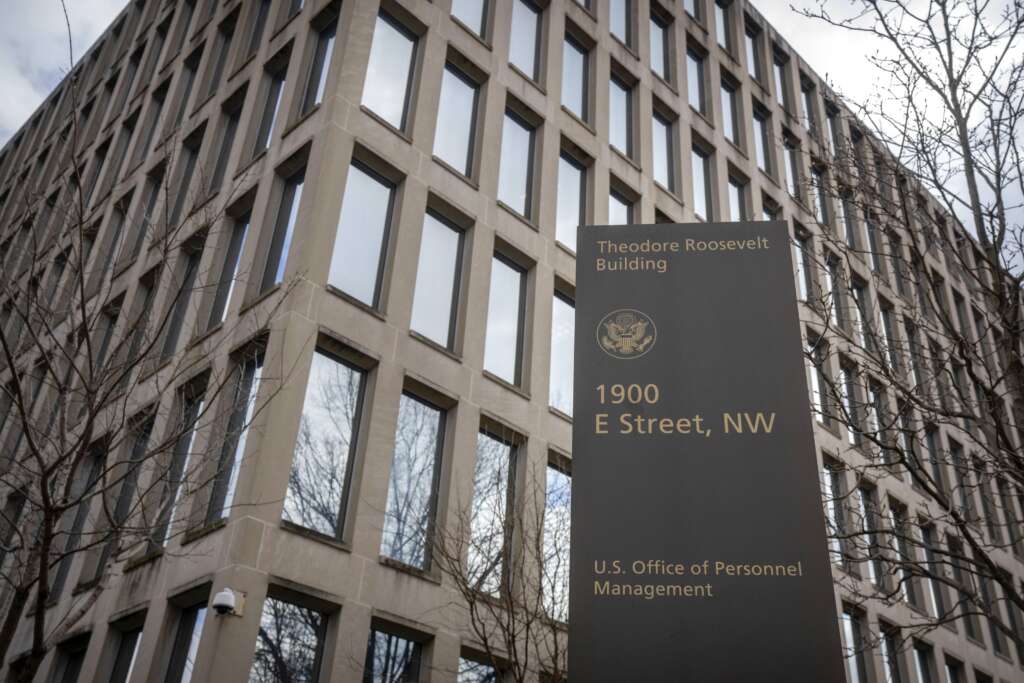
The Theodore Roosevelt Building, location of the U.S. Office of Personnel Management, on Tuesday, Feb. 13, 2024, in Washington. Former President Donald Trump has plans to radically reshape the federal government if he returns to the White House, from promising to deport millions of immigrants in the U.S. illegally to firing tens of thousands of government workers. (AP Photo/Mark Schiefelbein)
❌