NASA is marking America’s 250th year with a bold new symbol of the nation’s relentless drive to explore.
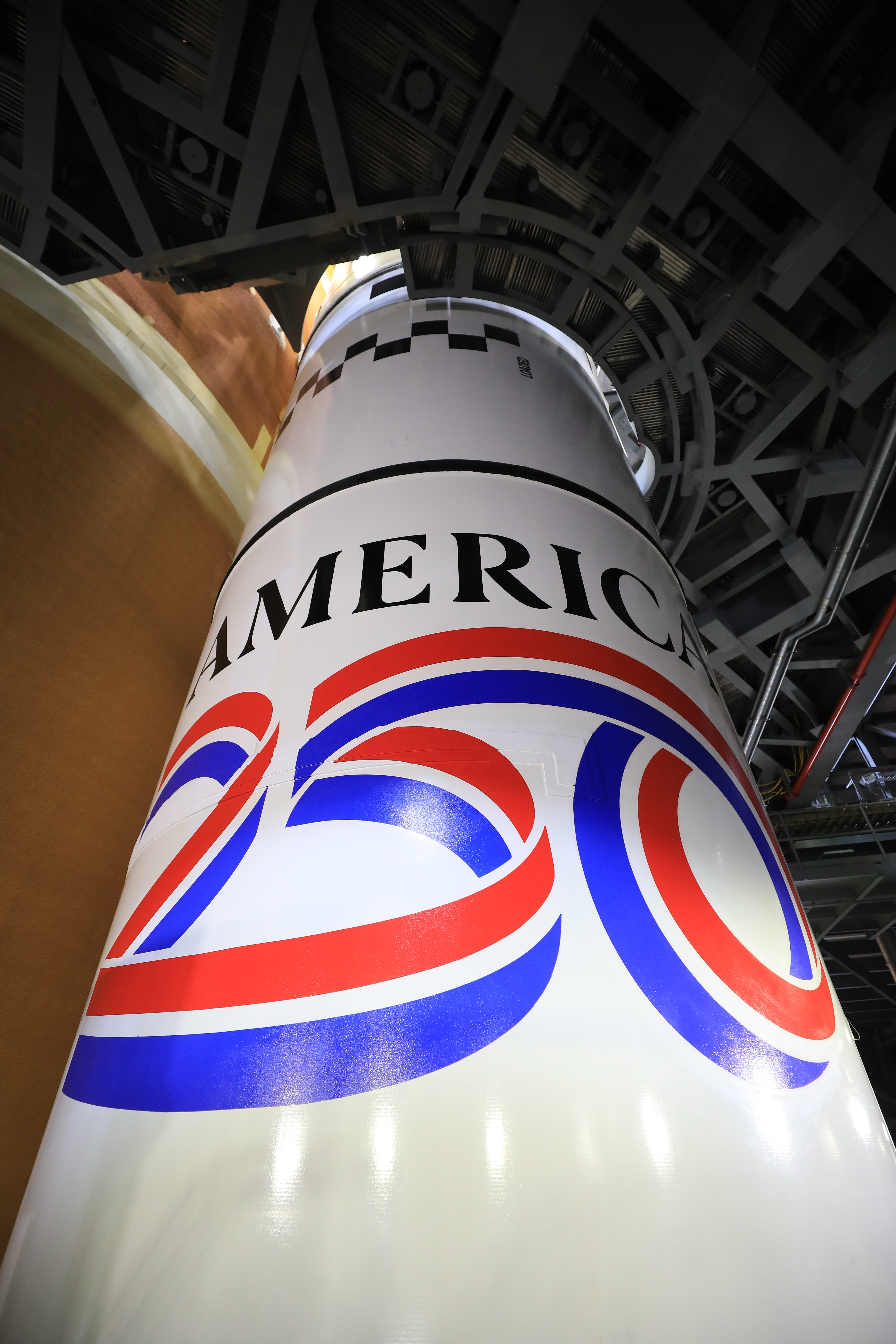

The America 250 emblem is now on the twin solid rocket boosters of the SLS (Space Launch System) rocket for Artemis II — the powerhouse that will launch a crew of four around the Moon next year. Unveiled Tuesday, the design echoes the America 250 Commission’s Spirit of Innovation theme, honoring a country that has never stopped pushing the horizon forward.
At NASA’s Kennedy Space Center in Florida, technicians spent recent weeks carefully applying the emblem on the rocket inside the Vehicle Assembly Building — the same place where rockets for Apollo once stood. Engineers are running final tests on SLS and the Orion spacecraft as preparations intensify for Artemis II.
The roughly 10-day Artemis II journey around the Moon will mark a defining moment in this new era of American exploration — paving the way for U.S. crews to land on the lunar surface and ultimately push onward to Mars.
America’s spirit of discovery is alive, and Artemis is carrying it to the Moon and beyond.
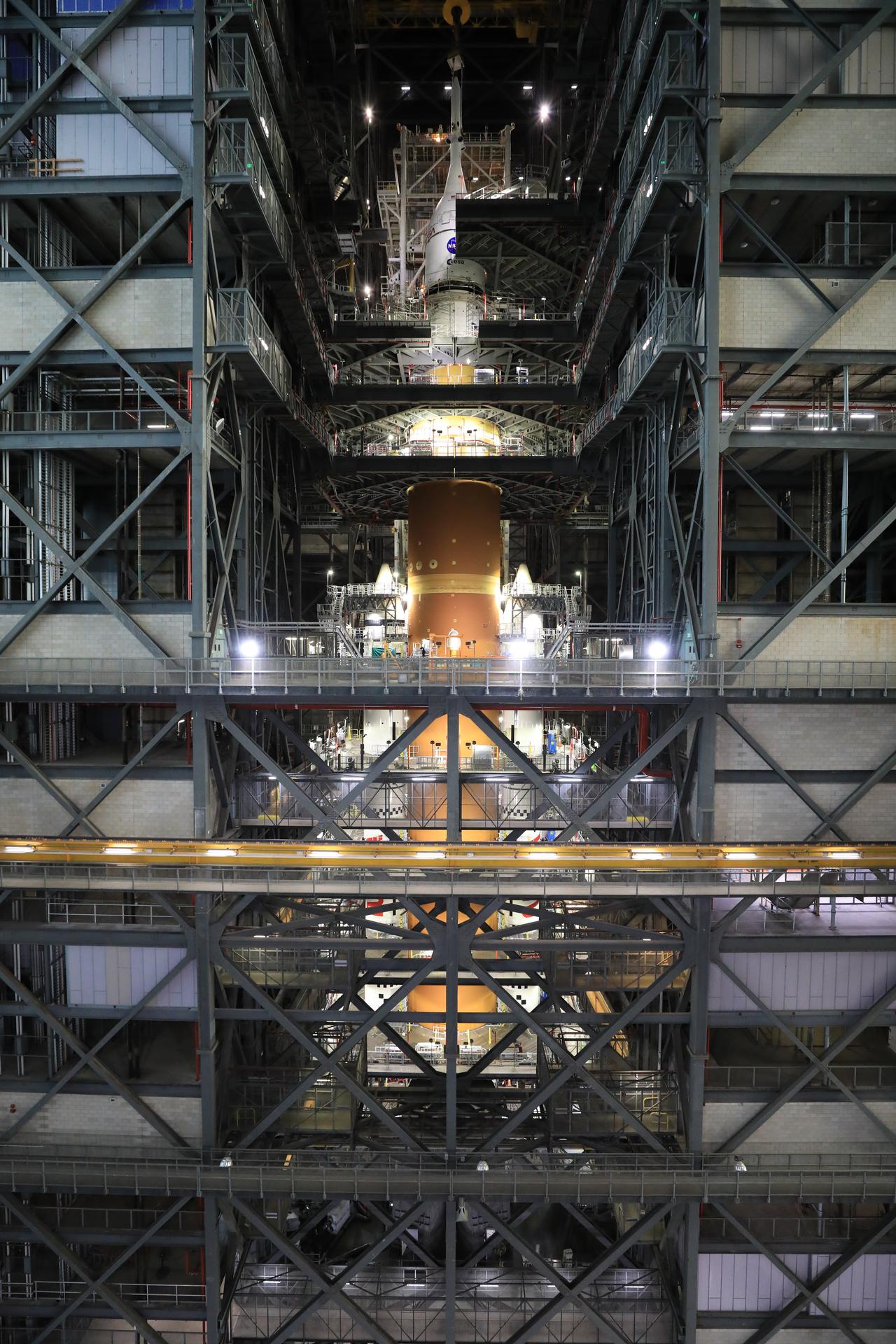
Technicians with NASA’s Exploration Ground Systems team use a crane to lift and secure NASA’s Orion spacecraft on top of the SLS (Space Launch System) rocket in High Bay 3 of the Vehicle Assembly Building at NASA’s Kennedy Space Center in Florida on Saturday, Oct. 18, 2025, for the agency’s Artemis II mission. Set to launch in 2026, the spacecraft will carry NASA astronauts Reid Wiseman, Victor Glover, Christina Koch, and CSA (Canadian Space Agency) astronaut Jeremy Hansen on a 10-day mission around the Moon and back. Once stacked, teams will begin conducting a series of verification tests ahead of rolling out to Launch Complex 39B for the wet dress rehearsal at NASA Kennedy.
NASA/Kim Shiflett
As 2026 nears, NASA continues moving forward to launching and flying Artemis II, the first crewed mission under the Artemis campaign, no later than April next year.
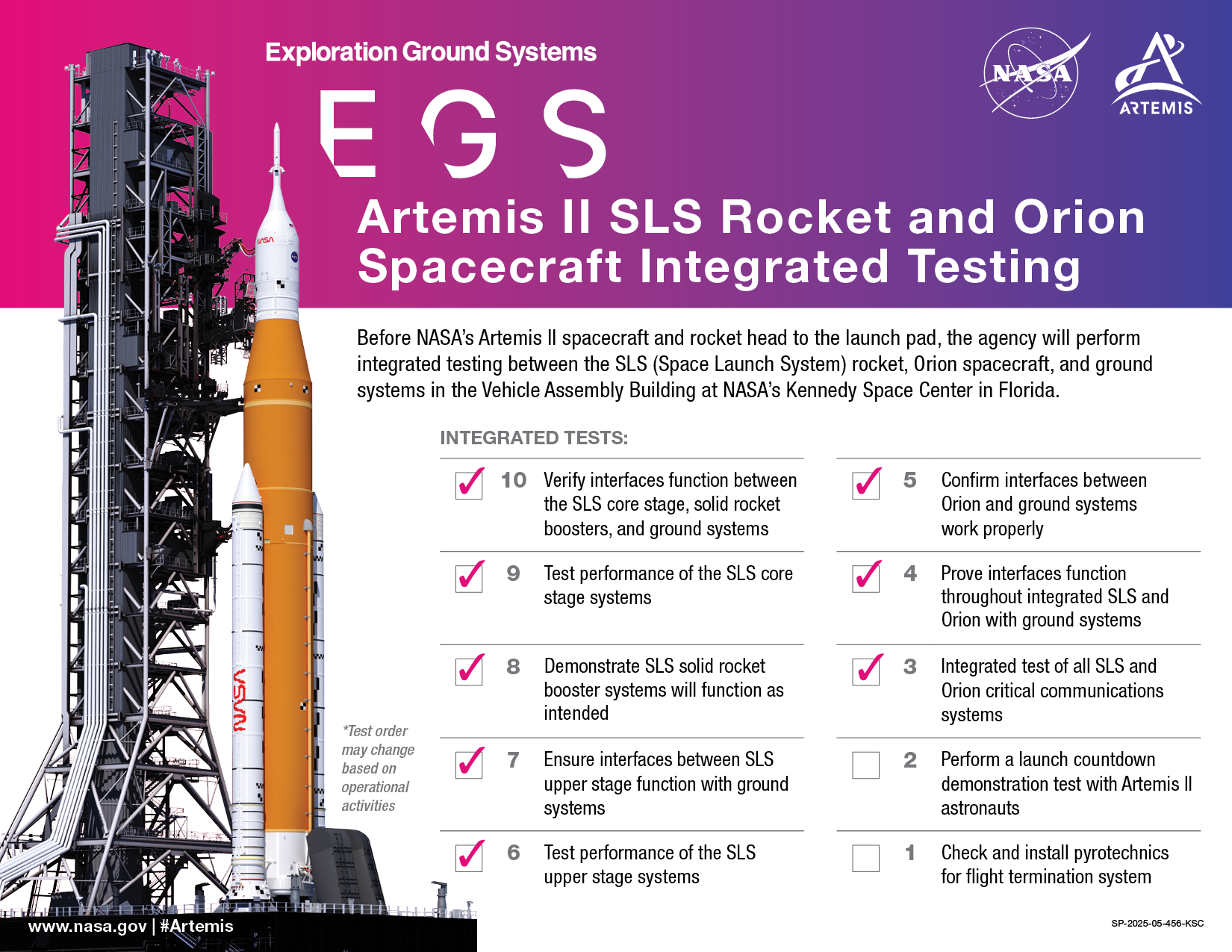
NASA’s Orion spacecraft, complete with its launch abort system escape tower, is now integrated with the SLS (Space Launch System) rocket in the Vehicle Assembly Building (VAB) at the agency’s Kennedy Space Center in Florida. Following Orion stacking, teams completed testing critical communications systems between SLS and Orion, and confirmed the interfaces function properly between the rocket, Orion, and the ground systems, including end-to-end testing with the Near Space Network and Deep Space Network, which aid in communications and navigation.
“NASA remains focused on getting ready to safely fly four astronauts around the Moon and back,” said acting NASA Administrator Sean Duffy. “Our mission will lay the groundwork for future missions to the lunar surface and to Mars.”
In the coming weeks, engineers and the Artemis II crew will conduct the first part of a Countdown Demonstration Test at Kennedy, a dress rehearsal for launch day. The crew will don their Orion crew survival system spacesuits and venture to their rocket before being secured inside Orion, which the crew recently named Integrity, simulating the final moments of the countdown. Because the rocket and spacecraft are not yet at the launch pad, the crew will board Orion inside the VAB. The test will serve as a final verification of the timeline for the crew and supporting teams on the ground. A second part of the test, preparing for an emergency at the launch pad, will occur after the rocket and spacecraft roll out to Launch Pad 39B.
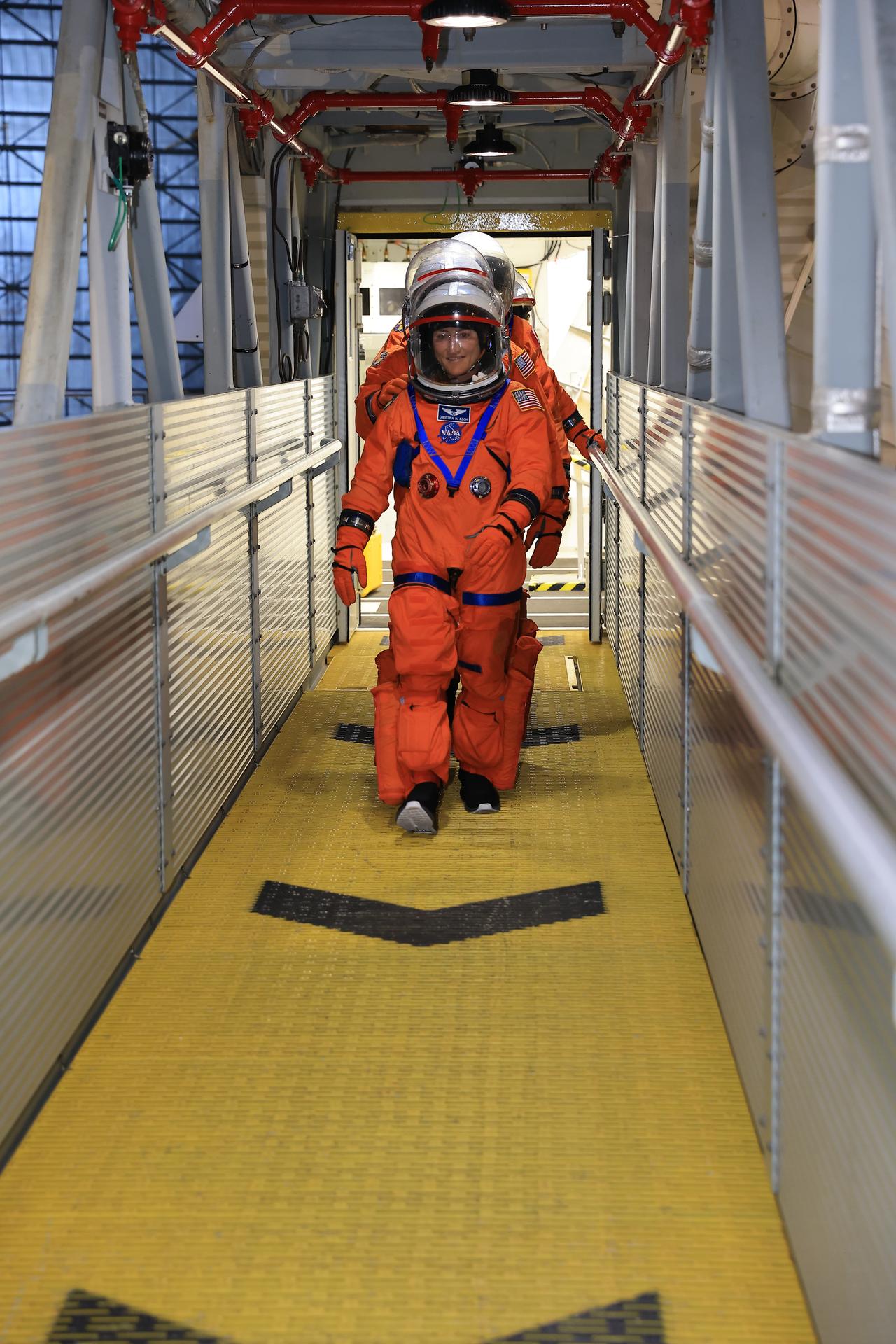
NASA astronaut Christina Koch, Artemis II mission specialist, and the remaining Artemis II crew members walk on the crew access arm of the mobile launcher in the Vehicle Assembly Building at NASA’s Kennedy Space Center in Florida on Tuesday, Aug. 12, 2025.
NASA/Kim Shiflett
The Artemis II crew and ground personnel responsible for launching and flying the mission are preparing to conduct additional integrated simulations across teams and facilities to prepare for any scenario that could arise as the crew of four launches from Florida and flies their approximately 10-day mission.
NASA astronauts Reid Wiseman, Victor Glover, and Christina Koch, and CSA (Canadian Space Agency) astronaut Jeremy Hansen, have a busy schedule over the next several months reviewing procedures for all phases of flight until their preparations are second nature, practicing for different mission scenarios, and maintaining their familiarity with every element of their spacecraft.
Through Artemis, NASA will send astronauts to explore the Moon for scientific discovery, economic benefits, and build the foundation for the first crewed missions to Mars.
All the pieces are stacking up – literally – for NASA’s first crewed mission of the Artemis program coming in 2026.
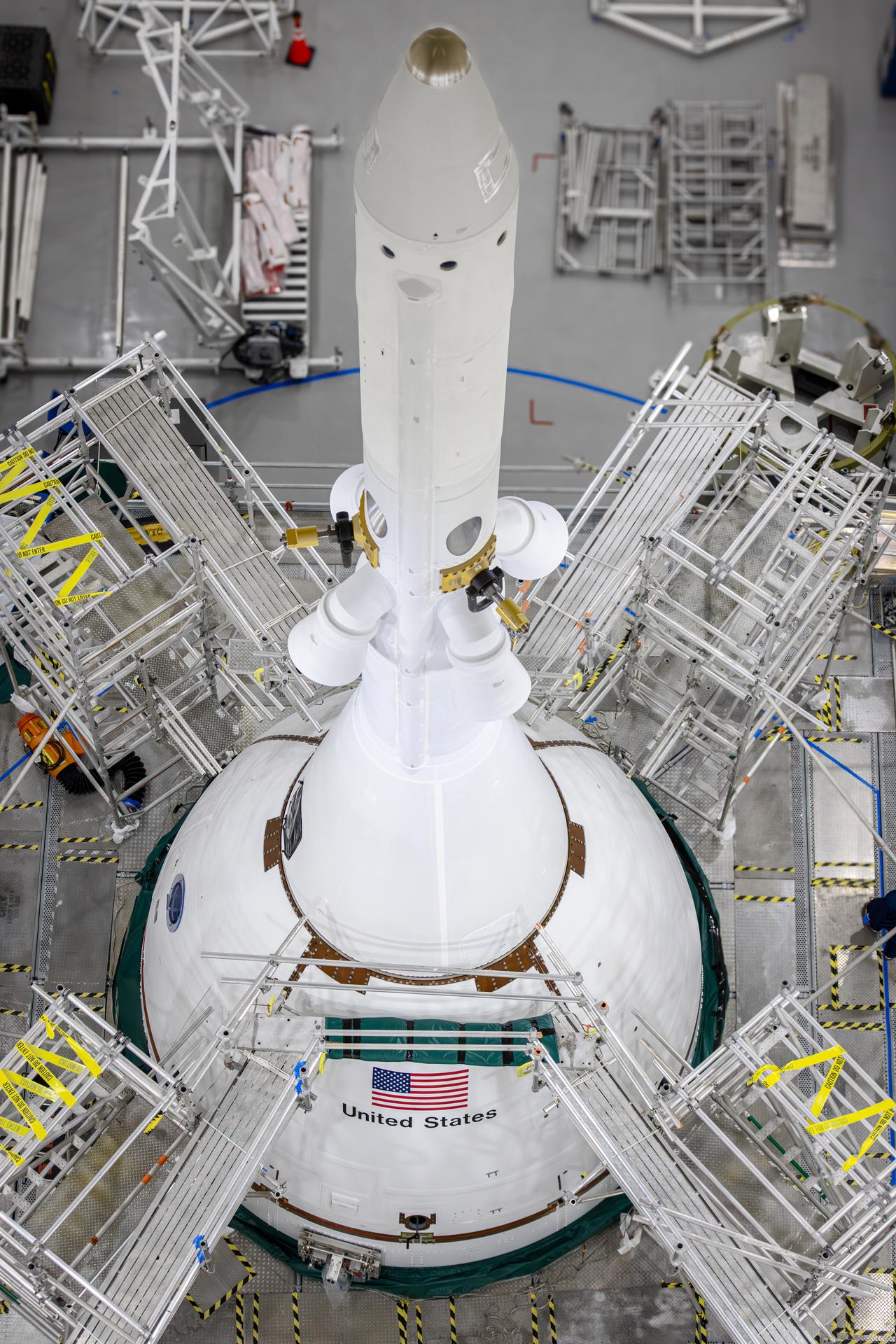
Teams are finishing integration of the Orion spacecraft for the Artemis II test flight with its launch abort system on Sept. 17 inside the Launch Abort System Facility at NASA’s Kennedy Space Center in Florida. The 44-foot-tall tower-like abort structure would swiftly carry the four-person crew inside Orion to safety in the unlikely event of an emergency during launch or ascent atop the SLS (Space Launch System) rocket.
Over the next few weeks, teams will complete remaining closeout activities before moving the spacecraft to its final stop before the launch pad: the agency’s Vehicle Assembly Building. There it will be added to the top of the rocket, before the finished stack is rolled out to the launch pad on its way to the Moon.
The abort system is comprised of three solid rocket motors: the jettison, attitude, and abort motors. In the case of an emergency, these motors work together to propel the astronauts inside Orion’s crew module to safety: the abort motor pulls the crew module away from the launch vehicle; the attitude control motor steers and orients the capsule; then the jettison motor ignites to separate the abort system from the crew module prior to parachute deployment. During a normal launch, Orion will shed the abort system and leave it behind once the crew is safely through the most dynamic part of ascent, leaving Orion thousands of pounds lighter for the rest of its journey.
NASA’s Artemis II SLS (Space Launch System) rocket poised to send four astronauts from Earth on a journey around the Moon next year may appear identical to the Artemis I SLS rocket. On closer inspection, though, engineers have upgraded the agency’s Moon rocket inside and out to improve performance, reliability, and safety.
SLS flew a picture perfect first mission on the Artemis I test flight, meeting or exceeding parameters for performance, attitude control, and structural stability to an accuracy of tenths or hundredths of a percent as it sent an uncrewed Orion thousands of miles beyond the Moon. It also returned volumes of invaluable flight data for SLS engineers to analyze to drive improvements.
Teams with NASA’s Exploration Ground Systems integrate the SLS (Space Launch System) Moon rocket with the solid rocket boosters onto mobile launcher 1 inside High Bay 3 of the Vehicle Assembly Building at NASA’s Kennedy Space Center in March 2025. Artemis II is the first crewed test flight under NASA’s Artemis campaign and is another step toward missions on the lunar surface and helping the agency prepare for future human missions to Mars.
NASA/Frank Michaux
For Artemis II, the major sections of SLS remain unchanged – a central core stage, four RS-25 main engines, two five-segment solid rocket boosters, the ICPS (interim cryogenic propulsion stage), a launch vehicle stage adapter to hold the ICPS, and an Orion stage adapter connecting SLS to the Orion spacecraft. The difference is in the details.
“While we’re proud of our Artemis I performance, which validated our overall design, we’ve looked at how SLS can give our crews a better ride,” said John Honeycutt, NASA’s SLS Program manager. “Some of our changes respond to specific Artemis II mission requirements while others reflect ongoing analysis and testing, as well as lessons learned from Artemis I.”
Engineers have outfitted the ICPS with optical targets that will serve as visual cues to the astronauts aboard Orion as they manually pilot Orion around the upper stage and practice maneuvers to inform docking operations for Artemis III.
The Artemis II rocket includes an improved navigation system compared to Artemis I. Its communications capability also has been improved by repositioning antennas on the rocket to ensure continuous communications with NASA ground stations and the U.S. Space Force’s Space Launch Delta 45 which controls launches along the Eastern Range.
An emergency detection system on the ICPS allows the rocket to sense and respond to problems and notify the crew. The flight safety system adds a time delay to the self-destruct system to allow time for Orion’s escape system to pull the capsule to safety in event of an abort.
The separation motors that push the solid rocket booster away after the elements are no longer needed were angled an additional 15 degrees to increase separation clearance as the rest of the rocket speeds by.
Additionally, SLS will jettison the spent boosters four seconds earlier during Artemis II ascent than occurred during Artemis I. Dropping the boosters several seconds closer to the end of their burn will give engineers flight data to correlate with projections that shedding the boosters several seconds sooner will yield approximately 1,600 pounds of payload to Earth orbit for future SLS flights.
Engineers have incorporated additional improvements based on lessons learned from Artemis I. During the Artemis I test flight the SLS rocket experienced higher-than-expected vibrations near the solid rocket booster attachment points that was caused by unsteady airflow.
To steady the airflow, a pair of six-foot-long strakes flanking each booster’s forward connection points on the SLS intertank will smooth vibrations induced by airflow during ascent, and the rocket’s electronics system was requalified to endure higher levels of vibrations.
Engineers updated the core stage power distribution control unit, mounted in the intertank, which controls power to the rocket’s other electronics and protects against electrical hazards.
These improvements have led to an enhanced rocket to support crew as part of NASA’s Golden Age of innovation and exploration.
The approximately 10-day Artemis II test flight is the first crewed flight under NASA’s Artemis campaign. It is another step toward new U.S.-crewed missions on the Moon’s surface that will help the agency prepare to send the first astronauts – Americans – to Mars.

 Login
Login