❌

Reading view

There are new articles available, click to refresh the page.

Signal in the noise: what hashtags reveal about hacktivism in 2025

What do hacktivist campaigns look like in 2025? To answer this question, we analyzed more than 11,000 posts produced by over 120 hacktivist groups circulating across both the surface web and the dark web, with a particular focus on groups targeting MENA countries. The primary goal of our research is to highlight patterns in hacktivist operations, including attack methods, public warnings, and stated intent. The analysis is undertaken exclusively from a cybersecurity perspective and anchored in the principle of neutrality.

Hacktivists are politically motivated threat actors who typically value visibility over sophistication. Their tactics are designed for maximum visibility, reach, and ease of execution, rather than stealth or technical complexity. The term β€œhacktivist” may refer to either the administrator of a community who initiates the attack or an ordinary subscriber who simply participates in the campaign.

Key findings

While it may be assumed that most operations unfold on hidden forums, in fact, most hacktivist planning and mobilization happens in the open. Telegram has become the command center for today’s hacktivist groups, hosting the highest density of attack planning and calls to action. The second place is occupied by X (ex-Twitter).
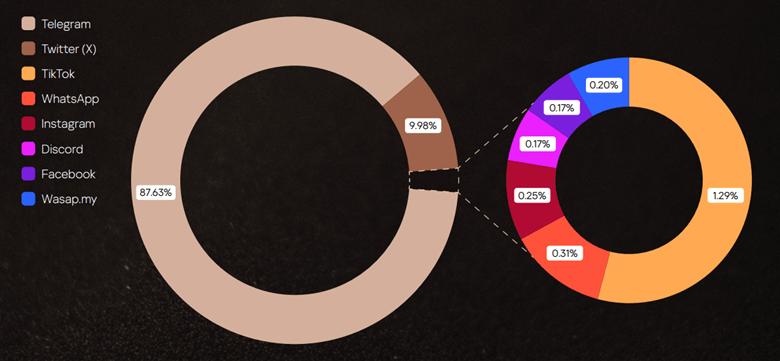
Distribution of social media references in posts published in 2025

Distribution of social media references in posts published in 2025

Although we focused on hacktivists operating in MENA, the targeting of the groups under review is global, extending well beyond the region. There are victims throughout Europe and Middle East, as well as Argentina, the United States, Indonesia, India, Vietnam, Thailand, Cambodia, TΓΌrkiye, and others.

Hashtags as the connective tissue of hacktivist operations

One notable feature of hacktivist posts and messages on dark web sites is the frequent use of hashtags (#words). Used in their posts constantly, hashtags often serve as political slogans, amplifying messages, coordinating activity or claiming credit for attacks. The most common themes are political statements and hacktivist groups names, though hashtags sometimes reference geographical locations, such as specific countries or cities.

Hashtags also map alliances and momentum. We have identified 2063 unique tags in 2025: 1484 appearing for the first time, and many tied directly to specific groups or joint campaigns. Most tags are short-lived, lasting about two months, with β€œpopular” ones persisting longer when amplified by alliances; channel bans contribute to attrition.

Operationally, reports of completed attacks dominate hashtagged content (58%), and within those, DDoS is the workhorse (61%). Spikes in threatening rhetoric do not by themselves predict more attacks, but timing matters: when threats are published, they typically refer to actions in the near term, i.e. the same week or month, making early warning from open-channel monitoring materially useful.

The full version of the report details the following findings:

  • How long it typically takes for an attack to be reported after an initial threat post
  • How hashtags are used to coordinate attacks or claim credit
  • Patterns across campaigns and regions
  • The types of cyberattacks being promoted or celebrated

Practical takeaways and recommendations

For defenders and corporate leaders, we recommend the following:

  • Prioritize scalable DDoS mitigation and proactive security measures.
  • Treat public threats as short-horizon indicators rather than long-range forecasts.
  • Invest in continuous monitoring across Telegram and related ecosystems to discover alliance announcements, threat posts, and cross-posted β€œproof” rapidly.

Even organizations outside geopolitical conflict zones should assume exposure: hacktivist campaigns seek reach and spectacle, not narrow geography, and hashtags remain a practical lens for separating noise from signals that demand action.

To download the full report, please fill in the form below.



Notes of cyber inspector: three clusters of threat in cyberspace

By: Kaspersky

Hacktivism and geopolitically motivated APT groups have become a significant threat to many regions of the world in recent years, damaging infrastructure and important functions of government, business, and society. In late 2022 we predicted that the involvement of hacktivist groups in all major geopolitical conflicts from now on will only increase and this is what we’ve been observing throughout the years. With regard to the Ukrainian-Russian conflict, this has led to a sharp increase of activities carried out by groups that identify themselves as either pro-Ukrainian or pro-Russian.

The rise in cybercrime amid geopolitical tensions is alarming. Our Kaspersky Cyber Threat Intelligence team has been observing several geopolitically motivated threat actors and hacktivist groups operating in various conflict zones. Through collecting and analyzing extensive data on these groups’ tactics, techniques, and procedures (TTPs), we’ve discovered a concerning trend: hacktivists are increasingly interconnected with financially motivated groups. They share tools, infrastructure, and resources.

This collaboration has serious implications. Their campaigns may disrupt not only business operations but also ordinary citizens’ lives, affecting everything from banking services to personal data security or the functioning of the healthcare system. Moreover, monetized techniques can spread exponentially as profit-seeking actors worldwide replicate and refine them. We consider these technical findings a valuable resource for global cybersecurity efforts. In this report, we share observations on threat actors who identify themselves as pro-Ukrainian.

About this report

The main goal of this report is to provide technical evidence supporting the theory we’ve proposed based on our previous research: that most of the groups we describe here actively collaborate, effectively forming three major threat clusters.

This report includes:

  • A library of threat groups, current as of 2025, with details on their main TTPs and tools.
  • A technical description of signature tactics, techniques, procedures, and toolsets used by these groups. This information is intended for practical use by SOC, DFIR, CTI, and threat hunting professionals.

What this report covers

This report contains information on the current TTPs of hacktivists and APT groups targeting Russian organizations particularly in 2025, however they are not limited to Russia as a target. Further research showed that among some of the groups’ targets, such as CloudAtlas and XDSpy, were assets in European, Asian, and Middle Eastern countries. In particular, traces of infections were discovered in 2024 in Slovakia and Serbia. The report doesn’t include groups that emerged in 2025, as we didn’t have sufficient time to research their activity. We’ve divided all groups into three clusters based on their TTPs:

  • Cluster I combines hacktivist and dual-purpose groups that use similar tactics, techniques, and tools. This cluster is characterized by:
    • Shared infrastructure
    • A unique software suite
    • Identical processes, command lines, directories, and so on
    • Distinctive TTPs
  • Cluster II comprises APT groups that have different TTPs from the hacktivists. Among these, we can distinguish simple APTs (characterized by their use of third-party utilities, scripts that carry out all the malicious logic, shared domain registrars, and concealing their real infrastructure behind reverse proxy systems – for example, using Cloudflare services), and more sophisticated ones (distinguished by their unique TTPs).
  • Cluster III includes hacktivist groups for which we’ve observed no signs of collaboration with other groups described here.

Example: Cyberthreat landscape in Russia in 2025

Hacktivism remains the key threat to Russian businesses and businesses in other conflict areas today, and the scale and complexity of these attacks keep growing. Traditionally, the term β€œhacktivism” refers to a blend of hacking and activism, where attackers use their skills to achieve social or political goals. Over the past few years, these threat actors have become more experienced and organized, collaborating with one another and sharing knowledge and tools to achieve common objectives.

Additionally, a new phenomenon known as β€œdual-purpose groups” has appeared in the Russian threat landscape in recent years. We’ve detected links between hacktivists and financially motivated groups. They use the same tools, techniques, and tactics, and even share common infrastructure and resources. Depending on the victim, they may pursue a variety of goals: demanding a ransom to decrypt data, causing irreparable damage, or leaking stolen data to the media. This suggests that these attackers belong to a single complex cluster.

Beyond this, β€œtraditional” categories of attackers continue to operate in Russia and other regions: groups engaged in cyberespionage and purely financially motivated threat actors also remain a significant problem. Like other groups, geopolitically motivated groups are cybercriminals who undermine the secure and trustworthy use of digitalization opportunities and they can change and adapt their target regions depending on political developments.

That is why it is important to also be aware of the TTPs used by threat actors who appear to be attacking other targets. We will continue to monitor geopolitically motivated threat actors and publish technical reports about their TTPs.

Recommendations

To defend against the threats described in this report, Kaspersky experts recommend the following:

  • Provide your SOC teams with access to up-to-date information on the latest attacker tactics, techniques, and procedures (TTPs). Threat intelligence feeds from reliable providers, like Kaspersky Threat Intelligence, can help with this.
  • Use a comprehensive security solution that combines centralized monitoring and analysis, advanced threat detection and response, and security incident investigation tools. The Kaspersky NEXT XDR platform provides this functionality and is suitable for medium and large businesses in any industry.
  • Protect every component of modern and legacy industrial automation systems with specialized OT security solutions. Kaspersky Industrial CyberSecurity (KICS) β€” an XDR-class platform β€” ensures reliable protection for critical infrastructure in energy, manufacturing, mining, and transportation.
  • Conduct regular security awareness training for employees to reduce the likelihood of successful phishing and other social engineering attacks. Kaspersky Automated Security Awareness Platform is a good option for this.

The report is available for our partners and customers. If you are interested, please contact report@kaspersky.com

❌