Reading view

There are new articles available, click to refresh the page.

Risk & Compliance Exchange 2025: Former DOJ lawyer Sara McLean on ensuring cyber compliance under the False Claims Act

Since January 2025, the Justice Department has been aggressively holding federal contractors accountable for violating cybersecurity violations under the False Claims Act.

Over the last 11 months, the Trump administration has announced six settlements out of the 14 since the initiative began in 2021.

Sara McLean, a former assistant director of the DOJ Commercial Litigation Branch’s Fraud Section and now a partner with Akin, said the Trump administration has made a much more significant push to hold companies, especially those that work for the Defense Department, accountable for meeting the cyber provisions of their contracts.

Sara McLean is a former assistant director of the DOJ Commercial Litigation Branch’s Fraud Section and now is a partner with Akin,

“I think there are going to be a lot more of these announcements. There’s been a huge uptick just since the beginning of the administration. That is just absolutely going to continue,” McLean said during Federal News Network’s Risk & Compliance Exchange 2025.

“The cases take a long time. The investigations are complex. They take time to develop. So I think there are going to be many, many, many more announcements, and there’s a lot of support for them. Cyber enforcement is now embedded in what the Justice Department does every day. It’s described as the bread and butter by leadership.”

A range of high-profile cases

A few of the high-profile cases this year so far include a $875,000 settlement with Georgia Tech Research Corp. in September and a $1.75 million settlement in August with Aero Turbine Inc. (ATI), an aerospace maintenance provider, and Gallant Capital Partners, a private equity firm that owned a controlling stake in ATI during the time period covered by the settlement.

McLean, who wouldn’t comment on any one specific case, said in most instances, False Claims Act allegations focus on reckless disregard for the rules, not simple mistakes.

“We’ve seen in some of the more recent announcements new types of fact patterns. What happens is when announcements are made that DOJ has pursued a matter and has resolved a matter, that often leads to the qui tam relators and their attorneys finding more matters like that and filing them,” said McLean who left federal service in October after almost 27 years. “It’ll be interesting to see if these newer fact patterns yield more cases that are similar.”

Recent cases that involve the security of medical devices or the qualifications of cyber workers performing on government contracts are two newer fact patterns that have emerged over the last year or so.

Launched in 2021, the Justice’s Civil-Cyber Fraud initiative uses the False Claims Act to ensure contractors and grantees meet the government’s cybersecurity requirements.

President Joe Biden signed an executive order in May 2021 that directed all agencies to improve “efforts to identify, deter, protect against, detect and respond to” malicious cyberthreats.

130 DOJ lawyers focused on cyber

Justice conducted a 360 review of cyber matters and related efforts, and one of the areas that emerged was to use the False Claims Act to hold contractors and grantees accountable and drive a change in behavior.

“The motivation was largely to improve cybersecurity and also to protect sensitive information, personal information, national security information, and to ensure a level playing field, so that you didn’t have some folks who were meeting the requirements and others who were not,” McLean said.

“It was to ensure that incidents were being reported to the extent the False Claims Act could be used around that particular issue. Because the thought was that would enable the government to respond to cybersecurity problems and that still is really the impetus now behind the enforcement.”

McLean said the Civil-Cyber Fraud initiative is now embedded as part of the DOJ’s broader False Claims Act practice. It has about 130 lawyers, who work with U.S. attorney’s offices as well as agency inspectors general offices.

Typically, an IG begins an investigation either based on a qui tam or whistleblower filing, or a more traditional review of contracts and grants.

The IG will assign agents and DOJ lawyers will join as part of the investigative team.

McLean said the agents are on the ground, interviewing witnesses and applying all the resources that come from the IGs. DOJ then decides, based on the information the IGs bring back, to either take some sort of action, such as intervening in a qui tam lawsuit and taking it over, or to decline or settle with a company.

“They go back to the agency for a recommendation on how to proceed. So it’s really the agencies and DOJ who are really in lockstep in these matters,” she said. “DOJ is making the decision, but it’s based on the recommendation of the agencies and with the total support of the agencies.”

Many times, Justice decides to intervene in a case or seek a settlement depending on whether the company in question has demonstrated reckless disregard for federal cyber rules and regulations.

McLean said a violation of the False Claims Act requires only reckless disregard, not intentional fraud.

“It’s critically important for anyone doing business with the government, especially those who are signing a contract and agreeing to do something, to make sure that they understand what that is, especially in the cybersecurity area,” she said. “What they’ve signed on to can be quite complicated. It can be legally complicated. It can be technically complicated. But signing on the dotted line without that understanding is just a recipe for getting into trouble.”

When a whistleblower files a qui tam lawsuit, McLean said that ratchets up the entire investigation. A whistleblower can be entitled to up to 30% of the government’s recovery, whether through a decision or a settlement.

Self-disclosures encouraged

If a company doesn’t understand the requirements and doesn’t put any resources into trying to understand and comply with them, that can lead to a charge of reckless disregard.

“When it comes to employee qualifications, it’s the same thing. If a contract says that there needs to be this level of education or there needs to be this level of experience, that is what needs to be provided. Or a company can get into trouble,” McLean said.

“The False Claims Act applies to making false claims and causing false claims. It’s not just the company that’s actually directly doing business with the government that needs to worry about the risk of False Claims Act liability, because a company that’s downstream, like a subcontractor who’s not submitting the claims to the government, could be found liable for causing a false claim, or, say, an assessor could be found liable for causing a false claim, or a private equity company could be found liable for causing a false claim. There are individuals who can be found liable for causing and submitting false claims.”

She added that False Claims Act allegations can apply not only to just the one company that has the direct relationship with the government but also to their partners if they are not making a good faith effort to comply.

But when it’s a mistake, maybe an overpayment or something similar, the company can usually claim responsibility and address the problem quickly.

“DOJ has policies of giving credit in False Claims Act settlements for self-disclosure, cooperation and remediation. That is definitely something that is available and that companies have been definitely taking advantage of in this space,” McLean said. “DOJ understands that there’s more focus on cybersecurity than there used to be, and so there are companies that maybe didn’t attend to this as much as they now wish they had in the past. The companies discover that they’ve got some kind of a problem and want to fix it going forward, but then also figure out, ‘How do I make it right and in the past?’ ”

McLean said this is why vendors need to pay close attention to how they comply with the DoD’s new Cybersecurity Maturity Model Certification.

She said when vendors sign certifications that they are complying with CMMC standards without fully understanding what that means, that could be considered deliberate ignorance.

“Some courts have described it as gross negligence. Negligence would be a mistake. I don’t know if that helps for the for the nonlawyers, but corporations which do not inform themselves about the requirements or not taking the steps that are necessary, even if it’s not through necessarily ill intent, but it’s not what the government bargained for, and it’s not just an accident. It’s a little bit more than that, quite a bit more than that,” she said.

“The one thing that’s important about that development is it does involve more robust certifications, and that is something that can be a factor in a case being a False Claims Act and a case being more or less likely to be one that the government would take over. Because signing a certification when the information is not true starts to look like a lie, which starts to look like the more intentional type of fraud … rather than a mistake. It looks reckless to be signing certifications without doing this review to know that the information that’s in there is right.”

Discover more articles and videos now on our Risk & Compliance Exchange 2025 event page.

The post Risk & Compliance Exchange 2025: Former DOJ lawyer Sara McLean on ensuring cyber compliance under the False Claims Act first appeared on Federal News Network.

© Federal News Network

Risk and Compliance Exchange 2025 (3)

Federal court blocks Trump administration’s plan to scrap 4 small agencies

The Trump administration’s plans to shutter four small agencies are indefinitely on hold, following a court’s recent ruling.

A federal judge in Rhode Island issued a permanent injunction on Nov. 21, blocking the administration from taking any further action to eliminate the Institute of Museum and Library Services, the Minority Business and Development Agency, the Federal Mediation and Conciliation Service, and the Interagency Council on Homelessness.

President Donald Trump signed an executive order in March, eliminating these agencies — and three others — “to the maximum extent consistent with applicable law.” But attorneys general in 21 states sued the administration, arguing that these agency closures would have downstream effects on state-level operations.

The permanent injunction ordered by U.S. District Court Judge John J. McConnell, Jr. prevents the four agencies from “taking any future action to implement, give effect to, comply with, or carry out the directives contained in the Reduction EO.”

McConnell determined that the Trump administration’s decision to conduct widespread layoffs, terminate grants and eliminate programs at these agencies “undermined their ability to perform functions mandated by statute.”

“By now, the question presented in this case is a familiar one: may the executive branch undertake such actions in circumvention of the will of the legislative branch? In recent months, this court — along with other courts across the country — has concluded that it may not. That answer remains the same here,” he wrote.

The agencies targeted for elimination are responsible for funding museums and libraries, mediating labor disputes, supporting minority-owned businesses, and preventing and ending homelessness.

Over the course of several months, the Trump administration fired, placed on administrative leave, or reassigned nearly all employees in these four agencies. The administration cancelled a wide range of grants to the agencies, and cancelled public programs and services that the agencies provided.

McConnell said these decisions left the agencies unable to carry out their statutorily mandated functions, and unable to spend their congressionally appropriated funds.

The court issued a preliminary injunction in May. The Trump administration appealed the district court’s preliminary injunction, but dropped its appeal on Nov. 21, following the judge’s permanent injunction. Federal News Network has reached out to the White House and the Justice Department for comment.

The Supreme Court and federal appeals courts have mostly allowed the Trump administration to proceed with plans to shutter agencies and conduct mass layoffs across the federal workforce.

The Trump administration argued that a preliminary injunction in this case prevented agencies from implementing the president’s priorities.  McConnell, however, said he ruled in favor of the states, given a “plethora of injuries” that would arise, if the court did not intervene.

States told the court that closing IMLS would force the closure of public libraries, force them to implement hiring freezes and stop providing services that support literacy and learning. State universities said they would be forced to lay off employees, eliminate student programming and default on contracts without continued funding for MBDA.

In other cases, states said some of their agencies and programs are at risk of work stoppages and negotiation impasses, without FMCS around to resolve labor disputes. States also told the court they would lose expert assistance on how to reduce homelessness without the Interagency Council on Homelessness.

“All this to say: the injuries alleged are to the States themselves and are far more than merely economic or speculative,” McConnell wrote.

New York State Attorney General Letitia James called the ruling a “major victory in our ongoing work to defend important services.”

“The federal government’s illegal attack on these agencies threatened vital resources for workers, small businesses, and the most vulnerable in our communities,” James said.

The American Library Association said the court’s decision “restores everything that the executive order tried to take away.”

“Convincing a federal judge that shuttering a supposedly obscure agency would have an immediate and devastating impact on millions of Americans is no small feat,” ALA President Sam Helmick said. “Libraries also strengthen local economies by supporting jobseekers, small businesses and community learning. Protecting these resources matters.”

The post Federal court blocks Trump administration’s plan to scrap 4 small agencies first appeared on Federal News Network.

© AP Photo/Jacquelyn Martin

FILE - A man enters the building that houses the offices of the Institute of Museum and Library Services (IMLS), Thursday, March 20, 2025, in Washington. (AP Photo/Jacquelyn Martin)

Lawmakers say agencies aren’t reinstating enough laid-off employees under shutdown-ending deal

Democratic lawmakers say agencies aren’t reinstating as many federal employees as they should be, as part of a recent spending deal that ended the longest government shutdown.

Employees who received reduction in force (RIF) notices before the government shutdown, but were on track to be officially separated from their agencies during the shutdown, say layoff protections included in the Nov. 12 continuing resolution mean they should get their jobs back.

Agencies, however, have followed a narrower interpretation, and have only reinstated federal employees who received RIF notices between Oct 1 and Nov. 12. Agencies told a federal court last week that they rescinded shutdown-era RIF notices for more than 3,600 employees.

The continuing resolution Congress passed on Nov. 12 states that “any reduction in force proposed, noticed, initiated, executed, implemented, or otherwise taken by an Executive Agency between October 1, 2025, and the date of enactment, shall have no force or effect.”

Sen. Tim Kaine (D-Va.) is leading the push for more RIF rescissions, along with several of his Democratic colleagues.

Kaine was one of eight Democratic senators who broke ranks to pass the stopgap spending bill, only after Republicans agreed to include language that would protect federal employees from layoffs at least through Jan. 30, 2026. Kaine and his colleagues backed standalone legislation during the shutdown that would have also barred the Trump administration from moving ahead with its most recent wave of mass layoffs.

Kaine, along with Sens. Ed Markey (D-Mass.), Jack Reed (D-R.I.), and Patty Murray (D-Wash.), told Small Business Agency Administrator Kelly Loeffler that the agency is “unlawfully pursuing reductions in force,” and that dozens of recently laid-off employees the agency hasn’t reinstated “have a right to continue their employment.”

Federal News Network first reported last week that SBA told 77 recently laid-off employees this week that they could get their jobs back, but rescinded that offer a day later. An SBA spokesperson said in a statement that the agency “has determined that the most recent continuing resolution signed into law does not apply to any RIFs executed by the SBA.”

The senators said the continuing resolution — particularly Section 120 of the stopgap bill — placed a moratorium on RIFs involving federal employees, and that the “moratorium is broad, clear and unequivocal.”

“Consequently, SBA is without authority to maintain any RIFs that occurred during the lapse in appropriations or to initiate or otherwise carry out any new or previously noticed RIFs,” the senators wrote in a Nov. 20 letter.

The senators are directing SBA to reinstate the SBA employees and “return them to working status with full back pay.” The letter gives SBA until this Friday to comply with their request and provide an update to their offices.

House Small Business Committee Ranking Member Nydia Velázquez (D-N.Y.) also sent a letter to SBA, expressing “serious concern” over the agency’s back-and-forth announcements about RIF rescissions.

Velázquez told Loeffler that “there was no justification for the change,” and that “you have deliberately sought to harm federal employees, who have dedicated their careers to helping entrepreneurs launch and grow their small businesses.”

“The erratic, cruel, and callous manner in which you handled this matter is unacceptable,” she wrote. “The law is clear, and SBA must restore these employees to their positions with back pay, effective immediately.”

Recently laid-off employees at the General Services Administration are calling on the agency to rescind their RIF notices, citing language in the recently passed continuing resolution. The American Foreign Service Association is urging the State Department to reverse RIF notices that went out this summer and took effect during the shutdown.

Recently RIF-ed Justice Department employees are also seeking reinstatement.

A former DOJ employee said about 30 recently laid-off staff from the agency’s Community Relations Service, Office for Access to Justice and the Organized Crime Drug Enforcement Task Forces are also seeking reinstatement. These are all offices DOJ is seeking to eliminate or consolidate, as part of its agency reorganization plans.

The recently separated employee, who worked for the Community Relations Service, said it’s clear lawmakers meant to cover as many federal employees as possible in the layoff protections.

The Justice Department declined to comment.

The former DOJ employee said several individuals seeking reinstatement have appealed to the Merit Systems Protection Board. The former employee, however, said some have not pursued an MSPB appeal because of the cost and the long wait to receive a ruling from the board.

Others are hopeful that a federal lawsuit in Boston challenging the DOJ’s reorganization plans could eventually lead to reinstatement. The lawsuit is challenging the department’s plans to eliminate the Community Relations Service.

On Monday, members of the Congressional Equality Caucus wrote that, without CRS, DOJ would be too understaffed to handle a rise in reported hate crimes in the U.S.

“With these changes, CRS would be unable to perform its statutorily required functions with just one staff member. The dismantling of CRS is not only unlawful, it is also particularly concerning given the rise in community unrest, where CRS’s peacebuilding and mediation services would play a vital role.”

The post Lawmakers say agencies aren’t reinstating enough laid-off employees under shutdown-ending deal first appeared on Federal News Network.

© AP Photo/J. Scott Applewhite

Sen. Tim Kaine, D-Va., meets with reporters to discuss President Donald Trump's strategy on tariffs, at the Capitol in Washington, Tuesday, Oct. 28, 2025. (AP Photo/J. Scott Applewhite)

House majority forces vote on bill to restore collective bargaining for most federal employees

A bipartisan bill that would end the Trump administration’s rollback of collective bargaining rights for most federal employees is guaranteed to get a full House vote, now that a majority of lawmakers support it.

As of Monday, 218 House lawmakers signed onto a discharge petition, forcing the House to vote on the Protect America’s Workforce Act.

The bill, led by Reps. Brian Fitzpatrick (R-Pa.) and Jared Golden (D-Maine) would restore collective bargaining rights for tens of thousands of federal employees, if approved by Congress.

President Donald Trump signed an executive order in March that barred unions from bargaining on behalf of federal employees at many agencies, on the grounds that those agencies work primarily in national security. In August, he signed another executive order that expanded the list of agencies barred from negotiations with federal employee unions.

Lawmakers estimate the executive order impacts about 67% of the federal workforce. The Trump administration’s policy has barred unions from representing employees at the departments of Defense, State, Veterans Affairs, Justice and Energy.

A group of six unions led by the American Federation of Government Employees sued the Trump administration over its rollback of collective bargaining rights, arguing that the administration has taken an overly broad view of agencies that work primarily in national security.

A federal judge blocked the administration from enforcing the executive order in April, but an appeals court stayed that decision this summer and allowed agencies to keep canceling collective bargaining agreements that cover broad swaths of the federal workforce. Since the appeals court’s ruling, several agencies have rescinded their collective bargaining rights with unions.

Reps. Mike Lawler (R-N.Y.) and Nick Lalota (R-N.Y.) contributed the last two signatures for the discharge petition on Monday. Lawler said in a statement that “restoring collective bargaining rights strengthens our federal workforce and helps deliver more effective, accountable service to the American people.”

“Every American deserves the right to have a voice in the workplace, including those who serve their country every single day. Supporting workers and ensuring good government are not opposing ideas. They go hand in hand,” Lawler said.

Everett Kelley, national president of the American Federation of Government Employees, applauded Republican lawmakers for supporting the bill, and called on the House to quickly vote on it.

Collective bargaining gives employees a fundamental voice in making the government work better for the American people, and we thank Congressman Lawler for recognizing that America functions best when labor and management cooperate toward common goals,” Kelley said.

AFGE’s National VA Council recently filed a lawsuit challenging the VA’s selective enforcement of the administration’s executive order. The complaint states that VA Secretary Doug Collins scrapped collective bargaining agreements with unions opposed to the Trump administration’s federal workforce polices, but spared labor contracts for unions that represent VA police, security guards and firefighters.

Meanwhile, another bipartisan group of lawmakers is also leading a bill that would restore collective bargaining rights for VA employees. Sens. Richard Blumenthal (D-Conn.), Lisa Murkowski (R-Alaska), Chuck Schumer (D-N.Y.), and Rep. Delia Ramirez (D-Ill.) are leading that bill.

The National Treasury Employees Union, as well as the National Weather Service Employees Organization and the Patent Office Professional Association, are also suing the Trump administration over its collective bargaining rollback.  Federal courts in D.C. will hold proceedings in both cases next month.

The post House majority forces vote on bill to restore collective bargaining for most federal employees first appeared on Federal News Network.

© AP Photo/J. Scott Applewhite

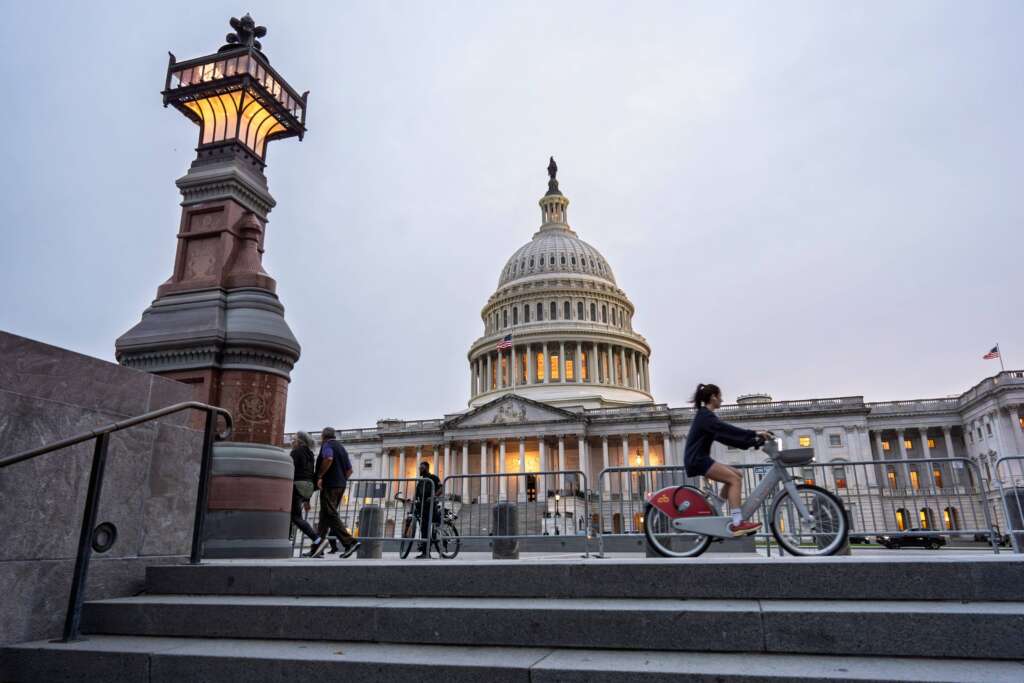
The Capitol is seen at dusk as Democrats and Republicans in Congress are angrily blaming each other and refusing to budge from their positions on funding the government, in Washington, Tuesday, Sept. 30, 2025. (AP Photo/J. Scott Applewhite)

Immigration courts understaffed and overwhelmed, as Trump administration surges enforcement hiring

The Trump administration is looking to hire thousands of federal law enforcement personnel, as part of expanded immigration enforcement efforts.

But the courts handling these cases aren’t seeing the same surge in resources. Several immigration judges recently fired by the Justice Department say the court system is losing staff, and is unable to address a multi-million case backlog.

Immigration and Customs Enforcement has intensified operations across the country, and detention facilities are full of individuals waiting for their cases to be heard.

The One Big, Beautiful Bill Act passed this summer gave the Department of Homeland Security billions of dollars to hire 10,000 new ICE agents, as well as 5,000 customs officers and 3,000 Border Patrol agents.

The legislation bill also authorized DOJ to hire about 100 new immigration judges, bringing their total headcount to about 800 nationwide.

But the total number of immigration judges is dwindling under the Trump administration, according to data tracked by the International Federation of Professional and Technical Engineers and its affiliate, the National Association of Immigration Judges.

According to the unions, the total number of immigration judges this year has dropped from 700 to 600. The Trump administration terminated more than 80 immigration judges since taking office, while others have retired or accepted voluntary separation incentives.

Recently terminated immigration judges say their colleagues still on the job don’t have the resources needed to address a backlog of about 3.4 million cases.

Before he was fired in September, Ted Doolittle, a former immigration judge at the immigration court in Hartford, Connecticut, was one of two judges handling about 46,000 cases.

Doolittle said he received his termination email one afternoon, as he was preparing for a docket of 57 cases the next day.

“The caseload is crushing. I think it’s probably one of the most overburdened court systems,” Doolittle said Thursday at an event at the National Press Club.

In order for the Justice Department to meaningfully address the backlog, Doolittle said the department needs about 2,000 or 3,000 immigration judges — not the few hundred currently working.

“That’s what’s going away, is the right of these people to have their cases heard fairly,” he said.

Emmett Soper, a former immigration judge in Virginia, who was fired in August after serving nine years on the job, said the widespread terminations are leading to a “chaotic situation,” where courts are scrambling to reassign cases to remaining judges.

“Each immigration judge is responsible for hundreds or thousands of these cases, and every time the administration unlawfully fires an immigration judge, they’re no longer there. Their cases have to be redistributed to the judges who remain at the court,” Soper said. “This is not a fair way to run a court system.”

Anam Petit, former immigration judge in Virginia, who was fired in September, said judges are hearing, at a minimum, 25 cases a day — sometimes 50 or more cases — in multiple languages.

“You can have a docket with five different languages,” she said.

Matt Biggs, president of the International Federation of Professional and Technical Engineers, said that the “lion’s share” of firings have been targeted at immigration judges who were hired during the Biden administration.

“Immigrants in this country are entitled to due process, and by firing these judges, you’re denying them their due process,” Biggs said.

To address the backlog, DOJ is training hundreds of military lawyers to temporarily serve as immigration judges. But Biggs said most of these don’t have a background in immigration law.

“We appreciate their service to our nation, and it’s no disrespect to them, but they should not be in these positions,” he said.

Federal News Network reached out to DOJ and DHS for comment.

The former judges said defendants are also failing to show up for court dates this year, because they are afraid of being detained by ICE agents afterward. Petit said that it was a “daily occurrence” for defendants in her courtroom.

“It has a huge chilling effect,” she said. “People are afraid to come to court because they’re seeing people get detained in the hallways.”

Defendants who don’t appear for their court date automatically receive a removal order, and have no legal avenue to appeal that decision.

Doolittle said ICE agents prefer making arrests in courthouses, because individuals have gone through security and been screened for weapons. He recalled that toward the end of his tenure, ICE agents repeatedly tased a suspect in the court’s lobby before bringing him into custody.

“Many of the court staff lost sleep — like physically, weren’t able to sleep for a period afterwards. And of course, it makes them question whether that’s a job they want to continue,” he said.

The post Immigration courts understaffed and overwhelmed, as Trump administration surges enforcement hiring first appeared on Federal News Network.

© The Associated Press

FILE - A U.S. Immigration and Customs Enforcement agent is seen in Park Ridge, Ill., Sept. 19, 2025. (AP Photo/Erin Hooley, File)

Post-shutdown, here’s how soon federal employees can expect back pay

Following the longest shutdown in U.S. history, the federal workforce is now trying to get back to at least some sense of normalcy.

While federal employees who have been furloughed for the last 43 days return to work Thursday, the Office of Personnel Management is setting expectations for agencies as they begin to update pay, leave and benefits for those impacted by the lapse in appropriations.

In new guidance, OPM said it is “is committed to ensuring that retroactive pay is provided as soon as possible.” Compensation will be provided for both furloughed and excepted federal employees, as the spending agreement that was enacted Wednesday evening reaffirmed. A 2019 law previously called for retroactive compensation for all federal employees impacted by a shutdown.

A senior Trump administration official said the White House “has urged agencies to get employee paychecks out expeditiously and accurately to not leave anyone waiting longer than necessary.”

But the timing of employees receiving their back pay varies, depending on what payroll provider an agency uses, and the different pay schedules across the federal workforce.

Sending out retroactive payments to employees involves working across agency HR offices, federal payroll providers and shared service centers. Agency HR offices, for instance, have to submit timecards for federal employees, which are then processed by the government’s various payroll providers.

According to the senior administration official, employees from the General Services Administration and OPM will be among the first to receive their retroactive paychecks, with an expected deposit date set for Saturday.

Employees at the departments of Veterans Affairs, Energy, and Health and Human Services, as well as civilian employees from the Defense Department, will receive their deposits shortly after that — this Sunday.

On Monday, affected employees from the departments of Education, State, Interior and Transportation, as well as the Environmental Protection Agency, National Science Foundation, Nuclear Regulatory Commission, Social Security Administration and NASA, are all expected to receive their back pay.

Then on Wednesday, employees from the departments of Agriculture, Commerce, Treasury, Labor and Justice, along with the Department of Homeland Security, the Department of Housing and Urban Development and the Small Business Administration, are projected to get their paychecks. The timing of the retroactive payments for feds was first reported by Semafor.

The National Finance Center, a payroll provider housed under the Agriculture Department, confirmed that employees at agencies using NFC’s services should expect a payroll deposit by the middle of next week.

“In order to provide backpay for employees as quickly as possible, the National Finance Center will be expediting pay processing for pay period 22 and backpay for pay periods 19 (October 1-4), 20 (October 5-18), and 21 (October 19-November 1),” USDA wrote in an all-staff email Wednesday evening, obtained by Federal News Network.

Federal News Network has reached out to several other federal payroll providers requesting details on the timeline for processing retroactive payments.

The National Treasury Employees Union urged immediate back pay for all federal employees who have been going without compensation for the last six weeks.

“This is an emergency for federal employees across the country, and they should not have to wait another minute longer for the paychecks they lost during the longest government shutdown in history,” NTEU National President Doreen Greenwald said. “We call on all federal agencies to process the back pay immediately.”

In its new guidance, OPM also noted that to make payments as quickly as possible, payroll providers may need to “make some adjustments.” That could mean, for instance, that the initial retroactive payments employees receive might not reflect the exact calculations of their pay and leave hours.

“Payroll providers will work with agencies to make any necessary adjustments as soon as practicable,” OPM said.

Who receives back pay, and how much?

Furloughed employees will receive their “standard rate of pay” for the hours they would have worked if the government shutdown hadn’t occurred, OPM said in its guidance Wednesday evening.

But there are some exceptions to that. If a furloughed employee, for example, had been scheduled for overtime hours that would have occurred during the shutdown, OPM said they should be paid their premium rate for those hours.

Additionally, OPM said that allowances, differentials and other types of payments, like administratively uncontrollable overtime pay or law enforcement availability pay, should be paid as if the furloughed employee continued to work.

Although most employees impacted by the shutdown are ensured back pay, there are some smaller exceptions carved out where employees may not receive retroactive pay, OPM added.

If a furloughed employee was in a non-pay status before the shutdown began, for instance, then they are not entitled to receive back pay.

Excepted employees who were considered “absent without leave” (AWOL) — or in other words, took unapproved time off — will also not receive back pay for that time.

Guidance on leave, post-shutdown

Although excepted employees are not required to use paid leave for taking time off during the shutdown — and can instead enter a “furlough” period — there may still have been some instances where excepted employees took leave during the funding lapse, OPM wrote in its guidance.

In those cases, excepted employees who were approved to take paid leave during the shutdown will be charged for the hours from their leave bank, OPM said.

Agencies are also expected to begin adjusting leave accrual for furloughed employees. Now that the shutdown is over, furloughed employees should be placed in a “pay status” for the time they would have otherwise spent working during the funding lapse. That means accrual of annual and sick leave will be retroactively adjusted as if the employees were in a pay status, OPM said.

Excepted employees continued to accrue leave during the shutdown, which should be reflected in their leave banks, OPM said.

What happens to RIFs of federal employees?

On top of reaffirming back pay, the spending bill that was enacted Wednesday evening also rescinds the roughly 4,000 reductions in force that have occurred since Oct. 1. Federal employees will be temporarily protected from additional RIFs, at least until the end of January.

Agencies have five days to inform federal employees who received RIF notices in October that those actions are rescinded.

“Agencies should issue those notices and confirm to OPM the rescissions have been issued,” OPM’s guidance states.

At least 670,000 federal employees have been furloughed, and 730,000 employees have been working without pay during the shutdown. Agencies have been putting plans in the works to return all furloughed federal employees to their duties as of Thursday.

OPM also said agencies “may consider” providing flexibility for employees who might not be able to return to work immediately, such as by approving personal leave or adjusting individual work schedules.

The post Post-shutdown, here’s how soon federal employees can expect back pay first appeared on Federal News Network.

© AP Photo/Mark Schiefelbein

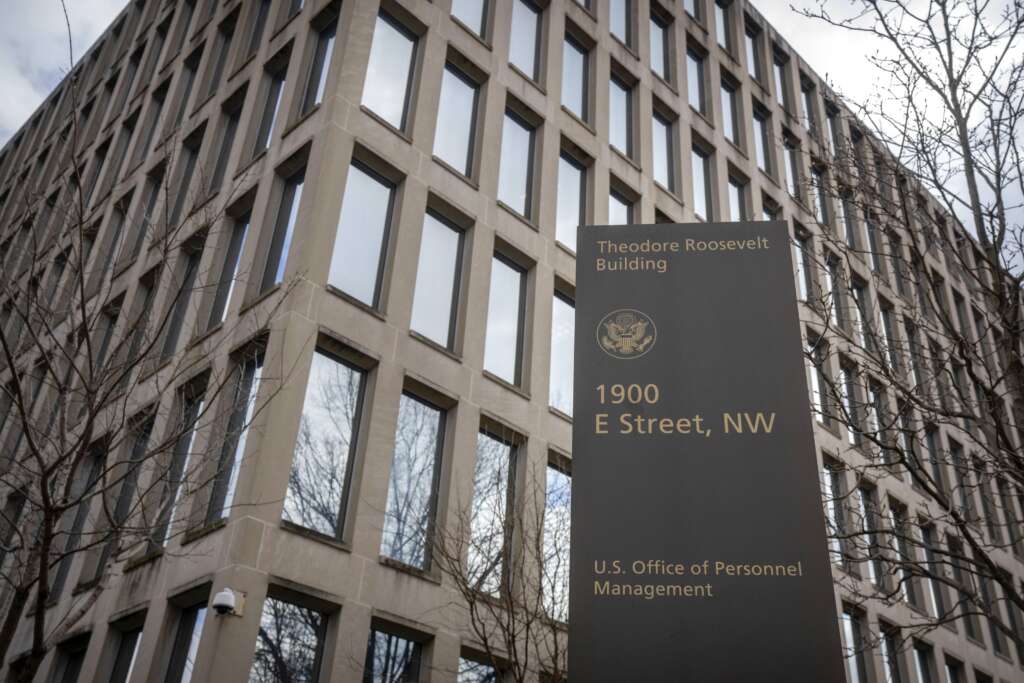
The Theodore Roosevelt Building, location of the U.S. Office of Personnel Management, on Tuesday, Feb. 13, 2024, in Washington. Former President Donald Trump has plans to radically reshape the federal government if he returns to the White House, from promising to deport millions of immigrants in the U.S. illegally to firing tens of thousands of government workers. (AP Photo/Mark Schiefelbein)

Bitzlato Exchange Busted as US Deals ‘Blow to Crypto Crime,’ Arrests Owner

Bitzlato Exchange Busted as US Deals ‘Blow to Crypto Crime,’ Arrests Owner

Cryptocurrency exchange Bitzlato, better known to the Russian-speaking segment of the market, has been taken down as part of an “international cryptocurrency enforcement action,” the U.S. Justice Department announced. The Russian owner of the platform has been arrested for his role in the alleged transmission of illicit money. Bitzlato claimed it was hacked.

US, France Hit Cryptocurrency Exchange Bitzlato, Russian Co-founder Detained in Miami

U.S. authorities have apprehended Anatoly Legkodymov, a resident of China, on charges that his Hong Kong-registered crypto trading platform, Bitzlato, processed illicit funds worth hundreds of millions of dollars. The Russian, a co-founder and majority owner of the exchange, was arrested by the FBI in Miami on Tuesday, a high-ranking official from the United States Department of Justice (DOJ) revealed.

Speaking during a press conference, Deputy Attorney General Lisa Monaco said that Justice Department agents and prosecutors, working with the U.S. Treasury Department and French law enforcement, have “disrupted Bitzlato, a China-based cryptocurrency exchange, notorious for laundering criminal proceeds from the darknet” and ransomware attacks. She also stated:

Today, the Department of Justice has dealt a significant blow to the crypto crime ecosystem.

Legkodymov is accused of operating the exchange as a “high-tech financial hub that, in his own words, catered to ‘known crooks’,” Monaco explained. She went on to allege that Bitzlato was a “crucial financial resource” for Hydra, the largest darknet market, with Russian roots, which was shut down in April, last year, by the German police with the support of U.S. agencies.

According to the DOJ, Hydra buyers funded illicit purchases from crypto accounts hosted at Bitzlato while sellers of drugs, stolen financial information and hacking tools sent criminal proceeds to accounts at the exchange, collectively amounting to $700 million in direct and indirect transfers between 2018 and 2022.

The deputy attorney general also said that the participants in the operation have engaged in a “coordinated campaign of disruption.” This included law enforcement actions in a number of European countries and the seizure of Bitzlato’s servers. By midday Wednesday, Bitzlato’s website was replaced by a notice saying that the service had been seized by French authorities, Reuters reported.

Crypto Exchange Bitzlato Claims It Was Hacked, Halts Withdrawals

Also on Wednesday, the operators of Bitzlato announced on Telegram, that the exchange had suffered a hacking attack. They told users that withdrawals had been suspended indefinitely and asked them to refrain from sending coins to the platform until the issue is resolved.

“Our service was hacked, part of the funds was withdrawn from the service,” the exchange said, noting that the attackers were able to steal a small portion of the funds without specifying the amount. It also sought to assure customers in a second message that their assets were not lost, stating:

For all victims, we guarantee a refund.

“As a security measure, we have disabled the service, we ask you not to replenish the wallets of our service until the work is restored,” Bitzlato reiterated, adding that its team was working on the problem. At the time of writing, the platform is still offline.

The hack presumably took place after on Tuesday the exchange announced maintenance scheduled for Thursday, Jan. 19, “aimed at improving the operation of the service and its security.” The notice informed users it will halt transactions between 5 and 9 a.m. Moscow time.

“We strongly recommend that you organize your work activities taking into account the amendments in order to avoid unpleasant situations,” the platform advised customers, informing them that it plans to disable deposits, withdrawals and trading.

Bitzlato launched in 2016 under the name Changebot and later became a cryptocurrency exchange offering peer-to-peer (P2P) trading services. It lists pairs of the Russian ruble with BTC, ETH, USDT, and other digital coins which can be bought and sold with a variety of payment methods.

Online crypto exchangers like Bitzlato are popular in Russia and the former Soviet space but as crypto assets are yet to be fully regulated in the region, they are often targeted by authorities across the Commonwealth of Independent States. A report recently revealed that the Belarusian judiciary has imposed a hefty fine on the operator of one such platform.

Do you expect other similar operations against crypto trading platforms in the near future? Share your thoughts on the subject in the comments section below.

❌