Reading view

There are new articles available, click to refresh the page.

A Constitutional Clash Over Trump’s War Powers in Venezuela

OPINION — “The question before the body is, can the Congress stop a military conflict declared by the Commander-in- Chief because we don’t agree with the decision, and without our [Congress] approval it must end? The answer, unequivocally, to me is no. Under the Constitution, the authority to be Commander-in-Chief resides exclusively with the President. The power to declare war is exclusive to the Congress. Now, what could the Congress do constitutionally if they disagree with a military action that is not a declaration of war? We could cut off funding.”

That was Sen. Lindsey Graham (R-S.C.) speaking on the Senate floor on the afternoon of November 6, when debate was to begin on S.J. Res. 90, legislation that was “to direct the President to terminate the use of U.S. Armed Forces for hostilities within or against Venezuela, unless explicitly authorized by a declaration of war or specific authorization for use of military force.”

Graham’s remark that Congress could cut off funds to halt a President ordered foreign military action took me back 56 years to December 1969, when I was working for Sen. J.W. Fulbright (D-Ark.), then chairman of the Senate Foreign Relations Committee. I had in late 1969 been to Laos where the Nixon administration was carrying out a secret bombing campaign in an attempt to limit weapons going from North Vietnam to pro-Communists in South Vietnam.

To halt the at-the-time classified Laos bombing program, Fulbright introduced an amendment to the fiscal 1970 Defense Appropriations Bill that prohibited the use of U.S. funds to send American ground combat troops into Laos or Thailand. To get his amendment debated and passed, Fulbright had to arrange for a closed-session of the Senate.

That closed session was held on December 16, 1969, with all 100 Senators present, a handful of staff – including me – but no one in the public galleries and no reporters in the press gallery. After a 90-minute debate, the amendment passed. The House accepted the amendment in conference and it was signed into law by President Nixon on December 29, 1969.

Fulbright’s purpose was to assert Congress’ Constitutional role when it came to a prospective military operation amid his concern that the Nixon administration was expanding the Vietnam War into neighboring countries without consulting Congress.

I describe that long-past activity to explain my continuing apprehension over today’s possible Trump administration military action against Venezuela. The Trump administration has already introduced deadly military operations against alleged narco-traffickers working from a secret list of drug cartels using a classified Justice Department Office of Legal Counsel opinion which claims the drugs are to kill Americans and finance arms to terrorists who will destabilize the U.S. and other Western Hemisphere countries.

Last Thursday and Friday, President Trump met in the Oval Office to discuss a host of options for Venezuela with Vice President JD Vance, Defense Secretary Pete Hegseth, Joint Chiefs Chairman Gen. Dan Caine, Secretary of State Marco Rubio and Deputy Chief of Staff Stephen Miller.

Friday night, in remarks to reporters aboard Air Force One as he traveled for the weekend to his Mar-a-Lago estate, the President said he had “sort of made up my mind” about how he will proceed with the possibility of military action in Venezuela. On Sunday, flying home, Trump told reporters the U.S. “may be having some discussions with [Venezuelan President Nicolas] Maduro,” adding that “they [the Venezuelans] would like to talk.”

Although he swings back and forth, it appears clear from President Trump’s point of view, he need not consult with Congress should he decide on any military action that targets the Venezuelan mainland. As Sen. Graham pointed out, “We have only declared war five times in 250 years, and we have had hundreds of military operations -- some authorized and some not.”

Need a daily dose of reality on national and global security issues? Subscriber to The Cipher Brief’s Nightcap newsletter, delivering expert insights on today’s events – right to your inbox. Sign up for free today.

Opening the Senate debate on November 6, Sen. Tim Kaine (D-Va.), a key sponsor of the congressional resolution, pointed out, “On October 31, public reporting shows that many Trump administration officials have told the press that a secret list of targets in Venezuela has been drawn up. All of this, together with the increased pace of strikes in the Caribbean and Pacific [21 attacks on alleged narco-trafficking boats, 83 individuals killed], suggests that we are on the verge of something that should not happen without a debate and vote in Congress before the American people.”

On November 6, after a relatively short debate, the Senate resolution to block the use of U.S. armed forces against Venezuela was defeated by a 49-to-51 vote.

But during that debate some important points were made, and they need some public exposure.

For example, Sen. Tammy Duckworth (D-Ill.), a military veteran herself, said, “Listen, if the Trump administration actually believes there is an ongoing credible threat of armed conflict, then they must bring their case to Congress and give the American people a say through their elected representatives. They must respect our service members enough to prove why war is worth turning more moms and dads into Gold Star parents. And they must testify about what the end state of these military operations would actually look like.”

Sen. Adam Schiff (D-Calif.) said, “Maduro is a murderous dictator. He is an illegitimate leader in having overturned the last election by the use of military force. He is a bad actor. But I do not believe the American people want to go to war to topple this regime in the hopes that something better might follow… Let them [the Trump administration] seek an authorization to use force to get rid of Maduro. But let us not abdicate our responsibility. Let us vote to say no to war without our approval. We don’t have to wait, nor should we wait for that war to begin before we vote.”

Sen. Rand Paul (R-Ky.) pointed out, “Of course, we have the capability of overthrowing the Maduro regime, just like we had the power to overthrow Saddam Hussein and Muammar Qadhafi. But what comes next? Is anyone thinking about the potential blowback that such a campaign could entail? Overthrowing the Maduro regime risks creating more regional instability, not less. The breakdown of state authority may create a power vacuum that the very drug cartels the administration is ostensibly trying to destroy could exploit.”

The Cipher Brief brings expert-level context to national and global security stories. It’s never been more important to understand what’s happening in the world. Upgrade your access to exclusive content by becoming a subscriber.

“You cannot bomb your way out of a drug crisis,” said Sen. Jack Reed (D-R.I.), ranking member on the Senate Armed Services Committee. “The demand that motivates drug trafficking is not found in the Caribbean. It is located in communities across America where people are suffering from addiction, where economic opportunity has dried up, where the social fabric has frayed. Military strikes do nothing to address those root causes. Boats have been blown out of the water in videos released by the administration. But has the flow of fentanyl into America decreased? Has a single trafficking network been dismantled? The administration hasn’t provided any evidence that these strikes are achieving anything beyond the destruction they document on camera. This is not a strategy. This is violence without a strategic objective.”

Sen. Reed also pointed out how the Trump administration is expanding its war powers. “The White House is apparently now arguing that these strikes [on alleged narco-boats] don’t constitute ‘hostilities’ under the War Powers Act because American service members aren’t directly in harm’s way while operating standoff weapons and drones. This is ridiculous…They are very much in harm’s way, and to say that this operation is so safe that it doesn’t qualify as ‘hostilities’ is embarrassing…This new interpretation creates a dangerous precedent. If standoff weapons exempt military operations from congressional oversight, we have effectively granted the Executive Branch unlimited authority to wage war anywhere in the world so long as American forces can strike from a distance.”

Taking a different approach, Sen. Chris Van Hollen (D-Md.) pointed out an irony in Trump’s anti-drug argument. Van Hollen said, “I will tell you what you don’t do. You don’t submit a budget to the U.S. Congress that cuts the funding for the Drug Enforcement Agency and cuts funding for the task forces we developed to go after major organized crime syndicates involved in the drug business.” He added, “I happen to be the ranking member of the Appropriations Committee that oversees the Justice Department. And all my colleagues have to do is take a look at the request from the President of the United States when it comes to resources for fighting drugs coming to the United States. They cut them.”

Raising an additional problem, Sen. Andy Kim (D-N.J.) said, “Letting Donald Trump ignore the law abroad makes him think he has a free pass to do it right here at home. Donald Trump thinks if he can do this in the Caribbean, he can do it on the streets of Chicago. He could use the military for his own political retribution and consolidation of power in and outside our borders. After all, he [Trump] said in his own words: ‘We’re under invasion from within, no different than a foreign enemy but more difficult in many ways because they don’t wear uniforms.’ That is what the President said. We cannot be complacent as he sends troops into our cities as a tool of intimidation against his political enemies.”

While we await President Trump’s decision on what comes next, let me close with another ironic situation, created last Wednesday by Secretary of Homeland Security Kristi Noem.

Giving the keynote address at the Potomac Officers Club’s 2025 Homeland Security Summit, Noem celebrated recent successes in the counter-drug mission. She said that since January, the Coast Guard has stopped 91 metric tons of drugs, confiscated 1,067 weapons and seized more than $3.2 million in cash from terrorist cartels, thanks primarily due to Operation Pacific Viper, which Noem said is strategically designed to seize historic amounts of drugs from smugglers in the eastern Pacific. “Viper has saved millions of lives of individuals and Americans by stopping those drugs before they ever got to the U.S.,” Noem said.

Operation Pacific Viper, according to a Coast Guard press release, also resulted in the arrest of 86 alleged narco-traffickers as of October 15. A needed reminder: Viper was an interdiction program where narco-traffickers were intercepted, arrested and drugs seized – not boats blown up and people killed.

The Cipher Brief is committed to publishing a range of perspectives on national security issues submitted by deeply experienced national security professionals.

Opinions expressed are those of the author and do not represent the views or opinions of The Cipher Brief.

Have a perspective to share based on your experience in the national security field? Send it to Editor@thecipherbrief.com for publication consideration.

Read more expert-driven national security insights, perspective and analysis in The Cipher Brief
Understanding the U.S. Military Mobilization in the Caribbean


OPINION / EXPERT PERSPECTIVE — The armada the U.S. has assembled in the Caribbean is more formidable than anything the region has seen in decades. What is going on? The administration says it is targeting drug trafficking through the Caribbean. Is that it? Is that really all we are doing? Trump administration officials insist that it is but also acknowledge that strikes on land targets may be necessary to achieve the administration’s goals. Skeptics suggest that regime change in Venezuela is part of the administration’s plan. Is it?

Early in 2025, shortly after taking office, the Trump administration designated several drug cartels as terrorist organizations. This signaled the administration’s intention to escalate U.S. efforts to fight trafficking beyond the usual efforts of the Coast Guard, Drug Enforcement Administration and Border Patrol. It also presaged the use of the military.

Combating narco-trafficking remains the administration’s declared purpose. Implicitly, the decision to escalate U.S. efforts is based on several key points. First, drug abuse in the United States remains at epidemic levels despite decades of efforts to control it. Second, previous efforts to suppress drug smuggling into the U.S. have not been successful. Third, because the cartels smuggling drugs into the U.S. are not merely drug traffickers but large terrorist organizations, they need to be confronted as forcefully as terrorist groups elsewhere. This, effectively, means employing military force.

The administration contends that Venezuela is the country from which much of the illicit boat and air traffic carrying cocaine emanates and that Venezuela’s long-time strong man is really the head of a cartel and “a fugitive from American justice.” On August 7, the administration announced a 50-million-dollar bounty on Venezuela’s long-time strong man, Nicolas Maduro. It is this view of the Venezuelan regime and its leader, in combination with the size and capabilities of the deployed U.S. military in the Caribbean, that suggests the administration’s goals are more ambitious than just striking alleged traffickers on the high seas.

The question then is, how would the Trump administration define regime change? New leadership or something more extensive? If regime change is a goal, how does the administration hope to achieve that result? Would a combination of intimidation, enhanced economic sanctions and diplomatic pressure from the world’s democratic community convince Maduro to abandon power? Can the Venezuelan military, which in 2002 temporarily removed Maduro’s mentor, Hugo Chavez, be persuaded to act once again? Or is the U.S. administration contemplating military strikes inside of Venezuela? If so, how extensively? Would a targeted attack of regime leadership result in regime change or would the U.S. need to hit various elements of the military plus drug labs? The scope of any U.S. kinetic actions would likely affect the way Venezuelans – who overwhelmingly rejected Maduro in last year’s presidential election, react. It would also affect how the region and the rest of the world regard the U.S. campaign.

If the U.S. were able to oust Maduro what would follow? There is a legitimate government in waiting. Former diplomat Edmundo Gonzalez won last year’s presidential election by a huge margin despite regime efforts to sabotage the democratic opposition. Would anything short of the installation of the democratic opposition be considered an acceptable outcome to Venezuelans or the United States? Would a government of national unity which included some of the Venezuelan dictator’s base and elements of the military be acceptable to the democratic opposition? To the U.S? The Venezuelan military has been deeply compromised by the Maduro regime’s criminal activity and is believed to be complicit at the highest levels in drug trafficking. The Cartel de los Soles is thought to include many high-ranking military personnel. Would the U.S.be prepared to put troops on the ground to prevent criminal elements of the Venezuelan military from regrouping even if current regime leadership were forced out?

Finally, what effect will current U.S. operations in the Caribbean have on U.S. relations with the rest of Western Hemisphere especially if U.S. military strikes Venezuela directly? What effect have U.S. operations already had? The answers to these questions are not all obvious.

The Cipher Brief brings expert-level context to national and global security stories. It’s never been more important to understand what’s happening in the world. Upgrade your access to exclusive content by becoming a subscriber.

The Trump team has never mentioned regime change as a campaign goal. The size and nature of the deployed U.S. forces, however, make speculation on the U.S. administration’s real intentions inevitable. The number of ships, aircraft, sailors and marines appeared to be substantially greater than required to combat narcotrafficking through the Caribbean and eastern pacific even before the ordered deployment of the U.S.’s most advanced aircraft carrier, the USS Gerald R Ford. The messaging from Washington, moreover, focuses squarely on the Venezuelan regime.

What we have been hearing from Washington about operations in the Caribbean is a logical extension of steps taken by the Trump administration prior to the start of current operations. While President Obama first called Venezuela a threat to national security in 2015, it was only earlier this year that the U.S. designated the cartels as terrorist organizations. The designation of the cartels as terrorists was a necessary step to operationalize the shift from a law enforcement effort to a military one.

The new militarized U.S. strategy in the Caribbean has had an effect. Drug trafficking by sea is apparently way down. That said, this new strategy has not diminished trafficking by land nor reduced the flow of deadly fentanyl into the country. It has, on the other hand, generated concern in some countries about the return of American gunboat diplomacy. Domestically, the president’s new approach resonates well in some quarters but has incensed many Democrats in the U.S. Congress and even worried some Republicans. British concern about the legality of the U.S. strikes on the high seas is now so acute that the United Kingdom has ended intelligence sharing on Venezuela. The Trump administration has, however, given no indication that either international concern or congressional criticism will precipitate a change in policy.

President Trump’s change of the U.S strategy for fighting the cartels and maybe for achieving regime change in Venezuela has important implications for U.S. relations with its allies everywhere but especially within the region. The Trump administration has clearly made the Western Hemisphere a national security priority but there are many other vitally important arenas in which U.S. interests are affected by developments in this hemisphere – both positively and negatively.

Accordingly, the administration’s agenda in Latin America must include more than just winning the drug fight and controlling our Southern border. More than 40% of all U.S. manufacturing goods are sold into the Western Hemisphere and the U.S. has a positive trade balance with many countries in the region, including Brazil, Chile, Peru, Panama and others. Millions of American jobs depend on trade with the region. Energy production in the region is also significant; Canada is our largest foreign supplier but there are other key players including Mexico, Brazil, Colombia, Ecuador, Trinity and Tobago and, more recently, Guyana. Guyana’s oil production, in fact, is exploding. The country’s GDP grew by over 25% in 2023 and by more than 30% in 2024. On the other hand, China’s influence continues to surge and China is now the largest trading partner for South America in the aggregate. The U.S. clearly needs to do what it can to strengthen the value proposition for the countries of Central and South American to see the U.S. as their commercial partner of choice.

Are you Subscribed to The Cipher Brief’s Digital Channel on YouTube? There is no better place to get clear perspectives from deeply experienced national security experts.

It is, at this point, not clear what the Trump administration’s end game is in the Caribbean. What is clear is that the U.S. cannot ignore other issues around the region or other views on how challenges should be met. Neither should we naively assume that success in suppressing the trafficking of cocaine out of South America is assured even temporarily, however many go-fast boats the U.S. military sinks. Transit by land, which the Trump administration has indicated it may take on next, is still robust. Demand for illegal drugs is still strong in the U.S. and Europe. The U.S. has recently made progress in engaging Mexico, especially on combating the Mexican cartels, but how effective joint efforts will be remains to be seen. Relations with Colombia, the source of most of the world’s cocaine, on the other hand, have deteriorated dramatically. Colombian President Gustavo Petro has characterized U.S. attacks on the drug boats as atrocities, called President Trump a criminal and encouraged American military personnel to defy his orders. The U.S., for its part, has decertified Colombia for failing to cooperate fully with U.S. counternarcotics efforts and cancelled Petro’s visa.

The U.S. still has partners in Latin America, especially trade partners, but there is also, always, concern over U.S. unilateralism. Moreover, President Trump’s announcement that he has authorized the Central Intelligence Agency to become active in Venezuela inevitably recalls for some an earlier and darker time in U.S. relations with Latin America. That said, criticism of U.S. operations in the region has been surprisingly muted – and some countries have been explicitly supportive.

Still, many in the region have been left wondering where multilateral cooperation, diplomacy, democracy support and human rights, pillars of U.S.-Latin American policy since at least the 1980s, fit in America’s new more muscular policy toward the region. At the same time, most of the region agrees that the cartels are a grievous problem, and recognize that Venezuela is a dictatorship and that it has become an epicenter for a great deal of the most pernicious activity in the region. I expect they are dubious about the likelihood of the U.S. eradicating all drug trafficking from South America because so much of the trafficking is by land. They are also unconvinced that combatting drug trafficking per se is the U.S.’s only goal. They do not wish to see a war in either South or Central America but they are also profoundly tired of living with the consequences of the growing and corrosive power of the cartels.

The Trump administration’s campaign to date has had some success and may have put Russia, China and Iran – Venezuela’s extra-regional allies -- on notice that the U.S. has decided to counter malign activity and actors in the region forcefully. But this is a high stakes game for the U.S. A U.S. escalation to ground operations could catalyze world-wide criticism of the U.S. Success with targeted strikes is not assured. At present, we are left to wrestle with the question of whether the campaign to date is a preamble to even more ambitious operations. And, can what has been accomplished to date be sustained at a time when coca cultivation in source countries like Peru and Colombia is increasing and the head of a cartel – which is how the administration has characterized Maduro – remains in control of the government of Venezuela?

Read more expert-driven national security insights, perspective and analysis in The Cipher Brief because National Security is Everyone’s Business.

The U.S. Coast Guard’s Quiet Drug War Wins Amid Trump’s Caribbean Strikes

OPINION / FINE PRINT — “The U.S. Coast Guard announced [last] Tuesday it has seized more than 100,000 pounds of cocaine in the eastern Pacific Ocean since launching Operation Pacific Viper in early August, averaging over 1,600 pounds interdicted daily. These drug seizures, and the apprehension of 86 individuals suspected of narco-trafficking, were the result of 34 interdictions since early August. Through Operation Pacific Viper, the Coast Guard is accelerating counter-drug operations in the eastern Pacific Ocean, where significant transport of illicit narcotics continues from Central and South America. In coordination with international and interagency partners, the Coast Guard is surging additional assets — cutters, aircraft and tactical teams — to interdict, seize and disrupt transshipments of cocaine and other bulk illicit drugs.”

That’s the beginning of a U.S. Coast Guard press statement released last Tuesday, which has gotten little national publicity.

I publish it, and more about Operation Pacific Viper, because until last week I had no knowledge of this successful Coast Guard operation. It’s important, because one day later, in the Oval Office last Wednesday, President Trump was asked by a reporter why he had not used the Coast Guard to stop alleged Venezuelan narco-boats rather than having – at that time -- at least five of them blown up causing the deaths of 27 individuals. A sixth narco-vessel was destroyed last Friday killing three more individuals.

Last Wednesday, Trump replied, “We've been doing that [using Coast Guard interdiction] for 30 years and it has been totally ineffective.” Trump went on: “They [the Venezuelan narco-traffickers] have faster boats. Some of these boats are seriously, I mean they're world-class speedboats, but they're not faster than missiles.”

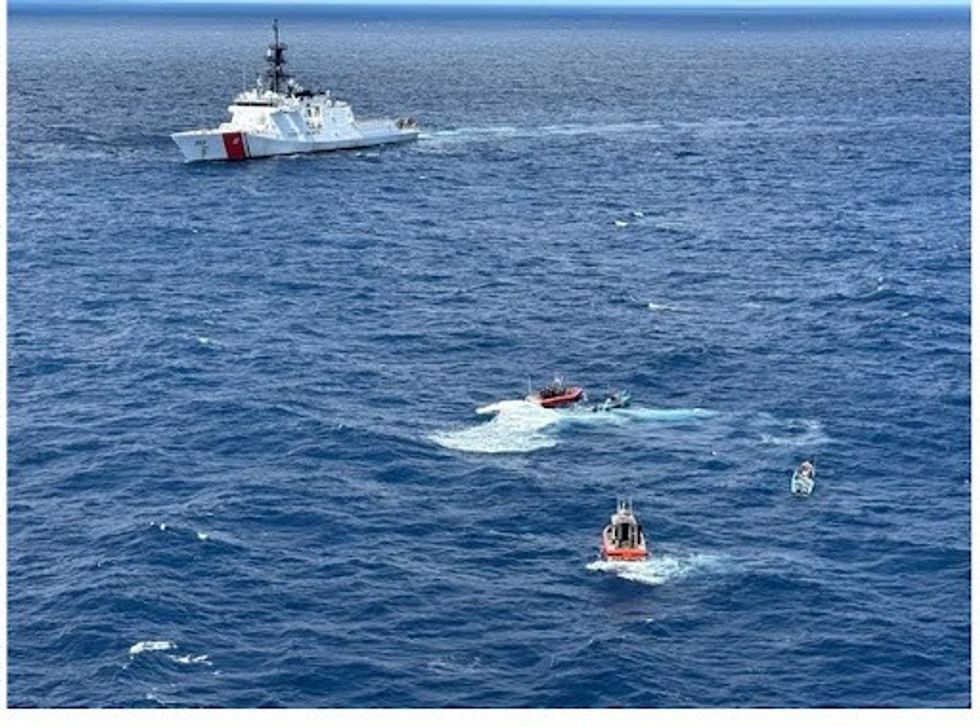
Apparently, the “world-class speedboats” have not affected the Coast Guard interdiction activities in the eastern Pacific. Below is a Coast Guard-released photo of Coast Guard Cutter USS Hamilton with its two boarding teams out interdicting two go-fast speedboats suspected of drug smuggling. It was taken June 26, 2025, southeast of the Galapagos Islands, Ecuador.

As last Tuesday’s Coast Guard press release explained, “Detecting and interdicting narco-terrorism on the high seas involves significant interagency and international coordination. U.S. Southern Command’s (SOUTHCOM’s) Joint Interagency Task Force-South (JIATFS), based in Key West, Florida, detects and monitors both aerial and maritime transit of illegal drugs. Once interdiction becomes imminent, the law enforcement phase of the operation begins, and control of the operation shifts to the U.S. Coast Guard throughout the interdiction and apprehension.”

I should point out that SOUTHCOM’s JIATFS is a Defense Department (DoD) command that uses the capabilities of U.S. intelligence and law enforcement agencies, allies and partner nations to detect, monitor, and support interdiction of illicit narcotics movements in the air and maritime throughout the Western Hemisphere – meaning both the Pacific and Caribbean areas.

Let me emphasize, SOUTHCOM directs what takes place both in the eastern Pacific and the Caribbean areas.

In the case of last June’s narco-trafficker speedboat in the above photo, the boat was initially detected by a U.S. Navy maritime patrol aircraft. Then the Hamilton’s own Helicopter Interdiction Tactical Squadron aircrew took over and provided airborne tactical support. Among their special weapons are helicopter-mounted, long-range rifles that can hit and disable the engines mounted at the rear of narco-trafficker speedboats. The result is the speedboats in the eastern Pacific are being halted, the crews arrested, and seizure of more than 4,475 pounds of cocaine, according to the Coast Guard.

In the Caribbean, the U.S. has Coast Guard cutters similar to the Hamilton, but also other U.S. Navy vessels that I believe would have permitted seizure of the five speedboats that instead were blown up. While the first Caribbean-located speedboat destroyed September 1, was moving, perhaps heading back to where it came from, videos of the next four that were destroyed showed they were not moving in the water before they were struck and exploded.

Why had those four stopped?

The Cipher Brief brings expert-level context to national and global security stories. It’s never been more important to understand what’s happening in the world. Upgrade your access to exclusive content by becoming a subscriber.

Last Thursday, Defense Secretary Hegseth announced a sixth strike, this time against a slow-moving semi-submersible submarine-type boat used by narco-traffickers in both the Caribbean and eastern Pacific.

On Friday, in an Oval Office press availability, President Trump said, “We attacked a submarine, and that was a drug-carrying submarine built specifically for the transportation of massive amounts of drugs.” The semi-submersible was destroyed, but while two crew members were killed, two survived.

Here I should note that under Operation Pacific Viper, the Coast Guard has also released recent video showing its personnel capturing a semi-submersible narco-trafficking vessel in the eastern Pacific, arresting its crew and seizing its drugs.

On Friday, President Trump tried to rationalize the Caribbean policy of blowing up narco-trafficking vessels, with no mention that in the eastern Pacific under Operation Pacific Viper similar narco-traffickers are stopped, boarded, crews arrested and drugs seized.

Trump on Friday defended the Caribbean destruction/killing policy saying, “We had tremendous amounts coming in by boats, by very expensive boats. You know, they have a lot of money, very fast, very expensive boats that were pretty big. And the way you look at it is every boat that we knock out, we save 25,000 American lives. So every time you see a boat [destroyed] and you feel badly, you say, ‘Wow, that's rough.’ It is rough. But if you lose three people and save 25,000 people -- these are people that are killing our population. Every boat is saving 25,000 lives.”

On the other hand, Rear Adm. Jeffrey Novak, deputy commander of the Coast Guard Pacific Area, whose Operation Pacific Viper since August has carried out 34 interdictions and arrested 86 suspected narco-traffickers, said last Tuesday, “Our maritime fighting force is scouring drug smuggling routes in the eastern Pacific and dismantling narco-terrorist networks. We are complementing the Coast Guard’s unique law enforcement authorities with cutting-edge capabilities to stop the flow of deadly drugs that threaten U.S. communities.”

Why a killing policy in the Caribbean and an interdiction policy in the eastern Pacific?

Need a daily dose of reality on national and global security issues? Subscriber to The Cipher Brief’s Nightcap newsletter, delivering expert insights on today’s events – right to your inbox. Sign up for free today.

On Thursday, the same day that Secretary Hegseth announced the striking of the semi-submersible, Adm. Alvin Holsey, commander of SOUTHCOM, unexpectedly announced he was retiring after less than a year into what normally is a three-to-four year assignment. Holsey gave no reason.

However, The New York Times reported last Thursday that one current and one former U.S. official said Adm. Holsey “had raised concerns about the mission and the attacks on the alleged drug boats.”

The Trump administration has argued that drug cartels are Foreign Terrorist Organizations and Transnational Criminal Organizations and it is the policy of the U.S. “to ensure the total elimination of these organizations’ presence in the United States and their ability to threaten the territory, safety, and security of the United States,” according to an Executive Order signed by President Trump on January 20, 2025.

This has led to the Trump administration’s legal justification for using military force against narco-traffickers in the Caribbean, classifying them as "unlawful combatants." This policy shift has been highly controversial and has triggered debate among lawmakers and legal experts.

Sen. Mark Kelly (D-Ariz.), appearing Sunday on CBS’ Face the Nation, said, “This [Caribbean] operation, which is clearly, traditionally a law enforcement operation, now escalating to something maybe, as the President talks about, regime change. I think this is the wrong move for this President. The Coast Guard has the resources to do this.”

A Navy pilot for more than 20 years who flew 39 combat missions during Desert Storm, and later three space flights as a NASA astronaut, Kelly added, “I do worry about the legal authorities or lack thereof that the United States military has to conduct these kinds of strikes… Those admirals and generals, they need to speak truth to power. I have had conversations with the most senior members of our military about this specific thing. They cannot be breaking the law.”

Kelly went on, “[It] doesn't matter if the President or the Secretary of Defense tells them to do something. If it's against the law, they have to say no. They're not required to follow an unlawful order. So we expect that from them.”

When it came to Adm. Holsey’s surprise retirement, Kelly said, “I don't know the exact circumstances, why the admiral quit. He hasn't said publicly yet. I expect, in time, we're going to find out more.”

Let us hope so, from Adm. Holsey or some other military personnel involved in the Caribbean killing operations.

The Cipher Brief is committed to publishing a range of perspectives on national security issues submitted by deeply experienced national security professionals.

Opinions expressed are those of the author and do not represent the views or opinions of The Cipher Brief.

Have a perspective to share based on your experience in the national security field? Send it to Editor@thecipherbrief.com for publication consideration.

Read more expert-driven national security insights, perspective and analysis in The Cipher Brief
❌