Reading view

There are new articles available, click to refresh the page.

NASA, NOAA Rank 2025 Ozone Hole as 5th Smallest Since 1992

5 min read

NASA, NOAA Rank 2025 Ozone Hole as 5th Smallest Since 1992

While continental in scale, the ozone hole over the Antarctic was small in 2025 compared to previous years and remains on track to recover later this century, NASA and the National Oceanic and Atmospheric Administration (NOAA) reported. The hole this year was the fifth smallest since 1992, the year a landmark international agreement to phase out ozone-depleting chemicals began to take effect.

At the height of this year’s depletion season from Sept. 7 through Oct. 13, the average extent of the ozone hole was about 7.23 million square miles (18.71 million square kilometers) — that’s twice the area of the contiguous United States. The 2025 ozone hole is already breaking up, nearly three weeks earlier than usual during the past decade.

a pole down look at antarctica with a color gradient overlay corresponding to ozone density shows high concentrations over most of the southern ocean and low density over antarctica, that is interspersed with density levels that do not qualify as a
This map shows the size and shape of the ozone hole over the South Pole on the day of its 2025 maximum extent. Moderate ozone losses (orange) are visible amid areas of more potent ozone losses (red). Scientists describe the ozone “hole” as the area in which ozone concentrations drop below the historical threshold of 220 Dobson units.
NASA Earth Observatory image by Lauren Dauphin, using data courtesy of NASA Ozone Watch and GEOS-5 data from the Global Modeling and Assimilation Office at NASA GSFC

The hole reached its greatest one-day extent for the year on Sept. 9 at 8.83 million square miles (22.86 million square kilometers). It was about 30% smaller than the largest hole ever observed, which occurred in 2006, and had an average area of 10.27 million square miles (26.60 million square kilometers).

“As predicted, we’re seeing ozone holes trending smaller in area than they were in the early 2000s,” said Paul Newman, a senior scientist with the University of Maryland, Baltimore County, and leader of the ozone research team at NASA’s Goddard Space Flight Center in Greenbelt, Maryland. “They’re forming later in the season and breaking up earlier. But we still have a long way to go before it recovers to 1980s levels.”

NASA and NOAA scientists say this year’s monitoring showed that controls on ozone-depleting chemical compounds established by the Montreal Protocol and subsequent amendments are driving the gradual recovery of the ozone layer in the stratosphere, which remains on track to recover fully later this century.

The ozone-rich layer acts as a planetary sunscreen that helps shield life from harmful ultraviolet (UV) radiation from the Sun. It is located in the stratosphere, which is found between 7 and 31 miles above the Earth’s surface. Reduced ozone allows more UV rays to reach the surface, resulting in crop damage as well as increased cases of skin cancer and cataracts, among other adverse health impacts.

The ozone depletion process starts when human-made compounds containing chlorine and bromine rise high into the stratosphere miles above Earth’s surface. Freed from their molecular bonds by the more intense UV radiation, the chlorine and bromine-containing molecules then participate in reactions that destroy ozone molecules. Chlorofluorocarbons and other ozone-depleting compounds were once widely used in aerosol sprays, foams, air conditioners, and refrigerators. The chlorine and bromine from these compounds can linger in the atmosphere for decades to centuries.

“Since peaking around the year 2000, levels of ozone-depleting substances in the Antarctic stratosphere have declined by about a third, relative to pre-ozone-hole levels,” said Stephen Montzka, a senior scientist with NOAA’s Global Monitoring Laboratory

As part of the 1987 Montreal Protocol, countries agreed to replace ozone-depleting substances with less harmful alternatives.

“This year’s hole would have been more than one million square miles larger if there was still as much chlorine in the stratosphere as there was 25 years ago,” Newman said.

Still, the now-banned chemicals persist in old products like building insulation and in landfills. As emissions from those legacy uses taper off over time, projections show the ozone hole over the Antarctic recovering around the late 2060s.

NASA and NOAA previously ranked ozone hole severity using a time frame dating back to 1979, when scientists began tracking Antarctic ozone levels with satellites. Using that longer record, this year’s hole area ranked 14th smallest over 46 years of observations.

Factors like temperature, weather, and the strength of the wind encircling Antarctica known as the polar vortex also influence ozone levels from year to year. A weaker-than-normal polar vortex this August helped keep temperatures above average and likely contributed to a smaller ozone hole, said Laura Ciasto, a meteorologist with NOAA’s Climate Prediction Center.

Researchers monitor the ozone layer around the world using instruments on NASA’s Aura satellite, the NOAA-20 and NOAA-21 satellites, and the Suomi National Polar-orbiting Partnership satellite, jointly operated by NASA and NOAA.

NOAA scientists also use instruments carried on weather balloons and upward-looking surface-based instruments to measure stratospheric ozone directly above the South Pole Atmospheric Baseline Observatory. Balloon data showed that the ozone concentration reached its lowest value of 147 Dobson Units this year on Oct. 6. The lowest value ever recorded over the South Pole was 92 Dobson Units in October 2006.
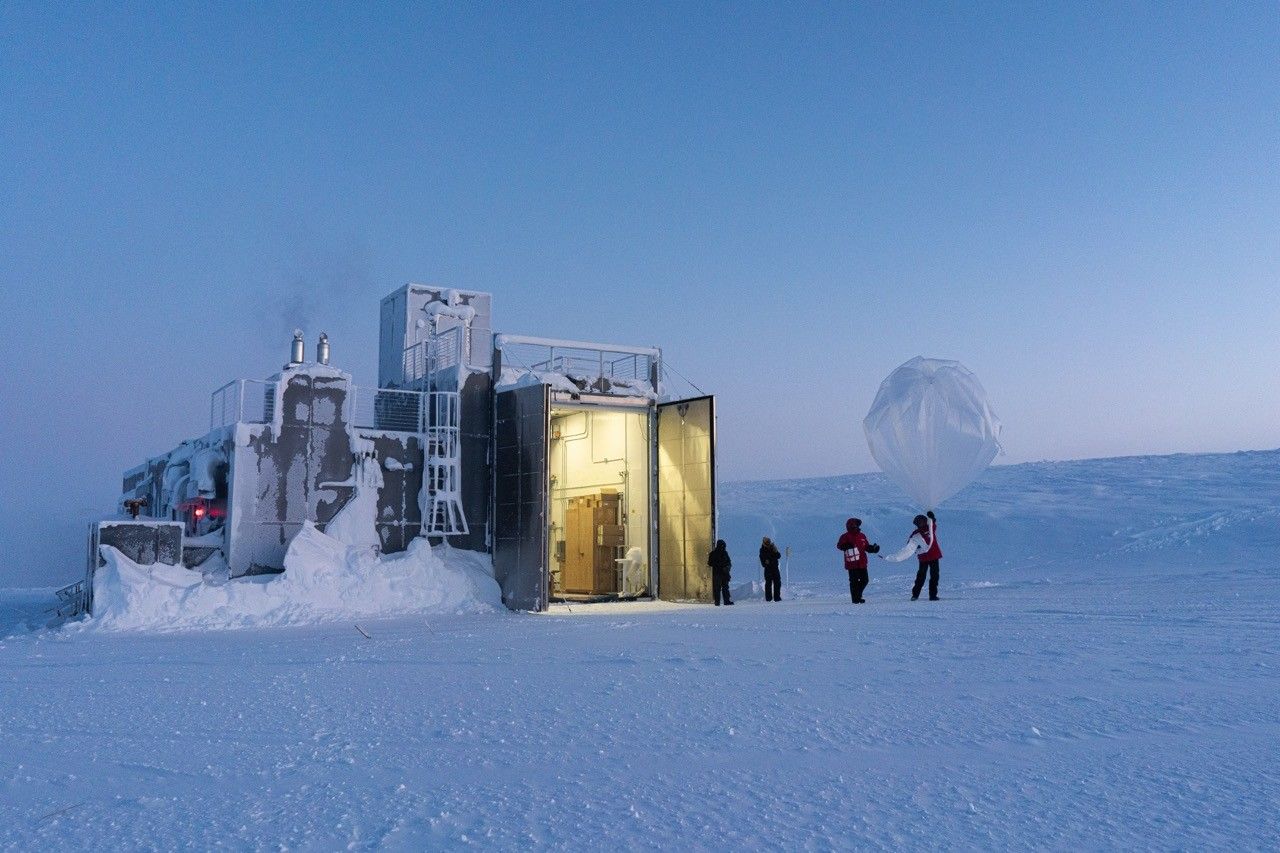
a partially snow encased metal building with a large open door to a utility space sits in the background of wholly snow covered landscape with two people holding onto a translucent plastic looking balloon which is roughly the diameter of the person holding it.
NOAA scientists launch a weather balloon carrying an ozonesonde near the South Pole in September 2025.
Simeon Bash/IceCube – courtesy of NOAA

The Dobson Unit is a measurement that indicates the total number of ozone molecules present throughout the atmosphere above a certain location. A measurement of 100 Dobson Units corresponds to a layer of pure ozone 1 millimeter thick — about as thick as a dime — at standard temperature and pressure conditions.

View the latest status of the ozone layer over the Antarctic with NASA’s ozone watch.

By Sally Younger

NASA’s Earth Science News Team

News Media Contacts:

Elizabeth Vlock
NASA Headquarters, Washington
202-358-1600
elizabeth.a.vlock@nasa.gov

Peter Jacobs
NASA’s Goddard Space Flight Center, Greenbelt, Md.
301-286-3308
peter.jacobs@nasa.gov

Theo Stein
NOAA Communications
303-819-7409
theo.stein@noaa.gov

Share

Details

Last Updated
Nov 25, 2025

Palo Alto Networks paying $3.3B to acquire observability startup Chronosphere, which has roots in Seattle

Chronosphere co-founders Martin Mao (CEO) and Rob Skillington (CTO). (Chronosphere Photo)

Cybersecurity giant Palo Alto Networks announced Wednesday it will acquire Chronosphere in a deal valued at $3.35 billion.

Founded in 2019, Chronosphere sells observability software that helps engineering teams spot problems quickly and keep cloud applications running. Palo Alto Networks said the acquisition will help it meet the massive data demands created by modern AI workloads.

Chronosphere CEO Martin Mao and CTO Rob Skillington first met in the Seattle area at Microsoft, where they worked on migrating Office to the cloud-based Office 365 format. They both later joined Uber’s engineering teams. 

The company describes itself as a “distributed team” with major hubs in New York City, Seattle, and Vilnius. Mao is based in the Seattle region, along with several Chronosphere employees. The team, including Mao and Skillington, will join Palo Alto once the acquisition closes. Chronosphere has more than 250 employees.

On the company’s earnings call with analysts Wednesday, Palo Alto Networks CEO Nikesh Arora described Chronosphere as “one of the fastest-growing software companies in history.” It counts two of the “premier LLMs” as customers.

Arora said existing observability tools were not built for the AI era and that full observability has become cost prohibitive for many organizations. Chronosphere, he said, can deliver observability at one-third the cost of other leading solutions.

He added that Chronosphere has “changed the observability model” with its combination of open source and architectural techniques.

When Palo Alto evaluated observability and data-pipeline vendors, Arora said the team was struck by Chronosphere’s engineering chops. “Generally, engineers have too much pride to tell you that somebody else is good,” he said. “But our team came back and said, ‘these guys are the best engineers we’ve run into.'”

Chronosphere reports more than $160 million in annual recurring revenue, growing at triple-digit rates, according to Palo Alto.

Chronosphere will remain “largely standalone” after the deal closes next year. “They are basically a bunch of really smart engineers and forward-deployed engineers, as well as a few salespeople,” Arora said. “So, we’re going to give them some support by introducing the right customers in very targeted fashion.”

The company’s investors include General Atlantic; Greylock Partners; Lux Capital; Addition; Founders Fund; Spark Capital; and Glynn Capital.

“When Rob Skillington and I started Chronosphere six years ago, we set out to build a next-generation observability platform capable of handling the most complex cloud native workloads,” Mao wrote on LinkedIn. “Today, we are the observability leader trusted by the world’s top AI and digital-native innovators.”

Earlier this year Palo Alto Networks also acquired Protect AI, a Seattle startup that helps companies monitor machine learning systems.

Palo Alto Networks to Acquire AI Observability Platform Chronosphere for $3.35 Billion

Palo Alto Networks Inc. announced Wednesday it will acquire Chronosphere, a next-generation observability platform designed for artificial intelligence (AI) workloads, in a $3.35 billion deal combining cash and replacement equity awards. The acquisition, pending regulatory approval, is expected to close in the second half of Palo Alto Networks’ fiscal 2026. The move represents the cybersecurity..

The post Palo Alto Networks to Acquire AI Observability Platform Chronosphere for $3.35 Billion appeared first on Security Boulevard.

A Constitutional Clash Over Trump’s War Powers in Venezuela

OPINION — “The question before the body is, can the Congress stop a military conflict declared by the Commander-in- Chief because we don’t agree with the decision, and without our [Congress] approval it must end? The answer, unequivocally, to me is no. Under the Constitution, the authority to be Commander-in-Chief resides exclusively with the President. The power to declare war is exclusive to the Congress. Now, what could the Congress do constitutionally if they disagree with a military action that is not a declaration of war? We could cut off funding.”

That was Sen. Lindsey Graham (R-S.C.) speaking on the Senate floor on the afternoon of November 6, when debate was to begin on S.J. Res. 90, legislation that was “to direct the President to terminate the use of U.S. Armed Forces for hostilities within or against Venezuela, unless explicitly authorized by a declaration of war or specific authorization for use of military force.”

Graham’s remark that Congress could cut off funds to halt a President ordered foreign military action took me back 56 years to December 1969, when I was working for Sen. J.W. Fulbright (D-Ark.), then chairman of the Senate Foreign Relations Committee. I had in late 1969 been to Laos where the Nixon administration was carrying out a secret bombing campaign in an attempt to limit weapons going from North Vietnam to pro-Communists in South Vietnam.

To halt the at-the-time classified Laos bombing program, Fulbright introduced an amendment to the fiscal 1970 Defense Appropriations Bill that prohibited the use of U.S. funds to send American ground combat troops into Laos or Thailand. To get his amendment debated and passed, Fulbright had to arrange for a closed-session of the Senate.

That closed session was held on December 16, 1969, with all 100 Senators present, a handful of staff – including me – but no one in the public galleries and no reporters in the press gallery. After a 90-minute debate, the amendment passed. The House accepted the amendment in conference and it was signed into law by President Nixon on December 29, 1969.

Fulbright’s purpose was to assert Congress’ Constitutional role when it came to a prospective military operation amid his concern that the Nixon administration was expanding the Vietnam War into neighboring countries without consulting Congress.

I describe that long-past activity to explain my continuing apprehension over today’s possible Trump administration military action against Venezuela. The Trump administration has already introduced deadly military operations against alleged narco-traffickers working from a secret list of drug cartels using a classified Justice Department Office of Legal Counsel opinion which claims the drugs are to kill Americans and finance arms to terrorists who will destabilize the U.S. and other Western Hemisphere countries.

Last Thursday and Friday, President Trump met in the Oval Office to discuss a host of options for Venezuela with Vice President JD Vance, Defense Secretary Pete Hegseth, Joint Chiefs Chairman Gen. Dan Caine, Secretary of State Marco Rubio and Deputy Chief of Staff Stephen Miller.

Friday night, in remarks to reporters aboard Air Force One as he traveled for the weekend to his Mar-a-Lago estate, the President said he had “sort of made up my mind” about how he will proceed with the possibility of military action in Venezuela. On Sunday, flying home, Trump told reporters the U.S. “may be having some discussions with [Venezuelan President Nicolas] Maduro,” adding that “they [the Venezuelans] would like to talk.”

Although he swings back and forth, it appears clear from President Trump’s point of view, he need not consult with Congress should he decide on any military action that targets the Venezuelan mainland. As Sen. Graham pointed out, “We have only declared war five times in 250 years, and we have had hundreds of military operations -- some authorized and some not.”

Need a daily dose of reality on national and global security issues? Subscriber to The Cipher Brief’s Nightcap newsletter, delivering expert insights on today’s events – right to your inbox. Sign up for free today.

Opening the Senate debate on November 6, Sen. Tim Kaine (D-Va.), a key sponsor of the congressional resolution, pointed out, “On October 31, public reporting shows that many Trump administration officials have told the press that a secret list of targets in Venezuela has been drawn up. All of this, together with the increased pace of strikes in the Caribbean and Pacific [21 attacks on alleged narco-trafficking boats, 83 individuals killed], suggests that we are on the verge of something that should not happen without a debate and vote in Congress before the American people.”

On November 6, after a relatively short debate, the Senate resolution to block the use of U.S. armed forces against Venezuela was defeated by a 49-to-51 vote.

But during that debate some important points were made, and they need some public exposure.

For example, Sen. Tammy Duckworth (D-Ill.), a military veteran herself, said, “Listen, if the Trump administration actually believes there is an ongoing credible threat of armed conflict, then they must bring their case to Congress and give the American people a say through their elected representatives. They must respect our service members enough to prove why war is worth turning more moms and dads into Gold Star parents. And they must testify about what the end state of these military operations would actually look like.”

Sen. Adam Schiff (D-Calif.) said, “Maduro is a murderous dictator. He is an illegitimate leader in having overturned the last election by the use of military force. He is a bad actor. But I do not believe the American people want to go to war to topple this regime in the hopes that something better might follow… Let them [the Trump administration] seek an authorization to use force to get rid of Maduro. But let us not abdicate our responsibility. Let us vote to say no to war without our approval. We don’t have to wait, nor should we wait for that war to begin before we vote.”

Sen. Rand Paul (R-Ky.) pointed out, “Of course, we have the capability of overthrowing the Maduro regime, just like we had the power to overthrow Saddam Hussein and Muammar Qadhafi. But what comes next? Is anyone thinking about the potential blowback that such a campaign could entail? Overthrowing the Maduro regime risks creating more regional instability, not less. The breakdown of state authority may create a power vacuum that the very drug cartels the administration is ostensibly trying to destroy could exploit.”

The Cipher Brief brings expert-level context to national and global security stories. It’s never been more important to understand what’s happening in the world. Upgrade your access to exclusive content by becoming a subscriber.

“You cannot bomb your way out of a drug crisis,” said Sen. Jack Reed (D-R.I.), ranking member on the Senate Armed Services Committee. “The demand that motivates drug trafficking is not found in the Caribbean. It is located in communities across America where people are suffering from addiction, where economic opportunity has dried up, where the social fabric has frayed. Military strikes do nothing to address those root causes. Boats have been blown out of the water in videos released by the administration. But has the flow of fentanyl into America decreased? Has a single trafficking network been dismantled? The administration hasn’t provided any evidence that these strikes are achieving anything beyond the destruction they document on camera. This is not a strategy. This is violence without a strategic objective.”

Sen. Reed also pointed out how the Trump administration is expanding its war powers. “The White House is apparently now arguing that these strikes [on alleged narco-boats] don’t constitute ‘hostilities’ under the War Powers Act because American service members aren’t directly in harm’s way while operating standoff weapons and drones. This is ridiculous…They are very much in harm’s way, and to say that this operation is so safe that it doesn’t qualify as ‘hostilities’ is embarrassing…This new interpretation creates a dangerous precedent. If standoff weapons exempt military operations from congressional oversight, we have effectively granted the Executive Branch unlimited authority to wage war anywhere in the world so long as American forces can strike from a distance.”

Taking a different approach, Sen. Chris Van Hollen (D-Md.) pointed out an irony in Trump’s anti-drug argument. Van Hollen said, “I will tell you what you don’t do. You don’t submit a budget to the U.S. Congress that cuts the funding for the Drug Enforcement Agency and cuts funding for the task forces we developed to go after major organized crime syndicates involved in the drug business.” He added, “I happen to be the ranking member of the Appropriations Committee that oversees the Justice Department. And all my colleagues have to do is take a look at the request from the President of the United States when it comes to resources for fighting drugs coming to the United States. They cut them.”

Raising an additional problem, Sen. Andy Kim (D-N.J.) said, “Letting Donald Trump ignore the law abroad makes him think he has a free pass to do it right here at home. Donald Trump thinks if he can do this in the Caribbean, he can do it on the streets of Chicago. He could use the military for his own political retribution and consolidation of power in and outside our borders. After all, he [Trump] said in his own words: ‘We’re under invasion from within, no different than a foreign enemy but more difficult in many ways because they don’t wear uniforms.’ That is what the President said. We cannot be complacent as he sends troops into our cities as a tool of intimidation against his political enemies.”

While we await President Trump’s decision on what comes next, let me close with another ironic situation, created last Wednesday by Secretary of Homeland Security Kristi Noem.

Giving the keynote address at the Potomac Officers Club’s 2025 Homeland Security Summit, Noem celebrated recent successes in the counter-drug mission. She said that since January, the Coast Guard has stopped 91 metric tons of drugs, confiscated 1,067 weapons and seized more than $3.2 million in cash from terrorist cartels, thanks primarily due to Operation Pacific Viper, which Noem said is strategically designed to seize historic amounts of drugs from smugglers in the eastern Pacific. “Viper has saved millions of lives of individuals and Americans by stopping those drugs before they ever got to the U.S.,” Noem said.

Operation Pacific Viper, according to a Coast Guard press release, also resulted in the arrest of 86 alleged narco-traffickers as of October 15. A needed reminder: Viper was an interdiction program where narco-traffickers were intercepted, arrested and drugs seized – not boats blown up and people killed.

The Cipher Brief is committed to publishing a range of perspectives on national security issues submitted by deeply experienced national security professionals.

Opinions expressed are those of the author and do not represent the views or opinions of The Cipher Brief.

Have a perspective to share based on your experience in the national security field? Send it to Editor@thecipherbrief.com for publication consideration.

Read more expert-driven national security insights, perspective and analysis in The Cipher Brief

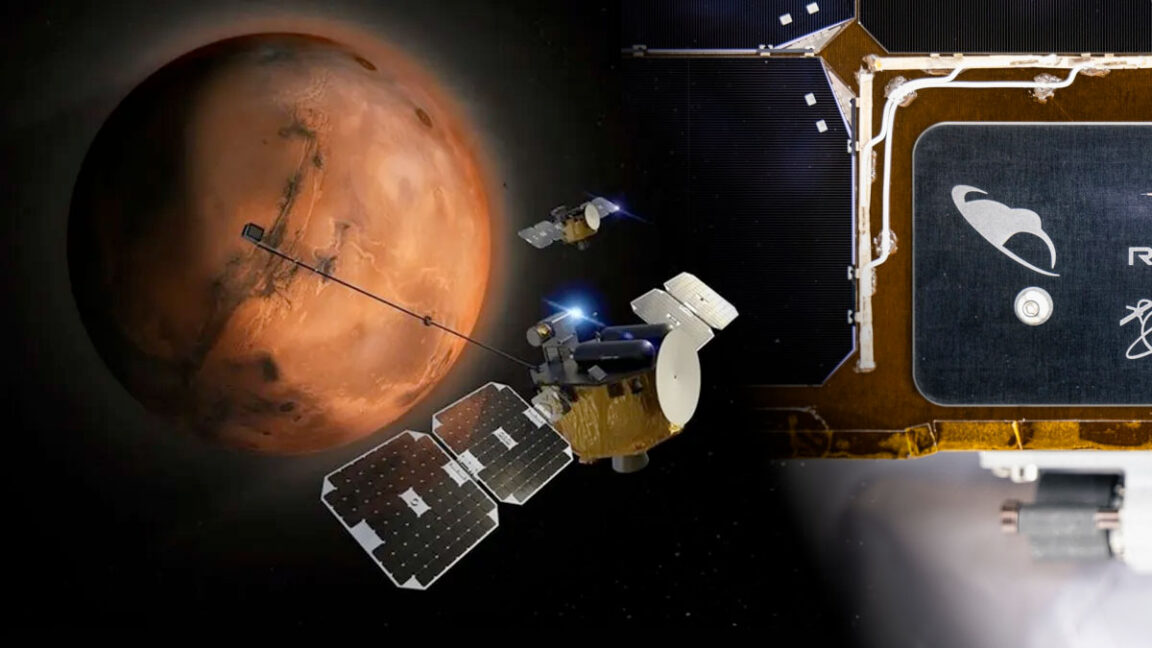
The twin probes just launched toward Mars have an Easter egg on board

The first multi-spacecraft science mission to launch to Mars is now on its way, and catching a ride on the twin probes are the first kiwis to fly to the red planet.

NASA’s ESCAPADE (Escape and Plasma Acceleration and Dynamics Explorers) mission lifted off on a 22-month trip to Mars on Thursday aboard a New Glenn rocket. Once there, the identical satellites will enter Martian orbit to study in real time how space weather affects the planet’s hybrid magnetosphere and how the interaction drove Mars to lose its once-dense atmosphere.

Led by the Space Sciences Laboratory at the University of California, Berkeley—the two spacecraft are named “Blue” and “Gold” after the school’s colors—the ESCAPADE probes are the first Mars-bound vehicles to be designed, built, and tested by Rocket Lab, the end-to-end space company headquartered in California but founded in New Zealand.

Read full article

Comments

© UCB-SSL/Rocket Lab/collectSPACE.com

Understanding the U.S. Military Mobilization in the Caribbean


OPINION / EXPERT PERSPECTIVE — The armada the U.S. has assembled in the Caribbean is more formidable than anything the region has seen in decades. What is going on? The administration says it is targeting drug trafficking through the Caribbean. Is that it? Is that really all we are doing? Trump administration officials insist that it is but also acknowledge that strikes on land targets may be necessary to achieve the administration’s goals. Skeptics suggest that regime change in Venezuela is part of the administration’s plan. Is it?

Early in 2025, shortly after taking office, the Trump administration designated several drug cartels as terrorist organizations. This signaled the administration’s intention to escalate U.S. efforts to fight trafficking beyond the usual efforts of the Coast Guard, Drug Enforcement Administration and Border Patrol. It also presaged the use of the military.

Combating narco-trafficking remains the administration’s declared purpose. Implicitly, the decision to escalate U.S. efforts is based on several key points. First, drug abuse in the United States remains at epidemic levels despite decades of efforts to control it. Second, previous efforts to suppress drug smuggling into the U.S. have not been successful. Third, because the cartels smuggling drugs into the U.S. are not merely drug traffickers but large terrorist organizations, they need to be confronted as forcefully as terrorist groups elsewhere. This, effectively, means employing military force.

The administration contends that Venezuela is the country from which much of the illicit boat and air traffic carrying cocaine emanates and that Venezuela’s long-time strong man is really the head of a cartel and “a fugitive from American justice.” On August 7, the administration announced a 50-million-dollar bounty on Venezuela’s long-time strong man, Nicolas Maduro. It is this view of the Venezuelan regime and its leader, in combination with the size and capabilities of the deployed U.S. military in the Caribbean, that suggests the administration’s goals are more ambitious than just striking alleged traffickers on the high seas.

The question then is, how would the Trump administration define regime change? New leadership or something more extensive? If regime change is a goal, how does the administration hope to achieve that result? Would a combination of intimidation, enhanced economic sanctions and diplomatic pressure from the world’s democratic community convince Maduro to abandon power? Can the Venezuelan military, which in 2002 temporarily removed Maduro’s mentor, Hugo Chavez, be persuaded to act once again? Or is the U.S. administration contemplating military strikes inside of Venezuela? If so, how extensively? Would a targeted attack of regime leadership result in regime change or would the U.S. need to hit various elements of the military plus drug labs? The scope of any U.S. kinetic actions would likely affect the way Venezuelans – who overwhelmingly rejected Maduro in last year’s presidential election, react. It would also affect how the region and the rest of the world regard the U.S. campaign.

If the U.S. were able to oust Maduro what would follow? There is a legitimate government in waiting. Former diplomat Edmundo Gonzalez won last year’s presidential election by a huge margin despite regime efforts to sabotage the democratic opposition. Would anything short of the installation of the democratic opposition be considered an acceptable outcome to Venezuelans or the United States? Would a government of national unity which included some of the Venezuelan dictator’s base and elements of the military be acceptable to the democratic opposition? To the U.S? The Venezuelan military has been deeply compromised by the Maduro regime’s criminal activity and is believed to be complicit at the highest levels in drug trafficking. The Cartel de los Soles is thought to include many high-ranking military personnel. Would the U.S.be prepared to put troops on the ground to prevent criminal elements of the Venezuelan military from regrouping even if current regime leadership were forced out?

Finally, what effect will current U.S. operations in the Caribbean have on U.S. relations with the rest of Western Hemisphere especially if U.S. military strikes Venezuela directly? What effect have U.S. operations already had? The answers to these questions are not all obvious.

The Cipher Brief brings expert-level context to national and global security stories. It’s never been more important to understand what’s happening in the world. Upgrade your access to exclusive content by becoming a subscriber.

The Trump team has never mentioned regime change as a campaign goal. The size and nature of the deployed U.S. forces, however, make speculation on the U.S. administration’s real intentions inevitable. The number of ships, aircraft, sailors and marines appeared to be substantially greater than required to combat narcotrafficking through the Caribbean and eastern pacific even before the ordered deployment of the U.S.’s most advanced aircraft carrier, the USS Gerald R Ford. The messaging from Washington, moreover, focuses squarely on the Venezuelan regime.

What we have been hearing from Washington about operations in the Caribbean is a logical extension of steps taken by the Trump administration prior to the start of current operations. While President Obama first called Venezuela a threat to national security in 2015, it was only earlier this year that the U.S. designated the cartels as terrorist organizations. The designation of the cartels as terrorists was a necessary step to operationalize the shift from a law enforcement effort to a military one.

The new militarized U.S. strategy in the Caribbean has had an effect. Drug trafficking by sea is apparently way down. That said, this new strategy has not diminished trafficking by land nor reduced the flow of deadly fentanyl into the country. It has, on the other hand, generated concern in some countries about the return of American gunboat diplomacy. Domestically, the president’s new approach resonates well in some quarters but has incensed many Democrats in the U.S. Congress and even worried some Republicans. British concern about the legality of the U.S. strikes on the high seas is now so acute that the United Kingdom has ended intelligence sharing on Venezuela. The Trump administration has, however, given no indication that either international concern or congressional criticism will precipitate a change in policy.

President Trump’s change of the U.S strategy for fighting the cartels and maybe for achieving regime change in Venezuela has important implications for U.S. relations with its allies everywhere but especially within the region. The Trump administration has clearly made the Western Hemisphere a national security priority but there are many other vitally important arenas in which U.S. interests are affected by developments in this hemisphere – both positively and negatively.

Accordingly, the administration’s agenda in Latin America must include more than just winning the drug fight and controlling our Southern border. More than 40% of all U.S. manufacturing goods are sold into the Western Hemisphere and the U.S. has a positive trade balance with many countries in the region, including Brazil, Chile, Peru, Panama and others. Millions of American jobs depend on trade with the region. Energy production in the region is also significant; Canada is our largest foreign supplier but there are other key players including Mexico, Brazil, Colombia, Ecuador, Trinity and Tobago and, more recently, Guyana. Guyana’s oil production, in fact, is exploding. The country’s GDP grew by over 25% in 2023 and by more than 30% in 2024. On the other hand, China’s influence continues to surge and China is now the largest trading partner for South America in the aggregate. The U.S. clearly needs to do what it can to strengthen the value proposition for the countries of Central and South American to see the U.S. as their commercial partner of choice.

Are you Subscribed to The Cipher Brief’s Digital Channel on YouTube? There is no better place to get clear perspectives from deeply experienced national security experts.

It is, at this point, not clear what the Trump administration’s end game is in the Caribbean. What is clear is that the U.S. cannot ignore other issues around the region or other views on how challenges should be met. Neither should we naively assume that success in suppressing the trafficking of cocaine out of South America is assured even temporarily, however many go-fast boats the U.S. military sinks. Transit by land, which the Trump administration has indicated it may take on next, is still robust. Demand for illegal drugs is still strong in the U.S. and Europe. The U.S. has recently made progress in engaging Mexico, especially on combating the Mexican cartels, but how effective joint efforts will be remains to be seen. Relations with Colombia, the source of most of the world’s cocaine, on the other hand, have deteriorated dramatically. Colombian President Gustavo Petro has characterized U.S. attacks on the drug boats as atrocities, called President Trump a criminal and encouraged American military personnel to defy his orders. The U.S., for its part, has decertified Colombia for failing to cooperate fully with U.S. counternarcotics efforts and cancelled Petro’s visa.

The U.S. still has partners in Latin America, especially trade partners, but there is also, always, concern over U.S. unilateralism. Moreover, President Trump’s announcement that he has authorized the Central Intelligence Agency to become active in Venezuela inevitably recalls for some an earlier and darker time in U.S. relations with Latin America. That said, criticism of U.S. operations in the region has been surprisingly muted – and some countries have been explicitly supportive.

Still, many in the region have been left wondering where multilateral cooperation, diplomacy, democracy support and human rights, pillars of U.S.-Latin American policy since at least the 1980s, fit in America’s new more muscular policy toward the region. At the same time, most of the region agrees that the cartels are a grievous problem, and recognize that Venezuela is a dictatorship and that it has become an epicenter for a great deal of the most pernicious activity in the region. I expect they are dubious about the likelihood of the U.S. eradicating all drug trafficking from South America because so much of the trafficking is by land. They are also unconvinced that combatting drug trafficking per se is the U.S.’s only goal. They do not wish to see a war in either South or Central America but they are also profoundly tired of living with the consequences of the growing and corrosive power of the cartels.

The Trump administration’s campaign to date has had some success and may have put Russia, China and Iran – Venezuela’s extra-regional allies -- on notice that the U.S. has decided to counter malign activity and actors in the region forcefully. But this is a high stakes game for the U.S. A U.S. escalation to ground operations could catalyze world-wide criticism of the U.S. Success with targeted strikes is not assured. At present, we are left to wrestle with the question of whether the campaign to date is a preamble to even more ambitious operations. And, can what has been accomplished to date be sustained at a time when coca cultivation in source countries like Peru and Colombia is increasing and the head of a cartel – which is how the administration has characterized Maduro – remains in control of the government of Venezuela?

Read more expert-driven national security insights, perspective and analysis in The Cipher Brief because National Security is Everyone’s Business.

Radical’s full-size prototype for a stratospheric drone makes first flight

A prototype for Radical’s Evenstar stratospheric solar-powered airplane flies over its Oregon test range. (Radical Photo)

Seattle-based Radical says it has put a full-size prototype for a solar-powered drone through its first flight, marking one low-altitude step in the startup’s campaign to send robo-planes into the stratosphere for long-duration military and commercial missions.

“It’s a 120-foot-wingspan aircraft that only weighs 240 pounds,” Radical CEO James Thomas told GeekWire. “We’re talking about something that has a wingspan just a bit bigger than a Boeing 737, but it only weighs a little bit more than a person. So, it’s a pretty extreme piece of engineering, and we’re really proud of what our team has achieved so far.”

Last month’s flight test was conducted at the Tillamook UAS Test Range in Oregon, which is one of the sites designated by the Federal Aviation Administration for testing uncrewed aerial systems. Thomas declined to delve into the details about the flight’s duration or maximum altitude, other than to say that it was a low-altitude flight.

“We take off from the top of a car, and takeoff speeds are very low, so it flies just over 15 miles an hour on the ground or at low altitudes,” he said. (Thomas later added that the car was a Subaru, a choice he called “a Pacific Northwest move, I guess.”)

The prototype ran on battery power alone, but future flights will make use of solar arrays mounted on the plane’s wings to keep it in the air at altitudes as high as 65,000 feet for months at a time. For last month’s test, engineers added ballast to the prototype to match the weight of the solar panels and batteries required for stratospheric flight. Thomas said he expects high-altitude tests to begin next year.

  • Radical team monitors flight test
    Radical CEO James Thomas and teammates monitor the first flight test of a full-size Evenstar prototype. (Radical Photo)
  • The prototype is mounted on top of a car for takeoff. (Radical Photo)
  • Radical’s prototype rises from the top of its launch car. (Radical Photo)
  • The Evenstar prototype takes to the air. (Radical Photo)
  • The prototype has a wingspan of 120 feet. (Radical Photo)

Thomas and his fellow co-founder, chief technology officer Cyriel Notteboom, are veterans of Prime Air, Amazon’s effort to field a fleet of delivery drones. They left Amazon in mid-2022 to launch Radical and have since raised more than $4.5 million in funding. September’s test of a full-size drone follows up on the 24-hour-plus flight of a 13-pound subscale prototype in 2023.

The company’s manufacturing operation is based in Seattle’s Ballard neighborhood. There are currently six people on the team, plus a new hire, Thomas said. “We’re still lean,” he said. “To make this airplane work, it has to be really efficient, right? Really efficient electronics and aerodynamics. And you also need a really efficient team.”

Thomas said Radical has attracted interest from potential customers, but he shied away from discussing details. “We’re working with groups in the government and also commercially,” he said. “Obviously there are applications at the end of this that span everything from imagery through telecommunications and weather forecasting. There are a lot of people really interested in the technology, and the thing that stops us from serving those customers is not having a product up in the sky. So, that’s what we’re working through.”

Radical’s solar-powered airplane, known as Evenstar, is just one example of a class of aircraft known as high-altitude platform stations, or HAPS. Thomas and his teammates use a different term to refer to Evenstar. They call it a StratoSat, because it’s designed to take on many of the tasks typically assigned to satellites — but without the costs and the hassles associated with launching a spacecraft.

Potential applications include doing surveillance from a vantage point that’s difficult to attack, providing telecommunication links in areas where connectivity is constrained, monitoring weather patterns and conducting atmospheric research.

“We have customers who are really excited about the way that this can improve how we understand Earth’s weather systems and climate,” Thomas said. “That’s an application that we’re really excited to get into.”

Evenstar will carry payloads weighing up to about 33 pounds (15 kilograms). “That was based on analysis about major use cases,” Thomas explained. “That payload is enough to carry high-bandwidth, direct-to-device radio communications, or to carry ultra-high-resolution imaging equipment.”

Radical isn’t the only company working on solar-powered aircraft built for long-duration flights in the stratosphere. Other entrants in the market include AeroVironment, SoftBank, BAE Systems, Swift Engineering, Kea Aerospace, Korea Aerospace Industries and NewSpace Research & Technologies. Airbus’ solar-powered Zephyr set the record for long-duration stratospheric flight in 2022 with a 64-day test mission that ended in a crash.

Among those who tried but failed to field stratospheric solar drones are Alphabet, which closed down Titan Aerospace in 2016; and Facebook, which abandoned Project Aquila in 2018.

Thomas said the outlook for high-flying solar planes has brightened in the past decade.

“The key supporting technologies have matured enormously,” he said. “Commercial battery energy density has doubled in that 10-year time period. Solar cells are 10 times cheaper than they were just 10 years ago. And then you have advances in compute and AI, and all of these things feed into the situation we have now, where it’s actually possible to make the models close — whereas when we run the 10-year-old numbers, we can’t close the models.”

The way Thomas sees it, the concept behind Radical isn’t all that radical anymore.

“Not only do our models say this will work, but we have flight data that agrees with our models, and says this is a technology that can serve its purpose and unlock the potential of persistent infrastructure in the sky,” he said. “I can see why other people are pursuing it. It’s not a new idea. It’s one that people have wanted to crack for a long time, and we’re at this critical inflection point where it’s finally possible.”

Inside the Visualization: Aerosols

1 min read

Inside the Visualization: Aerosols

NASA uses satellites, ground measurements, and powerful computer models to track tiny particles floating in our air called aerosols. These small particles can travel thousands of miles, affecting the air we breathe and how far we can see, even far from where they originated.

Share

Details

Last Updated
Sep 29, 2025

La NASA y la NOAA lanzan tres naves espaciales para cartografiar la influencia del Sol en el espacio

A SpaceX Falcon 9 rocket carrying NASA’s IMAP (Interstellar Mapping and Acceleration Probe), Carruthers Geocorona Observatory, and the National Oceanic and Atmospheric Administration’s (NOAA) Space Weather Follow On-Lagrange 1 (SWFO-L1) missions launches from the agency’s Kennedy Space Center in Florida, Wednesday, Sept. 24, 2025.
Un cohete Falcon 9 de SpaceX que transporta las misiones Sonda de Cartografía y Aceleración Interestelar (IMAP, por su acrónimo en inglés) y el Observatorio Carruthers de la Geocorona, ambos de la NASA, y la nave espacial de Seguimiento de la Meteorología Espacial en el Punto de Lagrange 1 (SWFO-L1, por sus siglas en inglés) de la NOAA, despega desde el Centro Espacial Kennedy de la NASA en Florida el miércoles 24 de septiembre de 2025.
Crédito: NASA

Read this press release in English here.

La NASA y la Administración Nacional Oceánica y Atmosférica (NOAA, por sus siglas en inglés) lanzaron el miércoles tres nuevas misiones para investigar la influencia del Sol en todo el sistema solar.

A las 7:30 a. m. EDT, un cohete Falcon 9 de SpaceX despegó del Complejo de Lanzamiento 39A del Centro Espacial Kennedy de la NASA en Florida, llevando a bordo las misiones Sonda de Cartografía y Aceleración Interestelar (IMAP, por su acrónimo en inglés) y el Observatorio Carruthers de la Geocorona, ambos de la NASA, y la nave espacial de Seguimiento de la Meteorología Espacial en el Punto de Lagrange 1 (SWFO-L1, por sus siglas en inglés) de la NOAA.

“Este exitoso lanzamiento mejora la preparación de nuestro país ante las condiciones meteorológicas espaciales para proteger mejor nuestros satélites, misiones interplanetarias y astronautas que viajan al espacio de los peligros de la meteorología espacial en todo el sistema solar”, afirmó el administrador interino de la NASA, Sean Duffy. “Esta información será fundamental a medida que nos preparamos para futuras misiones a la Luna y Marte con la intención de mantener a Estados Unidos a la vanguardia en el espacio”.

Estas misiones ayudarán a proteger de las duras condiciones de la meteorología espacial tanto a nuestra tecnología basada en tierra como a nuestros exploradores espaciales humanos y robóticos.

“Mientras Estados Unidos se prepara para enviar a seres humanos de vuelta a la Luna y más adelante a Marte, la NASA y la NOAA están proporcionando la guía definitiva de supervivencia interplanetaria para dar apoyo a este épico viaje de la humanidad”, afirmó Nicola Fox, administradora asociada de la Dirección de Misiones Científicas de la sede central de la NASA en Washington. “Nuestros descubrimientos científicos e innovaciones técnicas se incorporan directamente a nuestro plan de acción know-before-you-go (infórmate antes de ir) para garantizar una presencia humana bien preparada, segura y continua en otros mundos”.

Nueva ciencia para proteger a la sociedad

Cada misión investigará los diferentes efectos de la meteorología espacial y el viento solar, el cual es un flujo continuo de partículas emitidas por el Sol, desde su origen en nuestra estrella hasta el espacio interestelar.

“Estas tres misiones únicas nos ayudarán a conocer nuestro Sol y sus efectos sobre la Tierra mejor que nunca”, afirmó Joe Westlake, director de la División de Heliofísica en la sede central de la NASA. “Este conocimiento es fundamental, ya que la actividad solar afecta directamente a nuestra vida cotidiana, desde las redes eléctricas hasta el GPS. Estas misiones nos ayudarán a garantizar la seguridad y la resiliencia de nuestro mundo interconectado”.

La misión IMAP trazará los límites de la heliosfera, una burbuja inflada por el viento solar que protege nuestro sistema solar de los rayos cósmicos galácticos. Esta es una protección clave que contribuye a que nuestro planeta sea habitable. Además, la nave espacial tomará muestras y medirá las partículas del viento solar que fluyen hacia el exterior desde el Sol, así como las partículas energéticas que fluyen hacia el interior desde los límites de nuestro sistema solar y más allá.

“IMAP nos ayudará a comprender mejor cómo el entorno espacial puede perjudicarnos a nosotros y a nuestras tecnologías, y a descubrir la ciencia de nuestro vecindario solar”, afirmó David McComas, investigador principal de la misión IMAP en la Universidad de Princeton, en Nueva Jersey.

El Observatorio Carruthers de la Geocorona es la primera misión dedicada a medir los cambios en la capa más externa de nuestra atmósfera, la exosfera, la cual juega un papel importante en cómo la Tierra responde a la meteorología espacial. Al estudiar la geocorona —el brillo ultravioleta que emite la exosfera cuando la luz del sol la ilumina— la misión Carruthers revelará cómo la exosfera responde a las tormentas solares y cómo cambia con las estaciones. La misión se basa en el legado del primer instrumento que capturó imágenes de la geocorona, el cual viajó a la Luna a bordo de Apolo 16 y fue construido y diseñado por el científico, inventor, ingeniero y educador Dr. George Carruthers.

“La misión Carruthers nos mostrará cómo funciona la exosfera y nos ayudará a mejorar nuestra capacidad para predecir los efectos de la actividad solar aquí en la Tierra”, dijo Lara Waldrop, investigadora principal de la misión en la Universidad de Illinois en Urbana-Champaign.

La nave SWFO-L1 de la NOAA, la primera de su tipo, está diseñada para ser un observatorio de meteorología espacial operativo a tiempo completo. Al vigilar la actividad solar y las condiciones espaciales cerca de la Tierra las 24 horas del día, los 7 días de la semana, sin interrupciones ni obstrucciones, SWFO-L1 proporcionará pronósticos de meteorología espacial más rápidos y precisos que nunca.

“Se trata del primero de una nueva generación de observatorios de meteorología espacial de la NOAA dedicados a operaciones ininterrumpidas, que trabajarán para evitar lagunas en la continuidad. Las observaciones en tiempo real de SWFO-L1 proporcionarán a los operadores los datos fiables necesarios para emitir alertas tempranas, de modo que los responsables de la toma de decisiones puedan actuar con antelación para proteger las infraestructuras vitales, los intereses económicos y la seguridad nacional en la Tierra y en el espacio. Se trata de proteger a la sociedad contra los peligros de la meteorología espacial”, dijo Richard Ullman, subdirector de la Oficina de Observaciones de la Meteorología Espacial de la NOAA

Siguientes pasos

En las horas posteriores al lanzamiento, las tres naves espaciales se desplegaron desde el cohete con éxito y enviaron señales a la Tierra para confirmar que están activas y funcionando correctamente.

Durante los próximos meses, los satélites se dirigirán a su destino, un lugar situado entre la Tierra y el Sol, a unos 1,6 millones de kilómetros de la Tierra, denominado punto de Lagrange 1 (L1). Se espera que lleguen en enero y, una vez completadas las comprobaciones y calibraciones de sus instrumentos, comiencen sus misiones para comprender mejor la meteorología espacial y proteger a la humanidad.

David McComas, de la Universidad de Princeton, dirige la misión IMAP con un equipo internacional formado por 27 instituciones asociadas. El Laboratorio de Física Aplicada de la Universidad Johns Hopkins, ubicado en Laurel, Maryland, construyó la nave espacial y operará la misión.

La misión del Observatorio Carruthers de la Geocorona está dirigida por Lara Waldrop, de la Universidad de Illinois Urbana-Champaign. La ejecución de la misión está a cargo del Laboratorio de Ciencias Espaciales de la Universidad de California, Berkeley, que también diseñó y construyó los dos generadores de imágenes ultravioletas. BAE Systems diseñó y construyó la nave espacial Carruthers.

La División de Proyectos de Exploradores y Heliofísica de la NASA en el Centro de Vuelo Espacial Goddard de la NASA en Greenbelt, Maryland, gestiona las misiones IMAP y Observatorio Carruthers de la Geocorona para la Dirección de Misiones Científicas de la NASA.

La misión SWFO-L1 está gestionada por la NOAA y desarrollada en colaboración con el centro Goddard de la NASA y socios comerciales. El Programa de Servicios de Lanzamiento de la NASA, con sede en el centro Kennedy de la NASA, gestiona el servicio de lanzamiento de las misiones.

Para obtener más información sobre estas misiones, visite:

https://ciencia.nasa.gov/sol

-fin-

Abbey Interrante / María José Viñas
Sede central, Washington
301-201-0124
abbey.a.interrante@nasa.gov / maria-jose.vinasgarcia@nasa.gov

Sarah Frazier
Centro de Vuelo Espacial Goddard, Greenbelt, Maryland
202-853-7191
sarah.frazier@nasa.gov

Leejay Lockhart
Centro Espacial Kennedy, Florida
321-747-8310
leejay.lockhart@nasa.gov

John Jones-Bateman
Servicio de Satélites e Información de la NOAA, Silver Spring, Maryland
202-242-0929
john.jones-bateman@noaa.gov

NASA, NOAA Launch Three Spacecraft to Map Sun’s Influence Across Space

A SpaceX Falcon 9 rocket carrying NASA’s IMAP (Interstellar Mapping and Acceleration Probe), Carruthers Geocorona Observatory, and the National Oceanic and Atmospheric Administration’s (NOAA) Space Weather Follow On-Lagrange 1 (SWFO-L1) missions launches from the agency’s Kennedy Space Center in Florida, Wednesday, Sept. 24, 2025.
Credit: NASA

Lee este comunicado de prensa en español aquí.

NASA and the National Oceanic and Atmospheric Administration (NOAA) launched three new missions Wednesday to investigate the Sun’s influence across the solar system.

At 7:30 a.m. EDT, a SpaceX Falcon 9 rocket lifted off from Launch Complex 39A at NASA’s Kennedy Space Center in Florida carrying the agency’s IMAP (Interstellar Mapping and Acceleration Probe), Carruthers Geocorona Observatory, and NOAA’s SWFO-L1 (Space Weather Follow On-Lagrange 1) spacecraft.

“This successful launch advances the space weather readiness of our nation to better protect our satellites, interplanetary missions, and space-faring astronauts from the dangers of space weather throughout the solar system,” said acting NASA Administrator Sean Duffy, “This insight will be critical as we prepare for future missions to the Moon and Mars in our endeavor to keep America first in space.”

These missions will help safeguard both our ground-based technology, as well as our human and robotic space explorers from the harsh conditions known of space weather.

“As the United States prepares to send humans back to the Moon and onward to Mars, NASA and NOAA are providing the ultimate interplanetary survival guide to support humanity’s epic journey along the way,” said Nicola Fox, associate administrator, Science Mission Directorate at NASA Headquarters in Washington. “Our scientific discoveries and technical innovations directly feed into our know-before-you-go roadmap to ensure a prepared, safe, and sustained human presence on other worlds.”

New science to protect society

Each mission will investigate different effects of space weather and the solar wind, which is a continuous stream of particles emitted by the Sun, from their origins at the Sun all the way outward to interstellar space.

“These three unique missions will help us get to know our Sun and its effects on Earth better than ever before,” said Joe Westlake, Heliophysics Division director at NASA Headquarters. “This knowledge is critical because the Sun’s activity directly impacts our daily lives, from power grids to GPS. These missions will help us ensure the safety and resilience of our interconnected world.”

The IMAP mission will chart the boundary of the heliosphere, a bubble inflated by the solar wind that shields our solar system from galactic cosmic rays — a key protection that helps make our planet habitable. In addition, the spacecraft will sample and measure solar wind particles streaming outward from the Sun, as well as energetic particles streaming inward from the boundary of our solar system and beyond.

“IMAP will help us better understand how the space environment can harm us and our technologies, and discover the science of our solar neighborhood,” said David McComas, IMAP mission principal investigator at Princeton University in New Jersey.

The Carruthers Geocorona Observatory is the first mission dedicated to recording changes in the outermost layer of our atmosphere, the exosphere, which plays an important role in Earth’s response to space weather. By studying the geocorona — the ultraviolet glow given off by the exosphere when sunlight shines on it — the Carruthers mission will reveal how the exosphere responds to solar storms and how it changes with the seasons. The mission builds on the legacy of the first instrument to image the geocorona, which flew to the Moon aboard Apollo 16 and was built and designed by scientist, inventor, engineer, and educator Dr. George Carruthers.

“The Carruthers mission will show us how the exosphere works and will help improve our ability to predict the impacts of solar activity here on Earth,” said Lara Waldrop, the mission’s principal investigator at the University of Illinois at Urbana-Champaign.

The first of its kind, NOAA’s SWFO-L1 is designed to be a full-time operational space weather observatory. By keeping a watchful eye on the Sun’s activity and space conditions near Earth 24/7, and without interruption or obstruction, SWFO-L1 will provide quicker and more accurate space weather forecasts than ever before.

“This is the first of a new generation of NOAA space weather observatories dedicated to 24/7 operations, working to avoid gaps in continuity. Real-time observations from SWFO-L1 will give operators the trusted data necessary to issue advance warnings so that decision-makers can take early action to protect vital infrastructure, economic interests, and national security on Earth and in space. It’s about safeguarding society against space weather hazards,” said Richard Ullman, deputy director of the Office of Space Weather Observations at NOAA. 

Next steps

In the hours after launch, all three spacecraft successfully deployed from the rocket and sent signals to Earth to confirm they’re active and working well.

Over the next few months, the spacecraft will make their way to their destination — a location between Earth and the Sun, about a million miles from Earth, called Lagrange point 1 (L1). They should arrive by January and, once their instrument checkouts and calibrations are complete, begin their missions to better understand space weather and protect humanity.

David McComas of Princeton University leads the IMAP mission with an international team of 27 partner institutions. The Johns Hopkins Applied Physics Laboratory in Laurel, Maryland, built the spacecraft and will operate the mission.

The Carruthers Geocorona Observatory mission is led by Lara Waldrop from the University of Illinois Urbana-Champaign. Mission implementation is led by the Space Sciences Laboratory at University of California, Berkeley, which also designed and built the two ultraviolet imagers. BAE Systems designed and built the Carruthers spacecraft.

The Explorers and Heliophysics Projects Division at NASA’s Goddard Space Flight Center in Greenbelt, Maryland, manages the IMAP and Carruthers Geocorona Observatory missions for NASA’s Science Mission Directorate.

The SWFO-L1 mission is managed by NOAA and developed with NASA Goddard, and commercial partners. NASA’s Launch Services Program, based at NASA Kennedy, manages the launch service for the missions.

To learn more about these missions, visit:

https://www.nasa.gov/sun

-end-

Abbey Interrante
Headquarters, Washington
301-201-0124
abbey.a.interrante@nasa.gov

Sarah Frazier
Goddard Space Flight Center, Greenbelt, Md.
202-853-7191
sarah.frazier@nasa.gov

Leejay Lockhart
Kennedy Space Center, Fla.
321-747-8310
leejay.lockhart@nasa.gov

John Jones-Bateman
NOAA’s Satellite and Information Service, Silver Spring, Md.
202-242-0929
john.jones-bateman@noaa.gov

As Trump Expands Caribbean Strikes on Cartels, Much is Still Unclear

OPINION — “Extraordinarily violent drug trafficking cartels that the United States has designated as terrorist organizations have wrought devastating consequences on American communities for decades, causing the deaths of tens of thousands of United States citizens each year and threatening our national security and foreign policy interests both at home and abroad…In the face of the inability or unwillingness of some states in the region [the Western Hemisphere] to address the continuing threat…we have now reached a critical point where we must meet this threat to our citizens and our most vital national interests with United States military force in self-defense. Accordingly, at my direction, on September 2, 2025, United States forces struck a vessel [a Venezuelan speedboat] at a location beyond the territorial seas of any nation that was assessed to be affiliated with a designated terrorist organization and to be engaged in illicit drug trafficking activities.”

Those are excerpts from a September 4, 2025, letter to Congress from President Trump under the 1973 War Powers Resolution which requires a report within 48 hours after U.S. military forces undertake an action “into the territory, airspace or waters of a foreign nation,” without Congress having previously adopted a declaration of war.

Other requirements of such a letter are the “circumstances necessitating” U.S. armed forces; the “constitutional and legislative authority” for their use, and the “estimated scope and duration of the hostilities.”

I will discuss the first two requirements below, but as to the last, Trump makes clear he sees no end to this self-declared war on drug cartels by saying, “It is not possible at this time to know the full scope and duration of military operations that will be necessary. United States forces remain postured to carry out further operations.”

I should note here that back in January 2024, with the presidential campaign getting underway, The New York Times reported that Trump’s political campaign had released a video titled “President Donald J. Trump Declares War on Cartels,” and Trump promised to “deploy all necessary military assets, including the U.S. Navy” to impose a full naval embargo on the cartels and to “designate the major cartels as Foreign Terrorist Organizations.”

On January 20, 2025, immediately after his inauguration, Trump signed an Executive Order (EO) that created “a process by which certain international cartels [such as Tren de Aragua (TdA) and La Mara Salvatrucha (MS-13)] and other organizations will be designated as Foreign Terrorist Organizations.” The EO said further that TdA and MS-13 “present an unusual and extraordinary threat to the national security, foreign policy, and economy of the United States. I hereby declare a national emergency, under IEEPA [International Emergency Economic Powers Act], to deal with those threats.”

Having taken those actions, Trump expanded his anti-drug cartel war to include last month doubling up to $50 million the reward for information leading to the arrest and/or conviction of Nicolás Maduro for violating U.S. narcotics laws. Maduro, as head of the Cartel of the Suns, was first indicted on federal charges of narco-terrorism and conspiracy to import cocaine in 2020, during former President Trump's first term. The initial reward was $15 million. It was increased to up to $25 million during the last days of the Biden administration when Maduro assumed a third term as Venezuela’s president despite evidence that he had lost the previous presidential election.

At this time, the U.S. does not recognize Maduro as the rightful president of Venezuela.

It is against that background – Trump’s self-declared war against Western Hemisphere drug cartels and Maduro’s running Venezuela – that the U.S. last month began deploying a Navy force to the Caribbean near Venezuela. By early this month it included three Arleigh Burke-class guided-missile destroyers — the USS Sampson, USS Jason Dunham, and USS Gravely — which are designed to counter threats from the air, land, sea and even undersea simultaneously. Both the Sampson and Gravely have a Coast Guard Law Enforcement Detachment to deal with intercepted drug situations, according to Navy releases.

However, by late August, the Pentagon had also deployed an offensive force that appears to have more than halting possible drug shipments in mind.

Arriving in the area was the Iwo Jima Amphibious Ready Group, including the USS Iwo Jima equipped with AV-8B Harrier attack aircraft and the 22nd Marine Expeditionary Unit, with 2,200 Marines. Additionally there were two amphibious transport dock ships, the USS San Antonio and the USS Fort Lauderdale, plus several Navy P-8 surveillance planes and one attack submarine in the region.

The Cipher Brief brings expert-level context to national and global security stories. It’s never been more important to understand what’s happening in the world. Upgrade your access to exclusive content by becoming a subscriber.

It was with that significant Navy force in the area that on September 2, Trump announced on Truth Social: “Earlier this morning, on my Orders, U.S. Military Forces conducted a kinetic strike against positively identified Tren de Aragua Narco terrorists.” Trump said the strike “occurred while the terrorists were at sea in International waters transporting illegal narcotics, heading to the United States. The strike resulted in 11 terrorists killed in action.”

The New York Times reported the next day that “a senior U.S. official said a Special Operations aircraft — either an attack helicopter or an MQ-9 Reaper drone — carried out the attack on Tuesday morning against a four-engine speedboat loaded with drugs.”

At a briefing for congressional staffers September 9, Pentagon officials acknowledged that the boat had turned around after spotting a military aircraft, and the boat was headed back toward shore when it was sunk.

Other than these limited details, and the widely-seen Pentagon black-and-white video, neither the White House nor the Pentagon have released additional details on the event.

Exiled Venezuelan journalists reported that the destroyed boat and eight of its dead occupants were from the small Venezuelan fishing village of San Juan de Unare in a poor and crime-ridden section of Venezuela’s northwestern coast. Three of the dead were allegedly from nearby Guiria.

According to Latin American news reports, more than 20 years ago, San Juan de Unare became a transit point for drugs, and back on September 1, not one but three boats set out headed east for Trinidad and Tobago (T and T) [not to the U.S.], a key Caribbean transit hub for the international drug trade. It was normal for boats from San Juan de Unare to travel in flotillas, with the logic that some will manage to reach their destination. In this case, the boat hit was a faster speedboat, equipped with four engines of 200 horsepower each.

One more thing worth noting from the Latin press is that the normal crew for similar drug boats would have been three or four, and for that reason the additional passengers could have been men who were either escaping the Maduro regime or had found jobs in Trinidad and were on round trip rides.

These are elements to consider as we remember the U.S. military killed all 11 speedboat passengers outright, without the normal at sea stoppage and searching for drugs as usually done in such circumstances.

That was the case last Saturday when Venezuelan government announced on Saturday that a U.S. destroyer [the USS Jason Dunham] intercepted, boarded and occupied a Venezuelan tuna fishing vessel for eight hours in the waters of the South American country's Special Economic Zone on Friday.

There are many issues to be dealt with about the September 2 incident and Caribbean military buildup. Last Wednesday, 25 Democratic Senators sent a letter to President Trump telling him, “Classifying a clear law enforcement mission as counterterrorism does not confer legal authority to target and kill civilians.”

In turn, they asked 10 questions starting with: “Please clarify the legal and substantive basis for targeting and killing civilians suspected of being affiliated with a designated entity. Please also provide a copy of all legal assessments conducted by the White House, Department of Justice, Department of Defense, or any other entity prior to the strike.’

Another question was: “As noted above, in your September 4th War Powers Report to Congress, you note the ‘potential for further such actions.’ However, you do not specify in that report, nor have you specified elsewhere, any legal authority to take military action to target and kill civilians, including those suspected of committing crimes. What is your legal authority to conduct lethal military operations against civilians at sea, within Venezuela or within other Latin American countries?”

The Senators asked for answers by September 17. Let’s see if they get any answers at all.

Need a daily dose of reality on national and global security issues? Subscriber to The Cipher Brief’s Nightcap newsletter, delivering expert insights on today’s events – right to your inbox. Sign up for free today.

Meanwhile, Defense Secretary Pete Hegseth, in a September 10, interview on the USS Iwo Jima with Fox correspondent Rachel Campos-Duffy said, when asked about this U.S. Caribbean buildup, “We’re going to seek peace through strength. We’re going to put America first. It’s our hemisphere. It’s our homeland, but we are not going to sit back and watch the American people be threatened. We are not going to sit back and watch the American people be poisoned. We’re not going to see people be trafficked, see violent groups exist within our country.”

Hegseth then added, “That’s why you see mass deportations. That’s why you’re seeing criminality being locked down. That’s why our border is being locked down. This [the U.S. military force in the Caribbean] is an extension of that. This is an understanding of exactly how America should project power.”

Although Pentagon officials apparently have not yet shared such details on the September 2 strike with Congress, Hegseth claimed to Campos-Duffy, “I watched the strike live. We knew exactly who it was; exactly what they were doing; exactly where they were going; what they were involved in.”

Hegseth’s words do not replace the need for public disclosure of the facts behind such claims, nor does his rhetoric answer the Democratic Senators’ questions about the constitutional and legal justifications for what’s been going on.

This is all the more true with Trump’s announcement on September 15 that the U.S. military struck another boat allegedly carrying drugs from Venezuela. Trump said three people aboard were killed. A video included in Trump’s announcement shows that the boat, which had only two engines, was not moving when it was blown up. This strike further adds to the questions surrounding this issue.

The Cipher Brief is committed to publishing a range of perspectives on national security issues submitted by deeply experienced national security professionals.

Opinions expressed are those of the author and do not represent the views or opinions of The Cipher Brief.

Have a perspective to share based on your experience in the national security field? Send it to Editor@thecipherbrief.com for publication consideration.

Read more expert-driven national security insights, perspective and analysis in The Cipher Brief

❌