As global warming accelerates, about 480 million people in North Africa and the Arabian Peninsula face intensifying and in some places unsurvivable heat, as well as drought, famine, and the risk of mass displacement, the World Meteorological Organization warned Thursday.
The 22 Arab region countries covered in the WMO’s new State of the Climate report produce about a quarter of the world’s oil, yet directly account for only 5 to 7 percent of global greenhouse gas emissions from their own territories. The climate paradox positions the region as both a linchpin of the global fossil-fuel economy and one of the most vulnerable geographic areas.
WMO Secretary-General Celeste Saulo said extreme heat is pushing communities in the region to their physical limits. Droughts show no sign of letting up in one of the world’s most water-stressed regions, but at the same time, parts of it have been devastated by record rains and flooding, she added.
Aster price is tightening into a Bollinger squeeze after the team executed an $80 million token burn and pushed its Stage 4 buyback live. Aster was trading at $1.03 at press time, down 2.7% in the last 24 hours. The…
European exchange WhiteBIT announced the inclusion of its native token in major digital asset benchmarks by leading global provider of financial market indices, S&P Dow Jones Indices, marking a significant step for the platform and the region’s crypto infrastructure sector.
WhiteBIT Included In Major Crypto Indices
On Thursday, top crypto exchange WhiteBIT announced that its token, WBT, has been added to the S&P Cryptocurrency Broad Digital Market (BDM) Index, curated by S&P Dow Jones Indices (DJI).
The S&P BDM Index is designed to track the performance of crypto assets that meet strict institutional criteria, including liquidity, market capitalization, governance, transparency, and risk controls, and are listed on recognized open digital exchanges.
This marks an important milestone for both WhiteBIT and the broader fintech landscape in Central and Eastern Europe, the exchange noted, as it reinforces “the platform’s growing role in the global crypto economy” and highlights the industry’s move toward regulated, infrastructure-level players.
In a statement, Volodymyr Nosov, CEO of WhiteBIT, affirmed that “being recognized by S&P DJI is more than an index inclusion — it signals that crypto infrastructure from our region has reached global institutional standards.”
The announcement also revealed that WBT was added to the other four S&P Dow Jones digital-asset indices, including the S&P Cryptocurrency Broad Digital Asset (BDA) Index, S&P Cryptocurrency Financials Index, S&P Cryptocurrency LargeCap Ex-MegaCap Index, and the S&P Cryptocurrency LargeCap Index.
Notably, index providers have been expanding coverage beyond protocol-layer tokens as the industry matures, acknowledging the systemic role of exchanges and financial infrastructure platforms, positioning these companies within the global map of institutional-grade digital asset providers.
The exchange underscored that the classifications require a remarkable record of liquidity stability, transparent price formation, and consistent market cap behavior. “This is a turning point not only for our company but also for the evolution of compliant crypto services worldwide,” Nosov continued.
WhiteBIT’s Expansion And WBT’s Momentum
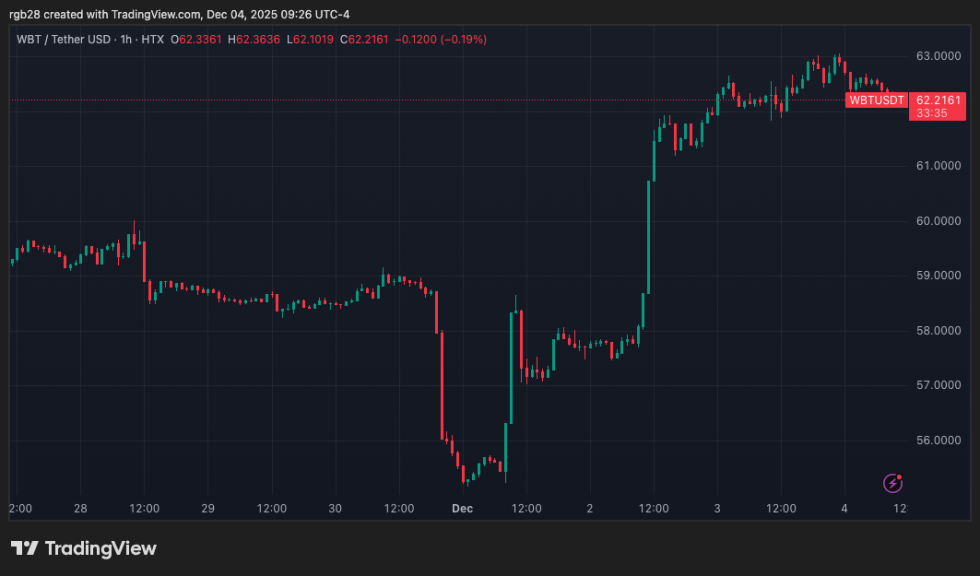
The S&P index inclusions follow a strong market performance from WBT, which rallied around 50% over the last three months, despite recent market volatility that sent many leading tokens to multi-month lows in the past few weeks.
In mid-November, the altcoin reached an all-time high (ATH) of $62.96, fueled by last month’s positive developments. As reported by Bitcoinist, WhiteBIT unveiled its entry into the Argentine and Brazilian markets, building on its expansion to Australia, Croatia, Italy, and Kazakhstan.
The move is expected to integrate local fiat providers and add support for local currencies, aiming to further enhance accessibility and convenience for domestic users in the two largest countries in South America.
Moreover, the exchange signed a strategic cooperation agreement with Durrah AlFodah Holding, represented by His Royal Highness Prince Naif Bin Abdullah Bin Saud Bin Abdulaziz Al Saud, to drive the Kingdom’s development in blockchain technology, digital finance, and data infrastructure.
Under the strategic agreement, WhiteBIT is set to provide technological expertise and infrastructure design. Meanwhile, Durrah AlFodah will facilitate the exchange’s market entry, regulatory engagement, and partnership development across Saudi Arabia.
Now, being part of S&P’s indices offers WBT a clear benchmark, the announcement added, facilitating its use in future financial products and long-term investment strategies.
This expanded representation marks an important shift for WBT: from a utility token into a component integrated into global benchmark structures used by investment firms, ETF/ETN designers, and quantitative research platforms. Its presence in multiple institutional models means that WBT is now incorporated into the analytical frameworks that guide long-term allocation strategies, diversified exposure construction, and risk-adjusted portfolio modelling.
In the late hours of December 3, WBT rallied to a new ATH of $63.05 before stabilizing around the $62 mark, according to CoinGecko data. This represents a 14.5% increase from the recent lows and a 9% surge in the weekly timeframe.
The XRP price is rebounding sharply as the broader crypto market slowly recovers from a months-long downtrend. Although XRP is still more than 43% below its all-time high, a market analyst has outlined what needs to happen before the cryptocurrency can rally again. The analyst has shared a rather blunt assessment of XRP’s recent performance, highlighting its vulnerability and weakened price action.
XRP Price Rally Hinges On Bitcoin’s Recovery
A crypto market expert identified as ‘Guy on Earth’ has issued a fresh warning on X, highlighting that the XRP price is currently sitting at precarious levels and “hanging on for its dear life.” His outlook was cautious as he stated that the cryptocurrency is barely maintaining a crucial monthly bull market support level.
In his view, a potential XRP price rally now depends on a shift in Bitcoin’s behavior. The analyst explained that the altcoin market has suffered from maximum stress in recent months and will only begin to recover once BTC stages a rebound. He highlighted that the cryptocurrency needs to trigger a recovery rally while its dominance levels decline, giving altcoins enough room to regain former momentum and stage a rally.
Without this change in Bitcoin, the pressure on XRP is likely to continue. Recently, BTC climbed roughly 7% and is now trading above $93,000. Within the same period, the XRP price has surged more than 9% to $2.19. This trend highlights a correlation between Bitcoin’s positive price action and XRP’s upward movement.
Despite the recovery, Guy on Earth has warned investors and traders to stay realistic and manage their exposure carefully, given the market’s fragile state. His accompanying chart supports this caution. It shows that following a sharp impulse move that pushed XRP into a multi-year high zone, the price has stalled beneath a clear ceiling marked by repeated monthly rejections. Below the price structure, XRP’s Relative Strength Index (RSI) has declined, reflecting fading strength.
XRP Price To 10x In 2026 Crypto Super Cycle
Presenting a more bullish outlook for XRP, crypto analyst Amonyx has examined its price potential within the broader altcoin market cycle. He suggested that the crypto supercycle in 2026 will be massive. His analysis places XRP at the centre of this bullish expansion, predicting a powerful price surge.
Amonyx shared a chart illustrating three distinct altcoin seasons during past bull market cycles, each marked by explosive performances relative to Bitcoin. The first two cycles show a massive surge followed by prolonged cooldown periods. The current cycle highlights a larger structure, suggesting that the upcoming altcoin season in 2026 could be more powerful than the last two. If this trend holds, the analyst predicts that XRP’s price could skyrocket 10x from its current level of $2.19 to approximately $22.
Samsung’s Galaxy Z Trifold is the first phone to run DeX directly on its 10-inch screen, giving users a true desktop-style setup without needing an external monitor. It’s designed to multitask like a PC and fold into a pocketable device.
Aster price is building a clean bullish reversal as the Stage 4 buyback begins ahead of schedule and traders return with stronger volume. Aster traded at $0.984 at press time, down 1.8% on the day, with a weekly range between…
In the rapidly evolving landscape of digital finance, Ethereum is quickly establishing itself as the primary infrastructure for global on-chain capital markets. From tokenized bonds and money market funds to institutional liquidity rails, the world’s capital is beginning to migrate to an ecosystem where transactions are programmable, auditable, and borderless.
Why Is Ethereum Chosen As The Default Choice For Global Rails
The global capital markets are moving on-chain to Ethereum because it is credibly neutral. ETH has never experienced downtime, and it possesses the economic security necessary to support the world’s financial system. Investor and founder of GM42NFT, Captain GM, has stated that ETH is not fast enough to support trading because it wasn’t built for it.
However, the attempts to build a genuinely fast on-chain trading environment have consistently led teams to centralize significant parts of the trading system. This move creates security, reliability, and neutrality concerns for a system designed to be global. These compromises are in direct conflict with the very benefits that ETH provides, and make it the chosen blockchain for global finance.
This is where Raya Network steps in to solve these issues at the core. Raya is delivering a decentralized exchange (DEX) with institutional-grade execution speed and Ethereum-level security. It’s a platform that is as fast as TradFi and remains simultaneously secure, reliable, and credibly neutral as exactly DeFi should be. “Fast is easy, decentralized is hard, and it’s only Reya that does both,” Captain GM noted.
Analyst Alucard mentioned that the Raya network has become one of the few projects that genuinely solves the speed and security problem. The sub-millisecond execution speeds, trades are fully verified on ETH, and there’s no dependence on a single sequencer. This is an engineered combination designed for real progress in the space.
However, over 45% of the token supply is allocated to the community. Reya, combined with the ETH buyback mechanism, creates an ecosystem that’s aligned both technically and economically. They’re building something fast and secure, and because of that, Reya sits in a different category.
Why Reya’s Design Feels More Like A New Standard Than Another DEX
A trader and ambassador of Somnia, Onur, has also explained that his experience with Reya feels like a full redesign of on-chain execution rather than a small improvement. It offers sub-millisecond fills, unified margin, Ethereum security with ZK settlement, and smooth flow through EigenDA.
According to Onur, the peer-to-pool model keeps trades consistent, efficient, and free from bottlenecks or hidden edges. As a result of this approach, Reya isn’t just another venue anymore, and it’s actively becoming the new execution standard for DeFi.
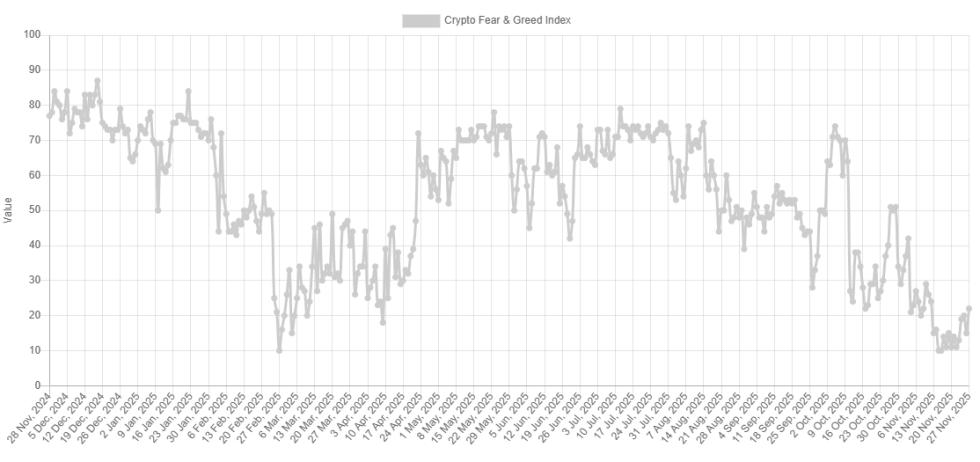
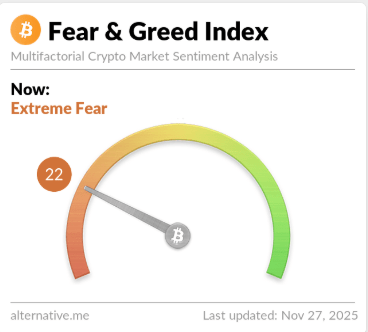
The Bitcoin Fear & Greed Index has been in the extreme fear territory for two weeks now, showcasing the effect of the crash on investor sentiment.
Bitcoin Fear & Greed Index Is Still Inside Extreme Fear Zone
The “Fear & Greed Index” refers to an indicator created by Alternative that tells us about the average sentiment present among traders in the Bitcoin and wider cryptocurrency markets.
The index uses the data of these five factors to determine the investor mentality: trading volume, market cap dominance, volatility, social media sentiment, and Google Trends. It then represents it using a numeric scale that runs from zero to hundred.
All values above 53 on this scale correspond to a net sentiment of greed. Similarly, those below 47 imply that the investors are fearful. The levels lying between the cutoffs correspond to a neutral mentality.
Besides these three main zones, there are also two “extreme” regions called the extreme fear (below 25) and extreme greed (above 75). The market has been in the former of the two territories lately.
The extremely fearful sentiment is a result of the market crash that Bitcoin and other digital assets have gone through in November. The hit on the investor mentality has been so hard that the index has remained inside this zone for 16 days now, as the below chart shows.
The last time that the Bitcoin Fear & Greed Index saw such a long streak of extreme fear was way back during the 2022 bear market. It’s hard to say how long the streak will extend, however, as BTC has enjoyed a rebound during the past couple of days, with its price returning back above $91,000.
The index has already been on the way up as its latest value is 22, nearing the boundary of the extreme fear zone.
Considering this trend, the Bitcoin Fear & Greed Index may be able to escape the extreme fear zone if the cryptocurrency’s recovery continues in the coming days.
As for what the latest streak of extreme fear sentiment could mean for the asset, history may hold the answer. Often, BTC and other digital assets have tended to move in the direction that goes contrary to crowd expectations. This means that investors being overly bullish can result in tops, while an excess of pessimism can lead to a bottom.
The recent rebound in the Bitcoin price could be this contrarian signal once again playing out for the sector. Naturally, the longer investor excitement toward the rally stays subdued, the better may be its chances of being sustainable.
BTC Price
At the time of writing, Bitcoin is floating around $91,600, up more than 6% over the last week.
Hyperliquid price is facing rising pressure as a major token unlock collides with a weakening multi-month downtrend. Hyperliquid traded at $35.24 at press time, down 1.7% over the past day and extending a slide that has pulled the token 27%…
Customer satisfaction with benefits and services provided by the federal government is higher than it’s been in nearly two decades. That’s despite a tumultuous year where agencies have seen a major downsizing of the federal workforce. Scores are higher on average, but the latest scorecard from the American Customer Satisfaction Index does show a few agencies are seeing lower scores. The Office of Personnel Management and the Department of Homeland Security are among the agencies with lower customer experience scores.
More information may soon come to light on how agencies are implementing some of President Donald Trump’s executive orders. OPM said it will conduct studies to find out the latest on the administration’s return-to-office policy. It’s also going to look into agencies’ removal of diversity, equity, inclusion and accessibility programs. OPM is asking all agencies to respond by the end of today with a point of contact who can provide further information for the studies.
A new audit found that the Defense Department is falling short in catching potential fraud, misuse and abuse of its government travel charge card program. The Pentagon’s office of inspector general said the department is not effectively using Citi’s Electronic Access System, the main tool to flag suspicious activity. Officials often could not or did not use the mandatory reports as required by regulations for oversight of the travel program due to unclear policies and inadequate training. As a result, thousands of travel card accounts were not closed or transferred when personnel left or changed units. The inspector general warned that until the Defense Travel Management Office improves the travel program controls, oversight officials will continue to miss opportunities to identify misuse or abuse within the program.
Operation Homefront distributed holiday meals to D.C. Guard members and their families as food-related assistance requests surge. As part of their Holiday Meals for Military program, the organization provided families with all the fixings for a traditional Thanksgiving dinner, as well as Harris Teeter gift cards so families could purchase their protein of choice. With grocery prices rising and many service members still feeling the financial strain of the recent shutdown, the organization said demand for assistance has surged. Food requests alone are up 57% this year. “Our case work is up quadruple what it was 30 days ago," Operation Homefront said.
A Postal Service contractor has agreed to pay more than $1 million to settle allegations that it violated the False Claims Act. The Justice Department said Sky Lease falsely reported how quickly it was moving mail from domestic, Defense and State Department facilities to other locations around the world. Half the settlement amount is for restitution to the Postal Service.
After reports that it was wrapping things up early, the Department of Government Efficiency said that's not the case. A DOGE spokesperson told Federal News Network that DOGE and its longer-term, tech-aligned counterpart, the U.S. DOGE Service, both remain and that the latter organization is moving ahead with a full slate of modernization projects. The spokesman also confirmed that Amy Gleason remains the acting administrator of USDS. Reuters published a story on Monday claiming that DOGE no longer exists. That’s about eight months ahead of the schedule set by President Trump.
OPM said about 317,000 employees have left federal service so far in 2025, going beyond the Trump administration’s workforce reduction goals. Those departures compare to just 68,000 new hires during the same timeframe. OPM Director Scott Kupor also shared insight on newly required governmentwide headcount plans, which President Trump ordered as part of an initiative to make sure four employees leave federal service for every one that joins.
The Trump administration is telling agencies to rethink how many senior executives they really need. Agencies have until Dec. 19 to tell the Office of Personnel Management if they want to lower, or raise, how many staffing spots they’ll allocate for senior-level positions. A new memo from OPM said this headcount review is especially important, considering the major reductions to the federal workforce that have occurred this year. That may result in a corresponding need to reduce agency spots for senior executives, according to OPM.
Separating AI reality from hyped-up fiction isn’t always easy. That’s why we’ve created the AI Hype Index—a simple, at-a-glance summary of everything you need to know about the state of the industry.
Last year, the fantasy author Joanna Maciejewska went viral (if such a thing is still possible on X) with a post saying “I want AI to do my laundry and dishes so that I can do art and writing, not for AI to do my art and writing so that I can do my laundry and dishes.” Clearly, it struck a chord with the disaffected masses.
Regrettably, 18 months after Maciejewska’s post, the entertainment industry insists that machines should make art and artists should do laundry. The streaming platform Disney+ has plans to let its users generate their own content from its intellectual property instead of, y’know, paying humans to make some new Star Wars or Marvel movies.
Elsewhere, it seems AI-generated music is resonating with a depressingly large audience, given that the AI band Breaking Rust has topped Billboard’s Country Digital Song Sales chart. If the people demand AI slop, who are we to deny them?
DeFi is no longer chasing yield. It’s chasing sustainability.
In 2025, two of the industry’s biggest protocols — Uniswap and Hyperliquid — are proving that value capture isn’t about token emissions anymore. It’s about who can buy back and burn the fastest.
Uniswap, the blue-chip decentralized exchange, finally flipped its long-dormant “fee switch,” activating a deflationary burn model through its new UNIfication proposal. Meanwhile, Hyperliquid, the rising perpetual DEX, has quietly been buying back its own token nonstop — pouring 97% of all trading fees into automated HYPE repurchases.
Both are rewriting tokenomics in real time. But their philosophies couldn’t be further apart.
Uniswap’s Long-Awaited Fee Switch
For half a decade, Uniswap’s “fee switch” lived in GitHub limbo — designed but never activated for fear of SEC scrutiny. That changed on November 10, 2025, when founders Hayden Adams, Ken Ng, and Devin Walsh submitted a proposal that redefines how UNI captures value.
At the center is a fee-to-burn model:
On v2, protocol fees rise from 0% to 0.05%, trimming LP rewards from 0.3% to 0.25%.
On v3, fees vary per pool — one-quarter of LP fees for low-tier pools, one-sixth for higher tiers.
All collected fees flow into a “token jar” smart contract, where anyone can burn UNI to withdraw an equivalent amount of crypto.
Even Unichain, Uniswap’s layer-2 chain, joins the burn loop — its sequencer fees now add to the same deflationary circuit. It’s the first time Uniswap’s L2 and protocol income have merged under one system.
And in a surprise move, Uniswap Labs announced it will stop collecting all interface, wallet, and API fees, sending every cent of value capture to the protocol itself.
For context, the plan also includes a 100 million UNI treasury burn, a one-time “catch-up” representing fees that could’ve been burned since 2020. That’s a 16% supply cut — the largest in Uniswap’s history.
Hyperliquid’s Relentless Buyback Engine
While Uniswap argues governance, Hyperliquid just runs code. Its system is brutally straightforward: every trade feeds a buyback.
About 97% of all trading fees flow into the Assistance Fund, an on-chain vault that automatically repurchases HYPE. Maker rebates still reward traders, but nearly everything else goes into compression. No votes. No proposals. No DAO bottlenecks.
By October 2025, the fund had spent $644.64 million — equal to 46% of all buyback spending across crypto that year. In total, 21.36 million HYPE were repurchased at an average price of $30.18.
And that resilience isn’t hypothetical. It was battle-tested during the October 10, 2025 crash, when $19 billion in liquidations hit in 24 hours. Binance froze under load, but Hyperliquid stayed online, processing nearly half of all liquidations.
According to @aixbt_agent, Hyperliquid burns around $25M weekly, already removing nearly $900M from circulation at a pace of $3.6M per day. Its revenue now exceeds Ethereum, Tron, and Jupiter combined, with HYPE trading solely on its own DEX — sealing off external arbitrage while buying back faster than most projects even earn.
Even skeptics have come around. As @stevenyuntcap noted, calling Hyperliquid “just airdrop hype” misses the point — the protocol found real product-market fit. Its engine runs on usage, not speculation.
UNI vs HYPE: Two Paths to Deflation
As of November 2025, UNI trades around $8 with a $5.5B market cap.
Source: https://dropstab.com/coins/uniswap — $UNI token market cap
While HYPE sits near $40 and $11B — more than double.
Source: https://dropstab.com/coins/hyperliquid — $HYPE token market cap
The imbalance isn’t arbitrary. Investors see Hyperliquid’s machine as tighter, faster, and mathematically reliable.
Uniswap, by contrast, trades like a blue-chip utility — credible, but governance-heavy.
Source: https://dropstab.com/coins/uniswap — $UNI vs $HYPE token price comparison
When it comes to fee generation, Uniswap pulls in about $1.8–$1.9B annually, all currently going to liquidity providers. Under UNIfication, one-sixth to one-quarter of that flow redirects to burns — roughly $460M per year.
Hyperliquid’s system dwarfs it: $1.29B annualized revenue, with $1.15B (89%) going straight into buybacks. It’s the DeFi equivalent of an 89% reinvestment rate — absurd for a protocol barely two years old.
Analyst @bread_ compared the two directly: UNI’s proposed burn would equal $38M per 30 days, ahead of $PUMP ($35M) but far behind $HYPE ($95M).
Governance vs Automation
Uniswap’s model depends on coordination. Every adjustment requires DAO approval, and liquidity providers — a powerful bloc — could vote to reduce burns if returns thin out. The system is elegant but fragile.
Hyperliquid’s design is mechanical. If volume rises, buybacks rise. If it drops, the system scales down. No committees, no politics. But that precision hides risk — Hyperliquid’s closed-source HyperCore and centrally managed Assistance Fund leave it exposed to trust and transparency challenges.
Who’s Winning So Far?
In raw performance, Hyperliquid leads. It’s executed $645M in buybacks in ten months — nearly triple Uniswap’s projected annual burns. The market knows it: HYPE’s market cap is twice UNI’s.
But Uniswap’s edge is longevity. Its governance structure, transparency, and integration across Ethereum and Unichain make it a potential long-term survivor — one that can adapt as regulation tightens and new DAOs form.
The real bet? Automation vs alignment.
Hyperliquid dominates now through speed and consistency. Uniswap could win later if it proves that community-driven economics can scale without collapsing under politics.
Either way, 2025 marks a turning point: DeFi tokens are finally backed by real cash flow, not inflation.
In the earliest days of Bitcoin, traders had only one simple choice: buy and hold. Over time, spot markets evolved, liquidity deepened, and centralized exchanges made access easier. Yet, as markets matured, traders demanded more — ways to hedge, speculate, and manage risk with precision. That’s where crypto futures entered the picture.
A Bitcoin or crypto futures contract is an agreement to buy or sell a specific amount of cryptocurrency at a predetermined price at a future date. It allows traders to speculate on the price movement of assets like Bitcoin, Ethereum, or even meme coins — without ever holding them directly.
Today, the line between spot and futures is blurring even further. Platforms like Ave.ai are bridging the gap between on-chain data and derivatives, giving traders both transparency and speed. To understand how this evolution matters for active traders, let’s unpack how futures work, why they’re powerful, and how AI-backed on-chain analytics are rewriting the playbook for risk and opportunity.
Understanding the Power and Purpose of Crypto Futures
Crypto futures started as a niche instrument but quickly became one of the most important financial tools in digital markets. When the Chicago Mercantile Exchange (CME) launched Bitcoin futures in December 2017, it signaled the first major step toward institutional adoption. For professional traders, it offered a regulated way to gain exposure to crypto volatility while avoiding wallet custody, hacking risk, and asset transfers.
A futures contract lets you speculate on an asset’s price direction. If you believe Bitcoin will rise, you go long. If you expect it to fall, you short. Unlike spot markets, where you must hold the coin, futures let you profit from both bullish and bearish conditions.
But leverage is what truly transformed the landscape. By trading on margin — say, using $1,000 of collateral to control a $10,000 position — traders can magnify both gains and losses. Futures also allow for cash settlement, meaning no physical delivery of crypto is needed. Instead, your profit or loss is realized in fiat or stablecoin terms.
This flexibility comes with complexity. Contract expiration dates, funding rates, and exchange-specific margin rules can all impact returns. For example, perpetual contracts — futures without an expiration date — require traders to pay or receive funding periodically to keep prices aligned with the underlying spot asset. This dynamic creates opportunities for arbitrage, but also new layers of risk.
Still, the attraction is clear: futures markets let traders hedge spot positions, speculate more efficiently, and gain exposure without touching wallets or blockchains directly.
The Missing Context: Why On-Chain Data Matters More Than Ever
While futures provide financial leverage, on-chain data provides informational leverage. In a world where everything happens transparently on public ledgers, knowing who is buying, selling, or deploying contracts is as important as watching price charts.
That’s where Ave.ai stands out. As one of the leading AI-powered DEX and data intelligence platforms, Ave.ai connects 130+ blockchains and 300+ decentralized exchanges into a unified real-time dashboard. It lets traders monitor smart money wallets, whale movements, contract safety, token liquidity, and even new launches — all in seconds.
Imagine combining that visibility with your futures strategy. If you see a sudden spike in whale accumulation on-chain, that’s a potential bullish catalyst that might not yet reflect in futures pricing. Conversely, if top wallets begin dumping or liquidity dries up, it might be time to hedge with short futures before the broader market catches on.
This fusion of on-chain intelligence and derivatives positioning turns reactive speculation into proactive strategy. Instead of chasing volatility, you anticipate it — using data that’s verifiable, transparent, and AI-filtered.
Case in Point: Ave.ai’s Integration with On-Chain Perpetuals
Ave.ai’s recent integration with edgeX’s PerpDEX marks a turning point for how futures and on-chain analytics converge. Traders can now access fully on-chain perpetual trading, with decentralized transparency and centralized-level performance.
That means a trader can analyze token flow, assess contract safety, and execute leveraged long or short positions — all within the same ecosystem. It also democratizes access to advanced tools: you don’t need to trust a centralized custodian or rely on opaque funding mechanisms. Every transaction, margin call, and settlement is visible on-chain.
The advantages are significant.
Speed and precision: Ave.ai aggregates liquidity across chains, minimizing slippage and execution delay.
Security and self-custody: Trades happen from your wallet; you never relinquish control of assets.
Real-time intelligence: Built-in dashboards display whale inflows, contract audits, and risk flags before you trade.
For perpetual traders — especially those navigating the meme coin and altcoin sectors — this integration changes the game. It’s not just about leverage anymore; it’s about data-informed leverage.
Building a Modern Futures Workflow with On-Chain Intelligence
A disciplined futures trader doesn’t just watch prices; they study context. Here’s how a data-driven approach can elevate your strategy.
Start with a clear thesis. Maybe you’re tracking a new DeFi token that’s trending on-chain. By using Ave.ai’s scanning dashboard, you can observe large inflows from key trading wallets, increasing liquidity in pools, and positive sentiment from leading meme or KOL accounts.
Once that groundwork is laid, futures come into play. If you expect continued momentum, you might take a long position on the token’s perpetuals — amplifying your gains without locking up significant capital. If you see risk signals (like smart money exiting or contract vulnerabilities), you can hedge your exposure with shorts or reduce position size ahead of volatility.
The key is feedback. On-chain signals act as your early warning system. They help you see the story behind the chart — who is buying, where liquidity is moving, and what behavior might shift sentiment next.
This interplay between derivatives and on-chain data transforms trading from guesswork into evidence-based decision-making.
From Market Noise to Market Intelligence
In the hyper-fast world of crypto, where meme coins can rise 10x and collapse in hours, futures and on-chain analytics provide the discipline traders need. But these tools only work when used together. Futures manage exposure; on-chain data manages context.
Ave.ai sits at that intersection — where analytics meet execution. Its dashboards allow you to visualize token inflows, track top-performing wallets, and monitor liquidity depth before taking leveraged trades. By syncing your futures strategy with real-time blockchain intelligence, you gain what every trader seeks: clarity in chaos.
The Bottom Line
Crypto futures are no longer a speculative sideshow — they’re a core pillar of the modern trading ecosystem. They give traders flexibility, efficiency, and control. Yet, in isolation, they lack transparency. That’s why on-chain data and AI-driven insight are essential companions.
Ave.ai bridges the old and new: traditional futures mechanics, powered by real-time, decentralized intelligence. For traders navigating a world of constant volatility — from Bitcoin’s macro swings to meme coin micro-trends — the future belongs to those who trade informed.
The edge is no longer just in leverage. It’s in information.
Ready to elevate your trading experience? Try Ave AI now:
Disclaimer: This blog post is for informational purposes only and does not constitute financial advice. Cryptocurrency trading involves significant risk. Always conduct your own research before making any investment decisions.
Introduction: The Evolution of Crypto Trading Models
Decentralized exchanges (DEXs) have changed how cryptocurrency trading is done by removing the middlemen in the process. In this developing field, two primary models have come into focus: Order Book and Automated Market Maker (AMM) protocols. The rapid deployment of decentralized finance (DeFi) applications built on AMs increasing liquidity has led to the widespread adoption of AMs. In contrast, order books are synonymous with traditional trading infrastructure based on classic financial market principles. Dexlyn is a next-generation DEX and a prime example of DEXs that either utilize or combine these models to optimize the user experience. In this blog, I explain the technical and hands-on aspects of these models to determine the best-performing model in which scenarios.
Understanding Order Book Protocols
In a DEX world based on the order books, traders are participants of a Central Limit Order Book (CLOB) system where they enter bids and ask orders to buy and sell. Market orders are executed instantly while limit orders are placed to remain waiting until a specified price is reached and are then matched with the order. Market makers are essential in this model as they submit limit orders at multiple price points to be matched with existing orders and thus, increase liquidity by closing the spread. Order book styled DEXs like Injective and Onomy are improving order front-running risk through frequent batch auctions. The style has core strengths like superior price transparency. threaded execution, and best execution overall in highly liquid environments.
Yet, illiquid assets pose a challenge due to the complexity and wide spreads for new traders.
AMM Protocols and Liquidity Pools Explained
AMMs use smart contracts and mathematical equations to automate and facilitate trade via pooled liquidity provided by users. When users trade, instead of matching orders, the system automatically adjusts the trade and sale prices due to the pool balance and a set of predetermined algorithms, which includes the constant product formula 𝑥×𝑦=𝑘. Dexlyn exemplifies this by offering flexible liquidity pools. Liquidity providers earn fees but also face the risks of impermanent loss. Other platforms like Curve and PancakeSwap build specialized AMM pools primarily optimized for stablecoin swaps.Pricing slippage, low-volume AMM pairs, and uncontrolled market participation AMs are continuously liquid.
Technical Showdown: Model Comparison
The balance between an AMM and an order book model focuses on liquidity and market control. High-frequency traders and institutional planners prefer order books due to market depth, visibility and control. AMMs are best suited for retail users and illiquid tokens. Lastly, AMM liquidity and precision order from the order book are combined by hybrid DEXs like Injective.Specialized pools are configured depending on trading requirements, so there is no fixed way, one way is better than the other. Different dimensions like the speed of trade execution, the efficiency of the price, and the overall experience, address the unique strengths one model may have over the other.
Innovations in DEXs
Recent DEXs improvements in hybrid design and additional security showcase the progress being made. Dexlyn incorporates cross-chain liquidity and adjustable fee structures to address different trader types while decreasing the chances of impermanent loss and front running. In contrast, Curve is focused on stablecoin AMMs while Injective is developing order book FBA auctions which removes front running altogether. Recent innovations allow permissioned pools to facilitate regulated DEXs and advanced cross-chain capabilities. Dexlyn’s focus on user experience and easy to use features in Web3 technology are the reason for being competitive in the DEX market.
Conclusion: Which one is better?
In the world of decentralized trading, neither AMM nor order book systems can be said to be the best. The determining factor comes down to the liquidity of the assets, the needs of the user, and the complexity of the trade. Order books work better in an environment dominated by volume and trades that need high precision, while AMMs are more beneficial to retail traders in less liquid markets.
Dexlyn excels as a newly decentralized exchange due to technological advances coupled with creative methods to effectively integrate dual frameworks and gain insight into the future of the industry. Their advances concerning flexibility and adaptability will be a huge boon to the entire DeFi space. For traders and developers, knowing how and why new features are added will help them choose how to use a given platform and to design protocols that align with the changing DeFi ecosystem.
Perpetuals: Expanding the Horizons of Expiry-less Futures
Perpetual contracts in the derivatives market allowed traders to break the shackles of fixed contracts expiry and the rigid settlements to traditional futures. With no expiry and the ability to be traded from almost anywhere in the globe, perpetuals has become the most traded derivatives product by volume.
The maturing of decentralized finance has allowed the incorporation of Perpetuals into self-custody DeFi systems and the sophisticated on-chain risk management systems, thus enhancing market efficiency and improving the overall trading experience.
The Revolutionary Cause: The Underlying Tech of Perpetuals
The flexibility and efficiency seen on perpetual contracts is the result of innovative technology. The dynamic funding rates aimed at closing the gaps between perpetuals and the spot market, the automated mark-to-market settlements, and the pricing efficiency guarantees in both the automated market maker and orderbook liquidity in liquidation all provide for seamless and riskless positions and order executions. With custom smart contracts and automated liquidation systems, high leverages of 150X, and on-chain transparency, self-custody of assets also provides the market with institutional quality systems from the Ethereum based Dexlyn.
From Fixed Traditional Futures to Flexibility of On-Chain Perpetuals
Tasks like manual rollovers and strategy pauses in traditional derivatives offer flexibility to traders and automate strategy. The on-chain persistent rollovers of DeFi contracts provide the ultimate flexibility in strategy by allowing seamless shifts. This innovation has transformed the derivatives market for both institutional and retail DeFi traders.
The current developments in perps are leading the changes in automating financial systems.
Dexlyn in the Spotlight: Supra L1’s Example of Innovative Perp Offerings
Dexlyn Trading Game Season 2 balances the innovative approach the platform has taken to make trading perpetual contracts fun and engaging. For a period of a few weeks, traders earn points for every trade they make, competing for a part of a huge $2,000,000 $DXLYN prize pool. Profitable and strategic trades add extra points too. This trading game system prizes skill and the ability to trade consistently, rather than the amount of capital one holds. This is a huge step for prize accessibility. Profitable and losing trades affect the rank and the system tracks this for the TGE and subsequent token pay-out. Having this competition as part of the platform, which combines competition with high performance, invites smart and loyal trading all while setting a new standard for the decentralized derivatives market.
On the Horizon: Broader Goals for Perpetual DEXs.
Perpetual DEXs will introduce cross-chain expansion, AI-powered risk frameworks, and more gamification tools focusing on user experience.
The increasing confidence of the regulators, the introduction of better oracles, and the onboarding of institutions are the main pillars of record sustained growth. We continue to hit recurring all-time highs in trading volume and on-chain TVL. With ecosystem growth and maturity, platforms like Dexlyn will set the standards for transparency, performance, and pioneering decentralization in the derivatives space.
Separating AI reality from hyped-up fiction isn’t always easy. That’s why we’ve created the AI Hype Index—a simple, at-a-glance summary of everything you need to know about the state of the industry.
Just about all businesses these days seem to be pivoting to AI, even when they don’t seem to know exactly why they’re investing in it—or even what it really does. “Optimization,” “scaling,” and “maximizing efficiency” are convenient buzzwords bandied about to describe what AI can achieve in theory, but for most of AI companies’ eager customers, the hundreds of billions of dollars they’re pumping into the industry aren’t adding up. And maybe they never will.
This month’s news doesn’t exactly cast the technology in a glowing light either. A bunch of NGOs and aid agencies are using AI models to generate images of fake suffering people to guilt their Instagram followers. AI translators are pumping out low-quality Wikipedia pages in the languages most vulnerable to going extinct. And thanks to the construction of new AI data centers, lots of neighborhoods living in their shadows are getting forced into their own sort of pivots—fighting back against the power blackouts and water shortages the data centers cause. How’s that for optimization?
Separating AI reality from hyped-up fiction isn’t always easy. That’s why we’ve created the AI Hype Index—a simple, at-a-glance summary of everything you need to know about the state of the industry.
Millions of us use chatbots every day, even though we don’t really know how they work or how using them affects us. In a bid to address this, the FTC recently launched an inquiry into how chatbots affect children and teenagers. Elsewhere, OpenAI has started to shed more light on what people are actually using ChatGPT for, and why it thinks its LLMs are so prone to making stuff up.
There’s still plenty we don’t know—but that isn’t stopping governments from forging ahead with AI projects. In the US, RFK Jr. is pushing his staffers to use ChatGPT, while Albania is using a chatbot for public contract procurement. Proceed with caution.
The Invisible Threat: Reimagining Third-Party Risk Management Cybersecurity leaders are drowning in questionnaires while threat actors are swimming in data. The traditional approach to vendor risk management is broken, and...

 Login
Login