From left: Microsoft CFO Amy Hood, CEO Satya Nadella, Vice Chair Brad Smith, and Investor Relations head Jonathan Nielsen at Friday’s virtual shareholder meeting. (Screenshot via webcast)
Microsoft’s annual shareholder meeting Friday played out as if on a split screen: executives describing a future where AI cures diseases and secures networks, and shareholder proposals warning of algorithmic bias, political censorship, and complicity in geopolitical conflict.
One shareholder, William Flaig, founder and CEO of Ridgeline Research, quoted two authorities on the topic — George Orwell’s 1984 and Microsoft’s Copilot AI chatbot — in requesting a report on the risks of AI censorship of religious and political speech.
Flaig invoked Orwell’s dystopian vision of surveillance and thought control, citing the Ministry of Truth that “rewrites history and floods society with propaganda.” He then turned to Copilot, which responded to his query about an AI-driven future by noting that “the risk lies not in AI itself, but in how it’s deployed.”
In a Q&A session during the virtual meeting, Microsoft CEO Satya Nadella said the company is “putting the person and the human at the center” of its AI development, with technology that users “can delegate to, they can steer, they can control.”
Nadella said Microsoft has moved beyond abstract principles to “everyday engineering practice,” with safeguards for fairness, transparency, security, and privacy.
Brad Smith, Microsoft’s vice chair and president, said broader societal decisions, like what age kids should use AI in schools, won’t be made by tech companies. He cited ongoing debates about smartphones in schools nearly 20 years after the iPhone.
“I think quite rightly, people have learned from that experience,” Smith said, drawing a parallel to the rise of AI. “Let’s have these conversations now.”
Microsoft’s board recommended that shareholders vote against all six outside proposals, which covered issues including AI censorship, data privacy, human rights, and climate. Final vote tallies have yet to be released as of publication time, but Microsoft said shareholders turned down all six, based on early voting.
While the shareholder proposals focused on AI risks, much of the executive commentary focused on the long-term business opportunity.
Nadella described building a “planet-scale cloud and AI factory” and said Microsoft is taking a “full stack approach,” from infrastructure to AI agents to applications, to capitalize on what he called “a generational moment in technology.”
Microsoft CFO Amy Hood highlighted record results for fiscal year 2025 — more than $281 billion in revenue and $128 billion in operating income — and pointed to roughly $400 billion in committed contracts as validation of the company’s AI investments.
Hood also addressed pre-submitted shareholder questions about the company’s AI spending, pushing back on concerns about a potential bubble.
“This is demand-driven spending,” she said, noting that margins are stronger at this stage of the AI transition than at a comparable point in Microsoft’s cloud buildout. “Every time we think we’re getting close to meeting demand, demand increases again.”
As more AI (artificial intelligence) technologies emerge, competition among them will intensify, and rankings of the best to worst may shift. Currently, the most significant AI models are Google Gemini, Microsoft CoPilot, OpenAI ChatGPT, and Apple Intelligence.
Microsoft has lowered sales growth targets for its AI agent products after many salespeople missed their quotas in the fiscal year ending in June, according to a report Wednesday from The Information. The adjustment is reportedly unusual for Microsoft, and it comes after the company missed a number of ambitious sales goals for its AI offerings.
AI agents are specialized implementations of AI language models designed to perform multistep tasks autonomously rather than simply responding to single prompts. So-called “agentic” features have been central to Microsoft’s 2025 sales pitch: At its Build conference in May, the company declared that it has entered “the era of AI agents.”
The company has promised customers that agents could automate complex tasks, such as generating dashboards from sales data or writing customer reports. At its Ignite conference in November, Microsoft announced new features like Word, Excel, and PowerPoint agents in Microsoft 365 Copilot, along with tools for building and deploying agents through Azure AI Foundry and Copilot Studio. But as the year draws to a close, that promise has proven harder to deliver than the company expected.
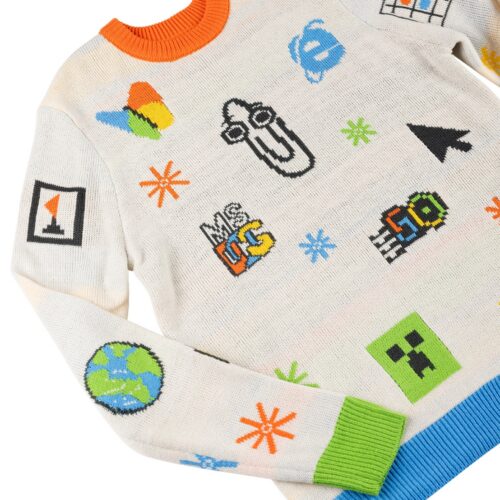
I can take or leave some of the things that Microsoft is doing with Windows 11 these days, but I do usually enjoy the company’s yearly limited-time holiday sweater releases. Usually crafted around a specific image or product from the company’s ’90s-and-early-2000s heyday—2022’s sweater was Clippy themed, and 2023’s was just the Windows XP Bliss wallpaper in sweater form—the sweaters usually hit the exact combination of dorky/cute/recognizable that makes for a good holiday party conversation starter.
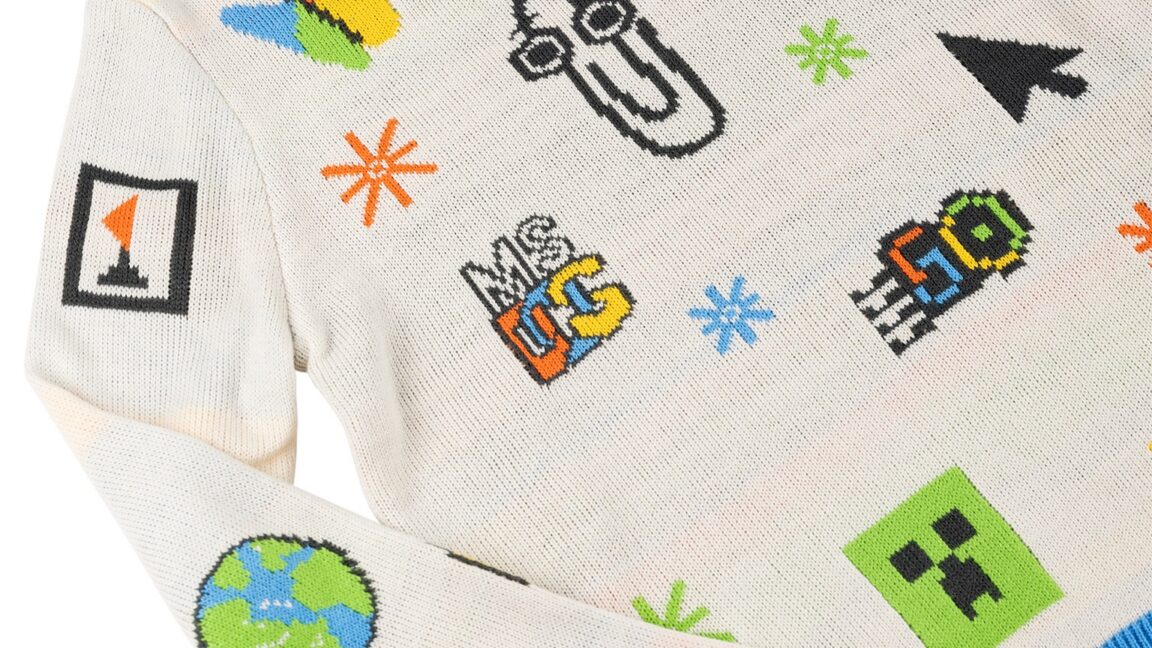
Microsoft is reviving the tradition for 2025 after taking a year off, and the design for this year’s flagship $80 sweater is mostly in line with what the company has done in past years. The 2025 “Artifact Holiday Sweater” revives multiple pixelated icons that Windows 3.1-to-XP users will recognize, including Notepad, Reversi, Paint, MS-DOS, Internet Explorer, and even the MSN butterfly logo. Clippy is, once again, front and center, looking happy to be included.
Not all of the icons are from Microsoft’s past; a sunglasses-wearing emoji, a “50” in the style of the old flying Windows icon (for Microsoft’s 50th anniversary), and a Minecraft Creeper face all nod to the company’s more modern products. But the only one I really take issue with is on the right sleeve, where Microsoft has stuck a pixelated monochrome icon for its Copilot AI assistant.
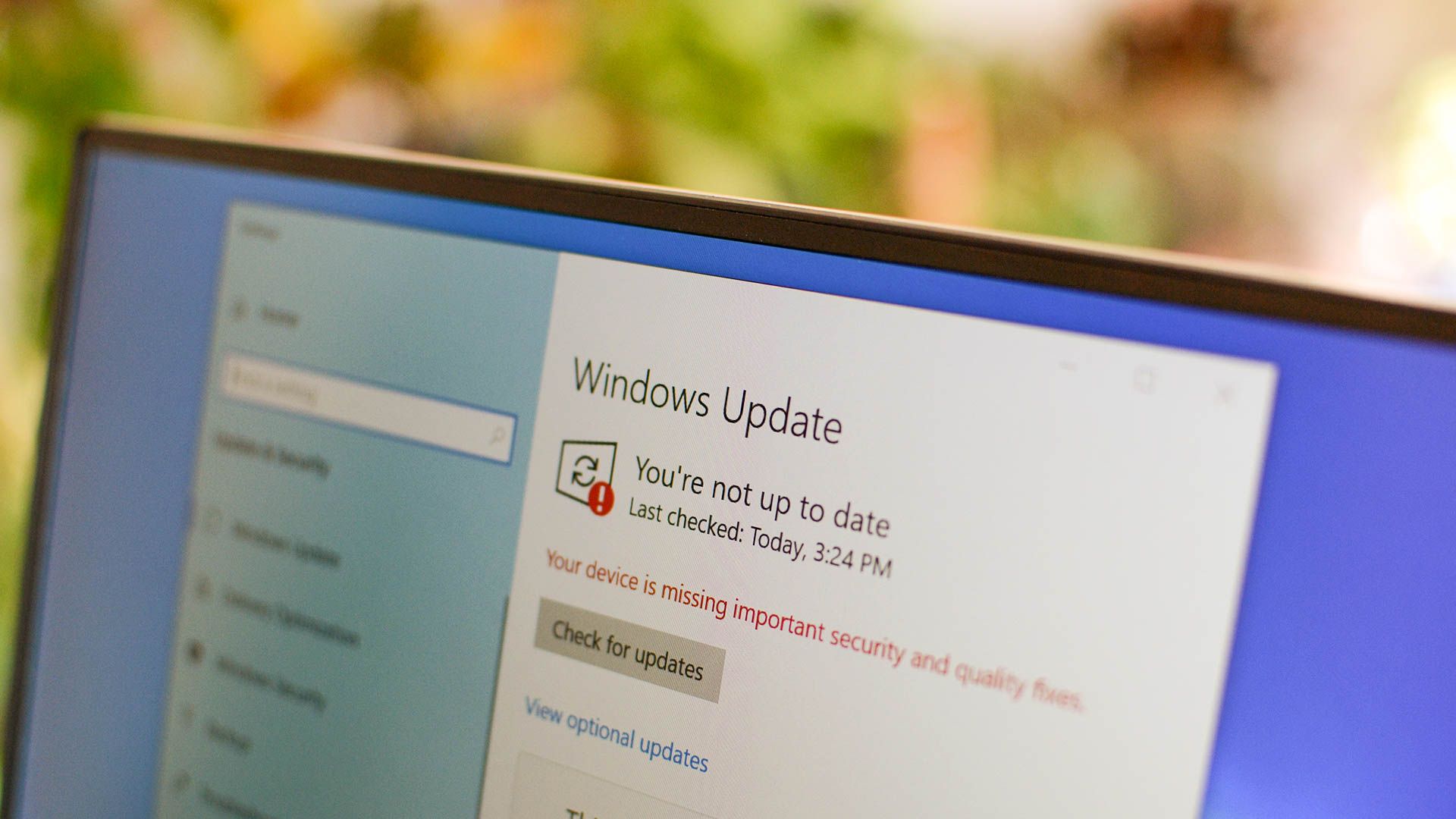
Another year, another long list of changes to Windows that "nudge" you into making choices or adopting behaviors that aren't in your interest. At some point, it really feels like Windows stopped existing to make the actual users of PCs happier, and now serve a different master. I think these changes are the most worrying.
Cybersecurity firm Cato Networks reveals HashJack, a new AI browser vulnerability using the '#' symbol to hide malicious commands. Microsoft and Perplexity fixed the flaw, but Google's Gemini remains at risk.
Microsoft’s Copilot will stop working on WhatsApp in January 2026, as Meta bans general-purpose AI chatbots, forcing users to move chats to official apps.
Microsoft’s Copilot will stop working on WhatsApp in January 2026, as Meta bans general-purpose AI chatbots, forcing users to move chats to official apps.
Microsoft’s warning on Tuesday that an experimental AI agent integrated into Windows can infect devices and pilfer sensitive user data has set off a familiar response from security-minded critics: Why is Big Tech so intent on pushing new features before their dangerous behaviors can be fully understood and contained?
As reported Tuesday, Microsoft introduced Copilot Actions, a new set of “experimental agentic features” that, when enabled, perform “everyday tasks like organizing files, scheduling meetings, or sending emails,” and provide “an active digital collaborator that can carry out complex tasks for you to enhance efficiency and productivity.”
Hallucinations and prompt injections apply
The fanfare, however, came with a significant caveat. Microsoft recommended users enable Copilot Actions only “if you understand the security implications outlined.”
Microsoft has been adding AI features to Windows 11 for years, but things have recently entered a new phase, with both generative and so-called “agentic” AI features working their way deeper into the bedrock of the operating system. A new build of Windows 11 released to Windows Insider Program testers yesterday includes a new “experimental agentic features” toggle in the Settings to support a feature called Copilot Actions, and Microsoft has published a detailed support article detailing more about just how those “experimental agentic features” will work.
If you’re not familiar, “agentic” is a buzzword that Microsoft has used repeatedly to describe its future ambitions for Windows 11—in plainer language, these agents are meant to accomplish assigned tasks in the background, allowing the user’s attention to be turned elsewhere. Microsoft says it wants agents to be capable of “everyday tasks like organizing files, scheduling meetings, or sending emails,” and that Copilot Actions should give you “an active digital collaborator that can carry out complex tasks for you to enhance efficiency and productivity.”
But like other kinds of AI, these agents can be prone to error and confabulations and will often proceed as if they know what they’re doing even when they don’t. They also present, in Microsoft’s own words, “novel security risks,” mostly related to what can happen if an attacker is able to give instructions to one of these agents. As a result, Microsoft’s implementation walks a tightrope between giving these agents access to your files and cordoning them off from the rest of the system.
Kiro’s ghost mascot assists an action-figure developer on a miniature set during a stop-motion video shoot in Seattle, part of an unconventional social marketing campaign for Amazon’s AI-powered software development tool. (GeekWire Photo / Todd Bishop)
Can the software development hero conquer the “AI Slop Monster” to uncover the gleaming, fully functional robot buried beneath the coding chaos?
That was the storyline unfolding inside a darkened studio at Seattle Center last week, as Amazon’s Kiro software development system was brought to life for a promotional video.
Instead of product diagrams or keynote slides, a crew from Seattle’s Packrat creative studio used action figures on a miniature set to create a stop-motion sequence. In this tiny dramatic scene, Kiro’s ghost mascot played the role that the product aims to fill in real life — a stabilizing force that brings structure and clarity to AI-assisted software development.
No, this is not your typical Amazon Web Services product launch.
Kiro (pronounced KEE-ro) is Amazon’s effort to rethink how developers use AI. It’s an integrated development environment that attempts to tame the wild world of vibe coding, the increasingly popular technique that creates working apps and websites from natural language prompts.
But rather than simply generating code from prompts, Kiro breaks down requests into formal specifications, design documents, and task lists. This spec-driven development approach aims to solve a fundamental problem with vibe coding: AI can quickly generate prototypes, but without structure or documentation, that code becomes unmaintainable.
A close-up of Kiro’s ghost mascot, with the AI Slop Monster and robot characters in the background. (GeekWire Photo / Todd Bishop)
It’s part of Amazon’s push into AI-powered software development, expanding beyond its AWS Code Whisperer tool to compete more aggressively against rivals such as Microsoft’s GitHub Copilot, Google Gemini Code Assist, and open-source AI coding assistants.
The market for AI-powered development tools is booming. Gartner expects AI code assistants to become ubiquitous, forecasting that 90% of enterprise software engineers will use them by 2028, up from less than 14% in early 2024. A July 2025 report from Market.us projects the AI code assistant market will grow from $5.5 billion in 2024 to $47.3 billion by 2034.
Amazon launched Kiro in preview in July, to a strong response. Positive early reviews were tempered by frustration from users unable to gain access. Capacity constraints have since been resolved, and Amazon says more than 250,000 developers used Kiro in the first three months.
The internet is “full of prototypes that were built with AI,” said Deepak Singh, Amazon’s vice president of developer agents and experiences, in an interview last week. The problem, he explained, is that if a developer returns to that code two months later, or hands it to a teammate, “they have absolutely no idea what prompts led to that. It’s gone.”
Kiro solves that problem by offering two distinct modes of working. In addition to “vibe mode,” where they can quickly prototype an idea, Kiro has a more structured “spec mode,” with formal specifications, design documents, and task lists that capture what the software is meant to do.
Now, the company is taking Kiro out of preview into general availability, rolling out new features and opening the tool more broadly to development teams and companies.
‘Very different and intentional approach’
As a product of Amazon’s cloud division, Kiro is unusual in that it’s relevant well beyond the world of AWS. It works across languages, frameworks, and deployment environments. Developers can build in JavaScript, Python, Go, or other languages and run applications anywhere — on AWS, other cloud platforms, on-premises, or locally.
That flexibility and broader reach are key reasons Amazon gave Kiro a standalone brand rather than presenting it under the AWS or Amazon umbrella.
AWS Chief Marketing Officer Julia White (right) on set with Zeek Earl, executive creative director at Packrat, during the stop-motion video shoot for Amazon’s Kiro development tool. (Amazon Photo)
It was a “very different and intentional approach,” said Julia White, AWS chief marketing officer, in an interview at the video shoot. The idea was to defy the assumptions that come with the AWS name, including the idea that Amazon’s tools are built primarily for its own cloud.
White, a former Microsoft and SAP executive who joined AWS as chief marketing officer a year ago, has been working on the division’s fundamental brand strategy and calls Kiro a “wonderful test bed for how far we can push it.” She said those lessons are starting to surface elsewhere across AWS as the organization looks to “get back to that core of our soul.”
With developers, White said, “you have to be incredibly authentic, you need to be interesting. You need to have a point of view, and you can never be boring.” That philosophy led to the fun, quirky, and irreverent approach behind Kiro’s ghost mascot and independent branding.
The marketing strategy for Kiro caused some internal hesitation, White recalled. People inside the company wondered whether they could really push things that far.
Her answer was emphatic: “Yep, yep, we can. Let’s do it.”
Amazon’s Kiro has caused a minor stir in Seattle media circles, where the KIRO radio and TV stations, pronounced like Cairo, have used the same four letters stretching back into the last century. People at the stations were not exactly thrilled by Amazon’s naming choice.
Early user adoption
With its core audience of developers, however, the product has struck a nerve in a positive way. During the preview period, Kiro handled more than 300 million requests and processed trillions of tokens as developers explored its capabilities, according to stats provided by the company.
Amit Patel (left), director of software engineering for Kiro, and Deepak Singh (right), Amazon’s vice president of developer agents and experiences, at AWS offices in Seattle last week. (GeekWire Photo / Todd Bishop)
Rackspace used Kiro to complete what they estimated as 52 weeks of software modernization in three weeks, according to Amazon executives. SmugMug and Flickr are among other companies espousing the virtues of Kiro’s spec-driven development approach. Early users are posting in glowing terms about the efficiencies they’re seeing from adopting the tool.
Kiro uses a tiered pricing model based on monthly credits: a free plan with 50 credits, a Pro plan at $20 per user per month with 1,000 credits, a Pro+ plan at $40 with 2,000 credits, and a Power tier at $200 with 10,000 credits, each with pay-per-use overages.
With the move to general availability, Amazon says teams can now manage Kiro centrally through AWS IAM Identity Center, and startups in most countries can apply for up to 100 free Pro+ seats for a year’s worth of Kiro credits.
New features include property-based testing — a way to verify that generated code actually does what developers specified — and a new command-line interface in the terminal, the text-based workspace many programmers use to run and test their code.
A new checkpointing system lets developers roll back changes or retrace an agent’s steps when an idea goes sideways, serving as a practical safeguard for AI-assisted coding.
Amit Patel, director of software engineering for Kiro, said the team itself is deliberately small — a classic Amazon “two-pizza team.”
And yes, they’ve been using Kiro to build Kiro, which has allowed them to move much faster. Patel pointed to a complex cross-platform notification feature that had been estimated to take four weeks of research and development. Using Kiro, one engineer prototyped it the next day and shipped the production-ready version in a day and a half.
Patel said this reflects the larger acceleration of software development in recent years. “The amount of change,” he said, “has been more than I’ve experienced in the last three decades.”
From empty offices in 2020 to AI colleagues in 2025, the way we work has been completely rewired over the past five years. Our guest on this week’s GeekWire Podcast studies these changes closely along with her colleagues at Microsoft.
As Stallbaumer explains in the book, the five-year period starting with the pandemic and continuing to the current era of AI represents one continuous transformation in the way we work, and it’s not over yet.
“Change is the only constant—shifting norms that once took decades to unfold now materialize in months or weeks,” she writes. “As we look to the next five years, it’s nearly impossible to imagine how much more work will change.”
Listen below for our conversation, recorded on Microsoft’s Redmond campus. Subscribe on Apple or Spotify, and continue reading for key insights from the conversation.
The ‘Hollywood model’ of teams: “What we’re seeing is this movement in teams, where we’ll stand up a small squad of people who bring their own domain expertise, but also have AI added into the mix. They come together just like you would to produce a film. A group of people comes together to produce a blockbuster, and then you disperse and go back to your day job.”
The concept of the ‘frontier firm’: “They’re not adding AI as an ingredient. AI is the business model. It’s the core. And these frontier firms can have a small number of people using AI in this way, generating a pretty high run rate. So it’s a whole new way to think about shipping, creating, and innovating.”
The fallacy of ‘AI strategy’: “The idea that you just need to have an ‘AI strategy’ is a bit of a fallacy. Really, you kind of want to start with the business problem and then apply AI. … Where are you spending the most and where do you have the biggest challenges? Those are great areas to actually think about putting AI to work for you.”
Adapting to AI: “You have to build the habit and build the muscle to work in this new way and have that moment of, ‘Oh, wait, I don’t actually need to do this.’ “
The biggest risk related to AI: “The biggest risk is not AI in and of itself. It’s that people won’t evolve fast enough with AI. It’s the human risk and ability to actually start to really use these new tools and build the habit.”
Human creativity and AI: “It still takes that spark and that seed of creativity. And then when you combine it with these new tools, that’s where I have a lot of hope and optimism for what people are going to be able to do and invent in the future.”
The optional new “Mico” persona is derived from the Microsoft Copilot name.
Microsoft is rolling out a series of updates to its consumer Copilot AI assistant, including shared group chats, long-term memory, and an optional visual persona named Mico.
New capabilities include a “real talk” conversation style, a Learn Live feature that acts as a voice-enabled Socratic tutor, new connectors that link to services like Google Drive, Gmail, and Outlook, and deeper integration with Microsoft’s Edge browser.
Microsoft is competing against AI tools including Google’s Gemini, Amazon’s Alexa, Apple’s revamped Siri, OpenAI’s ChatGPT, and Anthropic’s Claude in the consumer market.
It looks to be the single biggest Copilot update to date from the group led by Mustafa Suleyman, the Google DeepMind co-founder who joined Microsoft last year as its AI CEO.
“This release is a milestone for what AI can deliver,” Suleyman writes in a blog post, explaining that the idea is to make Copilot a comprehensive assistant that connects users to their personal information, contacts, and tools with the goal of improving their lives.
The features are rolling out starting today in the U.S, and the company says they will be available soon in the UK, Canada, and other parts of the world. Microsoft is showing the new features in the live stream below.

 Login
Login