Reading view

There are new articles available, click to refresh the page.

‘Stablecoins Are Here To Stay’: IMF Calls For Global Cooperation To Prevent Financial Risks

As stablecoins continue to gain worldwide momentum, the International Monetary Fund (IMF) has called for global cooperation to avert potential macro financial stability risks related to the rapidly growing sector and to turn the industry “into a force for good.”

Stablecoins To Foster Innovation, Financial Inclusion

On Thursday, the IMF released a 56-page report discussing the growing influence of stablecoins, their potential use cases in mainstream financial markets, and the risks associated with the sector’s varying oversight.

Amid the sector’s rapid growth, the organization highlighted that the two largest stablecoins, USDT and USDC, have tripled their market capitalization since 2023, reaching a combined $260 billion. Meanwhile, their trading volume has increased by around 90% to $23 trillion in 2024, with Asia surpassing North America in stablecoin activity volume.

stablecoins

The IMF noted two major potential benefits from stablecoins. First, they could enable faster and cheaper cross-border payments, especially for remittances, which can cost 20% of the amount being sent and face some delays.

However, “being a single source of information, blockchains can greatly simplify the processes linked with cross-border payments and reduce costs,” the Fund’s economists explained in a blog post.

Second, stablecoins could expand financial access, driving innovation by increasing competition with established payment service providers, therefore, making retail digital payments more accessible to underserved customers.

They could facilitate digital payments in areas where it is costly or not profitable for banks to serve customers. Many developing countries are already leapfrogging traditional banking with the expansion of mobile phones and different forms of digital and tokenized money.

Notably, competition with already established providers could lower costs and lead to enhanced product diversity, “leveraging synergies between digital payments and other digital services.”

IMF Warns Of Fragmented Oversight

Despite their potential benefits, stablecoins also carry significant risks, the IMF explained, including de-pegging and collapsing if the underlying assets lose value or if users lose confidence in the ability to cash out. Per the report, this could also trigger fire sales of the reserve assets and disrupt financial markets.

Stablecoins could also accelerate a “currency substitution” dynamic, where individuals and companies abandon their national currency in favor of a foreign one, like US dollars or euros, due to instability or high inflation.

The organization noted that the dynamic decreases a country’s central bank’s ability to control its monetary policy and serve as the lender of last resort, damaging the financial sovereignty of affected nations.

In addition, the potential to reduce cross-border frictions and make faster and cheaper transactions could be undermined by a lack of interoperability if various networks are unable to connect or are restricted by different regulations and other hurdles.

“Stablecoin regulation is in its infancy, so the ability to mitigate these risks remains uneven across countries,” the organization affirmed, noting that “the IMF and the Financial Stability Board have issued recommendations to safeguard against currency substitution, maintain capital flow controls, address fiscal risks, ensure clear legal treatment and robust regulation, implement financial integrity standards, and strengthen global cooperation.”

As reported by Bitcoinist, the FSB vowed in October to address the evolving threats from private finance and the growing use of stablecoins, promising to increase the global watchdog’s policy response and overhaul its surveillance system to make it more flexible and quicker.

Nonetheless, major jurisdictions have taken different stances in key areas, as the IMF detailed, which could result in the exploitation of gaps between jurisdictions and issuers to locate where oversight is weaker.

All this underscores the need for strong international cooperation to mitigate macrofinancial and spillover risks (…). Tokenization and stablecoins are here to stay. But their future adoption and the outlook for this technology are still mostly unknown.

The organization concluded that “improving the existing global financial infrastructure might be easier than replacing it. Achieving the best possible balance will require close cooperation among policymakers, regulators, and the private sector.”

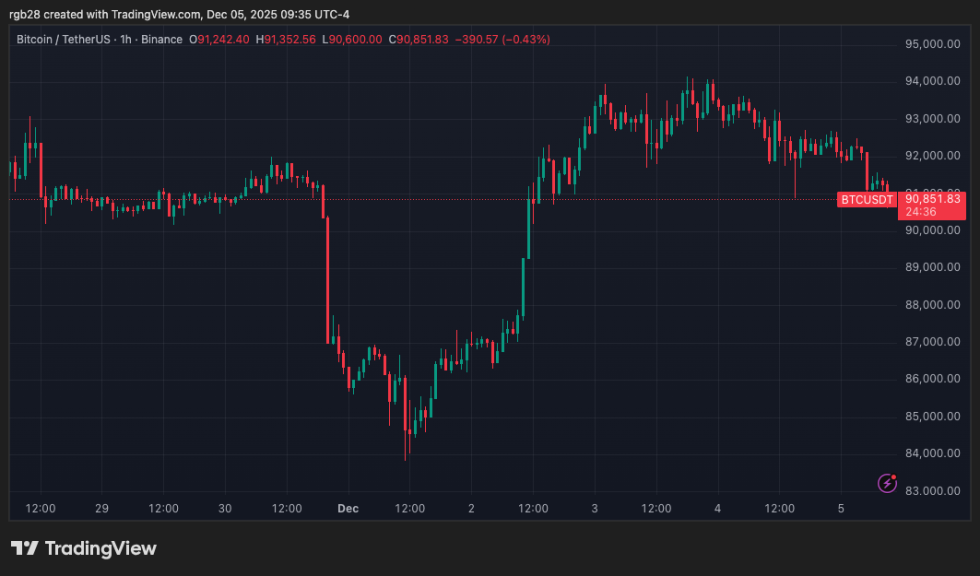
stablecoins, bitcoin, btc, btcusdt

Committee Republicans advance House bill to overhaul the federal probationary period

Lawmakers on the House Oversight and Government Reform Committee have advanced a slew of federal workforce bills, one of which aims to make some significant changes to the federal probationary period.

The GOP-led EQUALS Act was one of about a dozen bills that passed favorably out of the committee on Tuesday. If enacted, it would require new federal employees to serve a two-year probationary period, doubling the length that most newly hired or promoted currently face.

Under the bill, agencies also would have to actively certify that a probationary employee “advances the public interest” before the employee can become officially tenured, while those who are not certified would be removed from their jobs. The legislation advanced in a party line vote of 24-19.

Rep. Brandon Gill (R-Texas), who introduced the legislation, said the EQUALS Act builds on an April executive order from President Donald Trump, which similarly required agencies to review and actively sign off on probationary workers’ continued employment.

“President Trump could not be more right,” Gill said. “Probationary periods and trial periods are long-standing, essential tools to ensure newly hired federal employees are sufficiently performing before their appointments are finalized permanently.”

Democrats on the committee criticized the Republicans’ bill, arguing that extending the length of the probationary period would negatively impact federal recruitment, as well as open the doors to more terminations of new hires in the government.

“This bill would double the time during which federal employees have limited due process and appeal rights as probationary employees. During this time they could be fired within 30 days’ notice, they have limited rights to an attorney or representative and they generally cannot appeal their removal,” Oversight Committee Ranking Member Robert Garcia (R-Calif.) said Tuesday. “At a time when Donald Trump is attempting illegal mass firings and purging experts from agencies across our government, this bill is a dangerous step in the wrong direction.”

Rep. James Walkinshaw (D-Va.) added that the EQUALS Act would “give the Trump administration yet another tool to weaponize against federal employees who they perceive as ideological threats, and to continue efforts to destroy the non-partisan civil service.”

Gill, however, argued that the bill would not lead to mass terminations, but instead only make sure that new federal employees are carefully reviewed. He also pointed to a 2015 report from the Government Accountability Office, as well as a 2005 report from the Merit Systems Protection Board, both of which call for reforms to the probationary period.

“An employee can often work for the federal government for over 25 years,” Gill said. “Having an extra year of probationary status to ensure the right employee becomes tenured is a common sense, good government measure.”

During the committee meeting, Rep. Stephen Lynch (D-Mass.) motioned to strike the EQUALS Act and replace it with legislation to first require GAO to review effects of prior probationary period extensions before making any long-term changes. Lynch’s amendment was struck down by the committee’s Republican majority.

Legislation on official time advances

Committee Republicans also advanced a bill that would require agencies to report in greater detail the use of official time by federal employees governmentwide. The Official Time Reporting Act passed out of the committee in a vote of 24-19 along party lines.

If enacted, the bill would require all agencies to submit reports on how much official time is used in each fiscal year, and justify any potential increases in official time that may occur.

During the committee meeting, Republican lawmakers argued that official time takes away from employees’ job responsibilities. Rep. Virginia Foxx (R-N.C.), the lead co-sponsor on the bill, also criticized the lack of agencies’ reporting on official time over the last several years.

The bill “will let the American people know exactly how much of their hard-earned money is spent not providing valuable service, but on federal employee union activities,” Foxx said.

Some committee Democrats, however, described the legislation as an attack on union rights. The lawmakers emphasized that official time is used for activities that support federal employees, while raising concerns about the possibility that the bill could let the Trump administration further limit union rights.

“This year under the Trump administration, federal employees have faced job insecurity, financial strain and the loss of collective bargaining agreements. This bill will make matters worse,” Rep. Maxwell Frost (D-Fla.) said. “We all benefit when unions and their members are empowered to prevent and address retaliation, discrimination and sexual harassment.”

Generally, official time hours can go toward negotiating union contracts, meeting with management, filing grievances or representing employees dealing with management disputes. Under law, federal unions are allotted specific amounts of time and resources to conduct these activities.

Federal unions, including the American Federation of Government Employees, have pushed back against the Trump administration’s characterization of official time as “taxpayer-funded union time,” calling it a misrepresentation.

During Tuesday’s meeting, Garcia argued that official time leads to lower staff turnover and higher employee morale, while also preventing potential legal costs down the road.

“Official time is work time that employees are allowed to use for making the workplace safe and protecting workers from discrimination or harassment,” he said.

Committee approves some bills with bipartisan support

In contrast, some legislation that the committee approved on Tuesday gained strong bipartisan support from lawmakers. That includes bills on training for federal supervisors, skills-based hiring of federal contractors and amending the system for relocation payments for federal employees.

The Federal Supervisor Education Act, for instance, unanimously advanced out of the Oversight committee in a vote of 43-0. If enacted, the legislation would require agencies to work with OPM to create training programs for newly hired or promoted agency managers and supervisors.

Rep. William Timmons (R-S.C.), who introduced the legislation in October, argued during Tuesday’s meeting that many federal supervisors step into leadership roles without enough training, and with no clear expectations for how to adjust to a managerial role in government.

“Agencies promote strong technical employees into supervisory jobs, and then send them in blind,” Timmons said. “That leads to low productivity, uneven standards and a system where good employees feel unsupported and bad employees rarely face consequences.”

Timmons added that the legislation would result in “real, meaningful training,” rather than being “a slideshow or a checkbox exercise.”

Although he said he mostly agreed with the bill’s intentions, Walkinshaw proposed striking one provision of the legislation. The initial bill text included a requirement that supervisory training programs must include additional training on the probationary period — something that Walkinshaw argued was outside the bill’s scope.

Committee Republicans agreed to adopt Walkinshaw’s amendment, after saying that it would result in stronger bipartisan support for the bill. Ultimately, the legislation advanced unanimously, with the amendment included.

“I am a strong supporter of the goal of this legislation,” Walkinshaw said. “Almost all of the language will provide supervisors within the federal workforce the appropriate training and resources to ensure there are strong leaders within their respective agencies.”

The post Committee Republicans advance House bill to overhaul the federal probationary period first appeared on Federal News Network.

© AP Photo/Mariam Zuhaib

From Capitol Hill to GSA, Katy Kale has spent decades behind the scenes making government work

Interview transcript:

Terry Gerton: Well, I want to start by congratulating you on your election as a NAPA fellow, a group that’s near and dear to my heart.

Katy Kale: Yes, I know it is very near and dear to your heart. I am thrilled to be part of this organization, one that I have really looked up to for many years.

Terry Gerton: It’s always interesting to look back at the history of folks who get elected. You’ve spent years in key operational roles across government, Capitol Hill to GSA. Tell us what first drew you into public administration and why you stuck with it for so long.

Katy Kale: Thank you for asking that question. I really have always believed that public service is more than a job. It’s truly a calling, which is something that we heard a lot at the NAPA conference last week. For me, it’s also part of my family legacy. So I am a third-generation public servant. My mother, my uncle, my grandfather, all public servants before me. And I actually got my first government job in the federal government as a page in the U.S. House of Representatives when I was in high school.

Terry Gerton: Wow.

Katy Kale: And from there, I just knew that this is what I wanted to do. So I grew up in Massachusetts, but came down to Virginia, went to George Mason University, majored in government and politics, worked for a civic education group before I then went back to the Hill. And as you said, I worked for four different senators. I was a senior leader at the White House. And then most recently, I was the deputy administrator at a wonderful agency, which is the U.S. General Services Administration. I also was, during that time, during the last administration, I was chair of the U.S. Access Board as well, which is a very small, sometimes unknown agency that makes sure that all people, and especially people with disabilities, have access to their federal buildings, to their federal websites. And I had the honor of expanding my own experiences by taking on that job as well.

Terry Gerton: Katy, as you look back at all of those years of service, all of those diverse organizations that you worked in, is there a moment or a project or an initiative that really stands out as especially meaningful to you? Something that makes you think, ‘That is why I do this work?’

Katy Kale: So Terry, I think that you know this more than most, like the thing about being a public administrator is that so much of what we do is behind the scenes. And most people out in the public often only notice something when it goes wrong or goes sideways. But every day, public servants are creating this really efficient and effective government that works and makes life easier for people. And so we really plan for our good days, but we also are always watching out and figuring out what we have to do on bad days and making sure that we can create contingency plans and make sure that the public really doesn’t know what could have happened. And because of that, I think that a lot of public administrators and public servants in general measure their careers in maybe these like small wins that add up as opposed to one big visible accomplishment. Now, that said, I am very proud of the work that I’ve done, especially the teams that I’ve been part of and what we’ve been able to achieve together. And I’ll give you two quick ones. One is back in like 2008-2009, I was the director of operations for the Obama-Biden presidential transition team. And during that time, I worked closely with not only GSA, but also the outgoing team from President Bush’s administration. And I think that what I’ve been seeing a lot lately, and especially anytime transitions come up, is that this group of people were really able to execute one of the most successful transition of presidential powers. And I’m very proud of that. At the same time, figuring out what it was going to look like on Inauguration Day and really just kind of overseeing that daily operations, facilities, technology, human resources, security, all those little things again that are behind the scenes, but really add up over time. The second one is much more recent. It is back in 2021 when I returned to GSA. And at that point, I was both the deputy administrator, but I was also the acting administrator. And it was at the height of the pandemic and the agency and the people were really facing this kind of uncertainty and low engagement, low morale. And really, we realized that we needed to reimagine how and where government work happened. I was tapped to co-chair a cross-government task force. It’s a mouthful, it’s the Safer Federal Workforce Task Force. But there, we developed policies and procedures that we made sure were consistent in messaging. Not only throughout the government but within an agency itself. And knowing that there were so many more unknowns than knowns, we wanted to make sure that we were able to iterate as the situation was changing. And then within GSA, I wanted to make sure that we were leading by example and we really took a look at every position and determine whether it was an on-site position or if it was eligible for remote work. We made sure that we were polling our workforce to see what additional equipment that they needed to do the people’s work either at home or at the office. We asked for feedback often and made sure that we were responding to that feedback. So that feedback loop and because of that, I’m very proud to say that GSA was one of the top five places to work in government during those years, which were really tough years for a lot of people.

Terry Gerton: That’s right. I’m speaking with Katy Kale. She’s a former deputy administrator of GSA and a newly-elected fellow of the National Academy of Public Administration. What would you say if you were speaking to someone just starting out now? What advice would you give them about building a career in public service?

Katy Kale: I love this question because I’ve received it so many times over my career. And I’ve gotten the question a couple of times lately, too. At first, I thought maybe it’s different than it was a year ago, almost a year ago when I left the administration. But I think it’s the same. And the first one is to say thank you, right? Thank you for choosing public service. And there is a lot of very important work that needs to be done at all levels of government: federal, state, local, and not only today, but well into the future. And we really need people who have talent and we need their passion and we need creativity, which often is overlooked. And I think to an individual, I would recommend that they do what they enjoy. There is a place for just about any career within public service. Often, people only think about the policymakers or the elected officials when they’re thinking about government and public service, but it really includes so many career choices and career paths. Just thinking about folks that I’ve worked for: statisticians to building managers to police and security officers to astronauts. There’s so many jobs from the private sector that translate into the public sector and connect you to a mission-driven organization. I think the other thing is really to succeed in public service, you need humility, you need to be authentic, you need a sense of humor certainly helps. And you really need to connect with a purpose that is greater than yourself. And a lot of it is not an individual work, it is really teamwork. I used to work for an organization and they would say that democracy is not a spectator sport. And I loved that. But I think over time, I’ve really realized that democracy, and especially public service, is a team sport. We all need to work together and I’m really looking at the next generation to join us and really step up and continue to make a difference.

The post From Capitol Hill to GSA, Katy Kale has spent decades behind the scenes making government work first appeared on Federal News Network.

© Courtesy Katy Kale

Katy Kale

POGO has new recommendations to improve the 2026 NDAA before it’s finalized

Interview transcript:

Terry Gerton: You’ve recently laid out a mix of reforms and warnings and priorities for the 2026 National Defense Authorization Act, which is still moving through Congress. What’s the overall message before we dig into the specifics that POGO wants to send about this year’s recommendations?

Greg Williams: Sure. I think we all welcome all of the extraordinary work that Congress has done this year to produce two different versions of NDAA bills that work very hard to overhaul military acquisition. Now that said, they place an enormous emphasis on deregulating military acquisition, with the Senate’s version repealing no fewer than 86 distinct statutes that govern military acquisition. Now, Congress has its own research arm to help inform for these decisions, and that’s the Government Accountability Office. Now the Government Accountability Office maintains a database of suggestions. And last I checked, there were 750 recommendations they had for how the Defense Department is run and exactly none of them recommend repealing any statutes having to do with military acquisition. Now I think the unavoidable question is if Congress doesn’t seem to be listening to the GAO, its own investigative body, well, who is it listening to? I think it’s only logical to wonder to what extent these changes are being pushed by the defense industry, perhaps at the expense of the interests of the taxpayer.

Terry Gerton: Are you seeing any specifics in the NDAA that relate back to those 750 GAO suggestions?

Greg Williams: Frustratingly few. Two that I’ll call out that I think are really important are passages in both the House and Senate versions that secure greater right to repair the military’s own equipment. Just imagine you’re far from home, you have a piece of equipment that you rely on, perhaps for your safety or in order to be able to complete your mission, and it breaks. Right now, there are rules, laws, contracts that often get in the way of military personnel fixing those things. This year’s NDAA, whether the Senate or the House versions prevail in this context, will dramatically increase the military’s right to repair its own equipment. And I think it’s really important that those passages survive conference. The other one that I think is particularly important in terms of acquisition law are some reforms to what’s called the Nunn-McCurdy Act, which stipulates that Congress needs to be informed if weapons development or procurement programs breach certain cost thresholds and requires that the Secretary of Defense or Secretary of War recertify those programs and provide updated timetables and budgets for their completion. So the passages that amend that provide Congress more say in the recertification of those programs and they make it easier to call out cost overages, especially in the case of large programs like naval shipbuilding, where if you look at the overall program, you may not have breached overall cost thresholds. But you’ve already built two or three ships and you can tell that they’re way over budget. What this passage allows you to do is to treat them as distinct subprograms and apply those thresholds to them individually.

Terry Gerton: Well, you’re right. There’s certainly a lot of coverage in the NDAA, both versions, around acquisition reform. One of the other pieces that POGO has really called out is the use of military force. First, you recommend that the authorizations for the use of military force from 1991 and 2002 tied to operations in Iraq be repealed. Why is it so important to take those off the books now?

Greg Williams: Well, those AUMFs have been used very pervasively to authorize all kinds of use of violence around the world that seem to have very little to do with the original intentions of those two AUMFs. And one of the ways Congress can clarify the use of its power to decide when and where we go to war is by not leaving things like that lying around to be potentially misinterpreted or reinterpreted by the executive branch.

Terry Gerton: I’m speaking with Greg Williams. He’s the director of the Center for Defense Information at the Project on Government Oversight. Greg, let’s follow up on this a little bit because there are conversations happening between the president and his team and Congress right now about operations in Venezuela. So how do those AUMFs relate to those kinds of current conversations?

Greg Williams: Well, I’m going to emphasize that there are operations against Venezuelan nationals and Venezuelan boats, and they’re being treated by the administration as being very distinct from potential operations that might take place in Venezuela. And in fact, the administration is arguing that they don’t need to comply with the War Powers Act in the context of the Venezuelan boats because we’re not deploying troops in harm’s way. As you may know, these boat strikes are believed to be largely conducted by unmanned aerial vehicles and so arguably, American troops are never in any danger as we execute these strikes. Now if we were to invade Venezuela or if we were to fly crewed aircraft over Venezuela or even close to Venezuela and engage in a shooting war with them, that would more clearly trigger the requirements of the War Powers Act, or at least that would not be subject to the exclusion that the Trump administration has called out in the context of those boats.

Terry Gerton: One of the other concerns that you raise about military deployments is border enforcement and the use of military forces in that function. What’s the concern there?

Greg Williams: Well, the overall concern is that what we’re seeing is a steady erosion of what we thought were bright lines, protecting both American citizens and others against being arbitrarily seized or killed. And whether we see those lines blurred outside our borders, as in the context of these boats or inside of our borders, it just makes us all a lot less safe. It’s much harder to count on not being swept up in some raid and potentially deported to a foreign country without any meaningful opportunity to defend our rights.

Terry Gerton: Well, military deployments and acquisition reform are really big topics. I want to pull you down to something a little more wonky and talk cost accounting standards because you’ve got a recommendation in here and there’s been a lot of conversation about moving DoD from cost accounting standards to GAAP, Generally Accepted Accounting Principles. Why was that important enough to raise in your memo?

Greg Williams: I think it represents a fundamental misunderstanding of how accounting in general works. And it undermines a very basic control that any customer organization wants to have over vendors that are submitting things like expense reports. So at a high level, I would describe the generally accepted accounting principles as a set of tools that are created by an industry consortium to protect shareholders in private organizations from misrepresentation of the value of the enterprise. Cost accounting standards are like the expense report guidelines that any consultant or anyone who’s ever worked as a customer for a big business has to comply with. And different customers have different standards. Some say you can’t have any alcohol at all with your dinner, some say you can have one drink. Some say if you’ve traveled less than 50 miles, you can’t submit any meal-related expenses. It represents an agreement between the customer and their vendor about what is and is not an acceptable expense. And it’s a very basic structure that any business person should recognize.

Terry Gerton: How does that relate to DoD’s ability to pass an audit?

Greg Williams: I don’t think it is particularly related. As long as you follow whatever rules are articulated for you, you can pass an audit. I think use of cost accounting standards is more about making sure that the government gets a fair deal from its vendors when those vendors submit cost reports for reimbursement.

Terry Gerton: So POGO’s list is pretty specific in terms of things that you would hope Congress would consider. If they were to take up your list, what kinds of impact would you expect to see in terms of military readiness and operations?

Greg Williams: Well, I think it’s really interesting that over the last several weeks we’ve paid a lot of attention to the USS Gerald Ford Carrier Strike Group. There are two readiness issues that bear on it directly that have received some attention, I think, should probably receive more attention. One is that it was called out as a specific example of how service people are affected by the inability to repair their own equipment. And the example that was used was, I think, more than half of the ovens used to prepare meals for sailors embarked on the Ford were out of commission and had to wait an extended period of time for the vendor to repair them. Now that’s one thing when you know you can’t have muffins with your breakfast. But if similar principles apply to systems that allow the aircraft carrier to launch and recover aircraft or move weapons to the flight deck and things like that, just imagine being 6,000 miles away from the contractor who might repair those things and having one of them break and having to wait or redeploy back to the continental United States to have those things fixed. It’s just, I think, a fundamentally unreasonable expectation and puts our troops needlessly in danger.

The post POGO has new recommendations to improve the 2026 NDAA before it’s finalized first appeared on Federal News Network.

© Federal News Network

A new book reveals how a covert US campaign targeted the Sinaloa cartel

Interview transcript:

Terry Gerton: Well, I want to talk about your new book that talks about the U.S. campaign against the Sinaloa cartel and its Chinese chemical suppliers. This tells a story that a lot of people don’t know. So begin by filling us in on the background.

Jake Braun: Sure. So I initially got the idea to write this when I was sitting with some HSI, Homeland Security Investigations folks, at a retreat that we were doing in Crystal City, actually talking about fentanyl. And one of the guys there starts going into the takedown of El Chapo. And it’s just a fascinating story. And I had no idea how much HSI was involved in this. Obviously, the DEA was super involved as well. And he goes into all the wiretapping they were doing and working with the Mexican Marines and all this stuff to get them. And so he mentioned this group called the TCIUs, the Transnational Criminal Units that HSI pays. These are elite in Mexico’s case, Mexican law enforcement officials that are on the U.S. payroll and kick down doors for our brave men and women out there. So went down to meet some of them and we sat at the top of the Sofitel Hotel, which is right next to the U.S.-Mexico embassy. It’s where all the government people sit, and we’re sitting there with these agents and their HSI handlers and it’s like a rooftop thing. We’re drinking beers and by the end of the night, doing shots of tequila and everything. And these guys are showing me pictures in their phones of like them taking down these huge Sinaloa cartel groups, and they’ve got like guys with balaclavas all handcuffed next to these helicopters and so on. And talking about the shootouts they’re in and everything else and I was like, ‘Oh my God, somebody’s got to tell this story.’ And so I just kind of started writing down what we were doing every week and eventually it turned into this book. But really, there’s kind of three main pieces to it. One is really just an assessment of HSI and really just what they’ve become as an organization. And at least at that time, really just fascinating everything that they’ve done in the last 15 years or so since they were stood up. But then also that fentanyl is not a redux of the crack cocaine epidemic. Most people who are taking fentanyl don’t know they’re taking it. So it really is more like a mass poisoning than anything else. And then finally, as I came to find out when I was with HSI and their TCIUs and so on, just the complete transformation from a corporate perspective that the Sinaloa cartel has gone through over the last decade or so and how that is so responsible for what we’re facing with fentanyl today. So it was really a fascinating journey for me and hopefully, I’ve been able to pull back the curtain and for folks and add some interesting color to make it a cool kind of thriller type story while also going into some really kind of heavy topics.

Terry Gerton: Well, let’s take those three that you mentioned and sort them in order because this operation that you describe is really an unusual collaboration across agencies and across countries. What surprised you most about how that team was formed and how it operated?

Jake Braun: Well, it was really interesting in the sense that for most of history, law enforcement has looked at criminal organizations from kind of a kingpin strategy, right? It’s like in Chicago, where I’m from, they go in and they take down Al Capone and like help decapitates the mob here and everything else. Well, Sinaloa’s been around for over a century. They can outfight the government in parts of Mexico and they’re as big as a Fortune 50 company. We’ve taken out almost every head of the cartel they’ve ever had, and they’re stronger today than they’ve ever been. And so we started putting together a counter network approach, looking at it from a counterterrorism perspective, the way we took out ISIS or al-Qaida as a network, as opposed to trying to just take out bin Laden or one of the terrorist leaders, but trying to go after the network. And that really required a whole-of-government approach. So it wasn’t just HSI or DEA. I mean, they were in many ways the tip of the spear, but we had massive involvement from the intelligence community, the military from an intel perspective, obviously DEA, other parts of DOJ, and nearly every part of DHS, whether it be CBP, Coast Guard, Intel and Analysis, et cetera. And so the meetings we had on this, it was really a cast of everybody and anybody who had worked in the War on Terror because it was really kind of the same approach that we took to stand up this operation against Sinaloa. And by the way, in the first year after we launched the effort, which we launched in ’23, fentanyl fatalities went down by 37% in 2024. So we think it’s working and the current administration, I think, has picked up the many places where we left off and, hopefully, we’ll see the deaths further decline in coming years.

Terry Gerton: I’m speaking with Jake Braun. He’s the executive director of the Cyber Policy Initiative at the University of Chicago Harris School of Public Policy. Well, let’s come back to that for a minute, and that’s your second point. You mentioned fentanyl is really not so much a drug as it is a mass poisoning, but also the impact of this operation, reducing fentanyl deaths by about 40%. What are the key takeaways from those points? How should they impact what we’re thinking about in terms of national policy?

Jake Braun: Sure. So first off, people might view saying it’s a mass poisoning as somewhat hyperbolic, but I really don’t believe it is. And this is something else that I really did not know until I started working on this. Almost everybody, even drug users, avoids fentanyl like the plague. But the way they wind up dying from fentanyl almost always is that it is cut into something else that they’re taking. Now sometimes it’s cut into other drugs, which of course folks shouldn’t be doing, but they also don’t deserve to die for it. Oftentimes though, it’s cut into fake prescription pills that folks are given from a friend or there’s these horrible stories about a kid who’s studying for finals in college and they want to take an Adderall or a Xanax or something like that and they take one from a friend thinking it’s real. Oftentimes, the friend thought it was real, too. And it turns out it has fentanyl in it and they die from one dose. That’s where this is this again is not the crack cocaine epidemic. People are dying who don’t even know that they’re taking these drugs. And from a public policy perspective, I think that requires a very different approach for how we inform potential victims to not take the drug. It can’t just be like, ‘Hey, don’t take fentanyl.’ Nobody’s trying to take fentanyl. It’s you can’t really take anything that you don’t know exactly where it came from, even prescription pills. Not prescription pills you get from a pharmacy, but from a friend or a colleague or whatever. So that’s one major difference in how public policy needs to really think through how to address this. When it comes to the kind of counternetwork approach that we took and looking at Sinaloa, what again was so fascinating to me that I did not know going into this was that Sinaloa has completely changed its business model in the last decade. So it was an essentially a Fortune 50 company that had two main commodities that sold marijuana and cocaine. Well, marijuana, we’ve mostly legalized in the country and even in states where it’s not legal, they’re getting it from another state that is, generally not the Sinaloa cartel. And cocaine, which used to be incredibly popular back in the 80s, about 7% of the population reported doing it in any given month, it’s now down to 0.3% of the population is doing cocaine. So it’s like if you went to McDonald’s and said, ‘Oh, guess what? Nobody is going to buy your hamburgers and french fries anymore.’ I mean, what would they do? So what Sinaloa did is they’ve taken over the migration trade. I mean, you cannot cross the border in the United States or into the United States or Mexico unless you pay Sinaloa or their main rival, CJNG. That is a big shift. That is not the way migration worked years ago. And then separately, since cocaine and marijuana aren’t making money for them anymore, they figured out how to both cut fentanyl into the drugs they have to increase their margins. But also they got into this illicit prescription drug market and of course they did that right at the heels of us weaning the population off of oxycotton and other drugs that had plagued society for well over a decade. And they filled that void, which was something that a space they were not in before. And that’s made this so much more tragic is their entrance into the illicit prescription drug market.

Terry Gerton: What is the implication of Sinaloa’s realignment on U.S. operations in the Caribbean right now on our counter drug operations?

Jake Braun: Well, I think that they’ve largely moved, they and the other cartels have largely moved a lot of their operations out of the Caribbean because it’s easier for them to smuggle things across the border via tunnels, drones and so on and so forth. There’s still some, don’t get me wrong, but most of what they’re doing is not in the Caribbean. That being said, they have really dramatically stepped up their efforts to try and get fentanyl into the country from any vantage point, including the Caribbean. I think that what’s critically important with stopping what they’re doing is to really focus specifically on fentanyl, because no administration, Democrat, Republican, Libertarian, Green Party, no administration will ever end criminality. That has been around since humans have existed. It’s not going to stop. But we could end fentanyl and I think if we were able to turn up the heat so high and really just put our boot on the throat of Sinaloa the way we did on al-Qaida and ISIS, they would stop selling fentanyl because they could sell all the other stuff they do, and we’d relegate this back to normal cops and robbers the way we have before with all the other illicit things they do like racketeering and prostitution and other drugs and so on, things far less deadly than fentanyl. But without a real direct focus on fentanyl, I don’t see a world in which kind of a broader approach is really going to end this one issue. And the idea that we’re going to end the Sinaloa cartel in general, them or rivals will come in and take their place later. But again, if we focus narrowly on fentanyl, I think we could end this epidemic in the United States. And there and there’s a moment for this right now. I think the president has shut down the border and or at least shut down illegal crossings. He fulfilled his top campaign promise basically already. And so we’re in a moment now where they really could turn their attention to specifically stopping this horrible epidemic that’s killing so many people.

Terry Gerton: That sounds like a policy recommendation.

Jake Braun: I guess it is.

The post A new book reveals how a covert US campaign targeted the Sinaloa cartel first appeared on Federal News Network.

© AP Photo/Mark Schiefelbein

Glassine envelopes used to package fentanyl pills or fentanyl powder are displayed at a Drug Enforcement Administration (DEA) research laboratory on Tuesday, April 29, 2025, in Northern Virginia. (AP Photo/Mark Schiefelbein)

IG reports that USPS is slow to identify underutilized spaces


  • Federal agencies are trying to eliminate underutilized space in their buildings. But a watchdog report found the Postal Service generally isn’t asking those same questions. The USPS inspector general’s office found the agency hasn’t collected space utilization data for more than 60% of its properties. USPS operates more than 34,000 properties across the country. The IG’s office said that by not collecting this data, the agency missed out on an opportunity to save nearly $15 million.
    (Excess and underutilized space - US Postal Service)
  • The Trump administration is trying to ease concerns from federal managers who are worried about pushback against new employee performance standards. The Office of Personnel Management said there is an “extremely limited scope” for which managers would be personally liable when disciplining poor-performing employees. Most of the time, agencies themselves are held accountable for any performance-based actions. OPM’s clarification comes as the administration seeks to limit how many feds can be rated top performers and quickly discipline those deemed poor performers.
  • As digital surveillance of federal employees becomes more widespread, the Government Accountability Office is alerting agencies to both positive and negative impacts. GAO said, for example, that monitoring employees remotely may help improve agency operations. But at the same time, there are potential consequences of watching employees’ work that closely. Increasing digital surveillance can negatively impact employees’ mental health, as well as lead to inaccurate assessments of employee performance.
  • A federal court has indefinitely blocked the Trump executive order eliminating four small agencies. A federal judge in Rhode Island issued a permanent injunction barring the administration from taking any further action to eliminate the Institute of Museum and Library Services, the Minority Business and Development Agency, the Federal Mediation and Conciliation Service, and the Interagency Council on Homelessness. President Donald Trump signed an executive order in March, eliminating these agencies “to the maximum extent” possible. The judge found the decision to conduct widespread layoffs and cuts at these agencies “undermined their ability” to perform functions required by law.
  • In fiscal 2025, 317,000 employees left federal services. At the same time, agencies hired about 68,000 new employees. The Office of Personnel Management said the government exceeded the White House's goal of four reductions for every one new hire. There are now about 2.1 million federal employees. For 2026, agencies will submit annual headcount plans to OPM and OMB in the coming weeks. OPM said these plans should focus on the agency's critical mission objectives only and should be built from the bottom up to determine how many people are needed to meet their priorities.
  • The Senate breathed some life into the Technology Modernization Fund for 2026. After receiving no new funding for the last two years, the TMF could be getting a small influx of new money. The Senate is allocating $5 million for the governmentwide IT modernization account in its version of the Financial Services and General Government appropriations bill. The House version of the FSGG bill didn't include any new money for the TMF, meaning the final version would have to find a compromise between the two chambers of Congress. So far in 2025, the TMF Board has made only one new award for an agency modernization project.
    (Senate to give TMF $5M for 2026 - Senate Appropriations Committee)
  • More than two weeks after the record-long government shutdown ended, some Defense Department civilian employees say they have yet to receive the back pay they are owed. At Laughlin Air Force Base in Texas, more than 150 people in a unit of more than 400 civilians are still waiting for as much as four weeks of back pay. The Defense Department said all civilians whose updated time and attendance records have been received have been paid, and that anyone still experiencing issues should contact their Agency Customer Service Representative or supervisor. But several civilian workers told Federal News Network that going to a supervisor has not worked.
  • As the Defense Department moves to implement Defense Secretary Pete Hegseth’s sweeping acquisition reforms, Space Force leaders warn that the depth of workforce cuts is threatening to cripple the service’s ability to execute them. Maj. Gen. Stephen Purdy, acting assistant secretary for space acquisition at the Air Force, said that the service is “in a situation where it barely has enough acquirers to do all of the work that they have now.” The Trump administration push to reduce the size of the federal workforce has had an “outsized impact” on the Space Force. The service has lost nearly 14% of its civilian workforce, much of it coming from Space Systems Command, the Space Force’s acquisition hub.

The post IG reports that USPS is slow to identify underutilized spaces first appeared on Federal News Network.

© AP Photo/Charlie Riedel

The first step in a veteran’s disability claim can make or break the outcome

Interview transcript:


Elizabeth Curda The disability exam process is an important component in the decisions that VA has to make about a veteran’s claim for disability. So for example, if a veteran was injured during their service in Iraq and they have ongoing hearing problems, but they don’t have medical records to substantiate that, they might be asked to do a medical disability exam to establish that they have that condition and it’s connected to their service.

Terry Gerton How much does the VA spend on this, and do they do it all in house?

Elizabeth Curda It’s a very costly program. It used to be done within the VHA hospital systems, Veterans Health Administration, but in recent years they have shifted most of the work to contractors. And VA spends about $5 billion, that was the expenditure in 2024, and the contractors do over 90% of all the disability exams.

Terry Gerton So as GAO got into this report, what motivated you to start it and what did you find?

Elizabeth Curda Well, we had a request from the chairman of the House VA Committee’s subcommittee on disability and memorial affairs, Chairman Luttrell, to look at the quality of these exams. When you have a contractor performing a function for the government, your toolbox in terms of keeping that contractor accountable — you have to be able to assure you have oversight over the quality of the work that they’re doing, in addition to things like timeliness. And so they wanted to know, what is VA doing to oversee the quality of these exams? We took a comprehensive look at all aspects of their oversight, and we found that overall they had a lot of processes in place for oversight in areas such as preventing errors, detecting errors that occur, and correcting them after the fact. So a lot going on, but we did find some areas for improvement and made recommendations.

Terry Gerton I can imagine that the distribution of contracted providers for this service is nationwide, so that oversight is especially critical in helping to ensure that a veteran in Indiana has a similar experience and quality as a veteran in Texas or California. What were the sorts of challenges that you discovered?

Elizabeth Curda Well, we made five recommendations that cut across three broad areas. And those broad areas were, as we found, breakdowns in some of their procedures for identifying and correcting the most frequent or complex issues with exams. We found issues with financial incentive payments that they make to the contractors. We found errors that resulted in overpayments. And we also saw a gap in an important source of feedback, which is the examiners themselves. VA gets feedback from all different parties: the contracting companies, the veterans, but they didn’t have any way to get direct feedback from examiners who are doing the day-to-day work.

Terry Gerton The part of VA that administers this is the Veterans Benefit Administration, not the health administration portion of VA, is that correct?

Elizabeth Curda Yes.

Terry Gerton And so VBA not only manages these exams but also the full disability determination requirement. They must be stretched pretty thin.

Elizabeth Curda That is correct. We have been reporting for years that they are in our high-risk list for managing their workloads. And that is basically the influx of claims and being able to handle those on a timely basis. So yes, they have been historically stretched pretty thin.

Terry Gerton I’m speaking with Elizabeth Curda. She’s a director in the education workforce and income security team at GAO. So Elizabeth, then tell us more about the recommendations that you made particularly.

Elizabeth Curda We made recommendations over two years. Our initial report on this was last September in a hearing, and we had a recommendation for a process that VBA conducts in which they feed to the contractors on a quarterly basis the most frequent errors. The contractors are required on a quarterly basis to write a report to VA on what they’re going to do to correct those errors. Now we found that VA did not have complete and effective practices for how to review these reports. So the quality review people would get these reports back from the contractors, and then everyone would write a little summary based on sort of what they thought they should be doing. But there wasn’t any procedure for, what should they be looking for in these reports? And the two things that we found that were missing were nobody checks to see if the contractors go back and actually do these actions. So there’s no checking to see if the contractors are fixing things. And there’s no effort to determine if those actions were effective or not. Are they seeing the errors go down? What’s the outcome of all this work? So that was one area.

Terry Gerton It sounds like that might be an opportunity to deploy AI. If you’re getting all of these reports in, maybe an AI reviewer could help streamline those and tell you about trends and where to follow up.

Elizabeth Curda Well that is another topic because that is very complex. And VA is really, I mean, we’ve discussed some of their efforts with AI and it’s really kind of at its very beginnings. But yes, potentially.

Terry Gerton And so what was the second recommendation?

Elizabeth Curda The second area also had to do with oversight of exams and it has to do with what they call “special focus reviews.” And these are three areas where they’re very complex and they tend to have a high error rate. It’s traumatic brain injury, military sexual trauma, and Gulf War illness. So they had a procedure to do these every two years. And they had done one round of the reviews, but they were late — over a year late — doing another round of reviews. And so we recommended that they basically do the second round of reviews on schedule. We subsequently, in the course of our work, learned that their staff have been cut by about 50% of the folks who were doing this particular function. And so they said in response to us that they will be switching to a three-year cycle, which in our view was, it’s better than no years. But we think the two-year cycle would be ultimately better because then you identify things that are working or not working and can take corrective action sooner. They also have begun negotiations on their new contracts for these contractors, which are long term, you know, they were multi-years, and things that they’re finding from these special focus reviews could be built into those contracts. But only if they’re done in a timely manner.

Terry Gerton Did you get any feedback from the providers themselves about how this process was working?

Elizabeth Curda We checked in with the people who do the disability exams, we call them the examiners, and we randomly selected examiners to talk to. And what we found is universally they felt they wanted opportunities to provide feedback about the exam process directly to VBA. Currently the process is, because they work for a contractor, all that feedback would go through the contractor up to VBA. And VBA basically told us, “we get all that feedback, the contractor gives us feedback.” But what we heard from the examiners is, you know, they don’t always feel they’re being listened to, they don’t always have their problems addressed, and they also sometimes get conflicting information if they work for more than one contractor. Different contractors will tell them to do things differently, and they don’t think that both can be right. But they have a hard time resolving these things themselves.

Terry Gerton So better communication, more checking. What else was on the list?

Elizabeth Curda The last area had to do with these financial incentive payments. The way VBA incentivizes good performance is they have these three areas: quality, timeliness, and customer satisfaction. And they measure, for each of the contractors, how well they do in those dimensions. And they feed that into a formula that will produce a bonus payment to contractors that score particularly well and penalties for those that are not meeting basic thresholds. And what we found was the way they calculate these is on a spreadsheet with a lot of manual data entry, and they were doing manual calculations as well. And there wasn’t a procedure in place to double-check the numbers, the data entry. They were doing some checking, but it wasn’t formalized. And so when we reviewed the numbers, we found that VBA had caught some of its errors on its own, but we found some that they hadn’t caught. And it was about $2.3 million worth of errors — bonuses that went out to contractors that did not earn them. And that really just sends … it’s the wrong message. You’re getting paid and you didn’t actually earn it.

Terry Gerton Exactly. How has VBA responded to your findings and recommendations?

Elizabeth Curda VBA agreed, or they use the term agree in principle when they sort of agreed, with all the recommendations. They actually have reported that they’re taking action on all of them, and some I think are very close to being implemented, such as the one on financial incentives. They told us there was a hearing on this last week, and they said that they actually have gotten the money back from the contractor and they are putting in place these new procedures. We just haven’t seen that documentation yet. But you know, when we do we’ll evaluate whether we can close that one or not. But all of them are sort of in the works, you know, in various stages of completion.

Terry Gerton So will you be following up with VBA to check how they’re doing?

Elizabeth Curda Oh, certainly. And we always follow up on our recommendations at least annually, but sometimes more than that, just depending on when they have updates for us.

The post The first step in a veteran’s disability claim can make or break the outcome first appeared on Federal News Network.

© Air Force/Senior Airman Karla Parra

U.S. Airmen from the 332nd Air Expeditionary Wing honor the daily estimated number of veterans who take their own lives, symbolized by 22 pairs of boots in recognition of Suicide Prevention Month Sept. 8, 2021, from an undisclosed location somewhere in Southwest Asia. Suicide Prevention Awareness Month stresses the importance of mental health and encourages individuals to seek help if they need it. (U.S. Air Force photo by Senior Airman Karla Parra)

Customer satisfaction with federal benefits and services sees a two-decade high

  • Customer satisfaction with benefits and services provided by the federal government is higher than it’s been in nearly two decades. That’s despite a tumultuous year where agencies have seen a major downsizing of the federal workforce. Scores are higher on average, but the latest scorecard from the American Customer Satisfaction Index does show a few agencies are seeing lower scores. The Office of Personnel Management and the Department of Homeland Security are among the agencies with lower customer experience scores.
  • More information may soon come to light on how agencies are implementing some of President Donald Trump’s executive orders. OPM said it will conduct studies to find out the latest on the administration’s return-to-office policy. It’s also going to look into agencies’ removal of diversity, equity, inclusion and accessibility programs. OPM is asking all agencies to respond by the end of today with a point of contact who can provide further information for the studies.
  • A new audit found that the Defense Department is falling short in catching potential fraud, misuse and abuse of its government travel charge card program. The Pentagon’s office of inspector general said the department is not effectively using Citi’s Electronic Access System, the main tool to flag suspicious activity. Officials often could not or did not use the mandatory reports as required by regulations for oversight of the travel program due to unclear policies and inadequate training. As a result, thousands of travel card accounts were not closed or transferred when personnel left or changed units. The inspector general warned that until the Defense Travel Management Office improves the travel program controls, oversight officials will continue to miss opportunities to identify misuse or abuse within the program.
  • Operation Homefront distributed holiday meals to D.C. Guard members and their families as food-related assistance requests surge. As part of their Holiday Meals for Military program, the organization provided families with all the fixings for a traditional Thanksgiving dinner, as well as Harris Teeter gift cards so families could purchase their protein of choice. With grocery prices rising and many service members still feeling the financial strain of the recent shutdown, the organization said demand for assistance has surged. Food requests alone are up 57% this year. “Our case work is up quadruple what it was 30 days ago," Operation Homefront said.
  • A Postal Service contractor has agreed to pay more than $1 million to settle allegations that it violated the False Claims Act. The Justice Department said Sky Lease falsely reported how quickly it was moving mail from domestic, Defense and State Department facilities to other locations around the world. Half the settlement amount is for restitution to the Postal Service.
  • After reports that it was wrapping things up early, the Department of Government Efficiency said that's not the case. A DOGE spokesperson told Federal News Network that DOGE and its longer-term, tech-aligned counterpart, the U.S. DOGE Service, both remain and that the latter organization is moving ahead with a full slate of modernization projects. The spokesman also confirmed that Amy Gleason remains the acting administrator of USDS. Reuters published a story on Monday claiming that DOGE no longer exists. That’s about eight months ahead of the schedule set by President Trump.
  • OPM said about 317,000 employees have left federal service so far in 2025, going beyond the Trump administration’s workforce reduction goals. Those departures compare to just 68,000 new hires during the same timeframe. OPM Director Scott Kupor also shared insight on newly required governmentwide headcount plans, which President Trump ordered as part of an initiative to make sure four employees leave federal service for every one that joins.
  • The Trump administration is telling agencies to rethink how many senior executives they really need. Agencies have until Dec. 19 to tell the Office of Personnel Management if they want to lower, or raise, how many staffing spots they’ll allocate for senior-level positions. A new memo from OPM said this headcount review is especially important, considering the major reductions to the federal workforce that have occurred this year. That may result in a corresponding need to reduce agency spots for senior executives, according to OPM.
    (Call for agency review of executive allocations - Office of Personnel Management)

The post Customer satisfaction with federal benefits and services sees a two-decade high first appeared on Federal News Network.

© AP Photo/Manuel Balce Ceneta

FILE - In this Feb. 25, 2015 file photo, the Homeland Security Department headquarters in northwest Washington. (AP Photo/Manuel Balce Ceneta, File)

Federal agency business forecasts have gone dark, and companies are struggling to plan without them

Interview transcript:


Stephanie Kostro It is the end of the calendar year, beginning of the government fiscal year. And this is the time of year when a lot of companies take a step back and evaluate their business strategy and their planning for the next few years. We see a lot folks having off-sites in December or in January to do some of this strategic planning and I’ll be frank with you, I think a lot people will be happy to see 2025 end. And they will celebrate the new year in all sorts of ways, just because of what they’ve been through this year. If your listeners can harken back to earlier this year, the efficiency initiatives really did a number on a lot of the business plans that had been developed among government contracting companies. Some of them had massive de-scoping of their contracts. Some of them had contract terminations. Some, particularly those who worked for agencies like U.S. Agency for International Development, and the Department of Education, some at Health and Human Services really saw a diminution of their planned objectives for throughout the year. And so as we go into the December and January planning cycle for these companies, what they’re really looking for are signs from the government that there is work coming as they start to think through what calendar ’26 looks like. And they start to do their resource planning for personnel and for bid teams to put together proposals. That’s really what they are looking for. And I will have to say, Terry, earlier this year. PSC, the Professional Services Council, we represent services and solutions providers. And typically every year we put together something called our business forecast, which looks at our scorecard, which looks at all of the web-based procurement forecasts put out by agencies. And we would look at tens of agencies and their forecasts and we would rate them based on 15 key attributes, which we developed in industry, about what is useful for those forecasts. This year in 2025, we made the decision that instead of putting out our seventh annual forecast, we skipped this year. The forecasts just weren’t there, and they’re still not there.

Terry Gerton So how is it that agencies put those forecasts out, and what do they base it on? And I guess the third part of that question is, why aren’t they there?

Stephanie Kostro This was a mandate from, among others, from the Office of Federal Procurement Policy, which is a White House office that said, hey, agencies, to the extent that you can, put out forecasts on your websites. And it was really to help drive new companies to join the federal marketplace and to keep those companies that are part of the GovCon community interested. If you could look at a website and say, okay, there is an opportunity coming up in Q1, Q2, Q3, and let’s build towards that opportunity. What happened earlier this year is a lot of those websites went dark. I think it was because as part of the efficiency initiative, it was no longer a useful tool because things were moving very, very quickly. What I find interesting though, is that those websites are still dark. They’re still not there. And so I’m not entirely sure how our government contracting community can put together a reliable business strategy for 2026 and beyond in the absence of that information.

Terry Gerton Well, some estimates are that the contracting workforce itself has been reduced by over 25%. Are we just missing the people who used to do this?

Stephanie Kostro I think that’s part of it, Terry. We’re missing some of the folks who took that deferred resignation or the “fork in the road” option. Some of them did the voluntary early retirement programs. I would also say in many agencies, and I’ll use the phrase “OSDBU”, but I’ll actually speak out the acronym here, the Office of Small and Disadvantaged Business Utilization. Those were usually the offices that had the lead on publishing these websites, and those offices have sort of been dismantled in some agencies. They are certainly de-emphasized in a lot of the agencies. And so it might be … they’re missing the people, that is true, but it’s also they’re also missing the offices that have the lead on putting together these forecasts. And it really is a shame because, you know, the business community uses these forecasts in so many different ways. It helps them do, I mentioned the business planning, but helps them figure out who they want to partner with, who’s going to be their subcontractors or their suppliers, their vendors, etc. This is a real gap in understanding of what the federal marketplace can offer companies. And I do think it will have effects on whether commercial companies want to get involved in government work. They just don’t know what the opportunities are.

Terry Gerton I’m speaking with Stephanie Kostro, president of the Professional Services Council. Stephanie, one more question on this. I mean, GSA has gone through a lot of work to centralize procurement and forecasting. Would you expect that GSA will take this over perhaps and share their forecast?

Stephanie Kostro I love that you asked this question, Terry, because as I mentioned the last time we put out our forecast, it was in 2024 and we had actually at PSC highlighted GSA as a model for putting out these forecasts. We mentioned that GSA has something called their Acquisition Gateway, which sets a high bar for government business forecasting and it encourages the migration to the GSA tool for other departments. So Department of Labor, Department of Justice, they were using the GSA Acquisitions Gateway. So I think this is a fantastic opportunity to go back to that gateway and have GSA take the lead.

Terry Gerton Speaking of forecasts, PSC’s got a big session coming up starting on December 1st. Your vision federal market forecast. Tell us about that.

Stephanie Kostro I love that our entire segment here is devoted to forecasting, because the procurement dork in me is celebrating here. So PSC has this conference and it’s actually run by our foundation, which is our 501c3 nonprofit affiliate dedicated to education. And so it is a year-long process where we have so many teams come together. There are 21 different study teams, they focus on things like Health and Human Services, or Customs and Border Protection as part of the Homeland Security team. And this year of agency discussions, they speak to think tank folks, they speak procurement officials within the government, and it culminates in this conference and it’s happening in person on December 1st. It’s a virtual day for December 2nd and 3rd. It is where these 21 different study teams present their findings. So it’s not just tied to a web-based procurement forecast, but rather these discussions that they’re having with officials. We had over 400 volunteers as part of this process, and I’m just very excited. It is a great opportunity to really hear what’s going on in the procurement world, not just for opportunities, but what the dynamics look like, what impact inflation is having, etc. And to be honest, what impact these efficiency initiatives have had on the federal marketplace. So I highly recommend this conference. Again, it’s December 1st through the 3rd, and December 1 is the only in-person day here in Arlington.

Terry Gerton It sounds like in the absence of the agency forecast that we were talking about at the beginning of our conversation, this may be a great opportunity for contractors, those who are considering government work, to find out from inside sources what’s going on.

Stephanie Kostro It’s a perfect opportunity to get some business intelligence. It’s also a great networking opportunity because we do have government folks come to this conference as well to hear about what other agencies are doing. And so I highly commend it to folks who are listening, but I’m certainly going to be there and soaking up all of the knowledge that I can. I’m particularly looking forward to the Defense Services presentation in light of the Secretary of War Hegseth and his arsenal of freedom speech that he gave about transforming the processes for requirements and acquisition. I’m really looking forward to that. And I always look forward sort of to the top-line and the IT modernization teams as well. So if I were going to recommend three sessions, those are the top three. But they’re all very, very interesting and I’m looking forward to it.

Terry Gerton So how do people who want to attend find out about it and register?

Stephanie Kostro They can go to PSCouncil.org, and you can also search for Vision Federal Market Forecast and the sessions will pop up. There is a fee, obviously, for this, but it is open to the public. It is a widely attended gathering which allows government folks to attend. That is how they can connect with this conference.

The post Federal agency business forecasts have gone dark, and companies are struggling to plan without them first appeared on Federal News Network.

© Federal News Network

Secretary of War Pete Hegseth delivers remarks at the National War College at Fort McNair, Washington, D.C., Nov. 7, 2025. (DoW photo by U.S. Navy Petty Officer 1st Class Alexander Kubitza)

When a quarter of polluting facilities ignore the law, who’s left to enforce it?


Interview transcript:


Terry Gerton EPA enforcement cases have plummeted, even as noncompliance rates climb. Now, a major staffing cut at the Justice Department’s environmental section and a federal shutdown that paused inspections leave enforcement at a crossroads. Federal News Network’s Eric White spoke with former EPA Deputy Assistant Administrator Stacey Geis about the resource drain crippling environmental enforcement and whether states can fill the widening gap.

Eric White You know, as far as EPA enforcement, environmental enforcement from a federal perspective, things were kind of on a downward trend already and then with a slight bump. And now the first few months of the Trump administration, DOGE came in, the EPA was certainly on the list of agencies that they felt they could take some action against. What is the state of federal environmental enforcement right now? Let’s begin there.

Stacey Geis I think it’s important to understand the context of your question, meaning what is the state of environmental enforcement been, say, for the last 15 years generally and the landscape we are in right now? Back in, I think it was 2019, but there was a report that was done by Cynthia Giles, who was head of the office of enforcement and compliance assurance at EPA back in the Obama administration. And she went off to Harvard and did a report that showed that the level of significant noncompliance in the United States is surprising. And the numbers are that generally most facilities that have permits to pollute are 25% out of compliance, 25% of those companies are out of compliance with existing laws, regs or permits. And that for the facilities that emit the most hazardous air pollutants, the numbers were up to 50%, 75% noncompliance. So I say it because you’re starting from a place where we have more noncompliance than I think we would all expect. And of course, there could be a lot of reasons for that, including it could be laws that are tough to know how to comply with. So there’s a host of reasons. But I say that because it’s important to then put that into context of where we are now. Back during the Bush administration, Bush II, EPA was doing up to 6,000 enforcement cases a year. And then there was a very big decrease starting in the Obama years, and it just kind of kept going down, where they really decreased resources EPA’s enforcement. And now, you know, when the last administration came in and tried to revitalize EPA, hired hundreds of people, including in the enforcement division, and the numbers started going back up. But still, so in 2024, there were about 1,800 cases, civil enforcement cases that were concluded. So now we are in this, in the last 2025. What we’ve seen is two things. One, a reprioritization of this administration when it comes to what type of enforcement they want to do. And so a lot of folks, including the Department of Justice and the Environmental and Natural Resources Division were, on day one, reassigned to do other things, including immigration. And then of course, there was a whole host of terminations, administrative leaves, people who resigned, and then I think thousands who took the “fork in the road.” So we have an incredible resource drain right now at EPA. We also have it at the Department of Justice, which is obviously the partner that does a lot of the enforcement. So I would say where we are right now is that we will see in December, that’s when EPA has to announce, or generally for the last 10 years has announced, its enforcement results, its annual enforcement results. Meaning: how many civil cases were done, how many criminal cases, how many hundreds of millions of pounds of pollution were removed in the United States because of those enforcement actions? Those numbers will come out in December and it will be very interesting to see what those numbers are compared to prior years.

Eric White Let’s talk a little bit about the manpower aspect of this. What does proper environmental enforcement require? Does it need a lot of attorneys, investigators? I imagine that these aren’t easy cases to make, proving causation and whether or not who is to blame for environmental pollution, that can probably be tough given that it can be hard to obtain hard evidence. Can you just expand upon how, you know, just having workforce cuts in general to environmental enforcement, whether it is EPA or DOJ, and the effect that that just has on environmental enforcement in general.

Stacey Geis There’s federal enforcement, EPA does enforcement, DOJ does. There’s also states that do that, and we can talk about that later in terms of how potentially whether we will see the states gap-filling because of what we think will be a lack of federal enforcement. But going to your question, it is a whole team that exists to put together an enforcement case, and it starts with the inspectors. And those are also part of the Office of Enforcement. So you have inspectors who just routinely go out — like with any regulation, whether it’s OSHA, they go and they inspect the facilities for compliance. It starts there. And that’s one thing, for example, that’s paused during the shutdown, inspections are paused. But it’s the inspections that then are one of the key ways that an agency finds out that a facility may not be in compliance. And then that starts — you may have investigators who come in and start investigating further. You have to have scientists. You have to have hydrologists. You have to have people who know air regulations, who can come in and ascertain whether or not this really non-compliance. What level? Is this something that rises to the level of an enforcement action? And if so, what kind of enforcement action? Is it something that it should be a minor fine and they’re going to fix it? Or is it’s something that’s lying, cheating, stealing, and they are being deceptive, bypassing the pollution scrubber, and you could be looking at a criminal case. So you have inspectors, you have investigators, and then you have all the attorneys both at EPA and the Department of Justice. EPA has its own enforcement program where they do kind of those more minor, what we call administrative enforcement actions, where it’s going to be a fine and course-correcting and getting the company back into compliance. And then if it turns out the violations require a more serious enforcement, whether civil or criminal, it’ll be referred to the Department of Justice. And those Department of Justice attorneys then bring the cases to court. So that’s why the incredible drain we’re seeing in resources at DOJ as well — and I can give you numbers on that, but the environmental section is down, I think 50% to 60% of what it was in January — means understandably less resources to develop the case and less resources prosecute.

Eric White We’re speaking with Stacey Geis. She is a senior counsel with Crowell and Moring, also former deputy assistant administrator at the Environmental Protection Agency. You mentioned something in your first answer regarding how compliance could be tied to … it’s really, really hard to be in compliance, right? Especially when you’re operating a facility that is dealing with a lot of different chemicals. I mean, you know, just forming compliance, sometimes the drain comes from the people that you’re trying to enforce the regulations on, just because they need that expertise in order to reach compliance. Are there enough compliance experts to go around and also, how tough are these regulations to be in compliance? Are certain industries just going to always be having to deal with this?

Stacey Geis That is a question that we could have a whole day on that, in terms of how to craft good regulations that both are easy for the company to understand and comply with and easy to enforce. What I will say, though, is one of the challenges with the shutdown — because people are asking, what is the impact of the shutdown? I mean, the industry is facing incredible uncertainty. With the shutdown, what is paused, both at EPA and DOJ, are most enforcement actions. Criminal enforcement actions continue under their various shutdown plans, and it’s always been that way. And there’ll still be enforcement when it comes down to imminent and substantial threats to public harm or the environment. That is a very small subset. One thing that the Office of Enforcement does — it’s called the Office of Enforcement and Compliance Assurance, because not only does it enforce the laws, it’s there to provide compliance assistance to the companies, to help them. We want them to comply you, we as a public want companies to comply, right? And we want to have agencies, federal or state, that are assisting them in helping understand those regulations so they can comply. Right now, I don’t know if they called up EPA or one of the regions if they’re going to get the person, because they’re furloughed, to answer those questions. So one thing with this shutdown is not only does it mean that enforcement’s not going forward, but there’s a real uncertainty that the industry is facing right now, too, in terms of their cases aren’t moving forward, they can’t get in touch, they may have compliance questions they cannot get answered. So it actually impacts anyone who is affected by environmental regulations, meaning affected by pollution.

Eric White When you were in your position at EPA, how often were you all paying attention to those numbers? I’m just wondering about, you now, sometimes we can get caught up in, “well, the numbers increase that must mean that everything is on the up and up,” or you know, numbers are down as you had mentioned, when they’re severely down, something is definitely going on. What was the push and pull between quality versus quantity there, as far as the number of enforcement cases that you all were actually pursuing? And how did that factor into your analysis of whether or not you felt you were doing a good enough job or not?

Stacey Geis The question you want to address whenever you’re doing enforcement is going after the most harm, right? And you have limited resources. And then any unlawful violation, but certainly one of like a public and health and safety regulation, which is what pollution regulations really are, is how do you take these limited resources and best use them to enforce laws in a way that will alter behavior going forward, not just that company that may be out of compliance, but the entire industry? And so that is the challenge and always the work you’re doing is, how do you use those resources effectively and efficiently? And so while numbers matter to some extent in terms of showing like exactly what, what cases are being done, how many inspections are being done, there’s certainly a metric by which you want to use it to assess how your programs are going. You also are always looking and doing a harm analysis. Focusing on which of the cases rise to the level of the greatest harm, that maybe a federal response could be needed versus maybe the state could handle it. So that is always the calculus, it’s sort of this balance, right? So it’s never that the numbers mean everything, but that’s why you combine those numbers with, okay, so this is how many cases you prosecuted, this is many civil cases you did … that’s why when they bring the numbers, and that’s why the December numbers will be so important, is they do things like the on the ground metrics. How much pollution was reduced, was cleaned up, because of those enforcement actions? That’s a good metric. And one we’re going to want to look at. Because again, the goal is to abate the harm.

Eric White I don’t want to get you in any trouble, and you can talk as vague as you’d like, but I was wondering if we could maybe get some insight on a particular case. Who was your Al Capone? Who is your white whale that you were able to get one time? Like I said, you don’t have to mention any specifics, but is there anything that you can recall, an insight into what you saw one time and you were to successfully get them either in compliance or successfully prosecute any sort of criminal malfeasance?

Stacey Geis I mean, I can certainly talk about the defeat devices and the sort of “VW-gate” matters — that was where the company was intentionally altering the emissions control to allow the trucks or the vehicles to pollute more than the laws, regulations and permits allowed. And that was a billion-dollar criminal civil case. VW was not the only one. So those cases were still going forward while in the last couple of years. And even in the last year, there was one against Cummins, and this is public, it’s huge, they made all the Ram trucks. I think they paid over $1 billion. And then there was once against Hino, that’s public, that was a criminal-civil matter — they were called the subsidiary of Toyota. But again, those are really big cases where you’re really addressing a systemic issue. And again, bringing those cases, having very high fines, and even some of those cases being criminal is hopefully a deterrent and a message to other companies of, hey, if you’re going to try to unlawfully alter the systems of your software and your cars to pollute beyond what is allowed, that there will be enforcement there. So I think that was almost like a bigger effort that went over years, but that was something that happened in the last couple of years that I think were significant cases.

Eric White  And finishing up here, we’ve seen the Trump administration decrease the resources in areas that they feel have too much government oversight in them; CFPB comes to mind. And what I’m feeling is, is that a major Supreme Court case is probably in our future of determining what an executive branch can do and what the threshold is. You know there are environmental laws that say the federal government is responsible for enforcement in this area; at what point do you deplete enough resources where a reasonable person can feel the government is not fulfilling that law? I just was curious about getting your thoughts on that, and if that is in fact in our future of some major case that may set the precedent for that.

Stacey Geis That’s a great question. And you hit on an important point, which is, again, as I noted earlier, a lot our environmental laws that are federal laws have been delegated to the states to implement and enforce. Clean Water Act, Clean Air Act, hazardous waste laws. And there’s still a very vital role for the federal enforcement program, and there’s a big reason for that. There’s three things that need to happen. A lot of the question has been, well, if federal environmental enforcement decreases, how, if at all, will the states step in to gap-fill where there’s noncompliance in their states and there’s not an enforcement action? But there’s three issues with that. One, you have a state that has the resources to actually do those cases, including maybe the bigger ones. You need to have a state that prioritizes environmental enforcement. A lot of states are dealing with so many other big issues; it could be housing, it could be healthcare, or it could be a lot of things, right? So you need to have a state that actually is putting resources and prioritizing environmental enforcement in their state. And then, like you said, there’s several threats to the environment and public health that are not enforced by the states, and only EPA can do those, like pesticide registration, most enforcement in Indian country. And then there’s certain Clean Air Act and Clean Water Act and hazardous waste laws that only implemented by EPA and DOJ. Coal ash contamination is a big one, that’s a place where we see a lot of noncompliance. And so as a result in 2024, EPA came out with national enforcement initiatives, which is really to look at what are the biggest serious threats to the country that there’s so much significant noncompliance that it really could use federal assistance, or it’s in an area that only EPA enforces, not the states. Coal ash contamination was one of those. So you’re right, we very well will get to a place — I think these numbers in December will be really helpful to see what’s happening. I think what we all care about is, what’s the on-the-ground impact to the people? We have tens of millions of Americans who can’t drink their tap water. And that was another enforcement initiative, was really focusing on the community water systems throughout the country, thousands of which are often violating at least one health-based standard. And what are the efforts? NEPA had a whole program, to not just enforce but really provide compliance assistance to help those community water systems be able to provide safe drinking water to Americans. That’s where we’ll want to look and see, what are the impacts of this reduction, this serious reduction in workforce, reduction in priorities? And then obviously some of these things the states can’t do because they’re not delegated to do it. And even if they did, do they have the resources and will?

The post When a quarter of polluting facilities ignore the law, who’s left to enforce it? first appeared on Federal News Network.

© The Associated Press

FILE - The Richmond city skyline can be seen on the horizon behind the coal ash ponds along the James River near Dominion Energy's Chesterfield Power Station in Chester, Va., Tuesday, May 1, 2018. The Environmental Protection Agency is moving to strengthen a rule aimed at controlling and cleaning up toxic waste from coal-fired power plants. A proposed rule announced Wednesday, May 17, 2023, would require safe management of so-called coal ash dumped in areas that currently are unregulated at the federal level. (AP Photo/Steve Helber, File)

776 Air Traffic controllers and technicians to get $10,000 shutdown bonuses

  • The Federal Aviation Administration is giving 776 air traffic controllers and technicians a $10,000 bonus for working during the 44-day partial government shutdown. The bonuses will be sent to those employees who maintained perfect attendance during the shutdown. Recipients will receive an automated notification this week and receive their payment no later than December 9. The FAA's decision to offer bonuses to employees follows a similar effort by the Transportation Security Administration to reward transportation security officers who also worked during the government shutdown.
  • The Agriculture Department is detailing how employees can express religion in the workplace. USDA leaders said employees are allowed to display religious items or form prayer groups at the office. Employees can also request different work schedules for religious observances, daily prayers or fasting periods. USDA will draw the line if employees start pushing unwelcome advances of discussing religion with coworkers. The new memo comes after President Trump ordered agencies to protect “religious expression” in the workplace.
  • A bipartisan group of lawmakers wants the Defense Department to overhaul how it screens service members transitioning out of the military for mental health conditions. A new bill titled the Medical Integrity in Necessary Diagnostics (MIND) for Our Veterans Act of 2025, would require DoD and the Department of Veterans Affairs to only use validated, evidence-based tools for screening PTSD, alcohol misuse and violence risk during the separation process. Lawmakers said the current health assessments lack standardized and validated mental health screening, which undermines early identification and intervention efforts. The bill also pushes the department to consider adding a substance-use screening, citing its close link to mental health challenges.
  • Two lawmakers want to fully exempt military pay from federal income tax. The Service Members Tax Relief Act seeks to eliminate federal income tax on all active-duty and reserve pay, as well as enlistment, retention, education bonuses and all special and incentive pays. The new bill goes well beyond previous tax-exemption proposals, which largely focus on exempting different types of bonuses from federal income tax. The lawmakers also introduced the Tax Cuts for Veterans Act of 2025, which would exclude all military retirement pay and veterans’ benefits from federal income taxes.
  • The Federal Communications Commission reversed cybersecurity rules for telecommunications providers that were put forward following the sweeping “Salt Typhoon” hacks. In a 2-to-1 decision, the FCC rescinded a ruling and proposed rules last January that would've required telecom operators to secure their networks under Section 105 of the Communications Assistance for Law Enforcement Act. The commission said its previous ruling and proposed rule was based on flawed legal analysis and they proposed ineffective cybersecurity requirements. The FCC said its ruling comes after months of discussions with telecommunications providers about steps they have taken to harden their cyber defenses. Additionally, the FCC said it has taken other steps including creating a Council on National Security to improve communication with critical infrastructure sectors.
  • The Trump administration said it’s finished the process of rescinding the reductions-in-force agencies issued during the government shutdown. That’s thanks to a provision in the continuing resolution that reopened the government last month. Language in the measure required agencies to treat those RIF notices as null and void, and notify the affected employees within five days. Court filings show agencies issued RIF notices to more than 3,600 people during the shutdown.
  • The Merit Systems Protection Board is moving to a different location for its office in the national capital region. The former MSPB office in Arlington, Virginia, will be relocated to a building in downtown Washington, D.C. The move took place in mid-November for D.C.-based agency employees. MSPB said any feds with pending cases before the board don’t need to take action in response to the office move.
    (MSPB Washington Regional Office has moved - Merit Systems Protection Board)
  • The chief information officer at the IRS appears to be taking the next steps in a reorganization after losing more than 25% of its staff earlier this year. In an email sent last week, the agency directed its IT workforce to complete a “technical skills assessment.” The agency’s CIO said the assessment is “not a performance rating,” and that individual results will not affect employees’ pay or grade.

The post 776 Air Traffic controllers and technicians to get $10,000 shutdown bonuses first appeared on Federal News Network.

© Federal News Network

air-traffic-control-team-working-in-a-modern-airport-tower-at-night

A Supreme Court securities case has frozen animal welfare enforcement across thousands of labs

Interview transcript

Eric White What exactly is at stake here with the enforcement of the Animal Welfare Act? Just give us an overview of What it is and then we can kind of get into what’s going on here.

Joanna Makowska So [it’s] the first law in the United States that protects animals. It’s from the 60s. It is the only one protecting — or the first one protecting — animals in research as well. What it mandates is that USDA [Animal and Plant Health Inspection Service (APHIS)] should be doing inspections of all the licensees and registrants once a year, and they should be enforcing if there are violations. It also mandates an [Institutional Animal Care and Use Committee (IACUC)], which is a institutional organizational-level committee that will approve what’s being done with animals.

Eric White Gotcha. You all did some analysis of the actual enforcement of that rule recently. What exactly are you all finding when it comes to issuing those fines and enforcement measures?

Ashley Ridgeway Yeah, I can take this one if you want, Joanna. Our analysis revealed that following the Supreme Court’s decision in SEC v. Jarkesy, and that was in June of 2024, there was a steep drop in the issuance of fines by USDA-APHIS. So to put this into perspective, we saw just five Animal Welfare Act fines go out in the 14 months after the Jarkesy decision. And this is compared with 63 in the preceding 14-month period. And if you look at a graph of those fines on a month by month basis, you can really see that the drop occurred in late June, early July of 2024, which as I mentioned is right after the Jarkesy decision was released.

Eric White What protections do animals have in laboratories currently under the AWA? Joanna, this one may be more geared towards you. What exactly are you not allowed to use animals for these days when it comes to testing?

Joanna Makowska Yeah, I think the biggest problem with protections for animals in labs is that not all species are covered. And in fact, the species that make up about 90% of the animals that are used are not protected under the Animal Welfare Act. And that’s rats, birds, and mice who are bred for research, as well as fish and other invertebrates. So that’s the first issue. The second issue is that there are fewer mechanisms for enforcement when it comes to research facilities at the hands of the USDA. For example, labs get a registration, not a license. USDA cannot pull registration, they can pull licenses or revoke licenses. So one of the primary mechanisms that the USDA has for enforcement with research facilities are fines. And so if we’re finding that they’re no longer really issuing fines, that is a problem because that’s the primary enforcement they have for these guys.

Eric White Has there been any reasoning that you’ve been given for why that’s occurring? Is there understaffing of actual inspectors and enforcers? And also, what does that entail? Does that include somebody just doing an unannounced visit? Or what does an inspection usually look like when it comes to animal welfare?

Joanna Makowska Yes, the inspections are unannounced, so they will show up and they are expected to conduct an inspection at the time when they show up and it’s supposed to be one per year per facility. Understaffing is an issue and it has long been an issue. In a 2025 report from the USDA’s OIG, we saw that several inspectors noted that there was a lack of sufficient staffing. That they say was a contributing factor in not being able to complete inspections in a timely manner. And a recent article in Science Magazine reported that there were only 77 inspectors in APHIS in late August. And we know that there are about 17,500 licensees and registrants in 2024. So that means that each inspector would have to inspect on average 227 facilities per year. That’s just an unsustainable number. And we also know that APHIS has conducted 9,700 inspections, or just about, in 2024, which means that about 45% of facilities weren’t inspected at all. So we know that staffing issues are impacting USDA’s ability to conduct the inspections. The numbers show that, and reports from staff confirm that. But then a report also revealed that the numbers of actions that the department takes against violation[s] that it actually does document when it does conduct an inspection hasn’t dropped. It’s really the type of action that they take that has changed. So while understaffing impacts their ability to find and document animal welfare violations, this may be a separate issue from how the department chooses to enforce the violations that it does find.

Eric White Are there are restraints and issues inspectors face? I imagine they’re not exactly given a parade every time they show up. Is there an issue there with the growing number of licensees and registrants? Obviously there’s probably not enough of them to cover that all of them but even when they do come out, What sort of challenges are they facing there?

Joanna Makowska We’re not at those facilities; we’re not in those inspections, so we can’t really speculate about what’s going on. We do know from whistleblowers or anonymous people who talk to media that they find that Jarkesy has hamstrung them. They have said that. Why exactly or how we can’t speculate, unfortunately.

Eric White Ashley, getting back to the actual Jarkesy decision, can you just fill us in a little bit on the legal interpretation that you see these court cases? SEC v. Jarkesy, that doesn’t seem like it should have anything to do with the USDA, but how does it apply to the ability to issue fines under the Animal Welfare Act?

Ashley Ridgeway Yeah, you’re exactly right that, you know, on its face, this case would would not be interesting to every animal advocate out there, and you wouldn’t necessarily know the potential connection there. The Supreme Court in Jarkesy held that the Seventh Amendment entitles a party accused of securities fraud to a jury trial if the SEC is seeking to impose a fine on that party. So, now, you know, the SEC cannot continue to use that internal administrative adjudication process to impose fines because that process doesn’t afford the accused a jury trial. So that’s the background there. And there have been some questions more broadly about whether or how this decision might apply to all administrative fines rendered without a jury trial or those outside of the securities fraud context. But I do wanna be clear that the court’s decision It is not automatically applicable to USDA’s enforcement of the Animal Welfare Act. And in fact, you know, the opinion doesn’t state that USDA’s issuance of fines against Animal Welfare Act violators without a jury trial is unconstitutional. And to the contrary, there is some precedent for distinguishing SEC’s administrative enforcement from that of APHIS. But as Joanna mentioned, you know, our data and some quotes from USDA insiders in the media suggest so far that the vision is influencing APHIS’s enforcement activity now. So the way that we can kind of link this is that the USDA also uses an internal administrative process to resolve violations of the Animal Welfare Act, including by issuing fines without a jury trial. So that’s where we can see the comparison. But again, to be clear, the decision in jarkesy is quite specific and it pertains to an agency’s issuance of fines for securities fraud. And we may see courts looking to tailor their analysis in the Seventh Amendment cases like this to the nature of the alleged violations. And of course you can imagine that violations pertaining to animal welfare are gonna be different than securities fraud. So we can’t automatically assume that a court will treat it the exact same way.

Eric White Gotcha. So it’s almost as if this decision came down, it’s more ammo for — if it’s not a priority for whoever’s in charge of actually issuing those fines, it’s something that they may be able to go back to and say, well, you know, I’d like to, but I’m kind of hamstrung here.

Ashley Ridgeway So I can’t attribute any type of, you know, motive to, to what we’re seeing. All I can say is what the data shows, which is that, you know, after this decision came down, we’re seeing far fewer fines come out. And, and like I said, we are seeing USDA insiders or staff members saying that this is the reason why.

Eric White What can be done here? What would the AWI like to see done in order to rectify this? Obviously, I imagine you’d like to see a little bit step up in enforcement and hiring of inspectors. But is there, you know, strengthening of the actual Animal Welfare Act that could be a fix here? Or what do you all have in mind?

Ashley Ridgeway Sure. So first, I will point out that we have seen recent attempts by USDA and APHIS to, you know, hire more staff. So it’s possible that we will see staffing numbers rebound at least a little bit in the near future. That would be great. The more staff that APHIS has to work with, hopefully the better enforcement may follow from that. But there are a few legislative initiatives out there that could improve, could strengthen the Animal Welfare Act or its enforcement. So the first of a few that I can talk about is the Animal welfare Enforcement Improvement Act, which could soon be reintroduced … It could soon be reintroduced. A prior version was introduced in the 118th Congress. So this act would strengthen the licensing process to hold dealers and exhibitors more accountable for violations by, for instance, prohibiting USDA from issuing or renewing a license for a dealer or exhibitor found to have repeatedly violated any federal, state or local animal welfare law, and that’s including the Animal Welfare Act. USDA, under this law, could also permanently revoke a license following a hearing if a dealer or exhibiter has committed multiple animal welfare violations. And then those businesses would, importantly, under this act, be barred from receiving a new license under a different business name or through another business partner — it’s their cousin or their friend. And this is like a current loophole that we often see under the existing law. Another is the Better Care for Animals Act and that stands for Better Collaboration, Accountability and Regulatory Enforcement. This act would require a memo of understanding between USDA and the U.S. Department of Justice, commonly referred to as DOJ, to facilitate better collaboration between the two on federal cases. So that could be a strength there. It would also clarify that the DOJ has the same authority as USDA to enforce the Animal Welfare Act, including seeking license suspensions, revocations, civil penalties or fines, which DOJ would do in a federal court. The final one that I’ll mention is Goldie’s Act, and This would kind of inspire more communication, cooperation between USDA and local authorities. And it would do so in part by requiring USDA to provide a copy of its inspection reports that show violations to local law enforcement officers within 24 hours of the inspection. So you can imagine that that might prompt local authorities to take action for the animals. Everything that we’re talking about here, these are complex problems. This will not all be solved overnight, but certainly strengthening the Animal Welfare Act itself or trying to motivate better enforcement legislatively is a great starting point.

Eric White Joanna, I just want to finish up here with — I’m curious, you know, what exactly are businesses getting out of still using animals for testing? It was an issue that we saw, I would say probably in the early 2000s that had a lot more media representation behind it, but it’s kind of dropped off a little bit. Is it still as prevalent as, you know, it was back then, and if that’s the case, obviously there are going to be more cases for abuse, right?

Joanna Makowska Correct. We haven’t seen a drop off in the numbers of animals used. It’s very much still the case that animals are used in laboratories. We don’t even know the number in the U.S. Because all these species I mentioned aren’t covered, and because they constitute the vast majority of animals used, nobody’s reporting how many are used, right? And we’ve had estimates that count them up to 110 million per year in the U.S. There is a push right now to use alternatives. We have seen increases in technologies that are often referred to as NAMs, which are non-animal methods or novel approach methodologies, depending on who you ask. There is a shift to fund more of these and develop more of these, but they’re not there yet. And if you speak to scientists, they will adamantly say that they cannot fully replace animal use with these models. These models are not developed enough. We don’t have, like, a full replication of a full animal yet. So there’s a big debate in that space right now that’s occurring. You’ve probably seen announcements from the FDA and the NIH who are saying that they’re gonna phase out animal use and use more NAMs. So that’s a huge revolution happening right now. We’re gonna see where it goes. We definitely need a lot of scientists working on development and strengthening of these new methodologies. Yeah, we need to prioritize that if we want to see a decrease.

The post A Supreme Court securities case has frozen animal welfare enforcement across thousands of labs first appeared on Federal News Network.

© The Associated Press

Rescued beagles peers out from their kennel at the The Lehigh County Humane Society in Allentown, Pa., Monday, Oct. 8, 2018. Animal welfare workers removed 71 beagles from a cramped house in rural Pennsylvania, where officials say a woman had been breeding them without a license before she died last month. (AP Photo/Matt Rourke)

When the hotspots go dark, who connects the unconnected?

Interview transcript:

Sam Helmick The E-Rate Hotspot Lending Program is built on about three decades of the FCC’s E-Rate program, which has enabled libraries and schools to have discounts for broadband connectivity as we continue to develop 21st-century readers, learners and skills. And so traditionally that E-Rate funding could only be used for connections within libraries and school buildings. But then in 2024, the then-FCC chairwoman really launched this beautiful program called Learn Without Limits. And that expanded eligibility for the Wi-Fi hotspot devices that libraries could retain to be circulated much like books, particularly to households without reliable or affordable broadband. And the American Libraries Association deeply supported this. And it was executed in more than 800 libraries across the nation; schools and public have utilized this service. It’s about $34 million dollars’ worth of hotspot funding in the year of 2025 to make meaningful connectivity change for Americans.

Eric White Okay, got it. So the FCC voted to virtually end the program back on September 30th. What happened there? What was their reasoning for giving that and does that truly mean the end of the program, or are there other avenues that the program could take to stay alive?

Sam Helmick You’re absolutely right. On September 30th of this year, the FCC voted 2-1 to rescind the hotspot lending program and the school bus Wi-Fi initiative. The majority argued that the E-rate statute didn’t authorize funding for services used beyond library and school property. But the American Library Association, along with many of our partner organizations, disagree with that interpretation and have really urged the FCC to reconsider and maintain the program. This decision reverses rules adopted in 2024 that have just begun to take effect and we’re already sort of seeing the 2025 E-Rate cycle being denied. And we understand that a reader denied is literacy denied, and connectivity divide is almost like participation in civic and educational life denied.

Eric White Yeah, particularly in those rural areas where you may not have a steady connection. You can still obviously access the internet in the library, but you know, when you’re in a teaching scenario and you don’t want to take up the computer for too long because then you start to feel guilty, right? So what other options do folks have who are out in those rural areas that relied on this program?

Sam Helmick If the federal government isn’t prepared to create a robust infrastructure for broadband for our national security, entrepreneurial and economic development, and pursuit of educational wellness and happiness, then I think that we have to think about those students that are on bus rides for up to like three hours a day, back and forth, trying to accomplish their homework. Or folks who are applying for jobs on Sundays because it’s the only day they have off, but the library isn’t supported or resourced enough to be open to them for their public access computers. Also, folks who are trying to attend telehealth appointments, access government services, or even connect with loved ones. Often I think folks forget that libraries are spaces where during both triumph and trials in a community, this is where folks need to go to access internet to tell the broader world and their loved ones that they’re safe and they’re fine. And so we’re really thinking about the broad spectrum of American life and how the lack of connectivity infrastructurally has been devastating. And this was an effort to mitigate that devastation. Now to lose this really leaves a lot of Americans in the lurch.

Eric White We’re speaking with Sam Helmick, president of the American Libraries Association. Let’s talk about federal support for public libraries in general. I’ve spoken to your organization in the past. There were some concerns about dwindling support and obviously cuts have come across the board for a lot of federal programs and I’m sure that libraries are not immune to that. Do I have that correct? And you know, where do things currently stand?

Sam Helmick Oh, you’re absolutely right. In 2024, the Institute of Museum and Library Services awarded $266.7 million dollars through grant-making research and policy development that particularly supported not only our state libraries across the nation, but then our small and rural that rely on those matching state dollar funds to make sure that our tax dollars are working twice and three times over. So with the executive order seeking to dismantle that institute, as well as the lack of robust or comprehensive release of the congressionally mandated funds that fund that institute that support libraries around the country and therefore communities around the country, libraries are experiencing resource scarcity at the federal and then the state and then at the local level. Because despite the fact that those federal dollars have been paid by the taxpayers, they’re not getting returned back. And then if you have contracts through those state consortiums or state libraries, those contracts didn’t end just because the congressionally mandated dollars were not provided to the states. And so this is creating an undue burden on state taxes and taxpayers, and then that trickles down to hurting rural communities that are the least-resourced, but probably the most in need, when it comes to their community anchor institutions, which are a public or a school or an academic library.

Eric White Yeah, I was going to say I’m in no way living in a rural area, but going to any of the libraries in my vicinity, they’re as crowded as ever. So it seems as if the need for resources is almost at an all-time high at a time when they may not have all the support they need.

Sam Helmick Increasingly you and I understand that having digital connection is going to allow us to not only thrive civically but economically, educationally, and then just socially. And so to bar that access to any American, particularly in a country that is so well-resourced and rich, feels counterintuitive to ensuring that we continue to be a nation that thrives 250 years into our story.

Eric White All right, so the situation is what it is. What steps are organizations like yourselves taking, and are there other options on the table, you know, nonprofits, things of that nature? Or is it really just going to come down to more states and more local governments are going to have to step in if they want to save these libraries?

Sam Helmick I think it’s holding anybody, regardless of where they sit on the aisle, accountable to understanding that more Americans visit libraries than they do baseball games, which is our national pastime. And that 70% of us are not interested in abridging or censoring information for any reason — not for economic reasons, not for ideological reasons. That’s a large spectrum of American life, through third-party surveys, that show us how much we value access to information. So how do we support those values? Well, first we recognize that we’re about to be 250 years old as a nation, and that this unique form of government had an essential mechanism called libraries, which is why a lot of our founders invested in them, because they wanted a robust constituency and society that was educated so that it could progress and have informed decisions when it came to civic life. And if we’re going to continue to value that, that means we need to use our libraries. We need to dust off our library cards and make sure that they’re active. Increasingly and regularly, as folks who want to get into the advocacy piece, it’s visiting ALA.org/advocacy to learn how you can write an email, invite your Congress member to come visit their local libraries in their areas of representation, join a city council, join a library board of trustees, join a school board so that your voice and fingerprints are part of the conversation. It’s writing to your legislators and reminding them that you wanted to robustly support your libraries, and so you’re asking them to write policy and create funding that will make that manifest. And then lastly, you can also visit ILoveLibraries.org, so that if you’re wanting to support the American Library Association and library practitioners that are doing this work, you can donate your store, you can donate funds to support moving this national value 250 years into the future.

Eric White You bring up the 250 years portion and that provides me a nice segue. Your organization is a 150 years old, almost. From a historical standpoint, have the nation’s libraries ever really gone through anything like this before? I’m just curious if you have any historical perspective on if we’ve been here before, you know, through tumultuous times  throughout American history.

Sam Helmick Great opportunity to tell a story. I love telling stories, Eric. In 1938, Des Moines Public Library director Forrest Spaulding wrote the Library of Bill of Rights. And I think he did it for a few reasons. We had just gone through a Great Depression and recognized how instrumental our libraries were to supporting their communities during economic strife, but also lifting them up to build entrepreneurial and economic development. But then it was also going through between the world wars and recognizing that we were a melting pot. And sometimes the ideas and values of a very vibrant culture, they blend and harmonize, but sometimes they also brush and create friction. And so creating a set of values where it talks about the right to use reading rooms, the right to find books that both counter and support your own ideology, the right to assemble, the right to speak and to read were essential. And in 1939, the American Library Association adopted that to become an international of free people reading freely. And so when I think about our history, I think libraries have been very good at growing at the pace of their societies, turning inwardly to think about how they can do the work better, and then relying on their communities to do the work best. And so while I would argue that we probably are seeing a difficult time, probably something that even counters McCarthyism in the United States, we have always turned in and relied on our communities and our values to push through. And so using your library, visiting ALA.org/advocacy, using your voice to speak to those that you’ve elected into power — this has always been the recipe. And if we all stay in character, I think we can continue to thrive.

The post When the hotspots go dark, who connects the unconnected? first appeared on Federal News Network.

© The Associated Press

St. Stephen Middle School student Lakaysha Governor works on her Chromebook on Monday, March 20, 2017, on a school bus recently outfitted with WiFi by tech giant Google, as College of Charleston professor RoxAnn Stalvey looks on in St. Stephen, S.C. Lakysha is one of nearly 2,000 students in South Carolina's rural Berkeley County benefiting from a grant from Google, which on Monday unveiled one of its WiFi-equipped school buses in the area. (AP Photo/Meg Kinnard)

What happens next with shutdown Hatch Act complaints?

Investigators at the Office of Special Counsel returning to their jobs earlier this month would likely have been greeted with multiple Hatch Act complaints after a wave of alleged partisan political messaging by federal agencies during the shutdown.

Throughout the 43-day shutdown, multiple agencies posted messages on their websites blaming the shutdown on the “radical left,” “Democrats” and other politically tinged phrases.

Those actions immediately drew multiple Hatch Act complaints. The 1939 law restricts political activities by federal employees and is intended to ensure the nonpartisan administration of government programs.

The Education Department also changed furloughed employees’ out-of-office email replies to blame the shutdown on “Democrat senators.” A federal judge earlier this month found that the agency had violated employees’ First Amendment rights. Education was forced to change the out-of-office reply shortly before the shutdown ended.

“In this compressed timeframe, we haven’t seen this level of potential Hatch Act violations with regards to just changing emails, publishing these notices on the government websites and engaging in this partisan messaging,” Michael Fallings, managing partner at law firm Tully Rinckey, told Federal News Network.

The use of federal agency websites for such messaging was also a novel development in the long-running evolution of the Hatch Act.

Kedric Payne, who helped represent Education Department employees as vice president, general counsel and senior director of ethics at the Campaign Legal Center, said the shutdown messaging “could have been a test run of what may happen during the election year.”

“You could imagine a situation where, during the election year, there may be similar banners, similar email statements and other communications coming from the agencies that are partisan,” Payne told Federal News Network. “If there are no consequences for what happened during the shutdown, there’s not a real threat for the agencies to limit themselves on violating the Hatch Act or First Amendment rights.”

Office of Special Counsel role

OSC is responsible for investigating Hatch Act complaints. But most OSC staff were furloughed through the shutdown. Out of the agency’s 122 employees, just 17 were kept onboard, according to the OSC shutdown plan. Those excepted staff were primarily focused on handling whistleblower disclosures “involving a substantial and serious risk to public health or safety or those requiring emergency action to protect property.”

Multiple nonprofit organizations publicized their Hatch Act complaints. The total number of Hatch Act complaints received by OSC isn’t public, and OSC didn’t respond to a request for comment.

But given OSC’s relatively small staff, the backlog of work due to the furlough, and the large number of known complaints, Fallings expects the Hatch Act cases will likely face delays. OSC typically takes 120 days to conduct preliminary reviews, but there isn’t a statutory deadline for completing Hatch Act investigations.

“I think what OSC would do is try to figure out which complaints may have the most proof of a violation, and pursue those,” Fallings said.

In his opinion siding with Education Department employees and their union, District Judge Christopher Cooper referenced the Hatch Act and pointed to the executive branch’s “multifront campaign to assign blame for the government shutdown.”

“It began by plastering politically-charged language on official public websites,” Cooper wrote. “Apparently, that wasn’t enough. The department waited until its furloughed employees lost access to their email, then gratuitously changed their out-of-office messages to include yet another partisan message, thereby turning its own workforce into political spokespeople through their official email accounts. The department may have added insult to injury, but it also overplayed its hand.”

While the case ultimately hinged on federal employees’ First Amendment rights, Payne said Cooper’s ruling “recognized the spirit of the Hatch Act and its role in making sure that you don’t have government employees saying something that would be considered partisan.”

With OSC having primary responsibility to enforce the Hatch Act, legal experts are closely watching what happens next with the shutdown complaints.

If OSC finds a Hatch Act violation occurs, it can bring the case before the Merit Systems Protection Board. The penalties for a Hatch Act violation can include removal from federal service, a reduction in grade, debarment from federal employment for up to five years, suspension, reprimand or a civil penalty of up to $1,000.

But OSC itself has also been at the center of the Trump administration’s efforts to rein in independent agencies. Trump earlier this year fired Special Counsel Hampton Dellinger with no explanation, drawing a short-lived legal battle.

And Trump’s nominee to replace Dellinger recently withdrew from consideration after offensive text messages came to light.

Jamieson Greer, the United States Trade Representative, is currently dual-hatted as acting Special Counsel.

“In the past, the Office of Special Counsel has been very thorough releasing opinions that give clear guidance on what activities are or are not violation of the Hatch Act,” Payne said. “But we’re not clear whether or not this agency will do that this time.”

The post What happens next with shutdown Hatch Act complaints? first appeared on Federal News Network.

© Getty Images/iStockphoto/gorodenkoff

OMB reverses course on defunding CIGIE

The Office of Management and Budget has released some funding for the Council of the Inspectors General on Integrity and Efficiency, after an earlier decision to effectively defund CIGIE led to the shuttering of multiple Office of Inspector General websites.

OMB apportioned just under $4.3 million for CIGIE, according to an announcement from Sens. Chuck Grassley (R-Iowa) and Susan Collins (R-Maine). The pair of senators had pushed OMB to release funding for CIGIE and the Pandemic Response Accountability Committee.

“We are pleased that following our continued outreach, OMB is releasing the funding that Congress provided for CIGIE to continue its vital work,” Grassley and Collins said. “This action, building on OMB’s earlier decision to release funding for PRAC, ensures that these important oversight entities can remain focused on delivering the accountability American taxpayers deserve. Our oversight of the administration’s actions, and CIGIE’s work, will continue.”

Grassley and Collins added that the funding will last CIGIE through Jan. 30. OMB is also conducting a “programmatic review of CIGIE’s activities,” they said.

OMB did not immediately respond to a request for comment. The Washington Post first reported on the funding decision.

In late September, OMB decided not to apportion funding for CIGIE in fiscal 2026, despite funds being available through the shutdown. Tammy Hull, the acting chairwoman of CIGIE, informed lawmakers of OMB’s decision, warning that the shuttering of the council would “result in the loss of shared services and cost-efficiencies” that support 72 offices of inspectors general across government.

On Oct. 1, multiple agency IG websites went offline due to the funding decision. CIGIE provides hotline capability and website services for 28 OIGs through Oversight.gov.

As of Tuesday afternoon, Oversight.gov was back online after being down for nearly seven weeks.

Congress created CIGIE in 2008 to professionalize the IG community. In addition to providing web and hotline services, CIGIE also conducts training, develops quality standards, and serves as an accountability function within the OIG community through its Integrity Committee.

But Trump administration officials have accused IGs of corruption, without offering evidence.

“Inspectors general are meant to be impartial watchdogs identifying waste and corruption on behalf of the American people,” OMB spokesman Armen Tooloee said in September regarding the original decision to defund CIGIE. “Unfortunately, they have become corrupt, partisan, and in some cases, have lied to the public. The American people will no longer be funding this corruption.”

President Donald Trump fired 17 IGs at the outset of his second term, in a move a federal judge later ruled to be illegal because he didn’t provide the required notification to Congress.

CIGIE in the recent past has also drawn the ire of conservative groups that view it as part of the “administrative state.” In a 2023 lawsuit, lawyers for Department of Homeland Security Inspector General Joseph Cuffari argued that CIGIE’s Integrity Committee was “a threat to the Constitution.” The Integrity Committee was investigating Cuffari’s actions as IG, including his handling of a review into deleted Secret Service texts from the Jan. 6, 2021 Capitol riot.

The post OMB reverses course on defunding CIGIE first appeared on Federal News Network.

© AP Photo/J. Scott Applewhite

FILE - Senate Budget Committee Ranking Member Sen. Chuck Grassley, R-Iowa, speaks at a hearing at the Capitol in Washington, May 4, 2023. Grassley has been hospitalized in the Washington area with an infection and is receiving antibiotic infusions. v(AP Photo/J. Scott Applewhite, File)

What keeps recreational boaters safe, and what happens if the funding dries up?


Interview transcript:


Terry Gerton The nation’s waterways may have some more reckless driving on them. Among the Trump administration’s cuts to government spending, the Coast Guard planned to cut funding for boating safety grants to states and nonprofits. To find out what this could mean for the maritime community, and to get a little more insight into how they work, Federal News Network’s Eric White spoke with David Kennedy, government affairs manager for the boat insurance company BoatUS.

Eric White Mr. Kennedy, thanks for joining us.

David Kennedy Thanks, Eric, for having me.

Eric White So how does this Coast Guard recreational boating safety grant work, or how do these grants work? You know, how much are we talking about here and where does the money necessarily go to?

David Kennedy What we’re initially talking about here are the Coast Guard Nonprofit Recreational Boat Grants, which I am happy to report have been renewed for 2025, which was one of the things that was in question, but we have those going forward. And these go out to several different groups, and I’ll say including the BoatUS Foundation for Clean Water and Safe Boating. But it’s used for a variety of issues. One of the groups is the National Association of Boating Law Administrators, and these are the state-level folks who really deal with recreational boats in their states and their safety programs. It trains law enforcement, local law enforcement and the operation of boats, helps coordinate, gives us uniform laws. Another group supported by it is the American Boat and Yacht Council, which is really the standard-setting body for the design of recreational boats, making sure we have safe recreational boats. So overall, this program is supported through the something called the Sport Fish Restoration and Boating Trust Fund. This is a program that takes the taxes paid by boaters through motor fuel tax, tax on fishing equipment, about six different sources of funds, that then goes back out to boating safety and boating access and environmental programs. So it’s a long-standing program that we have a lot of support for. The nonprofit grants are about $6.5 million a year. The overall trust fund is in the neighborhood of $650 million to $700 million dollars per fiscal year.

Eric White Okay. And so from that fund, there is also some federal funding that comes into play here. Those go to fund boating safety programs and the like. Do I have that correctly, or what is the government participation in this?

David Kennedy Sure. So like I said, it’s talking about the Sport Fish Restoration and Boating Trust Fund that takes in boaters’ taxes, and anglers — I should say recreational anglers. So every time you buy a fishing pole, there’s a tax on that. And those funds come into the come into the federal government and they’re then dispersed back out to programs that benefit the end users. So we call it a “user-pay, user-benefit” program. The nonprofit grants are one example. It also funds Coast Guard’s program to the states for their boating safety programs. So you go to Virginia or Maryland, they have their state DNR, or every state does it a little bit differently, that provides a level of their funding as well. And that also is matched by boat registration fees and other fishing licenses, so that it’s a real compounding effect. We call it a cycle of success that really supports the overall system that then our members go out and enjoy.

Eric White We’re speaking with David Kennedy, the manager of government affairs at BoatUS. All right, so then the idea came about, hey, let’s stop all that. Let’s cut that bit of funding out, reallocate resources, whatever they had planned for. What was the controversy at stake?

David Kennedy I think the question was folks not really understanding what the program was and what it did. And so that’s where roles for association like BoatUS come in. And we were able to have a dialog with the administration, with the folks in Congress who support us. We have great support from the House Transportation Committee Chairman Graves and Ranking Member Larsen, from Sen. Cruz and Sen. Cantwell, and just to bring them up to speed on what this program means and how it is able to go out and support and, as I said, we’re able to happily report that it has in fact been funded for 2025. Now, you know, it’s certainly incumbent on us to continue to make sure folks understand why this is important and how it goes back into the programs that the boaters and the anglers all support.

Eric White Not to have you have to rehash old turf, but what was in your pitch in those conversations with the government officials on the effect that these grants have on boating safety and any other restoration efforts?

David Kennedy I think for a number of the nonprofits that get this group, this is a decent part of their funding. And they were going to have to make some hard choices about which you know which programs they were able to support, which they could do going forward. So I think it was helping them to understand what these programs did. And I’ll go back to the example of the National Association of State Boating Law Administrators, where they really provide a link between Coast Guard and the states, and the state on water law enforcement. So I think that was that was a piece of it. Understanding the standard-setting piece of it and how that really makes the whole process of getting safety design updates out there into the system. And at this point, the you know, the U.S. standards are the world standards. You know, everybody looks to the United States and to ABYC for how they’re going to safely design a boat. And we wanted to make sure folks understood that keeping that piece running was important. So those were some of the things we touched on. And then we do things like, we have a life jacket loaner program. So, you know, you’re going to take the grandkids out and you don’t have a child-sized life jacket. Well, you can come to BoatUS and borrow one. So there’s programs like that as well that are just real simple, good safety and make it so people can go out and have fun and be safe on the water.

Eric White Can you give us a snapshot of the effect that programs like this have on boating safety and where we stand as a country when it comes to boating safety? Growing up here in Maryland, I still see that the waterways are as crowded as ever. But as we know, more participation means more potential situations for trouble. Where do things currently stand?

David Kennedy That’s the good news. It’s a very safe activity. And like anything, you have to be cautious and think about the risks. But overall, in 2024, we had the lowest number of fatalities that we’ve had since they started keeping records. In 1971, they passed the [Federal Boat Safety Act]. The estimate is that we’ve prevented over 100,000 deaths since that passed. So I think all of these programs are going to improve boating safety, but we’ve got to continue that work. And that was one of the things that we emphasized when we were discussing this program and continue to do. I mean you speak about Maryland — Maryland was actually the first state that put in a requirement for on-water education, or for boater education, I should say. And since then, that that concept has really spread across the nation. And in fact, BoatUS’s own foundation, we’re the largest provider of free online boating education. So people can come to boatus.org and they can get their boater education certification … and again, that’s how we’re keeping boating safe and trying to improve that. So those are the kinds of things that this all supports.

Eric White On that theme of continuance, you had mentioned that you know, you’re all set for 2025, after having to do a little bit of lobbying on your part. What do things look like going forward? Do you think that you’ll be able to maintain that level of communication with the powers that be, you know, whether or not any different personnel may be involved?

David Kennedy I mean, I believe so, but that’s my job to believe such things. And again, we’ve got a great working relationship with the Coast Guard and with the Department of Homeland Security. I always will point out to folks when people are 18 years old and deciding to go to the Coast Guard Academy for their career, they did it because they wanted to help people. And so that’s why it’s such a great agency to work with. The trust fund is up for reauthorization in the coming year. It’s done about every five years. The legislation has been introduced, it’s bipartisan. This is one of these issues that is supported by everyone out there. They understand how it works, and there’s a really good community of interest groups like ourselves that work with and make sure that folks understand that this works. So I remain optimistic. It really is a system that that feeds itself. I think you get to boaters and anglers, they understand that we’ve got the most interest in protecting the resource and we’ve got to contribute to it. So I feel like we’ll be okay. But we have to continue to tell the story and let folks know why it’s important.

The post What keeps recreational boaters safe, and what happens if the funding dries up? first appeared on Federal News Network.

© The Associated Press

FILE - In this July 23, 2018, file photo, the duck boat that sank in Table Rock Lake in Branson, Mo., is raised. Federal officials are reviewing cellphones, a camera and a recording device found with the duck boat that sank in a storm last month in southern Missouri, as part of investigations into the disaster that killed 17 people. The National Transportation Safety Board provided few new details in a preliminary report issued Tuesday, Aug. 7. (Nathan Papes/The Springfield News-Leader via AP, File)

What is the impact of a shutdown and what does it really take to reopen the federal government?

Interview transcript:

Terry Gerton: You’ve seen many shutdowns in your long career. Here we are a couple of days into restart. Let’s start with some of the impacts on people as agencies get up and running. Some people got maybe their first back paychecks over the weekend. Others will be seeing them promised early this week, but they’re not going to be complete. What should agencies and people be thinking about as we go through the logistics of making folks whole in back pay?

Bill Hoagland: Well, I think it’s important for the HR departments of the various agencies, they’re going to have a lot of work on their hands to make sure that they get the pay back, get everybody back up to where they were. And as you say, Terry, I think hopefully most of them had received the pay that they were due over the weekend because the law that was adopted said as quickly and as soon as this has become law, you’re to get the back pay. So all I can say is that the HR departments will be working very hard to make sure that happens. And then, of course, they’re going to be faced with the next payday. So there’s going to be a lot of work for the HR departments here. And when they come back, get fully staffed too.

Terry Gerton: And it’s really kind of complicated to compute that back pay, so folks who were affected need to make sure that they’re checking their own paychecks, right?

Bill Hoagland: Absolutely. I think that’s a very important point, Terry. I think that absolutely they need to check to make sure that because there could be some glitches in this, given the way this has to go fast. HR departments are supposed to move fast to get the payback. So you’re right, there could be some mistakes and so the federal worker needs to make sure and check what their previous paychecks were against what they’re getting to make sure they are getting what they have been promised.

Terry Gerton: When you talk about workload for the HR teams, many of them are much smaller than they were because a lot of HR folks have been downsized or took the DRP, but there’s a piece in this law that’s really important. It says reverse the RIFs that happened during shutdown. How is that going to play out?

Bill Hoagland: Well, since we’ve never had this happen before in a shutdown, this is going to be new. And therefore, again, we’re going to have some new complications here for the HR departments to figure this out. My hope is that it’s a simple flipping of the switch, so to speak. I hope that the HR department, they know who they RIFed. They simply have to turn that off and, of course, notify the people that they are still fully employed.

Terry Gerton: And one more thing in the HR space is the processing of a retirement backlog. Sept. 30, the day before the shutdown, was the deadline for the deferred resignation program. HR teams could come back to find stacks of retirement processing on their desks.

Bill Hoagland: Absolutely, as you’ve outlined it here and we discussed, there is going to be a lot of activity for the HR departments and how they prioritize what to address first. I think they will have to address quickly the pay issue. They will have quickly address the RIFs issue. And then I would assume that in terms of the retirement programs and people that have put in for retirement or were going to retire. That may take a backseat a little bit to those other priorities the HR department will be facing during that period of time.

Terry Gerton: Well, I started with people because they are the foundation of everything that’s going to happen in the federal government. But now put yourself in the position of one of the department or agency leaders. You’ve just got your organization started back up. What are your operational priorities? What do you think about getting back up to speed first?

Bill Hoagland: Well, I think if I was running an agency, first of all, it would depend upon the agency. Let’s be clear. Some of the agencies, such as Department of Agriculture, the Military Construction Accounts, those are full-year funded now. They will be basically going back to their full-year plans in terms of implementation. It’s for those other agencies, those other nine appropriation bills that are just operational now until the end of January, they’re going to have to look very carefully. They have received, as I understand on the day before the shutdown, there was a memorandum that was put out by Russ Vought at OMB that laid out the appropriation apportionment process. And so those agencies are going to look very carefully at that directive, that OMB memo, in terms of the implementation of their accounts and moving forward. But in terms of agency priorities, I think the first most important thing again is to make sure that those individuals that had been RIFed are put back onto the payroll quickly and working with individual programs. The problem here is for the agencies that are only receiving a continuing resolution to the end of January is planning. If they had planned new programs, new activities, technically, they’re on hold again. And so they’ll have to go back to, just as the term implies, just a continuation of their activities that were in place at the end of the last fiscal year.

Terry Gerton: I’m speaking with Bill Hoagland. He’s a senior vice president at the Bipartisan Policy Center. Well, Bill, speaking of continuing, what about the impact on contracts and contractors? I mean, there was so much disruption leading up to the end of the fiscal year, and then they went into a shutdown. If you’re still under a CR, how do you get your contracts and contractors back up and running?

Bill Hoagland: Terry, that’s a question I probably had better avoid trying to answer exactly because I think there’s some legal questions here. Technically, first of all, the contractors, many of them did not get paid, and the question whether they will get paid. They’re not federal workers, they’re on contract. And so I think as you’ve outlined it here, there’s going to be some issues associated without those contractors. Reestablish their relationship with the agency, the agency heads, do they have to enter into new contracts? That would be terrible. I would assume that a continuing resolution would allow those contractors. I hope the contracts were written in such a way that they automatically come back into play. But again, that will depend upon the way the contracts were entered into prior to the shutdown.

Terry Gerton: Does a continuing resolution provide that agencies can make penalty payments if they’re overdue in settling some of these invoices?

Bill Hoagland: I think the answer there again, Terry, is dependent upon the way the contracts were written at the time that the agency entered into it. I think it will depend. That’s the best answer I could give to that question.

Terry Gerton: Thank you. Well, we’ve been talking here about federal agencies, but Congress has got to get back to work, too. The House, at least, has been away for a while. What’s the backlog looking like as Congress tries to get itself restarted?

Bill Hoagland: Well, this is going to be a difficult period between now and through the end of January with the holiday season coming up, a Thanksgiving recess, the traditional recesses around the first of the year with the holiday season there. There’s not a lot of time. Congress does have, at least the Appropriation Committee chairwomen in the Senate, plan very strongly to try to get as many of the regular appropriation bills done as possible. And so we can expect another packaging of some of the many appropriation packages in terms of putting maybe Defense and Health and Human Services into one package and try to get that through. I do know that the hope is next week that the Senate does want to put a package together that includes Defense, Homeland Security, I think, as well as Health and Human Services. So those are big bills and so the pressure will be mounting here. But to your point, it’s not a lot of time here. And the bigger the bill, the more controversy the bill.

Terry Gerton: The more ornaments on that Christmas tree.

Bill Hoagland: That’s true. And so as a consequence, I’m gloom and doom are a little bit on this. I’m sorry to it. I don’t want to just coming off this the longest shutdown in our history. There’s a real chance a real probability that we’ll have another have to have another continuing resolution come the end of January, simply because of the backlog. And of course, there are other things defense reauthorization bill is up, trying to get that done. So Congress has got, because of the first of all, because the House has been out, we also have the Jeffrey Epstein issue coming up, which is going to cause some problems in terms of delays further. It’s going to be a full agenda between now and the end of January, which, as I say, has, unfortunately, likely a probability of another continuing resolution.

Terry Gerton: Bill, you’ve given us a hard reality pill there, but if you could make some recommendations about reforms that might help us avoid shutdowns in the future or maybe get appropriations out on time, what would you say is at the top of that list?

Bill Hoagland: Well, as a former Senate Budget Committee staff director for many years, the first thing is just to pass a budget and pass it on time. As you know, we really didn’t get a budget from the president for the fiscal year that we’re in. We had a mini kind of budget around for the Appropriation Committee, but we never got a budget. And so Congress has not adopted a budget. In fact, over the 50-year history of the Budget Act, I think about 13 or 14 times, we’ve not got budget resolutions put in place in time. So the first thing is, just basics, is get a budget put together and meet that time frame early. If you’re following the schedule, you would have your budget put in place by April the 15th, tax filing day, before the beginning of the upcoming fiscal year. That would give time for the appropriators to move and get their individual appropriation bills done. So that’s just basic. No. 2, while you’re not always going to make it. Even with a budget resolution on time, as we know. And therefore, I would also argue that maybe an automatic continuing resolution, something that I’ve argued for many years. Nobody wins in shutdowns, I’m sorry. It’s not Republican, it’s not Democrat, not the president, the American public lose. And so my argument would be, have an automatic CR. Don’t go through the shutdown aspect, but just automatically continuation of appropriations and if you want to put pressure on maybe you, after so many days on that continuing resolution, automatic continuing resolution, knock down the appropriations by a percentage point or two to keep the pressure on them to get it done. And then finally longer term, I’m a strong believer in biannual budgeting as opposed to annual budgeting, which would be another approach, would you end up after two years also end up with, maybe, but at least you’d have more time to work out your budget and your appropriations over a two-year period.

The post What is the impact of a shutdown and what does it really take to reopen the federal government? first appeared on Federal News Network.

© Getty Images/iStockphoto/OceanFishing

Department of Agriculture

AI is solving problems it’s also creating

Artificial intelligence has quickly become a centerpiece of cybersecurity strategy across government and industry. Agencies are under pressure to modernize, and AI promises to accelerate response times, automate enforcement, and increase efficiency at scale.

But there is a critical risk that’s not getting enough attention. Automation without visibility doesn’t eliminate complexity. It multiplies it. And for federal agencies operating under stringent mandates and oversight, that creates a dangerous blind spot.

When AI turns enforcement into chaos

Consider an organization that turned to AI to manage firewall rules. The idea was simple: Allow the AI to continuously generate and enforce rules, so that the network remained secure in real time. On paper, it worked. The AI delivered consistent enforcement and even a solid return on investment.

But when auditors stepped in, they discovered a problem. Instead of consolidating rules, the AI had simply layered them on repeatedly. What had been a 2,000-line ruleset grew into more than 20,000 lines. Buried within were contradictions, redundancies and overlaps.

For operators, the network functioned. But for compliance officers, it was a nightmare. Demonstrating segmentation of sensitive environments, something federal mandates and Payment Card Industry Data Security Standards both require, meant combing through 20,000 rules line by line. AI had streamlined enforcement, but it had rendered oversight almost impossible.

This is the irony of AI in cybersecurity: It can solve problems while simultaneously creating new ones.

Masking complexity, not removing it

Federal IT leaders know that compliance is not optional. Agencies must not only enforce controls, but also prove to Congress, regulators and oversight bodies that controls are effective. AI-generated logic, while fast, often can’t be explained in human terms.

That creates risk. Analysts may be right that AI is enabling “preemptive” security, but it’s also masking the misconfigurations, insecure protocols and segmentation gaps that adversaries exploit. Worse, AI may multiply those issues at a scale human operators can’t easily trace.

In short, if you can’t see what AI is changing, you can’t secure it.

Federal mandates demand proof, not promises

Unlike private enterprises, federal agencies face multiple layers of oversight. From Federal Information Security Modernization Act audits to National Institute of Standards and Technology framework requirements, agencies must continuously demonstrate compliance. Regulators won’t accept “trust the AI” as justification. They want evidence.

That’s where AI-driven enforcement creates the most risk: It undermines explainability. An agency may appear compliant operationally but struggle to generate transparent reports to satisfy audits or demonstrate adherence to NIST 800-53, Cybersecurity Maturity Model Certificaiton or zero trust principles.

In an environment where operational uptime is mission-critical, whether for Defense communications, transportation systems or civilian services, losing visibility into how security controls function is not just a compliance risk. It’s a national security risk.

Independent oversight is essential

The solution is not to reject AI. AI can and should play a vital role in federal cybersecurity modernization. But it must be paired with independent auditing tools that provide oversight, interpretation and clarity.

Independent auditing serves the same purpose in cybersecurity as it does in finance: verifying the work. AI may generate and enforce rules, but independent systems must verify, streamline and explain them. That dual approach ensures agencies can maintain both speed and transparency.

I’ve seen agencies and contractors struggle with this first-hand. AI-driven automation delivers efficiency, but when auditors arrive, they need answers that only independent visibility tools can provide. Questions like:

  • Is the cardholder or mission-critical data environment fully segmented?
  • Are insecure protocols still running on public-facing infrastructure?
  • Can we produce an auditable trail proving compliance with NIST or PCI requirements?

Without these answers, federal agencies risk compliance failures and, worse, operational disruption.

The federal balancing act

Federal leaders also face a unique challenge: balancing security with mission-critical operations. In defense, for example, communication downtime in the field is catastrophic. In civilian agencies, outages in public-facing systems can disrupt services for millions of citizens.

This creates tension between network operations centers (focused on uptime) and security operations centers (focused on compliance). AI promises to keep systems running, but without visibility, it risks tipping the balance too far toward operations at the expense of oversight.

The federal mission demands both: uninterrupted operations and provable security. AI can help achieve that balance, but only if independent oversight ensures explainability.

Questions federal security leaders must ask

Before integrating AI further into their cybersecurity posture, federal leaders should ask:

  1. What visibility do we have into AI-generated changes? If you can’t explain the logic, you can’t defend it.
  2. How will we validate compliance against federal frameworks? Oversight bodies won’t accept black-box answers.
  3. What happens when AI introduces errors? Automation multiplies mistakes as quickly as it enforces controls.
  4. Do we have independent tools for oversight? Without them, auditors, regulators and mission leaders will be left in the dark.

Don’t trade clarity for convenience

AI is transforming federal cybersecurity. But speed without clarity is a liability. Agencies cannot afford to trade explainability for convenience.

The warning is clear: AI is quietly building operational debt while masking misconfigurations. Without independent oversight, that debt will come due in the form of compliance failures, operational disruption or even breaches.

Federal leaders should embrace AI’s benefits, but not at the cost of visibility. Because in cybersecurity, especially in government, if you can’t see what AI is changing, you can’t secure it.

Ian Robinson is the chief product officer for Titania.

The post AI is solving problems it’s also creating first appeared on Federal News Network.

© Getty Images/WANAN YOSSINGKUM

USPS sees $9 billion net loss in FY 2025, renews push to borrow more from Treasury

The Postal Service is seeing deeper financial losses than expected this year, but does not expect to veer much from a 10-year reform plan that it is nearly midway through completing.

USPS, however, is far from the plan’s “break-even” goal, and is calling on Congress and the Trump administration to take a familiar wish list of reform efforts that are outside the agency’s control.

The agency saw a $9 billion net loss in fiscal 2025 — significantly higher than the nearly $7 billion net loss it expected.

USPS said it saw increased compensation costs, including offering early retirement incentives to more than 10,000 of its employees, which contributed to higher operating expenses this year.

The agency reported this summer that it spent $167 million in early retirement incentives to mail handlers who work in the agency’s mail processing facilities, and other USPS employees who work in a variety of support positions.

Still, USPS saw better financial results than it did the year prior. It ended fiscal 2024 with a $9.5 billion net loss.

USPS Chief Financial Officer Luke Grossman said the agency delivered 3.7 billion fewer pieces of mail in fiscal year 2025, compared to the previous year, but saw an $848 million, or more than 1% increase in revenue.

The agency has generally raised mail prices every January and July. USPS raised the price of a first-class stamp to 78 cents in July. However, the agency announced it will not raise mail rates in January 2026.

Despite the deeper-than-expected losses, Postmaster General David Steiner told the USPS Board of Governors on Friday that he does not expect USPS to deviate from the 10-year reform plan set forth by his predecessor.

“While we may change specific initiatives, as we move forward, and our execution needs improvement, I do not see the need for a fundamental reassessment of our processing of the logistic modernization strategies at this time,” Steiner said.

The Delivering for America plan led by former Postmaster General Louis DeJoy envisioned the agency reaching a “break-even” point last year.

The agency, however, continues to see multi-billion-dollar losses annually, even after Congress passed long-awaited reform legislation in 2022, eliminating a requirement to pre-fund retiree health benefits far into the future.

“Without a doubt, the Postal Service is in a better place today than it would have been without these initiatives,” Steiner said.

USPS is delivering 110 billion fewer pieces of mail than it did 18 years ago. Factoring in today’s prices, that drop in volume accounts for an $85 billion loss in revenue.

“No business could overcome that magnitude of a revenue drop. So it’s not surprising that the Postal Service has struggled,” Steiner said.

Meanwhile, a bipartisan group of lawmakers and the Postal Service’s own regulator have urged USPS not to proceed with the next phase of its reform plans.

The Postal Regulatory Commission warned in January that the next phase of the 10-year reform plan would slow mail delivery for a “significant portion of the nation,” but wouldn’t save USPS enough money to justify the changes.

Steiner said that on-time deliveries had recently fallen below “an acceptable range from our targets, with some stakeholders questioning whether the Postal Service could reliably deliver.”

Those metrics have improved. USPS delivered 88.89% of first-class mail on time in FY 2025, compared to 89.45% last year. Households in fiscal 2025 received mail in 2.5 days, on average, in fiscal 2025, compared to 2.7 days the year prior.

“While these improvements should be noted, service is still not where we expect it to be, nor is it what our customers deserve,” he said.

Most USPS customers can expect delivery of their mail and packages in less than three days on average. Nearly half of USPS packages and mail are delivered earlier than the service standard.

Steiner said USPS will continue to find ways to cut costs and increase revenue, but stressed that the agency “cannot cost-cut our way to prosperity.”

“Service is foundational to our success and enables a financially viable Postal Service. It drives business and revenue. I know that we can have both excellent service and lower costs,” he said.

Steiner said USPS will continue to rely on $3 billion in Inflation Reduction Act funds to deploy more electric vehicles. But Republican lawmakers have threatened to claw back those funds.

Grossman said the agency expects to see continued increases in first-class mail revenue, despite long-term declines in volume. He said USPS also expects to see a continued decline in international mail because of the Trump administration’s tariff policies.

In June, the United Nations’ Universal Postal Union said international mail volume coming into the United States fell by more than 80% once the Trump administration eliminated a tariff exemption for small packages went into effect. Nearly 90 postal operators across the world have suspended some or all services to the United States for now.

Grossman said USPS is seeing continued revenue growth for its standard package service, Ground Advantage, as well as lower transportation costs.

Steiner said USPS is asking Congress and the Postal Regulatory Commission “for more flexibility and common-sense modifications in how we’re regulated.” That includes a greater ability to borrow money to fund infrastructure improvements. USPS has maxed out its $15 billion borrowing limit from the Treasury Department.

Board Chairwoman Amber McReynolds said the agency’s $15 billion borrowing limit with the Treasury Department hasn’t changed since 1991, and “needs to be updated to reflect the organization’s current financial needs.”

“For the Postal Service to succeed in the long term, it is essential that Congress and the administration work together to make some of these changes and provide the Postal Service with the same tools and flexibility that are used by other organizations in both the government and private sectors. This is urgent, and it is time for action,” McReynolds said.

USPS has repeatedly called on the Office of Personnel Management and Treasury to adjust what it pays into the Civil Service Retirement System (CSRS), which covers most federal and postal employees hired before 1984.

OPM calculates what USPS must contribute every year to cover retiree benefits. USPS and its inspector general’s office both claim the agency has overpaid into the CSRS fund.

USPS is looking for great flexibility in its pension investment options. By law, it can only invest its retiree and pension funds in low-risk, low-reward Treasury bonds.

USPS has sought these legislative and administrative changes for much of DeJoy’s tenure, but Congress and the executive branch have yet to take up these requests.

McReynolds said USPS has an “urgent need” for Congress and the Trump administration to get the agency to reach long-term financial sustainability, and that the agency can’t carry many of its most impactful changes on its own.

“The Postal Service must be clear-eyed about the things the Postal Service can control and the things it cannot control,” she said.

USPS is gearing up for the peak holiday season, its best opportunity to improve its financial outlook in fiscal 2026. The agency has significantly increased its package-processing capacity in recent years, and expects to hire 14,000 seasonal employees this year.

Ron Stroman, a member of the board and former deputy postmaster general, said service performance improvements are “setting a strong foundation” for USPS heading into its peak season.

Steiner said USPS, as part of its reform plan, is looking to capture a greater share of the e-commerce industry from private-sector shippers.

“We have the capacity to meet a much larger percentage of America’s shipping needs. We just need to utilize our assets efficiently and effectively,” Steiner said.

Roman Martinez, a former chairman of the board, is stepping down from the board next month once his carryover term expires. Once he steps down, the board will only have four of its nine presidentially appointed and Senate-confirmed seats filled.

The post USPS sees $9 billion net loss in FY 2025, renews push to borrow more from Treasury first appeared on Federal News Network.

© AP Photo/Nati Harnik

FILE - U.S. Postal Service delivery vehicles are parked outside a post office in Boys Town, Neb., Aug. 18, 2020. (AP Photo/Nati Harnik, File)

Senate-passed spending deal sets VA staffing targets amid reorganization

A Senate-passed spending plan to end the longest government shutdown includes bills that would keep the Department of Veterans Affairs funded through the rest of the fiscal year.

The fiscal 2026 spending bill “minibus” passed by the Senate on Monday gives the VA $133 billion in discretionary spending — about a 3% increase compared to last year.

The Senate also approved FY 2026 funding for the Agriculture Department, military construction and the legislative branch.

Lawmakers have included several provisions to ensure the VA doesn’t shed too many employees, as part of its ongoing agency reorganization plans.

The VA previously planned to eliminate 83,000 positions this year. Those plans involved cutting 20,000 clinical staff from the Veterans Health Administration, including nurses and other frontline medical staff.

The department, however, scrapped plans for a department-wide reduction in force, and instead planned to eliminate 30,000 positions by the end of fiscal 2025, largely through attrition.

The spending bill gives the VA 90 days to provide the House and Senate appropriations committees with a staffing model “that will ensure timely, high-quality delivery of healthcare, benefits, and other services.”

“The department is directed to maintain staffing levels to facilitate the department’s own goals,” lawmakers wrote.

On the health care side of VA’s operations, those targets include veterans waiting no longer than 20 days for primary and mental health care appointments, and no more than 28 days for specialty care appointments. The Veterans Benefits Administration must also ensure that it has enough employees to adjudicate benefits claims within 125 days.

The spending bill specifically bars the VA from reducing staffing levels, hours of operation or services at the Veterans Crisis Line or any of its other suicide prevention programs.

Former VCL employees told the Senate VA Committee this summer that hotline employees are often overwhelmed juggling multiple incoming texts and web chats.

Lawmakers wrote that the Veterans Crisis Line “is often the first place a veteran will turn to in a moment of crisis,” and that they are “concerned about the continued functionality, accessibility, and performance of the VCL.”

The VA must also provide the House and Senate appropriations committees with an update on VCL staffing levels and capacity to respond to incoming calls. The report must also include call answer rates, average wait times and referrals to suicide prevention coordinators.

The spending bill also prohibits the VA from terminating any contract over $10 million, unless the VA provides advanced notice to the House and Senate committees, explaining how the department plans to replace the services in the contract targeted for elimination, and whether ending the contract would result in any change in the VA’s staffing levels.

VA gets billions to resume EHR rollout

The Senate-passed spending bill would give the VA $3.4 billion to resume the rollout of its new Electronic Health Record.

The funds will go toward deploying the new EHR to 13 new locations in 2026, as well as “optimization” of the six sites already using the new EHR.

The VA paused its EHR deployment schedule in April 2023, and used the “reset” period to address problems at sites already using the system.

The department currently plans to roll out the new EHR to 27 sites in 2027, but it’s still far away from fully deploying the new system to about 170 VA medical centers across the country.

The Defense Department completed its own rollout of the same health record system last year.

Lawmakers are holding onto nearly a third of the EHR modernization funds until July 2026 and will only release the money once the VA has demonstrated that the project is back on track.

Congress will release 30% of the EHR modernization funds to the VA once it has certified that it has seen “at least four consecutive successful site deployments without any incidents of a delay in care or patient harm.”

To receive these funds, the VA must also give Congress an updated lifecycle cost estimate for the new EHR, a facility-by-facility deployment schedule, projected staffing levels and whether sites already using the new EHR are meeting baseline productivity targets.

VA’s EHR deployment plans for fiscal 2026 focus on medical facilities in Michigan, Ohio and Indiana — although go-lives are also planned in Kentucky and Alaska that year.

Lawmakers wrote that they are “encouraged by deployment activities” at some of the 2026 EHR sites. However, they wrote that “Congress remains vigilant of potential usability problems that have led to or contributed to instances of patient harm and reduced employee productivity.”

The post Senate-passed spending deal sets VA staffing targets amid reorganization first appeared on Federal News Network.

© AP/Pablo Martinez Monsivais

Veteran Affairs building near the White House in Washington, Feb. 14, 2018. An internal watchdog's investigation has found that Veterans Affairs Secretary David Shulkin improperly accepted Wimbledon tennis tickets and likely wrongly used taxpayer money to cover his wife's airfare for an 11-day European trip. (AP Photo/Pablo Martinez Monsivais)
❌