Reading view

There are new articles available, click to refresh the page.

Industry Leader Shares Why Ethereum Price Will Reach $12,000

Industry leader Tom Lee has shared how the Ethereum price could reach $12,000 within the next few months. He based his prediction on the Bitcoin price action and how ETH could match the flagship crypto on a potential run to the upside. 

Tom Lee Explains How The Ethereum Price Could Rally To $12,000

Speaking at the Binance Blockchain Week, Tom Lee predicted that the Ethereum price could reach $12,000 as Bitcoin rallies to $250,000 within the next few months. He explained that ETH can reach the $12,000 target if the ETH/BTC ratio returns to its eight-year average of 0.0479. Lee described this potential rally to $12,000 as a “huge move.”

Tom Lee further predicted that the Ethereum price could reach $22,000 if the ETH/BTC ratio gets to its 2021 high of 0.0873. He added that he believes Ethereum will become the future of finance and the payment rails. As such, Lee predicted that the ETH/BTC ratio could reach 0.2500, sparking an Ethereum rally to as high as $62,500. In line with this, the expert declared that ETH at $3,000 is “grossly undervalued.”

Ethereum

Tom Lee also remarked that the bigger the base, the bigger the breakout for the Ethereum price. He noted that ETH spent years building a similar base to its current price action before the move from $90 to its previous all-time high (ATH) of $4,866. The expert added that if the pattern plays out again, the next leg could be larger than what people expect. 

It is worth noting that Tom Lee is the chairman of BitMine, which is the largest Ethereum treasury company. According to Strategic ETH Reserve data, the company currently holds 3.73 million ETH, which is just over 3% of the altcoin’s total supply. Lee remains bullish on the Ethereum price, despite his company holding an unrealized loss of $3.3 billion of their ETH investment. 

A Rally To $62,000 Is “Ambitious”

Market commentator Milk Road described Tom Lee’s Ethereum price prediction of $62,000 in a few months as being ambitious. The platform stated that an ETH/BTC ratio of 0.25 has never happened. The highest it has ever gone is 0.15, and that was during the 2017 supercycle, which makes it less likely now, given that market conditions have changed. 

Tom Lee had based his Ethereum prediction on Bitcoin hitting $250,000, which Milk Road also described as an issue. The market commentator noted that BTC would need to surge 177% from current prices to reach this target. The last time this happened was in 2020 when it surged from $7,000 to $19,000 during the “peak mania.” Notably, BTC didn’t record a 100% gain even when the Bitcoin ETFs launched last year. 

At the time of writing, the Ethereum price is trading at around $3,000, down over 4% in the last 24 hours, according to data from CoinMarketCap.

Ethereum

XRP Adopted As Treasury Asset by Listed Japanese Company – A First Of Its Kind

Even with its price facing volatility, XRP, one of the top 5 crypto assets by market cap, is still gaining recognition around the world. XRP is currently picking up pace at a significant rate in regions such as Asia, and large companies are starting to adopt the leading altcoin in order to create a treasury reserve backed by the token.

Japan-Listed Firm Goes Crypto With XRP Treasury

As a leading asset in the cryptocurrency and financial landscape, XRP is making notable inroads into the Asian region. A publicly traded corporation in Japan has chosen to include the token directly on its balance sheet, causing a new uproar in the country’s corporate sector.

Specifically, this move, which has sent ripples throughout the community, is being carried out by AltPlus, a company that focuses on the design, creation, and running of mobile and social games. The Japanese company has decided to engage with the altcoin by including it in its official treasury strategy, bolstering the XRP Treasury initiative.

In the report shared by BankXRP, a crypto and DeFi enthusiast, outlined that the token is now officially part of the corporate strategy of AltPlus, marking its shift into the ever-evolving cryptocurrency landscape. This move reflects an act of conviction among institutional investors in an environment where the majority of corporations still keep a wary eye on digital assets.

XRP

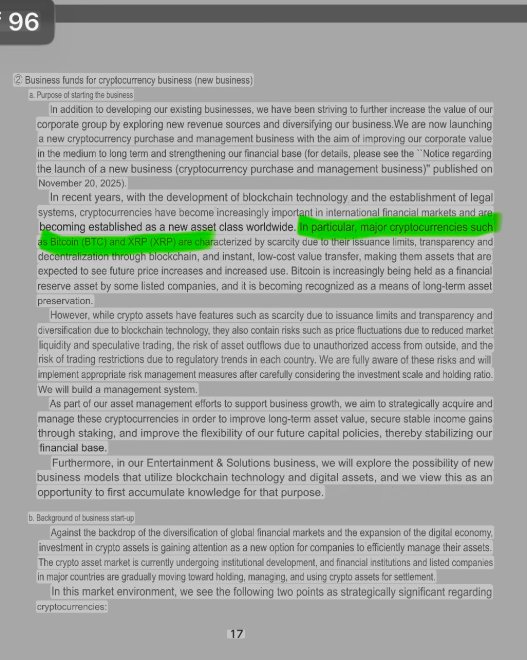
According to the pundit, the move was revealed in the company’s new shareholder filing. This new document confirms that the firm will purchase and hold XRP alongside Bitcoin, the flagship cryptocurrency, as a strategic asset. AltPlus aims at acquiring value in the long run, diversification, and staking-based income.

The filing details a complete transition of AltPlus into digital assets as the company expands into crypto operations. In this way, the firm is improving its balance sheet and navigating Web3 connections across its gaming and Internet Protocol (IP) ecosystem.

A Huge Wave Of Capital Flowing Into The Asset

While the crypto market is slowly recovering, several major assets witnessed a massive wave of capital, with XRP being among the leaders in inflows. A significant inflow into the altcoin reflects the growing conviction among retail and institutional investors.

Data from CoinShares disclosed by Coin Bureau on X shows that the altcoin pulled in capital worth $289 million in a week, which marks one of its biggest yet. The large inflow coincides with an improvement in investors’ sentiment toward the token, driven by strategic advancements in the larger ecosystem and expanding usefulness throughout international payment corridors.

Meanwhile, the total net inflows for digital asset Exchange-Traded Funds (ETFs) recorded in a week were more than $1 billion, signaling intensifying market interest. As more liquidity pours into digital assets, on-chain activity and market depth seem to be rising dramatically.

XRP

Solana Treasury Companies Mark New Lows In Ongoing Downtrend – What This Means For SOL’s Price

In a significant development, the bearish action of the Solana price is currently spilling into the SOL-backed Treasury reserves. A recent report shows that corporate treasury companies are experiencing a sharp decline in their SOL holdings in the shadow of broader market unease.

Corporate Solana Reserves Continue To Bleed

Solana is experiencing a notable development that is capable of shaping its next market direction. Ted Pillows, a market expert and investor, shared on the X platform that the corporate treasuries of Solana are sinking further as the price of SOL struggles to regain upward traction.

According to the expert, SOL treasury companies are making new lows that echo through the on-chain corridors of the network. This implied that the wallets previously renowned for their steady accumulation are now showing diminishing conviction as balances discreetly shrink in the current bearish market phase.

The trend shows how institutional Solana holders are adjusting in the face of tightened liquidity and increased volatility, but it’s not a sudden exodus. Rather, it may be a steady, calculated exhalation.

Solana

Pillows highlighted that this drop to new lows is a major reason why the price of SOL has been performing badly, as buying demand has faded among institutional investors. Until these companies recover, the expert is confident that a recovery in SOL will be difficult.

However, Solana has started throwing up a quiet flare, one that heralds a recovery. After examining the altcoin’s price action on the weekly time frame, Ali Martinez, a crypto analyst and trader, revealed that SOL is flashing a bullish signal that points to a potential upward move. 

Martinez’s analysis hinges on the key Tom DeMark (TD) Sequential indicator. Since March 2023, the TD Sequential has proven to be very accurate when it comes to identifying SOL trend shifts on the weekly chart. During the ongoing bearish wave, the indicator is flashing a buy signal, suggesting that Solana is likely gearing up for a bounce.

SOL Activity Is On The Rise

Despite Solan’s price facing volatility, the leading network continues to wax strong as activity grows. In a post on X, Solana Daily disclosed that the network’s x402 activity is accelerating at a pace that feels more like an explosion this week. Currently, transactions are broadening, participation is expanding, and on-chain discussion is rising in the community.

The platform highlighted that the daily transaction volume on the protocol reached a new all-time high with approximately $380,000 processed on November 30 alone. This move to a new peak represents a 750% Week-over-Week (WoW) surge.

Furthermore, Solana has flipped the chart in dollar volume for the first time since its inception. With x402 transactions reaching new highs and a flip in dollar volume, the network is emerging as the most active in the cohort.

Solana

You Won’t Believe How Much Bitcoin Companies Now Hold, What % Of Supply Do They Control?

Bitocin treasury companies continue to accumulate a significant amount of BTC despite current market conditions and now control around 5% of the total BTC supply. These companies are led by Michael Saylor’s Strategy and Metaplanet, which have recently raised fresh capital to buy the dip. 

Bitcoin Treasury Companies Now Hold Over 1 Million In BTC

Bitcoin Treasuries data shows that the top 100 public Bitcoin treasury companies currently hold 1,058,929 BTC, while all public companies combined hold 1,061,697. Notably, Strategy is the largest public Bitcoin holder with 650,000 BTC. Michael Saylor’s company yesterday announced another 130 BTC purchase for $11.7 million. 

Meanwhile, the second-largest Bitcoin treasury company is BTC miner MARA holdings, which holds 53,250 BTC. Tether-backed Twenty One Capital, Metaplanet, and Bitcoin Standard Treasury Company complete the top 5, with 43,514, 30,823, and 30,021 BTC, respectively. Meanwhile, companies like Coinbase, Bullish, and Trump Media are among the top 10 largest BTC treasury companies. 

It is worth noting that these public companies account for only a part of the Bitcoin treasuries. Further data from Bitcoin Treasuries shows that there is currently 4 million BTC in treasuries as a whole, including the coins held by governments, private companies, exchanges, DeFi platforms, and ETFs.  

Bitcoin

BlackRock is currently the second-largest Bitcoin holder, only behind Satoshi Nakamoto. Strategy is third on the list, while Binance and the U.S. government complete the top 5, with BTC holdings of 628,868 and 323,588, respectively. The 4 million BTC held by these treasury companies as a group accounts for 19% of the total Bitcoin supply. 

Bitcoin treasury companies such as Strategy and Metaplanet have raised new capital amid the recent crash to buy more BTC. Saylor’s company recently raised $836 million from its STRE offering, which it used to buy 8,178 BTC. Meanwhile, Metaplanet raised $130 million to expand its BTC treasury. 

More Companies Set To Adopt Bitcoin

More Bitcoin treasury companies are set to emerge as $10 trillion asset manager, Vanguard, will start offering BTC ETFs from today. Notably, some companies gain BTC exposure through these ETFs rather than buying Bitcoin directly. On-chain analytics platform Arkham Intelligence revealed that the largest U.S. bank, JPMorgan, holds $300 million worth of BlackRock’s BTC ETF. 

Meanwhile, it is worth mentioning that Bitcoin treasuries such as Strategy are coming under immense pressure amid the current market downtrend. Strategy’s CEO, Phong Le, admitted that they might have to sell Bitcoin as a last resort to fund dividend payments if their mNAV drops below 1x and they can no longer raise capital. 

At the time of writing, the Bitcoin price is trading at around $87,000, up in the last 24 hours, according to data from CoinMarketCap.

Bitcoin

Ripple, leading VCs invest in OpenEden to support the real-world asset tokenisation firm’s expansion

  • The company will focus on scaling TBILL and the yield-bearing stablecoin USDO.
  • cUSDO was approved this year as off-exchange collateral at Binance.
  • BNY Mellon now manages and safeguards Treasurys underlying TBILL.

Real-world asset tokenisation is becoming one of crypto’s most active areas in 2025, and OpenEden is positioning itself at the centre of this shift with a new round of investment supported by major industry players.

The company confirmed on Tuesday that leading trading firms, venture capital groups, blockchain networks and institutional infrastructure providers have backed its latest raise to expand access to tokenised US Treasurys.

The round, which follows OpenEden’s 2024 raise with YZi Labs, comes at a time when short-dated government debt has emerged as one of the fastest-growing niches in digital assets as institutions look for familiar, regulated yields on-chain.

Tokenisation demand drives new investment push

OpenEden said the fresh capital will help it scale its tokenisation-as-a-service platform as more institutions look to move traditional assets onto public blockchains.

The firm is leaning into rising demand for regulated products tied to government debt, with short-term Treasurys becoming a preferred entry point for investors seeking on-chain yield that mirrors conventional markets.

The company did not disclose the size of the round, but it confirmed participation from Ripple, Lightspeed Faction, Gate Ventures, FalconX, Anchorage Digital Ventures, Flowdesk, P2 Ventures, Selini Capital, Kaia Foundation, and Sigma Capital.

Expansion of TBILL and USDO across markets

A significant portion of upcoming development will centre on OpenEden’s two main offerings: TBILL, its tokenised US Treasury fund, and USDO, a stablecoin backed by those same Treasurys.

USDO and its wrapped version, cUSDO, have already been integrated across decentralised exchanges and lending markets.

Earlier this year, Binance authorised cUSDO as off-exchange collateral.

OpenEden said the new investment will support broader distribution of these products and allow the company to introduce additional market structures tied to real-world financial assets.

Broader product pipeline builds institutional focus

Beyond Treasurys, OpenEden is preparing several new instruments designed to deepen institutional engagement with tokenised markets.

These include upcoming tokenised bond exposure, a multi-strategy yield token and a range of structured products aimed at investors familiar with traditional income-generating instruments.

In August, the company appointed BNY Mellon as custodian and investment manager for the Treasurys underlying TBILL.

The product has also received investment-grade ratings from S&P Global and Moody’s, marking a notable step in bridging conventional market requirements with decentralised finance infrastructure.

The post Ripple, leading VCs invest in OpenEden to support the real-world asset tokenisation firm’s expansion appeared first on CoinJournal.

U.S., International Partners Target Bulletproof Hosting Services

disney, code, data, API security ransomware extortion shift

Agencies with the US and other countries have gone hard after bulletproof hosting services providers this month, including Media Land, Hypercore, and associated companies and individuals, while the FiveEyes threat intelligence alliance published BPH mitigation guidelines for ISPs, cloud providers, and network defenders.

The post U.S., International Partners Target Bulletproof Hosting Services appeared first on Security Boulevard.

Metaplanet is Building a Two-Tier Rocket Ship to Buy More Bitcoin

Bitcoin Magazine

Metaplanet is Building a Two-Tier Rocket Ship to Buy More Bitcoin

Metaplanet has introduced a new two-tier preferred equity structure designed to deepen its bitcoin-centric financing model, launching a senior Class A instrument called MARS and a new perpetual Class B preferred share, MERCURY, that is expected to raise roughly $150 million. 

The move positions the Tokyo-listed firm as the latest major bitcoin treasury company to adopt a perpetual preferred structure, following Strategy and Strive.

MARS — short for Metaplanet Adjustable Rate Security — becomes the top layer of the company’s capital stack. The senior preferred shares are non-dilutive, offer no conversion rights, and feature monthly dividends that adjust based on where the share trades relative to par. 

According to Head of Strategy Dylan LeClair, the design aims to give Metaplanet a volatility-smoothing income instrument while preserving common shareholders from dilution. MARS sits senior to both MERCURY and common equity.

JUST IN: 🇯🇵 Metaplanet to raise $150 million via perpetual preferred equity to buy more #Bitcoin

Nothing stops this train 🙌 pic.twitter.com/fMn7wC2TRl

— Bitcoin Magazine (@BitcoinMagazine) November 20, 2025

Metaplanet: Raise money, buy bitcoin

The second layer of the structure, MERCURY, forms the backbone of Metaplanet’s new capital raise. The company plans to issue 23.61 million Class B perpetual preferred shares at ¥900 each, generating ¥21.25 billion (approximately $150 million) through a third-party allotment to institutional investors. 

The preferred stock pays a 4.9% annual fixed dividend on a ¥1,000 notional strike, with quarterly distributions and an initial payout of ¥40.40 for the period ending Dec. 31, 2025. The shares carry a ¥1,000 liquidation preference and a long-dated optional conversion into common equity — a hybrid profile that blends fixed income with asymmetric upside tied to bitcoin.

The offering comes as Metaplanet’s common equity has fallen more than 80% from its all-time high and now trades around ¥387, pushing its market-to-NAV ratio below parity to 0.96. Investors currently value the company at less than the bitcoin it holds — a dynamic management believes the new structure can help correct by separating long-term capital providers from short-term equity flows.

“MERCURY sits junior to MARS, senior to common, offering a hybrid profile: fixed income + asymmetric upside tied to BTC,” LeClair posted on X.

Metaplanet, now the world’s fourth-largest corporate holder of bitcoin with 30,823 BTC, plans to allocate roughly ¥15 billion of the new capital toward additional bitcoin purchases, with the remainder directed to income-generating bitcoin strategies and the redemption of outstanding corporate bonds. 

Executives have emphasized that downturns are strategic buying opportunities, and that consistent bitcoin accumulation remains fundamental to its treasury model.

To support the overhaul, the company will convene an extraordinary general meeting on Dec. 22 to approve reductions to capital stock and capital reserves, expand authorized shares to 3.83 billion, and clear legacy financing overhangs. 

Metaplanet is cancelling multiple series of prior stock acquisition rights and issuing new rights to EVO FUND to streamline its structure ahead of the preferred rollout.

Metaplanet was once a Japanese firm rooted in hotel management, real estate, and Web3 initiatives, and has rapidly reinvented itself as a publicly traded Bitcoin treasury company. Its core mission is now to maximize Bitcoin held per share, tapping equity and debt markets to raise capital that is then converted into BTC. 

The company frames Bitcoin accumulation as both an inflation hedge and a long-term value engine for shareholders, making its treasury strategy the center of its corporate identity.

On October 1, Metaplanet (TSE: 3350, OTC: MTPLF) reinforced its transformation into Asia’s “Bitcoin rocketship” by acquiring 5,268 BTC for about $615.7 million, bringing its total holdings to 30,823 BTC at an average cost of $107,912 per coin.

This makes it the fourth-largest publicly traded Bitcoin treasury globally, exceeding its FY2025 goal of 30,000 BTC and achieving a 497% year-to-date BTC yield. Q3 2025 revenue surged 115.7% to ¥2.438 billion, prompting a doubling of FY2025 revenue guidance to ¥6.8 billion.

This post Metaplanet is Building a Two-Tier Rocket Ship to Buy More Bitcoin first appeared on Bitcoin Magazine and is written by Micah Zimmerman.

These New Shareholder Tools Make Bitcoin Activism Easy to Launch and Hard to Ignore

By: Nick Ward

Bitcoin Magazine

These New Shareholder Tools Make Bitcoin Activism Easy to Launch and Hard to Ignore

For most of my life, the limiting factor in bringing my ideas to life has been code. I’ve always had a clear vision for the tools I wanted to build, but the execution gap was real. The ideas stayed on whiteboards, in notebooks, or in half-finished PhotoShop mockups.

That barrier no longer exists.
AI has collapsed it.

In just 9 days, I built two fully functioning consumer applications designed to equip shareholders with the leverage they’ve never had: the ability to advocate—cleanly, credibly, and at scale, for Bitcoin on the corporate balance sheet.

These tools weren’t commissioned. No one told me to build them. They are not fancy, intricate, or technically complicated. They came from a simple observation: 1) corporations control the majority of global capital, and 2) shareholders deserve a frictionless way to push those corporations toward strategic, long-term Bitcoin adoption.

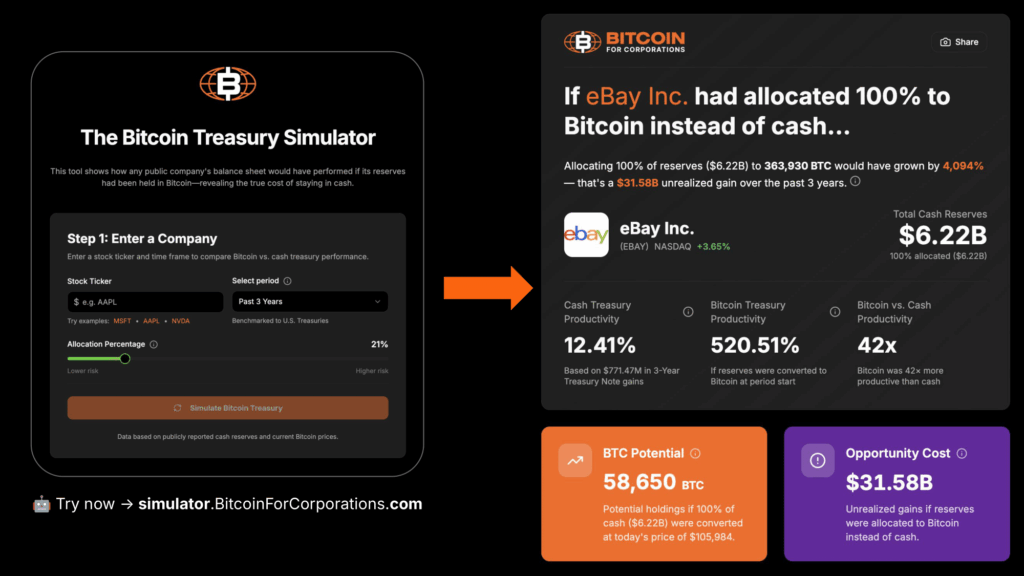
1. The Bitcoin Treasury Simulator

The Bitcoin Treasury Simulator answers a question that should be trivial but wasn’t:
How would a company have performed if it had allocated even a portion of its treasury to Bitcoin?

Retail investors can now enter a ticker, choose a time frame, and instantly see the opportunity cost of holding cash instead of Bitcoin—expressed in clear, defensible terms that anyone can understand.

For the first time, shareholders have a factual, data-driven tool they can bring to boards, IR teams, and fellow investors to show exactly what’s at stake.

🤖 Try the simulator: simulator.bitcoinforcorporations.com

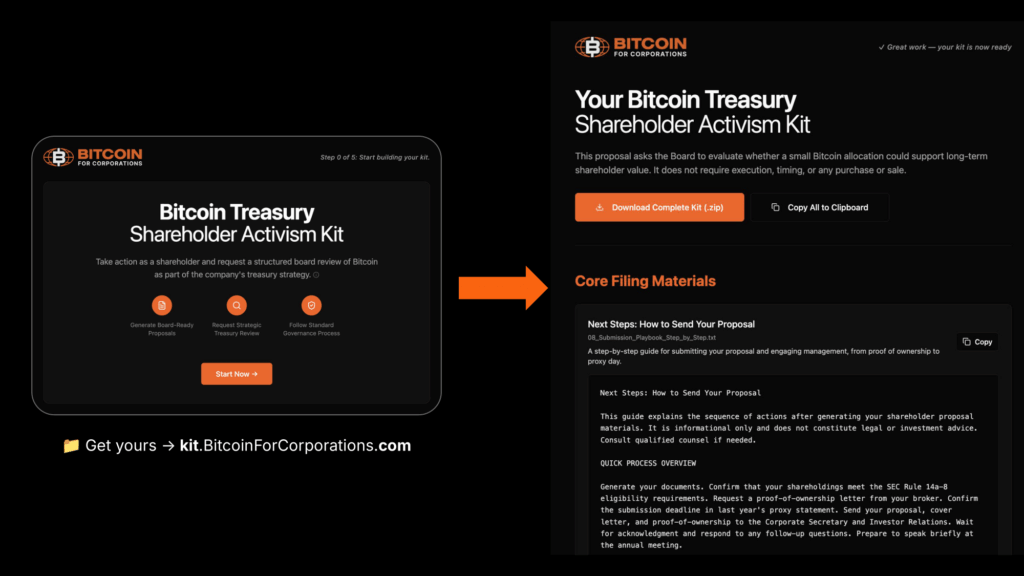
2. The Bitcoin Treasury Shareholder Activism Kit

Shareholder activism has always been powerful, but it’s been inaccessible to most investors. The rules are complex. The legalese is intimidating. The entire process feels like a wall you only get past if you’re a lawyer or a billion-dollar fund.

So I built a generator that removes all of that friction.

The Bitcoin Treasury Shareholder Activism Kit walks any verified shareholder—step by step—through generating a legitimate, SEC-compliant proposal asking a company to evaluate or adopt a Bitcoin treasury strategy. It produces the documentation, the language, the filing structure, and the instructions needed to get the proposal included in the company’s proxy.

Something that once felt like it required attorneys and institutional resources can now be completed in 2 minutes.

🤖 Create your kit: kit.bitcoinforcorporations.com

Why These Tools Exist

Corporate Bitcoin adoption does not happen by accident. It happens because someone—inside or outside the company—pushes for it with clarity, precision, and persistence.

These tools are built for the people willing to make that push.

They give shareholders:

  • Clear data.
  • A credible filing pathway.
  • A structured way to change corporate behavior.
  • And the confidence to take action without needing permission.

If you understand the value of compute, you should understand #Bitcoin.

Yet @Nvidia sits on ~$43B in cash.#Bitcoin outpaced cash reserves by ~41x over the last 3 years—That's nearly $216B in opportunity cost. pic.twitter.com/AftSN7LHpm

— Nick Ward (@nckbtc) November 11, 2025

What Comes Next

This is just the beginning. Both tools will evolve, expand, and integrate more deeply into the broader Bitcoin For Corporations ecosystem. But the important part is this: AI has made technical hurdles of these projects much easier to overcome.

And if enough people decide to build the future they want—one tool at a time—we accelerate corporate Bitcoin adoption far faster than anyone expects.

Disclaimer: This content was written on behalf of Bitcoin For CorporationsThis article is intended solely for informational purposes and should not be interpreted as an invitation or solicitation to acquire, purchase or subscribe for securities.

This post These New Shareholder Tools Make Bitcoin Activism Easy to Launch and Hard to Ignore first appeared on Bitcoin Magazine and is written by Nick Ward.

Treasury Department explores alternatives to suspended Direct File

  • The Treasury Department is officially suspending Direct File, a free, online tax filing platform the IRS launched last year. The department said it’s exploring alternatives. That includes strengthening its partnership with tax preparation companies through its Free File program. Direct File expanded to 25 states during this year’s filing season and saw higher favorability scores. But Treasury said the program cost too much and didn’t see enough usage to keep scaling it up. It said the IRS spent more than $40 million on Direct File this year. That breaks down to nearly $140 for every return submitted using Direct File.
  • Senate Democrats are trying to stop reductions-in-force during the government shutdown once and for all. A new bill called the SAFE Act would undo all RIF-related actions that have happened since the shutdown began. The legislation would also bar additional RIFs from occurring during any future lapse in appropriations. The Democrats’ bill comes after more than 4,000 RIF notices went out to federal employees last month. Almost all of those layoffs are currently on hold due to a court order.
  • More than 35,000 people applied to work at the U.S. Citizenship and Immigration Services since Sept. 30 under its Homeland Defender Campaign. USCIS said it has made hundreds of job offers and will begin onboarding the first Homeland Defenders soon. The agency said among those receiving offers are former law enforcement personnel and veterans with experience serving and protecting communities and the homeland. USCIS Homeland Defenders may be eligible for signing bonuses up to $50,000, student loan repayment, flexible duty locations and remote work options. USCIS is using an expedited hiring process for entry-level positions that do not require a college degree.
    (USCIS receives 50,000 applicants for Homeland Defenders jobs - U.S. Citizenship and Immigration Services)
  • Federal employees are experiencing disruptions in the workplace at a rate far higher than the national average. Close to one-third of federal employees say their workplace has been disrupted “to a very large extent.” That’s nearly triple the 10% of U.S. employees who say the same, according to the latest data from Gallup. The frequent disruptions in the workplace are leading to increases in stress and loneliness among federal employees, as well as a decline in employee engagement and satisfaction.
  • Michael Payne, President Donald Trump’s nominee to lead the Pentagon’s Cost Assessment and Program Evaluation office, told lawmakers he would work to restore the office’s credibility by refocusing on CAPE’s statutory mission as an independent advisory rather than an advocacy organization. The office has faced scrutiny for operating beyond its statutory responsibilities. House lawmakers previously considered shutting down the office altogether. While the 2024 defense policy bill mandated the department to overhaul how the office operates, it has yet to implement those changes. Payne also said the office has been pushing some of its cost-estimation work to the military services due to its strained workforce.
  • Feds anticipate more co-workers will call out sick as the shutdown drags on. A Federal News Network “pulse poll” taken over a 36-hour period earlier this week shows two-thirds of the 730 respondents say they believe more of their co-workers will call out sick more often if the lapse in appropriations continues deeper into November. The concept of a "sick-out" has been used by air traffic controllers and transportation security officers, but it hasn't been widespread among other agencies. More than 43% of the respondents to the survey say they haven't noticed more employees taking sick leave since the shutdown began. A majority of the respondents, however, did say as the shutdown continues, they are very or somewhat concerned about their personal finances.
  • The Marine Corps has rolled out its enlistment bonuses for fiscal 2026, offering the biggest payout to recruits who sign up for specialized roles in cyber and electronics maintenance. The incentives aren't limited to high-demand technical roles; the service is also offering shipping bonuses to recruits in any specialty who agree to leave for boot camp on the service’s schedule. Recruits who enter the electronics maintenance and cyber and cryptologic operations career fields could earn up to $15,000. Recruits across dozens of military specialties can also qualify for a $5,000 or $10,000 shipping bonus. The service is also offering $7,000 or $15,000 “targeted investment” bonuses for applicants willing to extend their enlistment contracts by one or two years.
  • Federal employee unions are suing the Trump administration for including a new essay question on thousands of federal job applications. One of several new essay questions on job applications asks candidates how they would “advance the President’s executive orders and policy priorities,” and to name one or two executive orders significant to them. The unions claim the question allows the administration to weed out applicants who aren’t loyal to President Donald Trump’s policies. Guidance from the Office of Personnel Management states candidates aren’t required to respond to the essay question and that responses can’t be treated as a political litmus test. But candidates are still encouraged to answer the question.

The post Treasury Department explores alternatives to suspended Direct File first appeared on Federal News Network.

© AP Photo/Mark Lennihan

FILE - A portion of the 1040 U.S. Individual Income Tax Return form is shown July 24, 2018, in New York. The IRS has been tasked with looking into how to create a government-operated electronic free-file tax return system for all. Congress has directed the IRS to report in on how such a system might work. (AP Photo/Mark Lennihan, File)

US Authorities Bust Billion-Dollar Crypto Laundering Network, Charge 2 Russians

US Charges 2 Two Russians in Billion-Dollar Crypto Laundering Network, Seizes $7M in CryptoTwo Russian nationals have been charged with running a massive money laundering network that processed billions through cryptocurrency exchanges, the U.S. Department of Justice (DOJ) announced. These exchanges, including Cryptex and Joker’s Stash, enabled criminals to bypass regulations and funnel funds from fraud, ransomware, and darknet activities. U.S. authorities, in collaboration with international law enforcement, […]
❌