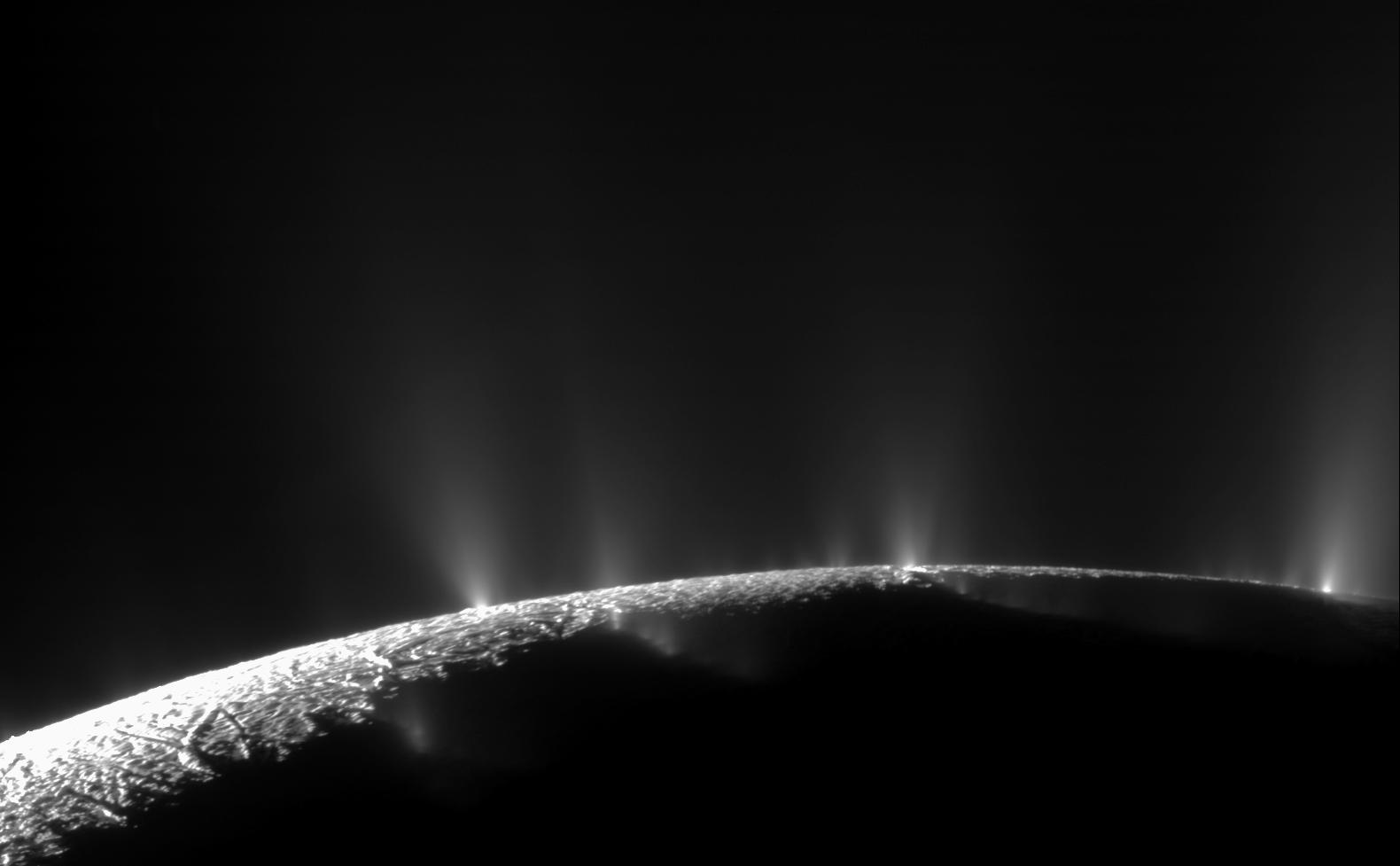
In this image captured by NASA’s Cassini spacecraft in 2009, dramatic plumes of water ice and vapor are seen erupting from the south pole of Saturn’s moon Enceladus.
NASA/JPL/Space Science Institute
Researchers dove deep into information gathered from the ice grains that were collected during a close and super-fast flyby through a plume of Saturn’s icy moon.
A new analysis of data from NASA’s Cassini mission found evidence of previously undetected organic compounds in a plume of ice particles ejected from the ocean that lies under the frozen shell of Saturn’s moon Enceladus. Researchers spotted not only molecules they’ve found before but also new ones that lay a potential path to chemical or biochemical activity.
The ice grains studied were collected just 13 miles (21 kilometers) from the moon’s surface and mark the first time scientists have observed this diversity of organics in fresh particles ejected from the subsurface water of Enceladus. Published Wednesday in Nature Astronomy, the findings signal an important step toward confirming active organic chemistry below the moon’s surface. This is the kind of chemical activity that could support compounds that are important to biological processes and are an essential component of life on Earth.
Besides increasing the diversity of detected organics, the recent work added a new layer to earlier findings by analyzing particles that the Cassini spacecraft collected when it flew directly through a plume — the next-best thing to diving directly into the moon’s ocean.
“Previously, we detected organics in ice grains that were years old and potentially altered by the intense radiation environment surrounding them,” said Nozair Khawaja of the Freie Universität Berlin, lead author of the study. “These new organic compounds were just minutes old, found in ice that was fresh from the ocean below Enceladus’ surface.”
Scientists knew from previous Cassini data-mining that nitrogen- and oxygen-bearing organic compounds were present in particles from Saturn’s E ring, a faint, wide outer band around the planet fed by the icy material that fans out from Enceladus’ plumes. But the new research analyzed ice grains from a moon plume itself — in other words, grains found closest to their subsurface origin.
“These molecules we found in the freshly ejected material prove that the complex organic molecules Cassini detected in Saturn’s E ring are not just a product of long exposure to space, but are readily available in Enceladus’ ocean,” said coauthor Frank Postberg, also of Freie Universität Berlin.
Fast and fruitful
The data was collected and sent to Earth in 2008, when ice particles impacted Cassini’s Cosmic Dust Analyzer instrument. Besides being directly sourced from a plume, the ice grains had another thing going for them: They’d been smashed to smithereens as they struck the instrument during the spacecraft’s fast fly-through at 11 miles per second (about 18 kilometers per second relative to the moon).
The energy of the impact vaporized the ice grains and ionized a substantial fraction of them. Those ions were then analyzed by the instrument’s mass spectrometer, which examined their chemical makeup.
The study’s authors were able to analyze the tiniest of fragments — smaller than a thousandth of a millimeter, smaller even than a flu virus — and identify organic compounds they hadn’t seen before in plume particles.
The newly detected compounds included those from the aliphatic and cyclic ester and ether families, some with double bonds in their molecular structures. Together with the confirmed aromatic, nitrogen- and oxygen-bearing compounds, these compounds can form the building blocks to support chemical reactions and processes that could have led to more complex organic chemistry — the kind that is of interest to astrobiology and narrows the focus of where we search for life in the solar system.
After flying through the plume, the spacecraft, managed by NASA’s Jet Propulsion Laboratory in Southern California, explored the complex Saturn system for nearly another decade.
More about Cassini
The Cassini-Huygens mission was a cooperative project of NASA, ESA (European Space Agency), and the Italian Space Agency. A division of Caltech in Pasadena, JPL managed the mission for NASA’s Space Mission Directorate in Washington and designed, developed, and assembled the Cassini orbiter.
Good morning, readers, and happy Friday. Welcome to This Week in Space, our Friday morning roundup of the week’s most important space news. Today we’ve got a bunch of good news, including a newfound exoplanet and a dozen new moons orbiting Jupiter. We’ve also got a report of an absolutely wild idea — a literal moonshot — for fighting climate change with moon dust.
SpaceX Starship Aces Static Fire Test
Thursday afternoon, SpaceX ran a successful static fire test of its gigantic Starship rocket. With 33 separate Raptor engines, Starship has the most engines of any rocket ever. Together, their thrust is twice that of a Saturn V or the Space Launch System. Is anyone else amazed the struts can hold that thing on the gantry?
Only 31 of the 33 engines fired. However, that’s actually good news because it means Starship can handle multiple engine failures.
SpaceX hopes to attempt a test flight for Starship in March. “That first flight test is going to be really exciting. It’s going to happen in the next month or so,” said Gwynne Shotwell, SpaceX’s president and chief operating officer.
“We will go for a test flight and we will learn from the test flight and we will do more test flights,” Shotwell added. “The real goal is to not blow up the launch pad. That is success.”
ISS Astronauts Work On Plasma Crystals, Space Plumbing
We’ve talked about how the folks aboard the International Space Station have to become polymaths to keep up with the demands of life in orbit. This winter, among many other pursuits, NASA astronauts on the ISS have been tending tomatoes and working on avant-garde methods of space propulsion. But the most recent projects in low-earth orbit make space tomatoes sound outdated. Over the past few days, crew on the ISS have been working on plasma crystals, servicing jetpacks, and… doing space plumbing.
NASA astronaut Frank Rubio and JAXA astronaut Koichi Wakata spent Thursday doing maintenance on the station’s water recovery system and orbital plumbing for the station’s bathroom, respectively. Meanwhile, station commander Sergey Prokopyev worked inside the Columbus lab “configuring video hardware that records how clouds of highly charged particles, or plasma crystals, behave in microgravity.”
Hubble Captures New Portrait of Tarantula Nebula
The Tarantula Nebula is the brightest star-forming region in our cosmic neighborhood. It’s not even in our galaxy — it’s in the Large Magellanic Cloud, one of the Milky Way’s satellite galaxies. But it’s so bright that it dazzles even at that distance. Astronomers recently used the Hubble space telescope to capture this image of the Tarantula Nebula in all its splendor:
What you see here is actually a joint effort between two different astronomy projects. One team sought to analyze the properties of dust grains floating between stars — a proposal dubbed Scylla by the Hubble team. Those dust grains create the dark, wispy clouds spread across the frame. The other, called Ulysses, studies interstellar dust and starlight interactions.
Curiosity Finds Clues to Mars’ Watery Past
NASA’s Perseverance rover went to Mars with a plan: Scour the planet’s surface for evidence that can teach us about Mars’ history and tell us whether the Red Planet might once have supported life. During its two years on Mars, the rover has found silicate clay and other minerals, signs that liquid water once flowed across Mars’ surface. But none of its discoveries have had evidence of water as visually obvious as a photograph that the agency’s Curiosity rover recently captured. The rover caught a photo of sandstone rock with ripples carved out of its surface, showing that the rock was once at the bottom of a lake.
The ripples support our observations of Mars’ weather and climate. Gentle, constant winds create standing ripple patterns like these. This fits with the constant prevailing winds and planetwide dust storms we’ve seen on Mars. It’s also exciting evidence that Mars indeed had liquid water once upon a time.
Russia Launches Progress Spacecraft to International Space Station
Russia successfully launched a Progress capsule aboard a Soyuz rocket this week, bound for the International Space Station. The rocket launched from Russia’s Baikonur aerodrome early Thursday morning, local time. This capsule, ISS Progress 83 (83P), carries about three tons of supplies, including food, water, and air. It will dock with the Russian Zvezda module on Saturday morning, replacing the Progress capsule that left Monday afternoon.
What happens to Progress 82 once it departs? Progress capsules are expendable. This means that the crew on the ISS loads the capsules with trash from the station while it’s docked. Then, hours or days after the capsule undocks, it burns up in the atmosphere.
CAPSTONE Lunar Satellite Reports In After 11-Day Glitch
NASA’s CAPSTONE satellite is finally responding to hails after nearly two weeks incommunicado. A software glitch left the probe unresponsive on Jan. 26 until it rebooted itself Monday.
“The spacecraft remained overall healthy and on-course throughout the issue,” NASA said in a blog post. “On Feb. 6, an automatic command-loss timer rebooted CAPSTONE, clearing the issue and restoring two-way communications between CAPSTONE and the ground.”
The satellite has made twelve successful circuits in its near-rectilinear halo orbit (NRHO) — twice what its original mission expected. That’s great news for NASA. CAPSTONE is trying out the fancy new NRHO orbit because it’s more fuel efficient than other lunar orbits we’ve used. In twelve orbits, CAPSTONE has only had to fire its engine twice. This smashing success means the agency may use the new orbital pattern for lunar support satellites under the aegis of its Artemis project.
Rolls-Royce Building Nuclear Engine For Spaceships
Did you know Ball makes Mason jars — and parts for space telescopes? Ball made parts for Hubble and the mirrors for the JWST. In a similar fashion, Rolls-Royce appears to be branching out. Way out. The luxury automaker’s subsidiary, Rolls-Royce Holdings, has announced plans to build a nuclear engine for deep space exploration.
Webb Telescope Breaks Own ‘Speed Limit’ Tracking DART Impact
NASA’s Guaranteed Time Observation program gives a certain amount of telescope time to those who worked on the JWST. One GTO project: Making observations of NASA’s DART kinetic asteroid redirect test. However, the project brought an unlooked-for surprise. Wednesday, JWST deputy project scientist Stefanie Milam explained how the telescope broke its own speed limit watching the asteroid impact.
Webb launched with the ability to track objects moving through the sky as fast as Mars. But scientists who study fast-moving small bodies like asteroids, comets, and interstellar objects “really wanted to study objects that moved faster than Mars,” said Milam. So, the team set out to show that not only could Webb exceed this “notional speed limit,” it could go much faster. Their efforts paid off when it came time to observe the DART asteroid impact.
NASA’s DART kinetic asteroid redirect test, as seen by the JWST. Image: NASA/JPL
The video Webb captured of the Dimorphos impact showed that the telescope can move its field of regard at more than triple its original maximum speed. Most of the time, though, Milam says the telescope will confine itself to double its original turning speed. Darn.
Chris Hadfield Meets With King Charles III
On Thursday, Canada’s favorite astronaut, Chris Hadfield, met with King Charles III at Buckingham Palace. The two sat down to discuss “efforts to encourage sustainability in space,” according to the Royal Family’s official Twitter.
“What a pleasure and privilege to be asked to advise and assist, and make the King laugh,” Hadfield wrote afterward.
While we don’t yet have specifics, Charles is a longtime environmentalist. Could it be that the King is interested in cleaning up space junk?
A Shield of Lunar Dust Could Help Cool Earth
Astrophysicists are pondering the pros and cons of a literal moonshot to blunt the effects of climate change. In a recent study, a group of researchers proposed launching moon dust into orbit around Earth to create a dusty shield that would reduce Earth’s exposure to the Sun. Evidently, lunar dust grains are just the right size and composition to block some of the solar energy that would hit the Earth.
For six days out of the year, the researchers say, the dust cloud would shield Earth from a few percent of the Sun’s radiation. To carry out this plan, the researchers’ numbers require dredging up some 22 billion pounds of lunar dust. They could fire the dust into orbit from the Moon or a platform in orbit — potato, poterrible idea. Surely there is some lower-hanging fruit?
Scientists Find a Dozen New Moons Orbiting Jupiter
In October 2019, astronomers at the Carnegie Institution for Science found 20 new moons orbiting Saturn. This made Saturn the “moon king” of the Solar System, with a total of 83. However, the same team has announced they’ve found a dozen new moons orbiting Jupiter.
An international team of astronomers has reported a newfound exoplanet in our cosmic backyard. The new planet, Wolf 1069 b, is between 1 and 1.4 Earth masses and just 8% bigger. Calling it Earth-like might be a stretch: Wolf 1069 b zips around its low-mass red dwarf star in just 15 Earth days. However, it’s just 31 light-years away.
Unlike our nearest neighbor, Proxima Centauri, Wolf 1069 doesn’t show the characteristic bursts of violent flares we frequently see in red dwarf stars. This could mean it has managed to retain an atmosphere. If so, the planet’s surface temperature could be about 55 degrees Fahrenheit. If not, it’s more likely an iceball, too cold to sustain liquid water.
Skywatchers Corner
Comet C/2022 E3 (ZTF) is a once-in-an-epoch visitor from the outer solar system. We haven’t seen it since the time of the Neanderthals, but it’s come back for one last visit. The outbound comet passed close to Earth last week. Now, it’s buzzing Mars.
It’s green! Comet C/2022 E3 (ZTF) and its twin tails. Image: NASA
The green comet will be near Mars in the constellation of Taurus for the next several days. After sunset, look high in the sky for the best shot at catching it through binoculars or a telescope. After Feb. 14, the comet will start heading toward Orion and Eridanus.
If you don’t have a good shot at viewing the comet where you are, you can still catch it online. This weekend, the Virtual Telescope Project is webcasting a free livestream of the comet’s approach to the Red Planet. The livestream will begin this Saturday, Feb. 11, at 2 p.m. EST (1900 GMT). You can watch it on the project’s website and YouTube channel.
Feature image: This week’s waning gibbous moon, taken from the International Space Station. Courtesy of NASA HQ Flickr.

 Login
Login