Reading view

There are new articles available, click to refresh the page.

XRP ETFs Are About To Hit $1 Billion – Here’s How Much Is Flowing In Daily

XRP ETFs are on the verge of hitting a significant milestone, with total Assets Under Management (AUM) approaching the $1 billion milestone. Since the launch of its ETF last month, hundreds of millions of dollars have been flowing in daily, making XRP the most successful new ETF entrant of 2025. 

XRP ETFs Close In On $1 Billion

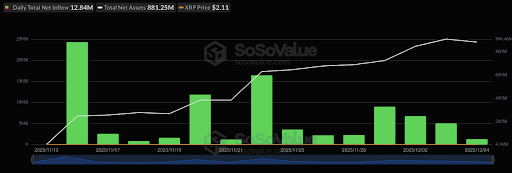
XRP ETFs have continued to experience skyrocketing growth and institutional demand, now rapidly closing in on the $1 billion inflow milestone. Over the past two weeks, all five XRP ETFs have recorded over $984.54 million in cumulative net inflows, just $15.46 million away from $1 billion. This explosive, accelerated growth has effectively solidified XRP’s position as the third-largest crypto ETF, behind Bitcoin and Ethereum.

Data from Sosovalue reports 15 consecutive days of positive flow, with the XRP ETF recording its highest single-day inflow on November 14 at $243.05 million. Over the last two weeks, all five XRP ETFs, including REX-Osprey, have seen notable inflows, reflecting growing institutional interest and demand. 
XRP

According to crypto enthusiast @NADZOE93 on X, XRP has become the third cryptocurrency ever to surpass the $800 million ETF inflow threshold. She noted that while Spot Bitcoin ETFs reached this cap in just two days after their launch, Ethereum ETFs took 95 days. This officially positions XRP as the second-fastest crypto to hit the $800 million inflow mark. 

Notably, strong inflows in the XRP ETF began on November 13 with the launch of Canary Capitals XRPC. A week later, Bitwise introduced its own XRP ETF, followed shortly by Grayscale and Franklin Templeton debuting their funds. Since then, investments have continued to pour in, with $26.17 million flowing in just yesterday alone, bringing the total to $887.12 million after 15 days of positive flow. 

Crypto market analyst Neil Tolbert shared additional insights on the XRP ETF performance on X this week. He noted that five spot XRP ETFs are currently trading, with a combined $995 million in Assets Under Management. Canary Capital’s XRPC stands at the top of the market with $358.88 million, followed by Grayscale’s GXRP with $211.07 million, Bitwise’s ETF at $184.87 million, Franklin Templeton’s XRPZ at $132.3 million, and REX-Osprey at $108 million. 

Tolbert has stated that more ETFs are reportedly in the pipeline, with institutional demand set to grow as traditional finance takes notice of XRP. With the race to a $1 billion inflow milestone heating up, XRP ETFs have already surpassed those of Solana and Dogecoin

Institutions Accumulate Over 400 Million XRP Through ETFs

Institutional demand for XRP is reaching new heights as data from ETF tracker XRP Insights show that a whopping 425.76 million tokens have been officially locked. This surge in accumulation comes as the five currently launched XRP ETFs collectively reach $984.54 million in AUM.

This large amount of XRP held in ETFs shows how quickly institutions are adopting, as investors increasingly seek regulated, transparent ways to gain exposure to cryptocurrencies. Analysts have also warned that if ETFs continue to absorb XRP at such a rapid pace, it could trigger a supply shock as the number of tokens in circulation declines.

XRP

XRP ETFs Record 13-Day Streak As SOL Funds See Largest Outflows Since Launch

As institutional demand intensifies and the crypto market recovers, US spot XRP Exchange-Traded Funds (ETFs) continue to lead the sector with a 13-day streak and over $200 million in positive net flows this week, outshining Solana (SOL) ETFs, which recorded their third day of outflows in seven days.

XRP Funds Lead Crypto ETF Inflows

Spot XRP exchange-traded funds have extended their record-breaking streak after registering their thirteenth consecutive day of positive net flows, with $50.27 million in inflows on December 3.

The investment products have seen a remarkable performance since the launch of Canary Capital’s XRPC, the first single-token XRP spot ETF, on November 13, positioning the funds as the fastest-growing altcoin-based category.

Notably, XRPC surpassed all initial expectations and debuted on Nasdaq with a total volume of $58 million, recording around $357.54 million in positive net flows in 13 days. Last week, the second group of XRP funds went live, becoming the largest US ETF launches of 2025 with over $60 million in net inflows each during their first day.

Moreover, the category, led by Grayscale’s GXRP and Franklin Templeton’s XRPZ, surpassed other major ETFs in single-day inflows, including those based on the largest cryptocurrencies by market capitalization, Solana, Bitcoin (BTC), and Ether (ETH).

Amid this week’s market recovery, XRP ETFs saw $89.65 million on Monday, $67.7 million the following day, and an additional $50.27 million on Wednesday, for a cumulative net inflow of $207.66 million during the first three days of December.

As a result, the leading category surpassed both Bitcoin ETFs’ $52.4 million and Ethereum ETFs’ $51.3 million positive net flows, respectively, during the same three-day period.

With a total of $874.28 million in inflows in 13 days, spot XRP ETFs have surpassed the $618.62 million total inflows of SOL ETFs, which held the record among the second wave of altcoin-based investment products.

Solana ETFs Demand Loses Steam

While XRP ETFs take the spotlight, Solana funds’ momentum has slowed, seeing their largest days of outflows this week. According to SoSovalue data, the investment products recorded $32.9 million in outflows on December 3, marking their third negative net flows day since the category debuted on October 28.

Despite pulling out positive net flows, Bitwise’s BSOL, Fidelity’s FSOL, and Grayscale’s GSOL were unable to absorb 21Shares’ TSOL $41.8 million in outflows. This performance also marks the fourth negative day for TSOL over the past week.

As reported by NewsBTC, Solana ETFs experienced a record performance in November despite the market correction, with $613 million in inflows during their 22 consecutive day positive streak.

However, the remarkable streak ended a week ago when TSOL registered negative net flows for the first time, and the category was unable to absorb them, recording outflows of $8.1 million.

SOL-based investment products started December with outflows worth $13.5 million, which were followed by strong inflows worth $45.77 million on Tuesday. On December 3, the funds registered $32.19 million in outflows, amounting to a negative net flow of $700,000 for the first half of the week, despite the altcoin’s recent price recovery.

XRP, XRPUSDT

Franklin Templeton Just Made A Major Dogecoin Move With Latest Filing

Franklin Templeton has taken a significant step that is already drawing attention across the crypto market. The asset-management giant has filed with the US Securities and Exchange Commission to broaden its Franklin Crypto Index ETF, confirming that Dogecoin will officially be added beginning December 1. 

The expansion shifts Franklin Templeton’s product from a Bitcoin- and Ethereum-focused offering into a more diversified crypto basket that gives investors access to a broader range of digital assets through a single instrument. This comes just a few days after Franklin Templeton launched its Spot XRP fund.

Franklin Templeton Expands Into A Wider Multi-Asset ETF

The success of Bitcoin and Ethereum ETFs has encouraged major institutions to look beyond the top two cryptocurrencies and build products that cover a wider range of well-known digital assets. Franklin Templeton’s latest move follows that trend by reshaping its Franklin Crypto Index ETF into a more expansive portfolio that includes several leading altcoins, Dogecoin among them.

The revised structure takes effect on December 1 and shifts the ETF to a design that reflects the broader market rather than a two-asset concentration. Franklin Templeton acknowledged this change through an announcement on X, presenting an updated token lineup that now spans everything from large market-cap cryptocurrencies like Cardano, Solana, and XRP. 

Even within that group, Dogecoin stands out, stepping further away from its reputation as a meme-based cryptocurrency and moving into a more institutionally recognized role.

Dogecoin Steps Into New Phase Of Institutional Exposure

Dogecoin’s inclusion in Franklin Templeton’s expanded ETF comes at a moment when the token is already experiencing increased attention from traditional finance. The first batch of Spot Dogecoin ETFs has only recently entered the market, and this is a milestone that would have been unthinkable a few years ago. 

Grayscale was the first major issuer out of the gate with its GDOG product, followed shortly after by Bitwise, which launched its own Dogecoin ETF at the request of its community. 

Early trading activity for these funds has been modest compared to the spectacular debuts once seen with Bitcoin and Ethereum ETFs, but it is still too early to tell, as the market might still be determining how much institutional interest exists for a meme-origin asset wrapped in a regulated structure.

Several other issuers have filings in progress and are preparing for their own Dogecoin products to go live. Some are positioning themselves carefully to see how the first batch of ETFs performs. According to Bloomberg Senior ETF analyst Eric Balchunas, there are likely about 100 crypto-based ETFs waiting to be launched in the next six months.

Dogecoin

CoinShares Withdraws Multiple US Crypto ETF Applications — Details

Asset management firm CoinShares has announced its decision to pull the plug on its different crypto exchange-traded fund (ETF) applications with the United States Securities and Exchange Commission (SEC). This move marks a change in the firm’s strategy as it looks away from the slowly-saturating US crypto ETF space.

CoinShares Pulls Plug On Solana, XRP, Litecoin ETFs

On Friday, November 28, CoinShares discontinued its interest in launching multiple spot crypto exchange-traded funds, including the XRP ETF, Solana staking ETF, and Litecoin ETF. The asset manager filed with the US SEC to withdraw its Form S-1 registration statements for these exchange-traded funds.

One of the withdrawal applications read:

The Registration Statement sought to register shares to be issued in connection with a transaction that was ultimately not effectuated. No shares were sold, or will be sold, pursuant to the above-mentioned Registration Statement.

In a bold move, CoinShares sought the SEC’s approval to list spot Litecoin and XRP ETFs in the United States in January 2025. The crypto asset manager then later filed for a spot Solana exchange-traded fund in June, while proposing a staking integration. 

However, CoinShares’ decision to wind down its push for these spot crypto ETFs seems to align with its shift in product strategy for the United States. Earlier on Friday, the digital asset manager announced its “strategic approach” to the United States market while preparing for its public listing in the country.

Jean-Marie Mognetti, CEO and co-founder of CoinShares, said in a statement:

The U.S. market presents a different landscape. Single-asset crypto ETPs have been rapidly commoditized, with the market consolidating around large-scale players, leaving limited opportunities for the differentiation that drives sustainable margins. As a result, this market requires a different playbook, one that leverages our core strengths in new product categories where we can deliver genuine investor value and premium economics.

With the plug already pulled on the spot single-crypto exchange-traded funds, CoinShares said it still aims to launch new products in the US market over the next 12 – 18 months. Some of these products will include crypto equity exposure vehicles, thematic baskets, and actively managed strategies combining crypto and other assets.

Crypto Asset Manager To Focus On ‘Higher-Margin’ Opportunities In US

In his statement, the CoinShares CEO also revealed the plans to further trim its US product list by winding down its Bitcoin Futures Leveraged product (with the ticker BTFX). 

Meanwhile, Mognetti noted that the resources initially allocated to the planned launches of the different single-asset crypto ETFs will now be redirected toward “higher-margin” opportunities.

As Bitcoinist reported in September, the European-based digital asset manager is preparing for its public listing in the US on the Nasdaq Stock Exchange. This initial public offering will come on the back of its $1.2 billion merger with Vine Hill Capital Investments, a special purpose acquisition company (SPAC). 

Crypto

XRP Spot ETFs Behind The Scenes – Here’s What Institutions Aren’t Saying Publicly

Following the launch of the historic XRP Spot ETFs, the community has been buzzing with excitement, triggering notable success for the funds over the next few days. As the exchange funds continue to attract significant inflows, a crypto expert has outlined the development that is unfolding behind the initiative.

What’s Happening Behind The XRP Spot ETFs

The Spot XRP ETFs are seeing robust growth, but what is happening behind the scenes is quite interesting and demands attention. Pumpius, a crypto expert and investor, has uncovered a subtle play among institutions that is not being shared with the general crowd.

According to the expert, ETF fund managers are legally forbidden from purchasing XRP directly from payment firm Ripple or escrow. This is due to the court’s injunction that every single ETF must acquire the altcoin on the open market only, breaking the concept of shortcuts, backdoor deals, and wholesale buying.

Pumpius has declared this underlying trend at the institutional level to be the most bullish step for the altcoin. His reason hinges on the fact that Ripple will only release what is absolutely necessary from the monthly escrow holdings

Furthermore, the payment firm will avoid causing taxable events this way by keeping the escrow untouched. Such a move would imply that Ripple is drip-feeding just enough liquidity to avoid dislocation while ETFs are actively absorbing circulating supply.

The expert considers this pattern the calm before a structural supply shock, and not a sign of stagnation. When the shift happens, it will be seen as a balancing act, a pressure build-up, and a loading phase.

In the meantime, fund managers are already in discussion with Ripple, which means timing coordination is currently ongoing. At the same time, the expert has highlighted that supply dynamics are now being designed in real time.

Once the early balance period concludes and ETF demand continues to rise while escrow is strictly regulated, XRP will not move at a slow pace. Instead, the expert predicts that the altcoin will experience substantial movement, breaking upside resistance levels with violence.

A High Demand For The Exchange Funds

Spot XRP ETFs have become a serious mode of investment in the landscape since their launch. Franklin Templeton recently stunned the market by introducing the Franklin XRP ETF on NYSE Arca and referring to the token as “fundamental to the global settlement system.”

Other major firms such as Bitwise, Grayscale, and Canary Capital have all rolled out their own ETFs, which attracted millions in inflows from their first day. With the robust adoption and interest in the funds, the message is clear that the demand for regulated XRP exposure is bigger than anticipated.

Despite the significant demand, BlackRock, the world’s largest asset manager, has yet to jump into the funds, stating that customer demand is still primarily centered on Bitcoin and Ethereum for now. Furthermore, they believe that regulatory clarity is still not entirely certain despite repeated victories over the US SEC.

However, if the company eventually launches its own fund, it would spur billions of capital and new institutional money. Considering its status in the finance sector, “a BlackRock ETF would be the ultimate stamp of approval.”

XRP

XRP Price Prediction: ETF Inflows Aren’t Helping – Is Something Seriously Wrong With Ripple Right Now?

Despite a flood of institutional interest, the XRP price prediction remains uncertain as the token struggles to react meaningfully to a wave of new ETF launches.

Over six XRP-linked ETFs have debuted in recent days, with combined assets nearing $800 million — yet XRP has posted just a 3% gain in the past week.

Wall Street’s crypto appetite shows no signs of slowing, but the market’s muted response is raising eyebrows.

xrp open interest

One possible reason for XRP’s muted reaction could be the lack of retail participation, as much of the recent demand appears to be coming from institutional flows.

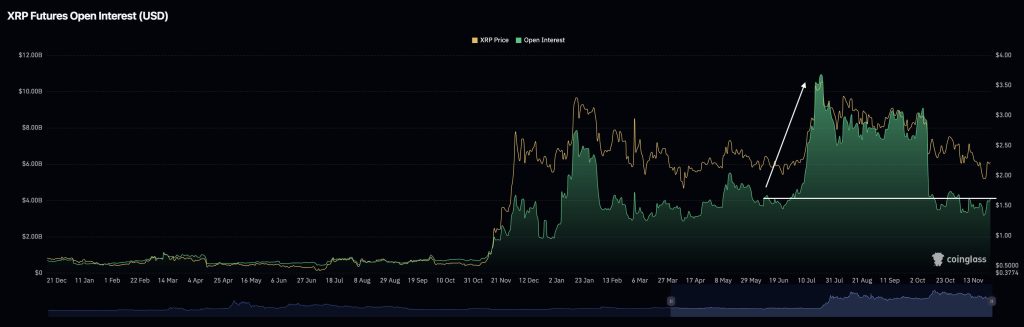
Open interest in XRP futures currently sits at $4 billion, which is the same level it reached in June, just days before XRP surged to its 2025 high of around $3.65.

This parallel is now fueling speculation that a breakout could still be on the table if retail traders begin to re-enter.

XRP Price Prediction: Historical Patterns Suggest That XRP Could Soon Explode

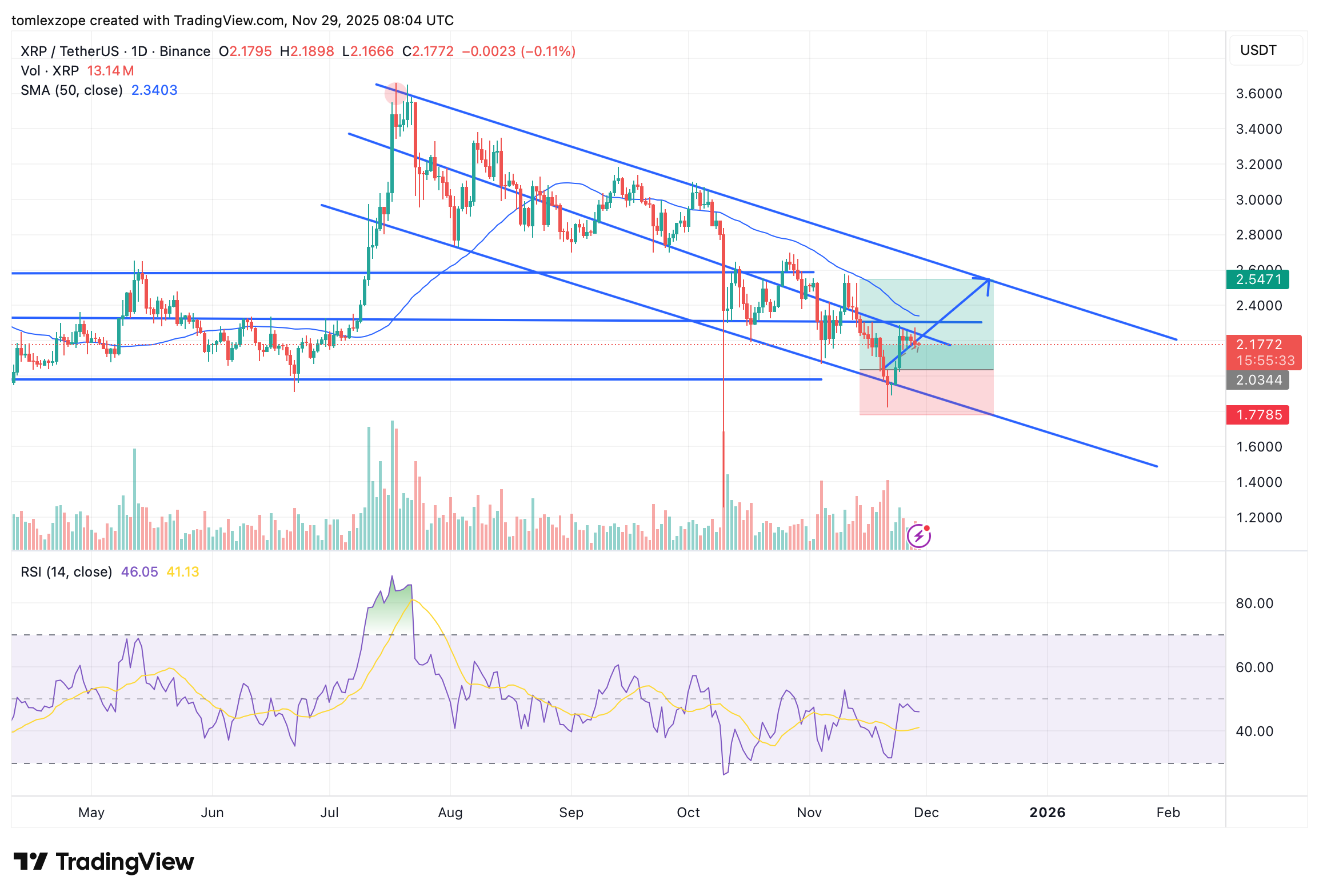
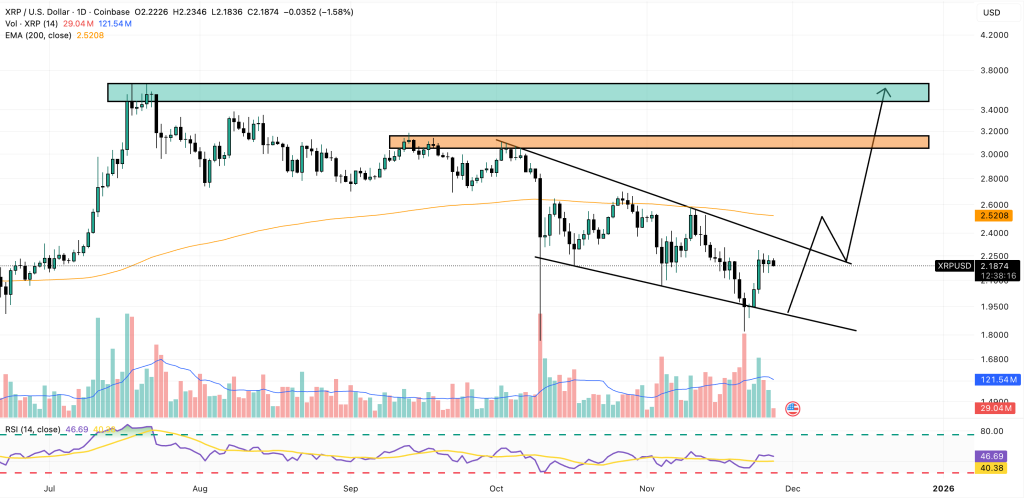
Looking at the daily chart, a confirmed breakout out of the token’s descending price channel could set in motion a trend reversal for XRP.

xrp price chart

The price would have to climb to $2.40 at least to achieve that. In that case, the first target could be the 200-day exponential moving average (EMA) at $2.60. Then, we could expect a much more pronounced move to $3.10 if positive momentum accelerates.

The Relative Strength Index (RSI) just sent a buy signal after rising above the 14-day moving average.

Hence, it seems that XRP is already on the move.

As the market shows early signs of recovery, top presales like Maxi Doge ($MAXI) are quickly gaining momentum.

This Dogecoin-themed meme coin has already raised over $4 million, giving traders a rare early-day chance to join a high-energy project before it hits the market.

Maxi Doge ($MAXI): Tapping Into the Spirit of Early Dogecoin

Maxi Doge ($MAXI) brings back the feel of Dogecoin’s early days, when meme coins were fun, fast-moving, and full of potential.

Built on Ethereum, it’s designed for traders who want to get in early and ride the momentum as the community grows.

Through fun competitions like Maxi Gains and Maxi Ripped, token holders can compete for both rewards and bragging rights by showcasing the ROI of their meme trades.

They also get access to an exclusive idea hub through which they can share insights, trading setups, their biggest Ws and Ls, and more.

Finally, the project plans to invest up to 25% of the presale funds into a handful of YOLO trades and use the money to pay for marketing.

To buy $MAXI and join the pump, simply head to the official Maxi Doge website and link up a compatible wallet like Best Wallet.

You can either swap USDT or ETH for this token or use a bank card instead.

Click Here to Participate in the Presale

The post XRP Price Prediction: ETF Inflows Aren’t Helping – Is Something Seriously Wrong With Ripple Right Now? appeared first on Cryptonews.

Franklin Templeton adds XRP, ADA, SOL, DOGE, LINK and XLM to its crypto index ETF

  • Franklin expands its crypto index ETF to include six major altcoins.
  • New SEC-approved rules allow broader asset tracking in crypto funds.
  • XRP demand surges as multiple US spot XRP products launch.

Franklin Templeton is widening the scope of its flagship digital-asset fund, marking one of the most significant shifts yet in how traditional finance approaches the crypto market.

The firm is moving beyond its long-standing focus on Bitcoin (BTC) and Ethereum (ETH) and opening the door to a broader mix of leading altcoins.

Franklin Crypto Index ETF adds more coins

According to a filing made on November 24, the Franklin Crypto Index ETF will begin tracking XRP, Solana (SOL), Dogecoin (DOGE), Cardano (ADA), Stellar (XLM), and Chainlink (LINK) on December 1, 2025, turning it into a far more comprehensive representation of the market.

Notably, the recently approved Fresh Cboe exchange rules have played a key role in making this expansion possible.

For the first time, issuers are allowed to include any cryptocurrency present in their benchmark indices rather than limiting exposure to only Bitcoin and Ethereum.

Franklin’s ETF is among the earliest to capitalise on the new framework, signalling how fast the regulated side of crypto investing is moving.

Particularly, instead of dominance by the two largest cryptocurrencies, the fund will now adjust its holdings each quarter to match index changes and market conditions.

These scheduled rebalancings open the door for assets to be added or removed depending on performance, liquidity, and market relevance.

The firm has also modernised its operational model, allowing authorised participants to create or redeem ETF shares using actual crypto assets instead of cash only, a change that should tighten tracking accuracy and improve liquidity.

This adjustment is likely to make the ETF more efficient during high-volatility periods, a common challenge for digital-asset funds.

Franklin Templeton recently launched a spot XRP ETF

Franklin Templeton’s index ETF overhaul follows closely behind another milestone: the launch of its spot XRP fund, trading under the ticker XRPZ with a 0.19% sponsor fee.

The debut of the XRP ETF arrived at a moment when interest in regulated XRP exposure has surged across the US market.

Franklin has now joined a fast-growing group of firms racing to meet the appetite for XRP-based products.

Canary Capital set the pace earlier in the month, securing more than $250 million on the launch day of its XRP ETF.

Other firms that have successfully launched XRP ETFs are Grayscale and Bitwise, which recorded $25 million in first-day volume and $118 million in inflows during the first week of trading.

This rapid expansion has placed XRP among the few assets outside BTC and ETH that have attracted this speed of ETF development.

As a result, the XRP price has rebounded, climbing more than 7% on November 25 to an intraday high of $2.28 as institutional-grade inflows begin accelerating.

The post Franklin Templeton adds XRP, ADA, SOL, DOGE, LINK and XLM to its crypto index ETF appeared first on CoinJournal.

Canary shakes Nasdaq as XRP ETF launch hits $58M on day one

  • Canary Capital launched its spot XRP ETF, XRPC, on 13 November.
  • The ETF recorded $58 million in trading volume on day one.
  • The listing was approved under Section 8(a) of the Securities Act without objections.

While most of the crypto market was digesting a sharp 3.5% decline on 13 November, Canary Capital’s XRP ETF surged to the top of the Nasdaq, recording the highest first-day trading volume of any fund launched in 2025.

The spot product, listed under the ticker XRPC, registered $58 million in trading activity on its debut, overtaking all previous launches this year.

Despite Bitcoin falling below $99,000 and a broader market slump, the appetite for regulated XRP exposure proved unshaken.

By 9:30 am EST, $26 million in volume had already been clocked.

Trading accelerated rapidly, with over $36 million executed by mid-morning.

Robinhood alone facilitated $500,000 in trades within the first five minutes.

Canary takes the lead in the 2025 ETF competition

XRPC overtook Bitwise’s BSOL ETF, which had previously led the 2025 pack with a $57 million opening day last month.

Both products now sit well ahead of the remaining 900-plus ETFs launched this year.

Bloomberg analyst Eric Balchunas highlighted that the third-most traded ETF debut trails by more than $20 million, underscoring how rare such volume has become in new fund launches.

The listing was certified by Nasdaq on 12 November under Section 8(a) of the Securities Act.

Its approval came without delays due to the absence of pushback during the review period, allowing Canary to activate the launch immediately and avoid the bottlenecks many other issuers face.

XRPC offers direct access to XRP price action

Unlike derivative-based funds or futures products, XRPC holds physical XRP and tracks the CME CF XRP-USD Reference Rate (New York Variant) in real time.

The ETF carries an annual fee of 0.50%. Custody is managed by Gemini Trust Company and BitGo Trust, both of which specialise in secure digital asset storage for institutional clients.

Canary Capital Group, headquartered in Tennessee, already operates ETFs tied to Bitcoin, Ethereum and HBAR.

The firm has positioned XRPC as a compliance-friendly solution for institutions looking to tap into XRP’s role in global payments infrastructure without managing wallet keys or custody operations directly.

Payment-focused crypto tokens see renewed demand

The launch of XRPC also highlights a broader trend in digital asset markets.

Utility tokens such as XRP and HBAR are attracting increasing institutional attention.

Earlier this month, Canary’s HBAR ETF raised $70 million within its first week.

Analysts suggest this reflects rising demand for crypto assets linked to real-world use cases like payments and settlements.

However, XRP’s performance is not immune to broader crypto cycles.

With a correlation to Bitcoin of nearly 40%, its price is often influenced by macro trends and volatility in the wider market.

This makes the ETF’s debut performance even more notable, as it succeeded in generating exceptional demand despite overall bearish sentiment.

The strong launch of XRPC suggests investors are still actively seeking structured exposure to crypto assets that offer functional value.

The post Canary shakes Nasdaq as XRP ETF launch hits $58M on day one appeared first on CoinJournal.

Bitcoin crashes below $97,000, XRP down 9%, ETH plunges 11%

  • Bitcoin falls below $100,000, signalling potential for deeper losses.

  • Ethereum and XRP struggle at key resistance levels amid bearish momentum.

  • Canary Capital’s XRP ETF records $58 million in debut trading volume.

Bitcoin (BTC), Ethereum (ETH), and Ripple (XRP) traded in negative territory on Friday, extending the week’s losses as bearish sentiment continued to grip the cryptocurrency market.

Bitcoin has fallen more than 5%, Ethereum over 10%, and XRP around 2% so far this week, with each facing strong technical resistance.

Bitcoin slipped below the $100,000 psychological level, signalling that bears remain in control.

The leading cryptocurrency faced rejection at the 38.20% Fibonacci retracement level at $106,453, drawn from the April 7 low of $74,508 to the October 6 all-time high of $126,299.

BTC has declined nearly 6% since Monday and is currently trading around $96,300.

If Bitcoin continues its correction and closes below support at $97,460, analysts see potential for further downside toward $95,000.

The Relative Strength Index (RSI) at 35—well below the neutral 50—indicates mounting bearish pressure, while the Moving Average Convergence Divergence (MACD) shows a bearish crossover, reinforcing the sell signal.

If BTC manages to stabilise, however, a recovery toward $106,453, the key Fibonacci resistance level, remains possible.

Ethereum faces rejection, eyes a deeper pullback

Ethereum’s (ETH) correction intensified after the token faced rejection near its broken trendline resistance at $3,592 on Monday, dropping roughly 10% over three days.

As of Friday, ETH trades around $3,200.

Should Ethereum close below the $3,170 support level, analysts anticipate a further decline toward $3,017, a major daily support zone.

Both RSI and MACD indicators are pointing to growing bearish momentum, suggesting that Ethereum’s downturn may not be over yet.

If ETH manages to rebound, a recovery toward the 38.20% Fibonacci retracement level at $3,592 would be the next upside target.

XRP slides below key support as ETF launch steals spotlight

XRP began the week with a strong 6.75% rally on Monday, retesting the 50-day EMA at $2.53, but failed to sustain the move.

After multiple rejections from the same level, XRP fell 2.5% on Thursday, closing below support at $2.35. As of Friday, it trades near $2.30.

If the downtrend continues, XRP could decline further toward the next major support at $1.96. Both RSI and MACD show bearish bias, with the latter reflecting indecision among traders.

Despite the pullback, XRP grabbed headlines this week with the launch of Canary Capital’s XRP ETF (ticker: XRPC), which debuted Thursday to record-breaking volume.

According to Bloomberg’s senior ETF analyst Eric Balchunas, XRPC generated $58 million in first-day trading, the highest debut among nearly 900 ETF launches this year.

Balchunas noted that the XRP ETF reached $26 million in its first hour, surpassing the prior record set by Bitwise’s Solana ETF (BSOL), which recorded $57 million on its debut day and $72 million on its second.

“The two of them are in a league of their own,” Balchunas said on X, referring to XRPC and BSOL as standout performers in this year’s ETF market.

If XRP manages to regain momentum and close above $2.35, it could trigger a recovery toward the 50-day EMA at $2.53.

The post Bitcoin crashes below $97,000, XRP down 9%, ETH plunges 11% appeared first on CoinJournal.

Nasdaq certifies XRP ETF as Canary Capital prepares to enter crypto fund arena

  • Canary’s fund is set to be the sixth single-crypto ETF if it launches.
  • The fund’s official website has gone live ahead of the anticipated debut.
  • Past ETFs launched during the government shutdown used automatic effectiveness rules.

The cryptocurrency market is poised for a new addition with the likely debut of the first spot XRP exchange-traded fund, issued by Canary Capital.

On Wednesday, Nasdaq confirmed it had accepted the Form 8-A filing for the Canary XRP ETF, under the ticker XRPC, signalling formal readiness to list the asset.

While the announcement stirred excitement among ETF watchers, the fund still lacks the US Securities and Exchange Commission’s final approval to begin trading.

This has left its launch in limbo, even as industry observers anticipate a possible debut on Thursday.

Canary’s ETF becomes the sixth single-asset crypto fund to reach this milestone following earlier approvals for Bitcoin, Ether, Solana, Litecoin and Hedera.

However, this fund’s progression highlights a more complex regulatory backdrop, influenced by recent shifts in SEC processes during the US government shutdown.

Certification clears Nasdaq listing, but trading awaits

Nasdaq formally notified the SEC that it had received and filed the Form 8-A for Canary’s XRP ETF.

Bloomberg’s ETF analyst Eric Balchunas shared the update on X, stating that “The official listing notice for XRPC has arrived from Nasdaq.”

Despite this progress, the ETF has not yet received the green light to commence trading. The letter issued by Nasdaq confirmed approval of the listing but did not equate to SEC authorisation.

Observers have clarified that the letter is a procedural step and part of the process to join the registrant’s request for the fund to become effective.

Some in the crypto community highlighted the difference, noting that the Nasdaq letter does not declare the fund effective but only acknowledges the listing certification.

The SEC has not issued an effectiveness order, which means trading cannot begin until that step is completed.

Canary’s XRP fund joins crypto ETF roster

Following the Nasdaq filing, Canary Capital launched its official website for the ETF.

Nate Geraci, president of NovaDius Wealth Management, posted about the development, signalling that Canary was likely to be the first to market with an XRP-backed ETF.

If approved, the XRPC ETF will join the growing roster of single-asset crypto ETFs now available to investors. These include Bitcoin, Ether, Solana, Litecoin and Hedera.

Eleanor Terrett of Crypto America also indicated on X that Nasdaq had cleared XRPC for a market open launch, which further raised expectations for an imminent debut. However, the fund cannot proceed to trading without confirmation from the SEC.

ETF timing reflects shutdown-related procedure shifts

Canary’s ETF launch coincides with the recent end of the longest US government shutdown in history.

On Wednesday, President Donald Trump signed legislation that officially reopened government operations.

During the shutdown, ETFs for Solana, Litecoin and Hedera began trading under automatic effectiveness provisions.

These mechanisms allowed trading to begin without active SEC approval during periods when regulatory processes were delayed.

This approach was not used in earlier launches of Bitcoin and Ether ETFs, which both started trading only after formal authorisation from the regulator.

It remains unclear which approach the XRPC fund will follow.

Without a current effectiveness order, Canary’s ETF may be subject to additional delays, unless it qualifies under the same automatic provisions used during the shutdown period.

Launch window narrows as market watches SEC decision

Although Nasdaq has certified the listing and Canary’s infrastructure appears ready, the fate of the XRPC ETF ultimately depends on the SEC.

Canary’s website launch and market interest reflect growing anticipation, but trading cannot begin until regulators give their final approval.

Although Nasdaq certified the listing and Canary Capital launched its website, the fund did not begin trading immediately after 28 October, the initially anticipated date.

Without a final effectiveness order from the SEC, the ETF remains in limbo. Until that regulatory step is completed, XRPC cannot begin trading, and the market continues to await confirmation.

The post Nasdaq certifies XRP ETF as Canary Capital prepares to enter crypto fund arena appeared first on CoinJournal.

❌