Reading view

There are new articles available, click to refresh the page.

Strategy’s Bitcoin Appetite Dries Up In 2025 — What Happened?

Strategy, the Michael Saylor-led corporate Bitcoin buyer long watched by investors, has sharply cut back purchases this year, according to CryptoQuant. Once a steady force of demand, its monthly buys have fallen dramatically, changing the way market watchers view institutional support for Bitcoin.

Sharp Drop In Monthly Purchases

Based on reports, Strategy’s monthly accumulation peaked around 134,000 BTC in late 2024. By November 2025 that figure had dropped to roughly 9,100 BTC. That move amounts to about a 93% decline from the high-water mark. Buying this month was almost nil, with only 135 BTC recorded early in December. Those numbers show how quickly a major buyer can thin out.

Strategy’s Bitcoin buying has collapsed through 2025.

Monthly purchases fell from 134K BTC at the 2024 peak to just 9.1K BTC in November 2025, only 135 BTC so far this month.

A 24-month buffer makes one thing clear: they’re bracing for the bear market. pic.twitter.com/qEwXR3JQ82

— CryptoQuant.com (@cryptoquant_com) December 3, 2025

A Big Buy Amid The Pullback

Reports have disclosed that on November 17, 2025, Strategy made a sizeable purchase of roughly 8,178 BTC, a buy worth near $835 million at the time. The purchase was the largest for the firm since July and pushed its total holdings to about 649,870 BTC. But while that single entry was large, it did not reverse the broader trend: overall monthly activity is far lower than it was a year earlier.

Big Holdings But More Cash On Hand?

According to CryptoQuant, Strategy has also piled up cash — about $1.4 billion has been set aside. That reserve is being held to cover dividend payments, debt servicing and other company needs. Observers say this signals a shift toward preserving liquidity rather than steady accumulation of Bitcoin. In other words, the company appears to be prioritizing cash stability over more buys for now.

What CryptoQuant And Others Are Watching

Market analysts are taking the slowdown as a warning sign that corporate appetite for Bitcoin treasuries may be cooling. If other big holders act the same, the structural demand that helped support prices could weaken.

Some traders will read the figures as a move to brace for a possible bear market. Others point out that Strategy’s enormous stash — nearly 650,000 BTC — still gives it room to ride out a downturn without having to sell immediately.

Key signals to monitor include the monthly purchase totals going forward and any change in Strategy’s cash holdings. Observers will be watching to see if the company returns to regular Bitcoin purchases or if the reduced buying becomes the standard.

It’s also important to monitor other corporate treasuries, because if several slowdowns occur together, the market for newly issued and available Bitcoin could tighten significantly.

Featured image from JRU, chart from TradingView

Making History With Bitcoin: What’s Going On With MicroStrategy And Wall Street?

Market expert Shanaka recently explained how a historical event is unfolding with MicroStrategy and its Bitcoin strategy. This comes as the company faces a negative valuation from Wall Street while MSCI considers whether to remove MSTR from its indices. 

MicroStrategy’s Market Cap Drops Below the Value Of Bitcoin Holdings

In an X post, Shanaka noted that MicroStrategy, which is the world’s largest corporate Bitcoin holder, is now worth less than its BTC holdings. The company currently holds 650,000 BTC, valued at around $60 billion, while the MSTR stock has a market cap of $55 billion. The expert noted that Wall Street is valuing the company at a negative based on this. 

He further remarked that this is the sustained NAV inversion since MicroStrategy began the Bitcoin model in 2020. Shanaka noted that the company has created a $1.44 billion emergency reserve to pay dividends. This came after the CEO Phong Le admitted that they might have to sell BTC to fund dividend payments if the mNAV drops below 1. 

MicroStrategy’s woes could deepen as MSCI will decide by January whether to expel the company from global stock indices. MSCI is considering whether companies that hold Bitcoin should be regarded as funds or trusts rather than as companies. JPMorgan estimates the company could see $8.8 billion in outflows if other index providers make a similar move.

Shanaka described the math as “merciless,” noting that MicroStrategy has $8.2 billion in debt, $7.8 billion in preferred stock, and $16 billion in total obligations against a $45.7 billion shell. Meanwhile, the company currently holds its BTC at an average cost of $74,436, which the expert noted is 15% above breakeven. As such, he remarked that one sustained drop erases every gain since 2020. 

Shanaka stated that MicroStrategy’s current situation is not just about one company but about whether corporations can hold sound money without being destroyed by the very system they sought to escape. He added that the largest experiment in corporate Bitcoin adoption is breaking in real time. 

Saylor Confirms Talks With MSCI Over Potential Exclusion

According to a Reuters report, Michael Saylor confirmed that MicroStrategy is in talks with MSCI over a potential exclusion from their indices. MSCI is expected to decide by January 15 whether to remove digital-asset treasury companies that buy Bitcoin and other crypto assets, amid concerns that they are classified as investment funds.  

Saylor opined that MicroStrategy’s potential exclusion from MSCI indices won’t make any difference. He explained that his company is currently leveraged by a multiple of 1.11 and could survive a 95% Bitcoin crash. Meanwhile, it is worth noting that Phong Le has stated that it is unlikely they will sell any BTC over the next three years following the creation of the USD reserves, which should be sufficient for dividend payments during this period.

Bitcoin

Strategy’s Michael Saylor Engages With MSCI Over Possible Index Exclusion By January 15

Concerns regarding the potential exclusion of Strategy (MSTR) from the MSCI index emerged last week, with estimates from JPMorgan analysts indicating that such a move could result in approximately $2 billion to $8 billion in outflows.

Amid mounting concerns within the crypto community, Michael Saylor confirmed that the company is in discussions with MSCI regarding its potential exclusion from the provider’s indices. 

Michael Saylor Weighs In On Exclusion Concerns

MSCI has stated that by January 15, it will decide whether to remove companies whose business models focus on purchasing cryptocurrencies, amid concerns that these firms resemble investment funds, which are currently ineligible for index inclusion.

Reuters reported that Saylor acknowledged the discussions with MSCI but expressed skepticism regarding JPMorgan’s projections of potential outflows. He commented, “It won’t make any difference, in my opinion,” regarding the implications of a possible exclusion. 

Saylor noted that the equity associated with Strategy is inherently volatile due to its significant reliance on Bitcoin’s (BTC) price. He cautioned, “If Bitcoin falls 30% or 40%, then the equity is going to fall more, because the equity is built to fall.” 

Currently, Strategy operates with a leverage ratio of 1.11, and Saylor indicated that the company could withstand a steep decline of 95% in Bitcoin prices.

Reports from NewsBTC indicated that Saylor Strategy’s position emphasizing that it is not merely a passive Bitcoin holding entity. Instead, he highlighted that the company functions as a software firm with a proactive financial strategy, countering the narrative surrounding MSCI’s concerns.

Strategy Establishes New USD Reserve 

The recent fluctuations in Bitcoin prices have reignited fears of a potential bear market, raising questions about whether Strategy would consider selling some of its substantial Bitcoin reserves, currently exceeding 650,000 coins. 

This speculation intensified after Strategy CEO Phong Le addressed the possibility of selling some holdings during an interview on the “What Bitcoin Did” podcast. 

Le stated that if the company’s stock trades below the value of its Bitcoin holdings and it is unable to raise additional capital for preferred dividends, a sale might become unavoidable. 

“If the stock trades below the value of our Bitcoin, then mathematically we would have to sell some Bitcoin. It would be the last resort,” he explained.

To support this vision, the Virginia-based company recently announced the establishment of a $1.44 billion reserve fund allocated for dividend payments on preferred stock and to meet its debt obligations.

The newly created reserve is funded through proceeds from its at-the-market stock offering. The company aims to maintain a balance sufficient to cover at least 12 months of dividends, with ambitions to extend this coverage to 24 months or more in the future. 

Saylor remarked, “Establishing a USD Reserve to complement our BTC Reserve marks the next step in our evolution. We believe it will better position us to navigate short-term market volatility while delivering on our vision of being the world’s leading issuer of Digital Credit.”

Strategy

At the time of writing, Bitcoin was trading just above $93,000, marking a 4.5% increase over the past 24 hours. MSTR, the stock of the investment firm Strategy, traded up 2% in the premarket. 

Featured image from Bloomberg, chart from TradingView.com 

Strategy Floats Possible Bitcoin Sales As MSCI Review Nears Deadline

Bitcoin is trading near $92,000, up by about 5% over 24 hours, as attention turns to how index rules and treasury policy could intersect in coming weeks. MSCI has an active consultation on the treatment of companies whose treasuries hold digital assets or whose business models are materially linked to them, with feedback windows running into January 2026, according to MSCI’s consultation materials.

In parallel, Strategy’s leadership has acknowledged the option to sell Bitcoin under specific circumstances, a shift in tone after years of continuous accumulation.

In a recent company update, Strategy CEO Phong Le described sales as a last-resort tool if balance-sheet metrics deteriorate, according to coverage and recordings of the briefing.

MSCI’s Consultation and Index Mechanics

MSCI’s review outlines scenarios in which index eligibility, classification, or weights could change if a firm’s risk profile is driven mainly by a digital asset rather than an operating business.

Outcomes range from unchanged inclusion to adjusted treatment or removal, with implementation details and timing to follow the comment window.

Any exclusion would force benchmark-tracking funds to rebalance according to index family rules, constituent weight, and transition procedures.

Liquidity can absorb staged flows, yet turnover tends to spike on effective dates, and moves often amplify when both equity and crypto depth are thin. Strategy’s share price has traded with high Bitcoin beta, which can compound swings during tight liquidity.

Strategy’s Toolkit If Price Pressure Persists

Strategy built its position through cash, convertible debt, and at-the-market equity programs. Management has now described sales as a last-resort tool if balance-sheet metrics deteriorate, a framing that puts liquidity and capital costs ahead of a rigid buy-only stance.

Strategy announces $1.44B USD Reserve and now hodls 650,000 $BTC. pic.twitter.com/FNFivMNQgh

— Strategy (@Strategy) December 1, 2025

Sustained spot levels below recent add prices raise the effective cost of issuance and debt, while any equity-to-NAV discount can slow net additions.

If sales occur, sequencing becomes a choice between faster de-risking to stabilize leverage and a paced approach to limit market impact, each with different implications for realized gains and tax outcomes.

What Markets Watch Next

On the index side, investors will look for the consultation’s conclusion, any grace period, and whether changes are phased. On the corporate side, filings will be read for updates to issuance plans, leverage targets, treasury language, and purchase cadence.

Crypto-linked flows still shape the backdrop. Net creations in spot Bitcoin products, exchange balances, and order-book depth across BTC and ETH pairs help determine whether equity moves tied to crypto exposure settle or extend.

When depth rebuilds and product creations turn positive together, risk typically steadies; when those series soften while index decisions approach, volatility can rise into the event window.

The current Bitcoin bounce trims immediate pressure, yet policy signals and index rules still define the near-term path. MSCI’s review and Strategy’s contingency language now share a calendar, and together they will determine how crypto-heavy corporate exposure fits within mainstream equity benchmarks.

The post Strategy Floats Possible Bitcoin Sales As MSCI Review Nears Deadline appeared first on Cryptonews.

You Won’t Believe How Much Bitcoin Companies Now Hold, What % Of Supply Do They Control?

Bitocin treasury companies continue to accumulate a significant amount of BTC despite current market conditions and now control around 5% of the total BTC supply. These companies are led by Michael Saylor’s Strategy and Metaplanet, which have recently raised fresh capital to buy the dip. 

Bitcoin Treasury Companies Now Hold Over 1 Million In BTC

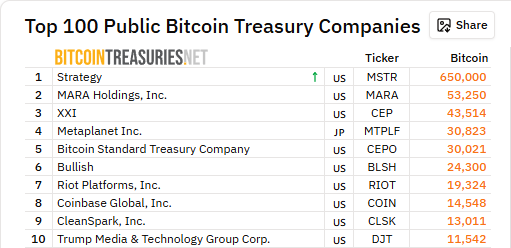
Bitcoin Treasuries data shows that the top 100 public Bitcoin treasury companies currently hold 1,058,929 BTC, while all public companies combined hold 1,061,697. Notably, Strategy is the largest public Bitcoin holder with 650,000 BTC. Michael Saylor’s company yesterday announced another 130 BTC purchase for $11.7 million. 

Meanwhile, the second-largest Bitcoin treasury company is BTC miner MARA holdings, which holds 53,250 BTC. Tether-backed Twenty One Capital, Metaplanet, and Bitcoin Standard Treasury Company complete the top 5, with 43,514, 30,823, and 30,021 BTC, respectively. Meanwhile, companies like Coinbase, Bullish, and Trump Media are among the top 10 largest BTC treasury companies. 

It is worth noting that these public companies account for only a part of the Bitcoin treasuries. Further data from Bitcoin Treasuries shows that there is currently 4 million BTC in treasuries as a whole, including the coins held by governments, private companies, exchanges, DeFi platforms, and ETFs.  

Bitcoin

BlackRock is currently the second-largest Bitcoin holder, only behind Satoshi Nakamoto. Strategy is third on the list, while Binance and the U.S. government complete the top 5, with BTC holdings of 628,868 and 323,588, respectively. The 4 million BTC held by these treasury companies as a group accounts for 19% of the total Bitcoin supply. 

Bitcoin treasury companies such as Strategy and Metaplanet have raised new capital amid the recent crash to buy more BTC. Saylor’s company recently raised $836 million from its STRE offering, which it used to buy 8,178 BTC. Meanwhile, Metaplanet raised $130 million to expand its BTC treasury. 

More Companies Set To Adopt Bitcoin

More Bitcoin treasury companies are set to emerge as $10 trillion asset manager, Vanguard, will start offering BTC ETFs from today. Notably, some companies gain BTC exposure through these ETFs rather than buying Bitcoin directly. On-chain analytics platform Arkham Intelligence revealed that the largest U.S. bank, JPMorgan, holds $300 million worth of BlackRock’s BTC ETF. 

Meanwhile, it is worth mentioning that Bitcoin treasuries such as Strategy are coming under immense pressure amid the current market downtrend. Strategy’s CEO, Phong Le, admitted that they might have to sell Bitcoin as a last resort to fund dividend payments if their mNAV drops below 1x and they can no longer raise capital. 

At the time of writing, the Bitcoin price is trading at around $87,000, up in the last 24 hours, according to data from CoinMarketCap.

Bitcoin

‘Saylor Is Finished’ – Peter Schiff Slams Bitcoin Tycoon Over $1.44B Reserve Build-Up

Strategy Inc., the firm once best known as MicroStrategy, said Monday it has raised cash and set aside a $1.44 billion US reserve to cover near-term obligations as Bitcoin tumbles. The move came after recent share sales and follows a brief buy of new coins, according to company statements and market reports.

Strategy Establishes $1.44B Cash Reserve

According to filings and market reports, the reserve was funded by selling Class A common stock under an at-the-market program and is meant to fund dividends on Strategy’s preferred shares and to help pay interest on its debt for at least 12 months, with a target to extend cover to 24 months or more. The company said it did not liquidate its Bitcoin stash to create the reserve.

The size of the company’s Bitcoin holdings remains unusually large. Based on reports, Strategy now holds about 650,000 BTC after a small recent purchase of roughly 130 BTC that cost about $11.7 million.

That hoard is still worth tens of billions of dollars at current prices, but price swings have put fresh pressure on a business built around holding the asset.

Strategy Inc. announced a $1.44 billion USD reserve to cover at least 12 months of preferred dividends and interest payments, funded through its at-the-market stock sales. The company now holds 650,000 BTC and says the reserve will help manage volatility. https://t.co/i4X1J62Qel

— Wu Blockchain (@WuBlockchain) December 1, 2025

Bitcoin: Market Reaction And Risks

Investors reacted quickly. Strategy’s shares have fallen sharply this year, and analysts say the new cash buffer may calm some fears but won’t erase larger funding and debt timelines that loom over the company.

Strategy announces $1.44B USD Reserve and now hodls 650,000 $BTC. pic.twitter.com/FNFivMNQgh

— Strategy (@Strategy) December 1, 2025

Reports put convertible debt tied to past financing at about $8 billion, and company metrics show the market-to-Bitcoin ratio (mNAV) sliding closer to levels where management has said it might consider selling coins only as a last resort.

Peter Schiff, a well-known Bitcoin critic, took to social media after the announcement and described the reserve as proof the model has failed, calling Michael Saylor a “conman” and saying Saylor is “finished.”

Today is the beginning of the end of $MSTR. Saylor was forced to sell stock not to buy Bitcoin, but to buy U.S. dollars merely to fund MSTR’s interest and dividend obligations. The stock is broken. The business model is a fraud, and @Saylor is the biggest con man on Wall Street.

— Peter Schiff (@PeterSchiff) December 1, 2025

Other market voices urged caution, saying the move changes how investors should value the company — from a pure Bitcoin treasury play to an entity with ongoing cash obligations.

According to reports, Strategy also cut its 2025 profit and Bitcoin-linked yield targets after recent price moves, a sign that management is dealing with a less bullish near-term outlook than it expected earlier this year.

The reserve is meant to prevent forced sales of Bitcoin to meet fixed payouts, but holding cash has its own costs and raises governance questions among long-time backers.

Schiff’s Issue With Saylor

Schiff’s blistering attack — calling Saylor a fraud and declaring him done — adds a sharp political edge to what had been framed as a financial maneuver.

His claims amplify worries among some investors about Strategy’s governance and capital plan, even as others dismiss the remarks as partisan rhetoric.

Ultimately, whether Schiff’s accusations stick will depend less on social-media barbs than on Strategy’s next moves around debt, disclosure and any future coin sales — actions that will tell investors whether Saylor’s stewardship can weather this storm.

Featured image from Unsplash, chart from TradingView

Saylor Changes Strategy: New $1.44 Billion USD Reserve Unveiled

Strategy has announced a new $1.44 billion US Dollar (USD) reserve, signaling a major shift for the Bitcoin-focused treasury company.

Strategy Establishes New USD Reserve

In a new post on X, Strategy co-founder and chairman Michael Saylor has revealed the formation of a USD reserve for the firm. Worth $1.44 billion, the reserve has been established using sales of class A common stock under the company’s at-the-market (ATM) offering program.

Since pivoting to being a Bitcoin treasury company back in 2020, Strategy has focused on expanding its BTC holdings, so this USD reserve reflects a shift for the company.

The current goal for Strategy is to maintain a USD reserve that can fund at least twelve months of dividends and interest payments (collectively referred to as just “Dividends”). Eventually, the firm intends to cover 24 or more months with the dollar reserve.

According to Phong Le, the treasury company’s president and CEO, the newly established USD reserve can currently cover 21 months of Dividends. “We intend to use this reserve to pay our Dividends and grow it over time,” noted Le.

Strategy has established this reserve as Bitcoin has witnessed a bearish transition recently, with its price dropping into the low $80,000 levels from a high of $126,000 in October.

Saylor noted:

Establishing a USD Reserve to complement our BTC Reserve marks the next step in our evolution, and we believe it will better position us to navigate short-term market volatility while delivering on our vision of being the world’s leading issuer of Digital Credit.

Strategy has also updated its year-end target for Bitcoin, slashing down its $150,000 assumption to a range between $85,000 and $110,000. The update in assumption is to reflect a range more consistent with recent BTC prices, the company said in the press release.

While the USD reserve is a fresh change for the firm, it hasn’t stopped buying Bitcoin. Alongside the same announcement, Strategy has also unveiled a new BTC acquisition.

With this new purchase, the company has added 130 BTC to its treasury, spending $89,960 per token, or $11.7 million in aggregate. A relatively modest buy; in fact, the smallest acquisition by the firm since March 2025.

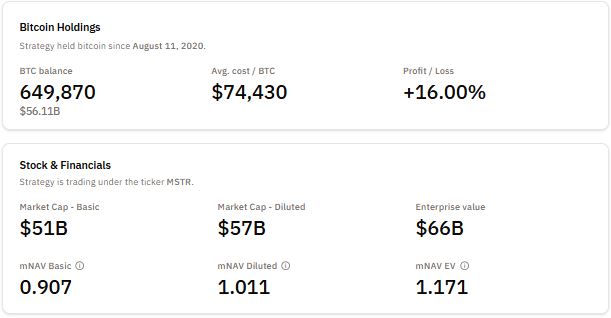
Strategy now holds 650,000 BTC, equivalent to 3.1% of the total Bitcoin supply cap. The company used a total of $48.38 billion to assemble these holdings, putting its cost basis per token at $74,436. At the current BTC price, the treasury is still in a profit of about 13.65%.

Saylor’s firm is by far the largest Bitcoin corporate treasury in the world, outweighing the second-placed MARA Holdings by nearly 600,000 BTC.

Bitcoin Treasuries Tracker

Bitcoin Has Plunged To $84,500

The past day has been quite bearish for Bitcoin as its price has gone through a decline of almost 8% and has erased much of its recent recovery. Initially, BTC fell toward $86,000, but it has seen another leg down to $84,500 after the Strategy USD reserve announcement, a sign that investors have taken the news negatively.

Bitcoin Price Chart

Will Strategy Liquidate Bitcoin Holdings? CEO Provides Concerning Clues

In a turbulent market marked by falling prices, Bitcoin (BTC) has once again dipped below the $85,000 threshold, driven by growing speculation that Strategy, formerly known as MicroStrategy, may be on the verge of selling some of its Bitcoin holdings. 

This intensified after a recent interview on the What Bitcoin Did podcast, during which Strategy CEO Phong Le was directly asked whether the company would consider parting with any of its BTC holdings

While the firm’s former CEO, Michael Saylor, has consistently maintained a resolute stance against selling, Le’s comments have raised concerns about potential sales in the future.

Is A Bitcoin Sell-Off Imminent? 

Le indicated that if Strategy’s stock trades below the actual value of its Bitcoin holdings and the company is unable to raise additional capital for preferred dividends, selling some Bitcoin could become a necessity. 

“If the stock trades below the value of our Bitcoin… then mathematically we would have to sell some Bitcoin. It would be the last resort,” he explained. 

While this does not confirm an imminent sale, it visibly places the option on the table, leading to increased speculation about a forced sale as preferred dividend payments approach due on December 31.

Adding to the unease, Strategy disclosed in a recent filing with the US Securities and Exchange Commission (SEC) that it has established a USD Reserve of $1.44 billion to cover these upcoming preferred dividends and mitigate the interest on its substantial debt. 

This reserve was funded through the proceeds from sales of its class A common stock under the company’s at-the-market offering program. Such moves have diluted current shareholders and contributed to a nearly 11% drop in Strategy’s stock price.

Strategy Downgrades BTC Price Forecast

This shift contrasts sharply with the company’s previous forecasts, which predicted that Bitcoin would soar to $150,000 by the end of the year. Strategy has now revised its expectations, projecting prices to range between $85,000 and $110,000. 

The forecast for BTC yields has also been revised down to 24% from a previous estimate of 30%, along with projected Bitcoin gains decreasing significantly from $20 billion to $10.6 billion at the midpoint.

As Bitcoin’s value continues to plummet, it further unravels Strategy’s financial outlook. Nevertheless, social media experts have pointed to a paradox within the company’s messaging. 

AlejandroXBT noted that while Saylor has consistently stated he will never sell Bitcoin, he has been conducting private presentations to clients outlining various strategic approaches, suggesting a potential disconnect between public declarations and private planning.

Strategy

When writing, the market’s leading cryptocurrency trades at $84,880, recording major losses of over 7% in the 24-hour time frame. 

Featured image from DALL-E, chart from TradingView.com 

Is Strategy Buying Bitcoin Again? Saylor’s ‘Green Dots’ Suggest Yes

Michael Saylor’s recent post has stirred fresh buy speculation around Strategy’s Bitcoin holdings. He shared a portfolio chart and wrote, “What if we start adding green dots?” — a line that many investors read as a nudge toward new purchases. According to the chart, Strategy’s Bitcoin stash is valued at close to $60 billion, reflecting a total of 649,870 Bitcoins acquired across 87 distinct buys.

Saylor’s Comment Spurs Market Talk

The company’s tracker shows each past purchase as an orange dot. The idea of green dots implies new markers — new buys — could appear if Strategy chooses to add more Bitcoin. That signal comes at a time when volatility has returned to crypto markets, making any hint of institutional accumulation a headline-worthy event.

CEO Lays Out When Sales Might Happen

According to Strategy’s CEO Phong Le, selling would be a last resort. Le told listeners on a podcast that the firm will only sell its Bitcoin in extreme conditions — chiefly if market values drop below net asset value (NAV) and fresh capital cannot be raised.

What if we start adding green dots? pic.twitter.com/a19bD33KzD

— Michael Saylor (@saylor) November 30, 2025

Reports indicate the company expects to meet yearly preferred-share dividend obligations of about $750 million to $800 million by raising capital when its stock trades above NAV. Le said this approach lets the firm keep building its holdings while meeting payouts.

Debt And Dividend Plans Remain Front And Center

Based on company materials, the firm says it can maintain dividends even in stress. Strategy recently rolled out a BTC Credit dashboard aimed at giving investors clearer visibility into how the company can service its liabilities over the long term.

Company figures show the average purchase price sits near $74,000. The dashboard suggests that, according to the firm’s math, dividend payments could be sustained for decades even if Bitcoin traded around the firm’s average cost.

Market Slide Tests Confidence

After touching highs above $126,000 in October, Bitcoin fell sharply and dropped below $86,000 in early Asian trading on December 1, sliding as much as 6% in a single session.

BREAKING: Bitcoin falls -$4,000 in 2 hours as mass liquidations return.

$400 million worth of levered longs have been liquidated over the last 60 minutes. pic.twitter.com/qKB7MYJapu

— The Kobeissi Letter (@KobeissiLetter) December 1, 2025

Other tokens moved lower too — Ethereum slipped more than 7% to about $2,800 during the same period. Analysts link the sell-off to a broader “risk-off” mood, with jitters around inflation and central bank policy weighing on risky assets.

Strategy’s Positioning Amid The Pullback

Strategy said it had faced pressure earlier when Bitcoin traded near $90,000, a stretch that briefly put its Nasdaq-100 membership at risk. Even so, company leaders continue to stress a long-term approach to holding Bitcoin.

The recent public hint from Saylor and Le’s comments on selling policies together signal that Strategy is keeping the door open to buy on dips, while also setting clear lines about when selling would be considered.

The coming weeks will test whether those green dots appear on the company’s tracker and whether market conditions give large holders the chance to add to their positions.

Featured image from Unsplash, chart from TradingView
Michael Saylor’s Strategy Forms $1.44B USD Reserve and Updates FY2025 Bitcoin-Linked Guidance

Strategy has created a U.S. dollar reserve totaling $1.44 billion, marking an expansion of its balance sheet strategy as it positions itself as the world’s largest “Bitcoin Treasury Company.”

Strategy announces $1.44B USD Reserve and now hodls 650,000 $BTC. pic.twitter.com/FNFivMNQgh

— Strategy (@Strategy) December 1, 2025

The reserve will be used to support dividend payments on preferred stock and meet interest obligations, providing enhanced liquidity cushions amid volatile digital-asset markets.

The fund was financed through proceeds from ongoing at-the-market stock sales. Strategy said its goal is to maintain coverage for at least 12 months of dividend obligations, ultimately extending that to 24 months or more. The reserve will remain at the company’s discretion and may be adjusted based on market conditions and capital requirements.

Founder and Executive Chairman Michael Saylor described the USD Reserve as the next step in the company’s evolution, complementing its Bitcoin reserve.

“We believe it will better position us to navigate short-term market volatility while delivering on our vision of being the world’s leading issuer of Digital Credit,” he said.

CEO Phong Le added that Strategy now holds 650,000 Bitcoin, representing roughly 3.1% of total eventual supply. The firm’s USD Reserve currently covers 21 months of dividends, he noted.

Strategy has acquired 130 BTC for ~$11.7 million at ~$89,960 per bitcoin. As of 11/30/2025, we hodl 650,000 $BTC acquired for ~$48.38 billion at ~$74,436 per bitcoin. $MSTR $STRC $STRK $STRF $STRD $STRE https://t.co/1oVrm9kxVn

— Strategy (@Strategy) December 1, 2025

Revised 2025 Outlook Reflects Bitcoin Price Volatility

Strategy has also updated the assumptions behind its FY2025 earnings guidance following recent declines in Bitcoin’s trading price.

If Bitcoin ends 2025 within the range of $85,000 to $110,000, Strategy said it expects operating income to fall anywhere between a loss of $7.0 billion and a profit of $9.5 billion, while net income could range from a loss of $5.5 billion to a gain of $6.3 billion.

Diluted earnings per share are projected to come in between a loss of $17.0 per share and earnings of $19.0 per share. These projections rely on the successful completion of planned capital raises that would allow Strategy to achieve its 2025 Bitcoin Yield Target and deploy the resulting proceeds into additional Bitcoin purchases.

Updated Bitcoin KPI Targets for 2025

Under the same Bitcoin price assumptions and incorporating anticipated common stock issuance to maintain the USD Reserve, Strategy said it now expects its Bitcoin yield for the year to fall between 22.0% and 26.0%. The company also forecasts Bitcoin dollar gains of between $8.4 billion and $12.8 billion.

Strategy said it expects to reach these targets through a combination of preferred stock offerings, disciplined equity issuance, and continued accumulation of bitcoin.

Market Reaction and Peter Schiff’s Criticism

The announcement drew swift and vocal commentary from market observers, including well-known Bitcoin critic Peter Schiff, who posted on X that Strategy’s establishment of a USD Reserve indicates “the beginning of the end of $MSTR.”

Today is the beginning of the end of $MSTR. Saylor was forced to sell stock not to buy Bitcoin, but to buy U.S. dollars merely to fund MSTR's interest and dividend obligations. The stock is broken. The business model is a fraud, and @Saylor is the biggest con man on Wall Street.

— Peter Schiff (@PeterSchiff) December 1, 2025

Schiff argued that Strategy was “forced to sell stock not to buy Bitcoin, but to buy U.S. dollars” in order to cover interest and dividend obligations, calling the business model “broken” and alleging that the company was relying on equity sales to sustain its financial commitments.

The post Michael Saylor’s Strategy Forms $1.44B USD Reserve and Updates FY2025 Bitcoin-Linked Guidance appeared first on Cryptonews.

Strategy’s Crash Rumors Intensify, CEO Reveals When $46 Billion In Bitcoin Will Be Sold

Strategy CEO Phong Le has revealed the instance in which his company may be forced to sell its Bitcoin holdings. This comes amid concerns about the MSTR stock crash, which puts the company at risk of seeing its mNAV drop below 1. 

Strategy CEO Reveals When They Will Sell Bitcoin

During an interview on the ‘What Bitcoin Did’ podcast, the Strategy CEO said they could sell Bitcoin to fund dividend payments on their preferred shares if the mNAV is trading below 1. He alluded to the BTC yield, which is their primary KPI, and that under 1x mNAV, it is more “creative” to sell their BTC holdings to pay the dividends. 

The Strategy CEO explained that they typically raise capital when their mNAV is above 1 to fulfill their obligations, even when it is below 1. He alluded to the 2022 crypto winter when they bought back their Bitcoin-backed loans as proof that they had prepared in advance for such market conditions. However, when they are unable to raise capital, Phong Le stated that they will have no option but to sell their BTC holdings. 

Bitcoin

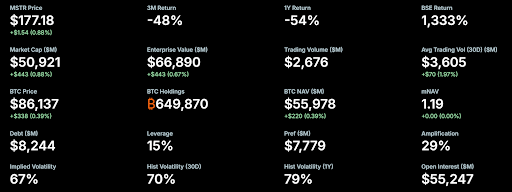
Strategy data shows that their mNAV is currently at 1.19. Meanwhile, the company currently holds 649,870 BTC, worth around $55 billion. With the MSTR stock on a downtrend, Michael Saylor’s company still faces the risk of seeing its mNAV fall below 1 for a sustained period. TradingView data shows that the stock is now down over 40% year-to-date (YTD) from a 2025 high of around $455. 

There were recently rumors that Strategy supposedly sold some of its Bitcoin holdings, which Saylor quickly denied. The company then went on to make one of its largest purchases this year, buying 8,178 for $836 million. This formed part of the proceeds from the company’s STRE offering. 

Saylor Teases Another Bitcoin Purchase

In an X post, Michael Saylor teased another Bitcoin purchase from Strategy. He posted the company’s BTC portfolio tracker with the caption, “What if we start adding green dots?” It is worth noting that these conventional Sunday posts have usually preceded a BTC purchase announcement by the company the following day. 

Based on this, Strategy likely bought more Bitcoin between November 24 and 30 last week. This comes amid the Bitcoin downtrend, with the flagship crypto again dropping below the psychological $90,000 level. Besides the BTC crash, the possibility of an exclusion from MSCI indices is another factor that paints a bearish picture for Saylor’s company. The MSCI will decide by January next year whether treasury companies like Strategy should remain in their indices. 

At the time of writing, the BTC price is trading at around $86,000, down over 5% in the last 24 hours, according to data from CoinMarketCap.

Bitcoin

Strategy ($MSTR) Creates $1.44 Billion Reserve to Calm Fears of Bitcoin Sell-Off

Bitcoin Magazine

Strategy ($MSTR) Creates $1.44 Billion Reserve to Calm Fears of Bitcoin Sell-Off

Strategy ($MSTR) announced Monday that it has created a $1.44 billion U.S. dollar reserve to safeguard future dividend and interest payments, a move aimed at calming investor concerns that the world’s largest corporate Bitcoin holder might eventually need to sell a portion of its roughly $56 billion BTC stack if market weakness persists.

The Tysons Corner, Virginia-based firm said the reserve, funded by recent Class A common stock sales, will initially cover at least 21 months of dividend obligations. 

Over time, Strategy intends to expand the buffer to cover as much as 24 months of payments, strengthening its liquidity position as Bitcoin endures its steepest monthly decline since mid-2021.

Founder and Executive Chairman Michael Saylor said the cash reserve represents the next phase of the company’s evolution, complementing its Bitcoin holdings and reinforcing its strategy of becoming the world’s leading issuer of “Digital Credit.”

CEO Phong Le, whose comments last week sparked fears of a potential BTC sale, said the newly formed reserve sharply reduces the likelihood the company would need to liquidate any of its 650,000 BTC holdings. 

Strategy’s market value to Bitcoin (mNAV) ratio — a key metric comparing enterprise value to Bitcoin holdings — had slipped to roughly 1.2 on Monday, inching closer to a level that historically raises concern among investors.

On Friday, Le told a podcast audience that Strategy could sell Bitcoin only if mNAV dropped below 1.0, and only as a last resort.

Investors reacted sharply early Monday to a bitcoin price sell-off, sending Strategy shares down more than 6% pre-market while Bitcoin fell roughly 6%. The stock pared losses after the reserve announcement.

At the time of writing, shares of MSTR are trading at 165.84, down 6.40%.

Strategy’s Bitcoin accumulation

Formerly known as MicroStrategy, the company has evolved from a business-intelligence software firm into a full-scale digital-asset-treasury vehicle, financing its Bitcoin accumulation through repeated equity raises and low-cost perpetual preferred offerings.

Its software division does not generate sufficient free cash flow to cover dividend or interest payments, while Bitcoin itself yields no income.

After a pause in purchases, Strategy added 130 BTC for $11.7 million last week, funded through new common share issuance.

Strategy’s updated forecast 

Alongside the reserve announcement, Strategy updated its 2025 guidance, acknowledging that its October forecast — based on a $150,000 year-end Bitcoin price — is no longer realistic. 

With Bitcoin recently trading between $80,660 and $111,612, Strategy now assumes a year-end price range of $85,000 to $110,000.

Under that scenario, the company expects operating income ranging from a $7 billion loss to a $9.5 billion profit—a wide spread driven by new accounting standards requiring fair-value BTC mark-to-market treatment each quarter.

Net income is projected between a $5.5 billion loss and a $6.3 billion profit, while diluted EPS could fall anywhere from –$17 to +$19 per share.

Despite market turbulence, Wall Street brokers such as Benchmark say the firm remains structurally sound, with Bitcoin unlikely to fall anywhere near the roughly $12,700 distress threshold analysts estimate would pose genuine solvency risk.

At the time of writing, Bitcoin price fell sharply to the mid-$84,000s early Monday, sliding 8% over the past 24 hours as a wave of macro anxiety, thin liquidity and fresh crypto-native stress hit markets simultaneously. 

The world’s largest digital asset traded between a 24-hour high of $91,866 and a low of $84,722, extending a two-month drawdown that has now erased more than 30% from October’s record highs, according to Bitcoin Magazine Pro data. 

The downturn marks a swift reversal from last week’s tentative recovery. After plunging below $81,000 on Nov. 21, the Bitcoin price steadily climbed into the end of November and briefly pushed above $92,500 during Black Friday’s morning session. 

At the time of writing, the bitcoin price is $86,469.  

This post Strategy ($MSTR) Creates $1.44 Billion Reserve to Calm Fears of Bitcoin Sell-Off first appeared on Bitcoin Magazine and is written by Micah Zimmerman.

Michael Saylor Teases Mysterious ‘Green Dots’ on Bitcoin Chart — What Do They Mean?

Billionaire Michael Saylor ignited fresh speculation this week after sharing a Bitcoin chart featuring a new set of mysterious green dots, prompting questions across the market about what they represent and whether they signal another wave of aggressive buying.

The chart, posted alongside new data on Strategy’s rapidly expanding Bitcoin position, showed a total of 87 purchase events, bringing the company’s holdings to 649,870 BTC worth about $59.45 billion at an average cost of $74,433 per coin.

What if we start adding green dots? pic.twitter.com/a19bD33KzD

— Michael Saylor (@saylor) November 30, 2025

The familiar orange dots reflected each individual accumulation since 2020, while the green dotted line captured immediate attention as traders debated its meaning.

Analysts Clarify MicroStrategy’s ‘Green Dot’ Metric

Analysts later clarified that the green dotted line represents Strategy’s average purchase price, a rolling figure that updates only when new Bitcoin is acquired.

It reflects the company’s dynamic cost basis rather than Bitcoin’s price or any form of prediction.

With each new buy, the line shifts depending on whether Bitcoin was purchased above or below the previous average.

Because Strategy’s positions are large, some buying events have pushed the line sharply higher, especially between 2024 and 2025, when the firm accelerated accumulation during Bitcoin’s run toward the $100,000 region.

Source: BitcoinTreasuries.NET

The chart confirmed that Strategy’s portfolio remains profitable, with the Bitcoin stack up 22.9% as of Nov. 30.

Bitcoin has been trading in the $95,000 to $110,000 range in late 2025, keeping the company comfortably above its $74,433 average cost.

Yet while the holdings show gains and the “green line” hints at more aggressive buying according to some analysts, Strategy’s stock has fallen more than 60% from recent highs, and this disconnect is feeding new questions about the long-term sustainability of Saylor’s strategy.

Strategy Signals It May Sell Bitcoin if Market Pressures Mount

In a development that marks a shift from years of strict “never sell” messaging, Strategy quietly acknowledged that Bitcoin sales are now possible under specific stress conditions.

CEO Phong Le said the company would consider selling some of its holdings only if two events occur at once: if Strategy’s market-to-net-asset-value ratio falls below one and if the company cannot raise new capital.

Le noted that he does not want to be the executive who sells Bitcoin but added that financial discipline must take priority in a hostile market.

He described a scenario where selling a portion of the treasury becomes mathematically justified to protect what he calls “Bitcoin yield per share,” especially if issuing new equity becomes more dilutive than liquidating a small fraction of BTC.

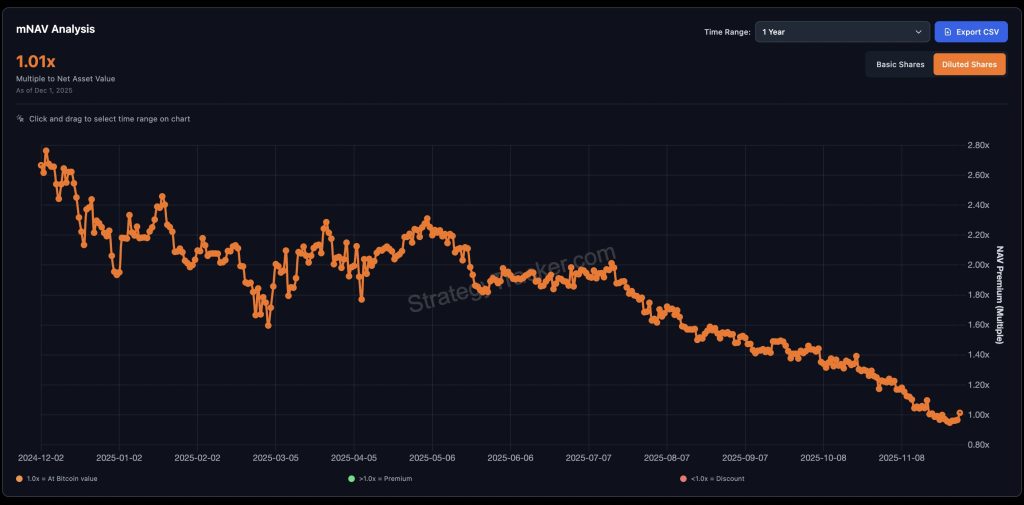
The company’s mNAV is currently 1.01, but this level has been unstable throughout 2025.

Source: Strategy Tracker

Earlier in the year, the ratio traded as high as 3.3, but by mid-November it slipped under 1.0 for the first time since Strategy began acquiring Bitcoin.

A drop below one means the market values the company at less than the worth of its Bitcoin holdings, undermining the premium that allows Strategy to raise capital cheaply.

Le warned that if the company cannot access cash while operating below that threshold, selling becomes an option of last resort.

Strategy’s $21B Fundraising Stands Firm as Bitcoin Drops 32% From All-Time High

Despite these risks, Strategy has raised $21 billion so far in 2025, nearly matching its 2024 total.

The company secured $11.9 billion through common equity, $6.9 billion through preferred equity, and $2 billion via convertible debt across seven different securities.

Investor appetite remains strong, even as the firm faces roughly $800 million in annual dividend obligations tied to its preferred shares.

Le said the plan is to maintain these payments using capital raised at a premium, adding that consistent dividend performance helps strengthen market confidence.

Strategy also introduced a new “BTC Credit” dashboard last week to reassure investors amid volatile market action.

The post Michael Saylor Teases Mysterious ‘Green Dots’ on Bitcoin Chart — What Do They Mean? appeared first on Cryptonews.

TD Cowen Sees Strategy ($MSTR) Under Pressure as MSCI Index Review Looms

Bitcoin Magazine

TD Cowen Sees Strategy ($MSTR) Under Pressure as MSCI Index Review Looms

TD Cowen analysts say Strategy’s stock could face continued pressure due to an impending MSCI review. 

The firm expects that PBTCs like Strategy will be removed from all MSCI indexes this February. A formal decision is expected around mid-January.

Cowen called the potential removal “capricious” but emphasized that investors should prepare for sustained selling pressure. The analysts note that Strategy is not a fund, trust, or holding company. Instead, it is a public operating company. Its $500 million software business generates all of its revenue. 

Meanwhile, its Bitcoin treasury operations are innovative and active, offering unique Bitcoin-backed securities.

“Removing Strategy from broad indexes simply because of its Bitcoin focus feels arbitrary,” the analysts wrote. Cowen questioned whether MSCI’s rationale reflects a bias against crypto rather than any strict classification criteria. MSCI has cited concerns that PBTCs may resemble investment funds, which are ineligible for index inclusion. 

Cowen counters that Strategy’s structure is clearly different.

Strategy and MSCI exclusion

The stakes are high. JPMorgan recently warned that excluding Strategy from MSCI could trigger $2.8 billion in passive outflows. If other indexes follow, the total could reach $8.8 billion. Strategy’s market cap currently sits near $59 billion, with roughly $9 billion held in passive index-tracking vehicles. 

Any forced selling could exacerbate an already depressed share price, JPMorgan argued. 

Strategy’s shares have fallen more than Bitcoin in recent months. The company’s mNAV — the ratio of market value to Bitcoin holdings — has dropped to just above 1.1, its lowest since the pandemic. Investors have seen the stock decline over 60% since last November. Its preferred shares and bond issuances have also sold off sharply.

Despite the volatility, Cowen recently long-maintained a bullish long-term outlook. The bank estimated thatthe company could hold 815,000 BTC by 2027. At that level, intrinsic Bitcoin value per share could support a price target of $585, implying roughly 170% upside from current levels. 

Cowen attributes the recent weakness to market volatility and index-related fears, rather than a failure of Strategy’s core accumulation model.

Michael Saylor, Strategy’s chairman, dismissed index concerns. In a recent statement, he emphasized that the company is a fully operating business with active software and Bitcoin-backed credit programs. Saylor has repeatedly highlighted its innovative financial products, including structured Bitcoin credit instruments like $STRK and $STRC, which offer yields above traditional credit markets.

Saylor envisions accumulating $1 trillion in Bitcoin and growing the company 20–30% annually, leveraging long-term appreciation to create a massive store of digital collateral. 

From this base, Saylor plans to issue Bitcoin-backed credit at yields significantly higher than traditional fiat systems, potentially 2–4% above corporate or sovereign debt, offering safer, over-collateralized alternatives. 

Saylor believes that other large scale traditional finance companies can follow the Strategy model with their income. 

Cowen also points to potential tailwinds. A possible inclusion in the S&P 500 could broaden institutional ownership and stabilize flows into the stock. Additional regulatory clarity around Bitcoin could further bolster investor confidence.

Strategy’s rise underscores the growing role of Bitcoin in global finance. Its inclusion in indexes like the Nasdaq 100 and MSCI benchmarks has historically funneled crypto exposure into mainstream portfolios. 

If MSCI excludes the company, Cowen argues, the market may see short-term disruption but long-term adoption trends remain intact.

Bitcoin itself has struggled over the past month, dropping from an October high above $126,000 to around $88,000 recently. Even amid this sell-off, Strategy continues to execute large Bitcoin purchases, now holding more than 3% of total supply.

Bitcoin bulls need to keep the price above $84,000 after last week’s close. If it falls, weak support sits near $75,000, with stronger buying likely in the $72,000–$69,000 zone. A deeper drop targets the “$58k gang” area around the 0.618 Fibonacci level at $57,700.

MSTR is up over 4% today trading at $177.47.

Strategy

This post TD Cowen Sees Strategy ($MSTR) Under Pressure as MSCI Index Review Looms first appeared on Bitcoin Magazine and is written by Micah Zimmerman.

Strategy’s (MSTR) Michael Saylor Dismisses Index Concerns: ‘Our Conviction in Bitcoin is Unwavering’

Bitcoin Magazine

Strategy’s (MSTR) Michael Saylor Dismisses Index Concerns: ‘Our Conviction in Bitcoin is Unwavering’

Michael Saylor pushed back on recent reports warning that Strategy could face billions in passive outflows if MSCI excludes the company from major equity indices.

In a statement on X, Saylor said that Strategy is “not a fund, not a trust, and not a holding company.” He described the firm as a publicly traded operating company with a $500 million software business and a unique treasury strategy that uses Bitcoin as productive capital.

Saylor highlighted the company’s recent activity, including five public offerings of digital credit securities — $STRK, $STRF, $STRD, $STRC, and $STRE — representing over $7.7 billion in notional value. 

He also pointed to Stretch ($STRC), a Bitcoin-backed credit instrument that offers variable monthly USD yields to institutional and retail investors.

“Funds and trusts passively hold assets. Holding companies sit on investments. We create, structure, issue, and operate,” Saylor wrote. “No passive vehicle or holding company could do what we’re doing.” 

He described Strategy as a new kind of enterprise: a Bitcoin-backed structured finance company innovating in both capital markets and software.

Saylor added that index classification does not define the company. “Our strategy is long-term, our conviction in Bitcoin is unwavering, and our mission remains unchanged: to build the world’s first digital monetary institution on a foundation of sound money and financial innovation.”

Will Strategy get removed from Nasdaq 100? 

The statement comes as JPMorgan analysts warned that MSCI’s potential exclusion of Strategy from major indices could trigger $2.8 billion in outflows, rising to $8.8 billion if other index providers follow. 

Strategy’s market cap sits around $59 billion, with nearly $9 billion held in passive index-tracking vehicles. Analysts said any exclusion could increase selling pressure, widen funding spreads, and reduce trading liquidity.

Strategy’s inclusion in indices such as the Nasdaq 100, MSCI USA, and MSCI World has long helped channel the Bitcoin trade into mainstream portfolios. However, MSCI is reportedly evaluating whether companies with large digital-asset holdings should remain in traditional equity benchmarks. 

Market participants increasingly see digital-asset-heavy companies as closer to investment funds, which are ineligible for index inclusion.

Despite all the recent bitcoin volatility and concerns about potential outflows, the company continues to pursue its long-term vision of a Bitcoin-backed financial enterprise, aiming to create new financial products and a digitally native monetary institution.

On October 10, bitcoin and the broader crypto market crashed. Some believe it was because Trump threatened tariffs on China, but some contend that the broader crash was triggered when MSCI announced it was reviewing whether companies that hold crypto as a core business, like MSTR, should be classified as “funds” rather than operating companies. Some contend that ‘smart money’ anticipated this risk immediately after MSCI’s announcement, leading to the sharp market drop, with the outcome now hinging on MSCI’s January 15, 2026 decision.

Trillions of dollars in Bitcoin 

Earlier this year in an interview with Bitcoin Magazine, Saylor outlined an ambitious vision to build a trillion-dollar Bitcoin balance sheet, using it as a foundation to reshape global finance. 

He envisions accumulating $1 trillion in Bitcoin and growing it 20–30% annually, leveraging long-term appreciation to create a massive store of digital collateral. 

From this base, Saylor plans to issue Bitcoin-backed credit at yields significantly higher than traditional fiat systems, potentially 2–4% above corporate or sovereign debt, offering safer, over-collateralized alternatives. 

He anticipates this could revitalize credit markets, equity indexes, and corporate balance sheets while creating new financial products, including higher-yield savings accounts, money market funds, and insurance services denominated in Bitcoin. 

At the time of writing, Bitcoin is experiencing extreme levels of sell pressure and its price is dipping near the $80,000 range. Bitcoin’s all-time high came only six weeks ago when it hit prices above $126,000.

Strategy’s stock, $MSTR, is trading at $167.95 down over 5% on the day and over 15% over the last five trading days.

Strategy

This post Strategy’s (MSTR) Michael Saylor Dismisses Index Concerns: ‘Our Conviction in Bitcoin is Unwavering’ first appeared on Bitcoin Magazine and is written by Micah Zimmerman.

JPMorgan Says Saylor’s Strategy Could See Billions in Outflows if MSCI Excludes MSTR

Bitcoin Magazine

JPMorgan Says Saylor’s Strategy Could See Billions in Outflows if MSCI Excludes MSTR

Strategy — the original “bitcoin-on-NASDAQ” proxy — is now facing its most consequential structural risk since Michael Saylor began converting the firm into a leveraged BTC holding vehicle five years ago.

A new JPMorgan research note warns that Strategy is “at risk of exclusion from major equity indices” as MSCI approaches a key January 15 decision on whether companies with large digital-asset treasuries belong in traditional stock benchmarks.

MSCI is weighing a rule that would remove companies whose digital-asset holdings exceed 50% of total assets — a category in which Strategy sits at the extreme. 

With the company’s market cap hovering around $59 billion and nearly $9 billion held in passive index-tracking vehicles, analysts say any exclusion could unleash severe mechanical selling pressure.

Outflows could amount to $2.8 billion if MSCI removes Strategy — and as much as $8.8 billion if other index providers follow, the analysts noted.

The current state of MSTR

The warning lands at a vulnerable moment. Strategy shares have fallen more than bitcoin itself in recent months as the company’s once-lofty premium — the “mNAV” spread between enterprise value and bitcoin holdings — has collapsed to just above 1.1, the lowest since the pandemic.

MSTR has lost roughly 40% in value over the last six months, with 11% coming in the last five trading days. 

The model that powered Strategy’s rise — raise equity, buy bitcoin, benefit from reflexivity, repeat — now faces structural headwinds: The stock is down over 60% since last November’s high.

Its perpetual preferred shares have sold off sharply, with yields on its 10.5% notes rising to 11.5%. A recent euro-denominated preferred issuance broke below its discounted offer price within two weeks.

Strategy’s inclusion in the Nasdaq 100, MSCI USA, MSCI World, and other benchmarks has quietly funneled the bitcoin trade into mainstream portfolios for years. Passive ETF and mutual-fund flows helped sustain Strategy’s liquidity, valuation, and visibility with institutional allocators.

But MSCI’s October consultation revealed something new according to JPMorgan: Market participants increasingly view digital-asset treasury companies as closer to investment funds than operating businesses. Investment funds are not eligible for index inclusion — and that’s the heart of Strategy’s problem.

JUST IN — Michael Saylor on #Bitcoin price crashing today: "They’ll say we got lucky." 👏 pic.twitter.com/3YgUkmj0yz

— Bitcoin Magazine (@BitcoinMagazine) November 20, 2025

MSCI said it does not “speculate on future index changes,” but is evaluating whether digital-asset-heavy balance sheets should remain inside equity benchmarks.

Active managers aren’t required to mimic index changes, but JPMorgan warns that removal alone could spark reputational damage, widen funding spreads, and thin trading activity — making the stock less attractive to large institutions.

Strategy’s rise — and its current risk — underscores how deeply bitcoin has seeped into global finance through indirect channels. 

At one point, analysts speculated the company might gain entry into the S&P 500. Instead, the digital-asset treasury model now looks increasingly fragile because Bitcoin is down 30% from its October high and crypto markets have shed over $1 trillion in value.

Strategy’s January 15 inflection point

JPMorgan believes Strategy’s dramatic underperformance relative to BTC is now primarily driven by index-exclusion fears, not bitcoin weakness. If MSCI rules negatively, the company’s valuation could become almost fully tethered to its underlying BTC — with its mNAV ratio drifting closer to 1.0.

That would eliminate the reflexive premium that powered the last half-decade of Saylor’s strategy.

Earlier this year in an interview with Bitcoin Magazine earlier this year, Saylor outlined an ambitious vision to build a trillion-dollar Bitcoin balance sheet, using it as a foundation to reshape global finance. 

He envisions accumulating $1 trillion in Bitcoin and growing it 20–30% annually, leveraging long-term appreciation to create a massive store of digital collateral. 

From this base, Saylor plans to issue Bitcoin-backed credit at yields significantly higher than traditional fiat systems, potentially 2–4% above corporate or sovereign debt, offering safer, over-collateralized alternatives. 

He anticipates this could revitalize credit markets, equity indexes, and corporate balance sheets while creating new financial products, including higher-yield savings accounts, money market funds, and insurance services denominated in Bitcoin. 

Strategy

This post JPMorgan Says Saylor’s Strategy Could See Billions in Outflows if MSCI Excludes MSTR first appeared on Bitcoin Magazine and is written by Micah Zimmerman.

Strategy adds $835M in Bitcoin even as BTC price continues decline

  • Strategy acquired 8,178 BTC for $835 million, bringing total holdings to 649,870 BTC.

  • The firm’s Bitcoin stash is now worth $61.7 billion, with $13.3 billion in unrealised gains.

  • CEO Michael Saylor dismissed rumours of BTC sales, reaffirming Strategy’s “buy-and-hold” stance.

The world’s largest corporate holder of Bitcoin, Strategy, has resumed aggressive accumulation of the cryptocurrency with a purchase worth $835 million, even as prices remained volatile and sentiment turned cautious.

In a filing with the US Securities and Exchange Commission on Monday, the company reported buying 8,178 Bitcoin (BTC) at an average price of around $102,100 each.

The acquisition marks a sharp uptick from the firm’s earlier pace of 400–500 coins per week through October and early November.

The latest buy underscores Executive Chairman Michael Saylor’s conviction in Bitcoin as the firm’s core treasury asset, despite the cryptocurrency’s recent pullback.

Bitcoin treasury expands to nearly 650,000 coins

Following the purchase, Strategy now holds 649,870 BTC, valued at roughly $61.7 billion at current prices, based on CoinGecko data showing BTC trading near $94,200.

The company’s cumulative acquisition cost stands at $48.4 billion, implying paper gains of about $13.3 billion.

At that scale, Strategy controls more than 3% of Bitcoin’s total 21 million supply, making it by far the world’s largest corporate holder of the asset.

“₿ig week,” Saylor hinted on X (formerly Twitter) ahead of the announcement, signalling to his followers that another large purchase was imminent.

Despite the buying spree, Strategy’s stock (MSTR) fell more than 16% over the past five days to $197.03 on Nasdaq, reflecting broader weakness in crypto-related equities after Bitcoin’s sharp correction.

Saylor reaffirms commitment, dismisses sale rumours

Last week, Saylor pushed back against speculation that the company had sold part of its Bitcoin holdings.

The rumour originated from a Walter Bloomberg post on X citing Arkham Intelligence data, which later clarified that the on-chain movement reflected wallet reorganisation, not liquidation.

“There is no truth to this rumour,” Saylor said in response.

“We are buying. We’re buying quite a lot, actually, and we’ll report our next buys on Monday morning. I think people will be pleasantly surprised,” he told CNBC.

Just a week earlier, Strategy disclosed it had purchased an additional 487 BTC for $49.9 million, taking its total holdings at the time to 641,692 BTC.

Volatility returns to Bitcoin

Bitcoin’s latest rally came under pressure last week, with the cryptocurrency falling as much as 25% from its October all-time high near $126,000, dropping to a Sunday low of $93,029 before rebounding modestly.

Despite the US government reopening after a record 43-day shutdown, market uncertainty tied to President Donald Trump’s tariff policies and global risk aversion has led to heavy liquidations across digital assets.

Even so, 2025 has marked a pivotal year for corporate Bitcoin adoption, with 194 public companies now holding BTC on their balance sheets, according to Bitcoin Treasuries data.

Other major holders include Marathon Digital (MARA), Twenty One, Metaplanet, and Riot Platforms, all of which have added to their reserves amid growing regulatory clarity under the Trump administration.


The post Strategy adds $835M in Bitcoin even as BTC price continues decline appeared first on CoinJournal.

Bitcoin Price Trades Near $93,000 as Strategy (MSTR) Adds 8,178 BTC in Largest Purchase Since July

Bitcoin Magazine

Bitcoin Price Trades Near $93,000 as Strategy (MSTR) Adds 8,178 BTC in Largest Purchase Since July

Bitcoin price traded around $93,000 on Monday after Strategy disclosed it acquired 8,178 BTC for approximately $835.6 million over the past week, its largest buy since mid-summer.

According to an SEC filing and a Michael Saylor post on X, the purchases were made at an average price of $102,171 per bitcoin. The company now holds 649,870 BTC acquired for roughly $48.37 billion at an average cost of $74,433 per coin. Strategy said its bitcoin yield has reached 27.8% year-to-date.

At the time of the announcement, Bitcoin was trading near $94,000 and Strategy’s stock ($MSTR) was trading down 2% at $195.86 in premarket trading. 

The acquisition was funded primarily through preferred stock issuance. The company raised about $715 million earlier this month through its new euro-denominated preferred series, STRE (“Steam”), which expanded its high-yield offerings to European investors.

It also generated another $131.4 million from sales of its STRC (“Stretch”) preferred shares, according to Monday’s filing.

The move marks a return to large-scale accumulation by Strategy. Strategy’s recent bitcoin purchases had been smaller and more incremental amid a sharp drop in the company’s stock price. 

MSTR shares have fallen roughly 56% over the past four months, reducing the firm’s ability to issue common stock without diluting existing shareholders. 

BREAKING: 🇺🇸 STRATEGY BUYS ANOTHER 8,178 #BITCOIN FOR $835.6 MILLION pic.twitter.com/d6WW2RNKBM

— Bitcoin Magazine (@BitcoinMagazine) November 17, 2025

At Monday’s ~$199 share price, Strategy’s enterprise value now sits only slightly above the value of its bitcoin reserves.

Bitcoin traded at $94,500 Monday morning, little changed from Friday. The latest purchase suggests Michael Saylor is doubling down on the firm’s bitcoin-as-treasury model despite the recent market decline. 

Strategy’s ‘zoom out’ fundamentals 

Bitcoin has dropped nearly 30% from its early-October highs, challenging assumptions that increased institutional participation and regulatory clarity would stabilize prices.

Strategy has increasingly turned to preferred stock as its mNAV premium compressed. Last week, the company closed a €620 million ($716.8 million) euro-denominated perpetual preferred offering, doubling its original size. The 10% Series A “Stream” preferred raised $703.9 million in net proceeds after fees.

Michael Saylor moved quickly last Friday to shut down rumors that Strategy was selling its bitcoin holdings, calling the reports “false” and reaffirming that the company is aggressively buying.

In an interview with CNBC, the Executive Chairman said, “We are buying bitcoin,” adding that Strategy is “accelerating [its] purchases” and will disclose new activity on Monday. He hinted that investors may be “pleasantly surprised” by what the company has done in recent days.

Saylor dismissed concerns that outflows from company wallets signaled liquidation, emphasizing that “there is no truth to this rumor.” He urged investors to “zoom out,” arguing that the company remains fundamentally strong despite volatility. He said Strategy has built a “strong base of support” and expressed confidence in the firm’s positioning.

Saylor also stressed that Strategy’s balance sheet is “pretty stable” and only lightly leveraged, with no near-term debt pressure. He reiterated his belief that bitcoin is “always a good investment” for those with a multi-year horizon, contrasting long-term “digital capital” accumulation with short-term trading strategies.

Earlier this year, Saylor outlined a plan to build a trillion-dollar Bitcoin-backed balance sheet and eventually issue over-collateralized credit products.

Strategy

In a conversation with Bitcoin Magazine, Strategy co-founder Michael Saylor outlined an ambitious “endgame”: amassing a trillion-dollar bitcoin balance sheet and using it to help reinvent global credit.

Saylor said the goal is to reach $1 trillion in BTC and compound it 20–30% annually, leveraging Bitcoin’s long-term appreciation. At a scale of that magnitude, he believes Strategy — and similar future treasury firms — could use their holdings to issue bitcoin-backed credit with yields far better than those in the fiat system.

Over the weekend, Bitcoin was trading below $92,000 at times, according to Bitcoin Magazine Pro data.

This post Bitcoin Price Trades Near $93,000 as Strategy (MSTR) Adds 8,178 BTC in Largest Purchase Since July first appeared on Bitcoin Magazine and is written by Micah Zimmerman.

‘We Are Buying’: Michael Saylor Confirms Strategy (MSTR) Is Aggressively Buying Bitcoin

Bitcoin Magazine

‘We Are Buying’: Michael Saylor Confirms Strategy (MSTR) Is Aggressively Buying Bitcoin

Amid a wave of panic in crypto markets, rumors surfaced Friday that Strategy (MSTR) was selling its bitcoin holdings as both BTC and MSTR stock tumbled. 

Executive Chairman Michael Saylor quickly dismissed the chatter, telling CNBC, “We are buying bitcoin,” and promising that the company’s next purchases will be reported Monday. He added that Strategy is “accelerating [its] purchases” and suggested investors could be “pleasantly surprised” by recent activity.

The rumors stemmed from on-chain movements showing BTC leaving company-controlled wallets, coinciding with a brief drop in bitcoin below $95,000, its lowest level in roughly six months. 

Saylor, however, maintained confidence, saying, “There is no truth to this rumor.”

MSTR shares fell under $200 in pre-market and early trading, down nearly 35% year-to-date, prompting concerns that the company might liquidate bitcoin to stabilize its balance sheet. 

Saylor advised investors to maintain perspective amid the volatility. “Zoom out,” he said, noting that bitcoin was trading in the $55,000-$65,000 range just over a year ago. Even after recent declines, BTC at $95,000 “is still showing a pretty great return.” 

JUST IN: Michael Saylor dismisses rumors of Strategy selling Bitcoin: "We are ₿uying." 🙌 pic.twitter.com/RC4PVA2E6F

— Bitcoin Magazine (@BitcoinMagazine) November 14, 2025

He added that Strategy has “put in a pretty strong base of support around here” and expressed comfort that bitcoin could rally from current levels.

Strategy now holds more than 641,000 BTC, valued at roughly $22.5 billion, with an average purchase price of around $74,000 per coin. The company’s market capitalization has fallen below the value of its bitcoin holdings, pushing its market-to-net-asset value (mNAV) below 1, a metric often cited as evidence that the stock may be undervalued. 

Despite these numbers, Saylor emphasized that Strategy’s balance sheet is “pretty stable” and only fractionally levered, with no imminent debt trigger points.

Bitcoin is always a good investment

On long-term prospects, Saylor remained bullish, stating, “Bitcoin is always a good investment,” provided investors are prepared for volatility and hold a time horizon of at least four years. 

He compared BTC’s performance to traditional assets, noting that bitcoin has averaged roughly 50% annual growth over the past five years, outperforming gold and the S&P. 

He also contrasted investment approaches, suggesting that those seeking exposure to digital credit instruments might prefer other products, while investors aiming for long-term ownership of “digital capital” should focus on bitcoin.

Even as market jitters continue and institutional outflows impact prices, Strategy is doubling down. “We’re always buying,” Saylor said, signaling that the firm intends to use market dips to expand its bitcoin holdings rather than sell.

Saylor: Trillions in Bitcoin 

In a wide-ranging interview with Bitcoin Magazine earlier this year, Saylor outlined an ambitious vision to build a trillion-dollar Bitcoin balance sheet, using it as a foundation to reshape global finance. 

He envisions accumulating $1 trillion in Bitcoin and growing it 20–30% annually, leveraging long-term appreciation to create a massive store of digital collateral. 

From this base, Saylor plans to issue Bitcoin-backed credit at yields significantly higher than traditional fiat systems, potentially 2–4% above corporate or sovereign debt, offering safer, over-collateralized alternatives. 

He anticipates this could revitalize credit markets, equity indexes, and corporate balance sheets while creating new financial products, including higher-yield savings accounts, money market funds, and insurance services denominated in Bitcoin. 

Earlier this week, Strategy bought 487 BTC for about $49.9 million. At the time of announcement, Bitcoin’s price was near $106,000. The purchases, made between November 3 and 9 at an average of $102,557 per BTC, bring Strategy’s total holdings to 641,692 BTC, acquired for roughly $47.54 billion at an average price of $74,079 each, underscoring the company’s ongoing commitment to its Bitcoin treasury strategy.

At the time of writing, Bitcoin is trading at $96,815, with lows recorded near $94,000.

This post ‘We Are Buying’: Michael Saylor Confirms Strategy (MSTR) Is Aggressively Buying Bitcoin first appeared on Bitcoin Magazine and is written by Micah Zimmerman.

❌