Login
LoginRep. Steil Demands Regulators Fast-Track GENIUS Act as Stablecoin Law Deadline Looms
Regulators are facing growing pressure from Congress to accelerate implementation of the United States’ new stablecoin law, with Rep. Bryan Steil warning that the one-year rulemaking deadline is approaching.
During a House Financial Services Committee hearing on Tuesday, Steil urged agency heads to provide concrete updates on their progress in rolling out the Guiding and Establishing National Innovation for U.S. Stablecoins Act, which President Donald Trump signed into law on July 18.
FDIC to Publish First GENIUS Act Proposal This Month as Multi-Agency Effort Begins
The Genius Act, signed into law on July 18, 2025, is the first U.S. statute to impose a unified federal structure on stablecoin issuers.
The law gives regulators until July 18, 2026, to complete the full set of implementing rules, although the framework will not take effect until the earlier of two dates: January 18, 2027, or 120 days after final regulations are published.
That timeline pressurizes agencies preparing the first wave of proposals.
Steil said the committee has seen cases where Congress passes a bill but implementing regulations arrive late or stall.
— Bryan Steil (@RepBryanSteil) December 2, 2025
Breaking Crypto Update
⁰NCUA Chair @kylehauptman confirms we are on track to implement the GENIUS Act by July 18. pic.twitter.com/Elvgme0f75
He told regulators that delivering the GENIUS Act on schedule is essential, especially as stablecoins play an increasingly important role in global dollar liquidity and digital-asset markets.
During the exchange, NCUA Chairman Kyle Hauptman assured lawmakers that the credit union regulator expects its first GENIUS-related rulemaking to focus on the application process for issuers.
Hauptman said the agencies involved understand the July deadline and are working to meet it.
The hearing brought together leaders from the Federal Reserve, the Office of the Comptroller of the Currency, the National Credit Union Administration, and the Federal Deposit Insurance Corporation.
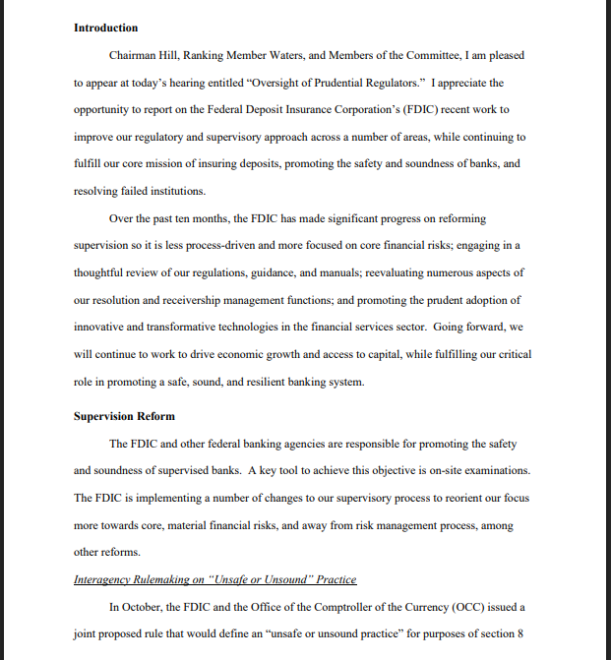
In prepared remarks released before the hearing, FDIC Acting Chair Travis Hill said his agency expects to publish its first proposal later this month, establishing the application process for stablecoin issuers supervised by the FDIC.
— Cryptonews.com (@cryptonews) December 2, 2025
The Federal Deposit Insurance Corporation will publish its first US stablecoin rule framework later this month.#Stablecoin #FDIChttps://t.co/yuIdMYcRek
Hill said the FDIC’s responsibilities extend well beyond licensing, noting that the law tasks his agency with defining the capital, liquidity, and reserve standards that bank-issued stablecoins must meet.
He said a separate proposal detailing prudential standards is planned for early next year, setting up a two-step regulatory rollout.
GENIUS Act Moves Forward Alongside CLARITY Act and Anti-CBDC Proposals
The GENIUS Act would require stablecoin issuers to maintain one-to-one backing with U.S. dollars or high-quality liquid assets and introduce annual audits for firms whose tokens exceed a $50 billion market cap.
It also outlines the first federal standards for foreign-issued stablecoins, giving Washington a clearer framework for overseeing offshore projects.
Federal agencies have already begun laying groundwork for implementation.
The Treasury Department has opened multiple public consultations to gather industry input on stablecoin rule designed and how illicit-finance risks should be monitored.
— Cryptonews.com (@cryptonews) August 19, 2025
The U.S. Treasury is calling on the public for feedback on how financial institutions can prevent crypto risks as part of the GENIUS Act. #Treasury #GENIUSActhttps://t.co/7Bu5ExndQt
Treasury Secretary Scott Bessent said the feedback will shape ongoing research into compliance tools, including their effectiveness and privacy impact.
He called the GENIUS Act “essential” to maintaining U.S. leadership in the stablecoin market.
The legislative process, however, continues to feature political flashpoints.
During the latest hearing, Rep. Maxine Waters raised concerns about whether a sitting president should hold business interests in sectors they regulate, referencing President Trump’s link to the World Liberty Financial project.
She said the situation highlights unresolved conflict-of-interest questions that Congress must address.
Regulatory momentum is advancing in parallel with broader market-structure efforts on Capitol Hill.
The House passed its digital-asset package, the CLARITY Act, earlier this year, assigning oversight responsibilities between the Commodity Futures Trading Commission and the Securities and Exchange Commission based on token classifications.
— Cryptonews.com (@cryptonews) July 16, 2025
GENIUS Act, Anti-CBDC Act, and CLARITY Act pass crucial procedural vote 215-211 in Congress after Trump's decisive Oval Office intervention rescues stalled crypto agenda.#GeniusAct #Trumphttps://t.co/Lm2tCBbimp
The bill still awaits Senate consideration, and analysts say its prospects remain unclear.
Another key proposal, the Anti-CBDC Surveillance State Act, is also pending in the Senate.
It would bar the Federal Reserve from issuing a retail central bank digital currency without explicit congressional authorization, a step supporters argue is necessary to safeguard financial privacy.
The post Rep. Steil Demands Regulators Fast-Track GENIUS Act as Stablecoin Law Deadline Looms appeared first on Cryptonews.