
โŒ

Reading view

There are new articles available, click to refresh the page.

DC-Sonar - Analyzing AD Domains For Security Risks Related To User Accounts
By: Unknown

DC Sonar Community

Repositories

The project consists of repositories:

Disclaimer

It's only for education purposes.

Avoid using it on the production Active Directory (AD) domain.

Neither contributor incur any responsibility for any using it.

Social media

Check out our Red Team community Telegram channel

Description

Architecture

For the visual descriptions, open the diagram files using the diagrams.net tool.

The app consists of:


Functionallity

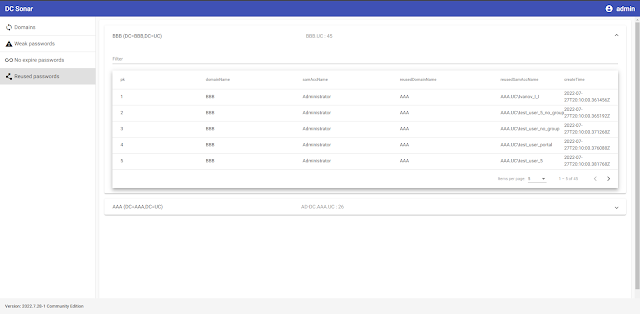
The DC Sonar Community provides functionality for analyzing AD domains for security risks related to accounts:

  • Register analyzing AD domain in the app

  • See the statuses of domain analyzing processes

  • Dump and brute NTLM hashes from set AD domains to list accounts with weak and vulnerable passwords

  • Analyze AD domain accounts to list ones with never expire passwords

  • Analyze AD domain accounts by their NTLM password hashes to determine accounts and domains where passwords repeat

Installation

Docker

In progress ...

Manually using dpkg

It is assumed that you have a clean Ubuntu Server 22.04 and account with the username "user".

The app will install to /home/user/dc-sonar.

The next releases maybe will have a more flexible installation.

Download dc_sonar_NNNN.N.NN-N_amd64.tar.gz from the last distributive to the server.

Create a folder for extracting files:

mkdir dc_sonar_NNNN.N.NN-N_amd64

Extract the downloaded archive:

tar -xvf dc_sonar_NNNN.N.NN-N_amd64.tar.gz -C dc_sonar_NNNN.N.NN-N_amd64

Go to the folder with the extracted files:

cd dc_sonar_NNNN.N.NN-N_amd64/

Install PostgreSQL:

sudo bash install_postgresql.sh

Install RabbitMQ:

sudo bash install_rabbitmq.sh

Install dependencies:

sudo bash install_dependencies.sh

It will ask for confirmation of adding the ppa:deadsnakes/ppa repository. Press Enter.

Install dc-sonar itself:

sudo dpkg -i dc_sonar_NNNN.N.NN-N_amd64.deb

It will ask for information for creating a Django admin user. Provide username, mail and password.

It will ask for information for creating a self-signed SSL certificate twice. Provide required information.

Open: https://localhost

Enter Django admin user credentials set during the installation process before.

Style guide

See the information in STYLE_GUIDE.md

Deployment for development

Docker

In progress ...

Manually using Windows host and Ubuntu Server guest

In this case, we will set up the environment for editing code on the Windows host while running Python code on the Ubuntu guest.

Set up the virtual machine

Create a virtual machine with 2 CPU, 2048 MB RAM, 10GB SSD using Ubuntu Server 22.04 iso in VirtualBox.

If Ubuntu installer asks for updating ubuntu installer before VM's installation - agree.

Choose to install OpenSSH Server.

VirtualBox Port Forwarding Rules:

Name Protocol Host IP Host Port Guest IP Guest Port
SSH TCP 127.0.0.1 2222 10.0.2.15 22
RabbitMQ management console TCP 127.0.0.1 15672 10.0.2.15 15672
Django Server TCP 127.0.0.1 8000 10.0.2.15 8000
NTLM Scrutinizer TCP 127.0.0.1 5000 10.0.2.15 5000
PostgreSQL TCP 127.0.0.1 25432 10.0.2.15 5432

Config Window

Download and install Python 3.10.5.

Create a folder for the DC Sonar project.

Go to the project folder using Git for Windows:

cd '{PATH_TO_FOLDER}'

Make Windows installation steps for dc-sonar-user-layer.

Make Windows installation steps for dc-sonar-workers-layer.

Make Windows installation steps for ntlm-scrutinizer.

Make Windows installation steps for dc-sonar-frontend.

Set shared folders

Make steps from "Open VirtualBox" to "Reboot VM", but add shared folders to VM VirtualBox with "Auto-mount", like in the picture below:

After reboot, run command:

sudo adduser $USER vboxsf

Perform logout and login for the using user account.

In /home/user directory, you can use mounted folders:

ls -l
Output:
total 12
drwxrwx--- 1 root vboxsf 4096 Jul 19 13:53 dc-sonar-user-layer
drwxrwx--- 1 root vboxsf 4096 Jul 19 10:11 dc-sonar-workers-layer
drwxrwx--- 1 root vboxsf 4096 Jul 19 14:25 ntlm-scrutinizer

Config Ubuntu Server

Config PostgreSQL

Install PostgreSQL on Ubuntu 20.04:

sudo apt update
sudo apt install postgresql postgresql-contrib
sudo systemctl start postgresql.service

Create the admin database account:

sudo -u postgres createuser --interactive
Output:
Enter name of role to add: admin
Shall the new role be a superuser? (y/n) y

Create the dc_sonar_workers_layer database account:

sudo -u postgres createuser --interactive
Output:
Enter name of role to add: dc_sonar_workers_layer
Shall the new role be a superuser? (y/n) n
Shall the new role be allowed to create databases? (y/n) n
Shall the new role be allowed to create more new roles? (y/n) n

Create the dc_sonar_user_layer database account:

sudo -u postgres createuser --interactive
Output:
Enter name of role to add: dc_sonar_user_layer
Shall the new role be a superuser? (y/n) n
Shall the new role be allowed to create databases? (y/n) n
Shall the new role be allowed to create more new roles? (y/n) n

Create the back_workers_db database:

sudo -u postgres createdb back_workers_db

Create the web_app_db database:

sudo -u postgres createdb web_app_db

Run the psql:

sudo -u postgres psql

Set a password for the admin account:

ALTER USER admin WITH PASSWORD '{YOUR_PASSWORD}';

Set a password for the dc_sonar_workers_layer account:

ALTER USER dc_sonar_workers_layer WITH PASSWORD '{YOUR_PASSWORD}';

Set a password for the dc_sonar_user_layer account:

ALTER USER dc_sonar_user_layer WITH PASSWORD '{YOUR_PASSWORD}';

Grant CRUD permissions for the dc_sonar_workers_layer account on the back_workers_db database:

\c back_workers_db
GRANT CONNECT ON DATABASE back_workers_db to dc_sonar_workers_layer;
GRANT USAGE ON SCHEMA public to dc_sonar_workers_layer;
GRANT ALL ON ALL TABLES IN SCHEMA public TO dc_sonar_workers_layer;
GRANT ALL ON ALL SEQUENCES IN SCHEMA public TO dc_sonar_workers_layer;
GRANT ALL ON ALL FUNCTIONS IN SCHEMA public TO dc_sonar_workers_layer;

Grant CRUD permissions for the dc_sonar_user_layer account on the web_app_db database:

\c web_app_db
GRANT CONNECT ON DATABASE web_app_db to dc_sonar_user_layer;
GRANT USAGE ON SCHEMA public to dc_sonar_user_layer;
GRANT ALL ON ALL TABLES IN SCHEMA public TO dc_sonar_user_layer;
GRANT ALL ON ALL SEQUENCES IN SCHEMA public TO dc_sonar_user_layer;
GRANT ALL ON ALL FUNCTIONS IN SCHEMA public TO dc_sonar_user_layer;

Exit of the psql:

\q

Open the pg_hba.conf file:

sudo nano /etc/postgresql/12/main/pg_hba.conf

Add the line for the connection to allow the connection from the host machine to PostgreSQL, save changes and close the file:

# IPv4 local connections:
host all all 127.0.0.1/32 md5
host all admin 0.0.0.0/0 md5

Open the postgresql.conf file:

sudo nano /etc/postgresql/12/main/postgresql.conf

Change specified below params, save changes and close the file:

listen_addresses = 'localhost,10.0.2.15'
shared_buffers = 512MB
work_mem = 5MB
maintenance_work_mem = 100MB
effective_cache_size = 1GB

Restart the PostgreSQL service:

sudo service postgresql restart

Check the PostgreSQL service status:

service postgresql status

Check the log file if it is needed:

tail -f /var/log/postgresql/postgresql-12-main.log

Now you can connect to created databases using admin account and client such as DBeaver from Windows.

Config RabbitMQ

Install RabbitMQ using the script.

Enable the management plugin:

sudo rabbitmq-plugins enable rabbitmq_management

Create the RabbitMQ admin account:

sudo rabbitmqctl add_user admin {YOUR_PASSWORD}

Tag the created user for full management UI and HTTP API access:

sudo rabbitmqctl set_user_tags admin administrator

Open management UI on http://localhost:15672/.

Install Python3.10

Ensure that your system is updated and the required packages installed:

sudo apt update && sudo apt upgrade -y

Install the required dependency for adding custom PPAs:

sudo apt install software-properties-common -y

Then proceed and add the deadsnakes PPA to the APT package manager sources list as below:

sudo add-apt-repository ppa:deadsnakes/ppa

Download Python 3.10:

sudo apt install python3.10=3.10.5-1+focal1

Install the dependencies:

sudo apt install python3.10-dev=3.10.5-1+focal1 libpq-dev=12.11-0ubuntu0.20.04.1 libsasl2-dev libldap2-dev libssl-dev

Install the venv module:

sudo apt-get install python3.10-venv

Check the version of installed python:

python3.10 --version

Output:
Python 3.10.5
Hosts

Add IP addresses of Domain Controllers to /etc/hosts

sudo nano /etc/hosts

Layers

Set venv

We have to create venv on a level above as VM VirtualBox doesn't allow us to make it in shared folders.

Go to the home directory where shared folders located:

cd /home/user

Make deploy steps for dc-sonar-user-layer on Ubuntu.

Make deploy steps for dc-sonar-workers-layer on Ubuntu.

Make deploy steps for ntlm-scrutinizer on Ubuntu.

Config modules

Make config steps for dc-sonar-user-layer on Ubuntu.

Make config steps for dc-sonar-workers-layer on Ubuntu.

Make config steps for ntlm-scrutinizer on Ubuntu.

Run

Make run steps for ntlm-scrutinizer on Ubuntu.

Make run steps for dc-sonar-user-layer on Ubuntu.

Make run steps for dc-sonar-workers-layer on Ubuntu.

Make run steps for dc-sonar-frontend on Windows.

Open https://localhost:8000/admin/ in a browser on the Windows host and agree with the self-signed certificate.

Open https://localhost:4200/ in the browser on the Windows host and login as created Django user.


KRIe - Linux Kernel Runtime Integrity With eBPF

By: Unknown


KRIe is a research project that aims to detect Linux Kernel exploits with eBPF. KRIe is far from being a bulletproof strategy: from eBPF related limitations to post exploitation detections that might rely on a compromised kernel to emit security events, it is clear that a motivated attacker will eventually be able to bypass it. That being said, the goal of the project is to make attackers' lives harder and ultimately prevent out-of-the-box exploits from working on a vulnerable kernel.

KRIe has been developed using CO-RE (Compile Once - Run Everywhere) so that it is compatible with a large range of kernel versions. If your kernel doesn't export its BTF debug information, KRIe will try to download it automatically from BTFHub. If your kernel isn't available on BTFHub, but you have been able to manually generate your kernel's BTF data, you can provide it in the configuration file (see below).


System requirements

This project was developed on Ubuntu Focal 20.04 (Linux Kernel 5.15) and has been tested on older releases down to Ubuntu Bionic 18.04 (Linux Kernel 4.15).

  • golang 1.18+
  • (optional) Kernel headers are expected to be installed in lib/modules/$(uname -r), update the Makefile with their location otherwise.
  • (optional) clang & llvm 14.0.6+

Optional fields are required to recompile the eBPF programs.

Build

  1. Since KRIe was built using CORE, you shouldn't need to rebuild the eBPF programs. That said, if you want still want to rebuild the eBPF programs, you can use the following command:
# ~ make build-ebpf
  1. To build KRIE, run:
# ~ make build
  1. To install KRIE (copy to /usr/bin/krie) run:
# ~ make install

Getting started

KRIe needs to run as root. Run sudo krie -h to get help.

# ~ krie -h
Usage:
krie [flags]

Flags:
--config string KRIe config file (default "./cmd/krie/run/config/default_config.yaml")
-h, --help help for krie

Configuration

## Log level, options are: panic, fatal, error, warn, info, debug or trace
log_level: debug

## JSON output file, leave empty to disable JSON output.
output: "/tmp/krie.json"

## BTF information for the current kernel in .tar.xz format (required only if KRIE isn't able to locate it by itself)
vmlinux: ""

## events configuration
events:
## action taken when an init_module event is detected
init_module: log

## action taken when an delete_module event is detected
delete_module: log

## action taken when a bpf event is detected
bpf: log

## action taken when a bpf_filter event is detected
bpf_filter: log

## action taken when a ptrace event is detected
ptrace: log

## action taken when a kprobe event is detected
kprobe: log

## action taken when a sysctl event is detected
sysctl:
action: log

## Default settings for sysctl programs (kernel 5.2+ only)
sysctl_default:
block_read_access: false
block_write_access: false

## Custom settings for sysctl programs (kernel 5.2+ only)
sysctl_parameters:
kernel/yama/ptrace_scope:
block_write_access: true
kernel/ftrace_enabled:
override_input_value_with: "1\n"

## action taken when a hooked_syscall_table event is detected
hooked_syscall_table: log

## action taken when a hooked_syscall event is detected
hooked_syscall: log

## kernel_parameter event configuration
kernel_parameter:
action: log
periodic_action: log
ticker: 1 # sends at most one event every [ticker] second(s)
list:
- symbol: system/kprobes_all_disarmed
expected_value: 0
size: 4
# - symbol: system/selinux_state
# expecte d_value: 256
# size: 2

# sysctl
- symbol: system/ftrace_dump_on_oops
expected_value: 0
size: 4
- symbol: system/kptr_restrict
expected_value: 0
size: 4
- symbol: system/randomize_va_space
expected_value: 2
size: 4
- symbol: system/stack_tracer_enabled
expected_value: 0
size: 4
- symbol: system/unprivileged_userns_clone
expected_value: 0
size: 4
- symbol: system/unprivileged_userns_apparmor_policy
expected_value: 1
size: 4
- symbol: system/sysctl_unprivileged_bpf_disabled
expected_value: 1
size: 4
- symbol: system/ptrace_scope
expected_value: 2
size: 4
- symbol: system/sysctl_perf_event_paranoid
expected_value: 2
size: 4
- symbol: system/kexe c_load_disabled
expected_value: 1
size: 4
- symbol: system/dmesg_restrict
expected_value: 1
size: 4
- symbol: system/modules_disabled
expected_value: 0
size: 4
- symbol: system/ftrace_enabled
expected_value: 1
size: 4
- symbol: system/ftrace_disabled
expected_value: 0
size: 4
- symbol: system/sysctl_protected_fifos
expected_value: 1
size: 4
- symbol: system/sysctl_protected_hardlinks
expected_value: 1
size: 4
- symbol: system/sysctl_protected_regular
expected_value: 2
size: 4
- symbol: system/sysctl_protected_symlinks
expected_value: 1
size: 4
- symbol: system/sysctl_unprivileged_userfaultfd
expected_value: 0
size: 4

## action to check when a regis ter_check fails on a sensitive kernel space hook point
register_check: log

Documentation

License

  • The golang code is under Apache 2.0 License.
  • The eBPF programs are under the GPL v2 License.


DC-Sonar - Analyzing AD Domains For Security Risks Related To User Accounts

By: Unknown

DC Sonar Community

Repositories

The project consists of repositories:

Disclaimer

It's only for education purposes.

Avoid using it on the production Active Directory (AD) domain.

Neither contributor incur any responsibility for any using it.

Social media

Check out our Red Team community Telegram channel

Description

Architecture

For the visual descriptions, open the diagram files using the diagrams.net tool.

The app consists of:


Functionallity

The DC Sonar Community provides functionality for analyzing AD domains for security risks related to accounts:

  • Register analyzing AD domain in the app

  • See the statuses of domain analyzing processes

  • Dump and brute NTLM hashes from set AD domains to list accounts with weak and vulnerable passwords

  • Analyze AD domain accounts to list ones with never expire passwords

  • Analyze AD domain accounts by their NTLM password hashes to determine accounts and domains where passwords repeat

Installation

Docker

In progress ...

Manually using dpkg

It is assumed that you have a clean Ubuntu Server 22.04 and account with the username "user".

The app will install to /home/user/dc-sonar.

The next releases maybe will have a more flexible installation.

Download dc_sonar_NNNN.N.NN-N_amd64.tar.gz from the last distributive to the server.

Create a folder for extracting files:

mkdir dc_sonar_NNNN.N.NN-N_amd64

Extract the downloaded archive:

tar -xvf dc_sonar_NNNN.N.NN-N_amd64.tar.gz -C dc_sonar_NNNN.N.NN-N_amd64

Go to the folder with the extracted files:

cd dc_sonar_NNNN.N.NN-N_amd64/

Install PostgreSQL:

sudo bash install_postgresql.sh

Install RabbitMQ:

sudo bash install_rabbitmq.sh

Install dependencies:

sudo bash install_dependencies.sh

It will ask for confirmation of adding the ppa:deadsnakes/ppa repository. Press Enter.

Install dc-sonar itself:

sudo dpkg -i dc_sonar_NNNN.N.NN-N_amd64.deb

It will ask for information for creating a Django admin user. Provide username, mail and password.

It will ask for information for creating a self-signed SSL certificate twice. Provide required information.

Open: https://localhost

Enter Django admin user credentials set during the installation process before.

Style guide

See the information in STYLE_GUIDE.md

Deployment for development

Docker

In progress ...

Manually using Windows host and Ubuntu Server guest

In this case, we will set up the environment for editing code on the Windows host while running Python code on the Ubuntu guest.

Set up the virtual machine

Create a virtual machine with 2 CPU, 2048 MB RAM, 10GB SSD using Ubuntu Server 22.04 iso in VirtualBox.

If Ubuntu installer asks for updating ubuntu installer before VM's installation - agree.

Choose to install OpenSSH Server.

VirtualBox Port Forwarding Rules:

Name Protocol Host IP Host Port Guest IP Guest Port
SSH TCP 127.0.0.1 2222 10.0.2.15 22
RabbitMQ management console TCP 127.0.0.1 15672 10.0.2.15 15672
Django Server TCP 127.0.0.1 8000 10.0.2.15 8000
NTLM Scrutinizer TCP 127.0.0.1 5000 10.0.2.15 5000
PostgreSQL TCP 127.0.0.1 25432 10.0.2.15 5432

Config Window

Download and install Python 3.10.5.

Create a folder for the DC Sonar project.

Go to the project folder using Git for Windows:

cd '{PATH_TO_FOLDER}'

Make Windows installation steps for dc-sonar-user-layer.

Make Windows installation steps for dc-sonar-workers-layer.

Make Windows installation steps for ntlm-scrutinizer.

Make Windows installation steps for dc-sonar-frontend.

Set shared folders

Make steps from "Open VirtualBox" to "Reboot VM", but add shared folders to VM VirtualBox with "Auto-mount", like in the picture below:

After reboot, run command:

sudo adduser $USER vboxsf

Perform logout and login for the using user account.

In /home/user directory, you can use mounted folders:

ls -l
Output:
total 12
drwxrwx--- 1 root vboxsf 4096 Jul 19 13:53 dc-sonar-user-layer
drwxrwx--- 1 root vboxsf 4096 Jul 19 10:11 dc-sonar-workers-layer
drwxrwx--- 1 root vboxsf 4096 Jul 19 14:25 ntlm-scrutinizer

Config Ubuntu Server

Config PostgreSQL

Install PostgreSQL on Ubuntu 20.04:

sudo apt update
sudo apt install postgresql postgresql-contrib
sudo systemctl start postgresql.service

Create the admin database account:

sudo -u postgres createuser --interactive
Output:
Enter name of role to add: admin
Shall the new role be a superuser? (y/n) y

Create the dc_sonar_workers_layer database account:

sudo -u postgres createuser --interactive
Output:
Enter name of role to add: dc_sonar_workers_layer
Shall the new role be a superuser? (y/n) n
Shall the new role be allowed to create databases? (y/n) n
Shall the new role be allowed to create more new roles? (y/n) n

Create the dc_sonar_user_layer database account:

sudo -u postgres createuser --interactive
Output:
Enter name of role to add: dc_sonar_user_layer
Shall the new role be a superuser? (y/n) n
Shall the new role be allowed to create databases? (y/n) n
Shall the new role be allowed to create more new roles? (y/n) n

Create the back_workers_db database:

sudo -u postgres createdb back_workers_db

Create the web_app_db database:

sudo -u postgres createdb web_app_db

Run the psql:

sudo -u postgres psql

Set a password for the admin account:

ALTER USER admin WITH PASSWORD '{YOUR_PASSWORD}';

Set a password for the dc_sonar_workers_layer account:

ALTER USER dc_sonar_workers_layer WITH PASSWORD '{YOUR_PASSWORD}';

Set a password for the dc_sonar_user_layer account:

ALTER USER dc_sonar_user_layer WITH PASSWORD '{YOUR_PASSWORD}';

Grant CRUD permissions for the dc_sonar_workers_layer account on the back_workers_db database:

\c back_workers_db
GRANT CONNECT ON DATABASE back_workers_db to dc_sonar_workers_layer;
GRANT USAGE ON SCHEMA public to dc_sonar_workers_layer;
GRANT ALL ON ALL TABLES IN SCHEMA public TO dc_sonar_workers_layer;
GRANT ALL ON ALL SEQUENCES IN SCHEMA public TO dc_sonar_workers_layer;
GRANT ALL ON ALL FUNCTIONS IN SCHEMA public TO dc_sonar_workers_layer;

Grant CRUD permissions for the dc_sonar_user_layer account on the web_app_db database:

\c web_app_db
GRANT CONNECT ON DATABASE web_app_db to dc_sonar_user_layer;
GRANT USAGE ON SCHEMA public to dc_sonar_user_layer;
GRANT ALL ON ALL TABLES IN SCHEMA public TO dc_sonar_user_layer;
GRANT ALL ON ALL SEQUENCES IN SCHEMA public TO dc_sonar_user_layer;
GRANT ALL ON ALL FUNCTIONS IN SCHEMA public TO dc_sonar_user_layer;

Exit of the psql:

\q

Open the pg_hba.conf file:

sudo nano /etc/postgresql/12/main/pg_hba.conf

Add the line for the connection to allow the connection from the host machine to PostgreSQL, save changes and close the file:

# IPv4 local connections:
host all all 127.0.0.1/32 md5
host all admin 0.0.0.0/0 md5

Open the postgresql.conf file:

sudo nano /etc/postgresql/12/main/postgresql.conf

Change specified below params, save changes and close the file:

listen_addresses = 'localhost,10.0.2.15'
shared_buffers = 512MB
work_mem = 5MB
maintenance_work_mem = 100MB
effective_cache_size = 1GB

Restart the PostgreSQL service:

sudo service postgresql restart

Check the PostgreSQL service status:

service postgresql status

Check the log file if it is needed:

tail -f /var/log/postgresql/postgresql-12-main.log

Now you can connect to created databases using admin account and client such as DBeaver from Windows.

Config RabbitMQ

Install RabbitMQ using the script.

Enable the management plugin:

sudo rabbitmq-plugins enable rabbitmq_management

Create the RabbitMQ admin account:

sudo rabbitmqctl add_user admin {YOUR_PASSWORD}

Tag the created user for full management UI and HTTP API access:

sudo rabbitmqctl set_user_tags admin administrator

Open management UI on http://localhost:15672/.

Install Python3.10

Ensure that your system is updated and the required packages installed:

sudo apt update && sudo apt upgrade -y

Install the required dependency for adding custom PPAs:

sudo apt install software-properties-common -y

Then proceed and add the deadsnakes PPA to the APT package manager sources list as below:

sudo add-apt-repository ppa:deadsnakes/ppa

Download Python 3.10:

sudo apt install python3.10=3.10.5-1+focal1

Install the dependencies:

sudo apt install python3.10-dev=3.10.5-1+focal1 libpq-dev=12.11-0ubuntu0.20.04.1 libsasl2-dev libldap2-dev libssl-dev

Install the venv module:

sudo apt-get install python3.10-venv

Check the version of installed python:

python3.10 --version

Output:
Python 3.10.5
Hosts

Add IP addresses of Domain Controllers to /etc/hosts

sudo nano /etc/hosts

Layers

Set venv

We have to create venv on a level above as VM VirtualBox doesn't allow us to make it in shared folders.

Go to the home directory where shared folders located:

cd /home/user

Make deploy steps for dc-sonar-user-layer on Ubuntu.

Make deploy steps for dc-sonar-workers-layer on Ubuntu.

Make deploy steps for ntlm-scrutinizer on Ubuntu.

Config modules

Make config steps for dc-sonar-user-layer on Ubuntu.

Make config steps for dc-sonar-workers-layer on Ubuntu.

Make config steps for ntlm-scrutinizer on Ubuntu.

Run

Make run steps for ntlm-scrutinizer on Ubuntu.

Make run steps for dc-sonar-user-layer on Ubuntu.

Make run steps for dc-sonar-workers-layer on Ubuntu.

Make run steps for dc-sonar-frontend on Windows.

Open https://localhost:8000/admin/ in a browser on the Windows host and agree with the self-signed certificate.

Open https://localhost:4200/ in the browser on the Windows host and login as created Django user.



KRIe - Linux Kernel Runtime Integrity With eBPF

By: Unknown


KRIe is a research project that aims to detect Linux Kernel exploits with eBPF. KRIe is far from being a bulletproof strategy: from eBPF related limitations to post exploitation detections that might rely on a compromised kernel to emit security events, it is clear that a motivated attacker will eventually be able to bypass it. That being said, the goal of the project is to make attackers' lives harder and ultimately prevent out-of-the-box exploits from working on a vulnerable kernel.

KRIe has been developed using CO-RE (Compile Once - Run Everywhere) so that it is compatible with a large range of kernel versions. If your kernel doesn't export its BTF debug information, KRIe will try to download it automatically from BTFHub. If your kernel isn't available on BTFHub, but you have been able to manually generate your kernel's BTF data, you can provide it in the configuration file (see below).


System requirements

This project was developed on Ubuntu Focal 20.04 (Linux Kernel 5.15) and has been tested on older releases down to Ubuntu Bionic 18.04 (Linux Kernel 4.15).

  • golang 1.18+
  • (optional) Kernel headers are expected to be installed in lib/modules/$(uname -r), update the Makefile with their location otherwise.
  • (optional) clang & llvm 14.0.6+

Optional fields are required to recompile the eBPF programs.

Build

  1. Since KRIe was built using CORE, you shouldn't need to rebuild the eBPF programs. That said, if you want still want to rebuild the eBPF programs, you can use the following command:
# ~ make build-ebpf
  1. To build KRIE, run:
# ~ make build
  1. To install KRIE (copy to /usr/bin/krie) run:
# ~ make install

Getting started

KRIe needs to run as root. Run sudo krie -h to get help.

# ~ krie -h
Usage:
krie [flags]

Flags:
--config string KRIe config file (default "./cmd/krie/run/config/default_config.yaml")
-h, --help help for krie

Configuration

## Log level, options are: panic, fatal, error, warn, info, debug or trace
log_level: debug

## JSON output file, leave empty to disable JSON output.
output: "/tmp/krie.json"

## BTF information for the current kernel in .tar.xz format (required only if KRIE isn't able to locate it by itself)
vmlinux: ""

## events configuration
events:
## action taken when an init_module event is detected
init_module: log

## action taken when an delete_module event is detected
delete_module: log

## action taken when a bpf event is detected
bpf: log

## action taken when a bpf_filter event is detected
bpf_filter: log

## action taken when a ptrace event is detected
ptrace: log

## action taken when a kprobe event is detected
kprobe: log

## action taken when a sysctl event is detected
sysctl:
action: log

## Default settings for sysctl programs (kernel 5.2+ only)
sysctl_default:
block_read_access: false
block_write_access: false

## Custom settings for sysctl programs (kernel 5.2+ only)
sysctl_parameters:
kernel/yama/ptrace_scope:
block_write_access: true
kernel/ftrace_enabled:
override_input_value_with: "1\n"

## action taken when a hooked_syscall_table event is detected
hooked_syscall_table: log

## action taken when a hooked_syscall event is detected
hooked_syscall: log

## kernel_parameter event configuration
kernel_parameter:
action: log
periodic_action: log
ticker: 1 # sends at most one event every [ticker] second(s)
list:
- symbol: system/kprobes_all_disarmed
expected_value: 0
size: 4
# - symbol: system/selinux_state
# expecte d_value: 256
# size: 2

# sysctl
- symbol: system/ftrace_dump_on_oops
expected_value: 0
size: 4
- symbol: system/kptr_restrict
expected_value: 0
size: 4
- symbol: system/randomize_va_space
expected_value: 2
size: 4
- symbol: system/stack_tracer_enabled
expected_value: 0
size: 4
- symbol: system/unprivileged_userns_clone
expected_value: 0
size: 4
- symbol: system/unprivileged_userns_apparmor_policy
expected_value: 1
size: 4
- symbol: system/sysctl_unprivileged_bpf_disabled
expected_value: 1
size: 4
- symbol: system/ptrace_scope
expected_value: 2
size: 4
- symbol: system/sysctl_perf_event_paranoid
expected_value: 2
size: 4
- symbol: system/kexe c_load_disabled
expected_value: 1
size: 4
- symbol: system/dmesg_restrict
expected_value: 1
size: 4
- symbol: system/modules_disabled
expected_value: 0
size: 4
- symbol: system/ftrace_enabled
expected_value: 1
size: 4
- symbol: system/ftrace_disabled
expected_value: 0
size: 4
- symbol: system/sysctl_protected_fifos
expected_value: 1
size: 4
- symbol: system/sysctl_protected_hardlinks
expected_value: 1
size: 4
- symbol: system/sysctl_protected_regular
expected_value: 2
size: 4
- symbol: system/sysctl_protected_symlinks
expected_value: 1
size: 4
- symbol: system/sysctl_unprivileged_userfaultfd
expected_value: 0
size: 4

## action to check when a regis ter_check fails on a sensitive kernel space hook point
register_check: log

Documentation

License

  • The golang code is under Apache 2.0 License.
  • The eBPF programs are under the GPL v2 License.


โŒ