Login
LoginCongratulations to the 2025 Component Abuse Challenge Winners

For the Component Abuse Challenge, we asked you to do the wrong thing with electrical parts, but nonetheless come out with the right result. It’s probably the most Hackaday challenge we have run in a long time, and you all delivered! The judging was tight, but in the end three projects rose up to the top, and will each be taking home a $150 DigiKey gift certificate, but that doesn’t mean you shouldn’t give all of the projects a look.
So without further ado, let’s check out the winners and all the others that tickled the hacky regions of our judges’ brains.
Prize Winners
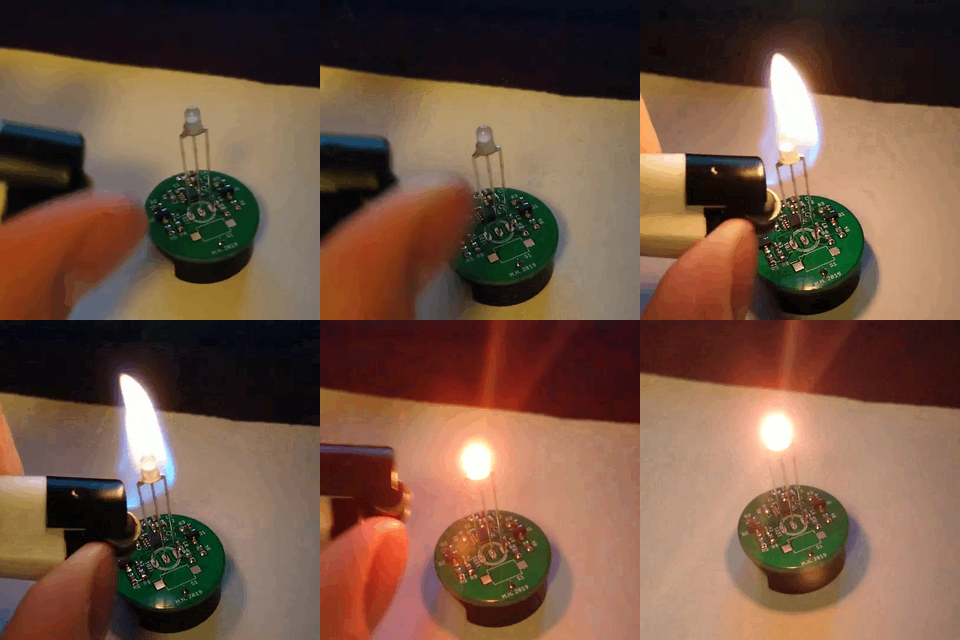 [Miroslav Hancar]’s LED Candles was a shoe-in, at least if you watched the video demo. It presents itself as a simple LED on a round PCB with a coin cell, but then when [Miroslav] lights it with an actual lighter, it starts glowing. (And maybe smoking just a little bit.) He makes both single-LED and quad-LED varieties, and they’re both gems.
The component misuse is an old favorite: the diode’s forward voltage drop depends on the temperature, and if you measure the voltage across the current-limiting resistor, you can read this voltage and determine when someone is setting fire to your LED. A bonus of the single-LED configuration is that if you touch the LED’s leads, your finger shunts some of the current, and you can “snuff” the LEDs out. And while we’ve seen similar LED hacks before, the addition of actual fire to this one seems to have warmed our judges’ hearts.
[Luke J. Barker]’s Need an Electrical Slip Ring? is simplicity itself, and appears to have been born of the mother of invention. [Luke] was making a VertiBird helicopter toy, which spins around on the desk and rises and falls with joystick control. And for that, he needed a slip ring. Enter the humble audio jack, which fills the job nicely, transmitting power to the rotating helicopter without twisting up wires in the process. There’s not much magic here, but it’s a fantastic idea when you need something to spin.
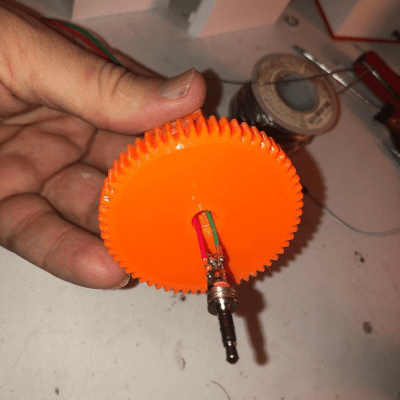
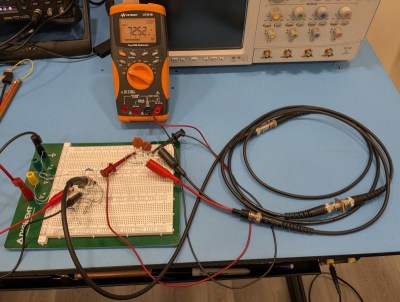
On the other end of the spectrum, [Craig D]’s Boosting voltage with a cable looks like it shouldn’t work at first, but it does. In most step-up-voltage setups, you’re storing the energy in either a capacitor or inductor, and switching it in and out of the circuit to hop the voltage up. Here, the energy isn’t ever really “stored” as much as it’s “in flight”.
A circuit sends a pulse down a long length of coaxial cable that is left open at the other end. The pulse reflects off the open end and heads back toward the voltage driver, which then fires off another pulse at just the right time to make the travelling wave a little bit bigger, and this continues. It’s like pushing a swing – adding a little extra oomph at just the right time can build up. There’s a lot of cool physics here, a nice simulation that actually ends up corresponding very well with reality, and in the end the pulse timing isn’t rocket science, but rather figuring out the resonant frequency along the coax. And it works well enough to light up two neon bulbs in series (~140 V) off of a 15 V power supply.
Honorable Mentions
We got way more cool entries than we have prizes, so we try to round them up into categories and give them a little time in the sun.
Out of Spec
Normally, a 555 timer oscillator circuit relies on filling up a capacitor with a current that’s throttled through a resistor. How can you make it go faster? Make the capacitor smaller and the resistor less resistive. What happens when you get rid of them both entirely, relying on stray capacitance and the resistance of whatever wire you’re using? That’s what [MagicWolfi] aimed to find out with his Ludicrous 555 project.
The IC-Abusing Diode Tester is an absolutely horrible circuit. Nothing in it works like it should. The only reason the IC doesn’t burn up is that it’s more robust than the datasheet promises, and the battery used has such a high internal resistance that it can’t source that much current anyway. Parts are powered by leakage current, and below their minimum voltage. [Joseph Eoff] counts seven values that are out of spec in this single historical circuit, so that’s gotta count for something.
Junk Box Substitutions
 You need GPIO lines, but you have a UART. [Ken Yap] proposes repurposing the DSR, DTR, RTS, and CTS lines as inputs and outputs, and he writes code to make them do his bidding.
Or maybe you’re working on self-assembling robots and you need some magic glue to hold different modules together. [Miana]’s Low-melt-solder connected robots is half research project, and half hack. Resistors are used to melt solder, magnets align the parts together, and when it all cools down, it’s as if two modules are brazed together. This one’s a lot more than a hack, but we’re honored to have it entered in the contest anyway!
Bizarro World
We honestly thought we’d get more entries that made use of the duality of most sensors / emitters. Instead, we got two. [Nick]’s Better Than Bluetooth does the LED-as-photosensor trick, and concludes that it’s better than Bluetooth if expense, limited range, and frustration are what you’re looking for in a data link. Meanwhile, [Kauz] proves that electromagnets are also pickups by building a guitar pickup out of six relays.
Side Effects
 Everything is a fuse if you run enough current through it. [JohnsonFarms] pushed conductive filament to the melting point, and calibrated it along the way. While roasting a hotdog with mains voltage and a couple forks, [Ian Dunn] discovered that if you stick some LEDs in it, they light up.
Most old op-amps oscillate out of control when given feedback, unless you damp it down a bit with a capacitor. [Adrian Freed] found an op-amp lousy enough that would do this at audio frequencies, and used it to reimagine a classic noisemaker.
Finally, while you should probably avoid the metastable middle-zones between digital one and zero, [SHAOS] combines unbuffered NAND and NOR gates to tease out a third logic state. [Bob Widlar] would be proud.
Thanks All!
As always, we had more great entries that we could feature here, so head on over to Hackaday.io and check them out. And thanks again to DigiKey for providing our top three with $150 gift certificates. If you’re looking for your chance to show off a project that you’re working on, hang on for a while because we’ll be starting up a new contest in early 2026.