Reading view

There are new articles available, click to refresh the page.

Indiana Bill Would Mandate Bitcoin in Pensions and Shield Self-Custody Rights

A newly introduced bill in Indiana would require public retirement programs to offer Bitcoin-related investment options and would also limit how much power local governments have to restrict the use of digital assets.

The proposal was filed on Thursday by State Representative Kyle Pierce, a Republican from Anderson. Known as House Bill 1042, the legislation was presented during a meeting of the House Financial Institutions Committee.

It focuses on giving public workers access to cryptocurrency investments while setting clear legal boundaries around digital asset use, custody, payments, and mining.

Indiana Targets First-in-the-Nation Mandate for Bitcoin in Public Pensions

Under the bill, administrators of several state-run retirement and savings plans would be required to include cryptocurrency exchange-traded funds as standard investment choices.

It would also permit certain public pension funds to invest directly in crypto-linked ETFs and give the state treasurer authority to place funds from specific accounts into stablecoin-based ETFs.

Pierce said the bill is designed to give Indiana residents more financial flexibility as digital assets become a larger part of the broader economy.

He added that the legislation is intended to balance investment choice with regulatory guardrails while allowing the state to explore potential government use of blockchain technology through pilot programs.

Source: Indiana House Republicans

The legislation goes beyond retirement investing and takes aim at local regulation. Cities and counties would be prohibited from passing rules that place “unreasonable” limits on digital assets if similar rules do not apply to traditional financial activity.

That protection would extend to crypto payments, private ownership of digital wallets, and mining operations.

The bill adds clear safeguards for self-custody. It states that private digital asset keys could only be demanded through a court order and only when no other legal method of access is available.

It would also prevent local governments from zoning out mining facilities from industrial zones and would protect properly zoned residential mining activity.

If enacted, Indiana would become the first state in the country to require publicly managed retirement programs to provide Bitcoin exposure as a standard option.

While some states permit limited crypto investment flexibility, none currently mandate it.

U.S. States Expand Crypto Access in Pensions, Payments, and Property Laws

Other states have taken related but narrower steps. Oklahoma passed a law in 2024 protecting residents’ right to hold crypto in self-custody wallets and blocking special taxes on Bitcoin transactions.

In 2025, Kentucky followed by formally recognizing self-custody as a protected property right. Wyoming has also approved laws that allow public pension funds to invest in digital assets.

Elsewhere, Arizona introduced legislation that would allow Bitcoin ETFs in retirement accounts, while Florida outlined legal pathways for holding digital assets through ETFs in certain state funds.

✅ Arizona’s push to integrate digital assets into state financial infrastructure is nearing a critical milestone. #Arizona #Bitcoinhttps://t.co/jNb7UnYvX1

— Cryptonews.com (@cryptonews) April 18, 2025

Indiana’s proposal stands apart by making crypto ETF access a requirement rather than a choice.

Momentum around crypto-linked retirement exposure continues to build nationwide. In August, Michigan’s state retirement system tripled its Bitcoin ETF holdings to 300,000 shares, valued at about $11.4 million, according to regulatory filings.

📈 The State of Michigan Retirement System has increased its exposure to Bitcoin, tripling its holdings in the @ARKInvest 21Shares Bitcoin ETF.#Michigan #Bitcoinhttps://t.co/lUxWycmp4A

— Cryptonews.com (@cryptonews) August 6, 2025

The fund also holds roughly $13.6 million in Ethereum through the Grayscale Ethereum Trust. Wisconsin’s state investment board has also disclosed more than $387 million in Bitcoin ETF exposure.

States are also widening their use of digital assets outside of investing. In September, Ohio finalized plans to accept Bitcoin and other cryptocurrencies for official state payments.

In October, California updated its Unclaimed Property Law to ensure dormant crypto is not automatically converted into cash when

transferred to state custody.

✅ California has become the first US state to formally protect unclaimed crypto from being forcibly converted to cash.#California #Bitcoinhttps://t.co/PoV40lmZi9

— Cryptonews.com (@cryptonews) October 14, 2025

New York City has taken its own steps by setting up a municipal Office of Digital Assets and Blockchain.

The move followed an executive order from Mayor Eric Adams aimed at coordinating crypto policy and encouraging blockchain development.

🗽 Bitcoin NYC Mayor Adams established the “nation’s first-ever” municipal office for crypto and blockchain to position the city as the global crypto hub.#EricAdams #NYCMayor #CryptoOfficehttps://t.co/oVEBRTRp5y

— Cryptonews.com (@cryptonews) October 15, 2025

At the federal level, broader regulatory efforts are also underway. Lawmakers are preparing new frameworks that could shape how states approach crypto policy, including updated guidance on 401(k) crypto exposure expected in 2026.

The post Indiana Bill Would Mandate Bitcoin in Pensions and Shield Self-Custody Rights appeared first on Cryptonews.


Key Updates On The US Crypto Market Structure Bill: What You Need To Know

The anticipated crypto market structure bill, or namely the CLARITY Act, designed to provide essential regulatory clarity for digital assets in the United States, is approaching critical dates in the Senate. However, it faces significant complexities related to stablecoin yield, conflicts of interest, and decentralized finance (DeFi).

Senate Divided On Crypto Market Structure Bill

Legal expert and Chief Legal Officer of Variant Jake Chervinsky, reports that the Senate is divided into two committees: Banking, which is handling the securities law aspect, and Agriculture, responsible for the commodities law portion. 

Both committees have published drafts of their work this fall, with the next step being markup, a process where hearings will be held to vote on amendments before sending the bill to the Senate floor for a full vote.

However, both committees are cautious and are unlikely to proceed with markup until they resolve ongoing disputes. Among these, three significant issues stand out.

The first major concern involves stablecoin yield. In the GENIUS Act, banks lobbied for a prohibition on interest payments, meaning stablecoin issuers cannot offer holders any form of interest or yield. 

While the current prohibition prevents direct yield payments to holders, it does not address non-yield rewards or yield provided by third parties. Banks consider this gap a “loophole” and are advocating for broader restrictions to be included in the market structure bill. 

Conflicts Of Interest And DeFi Regulations Stall Progress

The second issue revolves around conflicts of interest. Some Democratic senators have indicated they would not support the market structure legislation unless it includes provisions that restrict the President’s family from conducting business in the crypto space. 

The third and perhaps most crucial issue pertains to DeFi. It is important to note that market structure legislation primarily addresses centralized platforms that exercise custody over user funds and transactions. 

Chervinsky believes the bill should primarily focus on protecting DeFi, but traditional finance (TradFi) stakeholders have been pushing Congress to categorize virtually all entities in the crypto sector—developers, validators, and others—as intermediaries. 

The expert emphasized that the success of any market structure bill hinges on ensuring robust protections for developers since the viability of the crypto industry relies on their contributions. 

Given the intricate nature of these issues and the swiftly approaching holiday break, Chervinsky noted that it is possible that discussions about market structure could extend into January. 

Senate Markup Set For December 17-18

Market analyst MartyParty provided another update on December 4, indicating that the bipartisan Digital Asset Market Structure Bill is gaining significant momentum in Congress, with a markup session in the Senate Banking Committee tentatively scheduled for December 17-18, just before the holiday recess

If successfully passed, he states that the bill could establish clearer pathways for tokenized real-world assets (RWAs) and mitigate “debanking” risks, paving the way for compliant exchanges and potentially stimulating market volumes following the Commodity Futures Trading Commission (CFTC) approvals for spot crypto trading. 

This “regulatory convergence” is seen as a catalyst that could drive liquidity and energize the next bull market, reinforcing President Trump’s vision for the US to emerge as the “crypto capital of the world.”

Crypto

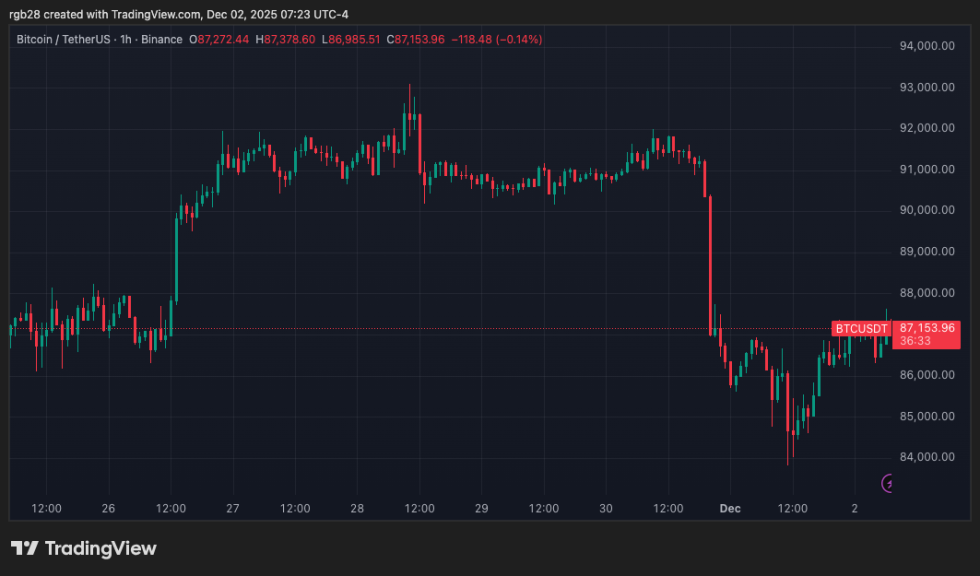
Featured image from DALL-E, chart from TradingView.com 

Crypto Gets Legal Recognition: UK Enacts Property Act 2025 For Digital Assets

The United Kingdom (UK) has reached a significant milestone in its approach to digital assets with the recent passage of the Property Act 2025, which now officially categorizes cryptocurrencies as legal property. 

UK’s New Law Sets Criteria For Digital Assets

The creation of this dedicated legal category for digital assets followed recommendations from the Law Commission, which advocated for a framework that acknowledges assets not fitting traditional definitions of personal property.

This legal evolution is seen as part of a broader strategy to position the UK as a leading digital finance hub, responding to experts’ calls for the country to align its regulatory environment with that of the United States in order to promote growth in the digital asset market. 

According to law firm Clyde & Co, a key provision in the law states that “a thing (including a thing that is digital or electronic in nature) is not prevented from being the object of personal property rights merely because it is neither (a) a thing in possession, nor (b) a thing in action.” 

This phrase confirms that digital assets can now be recognized as a third category of personal property, distinct from the traditional classifications of tangible and intangible assets.

However, the Act does not guarantee that any specific type of asset qualifies as personal property; rather, it aims to “unlock” the common law’s ability to adapt to technological advancements and new asset types, as outlined in the Explanatory Notes from Parliament. 

The interpretation of existing digital assets—such as cryptocurrencies and non-fungible tokens (NFTs)—as well as any emerging forms will ultimately depend on future court rulings. 

The law firm also noted that, under this new law, a digital asset must meet certain criteria to qualify as personal property: it must be definable and identifiable by third parties and capable of being assumed by them, as well as possess a degree of permanence.

Additionally, digital assets will be included in bankruptcy and insolvency proceedings, allowing them to be treated as part of the overall asset pool available to creditors and heirs. 

Government Moves To Ban Crypto Donations

While momentum continues for digital asset recognition, the UK government is also addressing concerns surrounding cryptocurrency in the political sphere. 

Ministers are reportedly working on legislation aimed at banning political donations made through digital currencies, although this crackdown may not be ready in time for the upcoming elections bill in the new year. 

Officials have raised alarms that cryptocurrency donations pose risks to the integrity of the electoral process, primarily due to their difficult-to-trace nature, which could open the door to exploitation by foreign entities or criminal organizations.

Crypto

At the time of writing, the market’s leading cryptocurrency, Bitcoin, was trading at $92,180, surging 4% in the past 24 hours. 

Featured image from Shutterstock, chart from TradingView.com 

Poland’s President Vetoes Crypto Market Bill Due To ‘Overregulation’ Concerns

The President of Poland has vetoed a controversial bill that aimed to set strict rules on the crypto assets market, following multiple concerns of a startup exodus, “overregulation” of the sector, and stifling market innovation.

Poland’s President Vetoes Divisive Crypto Bill

On Monday, Poland’s President Karol Nawrocki refused to sign a crypto market legislation over concerns that it could pose a real threat to the freedoms of Poles, the stability of the state, and market innovation.

In an official statement, the president’s office announced Nawrocki’s decision to veto the Crypto-Asset Market Act, introduced in June, to prevent “overregulation” and abuse of the “legal mess” proposed by the Polish government.

As reported by Bitcoinist, Poland’s crypto community previously raised concerns about the legislation in September, noting that the bill exceeded the European Union (EU)’s minimum regulatory requirements and could drive small businesses and startups abroad.

Notably, the bill’s text required all Crypto Asset Service Providers to obtain a license from the Polish Financial Supervision Authority (KNF) to operate in the market. It also proposed heavy fines and potential prison time for participants who breached the law.

Rafal Leśkiewicz, Press Secretary of the President, listed on X three main reasons for Nawrocki’s decision to reject the bill. He asserted that the legislation risks power abuse and overreach, as some provisions allow the government to shut down websites of companies offering crypto services “with a single click.”

“This is unacceptable. Most European Union countries use a simple list of warnings that protects consumers without blocking entire websites,” he noted.

In addition, the regulation’s size and lack of transparency risked overregulation, noting that countries like the Czech Republic, Slovakia, and Hungary implemented concise and comprehensive frameworks. Meanwhile, Poland’s text surpasses the one-hundred-page mark.

He argued that “Overregulation is a straight path to driving companies abroad—to the Czech Republic, Lithuania, or Malta—instead of creating conditions for them to earn money and pay taxes in Poland.”

Lastly, the Press Secretary listed the amount of supervisory fees as an issue, affirming that the government set them at a level that would have prevented small businesses and startups from developing, favoring foreign corporations and banks. To him, “this is a reversal of logic, killing the competitive market and posing a serious threat to innovation.”

Community Praises The ‘Necessary Decision’

Leśkiewicz emphasized that regulation is necessary, but added that it must oversee the market in a way that’s “reasonable, proportionate, and safe” for users, rather than overreaching and potentially harming the Polish economy.

“The government had two years to prepare a bill in line with the European MiCA regulation on the crypto-asset market in the European Union. Instead, it produced a legal mess that hurts Poles and Polish companies,” he asserted. “The decision to veto was necessary and was made responsibly. The president will defend the economic security of Poles.”

Polish economist Krzysztof Piech praised the president’s decision to veto the crypto bill, affirming that it was “a very bad law” that “violated the Polish Constitution and was contrary to the EU regulation it was supposed to implement in Poland.”

Piech also refuted claims that Poland will become a “paradise” for criminals and fraudsters, who will “be grateful” to President Nawrocki for “a crypto market without state supervision.”

The economist asserted that the government’s version of the bill “did not provide for any assistance to victims of fraudsters,” adding that, “as of July 1, 2026, the entire Polish market will be regulated and supervised — even without any legislation. After all, we are in the EU.”

crypto, bitcoin, btc, btcusdt

New Legislation Bans Hemp-Derived THC

President Donald Trump signed a spending measure Nov. 12, funding federal operations through January and ending the longest government shutdown in US history after 43 days. The Senate had approved the measure the previous day, with seven Democrats crossing party lines to reach the needed 60-vote majority. They were won over by a Republican pledge to revisit the question of subsidies for Obamacare in December.

However, a sideshow to the fight over the Affordable Care Act is causing outrage in the hemp industry—and among farmers in hemp-producing states like Kentucky. A last-minute provision added to the spending bill will effectively ban all hemp-derived THC products.  


The Dreaded ‘Loophole’

This concerns what has been derided as a “loophole” in the 2018 Farm Bill that legalized the production of industrial hemp in the United States. The Farm Bill kept the federal ban on cannabis and cannabis products with more than 0.3% Delta-9 THC—and on Delta-9 THC itself, whether derived from hemp or “marijuana.” However, in a measure intended to legalize the CBD market, it allowed extraction and sale of cannabinoids other than Delta-9 THC, if derived from hemp. 

This had an unanticipated effect. In the wake of the 2018 law, an industry suddenly boomed around hemp-derived cannabinoid products—and not just CBD but psychoactive THC. Particularly at issue was Delta-8 THC, an isomer of Delta-9, which behaves much the same way in the human organism. Products containing Delta-8 were suddenly available in convenience stores, gas stations and truck stops coast to coast.  

A backlash also quickly emerged. Critics argued that because the industry was essentially using a subterfuge to skirt the law, these new products were basically unregulated

The new law contains a provision added to Agriculture Department funding that restricts hemp and hemp-derived products to those containing low concentrations of all THC—not just Delta-9 THC. It is to take effect on Nov. 12, 2026, one year from the date of signing. 

The new provision “prevents the unregulated sale of intoxicating hemp-based or hemp-derived products, including Delta-8, from being sold online, in gas stations, and corner stores, while preserving non-intoxicating CBD and industrial hemp products,” reads a Senate Appropriations Committee summary.  

Media reports warn of an “extinction-level event” for the hemp industry when the provision kicks in. 


Bluegrass Senators at Odds

Kentucky’s Republican Sen. Rand Paul pushed an amendment to strip the provision from the bill, but this failed in a 76-24 vote. And his principal opponent was fellow Bluegrass State GOP senator, Mitch McConnell—who had championed the 2018 Farm Bill as then-majority leader of the Senate. 

The Louisville Courier-Journal quoted Kentucky farmers fearing that the new law could be a “death sentence.” 

The move is also meeting with pushback in Texas, where the GOP-dominated political establishment is divided over an effort to ban Delta-8 at the state level. Officials with the Texas chapter of the Veterans of Foreign Wars told Waco’s KWTX that many vets use hemp-derived THC products to treat PTSD and other ailments related to their service. 

“What in the world just happened last night?” Thus responded Mitch Fuller, legislative chair for Texas VFW, after the Congressional logjam broke. Fuller had successfully lobbied Gov. Greg Abbott to veto the Delta-8 ban in the statehouse earlier this year.  

Abbott’s big rival on the question in his own administration was Lt. Gov. Dan Patrick, who had pushed for the state ban and enthused in a tweet about the federal one after it passed: “As part of the resolution, consumable, highly intoxicating hemp-derived THC is essentially banned in America. Farmers are protected to produce industrial products. CBD and CBG are still legal. However, Delta-8, Delta-10, and candies, snacks, and gummies with high dosages of intoxicating THC are all banned. Hemp-derived Delta-9 will only be allowed to be sold in very low, non-intoxicating dosages.” (This is a reference to the 0.3% cap, well below the threshold for any psychoactive effect.)

Mitch Fuller retorted: “Of course, safety is important, of course children not having access to this is important. But let’s not use a chain-saw approach to this, let’s use a scalpel approach to it, and regulate it.”

The VFW chapter said they will use the year before the ban takes effect to organize pressure to have it reversed.

Industry Voices Sound Alarm 

The hemp and cannabis industries are, predictably, distressed over the new measure. Adam Stettner, CEO of financial lender FundCanna, said in a statement: “Banning intoxicating hemp through a government funding bill isn’t policymaking; it’s panic disguised as progress. You can’t erase a $28 billion market or the millions of consumers who already exist. You can only decide whether those dollars flow through legal, regulated channels or into the shadows. You’re kidding yourself if you think consumers will stop buying hemp beverages, gummies or wellness products because Congress flipped a switch.” 


Stettner raised the specter of backsliding toward prohibition: “Dismantling compliant supply chains won’t make these products disappear; it will make them untraceable, untaxed and unsafe. What we need isn’t a ban, it’s balance and logic. If lawmakers want safer products and clearer rules, they need to regulate, not eradicate. The responsible path forward is to regulate hemp like we do alcohol or caffeine at the federal level, with age limits, testing and labeling. Inserting a blanket prohibition by sneaking it into a budget deal won’t work; prohibition never works.”

Thomas Winstanley, executive vice president of infused products purveyor Edibles.com, emphasized the ironic role of the former Senate majority leader, who has announced that he will retire next year.

“Mitch McConnell has once again proven himself the architect of the law of unintended consequences,” Winstanley said. “When he introduced the 2018 Farm Bill, it was celebrated as a lifeline for America’s farmers—a rare bipartisan achievement that gave rural communities a new cash crop and built a thriving, homegrown industry. What no one expected was that it would also ignite a $28 billion consumer market, create over 300,000 American jobs, and form a domestic supply chain rooted in U.S. agriculture and innovation. That was the first unintended consequence, a positive one. Today, history repeats itself, but this time, the fallout will be devastating. By attaching a sweeping hemp restriction to the government spending bill, McConnell has chosen to end his career by crippling the very industry he created.”

He too pledged to use the one-year grace period to organize resistance: “Farmers, brands, and consumers, once fragmented, are now mobilizing together to defend what they’ve built and to finally push for the federal framework the hemp industry has long demanded.”

The post New Legislation Bans Hemp-Derived THC appeared first on Cannabis Now.

Lawmakers working to save Navy Reserve Center system

  • A bipartisan group of lawmakers is trying to save the Navy Reserve Center system. They say a provision in the Senate version of the fiscal 2026 defense policy bill would shutter 107 commands that provide administrative support and serve as home for approximately 48,000 Navy reservists across the country. In a letter to the House and Senate Armed Services committees, the lawmakers said if the Navy has issues with the current force structure, the service should identify those issues, present them to Congress along with their plans to fix them.
  • One of the longest serving federal agency CIOs has found a new home. Former Agriculture Department chief information officer Gary Washington has left government, but is remaining a part of the federal community. Washington, who served as USDA's CIO for more than seven years before leaving at the end of October, is the new chief strategy officer for the industry group ACT-IAC. Washington has been an active member of ACT-IAC as a federal employee, serving as the president of the American Council for Technology and is a 2006 graduate of the Industry Advisory Council Partners Program. Washington spent more than 25 years in government, also working at OMB, the FDA and Treasury during his career.
  • The American Postal Workers Union is under new leadership. Jonathan Smith who previously led union members in the New York metro area has been sworn in as APWU’s new national president. Smith ran on a platform focused on fighting back against privatizing, closing or consolidating Postal Service operations. He’s taking over for Mark Dimondstein who led the union for 12 years.
  • Paychecks for Defense Department civilians who haven’t been paid in over a month are slated to be processed on Sunday, while servicemembers are expected to get paid on time. President Trump signed a bill late Wednesday to fund the government through January 30, clearing the way for tens of thousands of Defense Department civilians to return to work. A senior administration official said that checks are scheduled to go out on Sunday, but DoD civilians are being told to expect payment sometime between Monday and mid-week. Agencies have also been told to “take all necessary steps to ensure offices open in a prompt manner on November 13.”
  • Nine Democratic lawmakers of Maryland are asking acting NASA Administrator Sean Duffy about the future of NASA Goddard Spaceflight Center. In a letter to Duffy, the legislators asked for details about NASA's plans to consolidate buildings on Goddard's campus in Greenbelt, Maryland. They also are concerned about NASA moving specific technological capabilities away from Goddard. The House and Senate members say actions taken over the last nine months with thousands of civil servants and contractors no longer working at the center threaten the organization's ability to meet its science and exploration missions. The lawmakers want answers to their questions by November 17.
  • Many federal employees are asking when they’ll receive their paychecks, now that the shutdown is over. Federal HR and payroll offices are working to process back pay as soon as possible, but when those checks actually hit employees’ bank accounts will depend on the agency. Feds from the General Services Administration and the Office of Personnel Management will be among the first to receive their retroactive paychecks on Saturday. Others won’t see their checks until next Wednesday, including feds at departments of Agriculture and Treasury, as well as Homeland Security. Both furloughed and excepted federal employees are guaranteed back pay, according to the spending agreement Congress passed on Wednesday.
  • Two non-profits are joining together to launch a new fellowship program, geared toward enhancing public service. The new opportunity from the National Academy of Public Administration and the Bridge Alliance will focus on public service leadership and civil service reforms. The two organizations have put out a request for proposals from the public this week. The end result of the initiative is expected to be a series of action plans for improvements across government.
    (Fellows for democracy and public service initiative - National Academy of Public Administration, Bridge Alliance)
  • The Trump administration is staffing up immigration enforcement, but not the courts that hear these cases. The One Big, Beautiful Bill Act passed this summer gave the Department of Homeland Security billions of dollars to hire 10,000 new Immigration and Enforcement agents, as well as more Customs and Border Protection staff. The legislation also authorizes the Justice Department to hire about 100 immigration judges. But the Trump administration fired nearly that many earlier this year. Recently terminated immigration judges say the courts are severely understaffed and unable to chip away at a backlog of more than three million cases.

The post Lawmakers working to save Navy Reserve Center system first appeared on Federal News Network.

© Getty Images/iStockphoto/Oleksii Liskonih

United States Navy flag textile cloth fabric waving on the top sunrise mist fog

2026 Open Season Exchange: OPM’s Shane Stevens on big-picture plans for FEHB, PSHB


Participants in both the Federal Employees Health Benefits and Postal Service Health Benefits programs may have more incentive than usual to take advantage of Open Season, as premium costs continue to surge in yet another year of double-digit percentage increases.

For 2026, FEHB premiums are rising by an average of 12.3% for enrollees, while those in PSHB will see their premium costs rise by an average of 11.3%. It comes after premiums increased by about 13.5% and 11.1% for FEHB and PSHB respectively in 2025.

Shane Stevens, associate director of healthcare and insurance at the Office of Personnel Management, acknowledged what he said was a “frustrating environment” for insurance enrollees who are facing continually rising premium costs.

“Health care costs have become somewhat unsustainable,” Stevens said during Federal News Network’s 2026 Open Season Exchange. “I’ve watched employees have to get second jobs to get insurance and cover it. I’ve watched where they’ve reduced the amount of coverage in order to afford it. In some cases, they’ve gone completely without insurance.”

Combating federal health insurance premium cost increases

To try to combat rising premiums costs, Stevens said OPM’s strategy will revolve around reducing “fraud, waste and abuse” in the government’s insurance programs.

“We have a fiduciary responsibility to the taxpayers, to our plan participants, the retirees, the current federal workers. Yet we have very little insight into what we’re actually spending this coming year,” he said. “We’re working very hard to try and get all of this information, all of this data, to be able to make good decisions, which will help us to detect fraud, waste, abuse and overpayments.”

OPM is also on a one-year deadline to implement recently added requirements from the One Big, Beautiful Bill Act. One provision of the reconciliation bill, called the FEHB Protection Act, requires OPM to create a system for verifying the eligibility of FEHB enrollees. The bill also directs OPM to include eligibility audits in any fraud risk assessments of the program.

The push in Congress came after the Government Accountability Office in 2022 found that OPM may be spending up to $1 billion annually on ineligible FEHB enrollees. Removing ineligible members, however, would reduce costs to the government but not necessarily lower premiums for beneficiaries directly.

“If we get the data and the information we need, I’m convinced that we could save approximately 7% to 8% per year,” Stevens estimated.

Addressing staff needs, other challenges within OPM

OPM’s insurance programs are facing other major challenges as well. The platform for the PSHB program in particular is at risk of an operational failure, according to OPM’s inspector general office. An OIG report over the summer found that staffing shortages at OPM this year, coupled with funding issues, may negatively impact enrollees’ experience or ability to change enrollments during Open Season.

On top of that, GAO recently reported that the staffing shortages at OPM are hindering the agency’s ability to address risks of fraud in the FEHB program.

When asked how OPM has responded to the watchdog’s concerns, “We do believe our staff can work effectively through everything,” Stevens said, adding, “In the short run, we’ve improved our systems and our processes to where we’re not concerned about delays or challenges.”

Stevens added that he plans to roll out more artificial intelligence tools for participants to use in the enrollment process for future years of Open Season.

Emulating the ‘Make America Healthy Again’ agenda

In addition to addressing fraud and saving costs, Stevens also described his goal of shifting the government’s insurance programs toward what he described as a “well care model,” as opposed to what he describes currently as a “sick care model.”

“We want to move more toward a holistic approach and something to where we’re not doing a pharmaceutical-first type of intervention, or where we have faith-based behavioral health care to where they can give true solutions,” he said.

“If we get healthier and we start making better health decisions, then we’re going to be able to reduce the costs, the premiums,” Stevens added.

It’s not yet entirely clear what OPM may change in the FEHB or PSHB programs based on the big-picture priorities Stevens outlined during the interview.

But for 2026, OPM already made one distinct change: Carriers were required to end coverage of all gender-affirming care, in line with an executive order from President Donald Trump earlier this year.

Enrollees who are mid-treatment for gender-affirming care can still continue receiving coverage, according to OPM’s new requirements, but the definition of “mid-treatment” is determined individually by each health carrier. Federal health plan experts have recommended that those impacted by OPM’s change check their carrier’s plan brochure for more details.

Going forward though, Stevens also expressed interest in reconsidering coverage of GLP-1 medications, a class of drugs that are prescribed to treat diabetes and obesity.

“We want to look at utilizing these as a tool for weight loss or for treatment of diabetes,” Stevens said. “However, we don’t want it to be viewed as the end-all be-all of, ‘this is going to save me.’”

Currently, OPM requires all carriers to cover at least one type of GLP-1 for enrollees, prescribed for weight loss. It’s a requirement that health care experts have said is a positive development and ahead of the curve compared with the private sector.

But Stevens said he wants to encourage physical exercise and nutrition over GLP-1s, through the government’s insurance programs. That type of change, he said, may also lead to some cost savings.

“I want to try and move away from that, move more to incentivizing providers to have good health outcomes for their patients versus prescribed medications,” he said.

Stevens’ approach for what he sees for the future of FEHB and PSHB mirrors goals of the Trump administration’s larger push toward the “Make America Healthy Again” agenda.

Stevens, for instance, discussed what he views as a “broken” health care system that focuses on prescriptions first — emulating a sentiment that Health and Human Services Secretary Robert F. Kennedy Jr. has expressed and that has influenced some of the Trump administration’s major health initiatives.

RFK’s MAHA report from May outlined contentious views on vaccines, the nation’s food supply, pesticides and prescription drugs. The HHS report, parts of which have received strong criticism, additionally includes increased scrutiny of childhood vaccines and “fear-based” views on farming chemicals, while also blaming ultra-processed foods for unhealthy Americans.

“We truly have a secretary of health that’s fighting for the real overall well-being of health. We have a president that truly cares about it, and then we have a lot of appointees that are trying to make a big difference,” Stevens said. “It’s a massive shift in the paradigm of how we look at health care — really looking at outcomes versus prescriptions and a lot of the things that have made us an unhealthy population.”

Encouraging Open Season action

In the immediate term, Stevens encouraged participants in FEHB and PSHB over the next several weeks to take advantage of Open Season. Participants have until the enrollment window closes on Dec. 10 to spend time looking at plan brochures and comparing various insurance options that are available to them.

The push to take action during Open Season comes as relatively few insurance enrollees end up selecting a different plan each year.

“Change is tough, change is scary, and a lot of times I think people would just rather stick with their current plan and do the same, regardless of how much it could cost them more,” Stevens said. “It will surprise a lot of people in seeing that if they were to shift over to a different type of plan that they could save a substantial amount of money.”

For measuring this year’s Open Season success, Stevens said he will be looking for any potential shifts in the statistic that just 5% of enrollees change their plans each year.

“We encourage everybody to take the time — I’m talking maybe an hour of your time — to jump in and look at the different tools that we’ve created and make sure that you’re picking the plan that’s best for you,” he said. “We’ll take all of that in and see what we can do to improve our systems and processes to make it even better next year.”

Discover more articles and videos now on our 2026 Open Season Exchange event page.

The post 2026 Open Season Exchange: OPM’s Shane Stevens on big-picture plans for FEHB, PSHB first appeared on Federal News Network.

© Federal News Network

2026 Open Season Exchange (5)

Immigration courts understaffed and overwhelmed, as Trump administration surges enforcement hiring

The Trump administration is looking to hire thousands of federal law enforcement personnel, as part of expanded immigration enforcement efforts.

But the courts handling these cases aren’t seeing the same surge in resources. Several immigration judges recently fired by the Justice Department say the court system is losing staff, and is unable to address a multi-million case backlog.

Immigration and Customs Enforcement has intensified operations across the country, and detention facilities are full of individuals waiting for their cases to be heard.

The One Big, Beautiful Bill Act passed this summer gave the Department of Homeland Security billions of dollars to hire 10,000 new ICE agents, as well as 5,000 customs officers and 3,000 Border Patrol agents.

The legislation bill also authorized DOJ to hire about 100 new immigration judges, bringing their total headcount to about 800 nationwide.

But the total number of immigration judges is dwindling under the Trump administration, according to data tracked by the International Federation of Professional and Technical Engineers and its affiliate, the National Association of Immigration Judges.

According to the unions, the total number of immigration judges this year has dropped from 700 to 600. The Trump administration terminated more than 80 immigration judges since taking office, while others have retired or accepted voluntary separation incentives.

Recently terminated immigration judges say their colleagues still on the job don’t have the resources needed to address a backlog of about 3.4 million cases.

Before he was fired in September, Ted Doolittle, a former immigration judge at the immigration court in Hartford, Connecticut, was one of two judges handling about 46,000 cases.

Doolittle said he received his termination email one afternoon, as he was preparing for a docket of 57 cases the next day.

“The caseload is crushing. I think it’s probably one of the most overburdened court systems,” Doolittle said Thursday at an event at the National Press Club.

In order for the Justice Department to meaningfully address the backlog, Doolittle said the department needs about 2,000 or 3,000 immigration judges — not the few hundred currently working.

“That’s what’s going away, is the right of these people to have their cases heard fairly,” he said.

Emmett Soper, a former immigration judge in Virginia, who was fired in August after serving nine years on the job, said the widespread terminations are leading to a “chaotic situation,” where courts are scrambling to reassign cases to remaining judges.

“Each immigration judge is responsible for hundreds or thousands of these cases, and every time the administration unlawfully fires an immigration judge, they’re no longer there. Their cases have to be redistributed to the judges who remain at the court,” Soper said. “This is not a fair way to run a court system.”

Anam Petit, former immigration judge in Virginia, who was fired in September, said judges are hearing, at a minimum, 25 cases a day — sometimes 50 or more cases — in multiple languages.

“You can have a docket with five different languages,” she said.

Matt Biggs, president of the International Federation of Professional and Technical Engineers, said that the “lion’s share” of firings have been targeted at immigration judges who were hired during the Biden administration.

“Immigrants in this country are entitled to due process, and by firing these judges, you’re denying them their due process,” Biggs said.

To address the backlog, DOJ is training hundreds of military lawyers to temporarily serve as immigration judges. But Biggs said most of these don’t have a background in immigration law.

“We appreciate their service to our nation, and it’s no disrespect to them, but they should not be in these positions,” he said.

Federal News Network reached out to DOJ and DHS for comment.

The former judges said defendants are also failing to show up for court dates this year, because they are afraid of being detained by ICE agents afterward. Petit said that it was a “daily occurrence” for defendants in her courtroom.

“It has a huge chilling effect,” she said. “People are afraid to come to court because they’re seeing people get detained in the hallways.”

Defendants who don’t appear for their court date automatically receive a removal order, and have no legal avenue to appeal that decision.

Doolittle said ICE agents prefer making arrests in courthouses, because individuals have gone through security and been screened for weapons. He recalled that toward the end of his tenure, ICE agents repeatedly tased a suspect in the court’s lobby before bringing him into custody.

“Many of the court staff lost sleep — like physically, weren’t able to sleep for a period afterwards. And of course, it makes them question whether that’s a job they want to continue,” he said.

The post Immigration courts understaffed and overwhelmed, as Trump administration surges enforcement hiring first appeared on Federal News Network.

© The Associated Press

FILE - A U.S. Immigration and Customs Enforcement agent is seen in Park Ridge, Ill., Sept. 19, 2025. (AP Photo/Erin Hooley, File)

‘Big Beautiful’ tax benefit: Amazon and other tech giants reap the rewards of new law, for now

Amazon is doubling down on AI investments under CEO Andy Jassy, who says recent job cuts were about reducing bureaucracy, not cutting costs. (GeekWire File Photo / Todd Bishop)

Amazon’s cash tax bill has dropped sharply this year under a new U.S. tax law that lets companies immediately deduct the cost of equipment and research — a policy designed to encourage spending on technology development and other investments.

The decrease is detailed in the company’s third-quarter 10-Q filing, released Friday morning following its blockbuster earnings report. Amazon’s shares rose more than 10% in early trading after beating expectations and reassuring investors about long-term AI demand.

In the filing, Amazon cites the “One Big Beautiful Bill Act of 2025” as a key factor in the tax deduction. The situation illustrates how tax changes championed by President Trump and the Republican-led Congress are rewarding U.S. investment and reshaping corporate finances.

But it’s not as simple as a basic tax break: while the law accelerates short-term deductions for domestic investment, it also changes the tax treatment on foreign profits — boosting long-term tax liabilities overall.

According to its quarterly filing, Amazon paid $1.1 billion in cash for income taxes in the third quarter, a 45% decrease from the $2 billion it paid in the same period last year — even as quarterly profits rose 38% to $21.2 billion. For the first nine months of 2025, cash tax payments fell to $6.8 billion, down from $8.2 billion in 2024.

The new law changed two key rules that impact companies making big capital investments.

  • First, it reinstated 100% “bonus depreciation,” allowing companies to deduct the full cost of new equipment — such as servers for AWS and AI or warehouse robotics — in the year it’s purchased rather than spreading the deduction over many years.
  • Second, it restored the immediate expensing of domestic R&D costs, reversing a recent rule that required this spending to be amortized over several years.

Boosting capital spending and cutting jobs

For a company like Amazon, these changes create a significant and immediate reduction in taxable income. The tech giant spent $35.1 billion on property and equipment in the third quarter, up 55% from a year earlier, driven by massive investments in AI infrastructure.

Backers of the U.S. tax changes said they would spur investment and job creation in the United States, but Amazon’s situation shows that the reality is more complicated. The company is reaping the benefits of the new tax incentives while eliminating about 14,000 corporate jobs

Speaking on Amazon’s earnings call, CEO Andy Jassy attributed the layoffs not to cost-cutting but to efforts to simplify operations and reduce bureaucracy after years of growth. Amazon took a $1.8 billion pre-tax charge in the quarter for severance and other costs related to the layoffs.

Amazon isn’t alone in spending big on AI infrastructure or benefitting from the tax changes.

Although they didn’t go into as much detail as Amazon did, Microsoft and Google both referenced the 2025 U.S. tax law in their latest quarterly reports, noting the reinstatement of immediate R&D expensing and accelerated depreciation. Both companies are realizing similar near-term tax benefits as they expand their AI and cloud infrastructure investments.

Long-term tax provision still intact

For Amazon, the changes in U.S. tax law mark a new chapter in a long-running national debate. The company, which faced criticism in years past for paying little or no federal income tax despite strong profits, has long maintained that it pays what it owes under U.S. law.

However, the immediate reduction is only part of the picture.

While Amazon’s cash payments declined, the tax expense reported on its income statement — a figure based on accounting rules rather than cash paid — nearly doubled. The company’s income-tax provision for the first nine months of 2025 was $14.1 billion, up from $6.9 billion in the same period last year.

Amazon’s filing says this increase was also driven by the new tax act, which reduced other benefits, such as the deduction for profits made overseas. 

This $7.3 billion gap between its accounting provision ($14.1 billion) and its cash tax bill ($6.8 billion) shows how the new law shifts the timing of tax payments rather than eliminating them. In effect, the deductions reduce the company’s cash outlay for taxes in the short term but will ultimately be paid in future years as those assets are depreciated on the company’s books.

House Democrat Targets President Trump With Bill to Ban Lawmakers From Owning Crypto

Bitcoin Magazine

House Democrat Targets President Trump With Bill to Ban Lawmakers From Owning Crypto

U.S. Congressman Ro Khanna (D-CA) is introducing legislation that would prohibit the U.S. President, members of Congress, and their immediate families from owning, trading, or creating cryptocurrencies while in office, according to MSNBC reporting.

Khanna’s bill would mark the first major attempt to separate digital assets from political power. 

Early details indicate the measure will bar elected officials and their families from holding or issuing cryptocurrencies and from accepting foreign-backed crypto investments. 

The California lawmaker said the initiative aims to rebuild public trust and prevent policymakers from profiting off the very technologies they regulate.

Trump’s Changpeng Zhao pardon 

The proposal follows President Donald Trump’s pardon of Binance founder Changpeng Zhao and seeks to eliminate what Khanna calls “blatant corruption” at the intersection of politics and crypto.

“The pardon of Zhao is corrupt,” Khanna said on MSNBC. “You’ve got a foreign billionaire engaged in money laundering and financing terrorism, who supports the president’s son’s cryptocurrency firm, and then the president pardons him. This is corruption in plain sight.”

Zhao, the co-founder and former CEO of Binance, served four months in prison after pleading guilty to violating U.S. banking laws. 

His company was accused of allowing illicit money flows linked to child exploitation, drug trafficking, and terrorism. Soon after Zhao’s financial backing of World Liberty Financial — the crypto project founded by Donald Trump Jr. and Eric Trump — was revealed, Trump granted him a pardon. 

Khanna’s proposal directly targets that entanglement. By banning crypto ownership and trading among officials, he hopes to draw a clear boundary between public service and private gain. 

The measure mirrors previous calls to ban stock trading by lawmakers and follows Senator Adam Schiff’s COIN Act, which specifically sought to limit the Trump family’s crypto activities.

Insider trading in Congress

Lawmakers have long and repeatedly introduced legislation in hopes to curb insider trading among members of Congress.

The STOCK Act, passed in 2012 with broad bipartisan support, was designed to require members to disclose stock trades within 30 days and penalize those who used insider information for personal gain. 

Earlier this year, The Preventing Elected Leaders from Owning Securities and Investments (PELOSI) Act (S.1498) was proposed in the U.S. Senate by Senator Josh Hawley (R-MO). 

The bill addresses concerns about conflicts of interest and potential insider trading among Members of Congress by prohibiting them and their spouses from holding, purchasing, or selling most individual stocks, security futures, commodities, and similar financial instruments while in office. 

This post House Democrat Targets President Trump With Bill to Ban Lawmakers From Owning Crypto first appeared on Bitcoin Magazine and is written by Micah Zimmerman.

Cannabis Is Legal! Seriously

By: Rod Kight

As a cannabis attorney, I’m often asked when cannabis will finally be legalized, to which I always respond, “Cannabis has been legal for almost a decade.” This response is often met with confused looks, but it’s true. Congress first legalized “industrial hemp” in 2014. In response to the rapid rise of the market for CBD and other cannabinoid products, Congress dropped the “industrial” prefix and dramatically expanded the definition of “hemp” in the 2018 Farm Bill to include the plant and all of its “cannabinoids, extracts, derivatives, isomers” etc.

Contrary to popular belief, “hemp” is cannabis; it’s not a separate plant species. In fact, the sole distinction between legal cannabis (hemp) and illegal cannabis (marijuana) is the concentration of delta-9 THC. Cannabis with more than 0.3 percent THC is marijuana. All other cannabis is hemp. This distinction is mostly immaterial as evidenced by a growing national market for consumer cannabis products, including ones that cause intoxication.

Right now, Total Wine carries THC beverages and DoorDash delivers an array of “hemp derived” cannabis products, such as flower, vapes, gummies as well as THC drinks throughout many parts of the country, including in states where marijuana is illegal. Many of my clients have direct-to-consumer websites where they sell cannabis products, all made from legal hemp to people throughout the US. One of my clients has even been called the “Amazon of weed.” Notably, all of its products meet the federal definition of hemp. Another client is one of the largest cannabis seed banks in the world. It legally sells its seeds to consumers throughout the US so that they can grow their own cannabis.

How can this be given the rhetoric about the need for “legalization” and the apparently stalled efforts at rescheduling marijuana?

Let’s start with seeds. Cannabis is a plant and all cannabis products flow from it. As I said above, hemp is cannabis. Since the sole legal distinction between legal hemp and illegal marijuana is the concentration of THC, cannabis seeds with no more than 0.3 percent THC are lawful hemp. Importantly, the potential for a seed to grow into a plant with more than 0.3 percent THC is irrelevant to its legal status. This has been confirmed by the DEA. As it turns out, no cannabis seeds contain more than 0.3 percent THC. This is because cannabis seeds don’t actually produce THC. The THC they carry is the residue on their surfaces from touching other parts of the plant, most of which is easily washed off. From a practical standpoint, this means that all cannabis seeds are therefore lawful.

What about consumable THC products? It has long been assumed that in legalizing hemp that Congress didn’t intend to create a market for intoxicating products. Regardless of what Congress may have intended to do, the expansive definition it created for hemp clearly paved the way for the wide array of hemp-derived THC products that are sold throughout the US. These include inhalables such as buds, prerolls, flower and vapes and edibles including gummies, drinks, tinctures and various food products, all of which have the capacity to cause intoxication. You might ask how this is possible given that the THC limit for hemp is 0.3 percent. In other words, how can you make an intoxicating product from hemp, which by law may only contain a small amount of THC? The answer is that the limit is based on the percentage of THC, and not the actual milligrams. For instance, a hemp-derived THC gummy can easily contain 20 milligrams of THC—more than sufficient to cause intoxication—while remaining within the 0.3 percent limit. The same is true for drinks, vapes, tinctures and other consumable product categories.  

Hemp has emerged, perhaps unexpectedly, as the primary vehicle for full cannabis legalization. While marijuana reform languishes, hemp has been legal for more than a decade. During that time, products derived from hemp have increased substantially to include many different categories and formats. The market for these products has rapidly expanded, and many well-known marijuana brands are pivoting into the hemp market. New regulatory models are also emerging. The best ones are based on what I call the “Three Pillars” approach. These pillars refer to appropriate age-limits, safe manufacturing and proper labeling, all designed to ensure that adults are able to make good choices about the safe cannabis products they choose to consume. 

As the battle for cannabis reform rages, and prohibitionists continue to spread disinformation, hemp has demonstrated that a nationwide legal cannabis market is both desired and viable. Hemp is cannabis and I strongly encourage you to support pro-hemp bills in the US Congress and in your home state.

The post Cannabis Is Legal! Seriously appeared first on Cannabis Now.

❌