The Ministry of Communications on had asked smartphone makers to install the government’s “Sanchar Saathi” app within 90 days and to prevent users from disabling it.
Solana Mobile will roll out a native token called SKR at the start of next year, a move that ties a new crypto asset directly to the company’s Seeker smartphone and its growing app network.
According to the company’s own blog and subsequent reports, SKR is being positioned as a governance and incentive token for people who use, build for, or operate parts of the platform.
Solana Mobile Confirms SKR Launch
Solana Mobile confirmed that SKR will launch in January 2026 and that the total supply will be 10 billion SKR. The announcement appeared on the company’s official channels and was widely picked up by crypto news outlets.
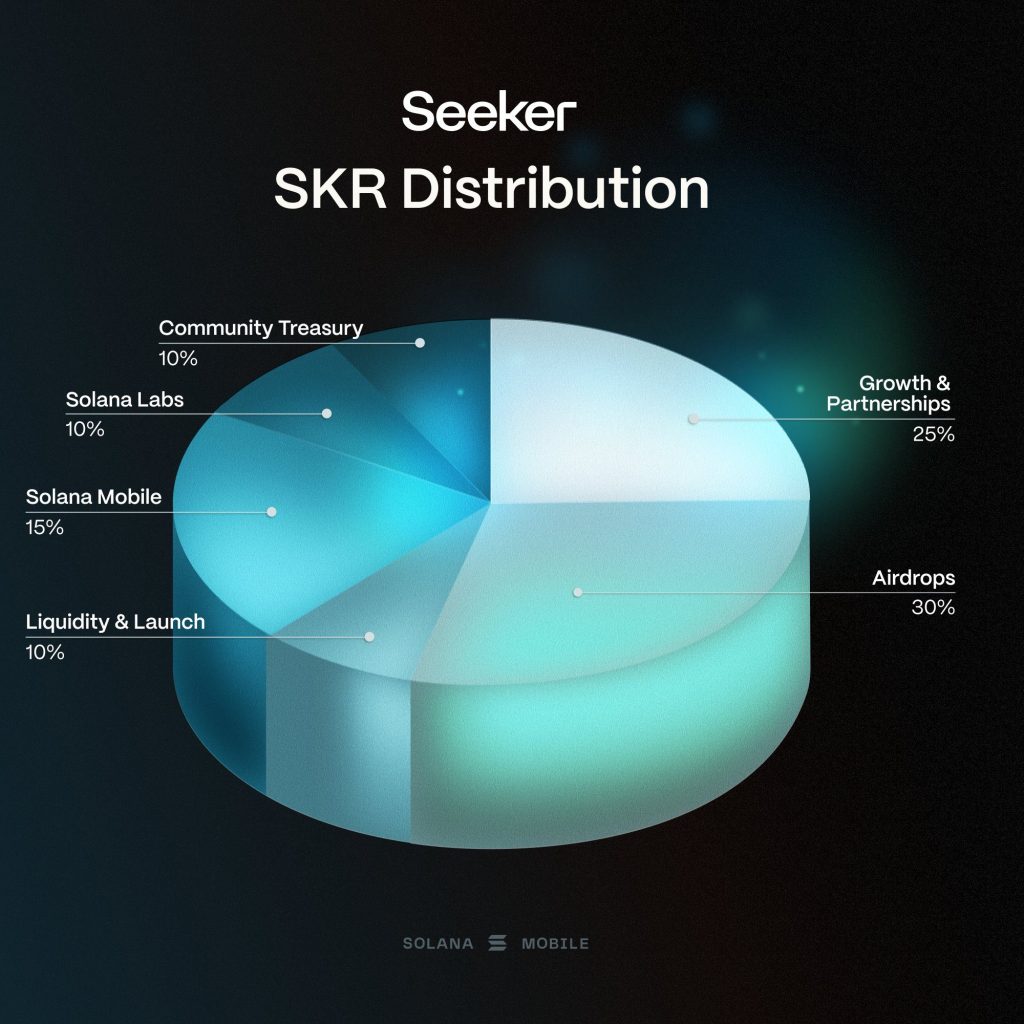
Reports have disclosed a detailed split of that 10 billion. Some 30% is reserved for airdrops. 25% goes to growth and partnerships. 10% is set aside for liquidity and launch, another 10% for a community treasury, and 15% for Solana Mobile itself, etc.
This arrangement puts a large chunk of supply into the hands of users and partners from day one, with a sizeable allocation kept for the company and its parent.
How SKR Will Be Used
According to the Solana Mobile post, SKR will be used to reward builders and reinforce device security, and it will help coordinate how the dApp Store and related services work on Seeker devices.
The company also described a “Guardian” model meant to involve trusted actors in tasks like app review and device verification.
Who Might Benefit First
Seeker owners and early dApp developers are the most likely to see immediate benefits. Airdrops are intended for users and builders, so people who actively use Seeker apps or who run services for that ecosystem could receive SKR at launch.
Based on reports, the token’s real value will hang on how many people buy Seeker phones, how many apps appear, and how active the community becomes.
A big airdrop number does not guarantee broad usage, and governance systems often face challenges if participation is low or power concentrates with a few parties.
Featured image from Gemini, chart from TradingView
Solana Mobile confirmed it will launch SKR, a governance token for its Seeker smartphone ecosystem, in January 2026, with a total supply of 10 billion tokens distributed across airdrops, partnerships, and community initiatives.
The company positioned the token as a mechanism to decentralize platform ownership and align incentives across device holders, developers, and network validators known as Guardians.
The announcement comes amid a hardware security controversy, as Ledger researchers disclosed an unfixable vulnerability in the MediaTek Dimensity 7300 chip used in Seeker devices that could enable a complete device takeover and private key theft through physical access.
SKR’s 10 billion token supply allocates 30% to airdrops targeting Seeker and original Saga phone holders, while 25% supports growth initiatives and partnerships with ecosystem participants.
Another 10% funds are used for initial liquidity and launch operations, with an additional 10% reserved for community treasury governance.
Solana Mobile receives 15% of the supply, and Solana Labs holds the remaining 10%.
The token employs linear inflation, starting at 10% in year one and declining by 25% annually until stabilizing at a 2% terminal rate.
Solana Mobile said this structure incentivizes early participants who stake tokens to secure the network and support platform development during critical growth phases.
Guardians, who are validators responsible for device authentication, dApp review, and community standards enforcement, will include Solana Mobile at launch, with committed partners Helius, DoubleZero, Triton, Jito, and Anza joining throughout 2026.
Users can stake SKR to Guardians, back builders, secure devices, and curate the dApp Store, with ecosystem value flowing back to active participants.
Security Flaw Shadows Launch Momentum
Hours before the token announcement, Ledger disclosed a critical hardware vulnerability in the MediaTek Dimensity 7300 chip powering Seeker devices and other smartphones across multiple manufacturers.
Security researchers Charles Christen and Léo Benito successfully executed electromagnetic fault injection attacks during the chip’s boot phase, gaining what they described as “full and absolute control” of compromised handsets.
The attack bypasses memory protections and overwrites security controls embedded in the system-on-chip, enabling the extraction of cryptographic keys and sensitive data.
Ledger found an unfixable flaw in the MediaTek Dimensity 7300 chip that can lead to full device takeover and private key theft.#Ledger#Solanahttps://t.co/F58gTKaxzi
While individual attack success rates range from 0.1% to 1%, Ledger estimates that repeated attempts can compromise a device within minutes for attackers with physical device access.
Ledger disclosed the flaw to MediaTek in early May after beginning tests in February, prompting the chipmaker to notify affected device vendors.
MediaTek responded that the Dimensity 7300 was designed for consumer smartphones rather than secure financial infrastructure, stating that manufacturers handling sensitive cryptographic material should implement specific physical attack protections.
The company added that the vulnerability falls outside the chip’s original design scope, leaving affected devices permanently exposed since no software patch can resolve hardware-level flaws.
Mixed Sentiment on Token Utility
Social media commentary revealed divided perspectives on SKR’s value proposition and long-term viability.
Critics questioned the token’s fundamental utility, noting the lack of clarity regarding revenue sharing or governance rights beyond platform coordination.
One observer described the launch as “backwards,” arguing that without defined revenue entitlements, SKR functions essentially as a meme coin rather than a legitimate governance infrastructure.
This is so backwards from how you should announce a token.
There’s all this information about how this token will be used to pay for things, but nothing explaining why the token has any actual value (i.e. what revenue am I entitled to as a token holder?)
Others outlined airdrop farming strategies, recommending daily device usage, wallet swaps, validator staking, dApp interactions, and the deployment of the DePIN application to maximize allocation from the 30% airdrop pool.
Tech creator Ashen noted the 10 billion supply represents unusually “high inflation” compared to standard 1 billion token launches. “Solana REALLY loves inflation lmfaoo,” he said.
However, he expressed cautious optimism given the Solana team’s backing and the substantial 30% airdrop allocation for approximately 100,000 Seeker holders.
Solana Foundation President Lily Liu recently emphasized at Binance Blockchain Week that stablecoin market capitalization has surged 50% this year, and positioned the blockchain as infrastructure for global improvements in capital efficiency.
— Expedia Group appointed Xavier Amatriain as its first chief artificial intelligence officer and data officer. He joins the Seattle-based travel giant from Google where he served as vice president of product in AI and Compute Enablement. Other past employers include Quora, LinkedIn and Netflix.
“[Amatriain’s] deep expertise in building large-scale AI platforms will help redefine how people experience travel,” Expedia CTO Ramana Thumu said in a statement. “Expedia Group operates at a scale few can match, and we invest deeply in our talent, giving technologists the space to learn, experiment, and push the boundaries of what AI can do.”
Amatriain, based in San Jose, Calif., has mapped a diverse career path — he’s been a university professor in Spain, a healthcare startup co-founder, a researcher, and an engineering leader.
Textio co-founder and former CEO Kieran Snyder. (Photo courtesy of Kieran Snyder)
— Textio co-founder and former CEO Kieran Snyder returned to Microsoft as vice president of AI transformation.
“My goal in this new role is to help Microsoft be the best living case study of effective, human AI transformation in the world,” Snyder said on LinkedIn.
Snyder began her tech career at Microsoft in 2004, working on the Bing search engine and Windows. In 2014, she launched Textio, which claims to be the first-to-market venture using AI for HR functions. The company’s software helps organizations recruit, hire and retain inclusive teams.
Over the past two years, Snyder ran a business called “nerd processor,” which offered research and leadership coaching, and served as chief scientist emeritus at Textio, where she is now on the board of directors.
— Ross Tennenbaum is leaving his role as president of Avalara for a new role with an unnamed public company, according to the Puget Sound Business Journal. Tennenbaum joined the tax software giant in 2019 and was previously CFO. He worked at Goldman Sachs and Credit Suisse before joining Avalara, which relocated its headquarters from Seattle to North Carolina following its acquisition by Vista Equity Partners in 2022. It filed to go public, again, earlier this year.
Janice Kapner. (LinkedIn Photo)
— After more than 12 years at T-Mobile, Janice Kapner is leaving the telecommunications giant. Kapner was chief communications and corporate responsibility officer and executive VP at the Bellevue, Wash., company where she led a team of more than 160 employees.
“From Magenta sneakers and confetti cannons to competitive stunts, big bets, and a front-line team that made the brand burst off the page and into the world — these are moments I’ll never forget,” Kapner said on LinkedIn. “They shaped me as much as I helped shape them.”
Prior to T-Mobile, Kapner was at Microsoft for more than a decade.
Vinita Ananth. (LinkedIn Photo)
— Former Microsoft and Amazon leader Vinita Ananth is now senior director of product for the cloud company Nebius. Ananth, based in the Seattle area, has been working since July on stealth-mode startups HelpViber and FulcrumAX. Ananth called the decision to leave these ventures “difficult and emotional.”
“I’m thrilled that my co-founder will continue driving both HelpViber and FulcrumAX forward, with a strategic focus on customer traction, platform maturity, and meaningful funding milestones over the coming year,” she said on LinkedIn, adding that she’ll continue in advisor and co-founder roles.
Bo English-Wiczling. (LinkedIn Photo)
— PayPal appointed Bo English-Wiczling as VP of global developer relations. English-Wiczling, based in Seattle, joins from Oracle, where she worked for nearly nine years in leadership roles in database product management and developer relations. Previous employers include Amazon and Best Buy.
“After an incredible journey working alongside talented engineers, community leaders, and innovation-minded partners, this new role feels like the perfect next step,” English-Wiczling said on LinkedIn. “I’ll be working at the intersection of PayPal’s global payments platform and developer ecosystems — helping build, grow, and energize the communities and relationships that power our future.”
— Jaimin Gandhijoined Seattle-based AI roleplay startup Yoodli as a product leader. Gandhi’s past roles include leadership positions at Nerdy, Binance, Uber, DocuSign, Microsoft and others.
Over the past year, Gandhi built FourPoint.AI, a tool that helps job seekers improve their communications. While he won’t be adding new features to FourPoint, “I am opening it up for free,” Gandhi said on LinkedIn. “If it helps someone land their next opportunity the way it helped me find mine, that is a meaningful way to pay it forward.”
— Kapil Hetamsaria is now chief business officer of Neo4j, a data analysis, graph intelligence platform. Hetamsaria joins from C3 AI, where he served as a vice president, and was previously co-founder and CEO of Viddl App, a Bellevue-based short-video platform.
— Dave Rosenbaum is leaving his role as senior publications manager at Seattle-based pet sitting company Rover to join Airbnb.
“I have always been a firm believer in the transformative power of travel — discovering new places, trying new foods, and having new experiences,” Rosenbaum wrote on LinkedIn. “Airbnb’s mission is central to this belief that the world offers limitless possibilities.”
Rosenbaum is also a deputy mayor and city council member for Mercer Island, a city east of Seattle, and previously served in legislative roles for members of Congress.
— Ambika Singh, founder and CEO of online clothing rental company Armoire, joined the board of trustees for the Seattle Metro Chamber.
— Pete Fewing, associate athletic director at Seattle University and longtime Sounders FC broadcaster, joined the board of directors for Starfire Sports. The organization provides coding classes, drone summer camps, and other free, after-school sports programming for underprivileged kids in South Seattle.
Be careful with your marketing stunts around national landmarks. That should be the take-home message from Chery Automobile’s recent attempt to measure itself up against Land Rover, an attempt that went sadly wrong.
In 2018, Land Rover and Chinese racing driver Ho-Pin Tung drove a Range Rover Sport up the 999 steps that make up the “Stairway to Heaven” that climb China’s Tianmen mountain. It was a dazzling stunt, for driving up a staircase that ranges between 45–60 degrees is no simple task, and one that’s certain to have left an impression with any acrophobics out there.
A screenshot of the attempt gone wrong.
Credit:
Youtube
Chery certainly remembered it. The brand—which in fact is a long-time collaborator with Jaguar Land Rover and next year even takes over the Freelander brand from the British marque—has a new electric SUV called the Fulwin X3L and decided that it, too, was made of the right stuff. The SUV, which costs between $16,500–$22,000 in China, features a plug-in hybrid powertrain, boxy looks, and a whole bunch of off-roading features, including the ability to do tank turns.
It looks like AI meets cultural flair — from remixing photos in Messages and summarizing long chats, to new “Wicked: For Good” themes and smarter safety tools.

 Login
Login


 Ledger found an unfixable flaw in the MediaTek Dimensity 7300 chip that can lead to full device takeover and private key theft.


 A screenshot of the attempt gone wrong.
Credit:
Youtube
A screenshot of the attempt gone wrong.
Credit:
Youtube