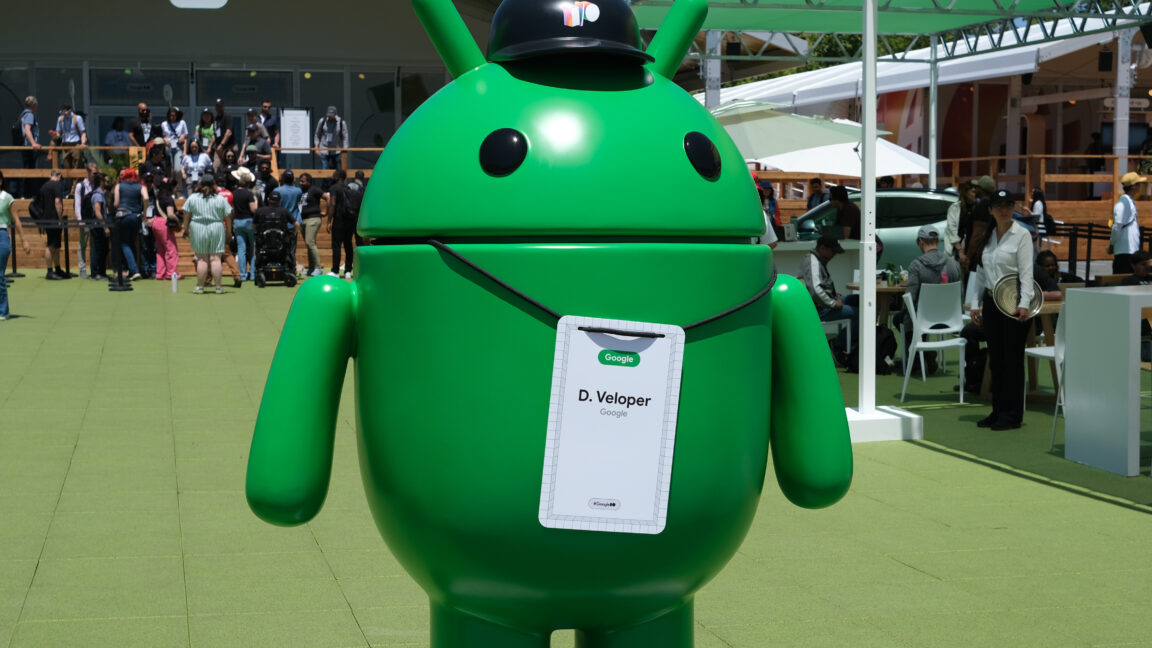
Google recently decided that the freedom afforded by Android was a bit too much and announced developer verification, a system that will require developers outside the Google Play platform to register with Google. Users and developers didn’t accept Google’s rationale and have been complaining loudly. As Google begins early access testing, it has conceded that “experienced users” should have an escape hatch.
According to Google, online scam and malware campaigns are getting more aggressive, and there’s real harm being done in spite of the platform’s sideloading scare screens. Google says it’s common for scammers to use social engineering to create a false sense of urgency, prompting users to bypass Android’s built-in protections to install malicious apps.
Google’s solution to this problem, as announced several months ago, is to force everyone making apps to verify their identities. Unverified apps won’t install on any Google-certified device once verification rolls out. Without this, the company claims malware creators can endlessly create new apps to scam people. However, the centralized nature of verification threatened to introduce numerous headaches into a process that used to be straightforward for power users.
Artificial Intelligence (AI) is entering a new era — one where Large Language Models (LLMs) are no longer just text-based systems but multimodal, domain-specific powerhouses capable of understanding text, images, audio, and even structured data. As businesses race to integrate these next-gen AI systems into their workflows, the need for expert LLM developers and engineers has never been greater.
Whether you’re building a medical chatbot, a financial research assistant, or an enterprise knowledge engine, hiring the right LLM development team can determine whether your AI system merely functions — or truly transforms your business.
In this comprehensive guide, we’ll break down why hiring LLM developers for multimodal and domain-specific AI is critical in 2025, what skills and experience to look for, and how these experts help you design, deploy, and fine-tune LLMs for maximum business value.
Table of Contents
Understanding the Evolution of LLMs
What Makes Multimodal AI So Powerful
The Rise of Domain-Specific LLMs
Why Businesses Need to Hire LLM Developers
Core Responsibilities of LLM Engineers
Essential Skills to Look For When Hiring LLM Developers
Key Tools, Frameworks, and Tech Stack
Benefits of Hiring Expert LLM Developers
Real-World Use Cases Across Industries
Cost Factors in Hiring LLM Engineers
How to Hire the Right LLM Developers in 2025
Why Partner with WebClues Infotech
Final Thoughts
1. Understanding the Evolution of LLMs
When GPT-3 launched, it sparked a global wave of innovation. Fast forward to 2025, and the AI landscape has evolved into an ecosystem of LLMs that combine language, vision, audio, and reasoning into one unified framework.
Modern LLMs like GPT-5, Gemini 2.0, Claude 3.5, and LLaMA 3 can interpret complex instructions, analyze multimodal inputs, and generate domain-specific outputs that rival human expertise. However, building and fine-tuning such systems requires a deep understanding of machine learning pipelines, vector databases, and retrieval-augmented generation (RAG) — all of which fall under the expertise of professional LLM developers.
2. What Makes Multimodal AI So Powerful
Multimodal AI refers to models that process and reason across multiple data types — text, images, audio, and even video.
Imagine a customer support system that can:
Read a customer’s message,
Analyze an attached image of a product,
Listen to a voice note explaining the issue, and
Generate an accurate, context-rich response instantly.
That’s the power of multimodality.
Hiring LLM engineers allows your organization to:
Integrate various data sources into a single intelligent pipeline.
Enhance user experiences with contextually aware, human-like responses.
Develop products like AI content creators, design assistants, or compliance auditors that operate across formats.
3. The Rise of Domain-Specific LLMs
While general-purpose models are impressive, enterprises increasingly require domain-specific LLMs — models tailored for particular industries or tasks.
Examples include:
Healthcare: LLMs trained on medical literature to assist with diagnostics.
Finance: Models that understand market data, regulatory compliance, and risk.
Legal: AI assistants capable of summarizing case law or drafting contracts.
Manufacturing: Predictive maintenance systems powered by multimodal sensor data.
Building these specialized models requires expertise in fine-tuning, data curation, and evaluation metrics — exactly what LLM developers bring to the table.
4. Why Businesses Need to Hire LLM Developers
Most organizations underestimate the complexity behind implementing LLMs effectively. It’s not just about plugging into an API — it’s about building scalable, reliable, and secure AI systems tailored to your unique data ecosystem.
Here’s why hiring LLM developers matters:
They bridge the gap between off-the-shelf LLMs and enterprise-grade applications.
They design pipelines for Retrieval-Augmented Generation (RAG) to ensure factual, grounded responses.
They handle model optimization to reduce inference costs and latency.
They ensure data privacy, compliance, and interpretability — crucial for regulated industries.
Simply put, hiring an experienced LLM engineer ensures your AI projects don’t just work — they perform.
5. Core Responsibilities of LLM Engineers
When you hire LLM developers, their role typically includes:
Designing and training domain-specific or multimodal LLMs.
Implementing fine-tuning and reinforcement learning (RLHF/RLAIF).
Setting up RAG pipelines using vector databases like Pinecone, Weaviate, or FAISS.
Integrating APIs for multimodal inputs (text, image, voice).
Conducting performance evaluation and continuous improvement.
Ensuring compliance with AI ethics, fairness, and security standards.
Their contribution ensures your LLM system is not only smart but also trustworthy and production-ready.
6. Essential Skills to Look For When Hiring LLM Developers
To successfully hire LLM developers, look for professionals with a combination of AI expertise, programming skills, and applied problem-solving capabilities.
Key skills include:
Proficiency in Python, PyTorch, and TensorFlow.
Experience with OpenAI, Hugging Face Transformers, Anthropic, or LangChain.
Understanding of vector databases and knowledge graph integration.
Familiarity with prompt engineering, RAG, and model fine-tuning.
Expertise in cloud infrastructure (AWS, Azure, GCP).
Experience building multimodal pipelines integrating text, image, and speech models.
7. Key Tools, Frameworks, and Tech Stack
Here’s what most LLM engineers work with in 2025:
8. Benefits of Hiring Expert LLM Developers
1. Tailored Solutions
Instead of relying on general-purpose APIs, you get custom LLM models aligned with your business logic and tone.
2. Cost Efficiency
Well-optimized models save thousands in inference costs by reducing unnecessary token usage.
3. Data Privacy and Compliance
In-house or custom-trained models ensure data sovereignty — essential for sectors like finance and healthcare.
4. Improved Accuracy
Domain-tuned models outperform generic LLMs in specialized contexts, increasing reliability.
5. Scalable Architecture
LLM developers design systems that can scale with your data and user base without degradation.
Healthcare: Automated transcription, diagnosis assistance, and drug discovery support.
Finance: Fraud detection, risk management, and personalized investment advisory.
Education: Adaptive tutoring systems and research assistants.
Legal: Document review, contract drafting, and case summarization.
Manufacturing: Predictive maintenance and process optimization.
Each of these applications benefits from LLM developers who understand how to adapt multimodal data for specific industry needs.
10. Cost Factors in Hiring LLM Engineers
The cost to hire LLM developers varies based on:
Project complexity (multimodal vs. single-modality).
Model size and training needs.
Integration with existing systems.
Data volume and preprocessing requirements.
Deployment scale (on-premise vs. cloud).
On average (as of November 2025), hiring an LLM engineer can range from $60/hour to $150/hour, depending on expertise and region.
Partnering with experienced development firms like WebClues Infotech provides access to skilled AI engineers, cost-effective engagement models, and full-cycle LLM development services — from ideation to deployment.
11. How to Hire the Right LLM Developers in 2025
When evaluating LLM developers or agencies:
Check for experience with multimodal and domain-specific models.
Review their portfolio and case studies.
Assess their understanding of AI ethics and compliance.
Ensure they follow scalable MLOps best practices.
Prefer teams offering end-to-end development — including data engineering, model tuning, and integration.
12. Why Partner with WebClues Infotech
WebClues Infotech stands out as a trusted AI development company specializing in LLM-driven solutions for enterprises worldwide.
Here’s why businesses partner with WebClues to hire LLM developers:
Expertise in custom LLM, RAG, and multimodal AI systems.
Proven experience across healthcare, fintech, logistics, and retail.
Access to dedicated LLM engineers with hands-on experience in cutting-edge frameworks.
Flexible engagement models — hourly, project-based, or dedicated teams.
Commitment to data privacy, scalability, and innovation.
As enterprises move toward AI-driven digital transformation, the need for multimodal, domain-specific LLMs is undeniable. But realizing this vision requires more than just technology — it requires the right people.
By hiring skilled LLM developers and engineers, businesses can unlock new levels of automation, insight, and innovation while ensuring their AI remains accurate, secure, and aligned with their goals.
In 2025, those who hire LLM developers now will lead the next wave of enterprise intelligence tomorrow.
JFrog researchers found a critical RCE vulnerability (CVE-2025-11953) in the popular React Native CLI. Developers using versions 4.8.0-20.0.0-alpha.2 must update to patch the flaw.
Bitcoin development nonprofit Btrust has named Nigerian Bitcoin Core contributor Abubakar Nur Khalil as its new chief executive officer, the organization announced today.
Khalil had previously served as interim CEO while sitting on the board as a non-voting member. Khalil will step down from his board position and report directly to the organization’s directors in the full-time role.
His three-year term is renewable once.
Founded to support open-source Bitcoin development in the Global South, Btrust has expanded its footprint across Africa, Latin America, and India over the past year. The non-profit received initial funding from Jay-Z and Jack Dorsey.
During his interim leadership, the group increased partnerships with organizations including Bitshala, Vinteum and 2140, and reported record grant distribution.
Since mid-2024, Btrust says it has issued more than $1.7 million in funding, with over half going directly to developers.
Khalil co-founded Btrust Builders, an initiative focused on growing the open-source developer pipeline in emerging markets. He is recognized as a prominent advocate for Bitcoin development in Africa.
“I’m honored to have led Btrust as interim CEO over the past year,” Khalil said in a statement, adding that he aims to strengthen the organization’s systems and scale its impact in 2026 and beyond. “Ensuring that Bitcoin continues to be a money that works for everyone worldwide.”
Board member Obi Nwosu said Khalil is well-positioned to guide Btrust through its next phase as it builds out long-term programs and developer support infrastructure.
The organization said continuity will be a major focus as it transitions from early-stage growth to broader execution.
Btrust’s board launched the CEO search in July, citing the need for dedicated leadership as its programming expands globally. The organization said the appointment marks “a meaningful next chapter” in its mission to strengthen decentralized Bitcoin development.
Abubakar Nur Khalil will also be speaking at Bitcoin MENA, happening December 8–9, 2025, at the ADNEC Center in Abu Dhabi.
"BITCOIN IS MONEY."
We're thrilled to announce Btrust CEO, Abubakar Nur Khalil, to speak at Bitcoin MENA! pic.twitter.com/1ozbQyNBoK

 Login
Login