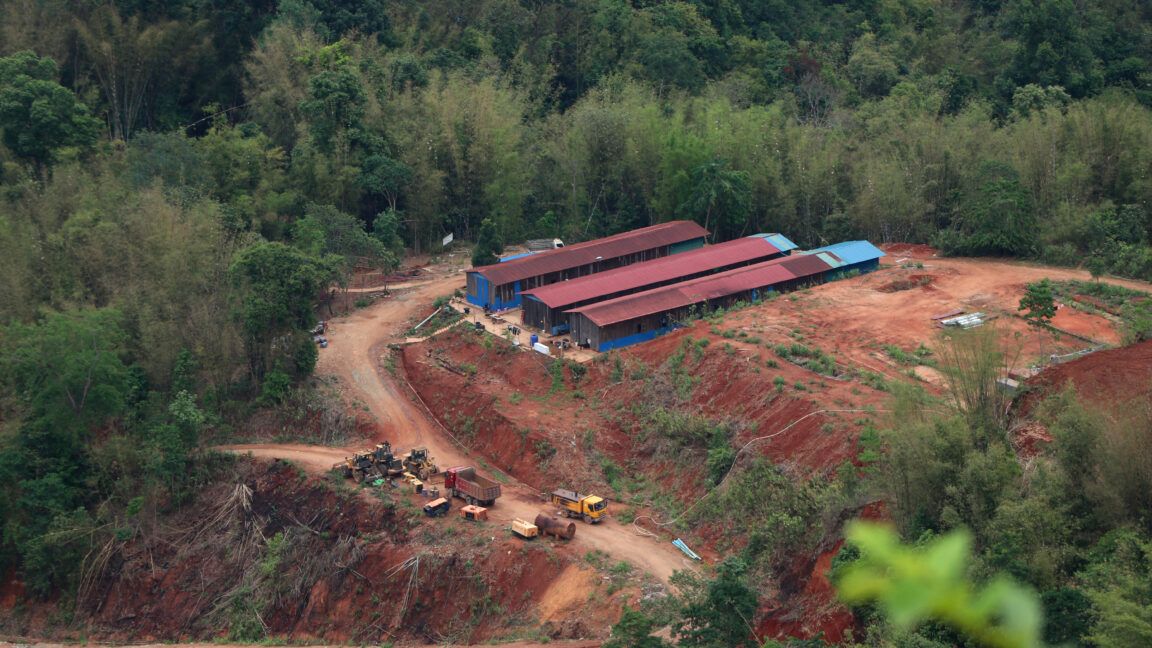
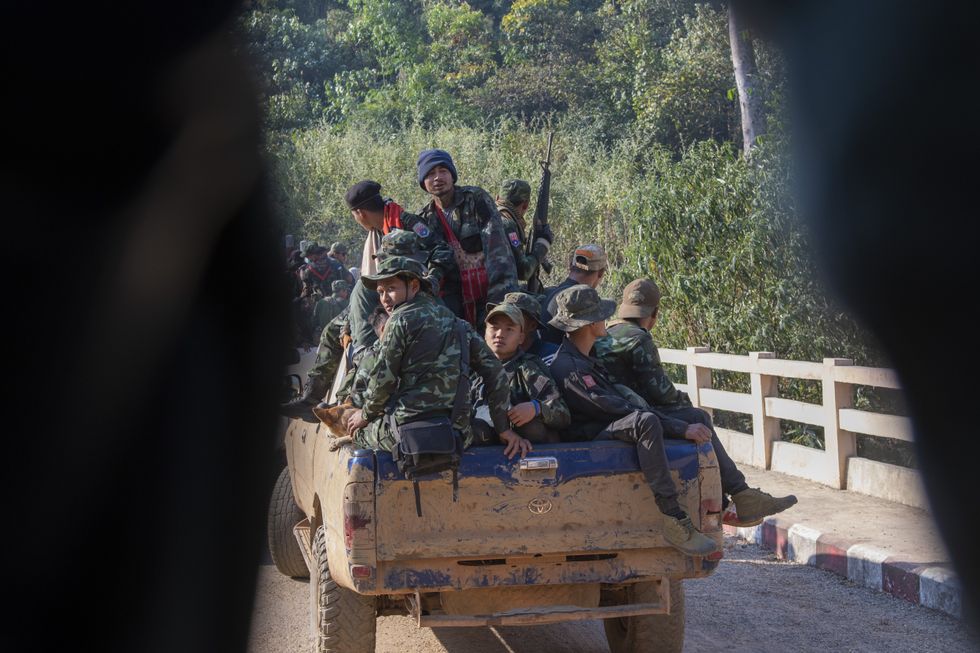
In early 2025, Sian traveled deep into the mountains of Shan State, on Myanmar’s eastern border with China, in search of work. He had heard from a friend that Chinese companies were recruiting at new rare-earth mining sites in territory administered by the United Wa State Army, Myanmar’s most powerful ethnic armed group, and that workers could earn upwards of $1,400 a month.
It was an opportunity too good to pass up in a country where the formal economy has collapsed since the 2021 military coup, and nearly half of the population lives on less than $2 a day. So Sian set off by car for the town of Mong Pawk, then rode a motorbike for hours through the thick forest.
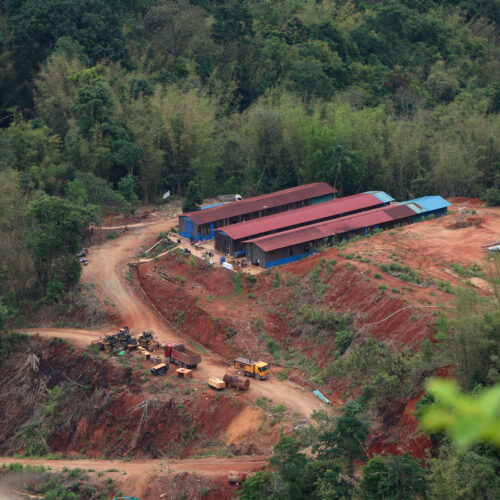
Hired for daily wages of approximately $21, he now digs boreholes and installs pipes. It is the first step in a process called in situleaching, which involves injecting acidic solutions into mountainsides, then collecting the drained solution in plastic-lined pools where solids, like dysprosium and terbium, two of the world’s most sought-after heavy rare-earth metals, settle out. The resulting sediment sludge is then transported to furnaces and burned, producing dry rare earth oxides.
OPINION — After decades of military rule in Myanmar, free and fair general elections were permitted in 2015 and the National League for Democracy and its leader, Aung San Suu Kyi, won by a landslide. In February 2021, a military coup d’etat installed General Min Aung Hlaing as the acting president, and imprisoned Aung San Suu Kyi, the de facto head of state and recipient of a Nobel Peace Prize in 1991 for her non-violent struggle for democracy and human rights in Myanmar.
The military coup has brought death and suffering to the people of Myanmar. Recent figures from the United Nations estimate that over 6,000 civilians have been killed by the military, including over 1,000 women and 695 children. According to the United Nations, over 62% of verified civilian deaths result from airstrikes and artillery barrages by the military. And more than 3.5 million people have been displaced within Myanmar since the military coup, with hundreds of thousands more seeking refuge in neighboring countries.
Anti-coup resistance forces are active in Myanmar, to include the People’s Defense Forces and ethnic armed organizations. The National Unity Government, an exiled government of elected politicians who were ousted in the coup, provides leadership, funding and support to the various resistance groups that often coordinate activities to fight the military junta, to restore democracy to Myanmar.
According to the United Nations, since the February 2021 coup, the military junta has imported over $1 billion in weapons, raw materials, and dual-use goods from several countries, with Russia and China topping the list of suppliers. Russia’s state arms exporter, Rosoboronexorrt, was instrumental in providing the military junta with over $400 million of weaponry: attack helicopters, fighter jets, missiles, drones, and radar systems. And for the world to see, there were joint naval exercises between Russia and Myanmar’s military junta.
China has resumed normal relations with the military junta and its various ministries, in addition to providing Chinese Y-8 transport planes. China is quite open about its political engagement with the military junta and, working with Russia, resists United Nations efforts to condemn the junta.
The Cipher Brief brings expert-level context to national and global security stories. It’s never been more important to understand what’s happening in the world. Upgrade your access to exclusive content by becoming a subscriber.
What has been disappointing is the inability of the Association of Southeast Asian Nations (ASEAN) to influence Myanmar’s military junta and restore democracy to Myanmar. Indeed, in April 2021 ASEAN adopted a “Five-Point Consensus” to stop the violence, initiate a dialogue and appoint a special envoy to oversee progress in restoring democracy in Myanmar. The military junta has basically ignored ASEAN and the five-point consensus, despite ASEAN’s engagement with the military junta, thus providing legitimacy with a regime committing grave abuses.
Malaysia, as the 2025 ASEAN Chair, has been proactive in pushing for a ceasefire and meaningful dialogue with resistance forces. Indonesia has been supportive and hopefully other ASEAN members will be equally supportive of a cease fire and dialogue with multiple ethnic armed organizations, to include the National Unity Government and the People’s Defense Forces.
The military junta announced phased elections in December 2025 through January 2026. There is understandable concern that this will be a sham election, designed to legitimize the military junta and its leader, General Min Aung Hlaing.
The United Nations, ASEAN and the U.S. should demand that they be permitted to send election monitors to Myanmar to certify that the election was fair and open to all the people.
This column by Cipher Brief Expert Ambassador Joseph DeTrani was first published in The Washington Times
Read more expert-driven national security insights, perspective and analysis in The Cipher Brief because National Security is Everyone’s Business.
CIPHER BRIEF REPORTING – The military government ruling Myanmar designated a significant ethnic rebel group as a terrorist organization on Thursday, just months before December’s planned elections. It may seem like just another headline in a far away land but the move to quell the Karen National Union (KNU) is a sign of what’s at stake in Myanmar, and how what’s happening there is shaping regional dynamics.
The country’s long-simmering civil war exploded after the 2021 coup that saw the military overthrow of the elected government led by Aung Aan Suu Kyi, uniting pro-democracy forces and ethnic militias against the junta.
But Myanmar’s civil war is not just a humanitarian catastrophe—it’s a geopolitical fault line. The protracted conflict has displacedover 2.6 million people, fueled transnational arms and drug networks, and drawn in outside powers like China and Russia—yet it remains largely absent from international policy debates.
Analysts warn that continued neglect could destabilize Southeast Asia for years to come, potentially empowering malign actors across the region.
“The United States has long had an interest in peace, stability and development in Asia and preventing the rise of a regional hegemon. The ongoing conflict in Burma challenges all of these interests,” Derek Mitchell, Senior Adviser at the Center for Strategic and International Studies, tells The Cipher Brief. “War and instability in a country at the cross-roads of Asia have cost the country billions of dollars in lost investment, led to cratering of the domestic economy, and unleashed an explosion of drug, human and weapons trafficking, infectious disease, and a humanitarian crisis that has driven millions into neighboring countries as refugees at the expense of regional stability and development.”
A Country in Collapse
Following theFebruary 2021 coup, Myanmar’s military, known as the Tatmadaw, unleashed a violent crackdown on protestors. When bullets and fear emptied the streets, resistance went underground.
Today, that resistance has evolved into a full-fledged civil war encompassing a patchwork of People’s Defense Forces (PDFs), ethnic armed organizations (EAOs), and local militias.
Some of the most powerful EAOs, such as the Kachin Independence Army (KIA) in the north and the Karen National Liberation Army (KNLA) in the southeast, have aligned with the PDFs, forming temporary alliances against the common enemy. The junta, meanwhile, hasregained territory in places like Nawnghkio, but at a high cost — both in casualties and growing resistance.
Just weeks ago, the junta said it transferred power to a civilian-led interim government and allowed the state of emergency in place since the coup, to expire ahead of elections set for December and January. The status quo hasn’t changed though, with coup leader Min Aung Hlaing retaining power. Western governments and several analysts have therefore dismissed the elections as a sham, expected to be dominated by military proxies and just a move to further entrench the military’s power.
The Cipher Brief Threat Conference is happening October 19-22 in Sea Island, GA. The world's leading minds on national security from both the public and private sectors will be there. Will you?Apply for a seat at the table today.
“The conflict in Myanmar undermines ASEAN unity and dilutes U.S. influence in the region because ASEAN is a weaker partner as a result, and more beholden to authoritarian partners in light of the Myanmar junta’s realignment with Beijing,” Hunter Marston, an Indo-Pacific security analyst focused on U.S. alliances, strategy and Southeast Asian geopolitics, tells The Cipher Brief. “At the same time, the conflict has facilitated the proliferation of crime and illicit economies flourishing in Myanmar’s borderlands, which have targeted U.S. citizens as well as other countries around the globe, raking in billions of dollars each year.”
ASEAN, the Association of Southeast Asian Nations, is a key regional bloc that the U.S. relies on to counterbalance China’s growing influence and advance diplomatic, economic, and security cooperation in the Indo-Pacific. The Association, long hampered by internal divisions and non-interference norms, hasnot intervened in Myanmar. Recent efforts tore-engage with the junta have made little impact and only highlighted the bloc’s diminishing leverage. A fractured or weakened ASEAN, experts caution, not only hampers coordinated regional responses but also complicates Washington’s efforts to engage effectively on shared challenges, from maritime security to transnational crime.
However, this is no longer just an internal fight concerning Myanmar. As the war drags on, it has become a new front in the global struggle between democratic and authoritarian powers.
China, Russia, and the Battlefield of Influence
Myanmar’s geographic position, wedged between China, India, and the Bay of Bengal, makes it a critical node in Southeast Asia’s strategic architecture. It is also a country rich in rare earth minerals, oil, gas, and hydropower — assets that Beijing, in particular, is keen to control.
China, which has long courted the Burmese military, has navigated a delicate balance in the conflict. While officially calling for peace and dialogue, Beijing has supplied the junta with arms and political cover. Meanwhile, itsaccess to rare earth supply chains through northern Myanmar has become even more valuable amid global competition for strategic resources.
“The junta receives direct and indirect financial support from its sales of oil and gas to China and Thailand, limited trade with other ASEAN states such as Thailand, Singapore, Malaysia, and Indonesia, and direct cash transfers and assistance packages from China,” said Marston. “Its state-owned banks and companies also extract a great deal of revenue from natural resources across the country, as well as property taxes to a lesser extent in urban centers like Yangon and Mandalay.”
Russia, too, has deepened ties with the military regime. In recent years, Moscow has become aleading arms supplier and defense partner to the junta, eager to expand its influence in a region where Western alliances have weakened. Myanmar has reciprocated, with junta generals attending Moscow’s military parades and inviting Russian advisors into the country.
“This is no longer just a civil war — it’s an open door for authoritarian powers to gain a foothold in Southeast Asia,” one former U.S. official who worked on Myanmar policy tells The Cipher Brief.
Cross-Border Instability
The conflict’s repercussions are already spilling across Myanmar’s borders. In Thailand, shelling and firefights near the frontier have driven thousands of refugees into crowded border camps. In India’s northeast, cross-border insurgencies and weapons flows have revived longstanding security concerns. Bangladesh continues to shoulder the burden ofover a million Rohingya refugees, with little prospect of safe repatriation as the military escalates its violence in Rakhine State.
Illicit arms trafficking, drug production in the Golden Triangle, and human smuggling have surged in tandem with the fighting. Some insurgent groups fund their campaigns through methamphetamine production and jade mining, while the junta leverages state-owned enterprises and military conglomerates to bankroll its war machine.
Mitchell emphasized that this has “also led to theproliferation of ‘scam centers’ along Burma’s border that are bilking Americans and others out of billions of dollars.”
“The violence and absence of an effective international response have created an opening for China to insert itself even further into the internal affairs of the country, corner its rare earths and broader resource market, and attempt to create a client state through which it would have strategic access to the Indian Ocean,” he added.
Washington’s Take
So, what is the United States government doing to address the Myanmar crisis?
The second Trump administration has taken a markedly different approach to Myanmar compared to the Biden era.
“The first Trump administration was slow to condemn the Myanmar military’s violent clearance operations against the Rohingya, which the Biden administration later confirmed met the criteria for genocide and crimes against humanity,” Marston said.
While sanctions against the military junta remain in place, the Trump administration has largely refrained from commenting on the country’s internal dynamics. Broadly, it has sharply reduced U.S. funding for democracy promotion, human rights, and independent media. American-backedoutlets such as Voice of America and Radio Free Asia have been significantly affected—a move that Min Aung Hlaing publicly welcomed,expressing his “sincere appreciation” to President Trump.
In a notable diplomatic development in July 2025, President Trump sent a direct letter to Min Aung Hlaing regarding tariffs, which the junta interpreted as a form of public acknowledgment and a diplomatic victory, marking a departure from previous diplomatic isolation.
Furthermore, the Trump administration hasenacted new travel restrictions, including a complete suspension of entry for Myanmar nationals as immigrants and non-immigrants, potentially preventing persecuted persons from reaching American soil.
This blend of continued sanctions with reduced democracy aid and a more transactional, direct communication approach with the junta underscores the Trump administration’s “America First” foreign policy, leaving the future of U.S. influence in Myanmar uncertain amidst the ongoing crisis.
There are, however, other efforts to bring Myanmar back into the limelight.
Recent legislative efforts,such as the “No New Burma Funds Act” introduced in July by Rep. Nikema Williams (D-GA), aim to curb indirect financial flows to the regime. These include revenues from natural gas exports involving foreign companies, fees paid to military-controlled infrastructure, and leakage from humanitarian aid operations in junta-held areas.
Additionally, Burmese gems and timber often reach U.S. markets via third countries, and digital platforms may unwittingly monetize content linked to the junta — all contributing to the regime’s financial lifeline.
According to Marston, “western countries could theoretically apply secondary sanctions on any country conducting business with Myanmar’s energy companies or state-owned banks, which would squeeze Thailand and Singapore in particular, along with China, but they have been unwilling to expend the political capital necessary to do so.”
“Furthermore, Washington has refrained from imposing the most comprehensive sanctions on Myanmar’s economy for fear of hurting the entire population and setting the country’s economic recovery back even further after previous rounds of sanctions in the 2000s,” he continued.
In addition, there is the “BRAVE Burma Act,” a bipartisan U.S. House billintroduced on May 5, 2025, by Representatives Bill Huizenga (R-MI) and Betty McCollum (D-MN), among other co-sponsors from both parties. This legislation, which has advanced in the House, aims to increase pressure on Myanmar’s military junta by requiring stronger sanctions on entities like state-owned enterprises and those involved in the jet fuel sector, and by establishing a U.S. Special Envoy for Burma.
“Right now, the administration should appoint a special envoy. Personnel is policy, and without a champion in Washington, US Burma policy will remain adrift,” Marston asserted.
Mitchell concurred that the Trump Administration “should appoint a special envoy based in the region to build closer relations with the (opposition) National Unity Government, ethnic leaders and other legitimate representatives of the Burmese people, and coordinate with our regional allies and partners on a common approach to the conflict.”
“The administration should make it clear that it does not consider the junta legitimate and that its pretensions to rule are unacceptable,” he continued. “To that end, it should tighten sanctions to shut off its access to money, weapons, and international legitimacy. Overall, the administration should recognize that China is taking advantage of our neglect and respond consistently with where developments in the country are trending.”
The Strategic Cost of Indifference
Entire towns have been razed. Schools and hospitals have been bombed. More than 18 million people—nearly a third of Myanmar’s population—nowrely on humanitarian aid, according to the United Nations. The war has triggered one of the world’s largest internal displacements and turned Myanmar’s borderlands into a hotbed of organized crime, cyber scams, and weapons trafficking—networks that now reach far beyond Southeast Asia.
“The longer the U.S. stays disengaged, the more space there is for China and Russia to entrench themselves,” says Hunter Marston. “Without high-level diplomatic pressure or punitive measures, the junta will have no reason to pursue a negotiated solution, and the country’s collapse will continue to drag down the region.”
China has already endorsed Myanmar’s planned elections in December, despite ongoing civil war and widespread instability. In contrast, ASEAN has said electionsshould only follow a return to peace.
“Realistically, the only hope of pressuring the military to pursue peace talks is to win on the battlefield. Thus, it is essential to curb the military’s access to arms,” Marston stressed. “The only way to do that is by imposing secondary sanctions on Chinese weapons companies like NORINCO, which continue to provide munitions to the military. Doing so would put Beijing on notice that it no longer has carte blanche in Myanmar and would align with the goals of U.S. competition with China in checking China’s global military expansion.”
Mitchell also underscored that Washington’s only leverage for positive change lies in directly cutting off the junta’s financial streams. If Myanmar is allowed to fall fully into the grip of autocracy, crime syndicates, and foreign military powers, the consequences will not remain confined to its borders.
“Pressuring foreign banks (in Thailand and Singapore, for instance) into shutting off financial services to the junta, sanctioning Myanmar’s Central Bank, and imposing penalties on other banks inside and outside the country doing business with the junta can help shut off capital to the regime,” he said.
This is exclusive Subscriber+Member content.
Read more expert-driven national security insights, perspective and analysis inThe Cipher Brief because National Security is Everyone’s Business.
Are you Subscribed toThe Cipher Brief’s Digital Channel on YouTube? There is no better place to get clear perspectives from deeply experienced national security experts. Subscribe now.

 Login
Login