If your “speaker” is still just your phone on max volume, this is a very straightforward upgrade. The Beats Pill portable Bluetooth speaker in Matte Black is currently $99.95 on Amazon, down from $149.95, which works out to about 33% off. You’re getting a compact, throw-it-in-your-bag speaker that’s built for loud, punchy sound, up to […]
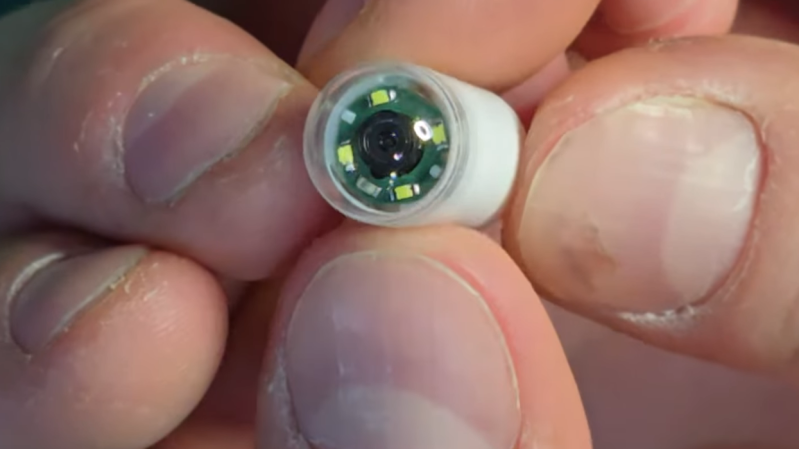
A gastroscopy is a procedure that, in simple terms, involves sticking a long, flexible tube down a patient’s throat to inspect the oesophagus and adjacent structures with a camera fitted to the tip. However, modern technology has developed an alternative, in the form of a camera fitted inside a pill. [Aaron Christophel] recently came across one of these devices, and decided to investigate its functionality.
[Aaron’s] first video involves a simple teardown of the camera. The small plastic pill is a marvel of miniaturization. Through the hemispherical transparent lens, we can see a tiny camera and LEDs to provide light in the depths of the human body. Slicing the camera open reveals the hardware inside, however, like the miniature battery, the microcontroller, and the radio hardware that transmits signals outside the body. Unsurprisingly, it’s difficult to get into, since it’s heavily sealed to ensure the human body doesn’t accidentally digest the electronics inside.
Unwilling to stop there, [Aaron] pushed onward—with his second video focusing on reverse engineering. With a little glitching, he was able to dump the firmware from the TI CC1310 microcontroller. From there, he was able to get to the point where he could pull a shaky video feed transmitted from the camera itself. Artists are already making music videos on Ring doorbells; perhaps this is just the the next step.
BluePill founder and CEO Ankit Dhawan (left), with team members Puneet Bajaj (top right) and Andy Zhu. (BluePill Photos)
BluePill, a new Seattle-based marketing startup that helps brands predict consumer behavior, raised $6 million in a seed round led by Ubiquity Ventures. Seattle-based firms Pioneer Square Labs and Flying Fish Partners also invested.
Founded earlier this year, BluePill helps marketers test ideas, products, and ads in minutes using artificial intelligence instead of traditional focus groups.
BluePill builds a custom AI consumer audience for each brand using real-world data — such as social conversations, surveys, and customer inputs — modeled after a brand’s target segment.
Clients log into the platform, upload a new concept, campaign, or packaging design, and receive instant feedback predicting how their audience would respond — essentially running a massive, simulated focus group.
The company is also developing ready-made, domain-specific AI audiences (like “U.S. moms” or “Gen Z snack buyers”) that brands can directly query for insights without building custom models.
BluePill says its simulated audiences achieve 93% accuracy compared to human panels. The company is working with consumer brands including Magic Spoon, Kettle & Fire, and the Seattle Mariners, which use the platform to test fan engagement ideas and in-stadium activations.
“Our edge is validated, accurate insights — and the fact that we deliver these in minutes for a fraction of the cost makes it a no-brainer,” said BluePill founder and CEO Ankit Dhawan.
BluePill is already generating revenue. It makes money off a fixed annual fee.
BluePill is taking on larger marketing research companies such as Ipsos, Qualtrics, and Nielsen. Dhawan said incumbents “rely on slow, costly human panels, while newer startups mostly have large language models role-play as consumers.”
Dhawan was an entrepreneur-in-residence at the Allen Institute for AI (Ai2) and co-founded virtual experience startup Virtuelly. He also spent more than four years at Amazon as a product leader working on AI products.
Sunil Nagaraj, founding partner at Ubiquity, noted that “predicting consumer behavior is the holy grail of marketing.” Nagaraj is based in Silicon Valley but is active in the Seattle startup scene. He was an early investor in Auth0, the Seattle-area startup acquired by Okta for $6.5 billion.

 Login
Login