
 Login
LoginMeet The Shape That Cannot Pass Through Itself
Can a shape pass through itself? That is to say, if one had two identical solids, would it be possible to orient one such that a hole could be cut through it, allowing the other to pass through without breaking the first into separate pieces? It turns out that the answer is yes, at least for certain shapes. Recently, two friends, [Sergey Yurkevich] and [Jakob Steininger], found the first shape proven not to have this property.
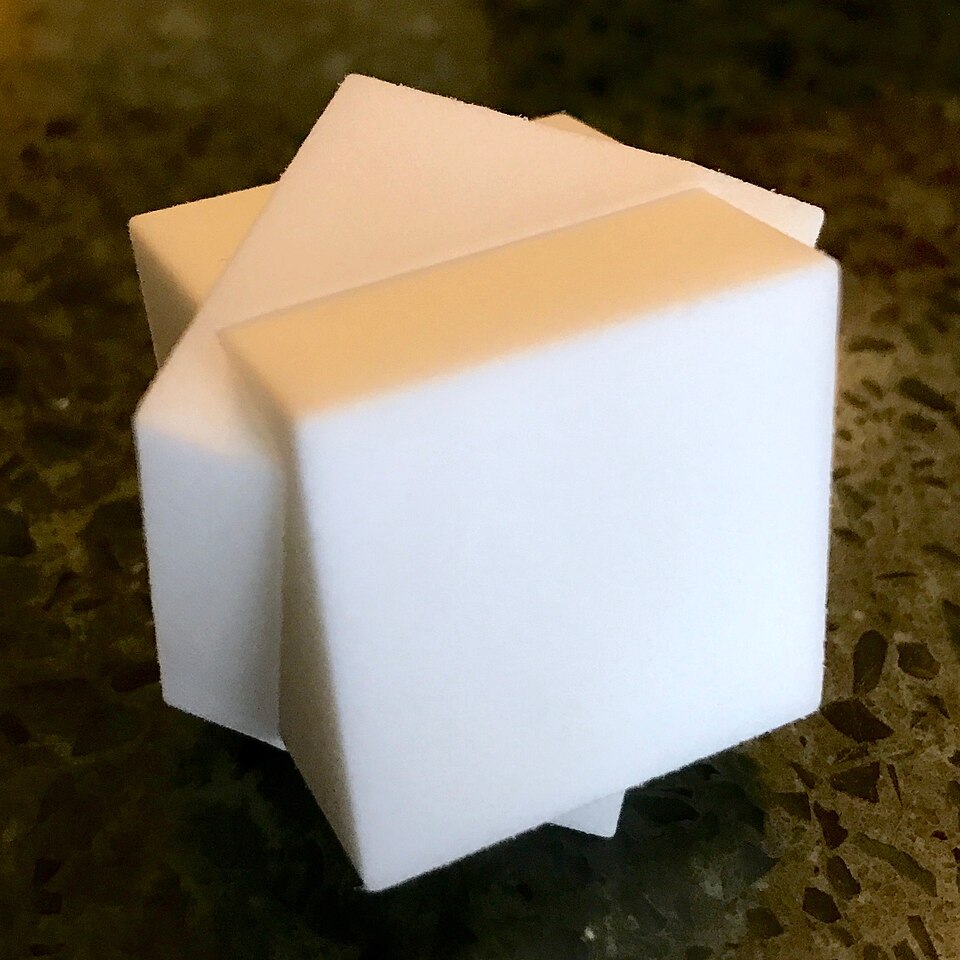
Later, researchers showed this was also true of more complex shapes. This ability to pass unbroken through a copy of oneself became known as Rupert’s Property. Sometimes it’s an amazingly tight fit, but it seems to always work.
In fact, it was so difficult to find candidates for exceptions to this that it was generally understood and accepted by mathematicians that every convex polyhedron (that is, every shape with flat sides and no holes, protrusions, or indentations) would have Rupert’s property. Until one was found that did not.
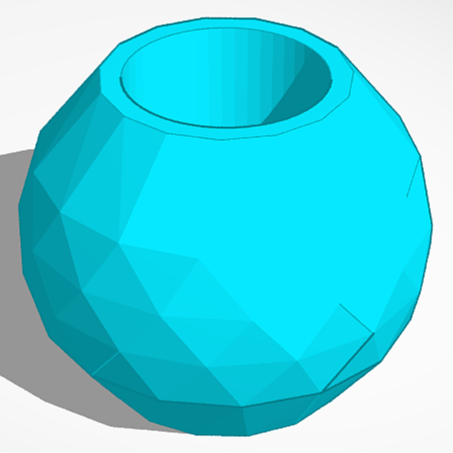
The first shape proven not to be able to pass through itself — known as the Noperthedron — is a vaguely ball-like shape, with a flat top and bottom. A fan has already added a cavity to create a 3D-printable pencil holder version of the noperthedron (shown here) if you want your own.
There are other promising candidate objects (they are rare) that may also lack Rupert’s property, but so far, this is the only proven one.
Shapes with unusual properties are interesting, and we love how tactile and visual they are. Consider Penrose tiles, a tile set that can cover any size of area without repeating. For decades, the minimum number of tile shapes needed to accomplish this was two. Recently, though, the number has dropped to one thanks to a shape known as “the hat.”
