Reading view

There are new articles available, click to refresh the page.

NASA’s X-59 Completes First Flight, Prepares for More Flight Testing

5 min read

Preparations for Next Moonwalk Simulations Underway (and Underwater)

After years of design, development, and testing, NASA’s X-59 quiet supersonic research aircraft took to the skies for the first time Oct. 28, marking a historic moment for the field of aeronautics research and the agency’s Quesst mission.

The X-59, designed to fly at supersonic speeds and reduce the sound of loud sonic booms to quieter sonic thumps, took off at 11:14 a.m. EDT and flew for 67 minutes. The flight represents a major step toward quiet supersonic flight over land.

“Once again, NASA and America are leading the way for the future of flight,” said acting NASA Administrator Sean Duffy. “The X-59 is the first of its kind, and a major breakthrough in America’s push toward commercial air travel that’s both quiet and faster than ever before. Thanks to the X-59 team’s innovation and hard work, we’re revolutionizing air travel. This machine is a prime example of the kind of ingenuity and dedication America produces.”

Following a short taxi from contractor Lockheed Martin’s Skunk Works facility, NASA X-59 test pilot Nils Larson approached U.S. Air Force Plant 42’s runway in Palmdale, California, where he completed final system checks and called the tower for clearance.
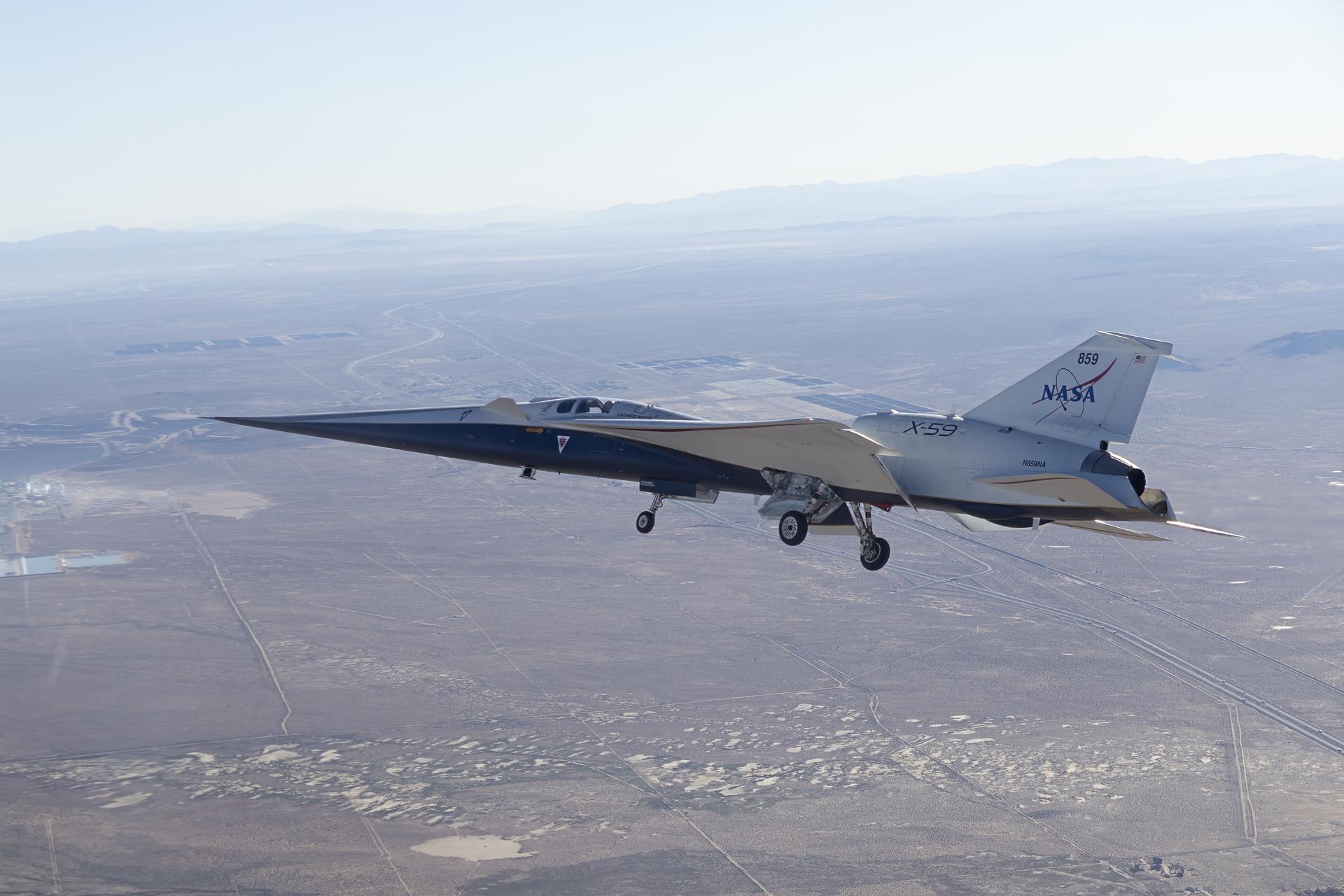
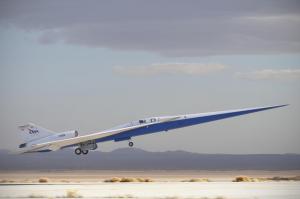
NASA’s X-59 is seen in flight, with a blue sky and mountains behind it and land below it. The aircraft’s long nose and distinct silhouette are visible as it ferries to NASA’s Armstrong Flight Research Center in Edwards, California 
NASA’s X-59 quiet supersonic research aircraft cruises above Palmdale and Edwards, California, during its first flight, Tuesday, Oct. 28, 2025. The aircraft traveled to NASA’s Armstrong Flight Research Center in Edwards, California.
NASA/Lori Losey

Then, with a deep breath, steady hands, and confidence in the labor of the X-59’s team, Larson advanced his throttle, picking up speed and beginning his climb – joining the few who have taken off in an experimental aircraft for the first time.

“All the training, all the planning that you’ve done prepares you,” Larson said. “And there is a time when you realize the weight of the moment. But then the mission takes over. The checklist starts. And it’s almost like you don’t even realize until it’s all over – it’s done.”

The X-59’s first flight went as planned, with the aircraft operating slower than the speed of sound at 230 mph and a maximum altitude of about 12,000 feet, conditions that allowed the team to conduct in-flight system and performance checks. As is typical for an experimental aircraft’s first flight, landing gear was kept down the entire time while the team focused on ensuring the aircraft’s airworthiness and safety.

The aircraft traveled north to Edwards Air Force Base, circled before landing, and taxied to its new home at NASA’s Armstrong Flight Research Center in Edwards, California, officially marking the transition from ground testing to flight operations.

“In this industry, there’s nothing like a first flight,” said Brad Flick, center director of NASA Armstrong. “But there’s no recipe for how to fly an X-plane. You’ve got to figure it out, and adapt, and do the right thing, and make the right decisions.”
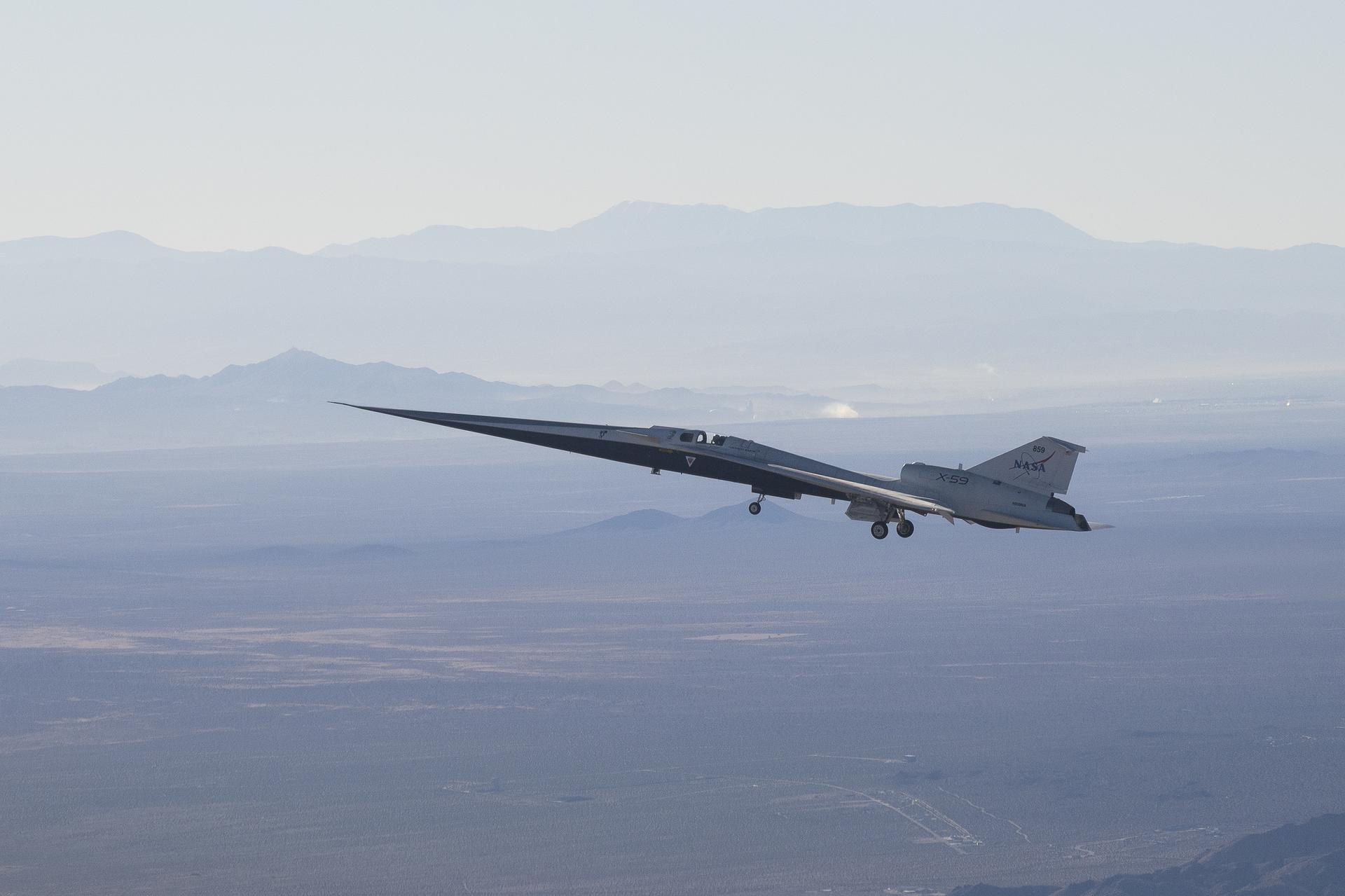
NASA’s X-59 flies above the Mojave Desert against a blue sky. The aircraft’s long nose is angled slightly upward to the left, with its landing gear down. Layers of mountains are visible in the background. The aircraft is backlit, appearing to float as it ferries to NASA’s Armstrong Flight Research Center in Edwards, California.
NASA’s X-59 quiet supersonic research aircraft flies above Palmdale and Edwards, California, on its first flight Tuesday, Oct. 28, 2025. The aircraft traveled to NASA’s Armstrong Flight Research Center in Edwards, California, where it will begin flight testing for NASA’s Quesst mission, which aims to demonstrate quiet supersonic flight over land.
NASA/Jim Ross

Historic flight

The X-59 is the centerpiece of NASA’s Quesst mission and its first flight connects with the agency’s roots of flying bold, experimental aircraft.

 “The X-59 is the first major, piloted X-plane NASA has built and flown in over 20 years – a unique, purpose-built aircraft,” said Bob Pearce, NASA associate administrator for the Aeronautics Research Mission Directorate. “This aircraft represents a validation of what NASA Aeronautics exists to do, which is to envision the future of flight and deliver it in ways that serve U.S. aviation and the public.”

NASA Armstrong has a long history of flying X-planes that pushed the edges of flight. In 1947, the X-1 broke the sound barrier. More than a decade later, the X-15 pushed speed and altitude to new extremes. Starting in the 1960s, the X-24 shaped how we understand re-entry from space, and in the 1980s the X-29 tested forward-swept wings that challenged aerodynamic limits.

Each of those aircraft helped answer a question about aeronautics. The X-59 continues that tradition with a mission focused on sound – reducing loud sonic booms to sonic thumps barely audible on the ground. The X-59 was built for one purpose: to prove that supersonic flight over land can be quiet enough for public acceptance.
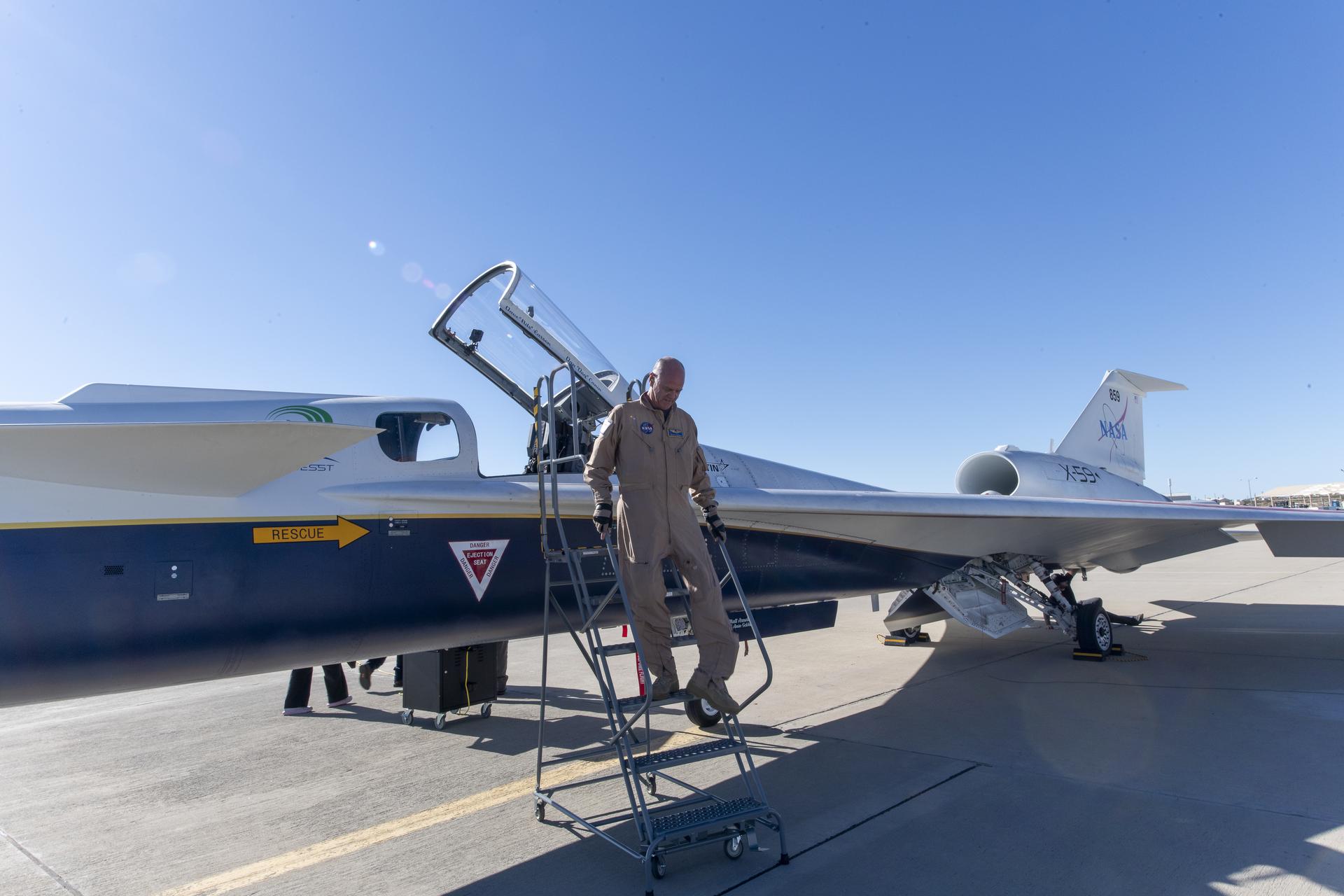
Nils Larson steps down a ladder beside the X-59’s cockpit. He is wearing a tan flight suit with the aircraft parked on the ramp and its canopy open behind him.
NASA test pilot Nils Larson steps out of the X-59 after successfully completing the aircraft’s first flight Tuesday, Oct. 28, 2025. The mission marked a key milestone in advancing NASA’s Quesst mission to enable quiet supersonic flight over land.
NASA/Genaro Vavuris

Next steps

Getting off the ground was only the beginning for the X-59. The team is now preparing the aircraft for full flight testing, evaluating how it will handle and, eventually, how its design will shape shock waves, which typically result in a sonic boom, in supersonic flight. The X-59 will eventually reach its target cruising speed of about 925 mph (Mach 1.4) at 55,000 feet.

The aircraft’s design sits at the center of that testing, shaping and distributing shock-wave formation. Its engine is mounted on top of the fuselage – the main body of the aircraft – to redirect air flow upward and away from the ground.

The cockpit sits mid-fuselage, with no forward-facing window. Instead, NASA developed an eXternal Vision System – cameras and advanced high-definition displays that allow the pilot to see ahead and below the aircraft, which is particularly critical during landing.

These design choices reflect years of research and modeling – all focused on changing how the quieter sonic thump from a supersonic aircraft will be perceived by people on the ground.

NASA’s goal is to gather community response data to support the development of new standards for acceptable levels of sound from commercial supersonic flight over land. To do this, NASA will fly the X-59 over different U.S. communities, collecting ground measurement data and survey input from residents to better understand people’s perception of the X-59’s sonic thump.

“Most X-planes only live in the restricted airspace here on center,” Flick said. “This one is going to go out and fly around the country.”

When the X-59 lifted off the ground for the first time, it carried a piece of NASA’s history back into the air. And with it, a reminder that advancing aeronautics remains central to NASA’s mission.

💾

NASA’s X-59 quiet supersonic research aircraft took to the skies for the first time Tuesday, Oct. 28, 2025, departing from Lockheed Martin’s Skunk Works faci...

NASA Flights Study Cosmic Ray Effects for Air, Future Space Travelers

4 min read

Preparations for Next Moonwalk Simulations Underway (and Underwater)

Recent airborne science flights to Greenland are improving NASA’s understanding of space weather by measuring radiation exposure to air travelers and validating global radiation maps used in flight path planning. This unique data also has value beyond the Earth as a celestial roadmap for using the same instrumentation to monitor radiation levels for travelers entering Mars’ atmosphere and for upcoming lunar exploration.

NASA’s Space Weather Aviation Radiation (SWXRAD) aircraft flight campaign took place August 25-28 and conducted two five-hour flights in Nuuk, Greenland. Based out of NASA’s Langley Research Center in Hampton, Virginia, the mission gathered dosimetry measurements, or the radiation dose level, to air travelers from cosmic radiation. Cosmic radiation is caused by high-energy particles from outer space that originate from our Sun during eruptive events like solar flares and from events farther away, like supernovae in our Milky Way galaxy and beyond.

Photo shows two researchers sitting in the back of an aircraft working on laptops and reviewing incoming data. The image composition shows the round cabin shape and rows of round windows on either side of the aircraft with light coming in during a flight.
Science team partners from Honeywell reviewing dosimeter data on board NASA’s B200 King Air during a flight over Nuuk, Greenland.
NASA/Guillaume Gronoff

“With NASA spacecraft and astronauts exploring the Moon, Mars, and beyond, we support critical research to understand – and ultimately predict – the impacts of space weather across the solar system,” said Jamie Favors, director of NASA’s Space Weather Program at NASA Headquarters in Washington. “Though this project is focused on aviation applications on Earth, NAIRAS could be part of the next generation of tools supporting Artemis missions to the Moon and eventually human missions to Mars.”

Two heliophysics researchers are seen in the doorway of NASA's B200 King Air aircraft holding and discussing a dol
Jamie Favors, NASA Space Weather Program director, and Chris Mertens, SWXRAD principal investigator, discussing a dosimeter at NASA’s Langley Research Center as specialized instruments are integrated onto NASA’s B200 King Air aircraft before deploying to Greenland.
NASA/Mark Knopp

NASA’s Nowcast of Aerospace Ionizing Radiation System, or NAIRAS, is the modeling system being enhanced by the SWXRAD airborne science flights. The model features real-time global maps of the hazardous radiation in the atmosphere and creates exposure predictions for aircraft and spacecraft.

NASA’s B200 King Air on the runway in Goose Bay, Canada, a stop during the flight to Nuuk, Greenland.
NASA/Guillaume Gronoff

“The radiation exposure is maximum at the poles and minimum at the equator because of the effect of Earth’s magnetic field. In the polar regions, the magnetic field lines are directed into or out of the Earth, so there’s no deflection or shielding by the fields of the radiation environment that you see everywhere else.” explained Chris Mertens, principal investigator of SWXRAD at NASA Langley. “Greenland is a region where the shielding of cosmic radiation by Earth’s magnetic field is zero.”

That means flight crews and travelers on polar flights from the U.S. to Asia or from the U.S. to Europe are exposed to higher levels of radiation.

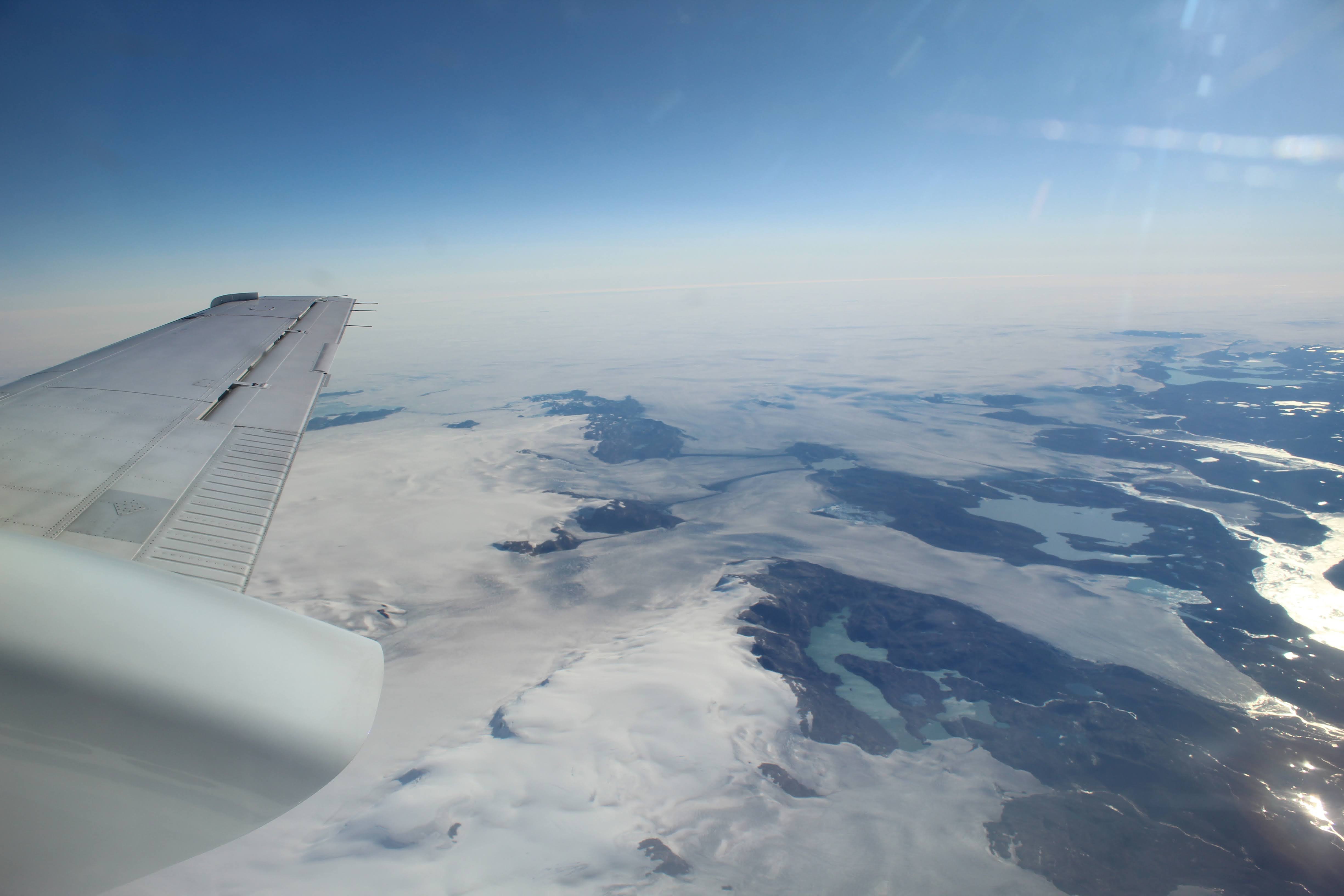
Frozen and rocky terrain in the Polar region observed from above Nuuk, Greenland during NASA’s SWXRAD science flights.
NASA/Guillaume Gronoff

The data gathered in Greenland will be compared to the NAIRAS modeling, which bases its computation on sources around the globe that include neutron monitors and instruments that measure solar wind parameters and the magnetic field along with spaceborne data from instruments like the NOAA GOES series of satellites.

“If the new data doesn’t agree, we have to go back and look at why that is,” said Mertens. “In the radiation environment, one of the biggest uncertainties is the effect of Earth’s magnetic field. So, this mission eliminates that variable in the model and enables us to concentrate on other areas, like characterizing the particles that are coming in from space into the atmosphere, and then the transport and interactions with the atmosphere.”

An aerial view of Nuuk, Greenland. Blue skies with white clouds are in the top of the frame. Mountains and villages and buildings are in the center with dark blue water seen at the bottom portion of the image.
An aerial view of Nuuk, Greenland.
NASA/Guillaume Gronoff

The SWXRAD science team flew aboard NASA’s B200 King Air with five researchers and crew members. In the coming months, the team will focus on measurement data quality checks, quantitative modeling comparisons, and a validation study between current NAIRAS data and the new aircraft dosimeter measurements.

All of this information is endeavoring to protect pilots and passengers on Earth from the health risks associated with radiation exposure while using NASA’s existing science capabilities to safely bring astronauts to the Moon and Mars.

Northern Lights, or auroras, seen over the city of Nuuk, Greenland. Auroras are considered space weather and are easily visible effects of activity from the Sun interacting with the magnetosphere and Earth’s atmosphere.
NASA/Guillaume Gronoff

“Once you get to Mars and even the transit out to Mars, there would be times where we don’t have any data sets to really understand what the environment is out there,” said Favors. “So we’re starting to think about not only how do we get ready for those humans on Mars, but also what data do we need to bring with them? So we’re feeding this data into models exactly like NAIRAS. This model is thinking about Mars in the same way it’s thinking about Earth.”

The SWXRAD flight mission is funded through NASA’s Science Mission Directorate Heliophysics Division. NASA’s Space Weather Program Office is hosted at NASA Langley and facilitates researchers in the creation of new tools to predict space weather and to understand space weather effects on Earth’s infrastructure, technology, and society.

For more information on NASA Heliophysics and NAIRAS modeling visit:

NASA Space Weather

NASA’s Nowcast of Aerospace Ionizing Radiation System

About the Author

Charles G. Hatfield

Charles G. Hatfield

Science Public Affairs Officer, NASA Langley Research Center

❌