My Raspberry Pi 500+ has finally been delivered, but I kept the order brief so I could keep the cost down. In spite of my attempts at being frugal, I’d be lying if I said I hadn’t toyed with the idea of throwing a few more items on the order.
“Build a better mousetrap and the world will beat a path to your door,” so goes the saying, but VHS beat Betamax and the world hasn’t been the same since. In any case, you might not get rich building a better mousetrap, but you can certainly create something more humane than the ol’ spring’n’snap, as [nightcustard] demonstrates.
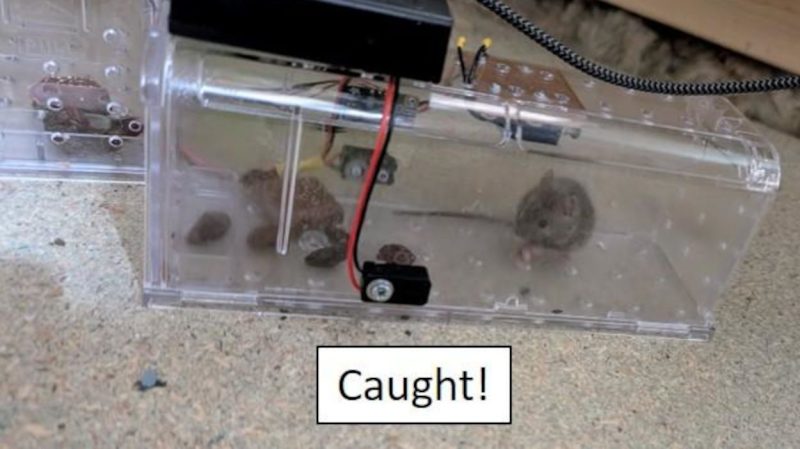
The concept is the same as many humane mousetraps on the market. The mouse is lured into a confined cavity with the use of bait, and once inside, a door closes to keep the mouse inside without injuring it. [nightcustard] achieved this by building a plastic enclosure with plenty of air holes, which is fitted with a spring-loaded door. When a mouse walks through an infra-red break beam sensor, a Raspberry Pi Pico W triggers a solenoid which releases the door, trapping the mouse inside. This design was chosen over a passive mechanical solution, because [nightcustard] noted that mice in the attic were avoiding other humane traps with obvious mechanical trigger mechanisms.
As a bonus, the wireless connectivity of the Pi Pico W allows the trap to send a notification via email when it has fired. Thus, you can wake up in the morning and check your emails to see if you need to go and release a poor beleaguered mouse back into the wild. This is critical, as otherwise, if you forget to check your humane trap… it stops being humane pretty quickly.
The co-founders of Alertmouse, from left: Nathan Kriege, Rand Fishkin and Adam Doppelt, along with Britt Klontz, founder of PR firm Vada Communications, who helped beta test the product. (LinkedIn Photos)
A trio of veteran entrepreneurs have joined forces to create a new Seattle startup — and any mentions of the company across the internet will likely be tracked by what they’re building.
Alertmouse generates email alerts for people and brands who want to know what’s being said about them — or anything else they’re interested in — online. The goal is to provide a better offering than other monitoring tools, most notably Google Alerts, which Alertmouse calls “so bad it might as well not exist.”
The startup was created by co-founders Rand Fishkin (SparkToro, Snackbar Studio), Adam Doppelt (Urbanspoon, Dwellable), and Nathan Kriege (Blueprint AI, Fresh Chalk).
Fishkin, the CEO, posted about Alertmouse on LinkedIn this week, saying that while the side project has turned into a full-fledged business, he’s not leaving his other two jobs.
“It doesn’t take a ton of my time but it has been really fun to build this thing that I desperately needed,” Fishkin said in a video on his post, before listing his grievances with Google Alerts, including how it “doesn’t pick up everything you want, it sends you useless alerts” and more.
Fishkin said tracking his mentions or those related to his companies, whether it’s in a news article or in a Reddit thread, allows him to monitor what’s being said and jump in if necessary to reply.
Alertmouse says it searches the index of websites and pages it can reach two or three times each day for the unique string of words/phrases/rules a user has entered. An email is sent with the pages that contained them.
“It’s not rocket science, but it takes a lot of clever programming, testing, and iteration to make a good alert service,” the company says in its FAQ.
In an interview with GeekWire this week, Fishkin said there are enterprise tracking tools that do what Alertmouse does, such as Mentioned, Hootsuite, and Brandwatch, but they can be cost-prohibitive.
“Google Alerts has been this free alternative for a long time, but sometime in the last decade, maybe even before that, it just stopped sending me anything decent,” he said. “I have no idea what they’re doing under the hood. I suspect it’s a defunct product that no one maintains anymore, but I couldn’t tell you what’s really going on.”
On a website loaded with cheesy puns, Alertmouse has four pricing tiers, including Nibble (free), Slice ($120/year), Wedge ($600/year), and Wheel ($1,200/year).
Alertmouse attracted 1,000 sign-ups in the first several hours it was live, and Fishkin credits the fun interface and language on the website, and the fact that it’s easy to use.
“We wanted to make a brand that no one could confuse for AI,” Fishkin laughed. “This is not an AI company. There’s going to be no venture capital, there’s no AI under the hood. It’s just really simple, straightforward, fun, delightful humans.”
Fishkin, an SEO expert who founded and led Moz, a Seattle-based maker of marketing software tools, co-founded SparkToro in 2018. The audience research tool helps marketers and others understand their target audiences. He raised $2.15 million last year for his new independent video game studio, Snackbar Studio.
Doppelt and Kriege previously worked on vacation rental startup Dwellable (sold to HomeAway in 2015), local professional recommendation site Fresh Chalk, and task management company Blueprint AI together. Last year they teamed up to create a resource website for everything you’d ever want to know about smoke detectors.
The Alertmouse website says the startup has no plans to hire. But that could change after a morning in which lots of people were emailing with questions.
“If it keeps going like this we might have to bring someone on,” Fishkin said.

 Login
Login