Reading view

There are new articles available, click to refresh the page.

Vivek Ramaswamy’s Strive Urges MSCI to Rethink Bitcoin Index Exclusion

Bitcoin Magazine

Vivek Ramaswamy’s Strive Urges MSCI to Rethink Bitcoin Index Exclusion

Strive Asset Management is pushing back against MSCI’s latest proposal. The index provider suggested removing companies with bitcoin holdings over 50% of total assets from major equity benchmarks.

In a letter to MSCI CEO Henry Fernandez, Strive warned the plan could create uneven results worldwide. Companies report bitcoin differently under U.S. GAAP and IFRS accounting standards. Strive said this could lead to inconsistent outcomes for firms with similar exposure.

The Nasdaq-listed firm urged MSCI to rely on optional “ex-digital-asset treasury” index variants instead of redefining eligibility for broad benchmarks. These custom indexes already exist for sectors like energy and tobacco.

Strive is the 14th-largest public corporate bitcoin holder, with more than 7,500 BTC on its balance sheet. Its executives argued that the proposal would “depart from index neutrality” and asked MSCI to “let the market decide” how bitcoin-heavy firms are treated.

Co-founded by Vivek Ramaswamy and Anson Frericks in 2022, Strive has a mission to “depoliticize corporate America.”

MSCI’s ruling affect on companies like Strive and Strategy

The rule change could affect major players like Strategy, which holds 650,000 BTC. JPMorgan estimates MSCI’s exclusion could trigger $2.8 billion in passive outflows from Strategy alone. If other index providers follow suit, the total could rise to $8.8 billion.

Strive’s letter criticized the 50% threshold as “unjustified, overbroad and unworkable.” Many bitcoin treasury companies operate real businesses. 

These include AI data centers, structured finance, and cloud infrastructure. Miners such as MARA, Riot, Hut 8, and CleanSpark are pivoting into renting excess power and compute capacity.

The firm drew comparisons to other industries. Indexes do not exclude energy companies with large oil reserves or gold miners whose value depends on metals. Applying a bitcoin-specific rule, Strive argued, imposes an investment judgment on benchmarks meant to remain neutral.

Executives also highlighted market volatility and accounting differences. Bitcoin’s price swings could push companies in and out of eligibility from quarter to quarter. Derivatives or structured products further complicate exposure calculations.

Strive warned that strict rules could push innovation abroad. U.S. markets may face penalties, while international companies benefit from IFRS treatment. The firm believes the proposal may stifle new bitcoin-backed financial products.

MSCI plans to announce its decision on January 15, 2026, before the February index review. Strive is among several firms lobbying against the proposal. Its argument centers on fairness, neutrality, and market choice rather than restricting investor access.

Last week, Strategy’s Michael Saylor disputed MSCI index disputes and clarified that Strategy is a publicly traded operating company with a $500 million software business and a treasury strategy using Bitcoin, not a fund, trust, or holding company. 

This post Vivek Ramaswamy’s Strive Urges MSCI to Rethink Bitcoin Index Exclusion first appeared on Bitcoin Magazine and is written by Micah Zimmerman.

Bitcoin Price Craters to $88,000, But JPMorgan Maintains $170,000 Target

Bitcoin Magazine

Bitcoin Price Craters to $88,000, But JPMorgan Maintains $170,000 Target

Bitcoin price plunged to $88,000s on Friday, down over 4% in the past 24 hours. The cryptocurrency is trading near its seven-day low of $88,091, and about 4% below its seven-day high of $92,805. 

The global market capitalization for Bitcoin now stands at $1.77 trillion, with a 24-hour trading volume of $48 billion.

Despite the recent drop, Wall Street bank JPMorgan remains bullish on the Bitcoin price over the long term. The bank continues to maintain its gold-linked volatility-adjusted BTC target of $170,000 over the next six to twelve months. 

Analysts say the model accounts for fluctuations in price and mining costs.

One key factor in the market is Strategy (MSTR), the largest corporate Bitcoin holder. The company owns 650,000 BTC. Its enterprise-value-to-Bitcoin-holdings ratio, known as mNAV, currently stands at 1.13. 

JPMorgan analysts describe this as “encouraging.” A ratio above 1.0 indicates Strategy is unlikely to face forced sales of its Bitcoin.

JUST IN: JPMorgan says it is sticking to its Bitcoin vs gold model target, which would see BTC hit $170,000 over the next year 🐂 pic.twitter.com/PNt9ojpBRv

— Bitcoin Magazine (@BitcoinMagazine) December 5, 2025

Strategy has also built a $1.44 billion U.S. dollar reserve. The reserve is designed to cover dividend payments and interest obligations for at least 12 months. The company aims to extend coverage to 24 months. 

Bitcoin mining pressure

Mining pressures continue to weigh on Bitcoin. The network’s hashrate and mining difficulty have fallen. High-cost miners outside China are retreating due to rising electricity costs and declining prices. Some miners have sold Bitcoin to remain solvent. 

JPMorgan now estimates Bitcoin’s production cost at $90,000, down from $94,000 last month. Falling hashrates can push production costs lower, but the short-term effect is sustained selling pressure from miners.

Institutional investors also show caution. BlackRock’s iShares Bitcoin Trust, or IBIT, has recorded six consecutive weeks of net outflows. Investors pulled more than $2.8 billion from the ETF over this period, according to Bloomberg.

The withdrawals highlight subdued appetite among traditional investors, even as Bitcoin prices stabilize. Analysts note that the trend marks a reversal from the persistent inflows seen earlier in the year.

The broader market is still recovering from the October 10 liquidation event. That crash wiped out over $1 trillion in crypto market value and pushed Bitcoin into a bear market.

Although the Bitcoin price has recovered some ground this week, momentum remains fragile.

JPMorgan analysts now say Bitcoin’s next major move depends less on miner behavior. Instead, it depends on Strategy’s ability to hold its Bitcoin without selling. The mNAV ratio and reserve fund provide confidence that the company can weather market volatility.

Other potential catalysts remain. The MSCI index decision on January 15 could impact Strategy’s stock and, indirectly, Bitcoin. Analysts say a positive outcome could trigger a strong rally.

Last week, Strategy’s Michael Saylor disputed MSCI index disputes and clarified that Strategy is a publicly traded operating company with a $500 million software business and a treasury strategy using Bitcoin, not a fund, trust, or holding company. 

He emphasized the firm’s recent activity, including five digital credit security offerings totaling over $7.7 billion in notional value.

Bitcoin price analysis

Bitcoin Magazine analysts believe that the bitcoin price correlation with Gold has recently strengthened mainly during market downturns, offering a clearer view of its purchasing power when analyzed against Gold instead of USD.

Breaking below the 350-day moving average (~$100,000) and the $100K psychological level signaled Bitcoin’s entry into a bear market, dropping roughly 20% immediately. 

While USD charts show a 2025 peak, Bitcoin measured in Gold peaked in December 2024 and has fallen over 50%, suggesting a longer bear phase. 

Historical Gold-based bear cycles indicate potential support zones approaching, with current declines at 51% over 350 days reflecting institutional adoption and constrained supply rather than cycle shifts.

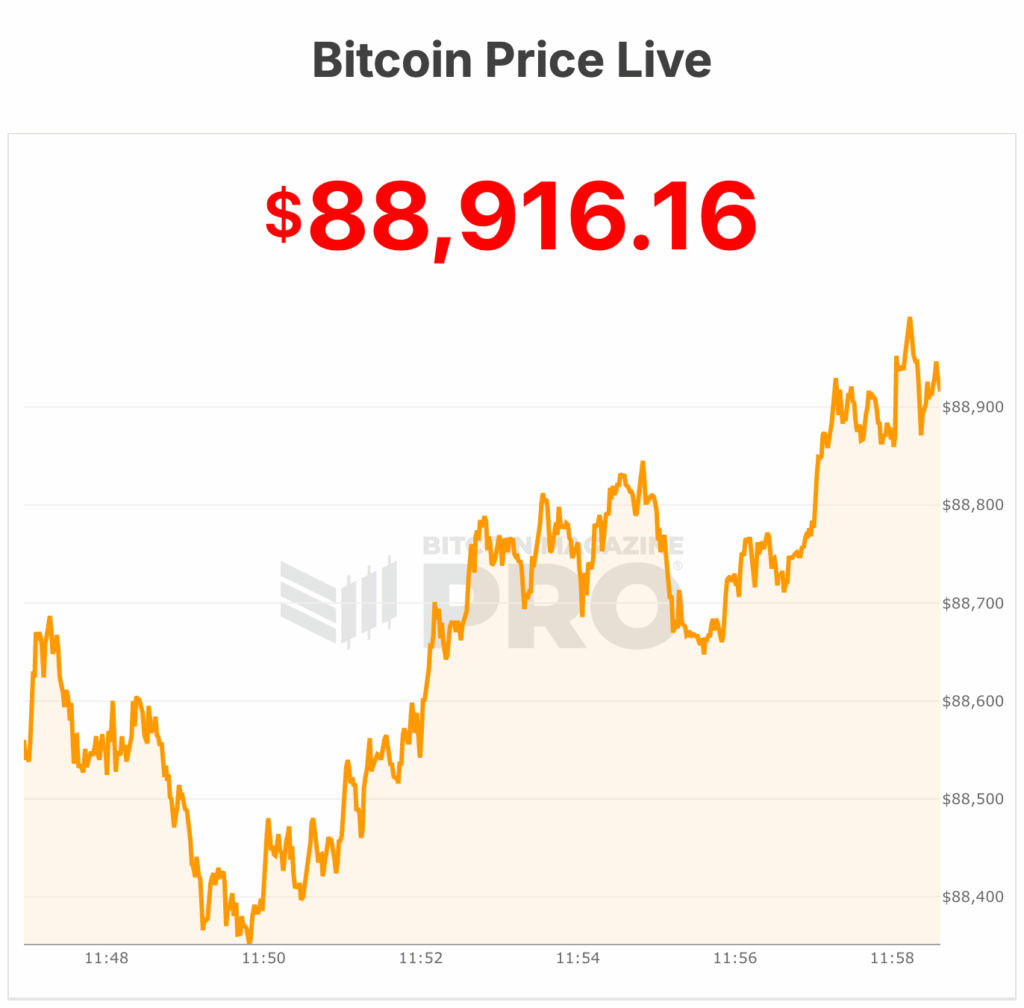
For now, bitcoin price hovers near $88,000. 

Bitcoin price

This post Bitcoin Price Craters to $88,000, But JPMorgan Maintains $170,000 Target first appeared on Bitcoin Magazine and is written by Micah Zimmerman.
Indiana Lawmakers Push Bill to Make State a Bitcoin Leader

Bitcoin Magazine

Indiana Lawmakers Push Bill to Make State a Bitcoin Leader

Indiana lawmakers are taking a bold step toward embracing bitcoin. A new proposal would let the state invest in digital assets like Bitcoin through regulated funds while blocking local governments from restricting crypto companies.

The measure, House Bill 1042, reflects growing political and financial interest in crypto. Digital assets once seen as fringe now have backing from top U.S. leaders, including President Donald Trump, and major financial institutions. 

Congress also passed its first major crypto bill earlier this year.

Indiana wants in. Lawmakers gave HB 1042 an early hearing as they juggle redistricting, signaling the issue is a top priority for Republicans.

“Digital assets are quickly becoming part of everyday finances, and Indiana should be ready to engage in a smart, responsible way,” said bill author Rep. Kyle Pierce, R-Anderson. “This bill gives Hoosiers more investment choices while establishing guardrails and helping us explore how blockchain and digital asset technology can benefit communities across our state.”

A cautious bitcoin and crypto approach

The Indiana bill would let public investment funds gain exposure to digital assets, but only indirectly. It does not allow direct crypto purchases. 

Instead, it authorizes cryptocurrency exchange-traded funds, or ETFs. These funds track crypto prices and operate under federal oversight.

ETFs offer more stability than holding tokens directly, but risks remain. The SEC has warned that crypto markets still lack strong safeguards and are vulnerable to fraud and manipulation.

That concern surfaced in testimony from Tony Green, deputy executive director of the Indiana Public Retirement System. He said INPRS was neutral on the bill but would want clear disclaimers about volatility. He also noted members have shown little interest in crypto options.

Under the bill, several major programs in Indiana must offer at least one crypto ETF. That list includes the 529 education savings plan, the Hoosier START plan, and retirement systems for teachers, public employees, and lawmakers. 

Other state funds would also gain authority to invest in crypto ETFs. The state treasurer could place assets in stablecoin ETFs as well.

Guardrails and a task force

The bill goes beyond investments. It would restrict how Indiana state agencies and local governments regulate digital assets. Pierce said the aim is fairness. The measure bars local rules that target crypto use, mining operations, or self-custody.

It also protects private keys as privileged information.

The proposal creates a Blockchain and Digital Assets Task Force. The group would study potential government and consumer uses of the technology. It would also recommend pilot projects across the state.

Bitcoin is a national trend

States are increasingly exploring crypto in pension funds and public accounts. The push comes as Bitcoin gains traction as a potential store of value for governments. Some federal proposals have even floated using Bitcoin reserves to offset national debt.

Last week, Texas became the first U.S. state to purchase Bitcoin through a spot ETF, buying $5 million worth via BlackRock’s iShares Bitcoin Trust, according to Texas Blockchain Council President Lee Bratcher. 

The acquisition is the state’s first move under its new Strategic Bitcoin Reserve, created by legislation signed in June. 

Texas plans to eventually self-custody its BTC but used IBIT for the initial allocation while the procurement process continues. The purchase highlights rising state and institutional interest in Bitcoin as a reserve asset. 

Harvard University recently tripled its IBIT holdings to $442.8 million, while Emory University and Abu Dhabi’s Al Warda Investments have also boosted exposure. 

Texas had previously explored a Bitcoin reserve proposal that called for cold storage, resident donations, and annual audits.

Meanwhile, New Hampshire approved a $100 million Bitcoin-backed municipal bond, the first of its kind globally, requiring borrowers to over-collateralize with BTC.

At the time of writing, the bitcoin price is flirting with $90,000.

Indiana

This post Indiana Lawmakers Push Bill to Make State a Bitcoin Leader first appeared on Bitcoin Magazine and is written by Micah Zimmerman.

Bitcoin Treasury Twenty One Capital to Start Trading on NYSE Next Week With $4 Billion BTC Treasury

Bitcoin Magazine

Bitcoin Treasury Twenty One Capital to Start Trading on NYSE Next Week With $4 Billion BTC Treasury

Bitcoin treasury firm Twenty One Capital will start trading on the New York Stock Exchange on December 9. The company will use the ticker symbol XXI.

Twenty One Capital is the result of a merger with Cantor Equity Partners (CEP). CEP shareholders approved the deal, clearing the way for the transaction to close around December 8. The merged entity will operate under the Twenty One Capital name.

The company will launch with about 43,514 BTC. At current prices, that is roughly $4 billion. This will make Twenty One Capital the largest BTC treasury company listed on the NYSE. Globally, it will be the second-largest corporate BTC holder after Strategy.

The firm was first announced in April as a joint venture between Tether, Bitfinex, SoftBank, and Cantor Fitzgerald. The name refers to Bitcoin’s total supply of 21 million coins, of which about 19.95 million have been mined.

Jack Mallers, CEO and co-founder of Twenty One Capital, posted on X, “Game on. See you at the NYSE on Tuesday.”

In July, the company added 5,800 BTC from Tether to its treasury. Combined with initial holdings, Twenty One Capital will hold more than 43,000 BTC at launch. The firm plans to continue growing its BTC holdings as part of its core strategy.

Pre-merger, Cantor Equity Partners raised $585 million through Private Investment in Public Equity (PIPE) financing. Twenty One Capital also sold $100 million in convertible notes. Part of these funds were used to increase the Bitcoin treasury.

Direct bitcoin exposure on Wall Street

Twenty One Capital’s model focuses on giving investors direct exposure to BTC through its corporate balance sheet. The company will introduce a metric called Bitcoin Per Share.

It shows the amount of BTC held per share. The measure relies on on-chain proof-of-reserves. This gives investors a verifiable reference to track Bitcoin holdings in real time.

The company aims to differentiate itself from other digital asset treasury firms. While competitors like Strategy and Metaplanet operate multiple businesses, Twenty One Capital is designed to focus solely on Bitcoin accumulation and related services.

Tether and Bitfinex remain majority shareholders and support the firm’s public listing. Cantor Fitzgerald provides expertise in investment banking and capital markets. 

CEP offered the SPAC vehicle to complete the merger and bring the company to the NYSE.

Upon its debut, Twenty One Capital will become a key player in publicly listed BTC treasuries. Its treasury, trading structure, and Bitcoin Per Share metric aim to provide a new model for investors seeking exposure to BTC.

The company plans to expand services connected to Bitcoin, including payments and infrastructure. CEO Jack Mallers has said his main goal is to increase Bitcoin per share, reinforcing shareholder value.

Shares of Twenty One Capital are expected to start trading on December 9 under the ticker XXI, one day after the merger closes. 

This post Bitcoin Treasury Twenty One Capital to Start Trading on NYSE Next Week With $4 Billion BTC Treasury first appeared on Bitcoin Magazine and is written by Micah Zimmerman.

Italy Launches Review of Crypto Safeguards Due to Rising Risks

Bitcoin Magazine

Italy Launches Review of Crypto Safeguards Due to Rising Risks

Italy’s Economy Ministry has ordered a detailed review of current protections against crypto risks, officials said on Thursday. 

The review will focus on safeguards for both direct and indirect investments in crypto-assets by retail investors, regulators added.

The decision came during a meeting of the Committee for Macroprudential Policies. The committee includes the heads of the Bank of Italy, market watchdog Consob, insurance and pension regulators, and the Treasury’s director general, according to Reuters reporting. 

Committee members warned that risks from crypto-assets could rise. Growing connections between crypto and the wider financial system, along with inconsistent international regulations, could heighten vulnerabilities, they said.

The committee said Italy’s economic and financial conditions remain generally stable. At the same time, global uncertainty continues to pose challenges for financial stability.

The review will examine how existing rules protect investors and the financial system. Officials said they aim to identify gaps and recommend measures to strengthen safeguards, per Reuters. 

Italy has increasingly monitored digital assets in recent years. Authorities have raised concerns over investor protection, market integrity, and potential spillovers into the broader financial system. The new review signals a more cautious approach to crypto adoption in the country.

Italy’s cold-shoulder to crypto

Last year, Italy proposed a steep tax hike on crypto trades, aiming to raise the rate on digital asset gains from 26% to 42% as part of its October budget plan.

The measure was designed to boost public finances but quickly drew criticism from the crypto industry, which warned that such an aggressive increase would damage the country’s competitiveness — especially with the EU preparing to roll out its Markets in Crypto-Assets (MiCA) framework later this year.

The government backed down from its proposal after sharp criticism from Italy’s crypto industry. Under the revised budget plan, the capital-gains tax on digital asset trades is now expected to rise to 33% starting in the 2026 financial year, per reports. 

Last week, Bitizenship launched BTC Italia and The Bitcoin Dolce Visa, a Bitcoin-aligned pathway for obtaining Italy’s Investor Visa through a €250,000 startup investment.

The Milan-based venture operates as an “Innovative Startup” focused on Bitcoin Layer-2 yield generation and treasury management, giving applicants exposure to a Bitcoin-native business while staying within Italy’s regulatory framework.

The initiative comes as Italy posts strong economic performance, including record exports, a €46 billion trade surplus, stabilizing public debt, and a stock market that has doubled since 2020. With capital-market reforms on the horizon and competitive tax incentives, the country has become an increasingly attractive destination for foreign investors.

Under the program, applicants receive visa approval before committing funds. BTC Italia maintains its treasury in Bitcoin, uses non-custodial Layer-2 staking for operations, and offers redemption windows every 24 months.

This post Italy Launches Review of Crypto Safeguards Due to Rising Risks first appeared on Bitcoin Magazine and is written by Micah Zimmerman.

2012 Video Resurfaces of Coinbase CEO Brian Armstrong Pitching What Became America’s Largest Bitcoin Exchange

Bitcoin Magazine

2012 Video Resurfaces of Coinbase CEO Brian Armstrong Pitching What Became America’s Largest Bitcoin Exchange

A video has surfaced showing Coinbase CEO Brian Armstrong rehearsing a pitch in 2012, years before the company became the largest Bitcoin exchange in the U.S.

In the recording, Armstrong lays out a simple argument: Bitcoin is a digital currency that can move money instantly anywhere in the world. But it’s hard to use. Tools were clunky, backups were tricky, and users could easily lose their funds. 

Coinbase, he said, would fix that. The platform would act as a hosted wallet, letting anyone access their money from any device without worrying about security or backups.

Armstrong compares his plan to what iTunes did for music. He emphasizes the early growth: sign-ups and transactions increasing “20 % a day,” and $65,000 in Bitcoin payments were processed in just five weeks.

The pitch is short, under three minutes, and candid. Armstrong discussed fees, competition, and the potential of Bitcoin as a global payment system. It’s a glimpse at the early vision of a company few outside crypto had heard of.

In 2012, Brian Armstrong recorded himself rehearsing his pitch for Coinbase.

Today, they're the largest Bitcoin exchange in the US ✨ pic.twitter.com/Ta4bKz0hYd

— Bitcoin Magazine (@BitcoinMagazine) December 4, 2025

Coinbase: Don’t get ‘left behind’

It’s safe to say that Armstrong’s idea was a success. More than a decade later, Coinbase is the top U.S. exchange, handling billions in Bitcoin transactions and shaping how Americans interact with digital assets. 

That scrappy 2012 rehearsal captures the first hints of a company that would grow into a crypto powerhouse.

Just yesterday, Armstrong sat beside BlackRock CEO Larry Fink and said that all major U.S. banks that ignore stablecoins risk being “left behind.” 

Speaking at the New York Times DealBook Summit, Armstrong said that several top banks are running pilot programs with Coinbase for stablecoins, crypto custody, and trading.

Armstrong acknowledged a split within traditional finance: some institutions’ lobbying arms resist crypto, while innovation teams explore it. 

“This is the classic innovator’s dilemma,” he said, noting banks must choose between embracing or fighting new technology. On concerns about capital flowing to stablecoins, Armstrong said banks are mainly focused on protecting profit margins.

Fink, once a bitcoin skeptic, said he now sees a “huge use case” for Bitcoin and worries the U.S. is falling behind in stablecoin innovation. 

Armstrong has championed crypto to the U.S. government. He has lobbied and pushed for clearer regulations for the crypto industry.

Armstrong supported legislation like the CLARITY Act to set legal clarity. He launched grassroots efforts, including Stand With Crypto. He has also spent millions on campaigns through PACs like Fair Shake. 

This post 2012 Video Resurfaces of Coinbase CEO Brian Armstrong Pitching What Became America’s Largest Bitcoin Exchange first appeared on Bitcoin Magazine and is written by Micah Zimmerman.

CFTC Opens Door for Spot Bitcoin and Crypto Trading in U.S. Markets

Bitcoin Magazine

CFTC Opens Door for Spot Bitcoin and Crypto Trading in U.S. Markets

The CFTC is opening the door for federally regulated spot crypto trading in the U.S. for the first time, with Bitnomial’s exchange opening up next week. 

Acting Chairman Caroline Pham announced that listed spot crypto products will trade on CFTC-registered exchanges, marking a major milestone in the effort to bring digital asset trading to the United States and under full federal oversight.

The announcement coincides with the launch of Bitnomial, Inc., a U.S.-based derivatives exchange, which will operate the first-ever leveraged retail spot crypto exchange under CFTC regulation. 

Bitnomial’s Designated Contract Market (DCM) and Derivatives Clearing Organization (DCO) will allow both retail and institutional traders to trade spot, perpetuals, futures, and options on a single platform. 

Unified portfolio margining and net settlement eliminate redundant margin requirements, boosting capital efficiency and reducing counterparty risk.

“Leveraged spot crypto trading is now available under the same regulatory framework as U.S. perpetuals, futures, and options,” said Luke Hoersten, founder and CEO of Bitnomial. “Broker intermediation and Clearinghouse net settlement provide the capital efficiency traders need. We’re bringing leveraged spot crypto trading back to the U.S. with CFTC oversight.”

BREAKING: 🇺🇸 CFTC announces spot Bitcoin and crypto can now trade on CFTC-registered exchanges 👀

CFTC said this is to help “make America the crypto capital of the world.” pic.twitter.com/dfzuNPtrTa

— Bitcoin Magazine (@BitcoinMagazine) December 4, 2025

Pham emphasized that the new framework gives Americans a safer alternative to offshore platforms, which have often been described as the “wild west.” 

Speaking on Fox News, she highlighted the collapse of FTX as a cautionary tale, noting that many investors lost out due to a lack of regulatory protections.

 “Not only do we want Americans to come back home to trade where they have the protections they deserve, but this also encourages U.S. companies to invest, build, and hire here,” Pham told Fox Business.

Under the new system, all orders—retail and institutional—will receive equal treatment. There is no preferential routing, no informational advantage, and equal access to liquidity, a structure long sought by industry participants.

For brokers and institutions, the move resolves longstanding compliance challenges related to state money transmitter rules, finally providing access to a federally regulated spot market.

The launch represents the culmination of Pham’s pro-innovation leadership at the CFTC. By recognizing that retail commodity transactions can be offered on a DCM and cleared through a DCO, the agency has created a compliant pathway for domestic leveraged spot crypto trading. 

United States as a global crypto leader

This approach aligns with broader goals to make the U.S. a global hub for digital asset markets while maintaining investor protections. The convergence of spot, perpetuals, futures, and options on a single platform also transforms capital efficiency for traders.

 Rather than maintaining fully collateralized positions across multiple venues, they can now offset risk across all product types on one exchange.

The Bitnomial platform is scheduled to go live the week of December 8, 2025. Pham called it a “historic milestone” for U.S. crypto markets and a key step in establishing the country as a leader in digital asset innovation. 

CFTC greenlights Polymarket

Earlier this week, Polymarket, the crypto-based prediction market platform, launched a U.S.-focused app today after receiving CFTC approval, ending nearly four years of restrictions on American users.

Polymarket bypassed the traditional multi-year CFTC registration by acquiring QCEX, a registered platform, for $112 million, and received a no-action letter in September to resume U.S. operations.

The platform upgraded its systems to meet CFTC requirements, including enhanced surveillance, clearing procedures, and regulatory reporting. 

It now supports direct Bitcoin deposits alongside stablecoins and has attracted potential investor interest, including a possible $2 billion investment from Intercontinental Exchange.

The CFTC was created in 1974 to regulate derivatives markets like futures, options, and swaps. Its mission is to oversee markets, prevent abuses, and protect customer funds. The agency monitors exchanges, trading platforms, and intermediaries, while its Division of Enforcement investigates violations.

This post CFTC Opens Door for Spot Bitcoin and Crypto Trading in U.S. Markets first appeared on Bitcoin Magazine and is written by Micah Zimmerman.

VTB Pushes to Open Russia’s First Bank-Run Bitcoin Trading Desk as Kremlin Moves to Classify Mining as an Export

Bitcoin Magazine

VTB Pushes to Open Russia’s First Bank-Run Bitcoin Trading Desk as Kremlin Moves to Classify Mining as an Export

Russia’s second-largest lender, VTB, is positioning itself to become the first major bank in the country to let customers trade bitcoin and crypto directly. 

Andrey Yatskov, head of VTB’s brokerage arm, told Russian outlet RBC that client demand for “real” crypto — not just derivative products — is rising sharply. “As we see it, real cryptocurrency will be available for purchase via our brokerage accounts,” he said, according to DLNews reporting.

The move comes despite the fact that crypto trading remains unregulated in Russia. For now, banks can only offer crypto-linked derivatives, a permission granted earlier this year to VTB, rival Sberbank, and the Moscow Exchange. 

But momentum in Moscow has turned. After years of pushing for a full ban, the central bank has recently signaled it is ready to regulate crypto instead, reflecting mounting pressure from lawmakers, ministries, and businesses eager for a legal framework — and tax revenue.

VTB plans to test its trading platform with “super-qualified clients,” those holding over $1.3 million in assets or earning more than $649,000 a year. 

The bank expects broader permission as regulators ease restrictions, a shift the central bank’s first deputy governor called a “strategic response to sanctions regimes.”

Commercial banks now see themselves playing a central role in a future market of licensed crypto brokers and depositories. 

Yatskov said clear rules would “definitely boost” transparency and confirmed VTB intends to participate once regulations are finalized.

JUST IN: 🇷🇺 Russia's second-largest bank, VTB, set to launch #Bitcoin & crypto trading in 2026.

Russia is coming 🚀 pic.twitter.com/oCHVOYCVEd

— Bitcoin Magazine (@BitcoinMagazine) December 4, 2025

Crypto is already finding new footholds in Russia, from cross-border payments to a rapidly expanding industrial mining sector. 

With the tide turning, VTB aims to launch full crypto trading services as early as 2026. Earlier this year, the Bank of Russia reportedly started allowing domestic banks to conduct limited crypto operations under tight regulatory oversight.

“We hold conservative views and think about how appropriate it is for the banking sector to include cryptocurrency in its assets,” First Deputy Chairman Vladimir Chistyukhin said at the time.

Kremlin adviser pushes to classify crypto mining as an export in Russia’s trade accounts

In the meantime, a senior Kremlin official is saying that Russia should treat crypto mining as a formal export sector, arguing that large volumes of mined Bitcoin effectively leave the country’s economy even without crossing a physical border.

Speaking at the ‘Russia Calling!’ investment forum, Maxim Oreshkin — Deputy Chief of Staff to President Vladimir Putin — said crypto flows are “enormous” yet absent from official statistics, despite influencing the foreign-exchange market and Russia’s balance of payments.

Russia legalized industrial crypto mining in 2024, and Oreshkin described the sector as a “new and undervalued export item” that the state fails to properly measure. 

Because Russian firms increasingly settle import bills with cryptocurrency, he said, those transactions should be counted in the nation’s trade and currency calculations.

Industry executives say the scale justifies the shift. Via Numeri Group CEO Oleg Ogienko estimates Russian miners will produce “tens of thousands” of BTC this year. Sergey Bezdelov, head of the Industrial Mining Association, put output at roughly 55,000 BTC in 2023 and around 35,000 BTC in 2024 following Bitcoin’s halving.

Regulators have tightened oversight as the sector expands. Companies and sole proprietors must register with the Federal Tax Service, hosting providers are tracked in a dedicated registry, and miners face corporate tax rates as high as 25%. 

Household miners remain exempt from registration only if their power consumption stays under 6,000 kWh per month.

The push to formalize the industry comes as authorities crack down on illegal operations that siphon electricity and evade taxes — losses officials say run into the millions. But with Russia now the world’s No. 2 Bitcoin-mining nation, pressure is mounting for Moscow to integrate the fast-growing sector into its national accounts.

This post VTB Pushes to Open Russia’s First Bank-Run Bitcoin Trading Desk as Kremlin Moves to Classify Mining as an Export first appeared on Bitcoin Magazine and is written by Micah Zimmerman.

Bitcoin Price Dances with $94,000 as Institutional Demand Fuels a Bullish Setup

Bitcoin Magazine

Bitcoin Price Dances with $94,000 as Institutional Demand Fuels a Bullish Setup

The bitcoin price is trading near $93,000, with roughly $81 billion changing hands in the past 24 hours. The price is up 3% on the day, holding just 1% below today’s high of $93,929 and about 3% above the weekly low near $90,837. 

Nearly 19.96 million BTC are in circulation, inching toward the fixed 21 million cap. The move pushed Bitcoin’s global market value to $1.86 trillion, also up 3% over the same period.

According to analysts, the Bitcoin price briefly dipped under its Metcalfe-based fair value for the first time since 2023, signaling what analysts say is a classic late-cycle reset. The move came during a sharp 36% drawdown that dragged the Bitcoin price towards $80,000 last week, erased excess leverage and flushed out speculative positions. 

According to network economist Timothy Peterson, periods when bitcoin trades below its fundamental network value have historically produced strong forward returns. Twelve-month gains have averaged 132%, with positive performance occurring 96% of the time, according to CoinDesk reporting

The network’s internal dynamics have also shifted. Long-term holders accumulated roughly 50,000 BTC over the past ten days, reversing months of steady distribution. 

Coins are maturing from short-term traders into long-term storage, reducing sell pressure at a moment when bitcoin is attempting to reclaim higher levels. Bitcoin recovered back above $90,000 this week and traded at highs of $93,978 on Wednesday.

Bitcoin price and macro conditions

Macro conditions are now converging with on-chain signals. The Federal Reserve just ended Quantitative Tightening, with markets pricing a December rate cut as nearly certain. 

Historically, each QT reversal has coincided with major bitcoin rallies. The pattern dates back to 2010 and includes the explosive 2013 cycle and the post-2019 surge that eventually carried the bitcoin price to $67,000.

Business-cycle indicators may also be turning. The copper-to-gold ratio, a leading gauge for U.S. manufacturing sentiment and future PMI strength, appears to be bottoming. 

Bitcoin’s recent stagnation despite expanding global liquidity suggests investors have been reacting more to weakening economic confidence than to crypto-specific factors. A recovery in risk appetite would likely benefit bitcoin after months of consolidation.

The short-term picture remains fragile. A bearish November close confirmed a monthly MACD cross, a signal that often precedes multi-month periods of slower momentum. 

Key levels near $85,000 and $84,000 continue to act as support, while analysts warn that a breakdown could open the door to a deeper test of $75,000. 

Bitcoin price remains down sharply from its $126,000 record set in October, though volatility has eased as liquidations subside.

Institutional participation continues to grow despite turbulence. BlackRock increased internal exposure to its IBIT ETF, JPMorgan introduced a structured note tied to the product, and Strategy Inc. expanded its bitcoin holdings while setting aside a $1.4 billion reserve to reassure investors it will not be forced to sell. 

Earlier today, Charles Schwab said it also wants to offer Bitcoin trading in early 2026.

Also earlier today, BlackRock CEO Larry Fink said he was “wrong” about Bitcoin, marking a sharp reversal from his past skepticism. 

Speaking at the NYT DealBook Summit, Fink called Bitcoin “an asset of fear,” bought during times of geopolitical stress, financial insecurity, or currency debasement. He warned it remains volatile and by leverage but said it can act as meaningful portfolio insurance. 

““If you’re buying it as a hedge against all your hope, then it has a meaningful impact on a portfolio… the other big problem of Bitcoin is it is still heavily influenced by leveraged players,” Fink said.

JUST IN: BlackRock CEO Larry Fink says he was wrong to be a Bitcoin critic and changed his views 👀

"My thought process always evolves. This is a big shift in my opinion." 👏 pic.twitter.com/4PhDuoy5Le

— Bitcoin Magazine (@BitcoinMagazine) December 3, 2025

BlackRock now offers major crypto products and is building tokenization tech, with Fink seeing a “large use case” for Bitcoin and digital assets.

Also during the summit, Brian Armstrong, the CEO of Coinbase, said that there is “no chance” of the bitcoin price going to zero.

At the time of publication, the bitcoin price is $92,923.

bitcoin price

This post Bitcoin Price Dances with $94,000 as Institutional Demand Fuels a Bullish Setup first appeared on Bitcoin Magazine and is written by Micah Zimmerman.

BlackRock CEO Larry Fink Says He Was Wrong About Bitcoin, Reveals a ‘Big Shift’ in His View

Bitcoin Magazine

BlackRock CEO Larry Fink Says He Was Wrong About Bitcoin, Reveals a ‘Big Shift’ in His View

BlackRock CEO Larry Fink has shifted his perspective on Bitcoin — and he openly acknowledged the change.

Speaking at the NYT DealBook Summit on Wednesday, Fink stated that he now sees potential in Bitcoin. Fink was once a vocal critic who famously labeled Bitcoin “an index for money laundering,” 

Today, Fink described Bitcoin as “an asset of fear,” elaborating that investors frequently purchase it in response to concerns about financial security, geopolitical instability, or the ongoing debasement of traditional assets caused by growing deficits.

“If you bought it for a trade, it’s a very volatile asset, you’re going to have to be really good at market timing, which most people aren’t,” Fink said. “If you’re buying it as a hedge against all your hope, then it has a meaningful impact on a portfolio… the other big problem of Bitcoin is it is still heavily influenced by leveraged players.”

Fink, speaking alongside Coinbase CEO Brian Armstrong, noted that market movements — like a recent 20–25% drawdown in Bitcoin — often reflect broader events, such as trade agreements with China or potential settlements in Ukraine. 

Despite all this, Fink still suggested it can serve as meaningful portfolio insurance for those holding it as a hedge rather than for short-term trading.

Fink emphasized that his perspective has evolved through years of client interactions and discussions with policymakers, calling his change of heart a “very glaring public example” of the need to reassess strong opinions. 

Meanwhile, BlackRock, the $13.5 trillion asset manager Fink helped build, now offers several crypto products, including a major Bitcoin ETF, marking a stark contrast to his earlier skepticism.

“There is no chance” that Bitcoin goes to zero, said Mr. Armstrong, who sat beside Fink. Fink also shared an optimistic view for the asset: “I see a big, large use case for Bitcoin,” he said.

JUST IN: BlackRock CEO Larry Fink says he was wrong to be a Bitcoin critic and changed his views 👀

"My thought process always evolves. This is a big shift in my opinion." 👏 pic.twitter.com/4PhDuoy5Le

— Bitcoin Magazine (@BitcoinMagazine) December 3, 2025

BlackRock’s bold embrace of bitcoin and crypto

Back in October, BlackRock said they were developing technology to tokenize a wide range of assets, including real estate, equities, and bonds.

Fink said at the time that global digital wallets held over $4.5 trillion across crypto, stablecoins, and tokenized assets. He noted much of this capital was outside the U.S., presenting opportunities to reach new investors. 

Fink said tokenization could allow crypto entrants to access traditional long-term products, like retirement funds. He described Bitcoin and crypto as serving a similar purpose to gold. 

This post BlackRock CEO Larry Fink Says He Was Wrong About Bitcoin, Reveals a ‘Big Shift’ in His View first appeared on Bitcoin Magazine and is written by Micah Zimmerman.

Bitcoin And Crypto Prediction Platform Polymarket Rolls Out US App Today After CFTC Approval

Bitcoin Magazine

Bitcoin And Crypto Prediction Platform Polymarket Rolls Out US App Today After CFTC Approval

Polymarket, the crypto-based prediction market platform, has officially launched a U.S.-focused app following approval from the Commodity Futures Trading Commission (CFTC). 

The move lifts nearly four years of restrictions preventing American users from participating in its blockchain-powered prediction markets.

Initially available in the App Store under the sports category, the app allows U.S. users to place bets on sports events, with plans to expand into other markets including proposition bets and election wagers. 

The app is opening access gradually, inviting users from a previously established waitlist, though not all applicants have received invitations yet.

Polymarket bypassed the traditional, multi-year CFTC registration process by acquiring QCEX, an already-registered platform, for $112 million in July. 

The company received a no-action letter from the CFTC in September, allowing it to resume operations legally in the U.S. after its 2022 settlement over unregistered event contracts.

Polymarket’s CFTC approval

In November, Polymarket secured an Amended Order of Designation from the U.S. Commodity Futures Trading Commission (CFTC), allowing it to operate as an intermediated trading platform under the full set of federal rules for U.S. exchanges. 

The approval enabled the platform to onboard brokerages and customers directly, allowing users to trade through futures commission merchants (FCMs) and access traditional custody, reporting, and market infrastructure.

To comply with the CFTC’s requirements, Polymarket upgraded its systems, introducing enhanced market surveillance, supervision policies, clearing procedures, and Part 16 regulatory reporting. 

The platform remains fully subject to the Commodity Exchange Act and other CFTC regulations, including self-regulatory obligations.

The platform had been barred from operating in the U.S. in 2022 after offering unregistered derivatives contracts. Its return followed the acquisition of QCEX, a regulated contract market and clearinghouse, for $112 million, which enabled the company to bypass a lengthy registration process.

 Earlier this year, the platform also introduced support for direct bitcoin deposits, allowing users to fund accounts with BTC alongside stablecoins like USDC and USDT.

The platform has attracted significant investor interest. In November, reports indicated that Intercontinental Exchange (ICE), owner of the New York Stock Exchange, is considering a $2 billion investment that could value Polymarket between $8 billion and $10 billion. 

Earlier funding discussions reportedly placed the company’s valuation at $12–15 billion. Investors also include 1789 Capital, backed by Donald Trump Jr.

Polymarket’s competitors, such as Kalshi, are also expanding, with Kalshi recently Kalshi raising $1 billion at a $11 billion valuation, doubling value in under two months

This post Bitcoin And Crypto Prediction Platform Polymarket Rolls Out US App Today After CFTC Approval first appeared on Bitcoin Magazine and is written by Micah Zimmerman.

UK Passes Bill Formally Recognizing Crypto as a New Category of Property

Bitcoin Magazine

UK Passes Bill Formally Recognizing Crypto as a New Category of Property

The United Kingdom has officially written crypto into its legal framework as a distinct form of property.

On Tuesday, the Property (Digital Assets etc.) Act 2025 received Royal Assent from King Charles III, completing its passage through Parliament and creating a third, legally recognized category of property specifically for digital assets. The act passed both houses without amendment.

The new classification places assets such as bitcoin, stablecoins and NFTs into a bucket separate from traditional “things in possession,” like physical objects, or “things in action,” like contractual rights. Policymakers say the reform was needed to modernize property law for the digital era.

“A third category of property now exists, and it finally gives legal protection to the sats you hold,” said Susie Ward, CEO of Bitcoin Policy UK. Her group’s Chief Policy Officer, Freddie New, called the act potentially “the biggest change in English property law since the Middle Ages.”

The reform stems from a 2023 recommendation by the Law Commission, which argued that digital assets did not fit neatly into existing legal categories. The bill was introduced in the House of Lords in September 2024 before moving swiftly through Parliament.

While U.K. courts had already been treating crypto as property in rulings over the past several years, the approach relied on case-by-case judgments. 

BREAKING: 🇬🇧 UK passes law officially recognising crypto as property. pic.twitter.com/d7HvkUyFEG

— Bitcoin Magazine (@BitcoinMagazine) December 3, 2025

Crypto’s ‘clearer legal’ footing

Trade association CryptoUK said codifying the principle in statute offers much clearer legal pathways in matters involving theft, fraud, insolvency and estate planning.

“This gives digital assets a much clearer legal footing — especially for things like proving ownership, recovering stolen assets, and handling them in insolvency or estate cases,” CryptoUK said in a statement on X.

Lawmakers also framed the legislation as a boost to consumer and investor protection.

“By recognizing digital assets in law, the U.K. is giving consumers clear ownership rights, stronger protections, and the ability to recover assets lost through theft or fraud,” Gurinder Singh Josan, co-chair of the Crypto and Digital Assets All Party Parliamentary Group, told CoinDesk

The Royal Assent was formally announced in the House of Lords around 2:30 p.m. Tuesday, marking the moment the bill became law.

UK’s bitcoin ETN ban lift 

Earlier this year, the U.K. lifted its four-year ban on retail access to bitcoin and crypto ETNs, allowing firms to offer the products on FCA-approved exchanges. 

After the ban, BlackRock then launched its fully backed iShares Bitcoin ETP (IB1T) on the London Stock Exchange.

Meanwhile, the UK government is reportedly weighing a ban on crypto donations to political parties as it drafts its upcoming Elections Bill, according to people familiar with internal discussions and POLITICO reporting. 

The move would directly affect Nigel Farage’s Reform UK, which became the first British party to accept digital asset donations and has already received several. 

This post UK Passes Bill Formally Recognizing Crypto as a New Category of Property first appeared on Bitcoin Magazine and is written by Micah Zimmerman.

Bitcoin Equities Jump as Strategy ($MSTR) Leads Sector Rebound

Bitcoin Magazine

Bitcoin Equities Jump as Strategy ($MSTR) Leads Sector Rebound

Bitcoin-linked stocks surged on Tuesday as the broader crypto market staged a sharp recovery and Bitcoin reclaimed the $91,000 level. 

Strategy was the standout mover, rising faster than both Bitcoin itself and most major tech names at times. MSTR shares climbed 8.66% at times to $186.26, lifted by heavy trading volume that exceeded 4.4 million shares.

MSTR is currently trading at $182.74.

The move slightly outpaced Bitcoin’s rebound to $91,000 and signaled renewed appetite for high-beta exposure to the digital asset through equities. 

Other crypto-adjacent stocks also advanced, including the iShares Bitcoin Trust ETF, which gained more than 7%, and smaller firms such as Smarter Web Company and Metaplanet Inc., which posted mid–single-digit gains. 

Capital B saw the largest percentage move of the group, trading more than 10% higher at times today.

The surge in Bitcoin equities came as institutional demand accelerated across the market. Trading desks reported strong flows into Bitcoin ETFs, a trend that has intensified as major Wall Street firms open the door to regulated crypto products.

Strategy won’t sell its Bitcoin 

Strategy’s rally also followed new comments from CEO Phong Le, who spoke with Bloomberg about the company’s balance sheet strategy and long-term commitment to Bitcoin.

Le reiterated that Strategy has no plans to sell Bitcoin except as a last resort and said the company remains firmly committed to paying dividends on its preferred shares. 

He argued that maintaining the dividend helps prevent uncertainty from spreading through the company’s capital structure, adding that the goal is to pay it “in perpetuity,” even though the board retains the ability to pause payments.

Le addressed concerns about leverage, pushing back on the idea that the company is overextended. He said Strategy’s leverage ratio stands at roughly 12%, or 27% when preferred shares are included — far below levels seen in typical U.S. corporations. 

The company recently raised $1.44 billion in equity in just over a week, enough to cover nearly two years of dividend obligations. 

Le said Strategy also now holds multiple years of dividend capacity in its Bitcoin reserves, reducing the risk that it would need to liquidate holdings during market stress.

The company is building a cash reserve designed to cover two to three years of dividend payments, a buffer Le expects to maintain for at least the next five to ten years. 

He again rejected the view that Strategy should be treated like a closed-end fund or ETF, arguing that the firm is a fully operational Bitcoin-focused company with employees, products and revenue, not a passive investment vehicle. 

He said the company has begun educating MSCI and other index providers on the distinction as they review whether digital-asset treasury companies should remain in major indices.

Strategy might start lending Bitcoin

Le also said MicroStrategy is evaluating opportunities to participate in Bitcoin lending once large U.S. banks fully enter the space. 

Discussions are already taking place with institutions preparing to offer custody and lending services. He emphasized that traditional banks bring the kind of scale and balance-sheet strength MicroStrategy wants in potential partners.

Bitcoin’s own rebound was decisive. The asset traded near $91,100 late Tuesday, rising 8% in 24 hours as volume approached $78 billion, one of the strongest sessions in weeks. 

The move lifted Bitcoin above its seven-day high and kept it comfortably above last week’s low near $84,000. 

The bounce came just as several major financial institutions made their most aggressive moves yet into Bitcoin investment products.

Bank of America announced that its 15,000 wealth advisers will be permitted to recommend crypto exposure for the first time. Beginning January 5, the bank will support allocations of 1% to 4% through a select group of Bitcoin ETFs, ending years of internal restrictions. 

In a separate reversal, Vanguard opened its platform to Bitcoin ETFs and crypto-linked mutual funds for the first time. 

The decision gives more than 50 million brokerage clients access to regulated Bitcoin exposure, marking a major shift for a firm that previously dismissed Bitcoin as too speculative for long-term investors.

This post Bitcoin Equities Jump as Strategy ($MSTR) Leads Sector Rebound first appeared on Bitcoin Magazine and is written by Micah Zimmerman.

American Bitcoin Stock ($ABTC) Collapses Over 50% as Crypto Volatility Continues Slamming Trump-Linked Ventures

Bitcoin Magazine

American Bitcoin Stock ($ABTC) Collapses Over 50% as Crypto Volatility Continues Slamming Trump-Linked Ventures

American Bitcoin’s stock unraveled in real time Tuesday. 

The mining and Bitcoin-treasury company co-founded by Eric Trump saw its stock plunge more than 50% in the first hour of trading, triggering multiple halts and wiping out months of speculative gains. 

The company, listed on Nasdaq under the ticker ABTC, had already been reeling from Bitcoin’s steep pullback over the past month. 

But the speed of Tuesday’s sell-off stunned even veteran crypto-equity watchers. Shares collapsed to an intraday low of $1.75, a 51% drop, before stabilizing slightly. By time of writing, the stock is still down more than 35%.

No single headline set off the avalanche. But market conditions were brittle. A day earlier, nearly $1 billion in leveraged crypto positions were liquidated. Bitcoin had crashed to the mid-$85,000s. 

A miner tied to a political brand

Eric Trump and Donald Trump Jr. helped launch American Bitcoin earlier this year. Eric serves as co-founder and chief strategy officer. Donald Trump Jr. is listed as an investor. 

Their involvement gave the company immediate name recognition, but also tied ABTC’s identity to one of the most politically charged families in America.

The firm was spun out of Hut 8 and went public in September through a reverse-merger with Gryphon Digital Mining. 

The market liked the story at first. Shares spiked to $9.31 in the early days. Some traders treated it like another Trump-themed momentum play. 

But that momentum hasn’t lasted. Since that September peak, the stock is now down more than 78%.

SEC filings show most insiders, including the Trump sons, are barred from selling shares until at least March 2026. That ruled out insider-dumping speculation.

Bitcoin rebounds — but American Bitcoin doesn’t

What made Tuesday’s collapse even more striking was that it happened as Bitcoin surged. After the Monday washout, BTC roared back above $91,000 by midday Tuesday. Most crypto-exposed stocks bounced. American Bitcoin wasn’t one of them.

Heavy volume — more than 55 million shares, compared with a 3 million daily average — signaled a stampede for the exits. 

ABTC’s business is deeply tied to the price of Bitcoin. The company says it holds more than 3,000 BTC accumulated through mining and market purchases.

In its third-quarter report, American Bitcoin posted $64.2 million in revenue and $3.5 million in net income. These are fairly healthy numbers — better than many miners.

Trump-linked crypto ventures take a hit

The sell-off has extended beyond ABTC. WLFI, the token tied to World Liberty Financial, fell more than 30% from its recent high, according to Bloomberg.

ALT5 Sigma, which holds WLFI in its treasury, dropped over 80%. Trump Media & Technology Group, the operator of Truth Social, also fell sharply after its $2 billion Bitcoin and crypto holdings lost roughly 25% of value.

Donald Trump’s stake in Trump Media has declined by an estimated $800 million since September. Other Trump-related crypto ventures, including miners, tokens, and meme coins, also faced heavy losses.

Eric Trump has called all bitcoin volatility a “buying opportunity,” saying investors who embrace dips could benefit. 

This post American Bitcoin Stock ($ABTC) Collapses Over 50% as Crypto Volatility Continues Slamming Trump-Linked Ventures first appeared on Bitcoin Magazine and is written by Micah Zimmerman.

Bitcoin Price Roars Above $91,000 as Wall Street Ramps Up Its Bitcoin Buying Plans

Bitcoin Magazine

Bitcoin Price Roars Above $91,000 as Wall Street Ramps Up Its Bitcoin Buying Plans

Bitcoin price ripped back above $91,000 on Tuesday, extending a powerful rebound as Wall Street institutions deepen their push into digital assets.

The bitcoin price traded at $91,089 at press time, up 8% over the past 24 hours. Trading volume surged to $78 billion, marking one of the strongest sessions of the past month.

Bitcoin price is now sitting just above its 7-day high of $89,966 and remains 7% above last week’s low of $83,989. The asset’s market cap stands at $1.79 trillion, rising 5% in a day as fresh institutional flows hit the market.

Momentum flipped sharply in the early morning session. BTC blasted through the $90,000 level after holding key weekend support zones. 

The rebound comes at a moment when major banks and brokerages — long hesitant — are finally opening the gates to regulated Bitcoin exposure. 

Banks and Wall Street affecting Bitcoin price

Bank of America is making its most aggressive move into digital assets yet. The bank will now allow its 15,000 wealth advisers to recommend a 1%–4% crypto allocation, a dramatic shift that brings one of the country’s largest institutions fully into the Bitcoin ETF era.

The change takes effect January 5, when the bank’s chief investment office begins formal research coverage of four leading Bitcoin ETFs:Bitwise BITB, Fidelity FBTC, Grayscale Bitcoin Mini Trust and BlackRock IBIT

Until now, advisers were barred from discussing Bitcoin unless the client initiated the conversation. That firewall is now gone.

Chris Hyzy, CIO for Bank of America Private Bank, said the bank is taking a “measured” approach, framing crypto as a thematic innovation play suitable only through regulated products. Conservative investors are expected to lean toward the 1% range, while higher-risk clients may approach 4%.

Bank of America’s move aligns it with peers that have already shifted. Morgan Stanley recommended a 2%–4% Bitcoin allocation in October. BlackRock has also argued that 1%–2% in BTC improves long-term portfolio efficiency.

Meanwhile, another big bank holdout just flipped. Vanguard, the second-largest asset manager in the world, will start allowing Bitcoin and crypto-linked ETFs and mutual funds on its platform starting today. More than 50 million brokerage clients will now gain access to crypto exposure for the first time.

The move is a major reversal for Vanguard, which for years called Bitcoin too speculative for long-term portfolios. 

Bitcoin price analysis: Bulls fight back as analysts eye $75,000

The price action turns sharply higher today, but the broader picture remains tense. Bitcoin price has been in a two-month downtrend since peaking above $126,000 in October. The asset fell nearly 30% before finding support between $83,800 and $84,000, a zone traders defended repeatedly over the past week.

Last month’s close was bearish. November produced a large red monthly candle, erasing gains from April through June and confirming a bearish MACD cross on the monthly chart — a high-time-frame signal that historically precedes weak momentum for several months.

Key levels are now becoming clearer on the chart. Bitcoin price faces immediate resistance at $91,400, followed by $93,000 and $94,000. There is also heavy resistance between $98,000 and $103,000, which remains a major ceiling for the market.

Bulls managed to push the price above $90,000 today, but they still face strong overhead pressure throughout the $91,400–$94,000 zone.

On the downside, support sits first at $87,000, which aligns with the 0.146 Fibonacci level, followed by $84,000. Below that, deeper supports appear at $75,000 and the broader $69,000–$72,000 range. The next major support beyond that sits near $57,700.

If BTC loses $84,000 again with momentum, analysts from Bitcoin Magazine warn the path to $75,000 opens quickly.

The Federal Reserve’s December 9–10 meeting looms large. Markets are pricing an 80%+ chance of a 25 bps rate cut — a move that historically supports risk assets. A pause, however, could trigger another wave of selling.

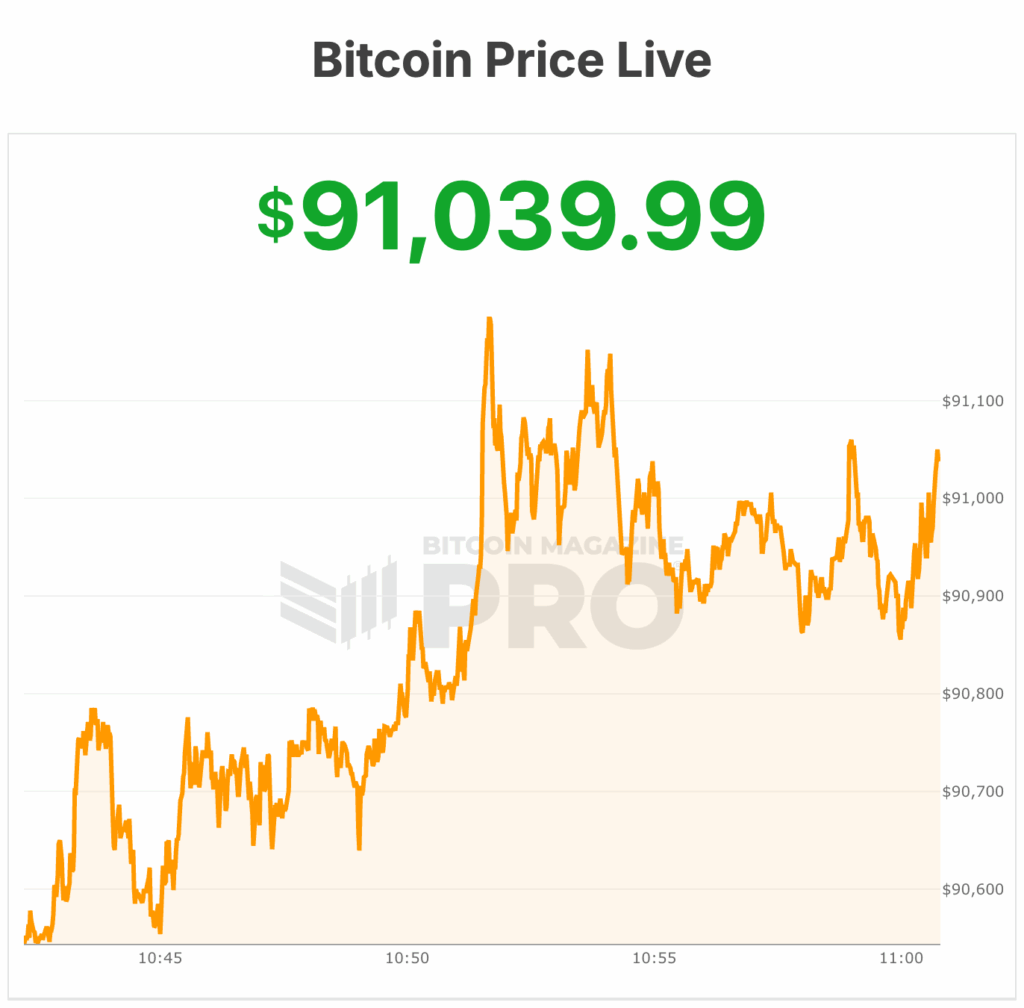
At the time of writing, the bitcoin price trades at $91,039.

bitcoin price

This post Bitcoin Price Roars Above $91,000 as Wall Street Ramps Up Its Bitcoin Buying Plans first appeared on Bitcoin Magazine and is written by Micah Zimmerman.

Bank of America Backs 4% Crypto Allocation for Wealth Clients as Wall Street Embraces Bitcoin

Bitcoin Magazine

Bank of America Backs 4% Crypto Allocation for Wealth Clients as Wall Street Embraces Bitcoin

Bank of America is urging its wealth management clients to consider placing a small but deliberate slice of their portfolios into digital assets.

The bank now recommends a 1% to 4% crypto allocation, marking a significant shift in how one of the country’s largest financial institutions approaches Bitcoin exposure.

The guidance applies across Merrill, Bank of America Private Bank, and Merrill Edge, according to a Yahoo Finance report

It also unlocks crypto recommendations for more than 15,000 advisers who were previously restricted from initiating conversations about digital assets unless a client asked for it directly.

The change takes effect Jan. 5, when the bank’s chief investment office begins formal research coverage of four bitcoin ETFs. Those funds include Bitwise’s BITB, Fidelity’s FBTC, Grayscale’s Bitcoin Mini Trust, and BlackRock’s IBIT.

Chris Hyzy, chief investment officer for Bank of America Private Bank, said the bank is taking a measured approach. A small allocation may suit investors seeking exposure to thematic innovation, he said, but only through regulated products. He also emphasized the need for clear expectations about volatility.

JUST IN: Bank of America says its wealth management clients should start getting some crypto exposure in their portfolios.

Bullish 🚀 pic.twitter.com/fuSYgcs0Xu

— Bitcoin Magazine (@BitcoinMagazine) December 2, 2025

The bank said the lower end of the 1% to 4% range may better fit conservative clients, while the higher end may appeal to those with stronger risk tolerance.

Bitcoin is getting more and more appealing to wealthy investors

The policy change reflects rising interest in Bitcoin from wealthy clients. Nancy Fahmy, head of the bank’s investment solutions group, said demand has grown noticeably over the past year. Many clients previously turned to platforms outside the bank to gain exposure to Bitcoin ETFs.

The shift puts Bank of America in line with peers that have already integrated Bitcoin exposure into their wealth strategies. Morgan Stanley recommended a 2% to 4% allocation for suitable clients in October, describing Bitcoin as “digital gold” and crypto as a speculative but maturing asset class. 

The firm also encouraged ETF-based exposure with disciplined rebalancing.

BlackRock, the world’s largest asset manager, has argued that a 1% to 2% allocation can improve long-term portfolio efficiency. Fidelity has long maintained a broader 2% to 5% range, with higher suggested allocations for younger investors.

Meanwhile, distribution channels continue to open. Bloomberg reported Monday that Vanguard — long resistant to offering any Bitcoin-linked products — will allow select crypto ETFs and mutual funds on its platform starting today. That move follows earlier approvals from Morgan Stanley, Charles Schwab, Fidelity, and JPMorgan Chase.

The institutional shift comes during a volatile period for Bitcoin. The asset has fallen roughly 10% over the past year after retracing from record highs above $126,000 reached in October. Still, major banks maintain bullish long-term views. 

JPMorgan recently set a $170,000 price target, while Standard Chartered reiterated its call for Bitcoin to approach $200,000.

At the time of writing, bitcoin is trading at $89,046. 

This post Bank of America Backs 4% Crypto Allocation for Wealth Clients as Wall Street Embraces Bitcoin first appeared on Bitcoin Magazine and is written by Micah Zimmerman.

World’s Second Largest Asset Manager Vanguard Opens Its Platform to Bitcoin and Crypto ETFs: Bloomberg

Bitcoin Magazine

World’s Second Largest Asset Manager Vanguard Opens Its Platform to Bitcoin and Crypto ETFs: Bloomberg

Vanguard Group will allow bitcoin and crypto-linked exchange-traded funds and mutual funds to trade on its platform, reversing a policy that for years barred retail clients from accessing digital-asset products through the firm.

Starting Tuesday, Vanguard brokerage customers will be able to trade ETFs and mutual funds that primarily hold select cryptocurrencies, including Bitcoin and other crypto, according to Bloomberg reporting

The move marks a shift for the world’s second-largest asset manager, which has long argued that digital assets were too volatile and speculative for long-term portfolios.

The decision follows growing demand from both retail and institutional investors and comes after the approval of spot Bitcoin ETFs in January 2024 ushered billions of dollars into regulated crypto products. 

BlackRock’s iShares Bitcoin Trust, the largest of those funds, peaked near $100 billion in assets earlier this fall and still manages about $70 billion despite recent price declines. 

A Bitcoin ETF lets investors gain exposure to Bitcoin without actually buying or storing the cryptocurrency themselves. 

Instead, the fund holds Bitcoin (or Bitcoin-related contracts) while investors simply buy shares on a stock exchange, with the share price moving alongside Bitcoin’s market value. It’s a convenient and easy way to get invested in Bitcoin. 

JUST IN: $11 trillion Vanguard to finally allow clients access to #Bitcoin ETFs starting tomorrow — Bloomberg pic.twitter.com/Zwh9N7EbzH

— Bitcoin Magazine (@BitcoinMagazine) December 1, 2025

More institutional money coming into bitcoin

Vanguard’s change opens access to crypto funds for more than 50 million brokerage customers who collectively oversee more than $11 trillion in assets, as of September 1, 2025.

“Cryptocurrency ETFs and mutual funds have been tested through periods of market volatility, performing as designed while maintaining liquidity,” Andrew Kadjeski, Vanguard’s head of brokerage and investments, told Bloomberg. 

He added that back-office processes for servicing crypto funds have matured as investor preferences evolve.

The policy shift comes more than a year after Salim Ramji, formerly a top executive at BlackRock and a longtime blockchain advocate, took over as Vanguard chief executive.

While Vanguard will support most crypto funds that meet regulatory requirements, the firm said it will not launch its own crypto products and will continue to exclude funds linked to meme coins.

“While Vanguard has no plans to launch its own crypto products, we serve millions of investors with diverse needs,” Kadjeski said.

Crypto-linked ETFs remain among the fastest-growing segments in U.S. fund industry history, even after a sharp market pullback, underscoring rising investor appetite for regulated exposure to digital assets.

BlackRock recently increased internal exposure to its IBIT spot Bitcoin ETF, with its Strategic Income Opportunities Portfolio now holding 2.39 million shares worth $155.8 million — up 14% since June. 

Bitcoin jumped on the news, trading above $86,500 at the time of writing. 

This post World’s Second Largest Asset Manager Vanguard Opens Its Platform to Bitcoin and Crypto ETFs: Bloomberg first appeared on Bitcoin Magazine and is written by Micah Zimmerman.

Bitcoin Price Teeters at $85,000 as Analysts Eye a Crash to $75,000

Bitcoin Magazine

Bitcoin Price Teeters at $85,000 as Analysts Eye a Crash to $75,000

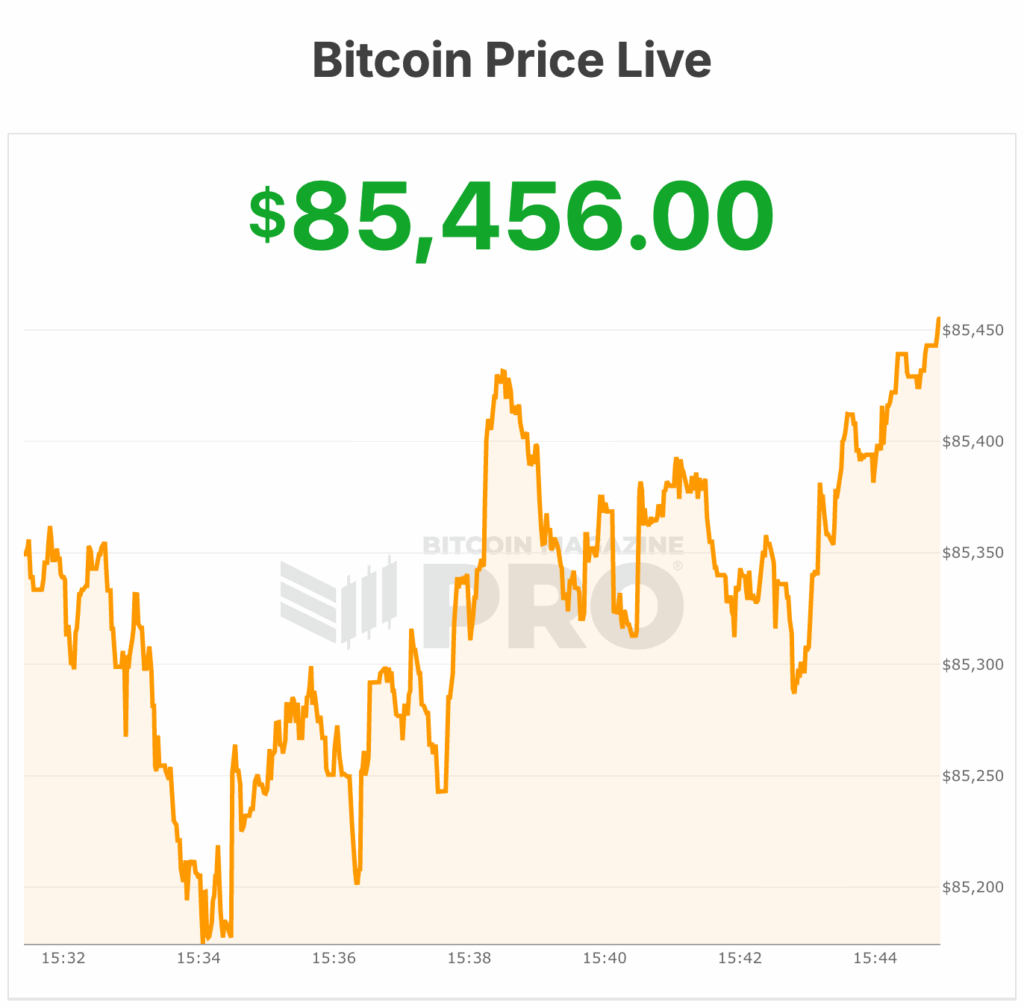
The bitcoin price stumbled into December with fresh volatility, plunging 8% early Monday to the mid-$84,000s before clawing back toward $85,456 at the time of writing.

The world’s largest digital asset is now teetering at a key $85,000 level — a price band analysts say could determine whether the bitcoin price stabilizes or slides toward a deeper test of $75,000 in the weeks ahead.

The pullback extends a two-month downtrend that has erased more than 30% from Bitcoin’s October record highs. Over the past 24 hours, BTC traded between $91,866 and $83,800, with thin liquidity and a surge in forced liquidations accelerating the move.

Bitcoin price key levels: $85,000, $84,000 — then $75,000?

Bitcoin price closed the week and month at $90,385, showing a brief green weekly candle, but bears quickly regained control, pushing the price down toward $87,000. 

The close remains below key resistance at $91,400, leaving bulls with an uphill battle. Initial resistance tests at $91,400 and $93,000 failed, with stronger resistance expected between $98,000 and $103,000 if bulls regain momentum, according to Bitcoin Magazine analysts

On the support side, $84,000 held this past week, though the bounce was weak. Bulls aim to defend the 0.146 Fibonacci level at $87,000, while failure to hold $84,000 could open a path down to $75,000. Further support lies between $72,000 and $69,000, with a deeper test of $57,700 if selling pressure intensifies.

November’s monthly candle closed strongly bearish, taking out prior green closes from April through June.

Although the bitcoin price remains above the 21-month EMA, the close confirmed a bearish MACD cross, signaling sustained subdued momentum over the next two to three months. This aligns with expectations of a potential top in the four-year cycle.

In the short term, the bitcoin price may trade in a range as bears consolidate, while bulls attempt to reclaim $91,400 and $94,000. Overall, the market faces downward pressure, and caution is warranted for bulls seeking a reversal.

Bitcoin’s November candle erased three months of prior gains and cemented a bearish monthly momentum shift. Analysts tracking the four-year cycle say the latest data adds weight to the argument that October likely marked the cycle top.

Federal Reserve, Bitcoin price and corporate bitcoin moves

The Federal Reserve’s upcoming December 9–10 meeting looms large. Markets currently assign an 80%–87% probability of a 25-basis-point rate cut — a move that typically supports risk assets and could potentially lift the bitcoin price.

But if the Fed stands pat, analysts warn the crypto market could see another wave of selling, especially with Bitcoin’s November close confirming a bearish MACD cross on the monthly chart — a historically powerful signal that often precedes multi-month side-ways trading and consolidation or decline.

Bitcoin-linked equities were also rattled Monday. Strategy Inc. (formerly MicroStrategy) announced it created a $1.4 billion reserve to cover at least 21 months of dividend and interest payments, aiming to quash investor fears it might be forced to sell part of its 650,000 BTC stash. 

The company also disclosed a new purchase of 130 BTC for $11.7 million. The move stabilized the stock after an early market sell-off of over 12% at times. Currently, $MSTR’s stock is down 4% on the day.

BlackRock, meanwhile, recently increased internal exposure to its IBIT spot Bitcoin ETF, with its Strategic Income Opportunities Portfolio now holding 2.39 million shares worth $155.8 million — up 14% since June. 

JPMorgan rolled out a structured note tied to IBIT, offering up to 1.5x upside by 2028.

Earlier this week, the price of gold nearly passed $2,300 an ounce.

At the time of writing, the bitcoin price is $85,456. On October 6, the bitcoin price hit all-time highs above $126,000.

bitcoin price

This post Bitcoin Price Teeters at $85,000 as Analysts Eye a Crash to $75,000 first appeared on Bitcoin Magazine and is written by Micah Zimmerman.

Europol, Swiss Police Dismantle ‘Cryptomixer’ in Major Bitcoin Laundering Crackdown

Bitcoin Magazine

Europol, Swiss Police Dismantle ‘Cryptomixer’ in Major Bitcoin Laundering Crackdown

Law enforcement agencies in Switzerland and Germany have shut down Cryptomixer.io, one of Europe’s largest illicit Bitcoin-mixing operations. 

The takedown unfolded between Nov. 24 and 28 in Zurich, with Europol coordinating cross-border support.

Authorities seized three servers, the cryptomixer.io domain, more than EUR 25 million in bitcoin and over 12 terabytes of data. A seizure banner (see below) now replaces the site. Investigators say the disruption will fuel new leads tied to ransomware groups, dark-web marketplaces and cross-border money-laundering schemes.

Cryptomixer launched in 2016. It quickly became a go-to service for cybercriminals who needed to hide their tracks, Europol said. The platform operated on both the clear web and dark web. Its hybrid design attracted users from ransomware crews, underground forums and online drug markets.

Cryptomixer

Mixers work by pooling user deposits, shuffling them for long, randomised intervals and redistributing them to new addresses. The process breaks the on-chain trail, making it difficult for analysts to trace specific coins. 

Authorities say Cryptomixer moved more than EUR 1.3 billion worth of bitcoin for clients seeking to wash criminal proceeds. The service was frequently used before funds were pushed to exchanges, ATMs or bank accounts.

German federal investigators said the operation generated “billions of euros in revenues,” much of it tied to illegal activity. The Frankfurt Prosecutor General’s Office and the German Federal Criminal Police Office (BKA) worked alongside Zurich city and cantonal police to lead the on-site action. 

Europol and Eurojust had support from The Hague.

Details of the cryptomixer shutdown

On the action day, Europol deployed cybercrime specialists to Zurich for forensic assistance and real-time coordination. The agency said its Joint Cybercrime Action Taskforce played a central role in connecting investigators across borders. 

Europol also noted similarities to its 2023 takedown of ChipMixer, at the time the largest mixer ever dismantled.

Swiss authorities said the volume of data seized—over 12 terabytes—will be crucial for mapping wider criminal networks. Investigators believe it contains transaction logs, operational documentation and communication records that may link multiple cybercrime groups.

Cryptomixing services have long drawn scrutiny for enabling ransomware payouts, drug sales, weapons trafficking and payment-card fraud.

Regulators and agencies across the EU and U.S. have increasingly targeted mixers that advertise anonymity. High-profile precedents include sanctions and criminal charges against Tornado Cash founders in the U.S. and Netherlands.

Germany’s BKA said the findings from Cryptomixer “will contribute to the investigation of further cybercrimes.” Both countries signaled that more actions against crypto-laundering infrastructure may follow as forensic teams dig through the seized servers and blockchain data.

This post Europol, Swiss Police Dismantle ‘Cryptomixer’ in Major Bitcoin Laundering Crackdown first appeared on Bitcoin Magazine and is written by Micah Zimmerman.

Elon Musk Calls Bitcoin a ‘Fundamental’ And ‘Physics-Based Currency’

Bitcoin Magazine

Elon Musk Calls Bitcoin a ‘Fundamental’ And ‘Physics-Based Currency’

Tesla and SpaceX CEO Elon Musk has reignited some discussion around Bitcoin, describing it as a “fundamental physics-based currency” grounded in energy. 

Speaking on a recent podcast with Nikhil Kamath, Musk emphasized that Bitcoin’s value is tied to real-world energy expenditure, highlighting a distinction between digital assets and traditional fiat currencies.

“Energy is the true currency,” Musk said. “This is why I said Bitcoin is based on energy. You can’t legislate energy. You can’t just, you know… pass a law and suddenly have a lot of energy.” 

The Tesla founder drew attention to the difficulty of producing and harnessing energy, linking it to Bitcoin’s proof-of-work system, which requires substantial computational power and electricity to secure the network.

He also referenced the Kardashev scale — a method for measuring a civilization’s energy consumption — as a lens for understanding societal progress. He suggested that evaluating a civilization by its capacity to generate and manage energy mirrors Bitcoin’s design principles, where scarcity and computational effort underpin value.

Looking further ahead, Musk proposed that advancements in artificial intelligence and robotics could render money obsolete.

“In a future where anyone can have anything, I think that you no longer need money as a database for labor allocation,” he said, citing Iain M. Banks’ post-scarcity Culture series as a blueprint for societies where super-intelligent machines manage resources without monetary systems.

JUST IN: Elon Musk says #Bitcoin is a fundamental currency based on energy 👀

“Energy is the true currency” pic.twitter.com/sTWKLKV0Fd

— Bitcoin Magazine (@BitcoinMagazine) November 30, 2025

Musk: You can’t print energy

Musk also underscored the unique qualities of Bitcoin. Unlike fiat money, which governments can print at will, Bitcoin’s proof-of-work system ties its creation to energy and computing power, giving it a built-in scarcity and relative independence from political influence. 

“Governments can print money, but they cannot print energy,” Musk said.

While Musk envisions a future where energy might serve as a more fundamental measure of value, he acknowledged that traditional money remains dominant today. 

National currencies continue to govern commerce, wages, and savings, while cryptocurrencies like Bitcoin exist as alternative assets rather than replacements for everyday transactions.

Musk’s remarks provide a reminder of the philosophical underpinnings of Bitcoin, linking it to physics and energy rather than policy and government control. 

Earlier today, the Bitcoin price plunged 8% to the mid-$84,000s early Monday, extending a two-month drawdown that has erased over 30% since October’s record highs. 

The drop followed last week’s brief recovery above $92,500 after November lows near $81,000. 

This post Elon Musk Calls Bitcoin a ‘Fundamental’ And ‘Physics-Based Currency’ first appeared on Bitcoin Magazine and is written by Micah Zimmerman.

❌