❌

Reading view

There are new articles available, click to refresh the page.

SWIFT Security Controls:Best Practices for Financial Institutions

4.5/5 - (2 votes)

Last Updated on September 2, 2025 by Narendra Sahoo

SWIFT, the global backbone for secure financial messaging, plays a critical role in enabling fast and reliable cross-border transactions. But as cyber threats grow more advanced, financial institutions must implement robust SWIFT security controls to safeguard their systems and prevent fraud.

The SWIFT Customer Security Programme (CSP) was established to enhance cybersecurity hygiene across its network, helping institutions protect against fraud and cyberattacks. This article explores key security controls within the SWIFT CSP compliance framework and outlines best practices for financial institutions to strengthen their SWIFT security posture.

What is SWIFT CSP?

The SWIFT CSP, launched in 2016, is designed to mitigate cybersecurity risks and enhance the overall security of financial institutions. The program includes the Customer Security Controls Framework (CSCF), which defines both mandatory and advisory security controls based on industry standards such as NIST, ISO 27001/2, and PCI DSS 4.0. These controls aim to secure financial institutions’ environments, restrict unauthorized access, and ensure timely detection and response to potential threats.

To learn more about SWIFT CSP, you may also check out our informative video on – What is the SWIFT Customer Security Programme (CSP)?

Key Security Controls in the SWIFT Framework

SWIFT CSCF has 32 security controls, in which 25 are mandatory and 7 are advisory controls. The difference between the mandatory controls and advisory controls is that the mandatory controls are considered extremely important, considering they set the baseline security that all users must adhere to, while advisory controls are recommended by SWIFT as best practices but are not strictly enforced.

Here are the three core objectives of SWIFT CSCF:

Secure Your Environment – Implementing controls to protect SWIFT-related systems from external and internal threats.

Know and Limit Access – Ensuring that only authorized personnel have access to critical systems.

Detect and Respond – Monitoring and responding to security incidents in a timely manner.

Below is the list of the 32 security controls with their principles.

1. Restrict Internet Access and Protect Critical Systems from General IT Environment

1.1 SWIFT Environment Protection

1.2 Operating System Privileged Account Control

1.3 Virtualisation or Cloud Platform Protection

1.4 Restriction of Internet Access

1.5 Customer Environment Protection

2. Reduce Attack Surface and Vulnerabilities

2.1 Internal Data Flow Security

2.2 Security Updates

2.3 System Hardening

2.4A Back Office Data Flow Security

2.5A External Transmission Data Protection

2.6 Operator Session Confidentiality and Integrity

2.7 Vulnerability Scanning

2.8 Outsourced Critical Activity Protection

2.9 Transaction Business Controls

2.10 Application Hardening

2.11A RMA Business Controls

3. Physically Secure the Environment

3.1 Physical Security

4. Prevent Compromise of Credentials

4.1 Password Policy

4.2 Multi-Factor Authentication

5. Manage Identities and Separate Privileges

5.1 Logical Access Control

5.2 Token Management

5.3A Staff Screening Process

5.4 Password Repository Protection

6. Detect Anomalous Activity to Systems or Transaction Records

6.1 Malware Protection

6.2 Software Integrity

6.3 Database Integrity

6.4 Logging and Monitoring

6.5A Intrusion Detection

7. Plan for Incident Response and Information Sharing

7.1 Cyber Incident Response Planning

7.2 Security Training and Awareness

7.3A Penetration Testing

7.4A Scenario-based Risk Assessment

Best Practices for Financial Institutions to Enhance SWIFT Security

Being SWIFT CSP compliant can bring many advantages to your organization along with enhanced security controls. To align with SWIFT CSP requirements, you should consider the following best practices:

1.Β Β Β Β  Adopt a Risk-Based Approach

  • Conduct regular risk assessments to identify vulnerabilities and address them proactively.
  • Prioritize security measures based on potential impact and threat landscape.

2.Β Β  Strengthen Access Controls

  • Enforce the principle of least privilege by restricting access based on roles and responsibilities.
  • Implement robust authentication mechanisms such as MFA.
  • Regularly review and update access permissions.

3.Β  Enhance Network Segmentation

  • Isolate SWIFT-related infrastructure from general IT environments.
  • Use firewalls and secure VPNs to control and monitor network traffic.

4.Β  Implement Continuous Monitoring and Threat Detection

  • Deploy Security Information and Event Management (SIEM) solutions for real-time monitoring.
  • Regularly analyze logs to detect and respond to suspicious activities.

5. Regularly Update and Patch Systems

  • Apply security updates to all SWIFT-related components to mitigate known vulnerabilities.
  • Conduct periodic penetration testing to identify and remediate security gaps.

6. Enhance Security Awareness and Training

  • Train employees on phishing, social engineering, and cybersecurity best practices.
  • Conduct regular security drills to test incident response readiness.

Importance of Engaging Independent Assessors

To ensure compliance with SWIFT CSP requirements and improve security maturity, financial institutions should engage independent assessors. These experts:

  • Provide an unbiased evaluation of SWIFT security implementation.
  • Identify gaps in security controls and recommend improvements.
  • Assist in compliance reporting and attestation processes.

By working with independent assessors, financial institutions can enhance their security resilience, meet regulatory expectations, and mitigate risks effectively.

Conclusion

SWIFT security is a critical component of financial institutions’ cybersecurity strategy. By implementing the best practices outlined in this article and adhering to SWIFT CSP security controls, you can protect your organization’s infrastructure, prevent fraudulent activities, and build a secure financial ecosystem.

Want to assess your SWIFT compliance or need expert guidance on securing your infrastructure? Fill out our inquiry form today and let our experts assist you in achieving a strong and compliant SWIFT security framework.

The post SWIFT Security Controls:Best Practices for Financial Institutions appeared first on Information Security Consulting Company - VISTA InfoSec.

Synack Triaging Prioritizes the Vulnerabilities that Matter

By: Synack

Putting the Most Critical Vulnerabilities First

Vulnerability testing, whether via an automatic scanning program or human-based penetration testing, can find an overwhelming number of vulnerabilities in your system as recent trends would suggest. Since 2017, record numbers of Common Vulnerabilities and Exposures (CVEs) have been reported, with 2022 on track to set a new high.Β 

Sorting through a record number of vulnerabilities to keep your organization secure is a daunting task without additional support and distillation.

The good news is that of all the vulnerabilities that might show up on a traditional vulnerability report, only around 5% of vulnerabilities discovered are ever exploited in the wild. And most of the exploited vulnerabilities are those with the highest CVSS (Common Vulnerability Scoring System) severity score of 9 or 10.Β 

So how do you know which vulnerabilities in your system need to be addressed right now, and which can be put on the back burner? Some vulnerabilities are an immediate risk to the business, while others are highly unlikely to be exploited. Prioritizing critical vulnerabilities can mean the difference between preventing an attack and responding to one.

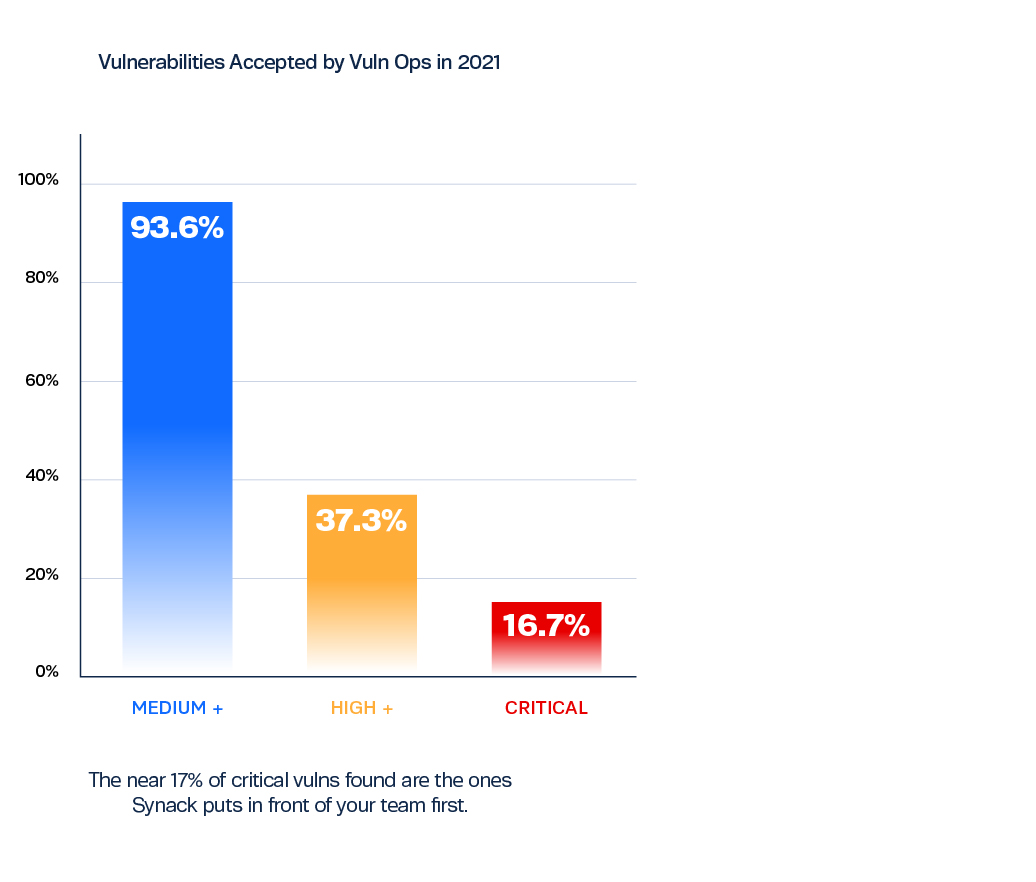
Finding and triaging critical vulnerabilities is where Synack’s pentesting outperforms traditional models. We continuously prioritize impactful vulns for your organization, surfacing only vulnerabilities that are reproducible and show exploitability.Β Β 

The Synack Differenceβ€”The Vulnerability Operations Team

The Synack Platform is the only solution to harness the best in augmented intelligence for more effective, continuous pentesting. First, the Synack Red Team (SRT), a group of vetted researchers, conducts open vulnerability discovery, while our automated SmartScan provides broad attack surface coverage. Together, they find vulnerabilities across your attack surface.

Next, the Synack Vulnerability Operations team assesses vulnerabilities found by the SRT and SmartScan by using a rigorous vetting process. Noise, such as duplicate submissions by SRT or non-replicable exploits, low-impact vulns, is kept to a minimum during penetration testing and you’re ultimately served vulnerabilities that present a clear risk.

This additional step to triaging is key to faster remediation and minimizing business risk.Β 

The Vulnerability Operations team is a group of seasoned security professionals with hacking expertise. They are full-time Synack employees with extensive vulnerability knowledge–they’ve seen tens of thousands of them. For the most accurate triaging, high impact vulnerabilities are often reviewed by multiple team members. So, when you get a vulnerability report from Synack, you know that it matters.

Remediating Exploitable Vulnerabilities with True Business Impact

The Vulnerability Ops team works alongside the SRT 365 days a year to bring order to the thousands of CVEs. When the team receives an initial vulnerability report, they will first validate the vulnerability by replicating it based on details provided in the report. When the vulnerability is confirmed, the Ops team proofreads and formats the report for utility and readability by a development team. Everything needed to reproduce the vulnerability is provided in each report.

After vulnerabilities are deemed exploitable and impactful, and the report has been detailed with steps to reproduce and suggestions on remediation, it will be published to the Synack Platform.

From there, the Synack Platform provides real-time findings on vulnerabilities found–their CVSS score, steps to remediate and evidence of the researcher’s finding. With this information you can address the vulnerabilities that are most important to your organization in a systematic and thorough manner.

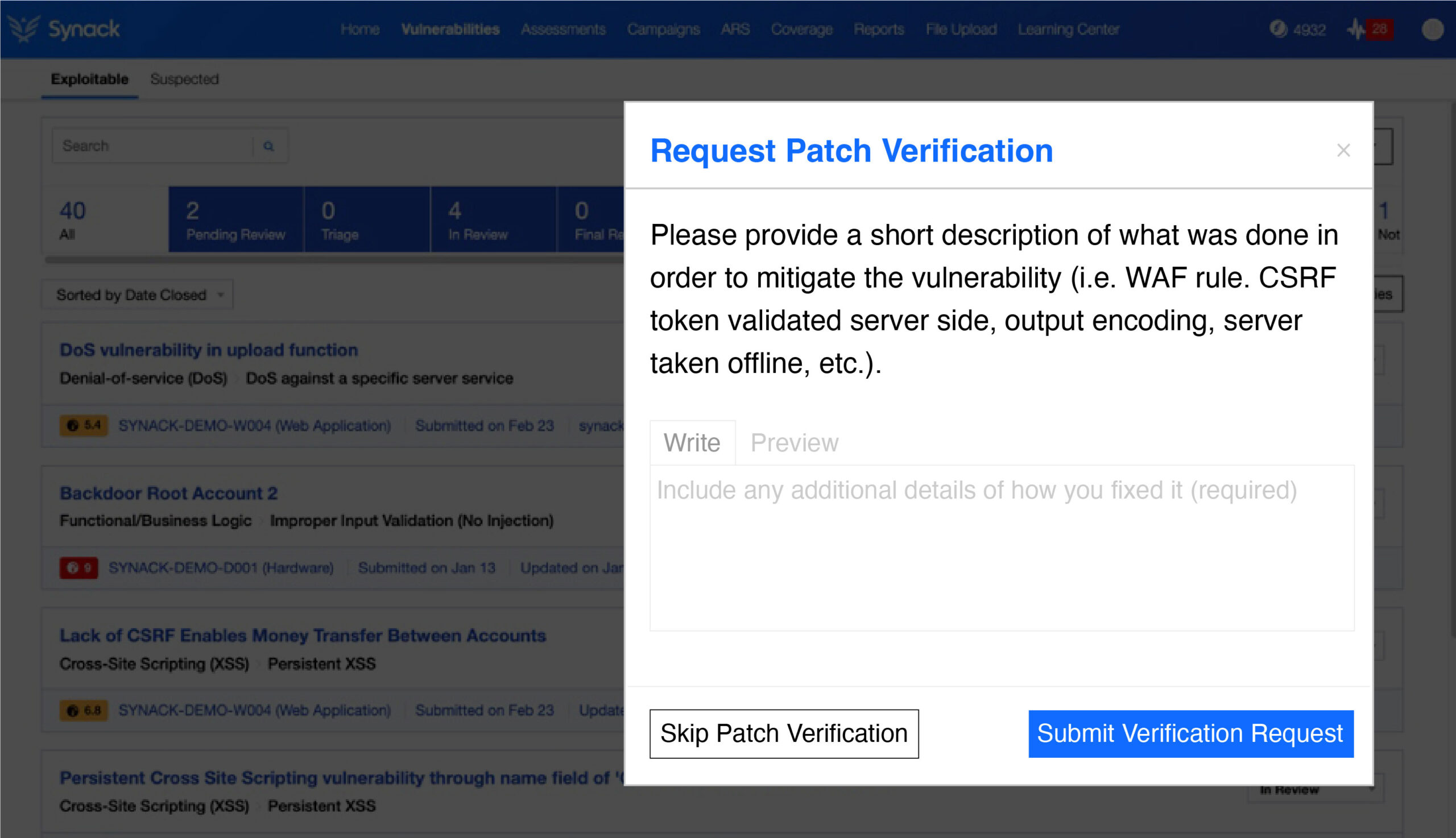
Through the Synack Platform, teams are also able to check if their remediation efforts were successful with Patch Verification. Patch Verification can be requested on-demand, and the researcher will provide further communications on the patch efficacy.

The Synack Platform facilitates delivery of vulnerabilities and
actions like submitting patch verification requests.

Β 

2021 Vulnerability Highlights

The six most popular types of vulnerabilities delivered to organizations were:

  • Cross-site Request Forgery (XSRF)
  • Authentication Permission
  • Information Disclosure
  • SQL Injection (SQLi)
  • Functional Business Logic
  • Authentication Session

Making the Most of Vulnerability Testing

Most organizations don’t have the resources to go chasing every vulnerability reported from initial testing. To further safeguard your organization, someone needs to determine which are true vulnerabilities and which of those are exploitable and at what level of criticality. That process is noise reduction, and it is essential for any cybersecurity operation to shoot for the highest level of noise reduction before proceeding to remediation. Synack, through the Vulnerability Operations, team can take on this task for you.Β 

Using Synack’s unique approach to continuous pentesting, your team will be able to proceed with confidence that their remediation efforts are critical to keeping the organization secure. Get started with Synack penetration testing today.

The post Synack Triaging Prioritizes the Vulnerabilities that Matter appeared first on Synack.

Get Ahead of Vulnerabilities With Proactive ASVS Benchmark Pentesting

By: Synack

Start With Pentesting to Harden Your Site Against Cyberattacks

Cybersecurity for web apps has never been more important than it is today. Websites and online applications are under constant attack by people and groups looking to penetrate systems to cause damage or steal vital information. And it’s not just criminals and mischief-makers; government-sponsored attackers are at work as well. Consider these cybersecurity statistics compiled by Patchstack:

  • A 2019 report found that security breaches had increased by 67% over the last five years.
  • 73% of black hat hackers said traditional firewall and antivirus security is irrelevant or obsolete.
  • A 2019 study found that hackers could attack users in 9 out of 10 web applications they analyzed.
  • Another 2019 study found that 46% of web applications have critical vulnerabilities, and a whopping 87% had β€œmedium” security vulnerabilities.

Β Even more, telling is a 2019 report that found that 47% of all hacked websites contained at least one backdoor, allowing hackers access to the website.Β  And the costs associated with data breaches continue to climb. The average cost of a data breach among companies surveyed in a 2021 IBM report reached $4.24 million per incident, the highest in 17 years.

Β Security personnel has a number of tools at their disposal to thwart cyberattacks. One of the most valuable is pentesting β€” checking for vulnerabilities that could give a hacker access to the system. But although not as reactive as remediating a breach that has already occurred, traditional pentesting is still somewhat reactive in nature. You’re being proactive in checking for vulnerabilities that could potentially be used by an attacker, but the vulnerabilities already exist. It’s like calling in a plumber to check for leaks in your pipes that could potentially cause water damage. The leaks are expected to already be there and be found, just as the vulnerabilities are in a pentest. So, although a valuable tool, pentesting only takes you part of the way to a truly security-hardened organization.Β 

How ASVS Benchmarks Go Beyond Pentesting

What you need is a way to check your security posture for conditions that might lead to a future vulnerability and remediate those issues as well. Only then can you consider your site truly security-hardened. It’s like that plumber fixing all the leaks in your pipes, then going back and making a systematic check of your pipes for conditions that could lead to a leak, such as rusting, pipes located in places where they are likely to freeze or improperly connected pipes.Β 

ASVS provides for this by listing security conditions analogous to those that might lead to leaky pipes. This is how ASVS benchmarks enable proactive security.

Enhance Your Security Posture Further With ASVS Benchmark Tests

The Application Security Verification Standard (ASVS) was developed by the Open Web Application Security Project (OWASP) to help organizations examine the state of their cybersecurity. The primary aim of the ASVS Project was to normalize the range in the coverage and level of rigor available in the market when it comes to performing Web application security verification using a commercially-workable open standard. The standard provides a basis for testing application technical security controls and technical security controls in the environment that protect against vulnerabilities such as Cross-Site Scripting (XSS) and SQL injection.

The ASVS benchmark provides a compilation of security controls that are expected to be in place in a well-secured application. It also provides developers with a list of requirements for secure development. The ASVS does not provide a framework to check for vulnerabilities. Rather, it provides a framework to check for controls that prevent, and conditions that could lead to, exploitable vulnerabilities. Synack recommends performing ASVS benchmark testing as part of an ongoing security process for maximum cybersecurity.

OWASP lists the following as objectives achieved by ASVS:

  • Use as a metric β€” Provide application developers and application owners with a yardstick with which to assess the degree of trust that can be placed in their Web applications
  • Use as guidance β€” Provide guidance to security control developers as to what to build into security controls in order to satisfy application security requirements
  • Use during procurement β€” Provide a basis for specifying application security verification requirements in contracts.

When to Run ASVS Benchmark Tests

The ASVS framework is best suited for organizations that are relatively mature in their security posture. Since the tests don’t actually check for vulnerabilities, it is most appropriate to run ASVS tests after you have examined your system for existing vulnerabilities and remediated them through continuous and effective penetration testing. Once existing vulnerabilities have been discovered and remediated or resolved, then it is time to check your security controls for best practice implementations. Running the ASVS benchmark can then help the organization create a better defense in depth posture.Β 

Proactive Vulnerability Testing With Synack’s ASVS Benchmark Product

There are three levels of ASVS benchmarks available in the Synack Catalog – Basic, Standard, and Advanced.Β  You choose the Synack ASVS Campaign to run based on the level that is appropriate for the organization. Across levels, an ASVS Campaign can ensure that an application follows best practices to protect user data and prevent exploitation by adversaries. An ASVS Campaign does this while respecting the appropriate level of security for an application, one that thoroughly protects the application, while not hampering user experience or business needs.

This process to engage Synack to prevent vulnerabilities before they occur is unique. Testing the ASVS framework lets us look for and proactively address the systemic issues that let the vulnerabilities come to an exploitable state and unlock the door for an attacker.Β 

With an ASVS benchmark test, you will receive a detailed report from a researcher on the Synack Red Team, our community of global ethical hackers, regarding their findings on the security posture of your assets. Their mission is to evaluate your assets relative to the ASVS framework. The goal of this assessment is to determine if your security controls are adequate for the application use case your organization has.

This report can offer guidance on where efforts would be best applied to further harden and future-proof assets. It can also be used to show a year-over-year improvement in the asset hardness, and can help quantify the effectiveness with both the ASVS metrics and a reduction in vulnerability findings. Long-term, the ASVS campaign can help support a multi-year effort to reduce the attack surface and improve the controls in assets against flaws.

Complete an ASVS Assessment With Synack ASVS Campaigns for Maximum Security Posture

Completing an ASVS assessment for your organization is easy with Synack Campaigns.Β  The ASVS campaigns are listed in the Security Benchmark section of the Catalog. Once credits are purchased, you can activate your campaign on-demand any time in the Synack Platform.Β Β 

Synack researchers complete the missions specified by the ASVS benchmark tests. After completing them, your team can leverage Synack’s Custom Report feature for audit-ready reports that will provide you with a view of security issues discovered by our testing.

When you are comfortable that pentesting and resulting remediation has moved your site to a sufficiently secure security posture, evidenced by pentesting not finding a significant number of new vulnerabilities, then you can move on to running the Synack ASVS Campaign. After completing the ASVS Campaign and remediating any discovered issues, it’s time to set up a plan for periodic testing going forward. Then you can be assured that you have applied the most comprehensive security testing to protect your assets.

Learn What Synack ASVS Benchmarks Can do for You

To learn more about Synack ASVS Campaigns and how it can expose conditions that could lead to exploitable vulnerabilities, contact Synack at sales@synack.com.

The post Get Ahead of Vulnerabilities With Proactive ASVS Benchmark Pentesting appeared first on Synack.

❌