NASA has selected Plug Power, Inc., of Slingerlands, New York, and Air Products and Chemicals, Inc., of Allentown, Pennsylvania, to supply up to approximately 36,952,000 pounds of liquid hydrogen for use at facilities across the agency.
The NASA Agency-wide Supply of Liquid Hydrogen awards are firm-fixed-price requirements contracts that include multiple firm-fixed-price delivery orders critical for the agency’s centers as they use liquid hydrogen, combined with liquid oxygen, as fuel in cryogenic rocket engines, and the commodity’s unique properties support the development of aeronautics. The total value for the combined awards is about $147.2 million.
The contracts begin Monday, Dec. 1, and each consists of a two-year base period followed by three one-year option periods that, if exercised, would extend the contracts to Nov. 30, 2030.
Air Products and Chemicals Inc. will supply up to about 36.5 million pounds of liquid hydrogen to NASA’s Kennedy Space Center and Cape Canaveral Space Force Station in Florida; NASA’s Marshall Space Flight Center in Huntsville, Alabama; and NASA’s Stennis Space Center in Bay St. Louis, Mississippi, for a maximum contract value of approximately $144.4 million.
Plug Power, Inc. will deliver up to approximately 480,000 pounds of the commodity to NASA’s Glenn Research Center in Cleveland, Ohio, and at Neil A. Armstrong Test Facility in Sandusky, Ohio, for a maximum contract value of about $2.8 million.
For additional information about NASA and agency programs, visit:
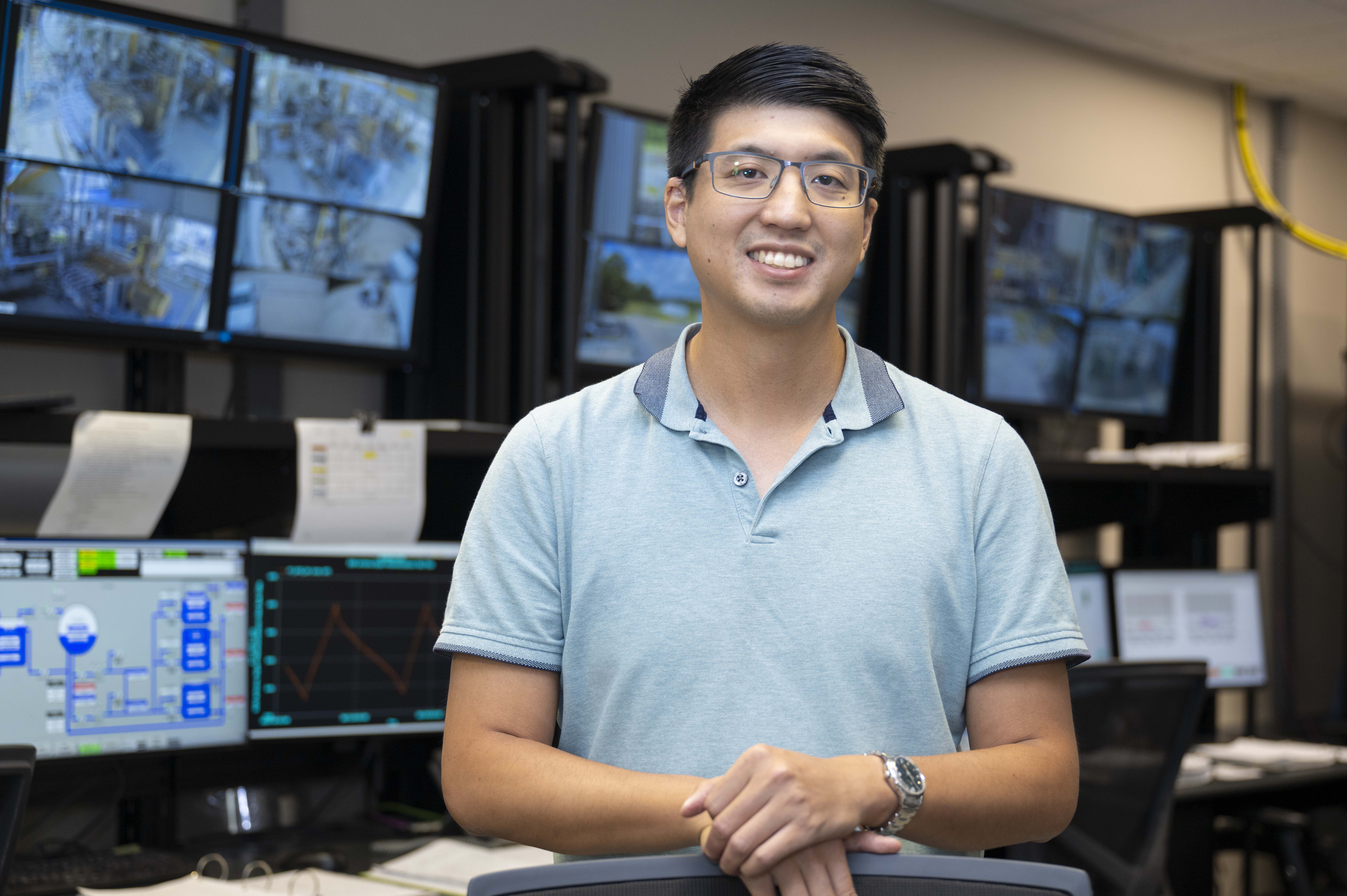
Huy Nguyen is an electrical controls engineer at NASA’s Stennis Space Center, where his work has contributed to NASA’s Artemis program that will send astronauts to the Moon to prepare for future human exploration of Mars.
NASA/Danny Nowlin
Huy Nguyen grew up hearing about rocket engines and space flight around the family table. His parents worked for NASA’s Michoud Assembly Facility in New Orleans, and those early conversations eventually started his path to NASA’s Stennis Space Center near Bay St. Louis, Mississippi.
“They both created a household that allowed me to be curious and to be a problem solver,” Nguyen said.
The dinner conversations have come full circle as the New Orleans native finds himself applying that same curiosity and problem-solving mindset at NASA Stennis.
Nguyen is currently the electrical controls engineer for propulsion testing support areas, which include the NASA Stennis High Pressure Gas Facility and the High Pressure Industrial Water Facility.
“Both areas are considered the heart and powerhouse of testing,” Nguyen said.
His work involves two key challenges: maintaining legacy systems with hard-to-find replacement parts and modernizing them with robust control systems that offer better monitoring and maintenance capabilities. What energizes Nguyen most is bridging old and new technology by creating improved user interfaces and integrating modern controls with existing infrastructure.
“This is what excites me about my work,” he said.
One of the most exciting moments in Nguyen’s NASA career came with the successful Green Run test series at NASA Stennis for NASA’s Artemis campaign to return humans to the Moon.
The test series helped validate the first SLS (Space Launch System) core stage for the Artemis I test flight around the Moon, setting the stage for the Artemis II test flight when four astronauts will fly around the Moon in early 2026.
As the engineer overseeing controls operations for the NASA Stennis High Pressure Gas Facility and High Pressure Industrial Water Facility, Nguyen had a critical responsibility leading to the Green Run test series.
He ensured the complex systems ran flawlessly to supply helium, nitrogen, air, and water for SLS core stage testing.
It turned into a career highlight.
“It was a lot of work to set it up and then run it around the clock for 24 hours,” Nguyen recalled.
For an entire day, multiple systems had to operate in perfect harmony, supplying everything the massive SLS core stage needed for a sitewide stress test.
“Seeing everyone focused on a single goal like that was truly amazing,” he said.
Engineers, technicians, and support staff worked in shifts around the clock. Each person knew their role was essential to the mission’s success. It was the kind of teamwork his NASA parents likely witnessed countless times, and now Nguyen experienced it himself.
The 24-hour exercise helped make way for a historic milestone at NASA Stennis. The Green Run testing series reached its conclusion on March 18, 2021, when the SLS core stage fired its four RS-25 engines for a full mission duration of 8 minutes and 19 seconds. The final Green Run hot fire represented the most powerful propulsion test at the center in more than 40 years.
As NASA prepares for Artemis II, Nguyen’s work upgrading these critical facilities ensures NASA Stennis will remain ready to support humanity’s next giant leaps into deep space.
When Artemis II launches in 2026, Nguyen looks forward to watching the test flight around the Moon with his parents, who inspired him as a young boy, and his young nephews.
“My nephews are currently obsessed with cars and trucks, so I hope Artemis II will expose them to space travel,” Nguyen said.
Through the Artemis campaign, NASA will send astronauts to the Moon to prepare for future human exploration of Mars and inspire the next generation of explorers.

 Login
Login