❌

Reading view

There are new articles available, click to refresh the page.

Education Dept soft-launches employee reassignments to other agencies, in latest step of closure plans

The Education Department, in the latest step of the Trump administration’s plan to dismantle the agency, has begun transferring its employees to other federal agencies.

The department said Tuesday that it signed six new interagency agreements to transfer some of its programs and employees to the departments of Labor, Interior, State and Health and Human Services, in order β€œto break up the federal education bureaucracy.”

Education Secretary Linda McMahon told employees in an all-hands meeting that the department is soft-launching plans to reassign its work to other parts of the federal government, before calling on Congress to permanently shutter the agency.

McMahon, in a transcript obtained by Federal News Network, told employees that Education is currently transferring its employees out to other agencies β€œon a temporary basis.”

That temporary reorganization, she said, will give the Education Department a proof-of-concept to show lawmakers. At that point, the Trump administration will call on Congress to pass legislation that will officially shut down the department and codify the reorganization.

The department, she added, has already transferred 13 employees to the Labor Department, β€œso that we can be more efficient and economical,” and that more interagency agreements will soon be signed to transfer other staff.

McMahon said the Education Department’s budget still covers those 13 detailed employees, and that the Education and Labor Departments are currently β€œco-managing” them.

McMahon told employees that she has spoken to members of Congress about this reorganization plan, and is planning to move programs out of the Education Department β€œon a temporary basis” for now. But in the end, she said the Trump administration’s goal is to find enough votes in Congress β€œto close the Department of Education.”

β€œIf it has worked, and we have proven that this is the best way to do it, then we’ll ask Congress to codify this and make it a permanent move out of the Department of Education into whatever agency that program has gone into,” McMahon told employees.

President Donald Trump signed an executive order in March, calling for the dismantling of the Education Department. McMahon told lawmakers during her confirmation hearing that the Education Department is set up by Congress, and β€œit clearly cannot be shut down without it.”

The department, so far this year, has lost about half of its employees through mass layoffs and voluntary separation incentives.

McMahon didn’t mention immediate layoffs or workforce reductions as part of this phase of the reorganization plans, but acknowledged shutdown-era layoffs could return in early 2026.

McMahon said the Education Department has cancelled reduction-in-force notices it sent to about 20% of its remaining workforce during the 43-day government shutdown.

The continuing resolution passed by Congress and signed by Trump put those RIF notices on hold at least through Jan. 30, 2026.

But beyond that point, McMahon acknowledged that RIFs may return.

β€œMoving forward, that creates unrest. It creates uncertainty for all of you, and I understand that,” she told employees. β€œI know how difficult it is to make decisions that, from my perspective, are going to affect people’s lives and their livelihood and their teams and what they’re working on. And it is not an easy decision.”

McMahon said a majority of the public didn’t support plans to close the Education Department, when the Trump administration first announced its plans. However, she said the majority of the public does support shifting these programs to other agencies to make them more efficient.

β€œWhen the goal will be to have congressional votes to close the Department of Education, we are not closing education. We’re lifting education up, and each of us in this room has a chance to be part of history, and that this is part of our legacy,” she said.

The six interagency agreements will move billions of dollars in grant programs to other agencies. The Labor Department, in particular, will oversee much of the federal funding that will go to K-12 schools, including grants for schools serving low-income communities.

The department says states and schools shouldn’t expect any disruptions to their funding, except that federal funds will now come from the Labor Department.

β€œThe funding will not change. That may flow through a different account or a different building,” McMahon told employees.

The reorganization would move two of the Education Department’s largest programs, the Office of Elementary and Secondary Education and Office of Postsecondary Education, to the Labor Department.

However, the Education Department will still retain student loan oversight and accreditation of colleges to ensure they are eligible to receive students’ federal financial aid.

Critics of the reorganization say that the agencies taking on Education programs and personnel don’t have expertise in these policy areas, and that the transfer could disrupt some of its essential programs.

β€œThat national mission is weakened when its core functions are scattered across other federal or state agencies that are not equipped or positioned to provide the same support and services as ED staff,” AFGE Local 252 President Rachel Gittleman said.

The Associated Press contributed to this story

The post Education Dept soft-launches employee reassignments to other agencies, in latest step of closure plans first appeared on Federal News Network.

Β© AP Photo/Ben Curtis

FILE - Secretary of Education Linda McMahon speaks to reporters at the White House in Washington, Thursday, March 20, 2025. (AP Photo/Ben Curtis, File)

Post-shutdown, here’s how soon federal employees can expect back pay

Following the longest shutdown in U.S. history, the federal workforce is now trying to get back to at least some sense of normalcy.

While federal employees who have been furloughed for the last 43 days return to work Thursday, the Office of Personnel Management is setting expectations for agencies as they begin to update pay, leave and benefits for those impacted by the lapse in appropriations.

In new guidance, OPM said it is β€œis committed to ensuring that retroactive pay is provided as soon as possible.” Compensation will be provided for both furloughed and excepted federal employees, as the spending agreement that was enacted Wednesday eveningΒ reaffirmed. A 2019 law previously called for retroactive compensation for all federal employees impacted by a shutdown.

A senior Trump administration official said the White House β€œhas urged agencies to get employee paychecks out expeditiously and accurately to not leave anyone waiting longer than necessary.”

But the timing of employees receiving their back pay varies, depending on what payroll provider an agency uses, and the different pay schedules across the federal workforce.

Sending out retroactive payments to employees involves working across agency HR offices, federal payroll providers and shared service centers. Agency HR offices, for instance, have to submit timecards for federal employees, which are then processed by the government’s various payroll providers.

According to the senior administration official, employees from the General Services Administration and OPM will be among the first to receive their retroactive paychecks, with an expected deposit date set for Saturday.

Employees at the departments of Veterans Affairs, Energy, and Health and Human Services, as well as civilian employees from the Defense Department, will receive their deposits shortly after that β€” this Sunday.

On Monday, affected employees from the departments of Education, State, Interior and Transportation, as well as the Environmental Protection Agency, National Science Foundation, Nuclear Regulatory Commission, Social Security Administration and NASA, are all expected to receive their back pay.

Then on Wednesday, employees from the departments of Agriculture, Commerce, Treasury, Labor and Justice, along with the Department of Homeland Security, the Department of Housing and Urban Development and the Small Business Administration, are projected to get their paychecks. The timing of the retroactive payments for feds was first reported by Semafor.

The National Finance Center, a payroll provider housed under the Agriculture Department, confirmed that employees at agencies using NFC’s services should expect a payroll deposit by the middle of next week.

β€œIn order to provide backpay for employees as quickly as possible, the National Finance Center will be expediting pay processing for pay period 22 and backpay for pay periods 19 (October 1-4), 20 (October 5-18), and 21 (October 19-November 1),” USDA wrote in an all-staff email Wednesday evening, obtained by Federal News Network.

Federal News Network has reached out to several other federal payroll providers requesting details on the timeline for processing retroactive payments.

The National Treasury Employees Union urged immediate back pay for all federal employees who have been going without compensation for the last six weeks.

β€œThis is an emergency for federal employees across the country, and they should not have to wait another minute longer for the paychecks they lost during the longest government shutdown in history,” NTEU National President Doreen Greenwald said. β€œWe call on all federal agencies to process the back pay immediately.”

In its new guidance, OPM also noted that to make payments as quickly as possible, payroll providers may need to β€œmake some adjustments.” That could mean, for instance, that the initial retroactive payments employees receive might not reflect the exact calculations of their pay and leave hours.

β€œPayroll providers will work with agencies to make any necessary adjustments as soon as practicable,” OPM said.

Who receives back pay, and how much?

Furloughed employees will receive their β€œstandard rate of pay” for the hours they would have worked if the government shutdown hadn’t occurred, OPM said in its guidance Wednesday evening.

But there are some exceptions to that. If a furloughed employee, for example, had been scheduled for overtime hours that would have occurred during the shutdown, OPM said they should be paid their premium rate for those hours.

Additionally, OPM said that allowances, differentials and other types of payments, like administratively uncontrollable overtime pay or law enforcement availability pay, should be paid as if the furloughed employee continued to work.

Although most employees impacted by the shutdown are ensured back pay, there are some smaller exceptions carved out where employees may not receive retroactive pay, OPM added.

If a furloughed employee was in a non-pay status before the shutdown began, for instance, then they are not entitled to receive back pay.

Excepted employees who were considered β€œabsent without leave” (AWOL) β€” or in other words, took unapproved time off β€” will also not receive back pay for that time.

Guidance on leave, post-shutdown

Although excepted employees are not required to use paid leave for taking time off during the shutdown β€” and can instead enter a β€œfurlough” period β€” there may still have been some instances where excepted employees took leave during the funding lapse, OPM wrote in its guidance.

In those cases, excepted employees who were approved to take paid leave during the shutdown will be charged for the hours from their leave bank, OPM said.

Agencies are also expected to begin adjusting leave accrual for furloughed employees. Now that the shutdown is over, furloughed employees should be placed in a β€œpay status” for the time they would have otherwise spent working during the funding lapse. That means accrual of annual and sick leave will be retroactively adjusted as if the employees were in a pay status, OPM said.

Excepted employees continued to accrue leave during the shutdown, which should be reflected in their leave banks, OPM said.

What happens to RIFs of federal employees?

On top of reaffirming back pay, the spending bill that was enacted Wednesday evening also rescinds the roughly 4,000 reductions in force that have occurred since Oct. 1. Federal employees will be temporarily protected from additional RIFs, at least until the end of January.

Agencies have five days to inform federal employees who received RIF notices in October that those actions are rescinded.

β€œAgencies should issue those notices and confirm to OPM the rescissions have been issued,” OPM’s guidance states.

At least 670,000 federal employees have been furloughed, and 730,000 employees have been working without pay during the shutdown. Agencies have been putting plans in the works to return all furloughed federal employees to their duties as of Thursday.

OPM also said agencies β€œmay consider” providing flexibility for employees who might not be able to return to work immediately, such as by approving personal leave or adjusting individual work schedules.

The post Post-shutdown, here’s how soon federal employees can expect back pay first appeared on Federal News Network.

Β© AP Photo/Mark Schiefelbein

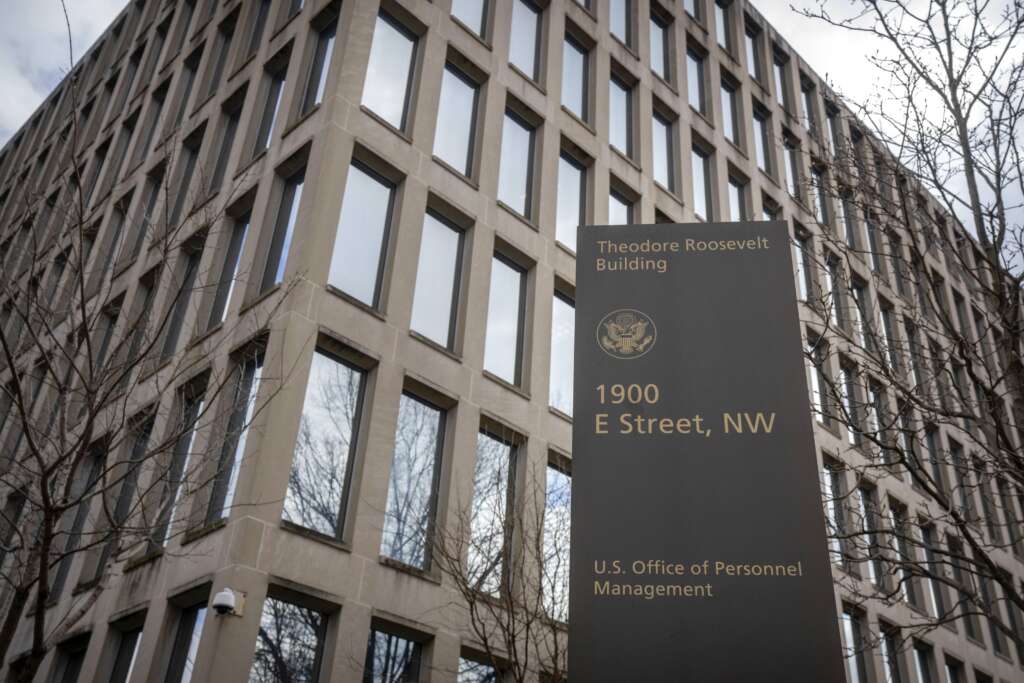
The Theodore Roosevelt Building, location of the U.S. Office of Personnel Management, on Tuesday, Feb. 13, 2024, in Washington. Former President Donald Trump has plans to radically reshape the federal government if he returns to the White House, from promising to deport millions of immigrants in the U.S. illegally to firing tens of thousands of government workers. (AP Photo/Mark Schiefelbein)
❌