Meta has acquired Limitless, the maker of an AI-powered "Pendant," to work on building consumer hardware for the company, the startup announced via a YouTube video and blog post. So far, Meta has focused on selling VR headsets and AI smart glasses. Now the company seems interested in branching out.
"Meta recently announced a new vision to bring personal superintelligence to everyone and a key part of that vision is building incredible AI-enabled wearables. We share this vision and we'll be joining Meta to help bring our shared vision to life," Limitless CEO Dan Siroker said in the post announcing the acquisition.
Limitless' first product was Rewind, desktop productivity software that recorded everything you did on your computer and turned it into a searchable database you interacted with via a chatbot. The company later expanded into hardware with Pendant, essentially a clip-on Bluetooth microphone that applies the same concept (privacy concerns be damned) to the things you say or hear throughout the day.
The company plans to support its existing Pendant customers "for at least another year," but will no longer sell the wearable going forward. Current customers will be able to access all the features of Pendant without having to pay for a subscription, though Limitless says availability will vary per region. If you have data stored with Limitless and don’t want to hold onto your Pendant, you're now also able to export or delete your data if you choose.
AI wearables focused on recording audio have emerged as a common form factor primarily because they lean on two things AI models do moderately well: transcribing audio into text and summarizing it. Meta dipping its toes into the space makes sense, if only because not everyone will want to wear glasses to receive the benefits of an AI assistant. Amazon acquired an AI wearable company called Bee in July 2025, presumably with similar intentions.
Add in Meta's recent hiring of former Apple design lead Alan Dye, and you can start to imagine where things might be headed. In the future, the Ray-Ban Meta Smart Glasses and Meta Ray-Ban Display could be two entries in a larger lineup of AI-powered wearables.
This article originally appeared on Engadget at https://www.engadget.com/ai/metas-latest-acquisition-suggests-hardware-plans-beyond-glasses-and-headsets-212930339.html?src=rss
CES doesn't start until January, but whispers of the products and announcements that could be in store for tech's biggest annual conference have already started to take shape. The CES 2026 show floor is officially open from January 6 through 9, although the show kicks off with events on Sunday January 4 and a host of press conferences on Monday. As always, product demos, announcements and networking happening at the Las Vegas Convention Center and surrounding hotels all over the city. As usual, Engadget will be covering the event in-person and remotely, bringing you news and hands-ons straight from the show floor.
More specific details and pre-announcements should trickle out as CES approaches, but in the meantime, we do know what companies will be hosting press conferences and what tech trends could rear their heads at the show.
What we already know about
Press conferences and show floor booths are the bread and butter of CES. The Consumer Technology Association has already published a searchable directory of who will have a presence at the show, along with a schedule of every official panel and presentation.
On Sunday, January 4, Samsung will kick-off CES with "The First Look," a presentation hosted by TM Roh, the CEO of Samsung's DX Division, on the company's "vision for the DX (Device eXperience) Division in 2026, along with new AI-driven customer experiences."
That'll be followed by multiple press conferences throughout Monday, January 5. LG is hosting its "Innovation in Tune with You" presentation to share "its vision for elevating daily life through Affectionate Intelligence" at the start of the day, Intel is launching its new Core Ultra Series 3 processors in the afternoon, Sony Honda Mobility is holding a press conference on its first car and AMD CEO Lisa Su will cover AMD's upcoming chip announcements at a keynote address that closes out the day.
Finally, on Tuesday, January 6, Lenovo CEO Yuanqing Yang will host Lenovo's Tech World Conference at Sphere, using the large and decidedly curved screen to share the company's "commitment to delivering smarter AI for all by constantly redefining how technology can engage, inspire, and empower."
Outside of the formal introduction of new products and initiatives, reading the tea leaves of what was announced last year and what companies are reportedly working on, we can make some educated guesses at what we could see at CES 2026.
New chips from AMD, Intel and Qualcomm
CES is frequently the start of a cascade of new chip announcements for a given year, and one of the first places new silicon appears in real consumer products. AMD will likely use its keynote to introduce new versions of its Ryzen chips, including the recently spotted Ryzen 7 9850X3D, which is expected to offer better single-threaded performance, and the Ryzen 9000G series, which could be built with AMD's Zen 5 architecture. The company might also use its CES stage to go over its new FSR Redstone AI upscaling tech.
Intel has already publicly announced that it'll launch its Panther Lake chips at CES 2026. The officially titled Intel Core Ultra Series 3 chips fit into Intel's overall "AI PC" push, but are specifically meant for premium laptops. Based on a preview from October 2025, Intel says the first chip made with its 2-nanometer 18A process will offer 50 percent more processing performance than previous generations and for the chip's Arc GPU, a 50 percent performance bump from last generation.
Qualcomm is also rumored to be targeting laptops at the show, building on the work it's done moving its Snapdragon chips out of phones and tablets and into other types of computers. The company's Snapdragon X2 Elite and X2 Elite Premium chips should start appearing in laptops at CES 2026, offering a look at the improved speed and AI performance the company promised in 2025.
Brighter, "truer" screens
Sony announced a collection of new Bravia TVs in April 2025, replacing the company's flagship, filling in its midrange options and adding a new budget model to the mix. The star of this updated Bravia lineup is the Bravia 9, which features a QD-OLED panel, but Sony appears to be prepping entirely new display tech for 2026. In March 2025, Sony introduced a new RGB LED panel that uses individual Mini LED backlights colored in red, green and blue to produce even brighter, more accurate colors. In contrast to a QD-OLED, which filters a layer of blue organic light emitting diodes through quantum dots that change color, Sony's "General RGB LED Backlight Technology" can get as bright as a Mini LED panel without needing an extra filter layer or worrying about OLED's problems with burn-in.
The company has already trademarked the name "True RGB," which could end up being what Sony calls this new flavor of display if it decides to show them off at CES. It seems entirely likely, because CES is nothing if not a TV show — it’s a sure bet that we’ll see new TVs from the likes of LG and Samsung in addition to Sony. If the company doesn't introduce new display tech for its TVs, it does have a new 240Hz PlayStation monitor coming in 2026 that it could show off at CES instead.
Sony isn't the only company hyped on bright screens. Samsung is reportedly pushing an updated version of the HDR10 and HDR10+ standards that could be ready to demo at CES 2026. The new HDR10+ Advanced standard would be Samsung's answer to Dolby Vision 2, which includes support for things bi-directional tone mapping and intelligent features that automatically adapt sports and gaming content. Samsung's take will reportedly offer improved brightness, genre-based tone mapping and intelligent motion smoothing options, among other improvements.
Ballie Watch 2026
The ball-shaped yellow robot lovingly known as "Ballie" has been announced twice, first in 2020 and then again in 2024 with a projector in tow. Samsung said Ballie would go on sale in 2025 at CES last year and then shared in April 2025 that Ballie would ship this summer with Google's Gemini onboard. But it's nearly 2026, and Ballie is nowhere to be seen. It's possible Samsung could make a third attempt at announcing its robot at CES 2026, but whether or not it does, robotics will still be a big part of the show.
Robot vacuums and mops were a major highlight of CES 2025, and it's safe to expect notable improvements from the new models that are announced at CES 2026. Not every company will adopt the retractable arm of the Roborock Saros Z70, but robot vacuums with legs for rising over small ledges like the Dreame X50 seem like they could become the norm. Roborock could also show off its new Roborock Qrevo Curv 2 Flow, the first of its robot vacuums to feature a retractable roller mop.
Beyond just traversing spaces more efficiently, improving robots' navigation could also be a major concern at the show. Prominent members of the AI industry are turning their attention from large language models to world models, which aim to give AI a deep understanding of physical space. Those world models could be the key to making robots, bipedal or otherwise, competent at navigating homes and workplaces, and will likely be a significant talking point at CES 2026.
We’ll be updating this article throughout the month as more rumors surface and new products are confirmed — stay tuned for future updates!
This article originally appeared on Engadget at https://www.engadget.com/big-tech/what-to-expect-at-ces-2026-120000278.html?src=rss
Roskomnadzor, Russia's federal agency for monitoring and censoring mass media, has blocked access to Snapchat and FaceTime in the country, Bloomberg reports, citing Russian news service Interfax. The bans were reportedly put in place because the platforms were used "to organize and carry out terrorist acts,” and commit fraud.
It's not clear if either service is still accessible by using a VPN, but banning Snapchat and FaceTime fits with Russia’s crackdown on communication and social platforms that started after the country’s invasion of Ukraine in 2022. Facebook and X were blocked in March of that year, and Instagram was added to the ban list not long after. In 2024, the encrypted messaging app Signal was also banned, and more recently in July 2025, Russia threatened to block access to WhatsApp.
Engadget has contacted both Apple and Snap to comment on the Russian bans. We'll update this article if we hear back.
Banning or restricting these platforms is a way to exert control over where and how conversation happens in Russia — and prevent the spread of "LGBT propaganda," if you believe Roskomnadzor's reasoning for banning Roblox — but it might also be an attempt to drive people to use "MAX," a state-run super app that offers services like communication, banking and document storage. The app is part of a long-standing push to rely on Russia's tech industry rather than foreign companies, and could potentially give the Russian government an easier method for surveilling its citizens, The New York Times reports.
This article originally appeared on Engadget at https://www.engadget.com/apps/russia-reportedly-bans-snapchat-and-facetime-194906404.html?src=rss
Bungie and Sony Interactive Entertainment appear to have settled the plagiarism scandal that rocked Marathon before the game was indefinitely delayed in June 2025. Fern Hook, an artist who goes by the name “Antireal” online, posted on X that her issues with Bungie using her work without credit in Marathon have been resolved to her "satisfaction."
Marathon's distinct art style is one of its charms, but as Hook claimed on X and Bungie later confirmed, a portion of the assets and textures featured in the game's alpha were lifted from Hook's work. At the time, Bungie announced that it was conducting an investigation and hoped to discuss the issue with Hook. It's not clear what kind of agreement Bungie, Sony and Hook came to, but it appears to have solved any outstanding issues.
The Marathon art issue has been resolved with Bungie and Sony Interactive Entertainment to my satisfaction.
Bungie delayed Marathon from its original September 2025 launch date in June, and more recently ran closed playtests of an updated version of the game in October. As of Sony's November earnings report, the company now says Marathon will launch by March 2026. Marathon is a reimagining of an older Bungie franchise, but more importantly, it's also the developer's first new game since Destiny 2 was released in 2017. Considering Sony's increased scrutiny of Bungie's performance, settling this issue and hopefully setting up Marathon for a smoother launch is definitely a good thing.
This article originally appeared on Engadget at https://www.engadget.com/gaming/artist-bungie-plagiarized-for-marathon-alpha-says-the-issue-has-been-resolved-223901094.html?src=rss
Alan Dye, Apple's Vice President of Human Interface Design, has been poached by Meta, Bloomberg reports. The designer played a pivotal role in the look and feel of Apple's products since Jony Ive left the company in 2019, and now he’ll be taking his talents to Meta.
Dye will reportedly work under Chief Technology Officer Andrew Bosworth as the head of a new studio that will oversee the design of hardware, software and AI products. The studio will also include former Apple designer Billy Sorrentino, Meta’s interface design lead Joshua To, an industrial design team led by Pete Bristol, and metaverse design and art teams led by Jason Rubin, Meta CEO Mark Zuckerberg announced on Threads.
“The new studio will bring together design, fashion, and technology to define the next generation of our products and experiences,” Zuckerberg shared in the post. “Our idea is to treat intelligence as a new design material and imagine what becomes possible when it is abundant, capable and human-centered.”
Apple, meanwhile, is replacing Dye with Stephen Lemay, Bloomberg reports, a senior designer at the company who's worked on all of the company’s interfaces since 1999. Considering the secrecy of Apple as a company, it's hard to credit individual breakthroughs to individual designers, but Dye worked on several of Apple's major new platforms and design changes, including things like the interface of visionOS and its new Liquid Glass design language.
Meta has had success with its Quest virtual reality headsets and more recently, its Ray-Ban Meta smart glasses, but the company clearly hopes to release many more consumer hardware products with Dye and its new design studio’s help. Those will likely include future versions of the Meta Ray-Ban Display and its Neural Band accessory.
Dye isn't the first designer Apple has lost to a competitor. Evans Hankey, the company’s former head of industrial design, left Apple in 2022 to work with Ive. Hankey is now one of several former Apple employees building OpenAI's upcoming hardware device. Dye joining Meta is particularly interesting in this case because Apple is rumored to be working on products that will bring the company in even closer competition to the social media giant. The Vision Pro could be considered to be a high-end competitor in VR, but Apple is reportedly working on its own pair of smart glasses, too.
Update, December 3, 5:54PM ET: Added information from Mark Zuckerberg’s Threads post on hiring Alan Dye and Meta’s new design studio.
This article originally appeared on Engadget at https://www.engadget.com/big-tech/apple-design-lead-alan-dye-is-heading-to-meta-214449944.html?src=rss
The developer of Cozy Grove and Alphabear is leaving Netflix. Spry Fox is being sold back to its original founders, Game File reports, and will continue to work on its upcoming "cooperative village life sim" Spirit Crossing as an independent company. Unlike other shuttered Netflix games studios Team Blue and Boss Fight Entertainment, Netflix will remain involved with the studio as Spirit Crossing's publisher on mobile.
As part of the arrangement, Spry Fox founders David Edery and Daniel Cook will be able to shop Spirit Crossing to other publishers for console and PC releases of the game. While reverting to being an independent studio is definitely a happier version of the typical studio closure story, it might not be without issues. Game File reports that layoffs at Spry Fox are still possible and the developer will need to find additional funding to continue long-term. Spirit Crossing may also need to be altered so that Spry Fox can continue to make money from the game after players purchase it.
Netflix acquired Spry Fox in 2022, a little over a year after it acquired Oxenfree developer Night School. Spry Fox released its first game for Netflix subscribers, a sequel to Cozy Grove, in 2024. The studio formally announced Spirit Crossing in March of this year, as an ambitious attempt to fuse the cozy life simulation elements of something like Animal Crossing: New Horizons with the online social experiences of MMOs like World of Warcraft or Final Fantasy XIV.
That pitch apparently no longer jives with Netflix's current game strategy, which changed when Epic Games' Alain Tascan took over from ex-EA executive Mike Verdu. Whereas Netflix Games under Verdu acquired studios, funded projects and licensed an eclectic collection of mobile games for Netflix subscribers, Tascan has refocused the company's games business around titles based on Netflix IP, social party games and known quantities, Game File writes. Spirit Crossing doesn't fit neatly into any of those categories, which might be one reason Netflix is parting ways with Spry Fox.
This article originally appeared on Engadget at https://www.engadget.com/gaming/netflix-is-getting-rid-of-another-of-its-game-studios-by-selling-it-back-to-its-founders-203645232.html?src=rss
Micron Technology is winding down its consumer-facing Crucial brand to focus on providing RAM and other components to the AI industry, The Wall Street Journal reports. The company plans to continue shipping Crucial RAM and storage through February 2026, and will honor warranty service and support for its existing Crucial products even after it stops selling directly to consumers.
"The AI-driven growth in the data center has led to a surge in demand for memory and storage. Micron has made the difficult decision to exit the Crucial consumer business in order to improve supply and support for our larger, strategic customers in faster-growing segments," Sumit Sadana, Micron Technology's EVP and Chief Business Officer said in an announcement to investors. Micron Technology didn't share how many jobs could be impacted by shuttering Crucial, but did note that it hoped to soften the blow via "redeployment opportunities into existing open positions within the company."
The majority of generative AI products used today are supported by a growing network of data centers that train and host large language models. The rapid buildout of servers at these data centers has been a boon to PC parts makers like NVIDIA, who provide the GPUs used to power them, but also companies like Micron, who build the memory components these computers need to run. It's not surprising the company would want to focus on where growing demand is, but it does put considerable strain on the remaining companies who continue to service both businesses and hobbyist PC-builders.
There were next to no true deals on memory or pre-built PCs for Black Friday due to how costly RAM has become now that AI companies are buying it in bulk. PC maker CyberPowerPC even went as far to say that "global memory (RAM) prices have surged by 500 percent and SSD prices have risen by 100 percent," forcing it to raise prices on its products. Losing another source of RAM like Crucial likely won't make things any better.
This article originally appeared on Engadget at https://www.engadget.com/computing/crucial-is-a-casualty-of-ais-hunger-for-ram-185910113.html?src=rss
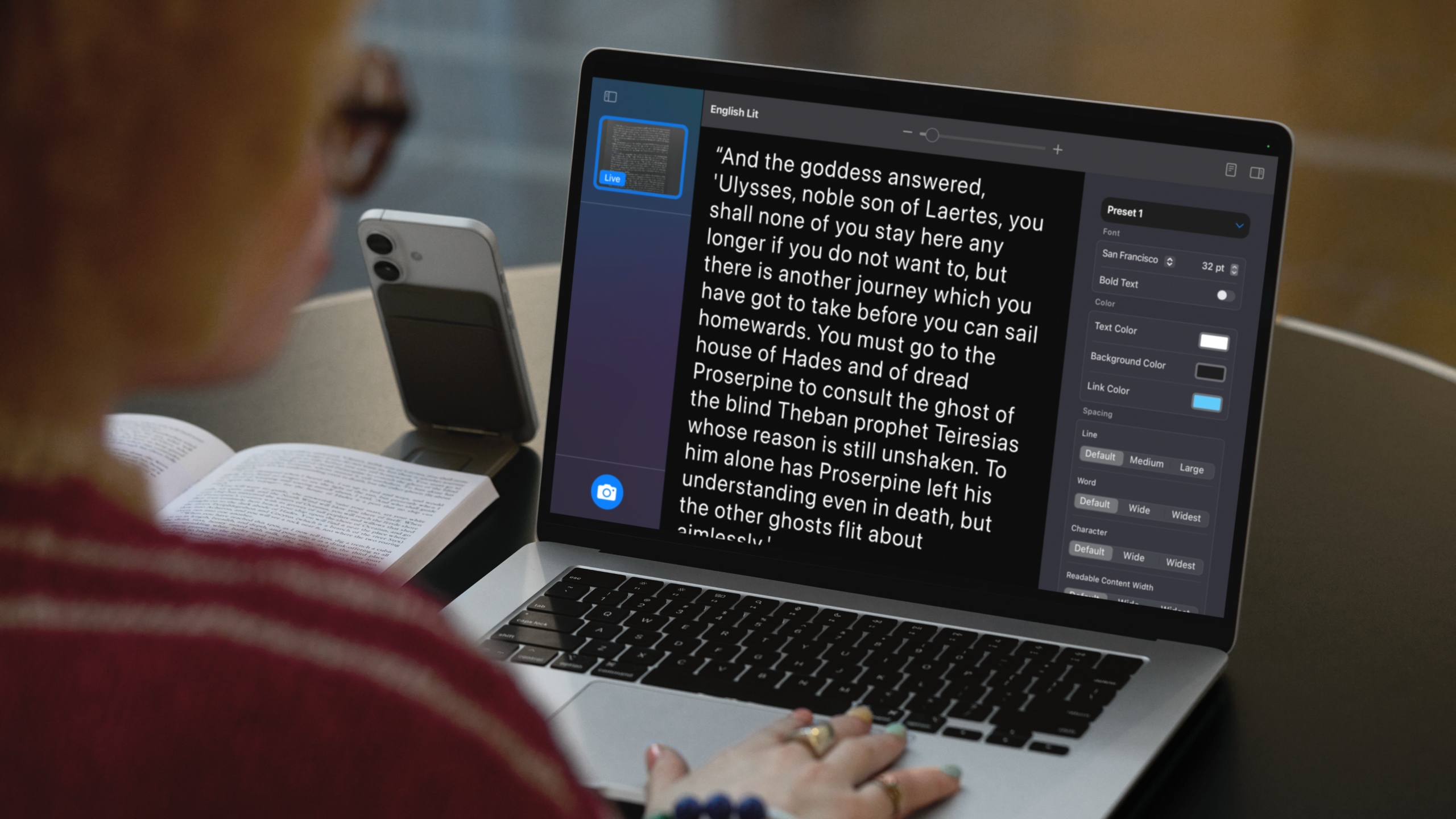
One of the iPhone’s many accessibility features is something Apple calls "Magnifier," which uses the smartphone's cameras to magnify and identify objects in the world around you. For Global Accessibility Awareness Day in May this year, Apple brought Magnifier to the Mac, opening up even more places the assistive tool can be used, like classroom or work environments where you might already have a MacBook pulled out.
Magnifier requires macOS 26 Tahoe and can work with a built-in webcam, a connected third-party camera or an iPhone via Apple's Continuity feature. Provided your MacBook can run Apple’s latest software update, it’s a natural fit for zooming in on a whiteboard at the back of a large lecture hall or getting a closer look at documents on a desk in front of you. You can use the app to both capture an individual image you want to refer to later, or to analyze text in a live video feed. But where to begin? Here’s how to set up and use Magnifier on your Mac.
How to use Magnifier to identify and display text
A MacBook using Magnifier and a connected iPhone to identify and format text from a book.
Apple
Magnifier's most powerful feature uses the MacBook's machine learning capabilities to identify, display and format text that your camera captures. This works with text your camera can see in the room around you, and things it captures via macOS' Desk View feature. For example, to view documents on your desk:
Open Magnifier.
Click on the Camera section in Magnifier's menu bar and then select your Desk View camera from the dropdown menu.
Click on the Reader icon (a simple illustration of a document) near the top-right of your Magnifier window.
Click on the sidebar menu icon to access settings to format text.
Apple gives you options to change the color, font and background of text Magnifier identifies, among other customization options. If you'd prefer to capture faraway text, you can position a webcam or iPhone camera facing away from you and swap to it via the Camera section in Magnifier's menu bar.
You can also listen to any text Magnifier has identified by clicking on the Play button in the top-right corner of Magnifier's reader mode. Clicking the Pause button will pause playback, clicking the Skip Forward or Skip Backward buttons skip through lines of text, and if you want to adjust playback speed, you can click on the 1x button and pick a speed from the dropdown menu.
How to use Magnifier to zoom in on yourself
Magnifier can identify text, but it also works as a way to get a zoomed in view of your own face.
Ian Carlos Campbell for Engadget
By default, Magnifier uses your MacBook's built-in webcam, which means you'll see a view of yourself and whatever's behind you if you don't have another camera selected. This might not be usual for seeing faraway text, but it is handy if you're applying makeup, putting in contacts or doing anything else where you need a detailed view of your face.
In my tests, using Magnifier worked the best with my MacBook's built-in webcam or an iPhone. When I tried using a third-party webcam from Logitech, my live camera feed was noticeably laggy. Your mileage may vary, but if you experience any issues with your own webcam, it's worth trying your built-in webcam to see if that helps. You can swap between cameras and zoom in to your camera feed inside the Magnifier app:
Open Magnifier.
In the top menu bar, select Camera and then click on the camera you'd like to use in the dropdown menu.
Use the slider in the top center of the Magnifier window to zoom in on yourself.
You can see a live feed of your zoomed in view in Magnifier's main window. If you click on the Camera button in the bottom-left corner of the app, you can also snap a photo to review later. Any photos you capture will appear in Magnifier's left sidebar menu. Clicking on them lets you view them, zoom in on them and adjust their visual appearance (Brightness, Contrast and other visual settings) via the Image section in Magnifier's menu bar.
This article originally appeared on Engadget at https://www.engadget.com/computing/laptops/how-to-use-magnifier-on-a-macbook-to-zoom-in-on-faraway-text-080100677.html?src=rss
Ireland's media regulator, Coimisiún na Meán, has announced investigations into both TikTok and LinkedIn for possible violations of the European Union's Digital Services Act, Reuters reports. The investigations are focused on both platforms' illegal content reporting features, which might not meet the requirements of the DSA.
The main issue appears to be how these platforms’ reporting tools are presented and implemented. Regulators found possible "deceptive interface designs" in the content reporting features they examined, which could make them less effective at actually weeding out illegal content. "The reporting mechanisms were liable to confuse or deceive people into believing that they were reporting content as illegal content, as opposed to content in violation of the provider’s Terms and Conditions," the regulator wrote in a press release announcing its investigation.
“At the core of the DSA is the right of people to report content that they suspect to be illegal, and the requirement on providers to have reporting mechanisms, that are easy to access and user-friendly, to report content considered to be illegal, “ John Evans, Coimisiún na Meán's DSA Commissioner, said in the press release. "Providers are also obliged to not design, organize or operate their interfaces in a way which could deceive or manipulate people, or which materially distorts or impairs the ability of people to make informed decisions."
Evans goes on to note that Coimisiún na Meán has already gotten other providers to make "significant changes to their reporting mechanisms for illegal content," likely due to the threat of financial penalties. Many tech companies have headquarters in Ireland, and if a platform provider is found to violate the DSA, Irish regulators can fine them up to six percent of their revenue in response.
Ireland's Data Protection Commission is already conducting a separate investigation into the social media platform X for allegedly training its Grok AI assistant on posts from users. Doing so would violate the General Data Protection Regulation or GDPR, and allow Ireland to take a four percent cut of the company's global revenue.
This article originally appeared on Engadget at https://www.engadget.com/social-media/ireland-is-investigating-tiktok-and-linkedin-for-possible-dsa-violations-194519622.html?src=rss
Putting together a photo album is a sweet way to share memories with loved ones, and a digital frame lets you package those feelings in a device that can be constantly updated with new pictures. Aura makes some of the best frames we've tested, and for Black Friday you can get our favorite digital picture frame the company makes for $139. That's $40 off the normal $179 price of the Aura 10.1" Carver Mat Frame, and one of the lowest prices we've seen the frame hit this year.
The Aura Carver Mat has a 10.1-inch display that's bright and high-resolution enough to show off a rotating collection of photos and videos without worrying about glare. The display is designed to be used in landscape orientation, and Aura's software can intelligently pair portrait photos together so the screen isn't left with awkward negative space.
Better yet, actually getting photos on the frame is a breeze. You can add whatever photos or videos you choose through a handy smartphone app, and even organize photos in albums if you want them to be displayed together. By default, the Aura Carver will shuffle through what you've uploaded, but you can also manually swipe through photos via a touch panel at the top of the frame if there's something particular you want to display.
In terms of quality and ease-of-use, the Aura 10.1-inch Carver Mat Frame is the top pick in our list of the best digital picture frames for a reason. Parents and grandparents find it kind of magical to have a frame that you can randomly update with new photos, and of the Black Friday deals we've spotted this year, it's a guaranteed crowd-pleaser.
This article originally appeared on Engadget at https://www.engadget.com/home/smart-home/our-favorite-aura-digital-photo-frame-is-40-off-for-black-friday-202715971.html?src=rss
Sling TV offers multiple ways to stream cable channels without having to commit to a month of service, and for Black Friday it's offering its new $5 Day Passes for a healthy discount. You can get a Sling Orange Day Pass for just $1 through November 30, and get access to 34 channels, including ESPN, ESPN 2 and ESPN 3.
Besides ESPN, the Sling Orange Day Pass includes access to TNT and TBS, which makes it a solid option if you're trying to watch the NBA, NFL or college sports. The pass also includes children's channels like Disney Channel and Nick Jr., CNN for news and HGTV and Food Network for purer forms of lean back entertainment. Sling TV is Engadget's pick for the best customizable live streaming service for a reason: You can add on extra premium channels when you buy a pass, and their price will be prorated for whatever length you choose. That way even if a dollar isn't getting you all the channels you need, you don't need to pay that much more to get them.
It's worth noting, while this promotion runs during Thanksgiving in the US, a Sling Orange subscription won't get you access to the football games scheduled for that Thursday. To watch those, you'll need at least a Sling Blue subscription, which includes FS1 and NFL Network, but isn't available as a day-long pass. A Sling Blue subscription currently starts at $46 a month.
Still, for your $1, around $4 off the price Sling TV normally charges, you're getting a deal. Dozens of popular channels, access to Sling TV's DVR feature, and the ability to use your subscription from a smartphone, tablet, the web or your TV. Plus, Sling TV's interface is easy to navigate, which is what you want when you're likely subscribing with one game or show in mind.
This article originally appeared on Engadget at https://www.engadget.com/deals/black-friday-streaming-deals-include-sling-orange-day-passes-for-only-1-each-231208088.html?src=rss

 Login
Login