Reading view

There are new articles available, click to refresh the page.

NASA Wins Second Emmy Award for 2024 Total Solar Eclipse Broadcast

3 min read

Preparations for Next Moonwalk Simulations Underway (and Underwater)

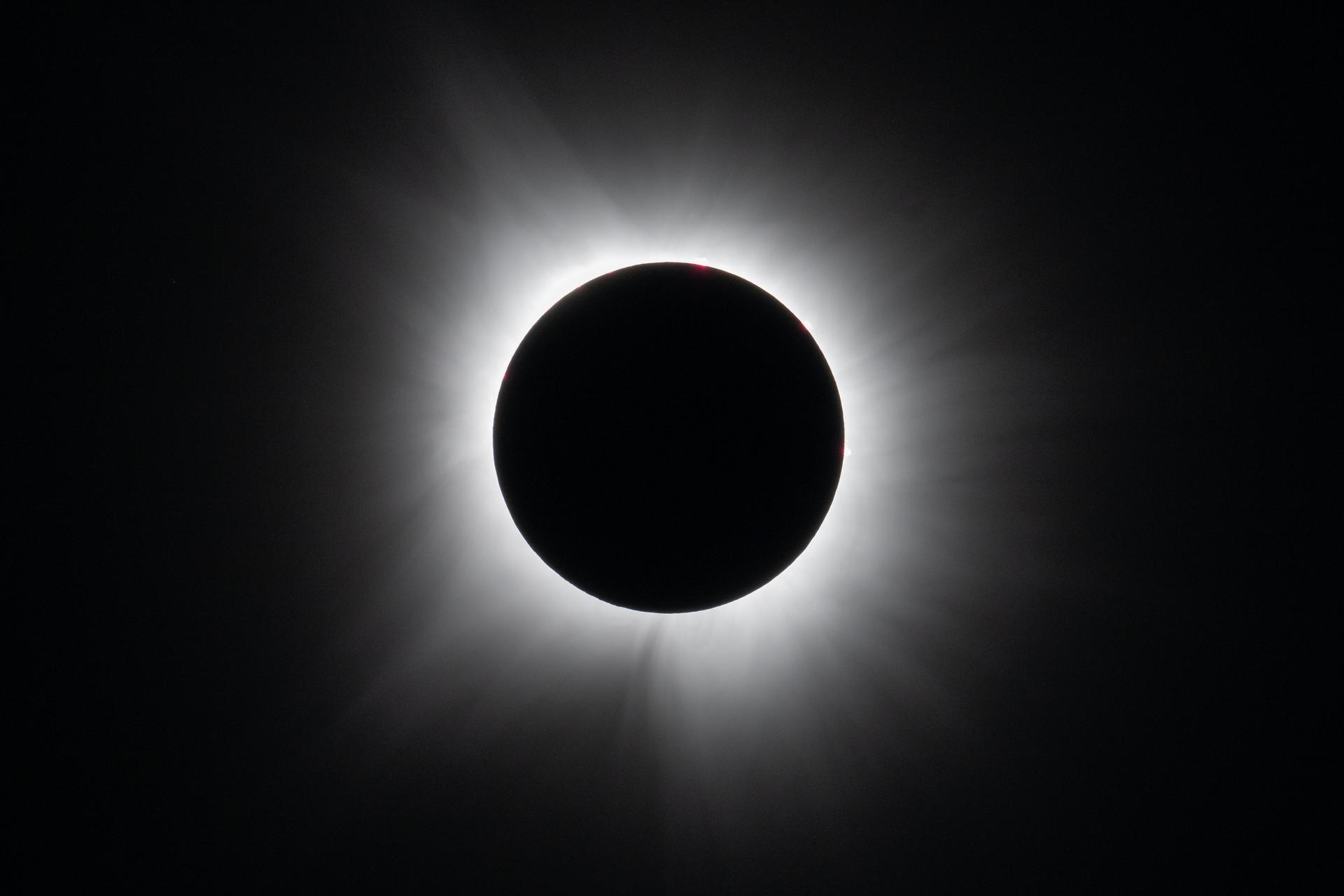
NASA’s broadcast of the April 8, 2024, total solar eclipse has won an Emmy Award for Excellence in Production Technology.

At the 76th Technology & Engineering Emmy Awards on Dec. 4, in New York City, the Academy of Television Arts & Sciences announced the win. Walt Lindblom and Sami Aziz accepted the award on behalf of the agency. For the broadcast, Lindblom served as the coordinating producer and Aziz served as the executive producer.

“By broadcasting the total solar eclipse, this team brought joy and wonder for our Sun, Moon, and Earth to viewers across America and the world,” said Will Boyington, associate administrator for the Office of Communications at NASA Headquarters in Washington. “Congratulations to the production team, whose efforts demonstrate the hard work and dedication to the sharing the marvel that makes our solar system something we strive to understand.” 

NASA’s live broadcast coverage of the 2024 total solar eclipse was the most complex live project ever produced by the agency. In total, NASA’s eclipse broadcasts garnered almost 40 million live and replay views across its own distribution channels, including on NASA+, the agency’s free streaming service. Externally, the agency’s main broadcast was picked up in 2,208 hits on 568 channels in 25 countries.

“Our unique place in the solar system allows us on Earth to witness one of the most spectacular science shows nature has to offer. NASA’s production team captured the action every step of the way across the path of totality, including the rare glimpse of the Sun’s corona,” said Nicky Fox, associate administrator for science at NASA Headquarters. “Congratulations to the NASA team for successfully showing the 2024 total solar eclipse through the eyes of NASA for the whole world to experience together.”

The broadcast spanned three hours, showcasing the eclipse across seven American states and two countries. From cities, parks, and stadiums, 11 hosts and correspondents provided on air commentary, interviews, and live coverage. Viewers tuned in from all over the world, including at watch parties in nine locations, from the Austin Public Library to New York’s Times Square. An interactive “Eclipse Board” provided real time data analysis as the Moon’s shadow crossed North America.

Live feeds from astronauts aboard the International Space Station and NASA’s WB-57 high-altitude research aircraft were brought in to provide rare and unique perspectives of the solar event. To make this possible, NASA deployed and enabled 67 cameras, 6 NASA Wide Area Network control rooms, 38 encoders, and 35 decoders. The team coordinated 20 live telescope feeds which represented 12 locations across the path of totality.

NASA’s eclipse broadcast won another Emmy award earlier this year at the 46th Annual News & Documentary Emmy Awards for Outstanding Live News Special. Additionally, the show received an Emmy nomination for Outstanding Show Open or Title Sequence – News. NASA’s eclipse communication and broadcast efforts also won two Webby Awards and two Webby People’s Voice Awards.

For more information about NASA, visit:

https://www.nasa.gov

Abbey Interrante / Karen Fox
Headquarters, Washington
301-201-0124 / 202-358-1600
abbey.a.interrante@nasa.gov / karen.c.fox@nasa.gov

💾

On April 8, 2024, North America's last total solar eclipse until 2045 moved across the continent. It made landfall in Mexico, crossed the United States from ...

100 Million TRX Leaves Binance — Justin Sun Behind The Move

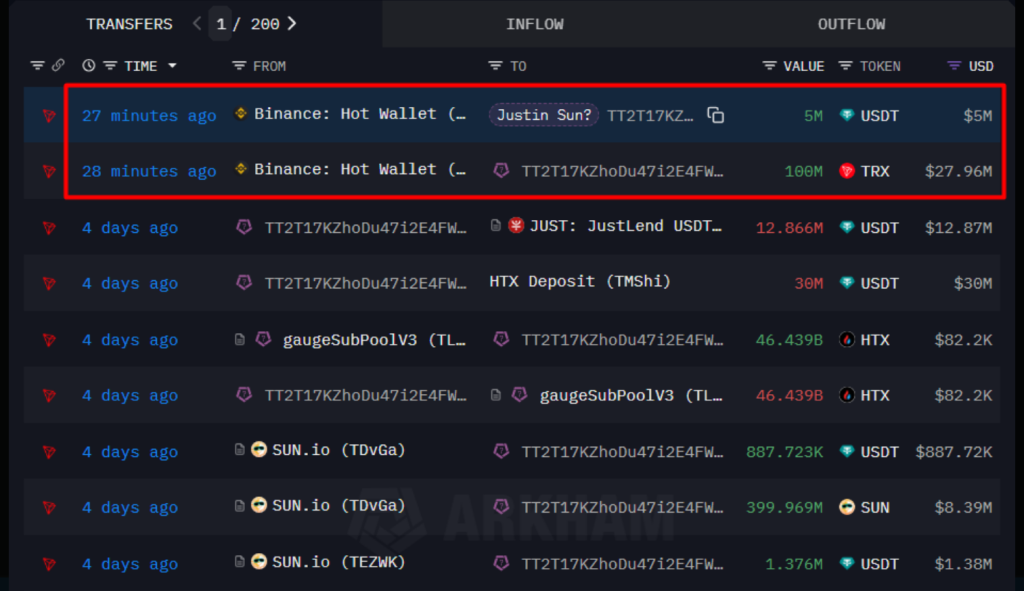
According to on-chain monitors, a wallet linked to TRON founder Justin Sun pulled 100 million TRX from Binance on December 3, 2025. Reports say the same address also moved $5 million USDT around the same time. These large transfers were flagged publicly by Onchain Lens and picked up by multiple crypto news outlets.

Transaction Values And Timing

Onchain tracking shows the 100 million TRX was worth close to $28 million at the time of the move. The USDT transfer of $5 million happened within a minute of the TRX withdrawal, which has led observers to call the action coordinated rather than routine.

Based on reports, the close timing and mixed asset types — token plus stablecoin — drew extra attention from traders and on-chain sleuths.

Data also shows the Justin Sun-linked wallet now holds a much larger TRX balance than just this single transfer. Tracking services report the address sits at about 492 million TRX, a holding with a notional value near $138 million based on market rates at the time. That swelling balance has prompted talk that accumulation of TRX has been steady in recent days.

A wallet linked to Justin Sun (@justinsuntron) withdrew 100M $TRX worth $27.96M from #Binance and also withdrew $5M $USDT.https://t.co/4d2utqwsv0 pic.twitter.com/k40pMUj15d

— Onchain Lens (@OnchainLens) December 3, 2025

Market Reaction And Liquidity

Initial market moves were muted. Some exchange data and commentaries noted a mild uptick in TRX price after the news, suggesting traders saw the outflow as removing sell pressure from exchange order books.

Analysts who track exchange liquidity say large withdrawals like this can shrink available sell-side supply and can support price stability if demand holds. Still, any clear price trend will depend on what happens next with the withdrawn tokens.

No Official Word Yet

There has been no public statement from Justin Sun or TRON explaining the transfers. Without confirmation, motives remain speculative. Observers are weighing a few common possibilities: long-term cold storage, staking or protocol use, or internal treasury moves. All of those ideas are possible, but none are confirmed by the team.

What Could Happen Next

If the tokens stay offline, some traders may view the move as bullish since it cuts the floating supply held on big exchanges. If the funds are later sold or used to provide liquidity, the effect could swing the other way.

Reports point out that similar moves by major holders have sometimes been followed by quiet accumulation and other times by large transfers into trading venues — timing and intent matter.

Featured image from Unsplash, chart from TradingView

New NASA Mission to Reveal Earth’s Invisible ‘Halo’

5 min read

New NASA Mission to Reveal Earth’s Invisible ‘Halo’

This story is also available in Spanish.

A new NASA mission will capture images of Earth’s invisible “halo,” the faint light given off by our planet’s outermost atmospheric layer, the exosphere, as it morphs and changes in response to the Sun. Understanding the physics of the exosphere is a key step toward forecasting dangerous conditions in near-Earth space, a requirement for protecting Artemis astronauts traveling through the region on the way to the Moon or on future trips to Mars. The Carruthers Geocorona Observatory will launch from NASA’s Kennedy Space Center in Florida no earlier than Tuesday, Sept. 23.

Revealing Earth’s invisible edge

In the early 1970s, scientists could only speculate about how far Earth’s atmosphere extended into space. The mystery was rooted in the exosphere, our atmosphere’s outermost layer, which begins some 300 miles up. Theorists conceived of it as a cloud of hydrogen atoms — the lightest element in existence — that had risen so high the atoms were actively escaping into space.

But the exosphere reveals itself only via a faint “halo” of ultraviolet light known as the geocorona. Pioneering scientist and engineer Dr. George Carruthers set himself the task of seeing it. After launching a few prototypes on test rockets, he developed an ultraviolet camera ready for a one-way trip to space.

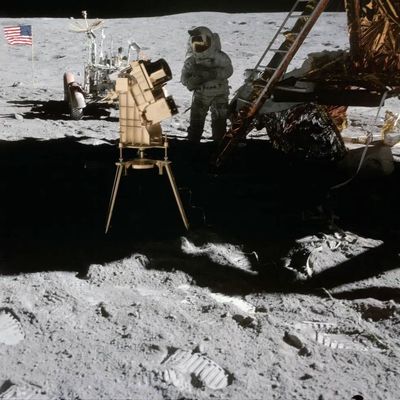
An astronaut stands on the Moon near a lunar module and scientific equipment, with an American flag and lunar rover in the background. The lunar surface is covered in footprints and gray dust.
Apollo 16 astronaut John Young is pictured on the lunar surface with George Carruthers’ gold-plated Far Ultraviolet Camera/Spectrograph, the first Moon-based observatory. The Lunar Module “Orion” is on the right and the Lunar Roving Vehicle is parked in the background next to the American flag.
NASA

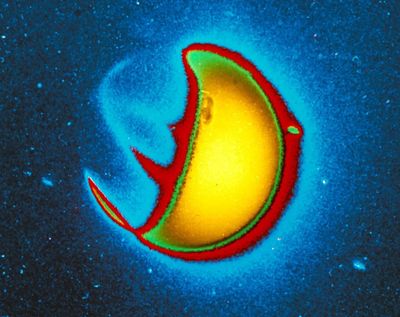
In April 1972, Apollo 16 astronauts placed Carruthers’ camera on the Moon’s Descartes Highlands, and humanity got its first glimpse of Earth’s geocorona. The images it produced were as stunning for what they captured as they were for what they didn’t.

“The camera wasn’t far enough away, being at the Moon, to get the entire field of view,” said Lara Waldrop, principal investigator for the Carruthers Geocorona Observatory. “And that was really shocking — that this light, fluffy cloud of hydrogen around the Earth could extend that far from the surface.” Waldrop leads the mission from the University of Illinois Urbana-Champaign, where George Carruthers was an alumnus.

A false-color, close-up image of Earth’s exosphere as captured by the Carruthers Geocorona Observatory against a dark blue background. The image shows a semicircle glowing yellow and outlined in red.
The first image of UV light from Earth’s outer atmosphere, the geocorona, taken from a telescope designed and built by George Carruthers. The telescope took the image while on the Moon during the Apollo 16 mission in 1972.
G. Carruthers (NRL) et al./Far UV Camera/NASA/Apollo 16

Our planet, in a new light

Today, the exosphere is thought to stretch at least halfway to the Moon. But the reasons for studying go beyond curiosity about its size.

As solar eruptions reach Earth, they hit the exosphere first, setting off a chain of reactions that sometimes culminate in dangerous space weather storms. Understanding the exosphere’s response is important to predicting and mitigating the effects of these storms. In addition, hydrogen — one of the atomic building blocks of water, or H2O — escapes through the exosphere. Mapping that escape process will shed light on why Earth retains water while other planets don’t, helping us find exoplanets, or planets outside our solar system, that might do the same.

NASA’s Carruthers Geocorona Observatory, named in honor of George Carruthers, is designed to capture the first continuous movies of Earth’s exosphere, revealing its full expanse and internal dynamics.

“We’ve never had a mission before that was dedicated to making exospheric observations,” said Alex Glocer, the Carruthers mission scientist at NASA’s Goddard Space Flight Center in Greenbelt, Maryland. “It’s really exciting that we’re going to get these measurements for the first time.”

Download this video from NASA’s Scientific Visualization Studio.

Journey to L1

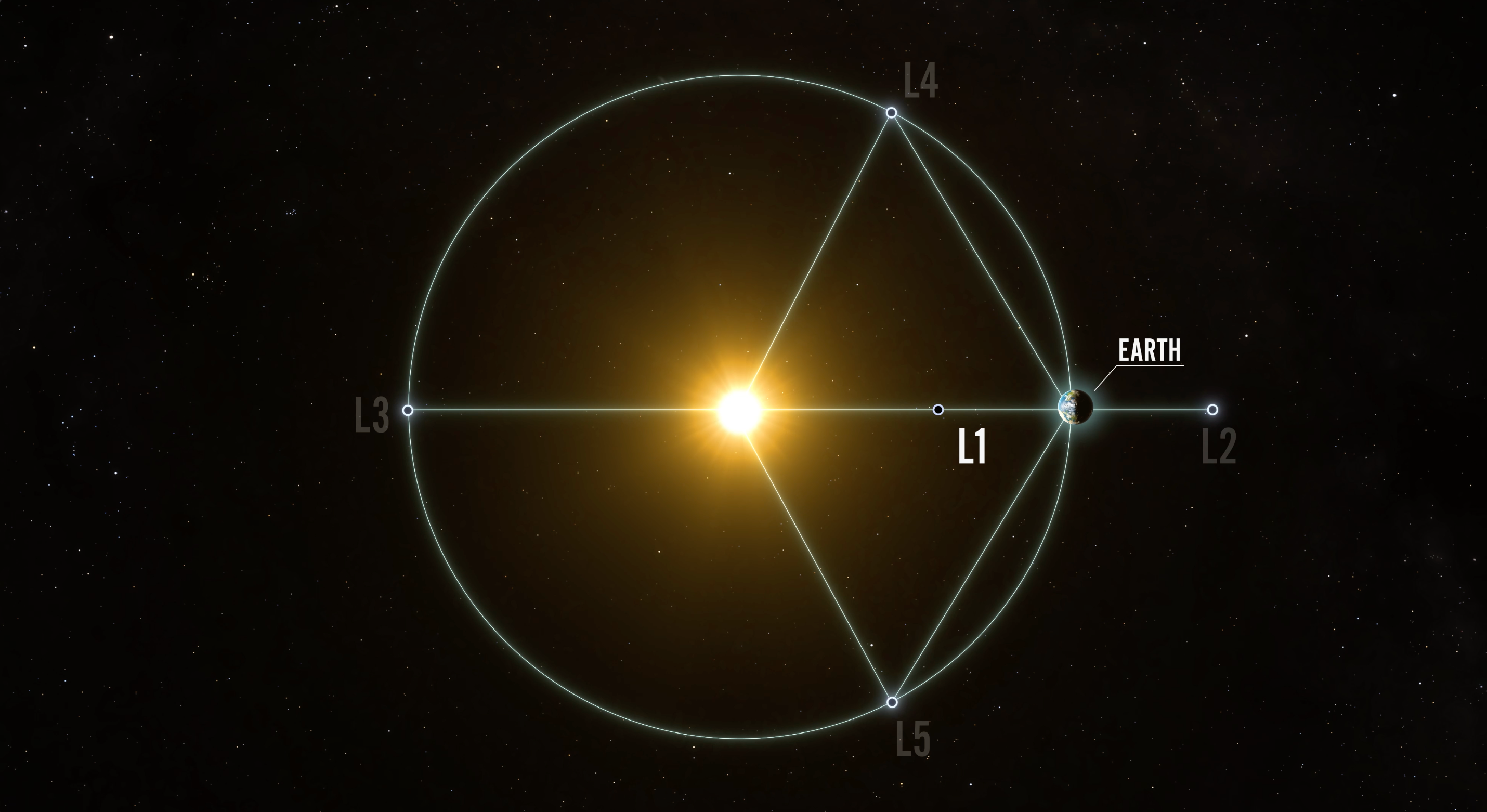
At 531 pounds and roughly the size of a loveseat sofa, the Carruthers spacecraft will launch aboard a SpaceX Falcon 9 rocket along with NASA’s IMAP (Interstellar Mapping and Acceleration Probe) spacecraft and the National Oceanic and Atmospheric Administration’s SWFO-L1 (Space Weather Follow On – Lagrange 1) space weather satellite. After launch, all three missions will commence a four-month cruise phase to Lagrange point 1 (L1), a location approximately 1 million miles closer to the Sun than Earth is. After a one-month period for science checkouts, Carruthers’ two-year science phase will begin in March 2026.

An artist’s concept showing a diagram including the Sun, Earth, and five labeled points (L1–L5) representing the Sun-Earth Lagrange Points, where gravitational forces balance in the Sun-Earth system, against the backdrop of space. L1, where the Carruthers spacecraft will orbit, is labeled with brighter, bold text. Earth is labeled as well.
Artist’s concept of the five Sun-Earth Lagrange points in space. At Lagrange points, the gravitational pull of two large masses counteract, allowing spacecraft to reduce fuel consumption needed to remain in position. The L1 point of the Earth-Sun system affords an uninterrupted view of the Sun and will be home to three new heliophysics missions in 2025: NASA’s Interstellar Mapping and Acceleration Probe (IMAP), NASA’s Carruthers Geocorona Observatory, and NOAA’s Space Weather Follow-On – Lagrange 1 (SWFO – L1).
NASA’s Conceptual Image Lab/Krystofer Kim

From L1, roughly four times farther away than the Moon, Carruthers will capture a comprehensive view of the exosphere using two ultraviolet cameras, a near-field imager and a wide-field imager.

“The near-field imager lets you zoom up really close to see how the exosphere is varying close to the planet,” Glocer said. “The wide-field imager lets you see the full scope and expanse of the exosphere, and how it’s changing far away from the Earth’s surface.”

The two imagers will together map hydrogen atoms as they move through the exosphere and ultimately out to space. But what we learn about atmospheric escape on our home planet applies far beyond it.

“Understanding how that works at Earth will greatly inform our understanding of exoplanets and how quickly their atmospheres can escape,” Waldrop said.

By studying the physics of Earth, the one planet we know that supports life, the Carruthers Geocorona Observatory can help us know what to look for elsewhere in the universe.

The Carruthers Geocorona Observatory mission is led by Lara Waldrop from the University of Illinois Urbana-Champaign. The Space Sciences Laboratory at the University of California, Berkeley leads mission implementation, design and development of the payload in collaboration with Utah State University’s Space Dynamics Laboratory. The Carruthers spacecraft was designed and built by BAE Systems. NASA’s Explorers and Heliophysics Projects Division at the agency’s Goddard Space Flight Center in Greenbelt, Maryland, manages the mission for the agency’s Heliophysics Division at NASA Headquarters in Washington.

By Miles Hatfield
NASA’s Goddard Space Flight Center, Greenbelt, Md.

Keep Exploring

Discover More Topics From NASA

❌