 Login
LoginTrump’s Tiny Car Wish Isn’t The Way to Make Americans Want Smaller Cars

America is a big country that likes big vehicles, no matter how cute those kei cars can be.


Bitcoin has climbed back above $93,000 after enduring days of intense selling pressure, heightened volatility, and widespread market uncertainty. The recovery marks a significant shift in sentiment, but according to a new report from CryptoQuant, one signal stands out as the primary driver behind the rebound: institutional capital is quietly flowing back into the market.
The analysis highlights a key metric— the Coinbase Premium Index, long regarded as a reliable proxy for US institutional demand. Throughout November’s steep correction, the premium plunged deep into negative territory, revealing a stark imbalance: US spot buyers were far weaker than their offshore counterparts.
During this phase, as Bitcoin slid below $90,000, the sharp drop in the premium reflected clear risk-off positioning among US-regulated investors, many of whom stepped back or took profits amid rising macro uncertainty.
Now, with Bitcoin recovering key levels, the data shows early signs of renewed accumulation from US-based institutions. This subtle but meaningful shift suggests that the most conservative segment of the market—professional and regulated capital—may be positioning again after the correction. If this trend continues, the rebound above $93K could evolve into a much broader shift in market structure.
According to the CryptoQuant report, the narrative has shifted decisively. The Coinbase Premium Index has climbed back into positive territory, signaling renewed accumulation from US-based institutional and regulated investors. This shift coincides with a wave of major developments reshaping the global investment landscape.

Most notably, Charles Schwab, a $12 trillion asset manager, announced plans to offer Bitcoin and Ethereum trading in early 2026. This follows Vanguard’s market-moving reversal that opened access to spot crypto ETFs for more than 50 million conservative investors. These firms are not speculative players—they are the backbone of American retirement wealth.
At the same time, a powerful but less publicized catalyst is emerging overseas: Japan is moving toward formal approval of Bitcoin ETFs. Given the size of Japanese investment trusts, pension-linked products, and retail participation, early adoption could inject $3–10 billion of fresh demand. While no single region drives Bitcoin’s valuation alone, combined flows from the US, Europe, and Japan could easily deliver a mid-single-digit percentage uplift to BTC in the early phases of this expansion.
The broader takeaway is unmistakable: Bitcoin is transitioning from a niche risk asset into a globally standardized investment product. The return of a positive Coinbase Premium may be the market’s earliest confirmation that institutions—especially the most conservative ones—are positioning ahead of 2026.
Bitcoin’s weekly chart shows a decisive rebound, with price pushing back above $93,000 after weeks of aggressive selling pressure. The recent wick down toward the green 100-week moving average (100W MA) marked a key moment: buyers stepped in precisely at long-term dynamic support, preventing a deeper breakdown toward the $80,000–$82,000 region.
This reaction confirms that long-term holders and institutional buyers are protecting this level, aligning with the recent return of positive signals from the Coinbase Premium Index.

Despite the rebound, the chart still shows Bitcoin facing overhead resistance. The 50-week MA sits just above the price, creating a supply zone between $97,000 and $102,000. This has historically acted as a trend-determining range; reclaiming it would shift momentum decisively back to the bulls. Until then, the market remains in a mid-cycle consolidation.
Volume behavior also supports the recovery narrative. The huge sell-volume spikes seen in November marked capitulation-like behavior, which often precedes trend reversals. The recent green weekly candle forming on rising buy volume suggests that demand is returning, aligning with improving liquidity conditions on major US and global exchanges.
Featured image from ChatGPT, chart from TradingView.com

 Japan is moving forward with live trials of its new 100-kilowatt-class laser weapon system aboard a military test ship. The high-energy laser was recently installed on the Japan Maritime Self-Defense Force’s (JMSDF) testbed vessel Asuka and is now being readied for sea-based testing at Japan Marine United’s shipyard. The newly fitted laser system—developed by the […]
 Crypto analyst Tony Severino has revealed a historical bearish pattern that could send the Bitcoin price to as low as $42,000. This bearish outlook for BTC comes amid a rebound for the flagship crypto, with a recent surge above the psychological $90,000 level.
In an X post, Severino stated that the Bitcoin price likes to retrace to subwave 3/4 of wave 3/4 of its impulse. Based on this, the analyst indicated that BTC could crash to as low as $42,000 on wave C of this move to the downside. His accompanying chart showed that this decline could happen sometime at the start of next year.
This bearish Bitcoin price prediction comes amid BTC’s rebound above $90,000 following the end of quantitative tightening (QT) by the U.S. Federal Reserve. The flagship crypto has also rebounded amid optimism of another rate cut at this month’s FOMC meeting. CME FedWatch data shows there is almost a 90% chance that the Fed will lower rates again this month.

However, despite these macro positives for the Bitcoin price, analysts such as Tony Severino have suggested that BTC is in a bear market and is likely to trend lower in the coming months. In an X post, he highlighted the BTC monthly chart, suggesting it showed a subtle volume breakout that confirmed a “not-so-subtle” trendline breakdown.
Meanwhile, market technician JT described statements that the QT ending is bullish for the Bitcoin price as being a “fallacy.” He alluded to the possibility that the Bank of Japan (BOJ) may hike rates this month as one of the stressors to liquidity beyond QT.
In an X post, veteran trader and analyst Peter Brandt predicted that the Bitcoin price could drop to mid $40,000. He stated that the upper boundary of the lower green zone starts below $70,000 and that the lower support boundary is in the mid $40,000. Notably, Brandt had previously predicted that BTC could drop to around $50,000 before it then rallies to around $200,000 in the next bull market.
The veteran analyst noted that there have been five major bull market cycles for the Bitcoin price since its inception. He further stated that in all previous cycles, the violation of the dominant parabolic advance has been followed by a 75% plus correction with no exception. As such, he expects BTC to undergo another significant correction in this cycle, potentially dropping below $50,000.
At the time of writing, the Bitcoin price is trading at around $93,000, up almost 7% in the last 24 hours, according to data from CoinMarketCap.


Read more of this story at Slashdot.
Japan’s government is backing a plan to tax cryptocurrency profits at a flat 20% rate, a major change from the current system that can push some traders into much higher brackets. Reports have disclosed the move aims to treat crypto gains more like stock trading, simplifying what many investors have called a confusing tax regime.
Under the proposal, gains from crypto trades would be taxed separately from salaries and other miscellaneous income and instead be subject to the same 20% capital gains-style rate that applies to many investment products. Right now, crypto earnings in Japan are lumped in with other income and can be taxed at rates reaching as high as 55%.
Reports have also said regulators want to reclassify many cryptocurrencies as financial products. That would bring new rules, such as tighter disclosure and the potential application of insider trading laws to crypto markets. The Financial Services Agency is said to be leading the drafting of the proposal.
Exchanges and brokers in Japan are studying what a uniform 20% rate would mean for fees, trading volumes, and client onboarding. Some market participants welcome the predictability; others worry about additional compliance burdens if exchanges must follow securities-style rules. Firms in other Asian hubs are watching closely because lower retail tax costs in Japan could shift where regional investors choose to trade.
Analysts note two effects are likely: clearer tax bills for individual traders and a possible uptick in institutional interest if banks and insurers can sell crypto through regulated channels. Still, some retail traders who benefited from earlier tax treatments may see little immediate gain.
Implementation Timeline And Next StepsBased on reports, the measure is expected to be included in the fiscal 2026 tax reform package that ruling parties will compile soon, with legislation to be introduced in the next parliamentary session. That timetable means practical implementation could come in 2026 or take effect in 2027 depending on parliamentary approval and technical details.
Several important details remain unclear. Which assets will qualify, how past losses will be handled, and whether a list of approved tokens will be set are all open questions. Some coverage mentions a specific list of approved cryptocurrencies will be treated like equities, but final wording has not been released.
Featured image from Frank Lukasseck/Getty Images, chart from TradingView


Market anxiety is driving price action. Bitcoin is trading around $85,000 after a sharp single-session drop of nearly 6%, extending a decline from the October peak of around $125,000.
The Crypto Fear and Greed Index is currently near 20, following a trough around 10, which still indicates extreme fear. That backdrop links directly to central-bank signs, thinner liquidity, and continued long liquidations.
The Bank of Japan has been preparing markets for a shift away from ultra-easy settings, with Governor Kazuo Ueda indicating that a policy change meeting is scheduled for December, contingent on wage data. Traders have read that guidance as a potential end to the negative-rate era, which tightened financial conditions into the weekend and helped set off the slide.
On the U.S. side, Federal Reserve officials have leaned cautious on additional easing. Boston Fed President Susan Collins said she would be “hesitant to ease policy further,” describing a “relatively high bar” for further moves without clearer labor-market deterioration.
The remarks of the Federal Reserve and the talk of a policy shift in Japan have pushed yields higher and firmed the dollar; the combination raises funding costs, softens futures basis toward neutral, and reduces tolerance for leverage that had supported rallies during stronger tapes.
Outflows from some spot vehicles on risk-off sessions compound that pressure because they drain cash that would otherwise stabilize closes.
Crypto markets shed billions as the global market enters December 2025. More than $637 million in long positions were liquidated during the slide, and the Altcoin Season Index fell to 25, pointing to weak breadth beyond Bitcoin.
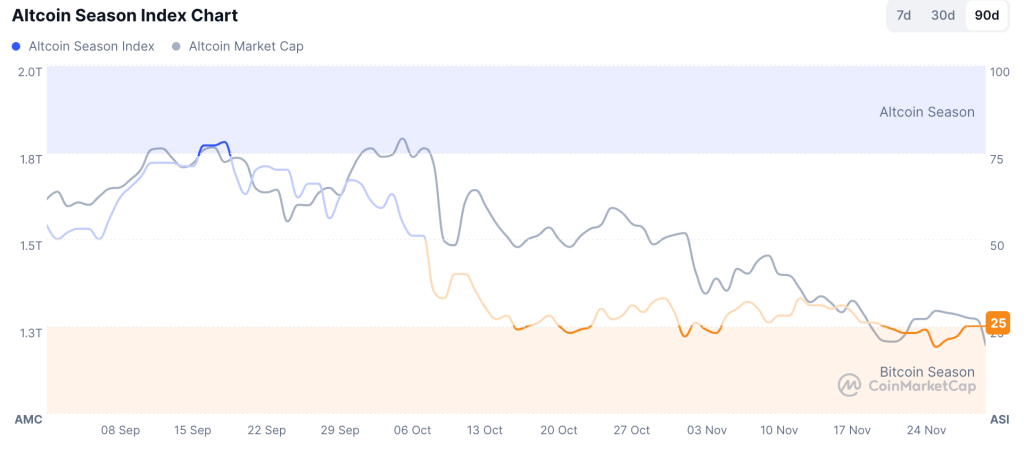
Altcoin Season Index (Source: CoinMarketCap)
A credible turn would show up together rather than in fragments. Order-book depth on the largest BTC and ETH pairs would rebuild into and after the United States session, while spreads would stay contained during moderate selling, and funding would stabilize without leaning on short squeezes that exhaust by the close.
Spot product creations would need to improve alongside a rise in net stablecoin issuance, since that pairing signs fresh cash coming in rather than transient covering. When those flows persist for several sessions, rebounds tend to settle more cleanly at the end of the day.
Central bank remarks that push yields higher or firm the dollar can keep bids soft, and relief rallies risk fading when depth thins and exchange-traded flow does not offset de-risking. The tone across majors still follows Bitcoin, and Bitcoin remains one policy headline away from another test of support.
The post Federal Reserve and Bank of Japan Indicators Hit Crypto, Market Losses Deepen appeared first on Cryptonews.

Japan is preparing to overhaul its cryptocurrency tax rules by introducing a flat 20% levy on trading gains, a move that would place digital assets on the same footing as stocks and other mainstream investments.
Key Takeaways:
The plan, first reported by Nikkei, signals a major shift in how the country treats crypto profits and could ease one of the biggest complaints among local investors.
Under the proposal, income from cryptocurrency trading would no longer be lumped together with salaries or business earnings.
Instead, it would fall under a separate taxation scheme, with 15% of revenue directed to the central government and 5% allocated to prefectural and municipal authorities.
The reform is expected to be written into Japan’s 2026 tax policy outline, due later this year.
At present, profits from digital assets are taxed at progressive rates that can climb as high as 55%, depending on total income.
Critics say this structure discourages selling and distorts trading behavior, as investors try to avoid triggering steep tax bills.
By contrast, gains from equities and investment trusts are already taxed at a uniform 20%.
Japan might become the silent bull for Bitcoin
— Mrmemon
Everyone is asking why BTC is falling
But nobody is looking at Japan and that’s where the real longterm story is building
Japan is about to flip the scriptCrypto reclassified as a financial product
/acc
(@Mrmemon0147) December 1, 2025
Lawmakers backing the proposal argue that lowering the burden could revive trading activity in the domestic market and ultimately lead to higher overall tax revenue.
They also see the reform as a way to encourage innovation across the broader technology sector, including companies building services around blockchain infrastructure.
The effort reflects a wider view in government that cryptocurrencies have evolved into a standard investment category rather than a fringe asset class.
Industry figures show strong participation at the retail level. Data from the Japan Virtual and Crypto Assets Exchange Association indicate there are around eight million active crypto accounts in the country, while spot trading volume in September alone reached approximately 1.5 trillion yen, or $9.6 billion.
If enacted, the change would mark one of the most crypto-friendly tax reforms by a major economy in recent years.
As reported, Nomura Asset Management has formed a cross-division task force to prepare product strategies for a post-regulatory-change environment, while Daiwa Asset Management is coordinating closely with ETF specialist Global X Japan.
Mitsubishi UFJ Asset Management and Amova Asset Management are also evaluating fund lineups for both retail and institutional investors.
Still, practical challenges remain. Asset managers must determine pricing benchmarks, ensure they can acquire crypto quickly enough to match investor flows, and put robust custody and security systems in place. The volatility of digital assets also looms large.
Meanwhile, Japan is preparing a major reset of its crypto rulebook, moving to treat digital assets as financial products subject to insider trading laws and to lower the tax burden on profits.
The Financial Services Agency is drafting measures that would cover 105 cryptocurrencies listed domestically, including Bitcoin and Ethereum.
The post Japan Moves to Impose Flat 20% Tax on Crypto Gains, Matching Stock Market Rates appeared first on Cryptonews.

South Korea is taking a major step toward formalising how won-based stablecoins will be issued and supervised, after lawmakers settled a long-running dispute over who should control the process.
A closed-door meeting brought clarity to the core question of authority, with policymakers agreeing that banks should lead the effort while still allowing tech firms to participate.
The move comes at a time when crypto adoption is rising among people aged 20 to 50, and when global players continue to dominate stablecoin markets.
With a December deadline approaching, officials want to finalise a structure that supports innovation but keeps monetary stability at the centre of regulation.
A Dec. 1 report by Maeli Business Newspaper said lawmakers agreed on a consortium model where banks maintain majority control of stablecoin-issuing entities.
Tech companies will still be able to participate, but financial institutions will take the lead to reduce systemic risks.
The goal is to create a Korean-style stablecoin framework that mirrors the safeguards of traditional finance, with clear rules governing reserves, issuance, and supervision.
The model was designed to align with the Bank of Korea’s concerns about protecting the money supply.
It also provides a common structure for private companies, reducing the risk of fragmented products entering the market without consistent stability mechanisms.
By setting shared standards early, policymakers hope to shape a domestic stablecoin ecosystem that can support innovation without compromising financial security.
Senior Democratic Party lawmaker Kang Joon-hyun said the government must submit its proposal by Dec. 10. If it misses the deadline, lawmakers will move ahead with their own version of the bill.
The aim is to pass the legislation during the National Assembly’s January extraordinary session, after consultation with the ruling People Power Party and the president’s office.
This new act expands on the Digital Asset Basic Act passed earlier this year.
That earlier law established licensing rules for issuers, requirements for reserve protection, and compliance obligations for virtual asset service providers.
The upcoming bill fills in the remaining regulatory gaps by specifying how stablecoins should be managed when they operate like traditional financial instruments.
It also provides clearer guidance for US-based stablecoins such as USDT and USDC, which have become increasingly influential in Korea’s growing digital asset market.
Officials warn that delays could leave Korean companies trailing behind their global competitors.
The US, EU, and Japan strengthened their stablecoin rules in 2025, creating a more defined landscape for exchanges and financial institutions.
Korean regulators want to avoid losing momentum, especially as domestic interest in crypto continues to rise.
The updated framework aims to reduce uncertainty for developers, financial firms, and exchanges.
By bringing digital assets closer to mainstream financial oversight, authorities hope to support responsible growth and give consumers access to well-regulated products.
The focus is on keeping the domestic market aligned with international standards while maintaining space for private-sector innovation.
The meeting also covered planned updates to financial security and capital-market rules.
After recent hacking incidents at major financial companies, officials intend to revise the Electronic Financial Transactions Act.
Proposed changes include tougher penalties and stronger enforcement following cyber breaches.
Lawmakers are also working with opposition parties on a set of capital-market reforms.
These include rules that would require mandatory tender offers in certain corporate situations.
They also plan to update share-allocation standards so that everyday investors have fairer access to offerings.
The goal is to improve transparency and strengthen market integrity as Korea reshapes its financial regulatory environment.
The post South Korea moves to tighten stablecoin rules with a bank-led model appeared first on CoinJournal.

Blockchain analytics platform XWIN Research Japan shares that Bitcoin’s NPRL has returned to a neutral zone following a period of significant volatility. This development represents one of many positives following Bitcoin’s modest price gain over the last week.
The Net Realized Profit and Loss (NRPL) is an on-chain metric that measures the total profit or loss that Bitcoin holders realize when they sell their coins at a given price. A positive NRPL suggests more BTC are being sold at a profit rather than at a loss, i.e., market participants are realizing gains, while a negative NRPL means more BTC are being sold at a loss than at a profit.
According to analysts at XWIN Research Japan, Bitcoin’s NPRL registered significant positive and negative deviations between November 22 and 24. However, the metric has stabilized in its neutral zone since November 25, as Bitcoin achieved a sustained market recovery. At near-zero NRPL, realized gains and losses are roughly balanced, suggesting market indecision or consolidation. This period usually comes after periods of market capitulation, marking a transition from a volatile phase to a calmer market environment.

As earlier stated, the stabilization of NRPL aligns with Bitcoin’s price action, which has recently risen to steady around the $90,000 range. The lack of significant upward or downward pressure suggests that the market is digesting recent volatility and building a foundation for future movements. Analysts at XWIN state similar NRPL neutralization from the past phases has preceded the emergence of new trends, indicating BTC price may be consolidating for a new direction.
Looking ahead, XWIN Research Japan states the critical factor will be whether NRPL maintains its position above the zero line or slips back into negative territory. A sustained positive NRPL would indicate improving demand and healthier inflows, potentially supporting a stronger recovery. Conversely, a return to negative NRPL could signal renewed weakness and the potential for another round of selling pressure.
In summary, the recent pattern, from deep negative swings to positive spikes, followed by convergence near zero, demonstrates that the market’s internal structure has largely reset and has completed its clearing phase for a new price trend to emerge.
At the time of writing, Bitcoin trades at $90,485 after a minor 0.65% loss in the last 24 hours. Meanwhile, its daily trading volume is up by 14.06% and valued at $57.04 billion.

The incident occurred in September, and the Japanese firm has now released its full internal investigation results.
The post Asahi Confirms Cyberattack Exposed Data of 1.5M Customers appeared first on TechRepublic.
The incident occurred in September, and the Japanese firm has now released its full internal investigation results.
The post Asahi Confirms Cyberattack Exposed Data of 1.5M Customers appeared first on TechRepublic.
 Japan’s Defense Minister Shinjiro Koizumi defended the planned deployment of surface-to-air missiles on Yonaguni Island, calling the move a protective measure aimed solely at strengthening the country’s air defense posture. His remarks came after Beijing accused Tokyo of escalating regional tensions. Speaking at a press conference at the Ministry of Defense, Koizumi said the missiles […]
  Japan, the United Kingdom and Italy moved one step closer to a major milestone in their joint next-generation fighter program this week, as the three defense ministers met by video conference to advance the Global Combat Air Program (GCAP). The Japanese Ministry of Defense said the meeting took place on Nov. 25 from 5:00 p.m. […]
  Japan’s Acquisition, Technology & Logistics Agency (ATLA) has released new details on an advanced uncrewed aircraft research program designed to enable future drones to operate alongside manned combat aircraft. The update comes after ATLA published footage on Nov. 21 showing flight tests involving an experimental uncrewed aircraft and a manned helicopter. According to ATLA’s Aeronautical […]
 Bitcoin Magazine
Japan Moves to Mandate Reserves for Crypto Exchanges as Hacks Mount
Japan is preparing another major tightening of its digital-asset rulebook, with the Financial Services Agency (FSA) planning to require crypto exchanges to set aside liability reserves to compensate customers in the event of hacks, operational failures, or bankruptcies, according to reporting from Nikkei.
The proposal marks a shift in how Japan views the risks attached to digital-asset custody. Exchanges are already required to store customer crypto in cold wallets — a measure meant to reduce the chance of theft because the assets are kept offline.
But under current law, firms have no obligation to hold reserve funds if losses occur despite these safeguards. Regulators now see that gap as unacceptable, particularly after repeated high-profile breaches.
The FSA aims to submit legislation to parliament in 2026. If passed, exchanges would need to build reserve balances similar to those maintained by traditional securities firms, which typically set aside between ¥2 billion and ¥40 billion depending on trading volumes.
Those benchmarks, along with the history of crypto-asset leaks, will guide the FSA in determining appropriate thresholds for digital-asset platforms.
To ease the financial burden, the agency is considering allowing exchanges to meet part of the requirement through insurance. That approach mirrors policies in the European Union and Hong Kong, both of which have introduced capital and insurance mandates for crypto platforms following their own surge in security incidents.
Japan’s shift is informed by a painful track record. In May 2024, DMM Bitcoin lost ¥48.2 billion in bitcoin — one of the largest exchange breaches in the country since Mt. Gox. In February 2025, Bybit lost roughly $1.46 billion in a global hack.
Those events renewed questions about whether cold-wallet rules alone are enough, especially as exchanges increasingly outsource technology and operational functions to external vendors.
The reforms extend beyond reserves. The FSA wants a legal framework that ensures customer assets can be swiftly returned if an exchange collapses or loses managerial control.
That means stricter asset segregation and clearer authority for court-appointed administrators to return funds directly to users.
Regulators are also weighing a broader reclassification of crypto assets under the Financial Instruments and Exchange Act, reflecting their evolution from payment tools into speculative investment products. Such a shift would trigger insider-trading bans, enhanced disclosure rules, and more rigorous custody audits — effectively pulling crypto closer to the standards applied to securities firms.
Japan is also moving in parallel on adjacent fronts. The FSA is considering a registration system for third-party custodians and technology providers, tightening oversight of the wider ecosystem that supports exchanges.
Meanwhile, domestic financial institutions continue to deepen their involvement: JPYC recently launched what it calls the world’s first fully redeemable yen-pegged stablecoin, and major asset managers are preparing the country’s first crypto-based investment trusts.
Taken together, the planned reserve requirement and the broader regulatory overhaul signal Japan’s intent to fortify its crypto market while encouraging institutional participation.
Earlier this year, Japan’s Financial Services Agency (FSA) finalized a major plan to reclassify 105 cryptocurrencies — including bitcoin — as financial products under the Financial Instruments and Exchange Act. The shift would impose the same disclosure, reporting, and market-surveillance rules that govern traditional securities.
Exchanges would need to publish detailed data on each token’s issuer, blockchain design, and volatility, while new insider-trading rules would bar issuers and exchange executives from trading on non-public information such as upcoming listings or bankruptcies. The amendments are slated for submission during the 2026 Diet session.
The FSA is also pushing a sweeping tax overhaul. Today’s crypto profits are taxed as “miscellaneous income” at rates up to 55%, but the agency wants a flat 20% rate, matching equities. The change could arrive in 2026 and would apply to individuals and institutions. The moves come as Japan accelerates its Web3 push, including reconsidering rules that restrict banks from holding or offering crypto.
This post Japan Moves to Mandate Reserves for Crypto Exchanges as Hacks Mount first appeared on Bitcoin Magazine and is written by Micah Zimmerman.
 Japan scrambled fighter jets on Monday after a Chinese high-altitude surveillance drone passed between Yonaguni Island and Taiwan, prompting a response from the Japan Air Self-Defense Force’s (JASDF) Southwest Air Defense sector. According to the official statement from the Joint Staff Office of Japan’s Ministry of Defense, “On Monday, November 24, a presumed Chinese unmanned […]
  The Japan Ground Self-Defense Force (JGSDF) and the British Army completed Exercise Vigilant Isles 25 in Hokkaido, conducting expanded training that included the first-ever joint Japan–UK airborne drop on Japanese territory. The exercise ran from November 5 to November 20 and brought together Japanese airborne and amphibious forces with British paratroopers from the 2nd Battalion, […]
  In a rare diplomatic turn, Chinese leader Xi Jinping initiated a call with President Trump on Monday, raising Taiwan and Ukraine as Washington, Kyiv and Moscow explore options for ending the war in Europe. The outreach comes as Beijing sharpens its position on Taiwan and new friction with Japan adds pressure to the regional landscape. […]