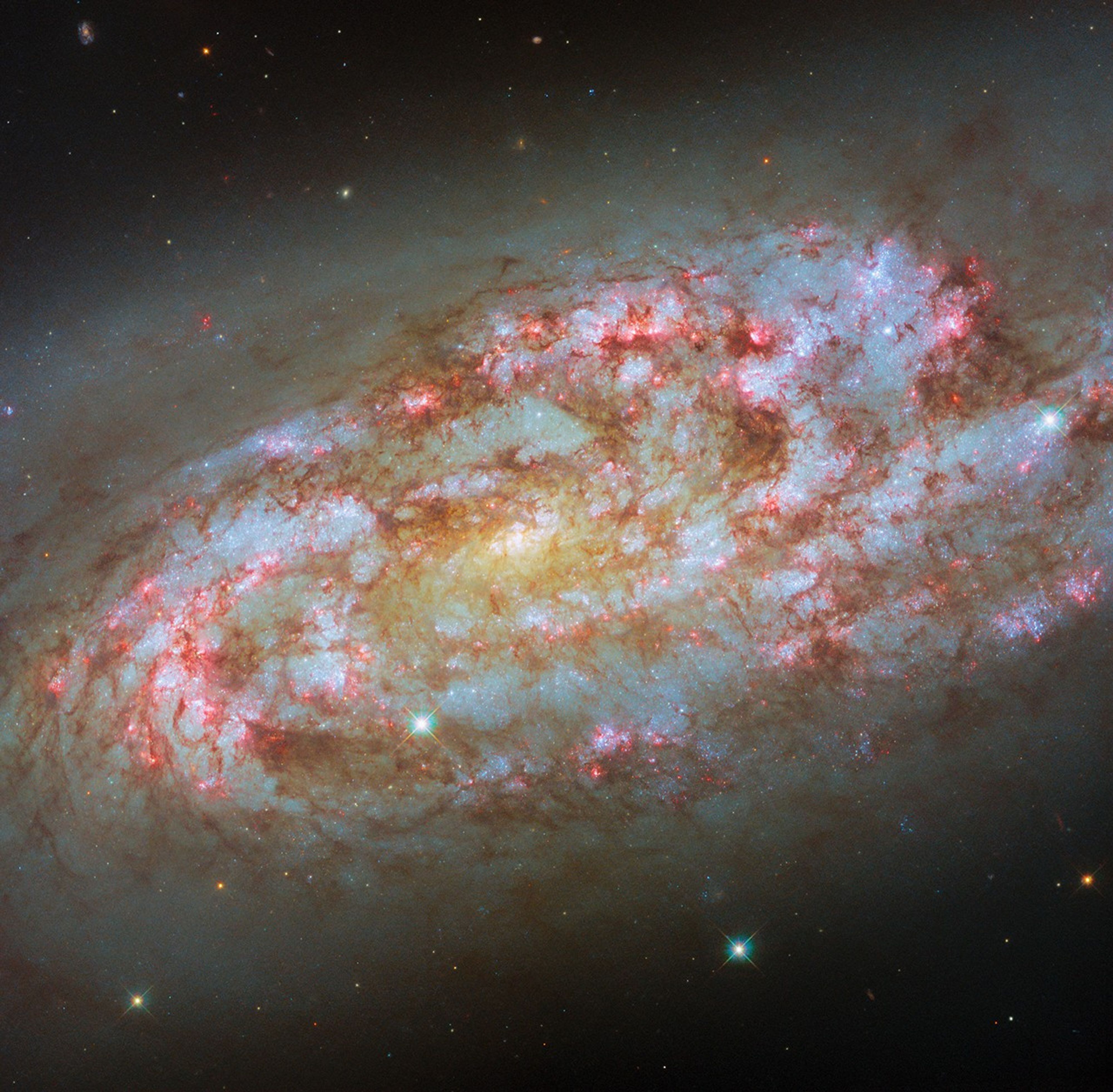
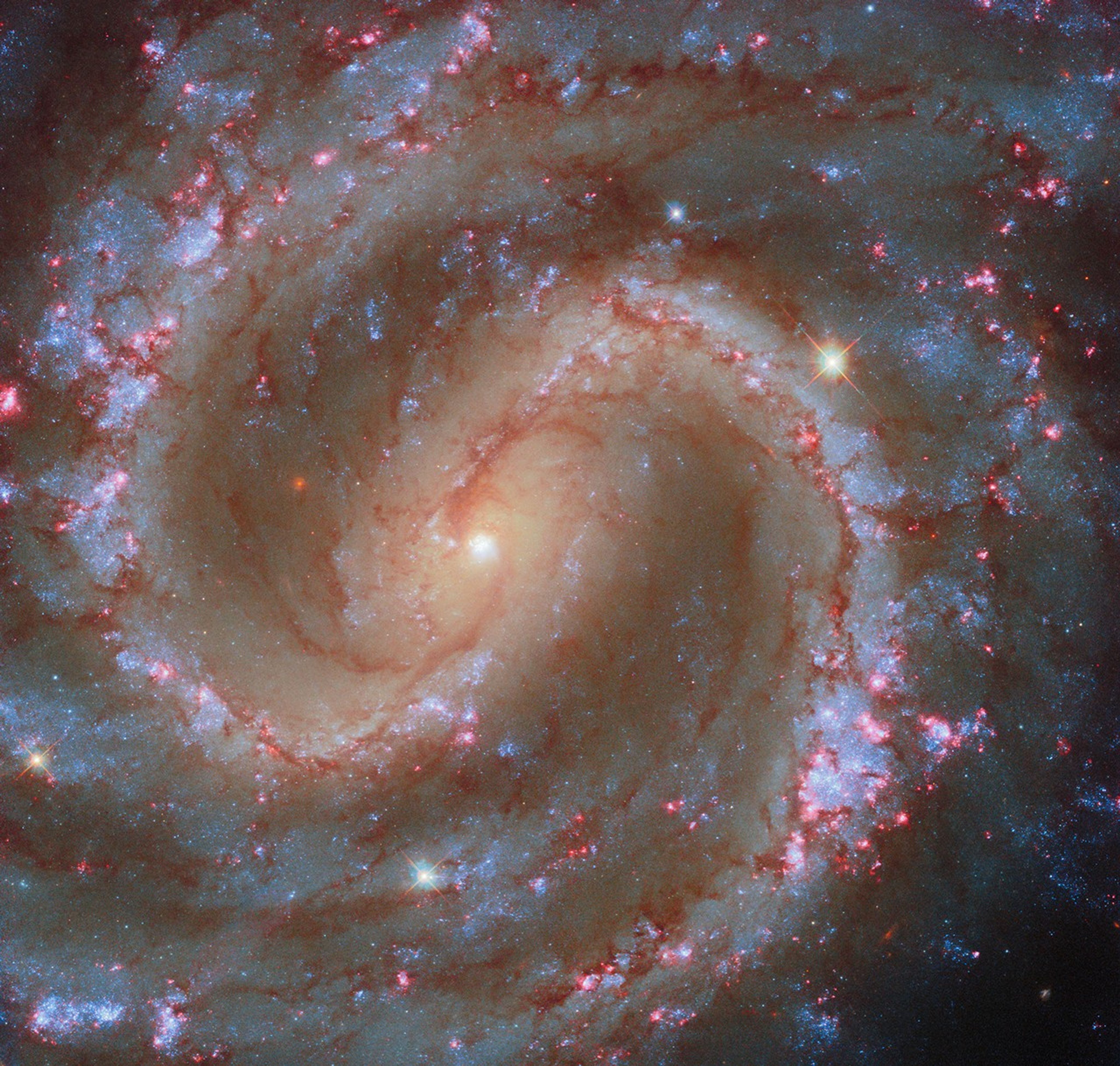
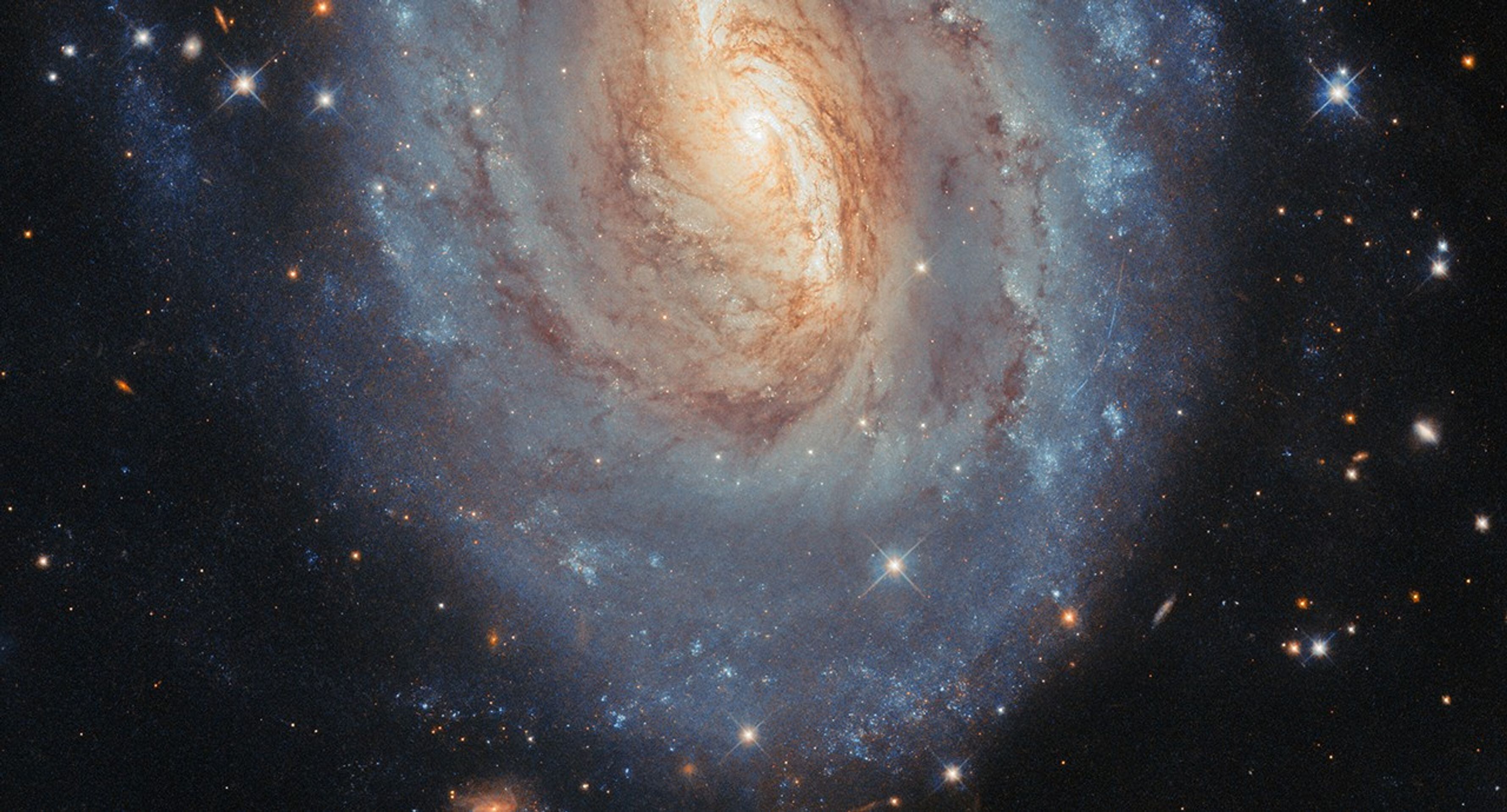
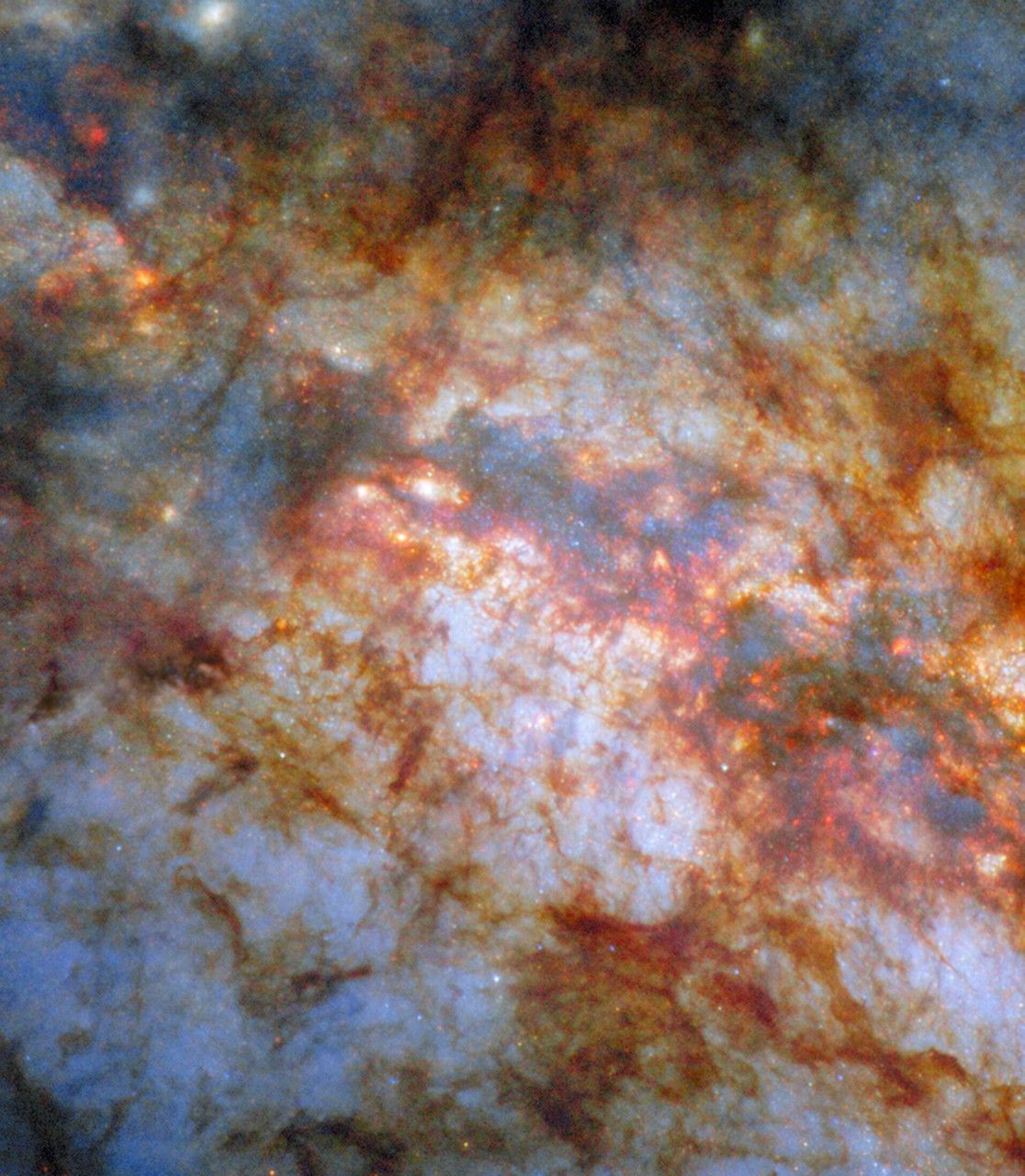
This NASA/ESA Hubble Space Telescope image features the spiral galaxy named NGC 1792.
ESA/Hubble & NASA, D. Thilker, F. Belfiore, J. Lee and the PHANGS-HST Team
This NASA/ESA Hubble Space Telescope image features a stormy and highly active spiral galaxy named NGC 1792. Located over 50 million light-years from Earth in the constellation Columba (the Dove), the bright glow of the galaxy’s center is offset by the flocculent and sparkling spiral arms swirling around it.
NGC 1792 is just as fascinating to astronomers as its chaotic look might imply. Classified as a starburst galaxy, it is a powerhouse of star formation, with spiral arms rich in star-forming regions. In fact, it is surprisingly luminous for its mass. The galaxy is close to a larger neighbor, NGC 1808, and astronomers think the strong gravitational interaction between the two stirred up the reserves of gas in this galaxy. The result is a torrent of star formation, concentrated on the side closest to its neighbor, where gravity has a stronger effect. NGC 1792 is a perfect target for astronomers seeking to understand the complex interactions between gas, star clusters, and supernovae in galaxies.
Hubble studied this galaxy before. This new image includes additional data collected throughout 2025, providing a deeper view of the tumultuous activity taking place in the galaxy. Blossoming red lights in the galaxy’s arms mark Hydrogen-alpha (H-alpha) emission from dense clouds of hydrogen molecules. The newly forming stars within these clouds shine powerfully with ultraviolet radiation. This intense radiation ionizes the hydrogen gas, stripping away electrons which causes the gas to emit H-alpha light. H-alpha is a very particular red wavelength of light and a tell-tale sign of new stars.
NASA-JAXA XRISM Finds Elemental Bounty in Supernova Remnant
For the first time, scientists have made a clear X-ray detection of chlorine and potassium in the wreckage of a star using data from the Japan-led XRISM (X-ray Imaging and Spectroscopy Mission) spacecraft.
The Resolve instrument aboard XRISM, pronounced “crism,” discovered these elements in a supernova remnant called Cassiopeia A or Cas A, for short. The expanding cloud of debris is located about 11,000 light-years away in the northern constellation Cassiopeia.
“This discovery helps illustrate how the deaths of stars and life on Earth are fundamentally linked,” said Toshiki Sato, an astrophysicist at Meiji University in Tokyo. “Stars appear to shimmer quietly in the night sky, but they actively forge materials that form planets and enable life as we know it. Now, thanks to XRISM, we have a better idea of when and how stars might make crucial, yet harder-to-find, elements.”
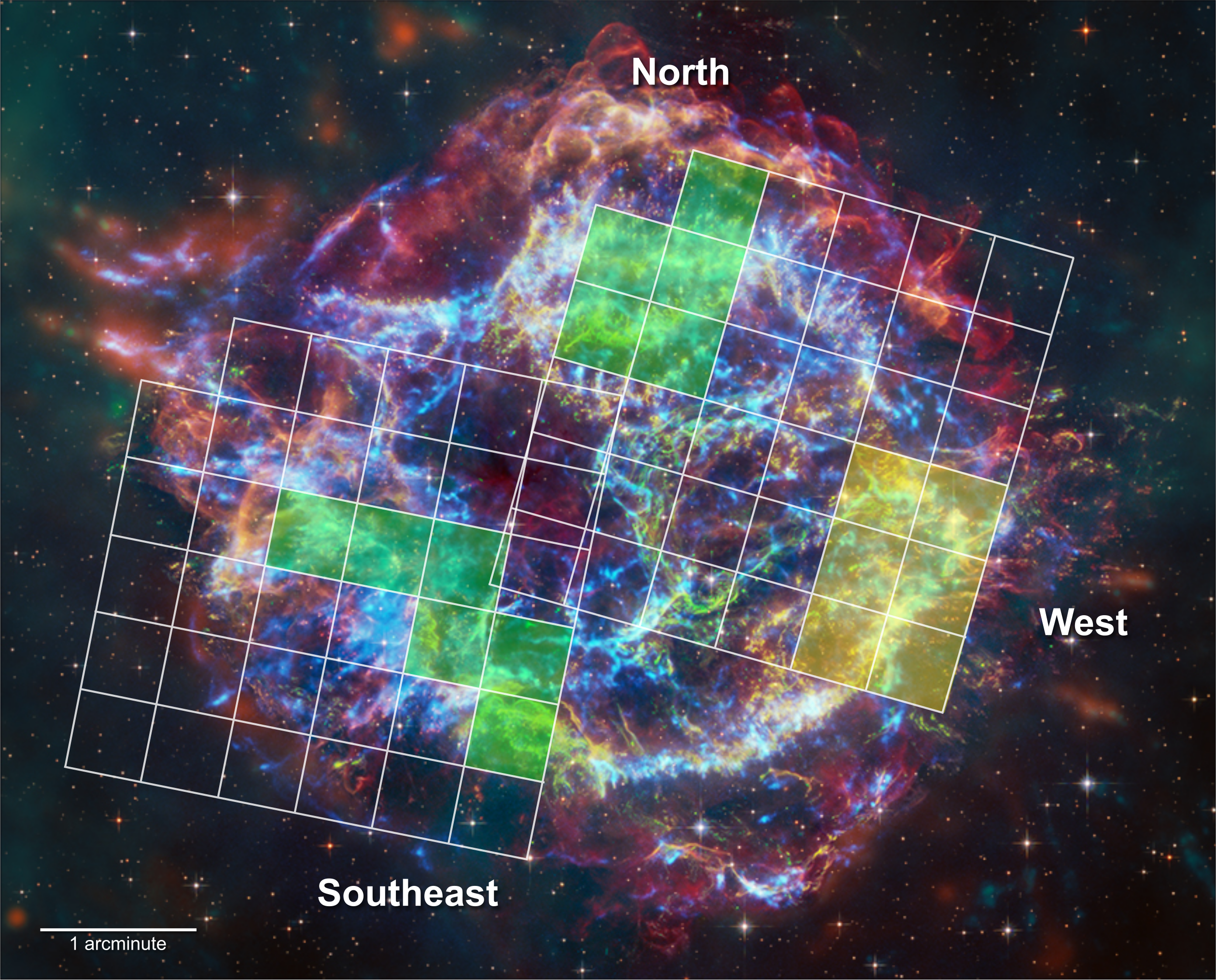
Observations of the Cassiopeia A supernova remnant by the Resolve instrument aboard the NASA-JAXA XRISM (X-ray Imaging and Spectroscopy Mission) spacecraft revealed strong evidence for potassium (green squares) in the southeast and northern parts of the remnant. Grids superposed on a multiwavelength image of the remnant represent the fields of view of two Resolve measurements made in December 2023. Each square represents one pixel of Resolve’s detector. Weaker evidence of potassium (yellow squares) in the west suggests that the original star may have had underlying asymmetries before it exploded.
NASA’s Goddard Space Flight Center; X-ray: NASA/CXC/SAO; Optical: NASA/ESA/STScI; IR: NASA/ESA/CSA/STScI/Milisavljevic et al., NASA/JPL/CalTech; Image Processing: NASA/CXC/SAO/J. Schmidt and K. Arcand
Stars produce almost all the elements in the universe heavier than hydrogen and helium through nuclear reactions. Heat and pressure fuse lighter ones, like carbon, into progressively heavier ones, like neon, creating onion-like layers of materials in stellar interiors.
Nuclear reactions also take place during explosive events like supernovae, which occur when stars run out of fuel, collapse, and explode. Elemental abundances and locations in the wreckage can, respectively, tell scientists about the star and its explosion, even after hundreds or thousands of years.
Some elements — like oxygen, carbon, and neon — are more common than others and are easier to detect and trace back to a particular part of the star’s life.
Other elements — like chlorine and potassium — are more elusive. Since scientists have less data about them, it’s more difficult to model where in the star they formed. These rarer elements still play important roles in life on Earth. Potassium, for example, helps the cells and muscles in our bodies function, so astronomers are interested in tracing its cosmic origins.
The roughly circular Cas A supernova remnant spans about 10 light-years, is over 340 years old, and has a superdense neutron star at its center — the remains of the original star’s core. Scientists using NASA’s Chandra X-ray Observatory had previously identified signatures of iron, silicon, sulfur, and other elements within Cas A.
In the hunt for other elements, the team used the Resolve instrument aboard XRISM to look at the remnant twice in December 2023. The researchers were able to pick out the signatures for chlorine and potassium, determining that the remnant contains ratios much higher than expected. Resolve also detected a possible indication of phosphorous, which was previously discovered in Cas A by infrared missions.
Watch to learn more about how the Resolve instrument aboard XRISM captures extraordinary data on the make-up of galaxy clusters, exploded stars, and more using only 36 pixels. Credit: NASA’s Goddard Space Flight Center
“Resolve’s high resolution and sensitivity make these kinds of measurements possible,” said Brian Williams, the XRISM project scientist at NASA’s Goddard Space Flight Center in Greenbelt, Maryland. “Combining XRISM’s capabilities with those of other missions allows scientists to detect and measure these rare elements that are so critical to the formation of life in the universe.”
The astronomers think stellar activity could have disrupted the layers of nuclear fusion inside the star before it exploded. That kind of upheaval might have led to persistent, large-scale churning of material inside the star that created conditions where chlorine and potassium formed in abundance.
The scientists also mapped the Resolve observations onto an image of Cas A captured by Chandra and showed that the elements were concentrated in the southeast and northern parts of the remnant.
This lopsided distribution may mean that the star itself had underlying asymmetries before it exploded, which Chandra data indicated earlier this year in a study Sato led.
“Being able to make measurements with good statistical precision of these rarer elements really helps us understand the nuclear fusion that goes on in stars before and during supernovae,” said co-author Paul Plucinsky, an astrophysicist at the Center for Astrophysics | Harvard & Smithsonian in Cambridge, Massachusetts. “We suspected a key part might be asymmetry, and now we have more evidence that’s the case. But there’s still a lot we just don’t understand about how stars explode and distribute all these elements across the cosmos.”
NASA’s next big eye on the cosmos is now fully assembled. On Nov. 25, technicians joined the inner and outer portions of the Nancy Grace Roman Space Telescope in the largest clean room at the agency’s Goddard Space Flight Center in Greenbelt, Maryland.
NASA’s Nancy Grace Roman Space Telescope is now fully assembled following the integration of its two major segments on Nov. 25 at the agency’s Goddard Space Flight Center in Greenbelt, Md. The mission is slated to launch by May 2027, but the team is on track for launch as early as fall 2026.
Credit: NASA/Jolearra Tshiteya
“Completing the Roman observatory brings us to a defining moment for the agency,” said NASA Associate Administrator Amit Kshatriya. “Transformative science depends on disciplined engineering, and this team has delivered—piece by piece, test by test—an observatory that will expand our understanding of the universe. As Roman moves into its final stage of testing following integration, we are focused on executing with precision and preparing for a successful launch on behalf of the global scientific community.”
After final testing, Roman will move to the launch site at NASA’s Kennedy Space Center in Florida for launch preparations in summer 2026. Roman is slated to launch by May 2027, but the team is on track for launch as early as fall 2026. A SpaceX Falcon Heavy rocket will send the observatory to its final destination a million miles from Earth.
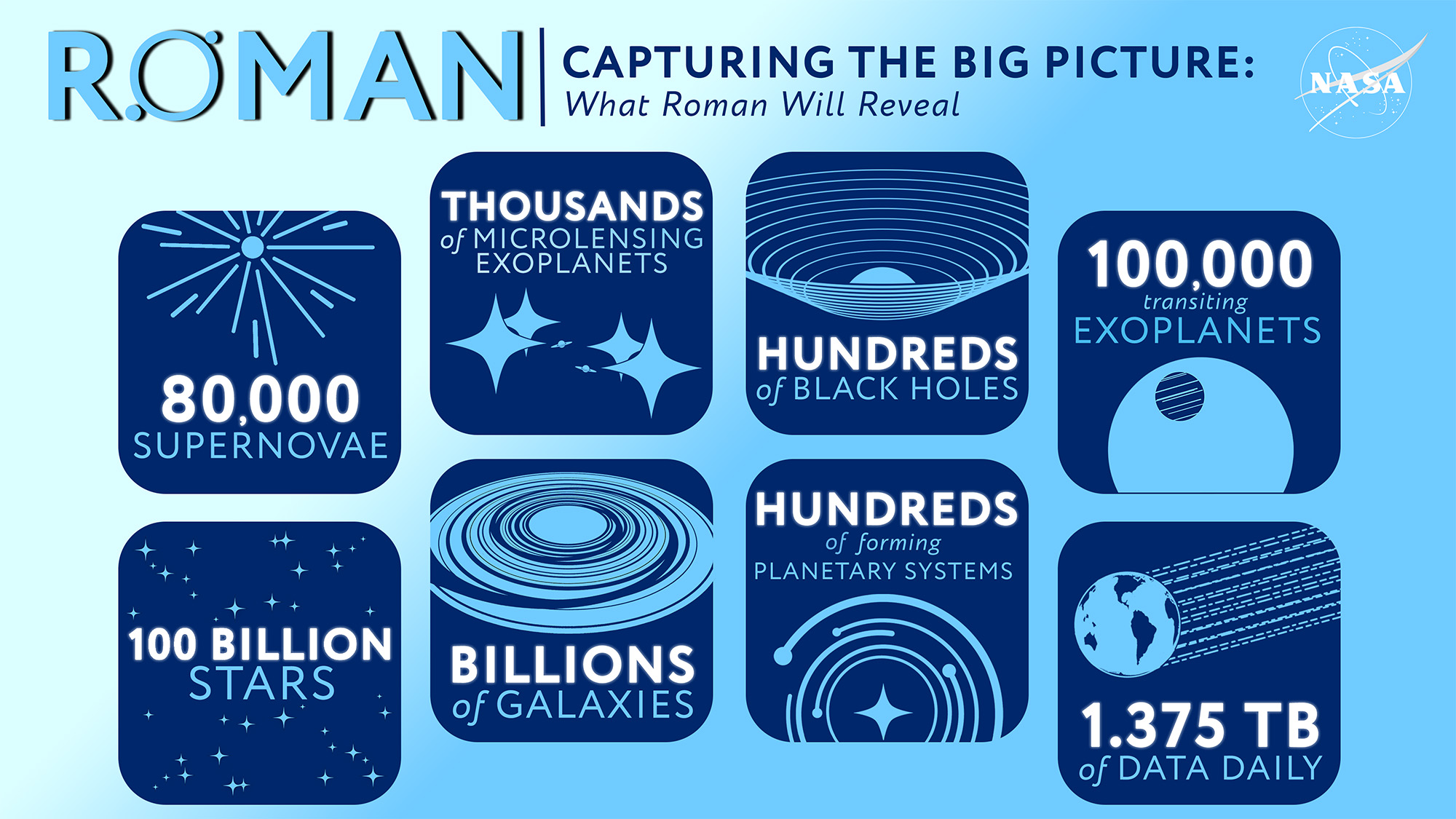
“With Roman’s construction complete, we are poised at the brink of unfathomable scientific discovery,” said Julie McEnery, Roman’s senior project scientist at NASA Goddard. “In the mission’s first five years, it’s expected to unveil more than 100,000 distant worlds, hundreds of millions of stars, and billions of galaxies. We stand to learn a tremendous amount of new information about the universe very rapidly after Roman launches.”
NASA’s Nancy Grace Roman Space Telescope will survey vast swaths of sky during its five-year primary mission. During that time, scientists expect it to see an incredible number of new objects, including stars, galaxies, black holes and planets outside our solar system, known as exoplanets. This infographic previews some of the discoveries scientists anticipate from Roman’s data deluge.
Credit: NASA’s Goddard Space Flight Center
Observing from space will make Roman very sensitive to infrared light — light with a longer wavelength than our eyes can see — from far across the cosmos. Pairing its crisp infrared vision with a sweeping view of space will allow astronomers to explore myriad cosmic topics, from dark matter and dark energy to distant worlds and solitary black holes, and conduct research that would take hundreds of years using other telescopes.
“Within our lifetimes, a great mystery has arisen about the cosmos: why the expansion of the universe seems to be accelerating. There is something fundamental about space and time we don’t yet understand, and Roman was built to discover what it is,” said Nicky Fox, associate administrator, Science Mission Directorate, NASA Headquarters in Washington. “With Roman now standing as a complete observatory, which keeps the mission on track for a potentially early launch, we are a major step closer to understanding the universe as never before. I couldn’t be prouder of the teams that have gotten us to this point.”
The coronagraph will demonstrate new technologies for directly imaging planets around other stars. It will block the glare from distant stars and make it easier for scientists to see the faint light from planets in orbit around them. The Coronagraph aims to photograph worlds and dusty disks around nearby stars in visible light to help us see giant worlds that are older, colder, and in closer orbits than the hot, young super-Jupiters direct imaging has mainly revealed so far.
“The question of ‘Are we alone?’ is a big one, and it’s an equally big task to build tools that can help us answer it,” said Feng Zhao, the Roman Coronagraph Instrument manager at NASA’s Jet Propulsion Laboratory in Southern California. “The Roman Coronagraph is going to bring us one step closer to that goal. It’s incredible that we have the opportunity to test this hardware in space on such a powerful observatory as Roman.”
The coronagraph team will conduct a series of pre-planned observations for three months spread across the mission’s first year-and-a-half of operations, after which the mission may conduct additional observations based on scientific community input.
The Wide Field Instrument is a 288-megapixel camera that will unveil the cosmos all the way from our solar system to near the edge of the observable universe. Using this instrument, each Roman image will capture a patch of the sky bigger than the apparent size of a full moon. The mission will gather data hundreds of times faster than NASA’s Hubble Space Telescope, adding up to 20,000 terabytes (20 petabytes) over the course of its five-year primary mission.
“The sheer volume of the data Roman will return is mind-boggling and key to a host of exciting investigations,” said Dominic Benford, Roman’s program scientist at NASA Headquarters.
Over the course of several hours, technicians meticulously connected the inner and outer segments of NASA’s Nancy Grace Roman Space Telescope, as shown in this time-lapse. Next, Roman will undergo final testing prior to moving to the launch site at NASA’s Kennedy Space Center in Florida for launch preparations in summer 2026.
Credit: NASA/Sophia Roberts
Survey trifecta
Using the Wide Field Instrument, Roman will conduct three core surveys which will account for 75% of the primary mission. The High-Latitude Wide-Area Survey will combine the powers of imaging and spectroscopy to unveil more than a billion galaxies strewn across a wide swath of space and time. Astronomers will trace the evolution of the universe to probe dark matter — invisible matter detectable only by how its gravity affects things we can see — and trace the formation of galaxies and galaxy clusters over time.
The High-Latitude Time-Domain Survey will probe our dynamic universe by observing the same region of the cosmos repeatedly. Stitching these observations together to create movies will allow scientists to study how celestial objects and phenomena change over time periods of days to years. That will help astronomers study dark energy — the mysterious cosmic pressure thought to accelerate the universe’s expansion — and could even uncover entirely new phenomena that we don’t yet know to look for.
Roman’s Galactic Bulge Time-Domain Survey will look inward to provide one of the deepest views ever of the heart of our Milky Way galaxy. Astronomers will watch hundreds of millions of stars in search of microlensing signals — gravitational boosts of a background star’s light caused by the gravity of an intervening object. While astronomers have mainly discovered star-hugging worlds, Roman’s microlensing observations can find planets in the habitable zone of their star and farther out, including worlds like every planet in our solar system except Mercury. Microlensing will also reveal rogue planets—worlds that roam the galaxy untethered to a star — and isolated black holes. The same dataset will reveal 100,000 worlds that transit, or pass in front of, their host stars.
The remaining 25% of Roman’s five-year primary mission will be dedicated to other observations that will be determined with input from the broader scientific community. The first such program, called the Galactic Plane Survey, has already been selected.
Because Roman’s observations will enable such a wide range of science, the mission will have a General Investigator Program designed to support astronomers to reveal scientific discoveries using Roman data. As part of NASA’s commitment to Gold Standard Science, NASA will make all of Roman’s data publicly available with no exclusive use period. This ensures multiple scientists and teams can use data at the same time, which is important since every Roman observation will address a wealth of science cases.
NASA’s freshly assembled Nancy Grace Roman Space Telescope will revolutionize our understanding of the universe with its deep, crisp, sweeping infrared views of space. The mission will transform virtually every branch of astronomy and bring us closer to understanding the mysteries of dark energy, dark matter, and how common planets like Earth are throughout our galaxy. Roman is on track for launch by May 2027, with teams working toward a launch as early as fall 2026. Credit: NASA’s Goddard Space Flight Center
Roman’s namesake — Dr. Nancy Grace Roman, NASA’s first chief astronomer — made it her personal mission to make cosmic vistas readily accessible to all by paving the way for telescopes based in space.
“The mission will acquire enormous quantities of astronomical imagery that will permit scientists to make groundbreaking discoveries for decades to come, honoring Dr. Roman’s legacy in promoting scientific tools for the broader community,” said Jackie Townsend, Roman’s deputy project manager at NASA Goddard. “I like to think Dr. Roman would be extremely proud of her namesake telescope and thrilled to see what mysteries it will uncover in the coming years.”
The Nancy Grace Roman Space Telescope is managed at NASA’s Goddard Space Flight Center in Greenbelt, Maryland, with participation by NASA’s Jet Propulsion Laboratory in Southern California; Caltech/IPAC in Pasadena, California; the Space Telescope Science Institute in Baltimore; and a science team comprising scientists from various research institutions. The primary industrial partners are BAE Systems Inc. in Boulder, Colorado; L3Harris Technologies in Rochester, New York; and Teledyne Scientific & Imaging in Thousand Oaks, California.
The highlight of the year, the Geminids are the most active and colorful meteor shower, offering the chance to see hundreds of shooting stars every hour when they peak in mid-December.
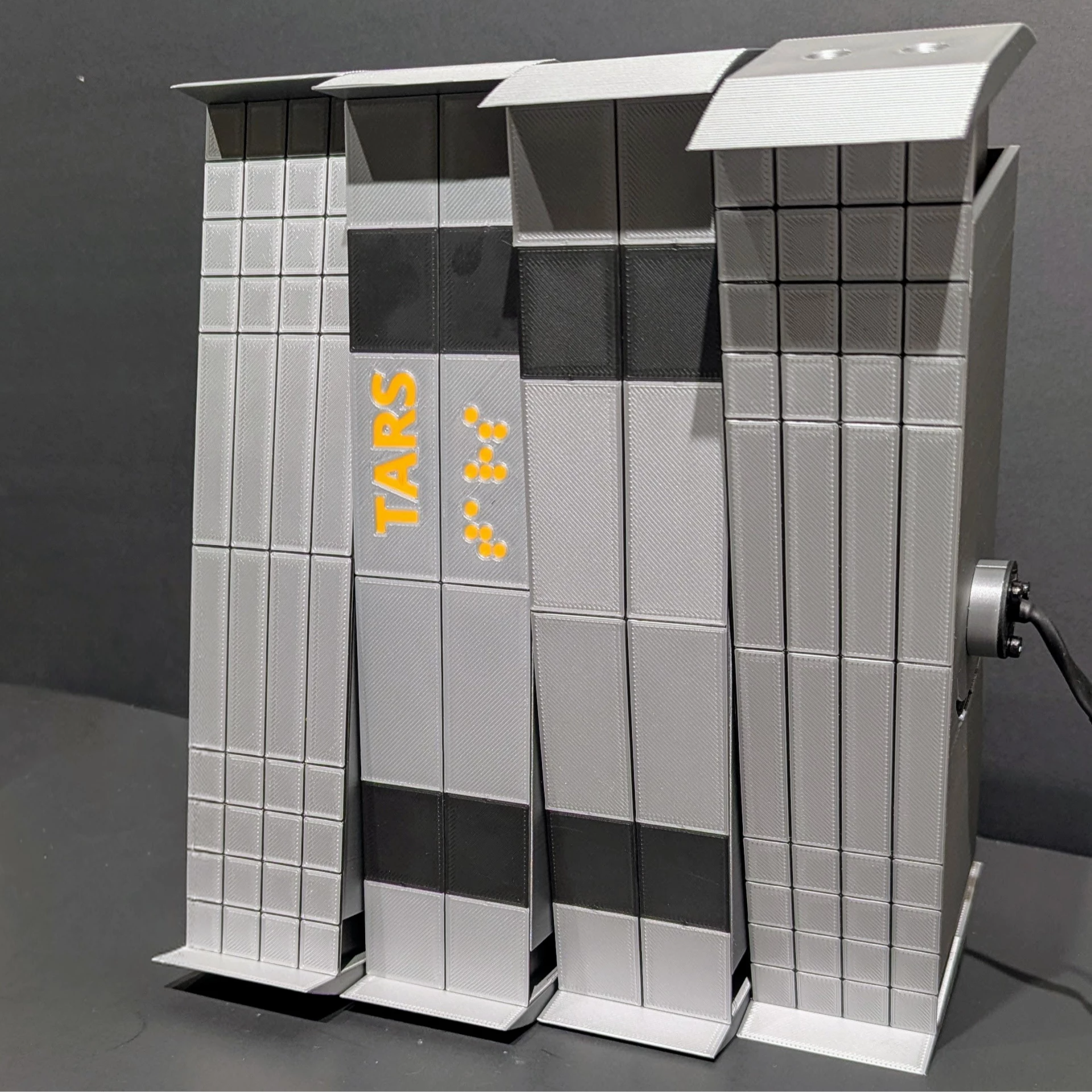
[Aditya Sripada] and [Abhishek Warrier]’s TARS3D robot came from asking what it would take to make a robot with the capabilities of TARS, the robotic character from Interstellar. We couldn’t find a repository of CAD files or code but the research paper for TARS3D explains the principles, which should be enough to inspire a motivated hacker.
What makes TARS so intriguing is the simple-looking structure combined with distinct and effective gaits. TARS is not a biologically-inspired design, yet it can walk and perform a high-speed roll. Making real-world version required not only some inspired mechanical design, but also clever software with machine learning.
[Aditya] and [Abhishek] created TARS3D as a proof of concept not only of how such locomotion can be made to work, but also as a way to demonstrate that unconventional body and limb designs (many of which are sci-fi inspired) can permit gaits that are as effective as they are unusual.
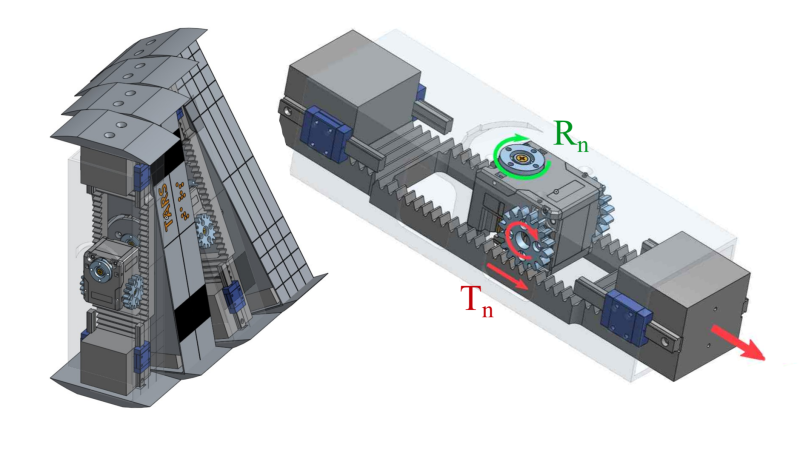
TARS3D is made up of four side-by-side columns that can rotate around a shared central ‘hip’ joint as well as shift in length. In the movie, TARS is notably flat-footed but [Aditya] found that this was unsuitable for rolling, so TARS3D has curved foot plates.
The rolling gait is pretty sensitive to terrain variations, but the walking gait proved to be quite robust. All in all it’s a pretty interesting platform that does more than just show a TARS-like dual gait robot can be made to actually work. It also demonstrates the value of reinforcement learning for robot gaits.
A brief video is below in which you can see the bipedal walk in action. Not that long ago, walking robots were a real challenge but with the tools available nowadays, even a robot running a 5k isn’t crazy.
This NASA/ESA Hubble Space Telescope image features the spiral galaxy NGC 4535.
ESA/Hubble & NASA, F. Belfiore, J. Lee and the PHANGS-HST Team
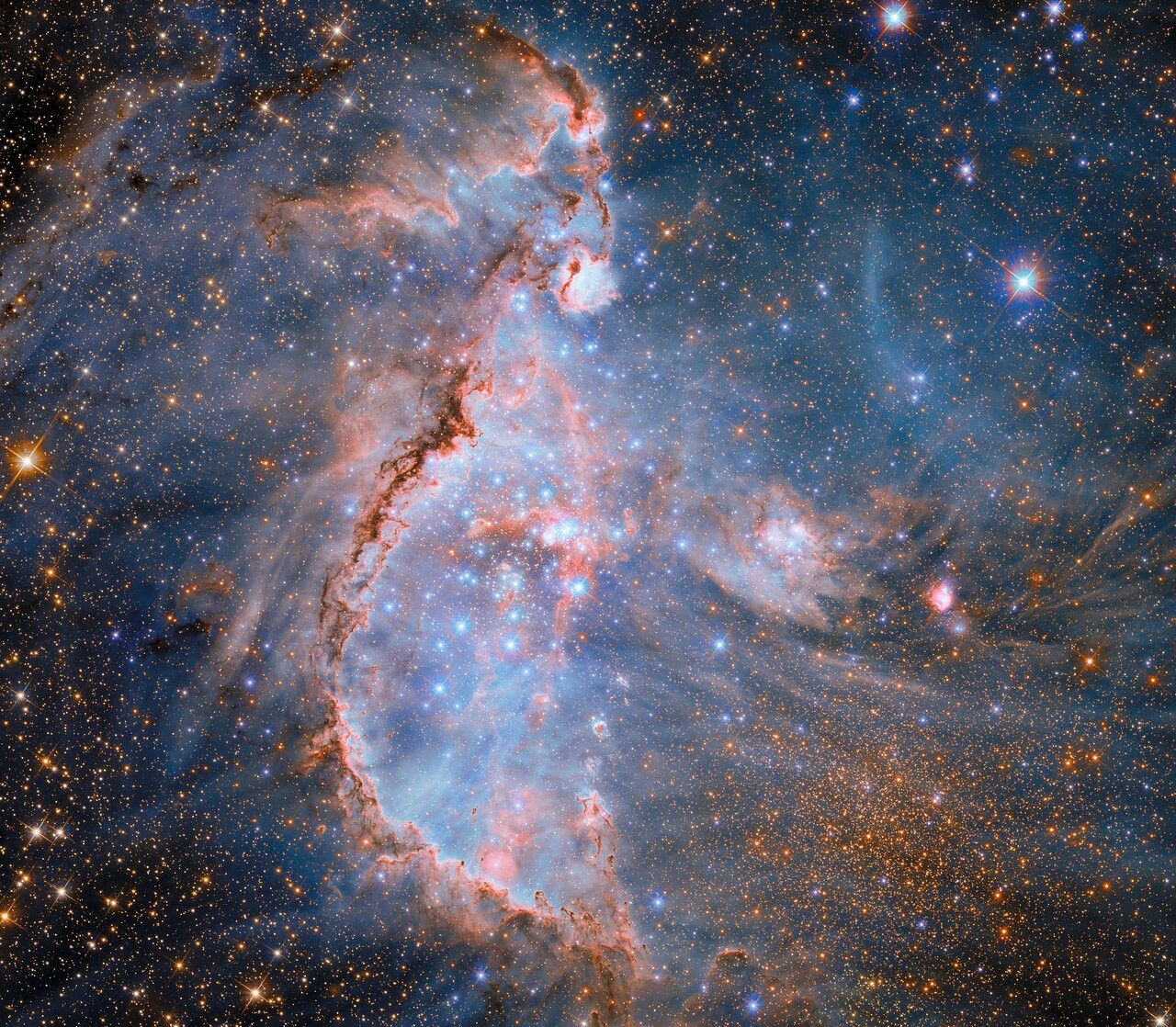
Today’s NASA/ESA Hubble Space Telescope image features the spiral galaxy NGC 4535, which is situated about 50 million light-years away in the constellation Virgo (the Maiden). Through a small telescope, this galaxy appears extremely faint, giving it the nickname ‘Lost Galaxy’. With a mirror spanning nearly eight feet (2.4 meters) across and its location above Earth’s light-obscuring atmosphere, Hubble can easily observe dim galaxies like NGC 4535 and pick out features like its massive spiral arms and central bar of stars.
This image features NGC 4535’s young star clusters, which dot the galaxy’s spiral arms. Glowing-pink clouds surround many of these bright-blue star groupings. These clouds, called H II (‘H-two’) regions, are a sign that the galaxy is home to especially young, hot, and massive stars that blaze with high-energy radiation. Such massive stars shake up their surroundings by heating their birth clouds with powerful stellar winds, eventually exploding as supernovae.
The image incorporates data from an observing program designed to catalog roughly 50,000 H II regions in nearby star-forming galaxies like NGC 4535. Hubble released a previous image of NGC 4535 in 2021. Both the 2021 image and this new image incorporate observations from the PHANGS observing program, which seeks to understand the connections between young stars and cold gas. Today’s image adds a new dimension to our understanding of NGC 4535 by capturing the brilliant red glow of the nebulae that encircle massive stars in their first few million years of life.
A team of researchers has confirmed stars ring loud and clear in a “key” that will harmonize well with the science goals and capabilities of NASA’s upcoming Nancy Grace Roman Space Telescope.
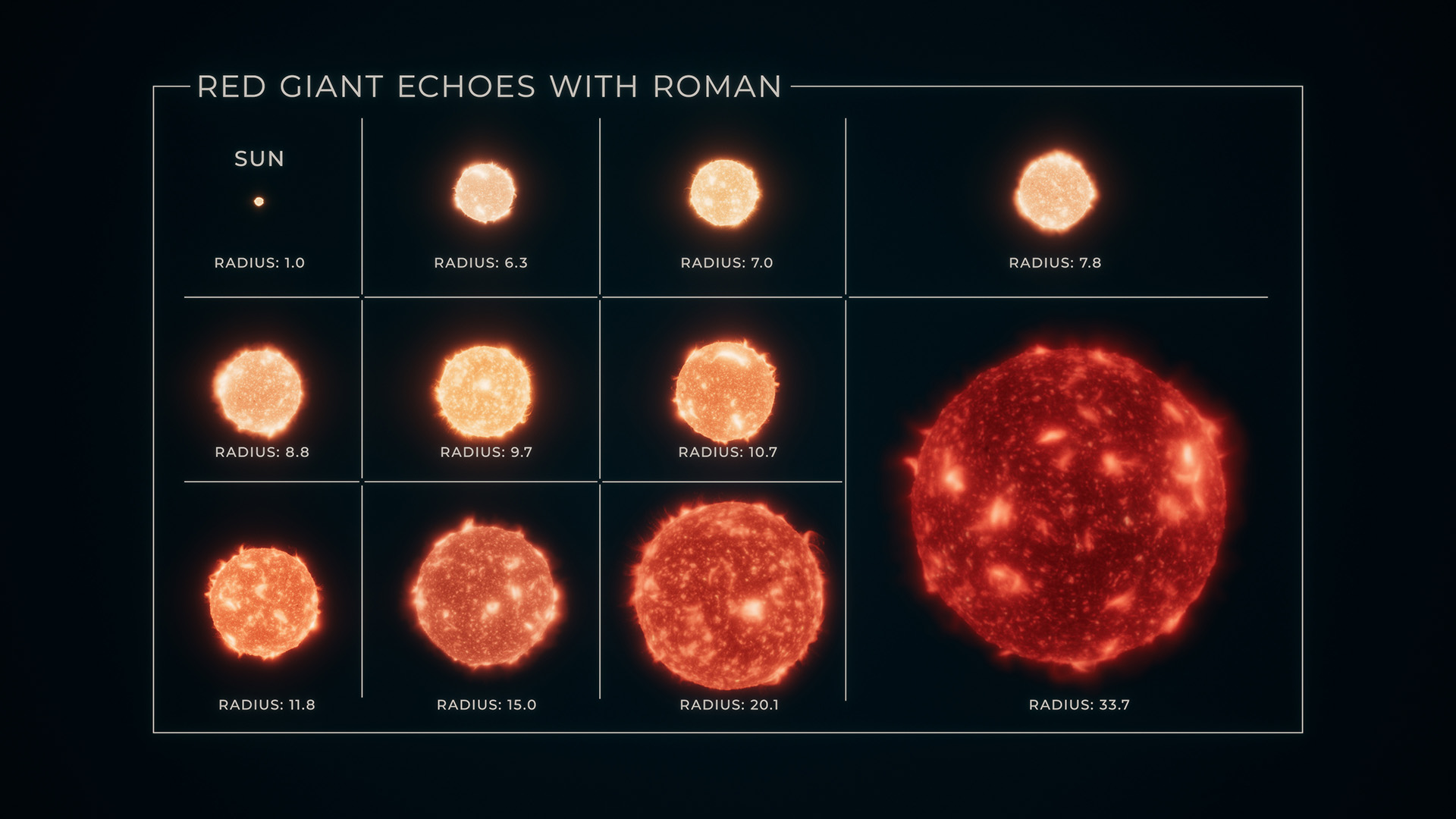
This artist’s concept visualizes the Sun and several red giant stars of varying radii. NASA’s upcoming Nancy Grace Roman Space Telescope will be well suited for studying red giant stars with a method known as asteroseismology. This approach entails studying the changes in stars’ overall brightness, which is caused by their turbulent interiors creating waves and oscillations. With asteroseismic detections, astronomers can learn about stars’ ages, masses, and sizes. Scientists estimate Roman will be able to detect a total of 300,000 red giant stars with this method. This would be the largest sample of its kind ever collected.
Credit: NASA, STScI, Ralf Crawford (STScI)
Stars’ turbulent natures produce waves that cause fluctuations in their overall brightness. By studying these changes — a method called asteroseismology — scientists can glean information about stars’ ages, masses, and sizes. These shifts in brightness were perceptible to NASA’s Kepler space telescope, which provided asteroseismic data on approximately 16,000 stars before its retirement in 2018.
Using Kepler data as a starting point and adapting the dataset to match the expected quality from Roman, astronomers have recently proven the feasibility of asteroseismology with the soon-to-launch telescope and provided an estimated range of detectable stars. It’s an added bonus to Roman’s main science goals: As the telescope conducts observations for its Galactic Bulge Time-Domain Survey — a core community survey that will gather data on hundreds of millions of stars in the bulge of our Milky Way galaxy — it will also provide enough information for astronomers to determine stellar measurements via asteroseismology.
“Asteroseismology with Roman is possible because we don’t need to ask the telescope to do anything it wasn’t already planning to do,” said Marc Pinsonneault of The Ohio State University in Columbus, a co-author of a paper detailing the research. “The strength of the Roman mission is remarkable: It’s designed in part to advance exoplanet science, but we’ll also get really rich data for other scientific areas that extend beyond its main focus.”
Exploring what’s possible
The galactic bulge is densely populated with red giant branch and red clump stars, which are more evolved and puffier than main sequence stars. (Main sequence stars are in a similar life stage as our Sun.) Their high luminosity and oscillating frequency, ranging from hours to days, work in Roman’s favor. As part of its Galactic Bulge Time-Domain Survey, the telescope will observe the Milky Way’s galactic bulge every 12 minutes over six 70.5-day stretches, a cadence that makes it particularly well suited for red giant asteroseismology.
While previous research has explored the potential of asteroseismology with Roman, the team took a more detailed look by considering Roman’s capabilities and mission design. Their investigation consisted of two large efforts:
First, the team members looked at Kepler’s asteroseismic data and applied parameters so the dataset matched the expected quality of Roman data. This included increasing the observation frequency and adjusting the wavelength range of light. The team calculated detection probabilities, which confirmed with a resounding yes that Roman will be able to detect the oscillations of red giants.
The team then applied their detection probabilities to a model of the Milky Way galaxy and considered the suggested fields of view for the galactic bulge survey to get a sense of how many red giants and red clump stars could be investigated with asteroseismology.
This sonification is based on a simulation of data that NASA’s Roman Space Telescope will collect after its launch as soon as fall 2026. The sonification converts the waves moving inside red giant stars into sound. These pressure waves cause tiny changes in brightness that Roman can measure. Bigger stars take longer for the waves to bounce around, which means brightness changes have lower frequencies. Here, those frequencies are turned into sound and sped up so we can hear them. The first sound in the sonification comes from the Sun to give a sense of scale (even though Roman won’t look at the Sun). It then moves on to bigger and bigger red giants, with the pitch changing for each one. Astronomers can calculate a star’s size and other properties by measuring these frequencies. An audio-described version is available for download at the bottom of the page.
“At the time of our study, the core community survey was not fully defined, so we explored a few different models and simulations. Our lower limit estimation was 290,000 objects in total, with 185,000 stars in the bulge,” said Trevor Weiss of California State University, Long Beach, co-first author of the paper. “Now that we know the survey will entail a 12-minute cadence, we find it strengthens our numbers to over 300,000 asteroseismic detections in total. It would be the largest asteroseismic sample ever collected.”
Bolstering science for all
The benefits of asteroseismology with Roman are numerous, including tying into exoplanet science, a major focus for the mission and the galactic bulge survey. Roman will detect exoplanets, or planets outside our solar system, through a method called microlensing, in which the gravity of a foreground star magnifies the light from a background star. The presence of an exoplanet can cause a noticeable “blip” in the resulting brightness change.
“With asteroseismic data, we’ll be able to get a lot of information about exoplanets’ host stars, and that will give us a lot of insight on exoplanets themselves,” Weiss said.
“It will be difficult to directly infer ages and the abundances of heavy elements like iron for the host stars of exoplanets Roman detects,” Pinsonneault said. “Knowing these things — age and composition — can be important for understanding the exoplanets. Our work will lay out the statistical properties of the whole population — what the typical abundances and ages are — so that the exoplanet scientists can put the Roman measurements in context.”
Additionally, for astronomers who seek to understand the history of the Milky Way galaxy, asteroseismology could reveal information about its formation.
“We actually don’t know a lot about our galaxy’s bulge since you can only see it in infrared light due to all the intervening dust,” Pinsonneault said. “There could be surprising populations or chemical patterns there. What if there are young stars buried there? Roman will open a completely different window into the stellar populations in the Milky Way’s center. I’m prepared to be surprised.”
Since Roman is set to observe the galactic bulge soon after launch, the team is working to build a catalog in advance and provide a target list of observable stars that could help with efforts in validating the telescope’s early performance.
“Outside of all the science, it’s important to remember the amount of people it takes to get these things up and running, and the amount of different people working on Roman,” said co-first author Noah Downing of The Ohio State University. “It’s really exciting to see all of the opportunities Roman is opening up for people before it even launches and then think about how many more opportunities will exist once it’s in space and taking data, which is not very far away.” Roman is slated to launch no later than May 2027, with the team working toward a potential early launch as soon as fall 2026.
The Nancy Grace Roman Space Telescope is managed at NASA’s Goddard Space Flight Center in Greenbelt, Maryland, with participation by NASA’s Jet Propulsion Laboratory in Southern California; Caltech/IPAC in Pasadena, California; the Space Telescope Science Institute in Baltimore; and a science team comprising scientists from various research institutions. The primary industrial partners are BAE Systems, Inc. in Boulder, Colorado; L3Harris Technologies in Melbourne, Florida; and Teledyne Scientific & Imaging in Thousand Oaks, California.
NASA’s TESS Spacecraft Triples Size of Pleiades Star Cluster
These young, hot blue stars are members of the Pleiades open star cluster and resides about 430 light-years away in the northern constellation Taurus. The brightest stars are visible to the unaided eye during evenings from October to April. A new study finds the cluster to be triple the size previously thought — and shows that its stars are scattered across the night sky. The Schmidt telescope at the Palomar Observatory in California captured this color-composite image.
NASA, ESA and AURA/Caltech
Astronomers have revolutionized our understanding of a collection of stars in the northern sky called the Pleiades. They used data from NASA’s TESS (Transiting Exoplanet Survey Satellite) and other observatories as NASA explores the secrets of the universe for the benefit of all, from the Moon to Mars and beyond.
By examining the rotation, chemistry, and orbit around the Milky Way of members of several different nearby stellar groups, the scientists identified a continuum of more than 3,000 stars arcing across 1,900 light-years. This Greater Pleiades Complex triples the number of stars associated with the Pleiades and opens new approaches for discovering similar dispersed star clusters in the future.
“The Pleiades are very well studied — we often use them as a benchmark in astronomical observations,” said Andrew Boyle, a graduate student at the University of North Carolina at Chapel Hill. “When I started this research, I didn’t expect the cluster to balloon to the size that it did. It really touches on a human note. In the Northern Hemisphere, we’ve been looking up at the Pleiades and telling stories about them for thousands of years, but there’s so much more to them than we knew.”
A paper about the result, led by Boyle, published Wednesday, Nov. 12, in the Astrophysical Journal.
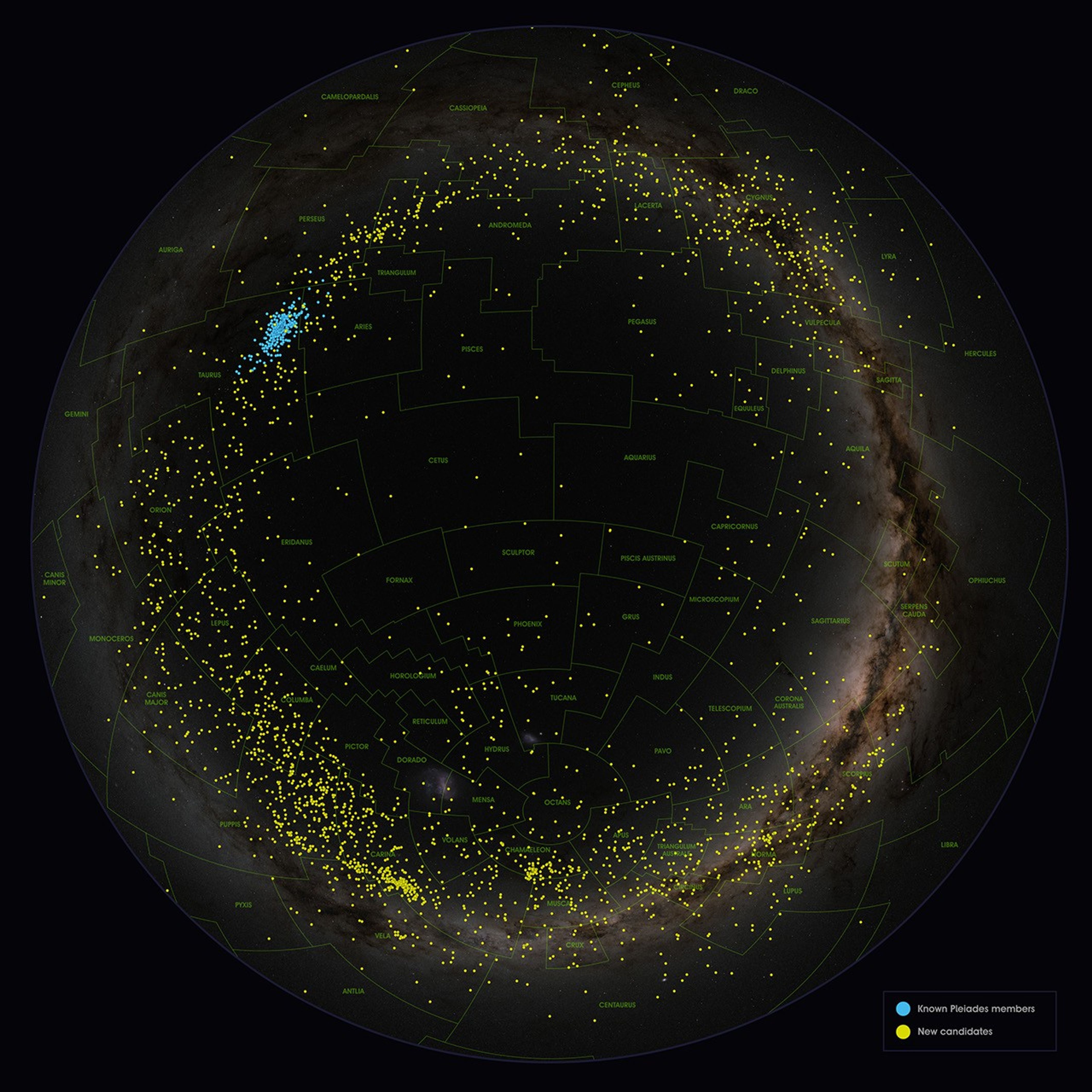
This image shows two-thirds of the night sky, illustrating the vast extent of the Greater Pleiades Complex. Original stellar members of the Pleiades, sometimes called Messier 45, appear as blue dots. Newly identified members are in yellow. The constellations are outlined and labeled in green.
The Pleiades is a bright cluster of stars, also known as Messier 45. This loose grouping of about 1,000 members was born roughly 100 million years ago from the same molecular cloud, a cold dense patch of gas and dust.
About six of the stars in the cluster are visible to the unaided eye during evenings from October to April in the northern constellation Taurus. This collection has also been known since antiquity as the Seven Sisters, although the seventh star is no longer visible.
Boyle and his team initially identified over 10,000 stars that could be related to the Pleiades. These stars were orbiting at a similar rate around our Milky Way galaxy according to data from ESA’s (European Space Agency) Gaia satellite.
They narrowed down that collection using stellar rotation data from TESS.
Watch how a star’s rotation slows with age in this artist’s concept of a Sun-like star. The number of star spots also decreases with age.
NASA’s Goddard Space Flight Center
NASA’s TESS mission scans a wide swath of the sky for about a month at a time, looking for variations in the light from stars to spot orbiting planets. This technique also allows TESS to identify and monitor asteroids out to large distances, determining their spin and refining their shape. Such observations improve our understanding of asteroids in our solar system, which can aid in planetary defense.
Scientists can also use TESS data to determine how fast the stars are rotating by looking at regular fluctuations in their light caused when dark surface features called star spots come in and out of view. Because stellar rotation slows as stars age, the researchers were able to pick out the stars that were about the same age as the Pleiades.
The team also looked at the chemical abundances in potential members using data from ground-based missions like the Sloan Digital Sky Survey, which is led by a consortium of institutions.
“The core of the Pleiades is chemically distinct from the average star in a few elements like magnesium and silicon,” said Luke Bouma, a co-author and fellow at the Carnegie Science Observatories in Pasadena, California. “The other stars that we propose are part of the Greater Pleiades are chemically distinct in the same way. The combination of these three major lines of evidence — Milky Way orbits, ages, and chemistry — tells me that we’re on the right path when making these connections.”
The team members think that all the stars in the Greater Pleiades Complex formed in a tighter collection, like the stars in the young Orion cluster, about 100 million years ago. Over time, the cluster dispersed due to the explosive forces of internal supernovae and from the tidal forces of our galaxy’s gravity.
The result is a stream of stars arcing across the sky from horizon to horizon.
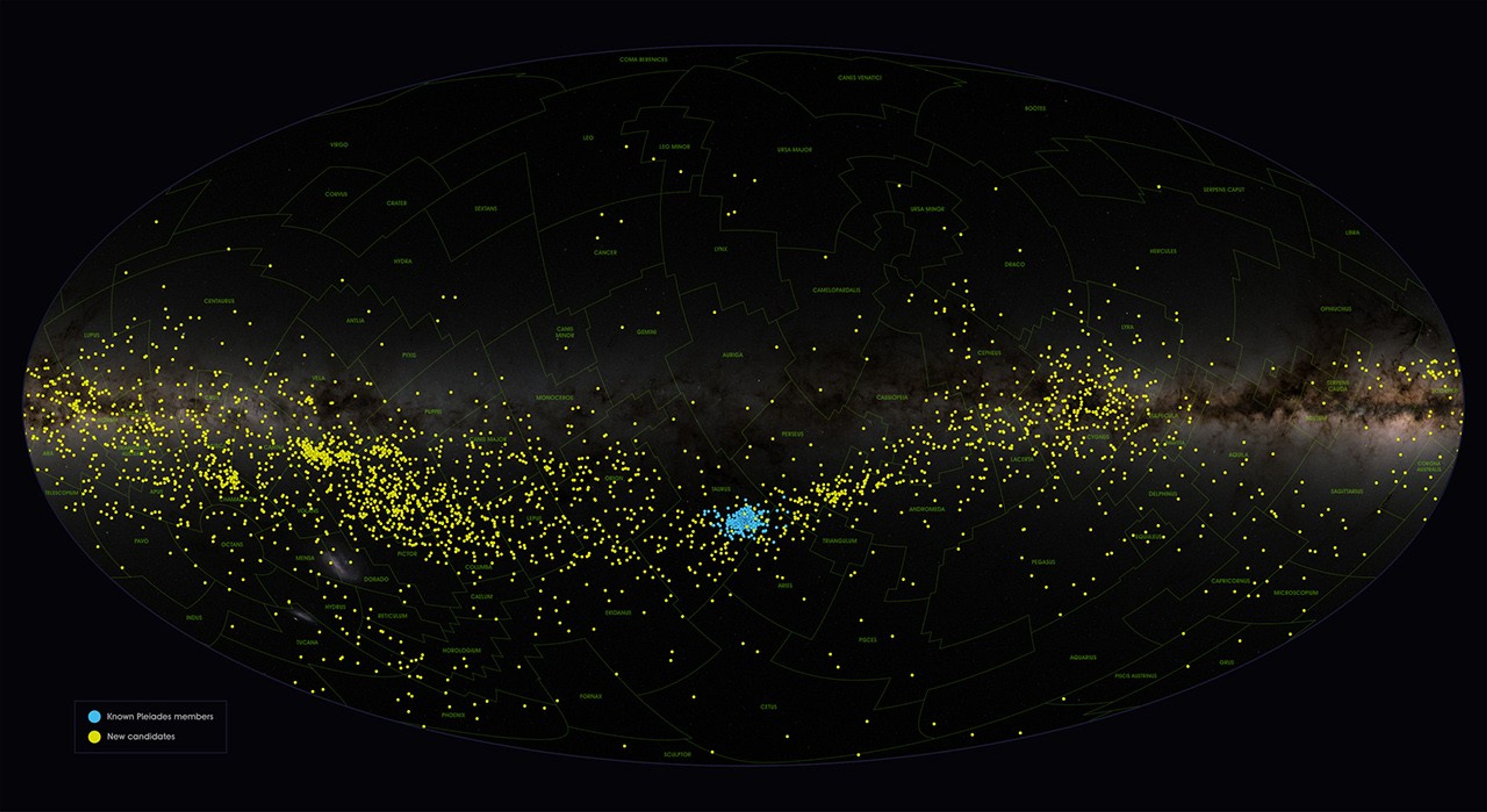
This image shows an all-sky view of the Greater Pleiades Complex with the plane of our Milky Way running through the middle. Members of the original open cluster are in blue, and new members are in yellow. The constellations are outlined and labeled in green.
Boyle and Bouma are now working on what they call the TESS All-Sky Rotation Survey. This database will allow researchers to access the rotation information for over 8 million stars to discover even more hidden stellar connections like the Greater Pleiades Complex.
“Thanks to TESS, this team was able to shed new light on a fixture of astronomy,” said Allison Youngblood, the TESS project scientist at NASA’s Goddard Space Flight Center in Greenbelt, Maryland. “From distant stars and planets to asteroids in our solar system and machine learning models here on Earth, TESS continues to push the boundaries of what we can accomplish with large datasets that capture just a part of the complexity of our universe.”
Webb First to Show 4 Dust Shells ‘Spiraling’ Apep, Limits Long Orbit
5 Min Read
Webb First to Show 4 Dust Shells ‘Spiraling’ Apep, Limits Long Orbit
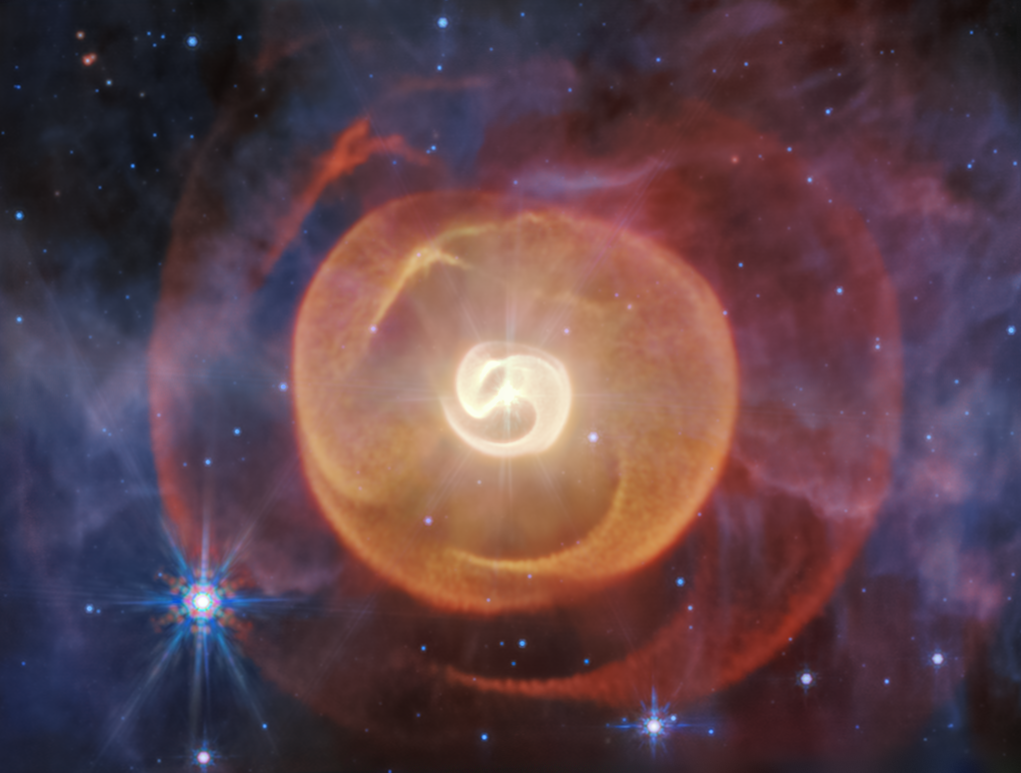
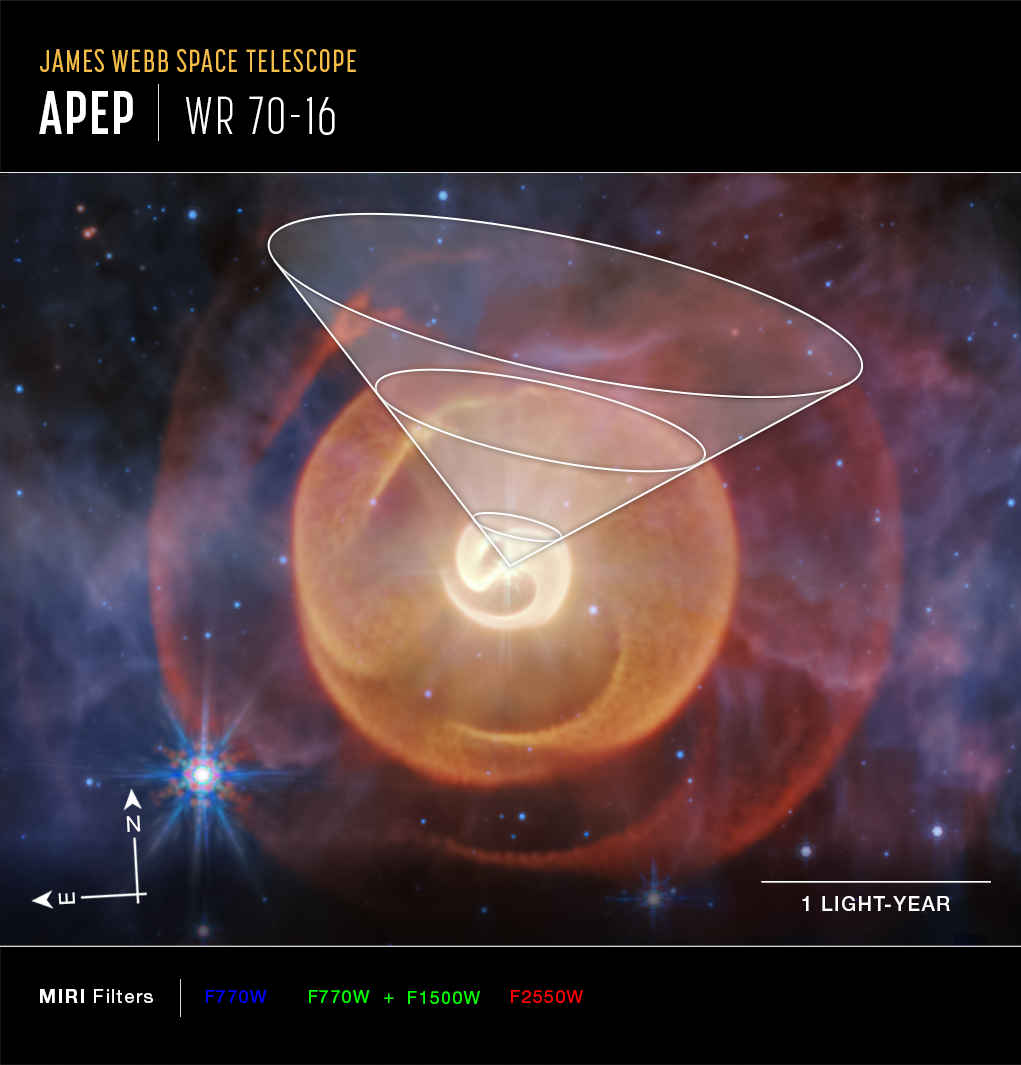
Webb’s mid-infrared image shows four coiled shells of dust around a pair of Wolf-Rayet stars known as Apep for the first time. Previous observations by other telescopes showed only one. Webb’s data also confirmed that there are three stars gravitationally bound to one another.
Credits: Image: NASA, ESA, CSA, STScI; Science: Yinuo Han (Caltech), Ryan White (Macquarie University); Image Processing: Alyssa Pagan (STScI)
NASA’s James Webb Space Telescope has delivered a first of its kind: a crisp mid-infrared image of a system of four serpentine spirals of dust, one expanding beyond the next in precisely the same pattern. (The fourth is almost transparent, at the edges of Webb’s image.) Observations taken prior to Webb only detected one shell, and while the existence of outer shells was hypothesized, searches using ground-based telescopes were unable to uncover any. These shells were emitted over the last 700 years by two aging Wolf-Rayet stars in a system known as Apep, a nod to the Egyptian god of chaos.
Webb’s image combined with several years of data from the European Southern Observatory’s Very Large Telescope (VLT) in Chile narrowed down how often the pair swing by one another: once every 190 years. Over each incredibly long orbit, they pass closely for 25 years and form dust.
Webb also confirmed that there are three stars gravitationally bound to one another in this system. The dust ejected by the two Wolf-Rayet stars is “slashed” by a third star, a massive supergiant, which carves holes into each expanding cloud of dust from its wider orbit. (All three stars are shown as a single bright point of light in Webb’s image.)
Image A: Wolf-Rayet Apep (MIRI Image)
Webb’s mid-infrared image shows four coiled shells of dust around a pair of Wolf-Rayet stars known as Apep for the first time. Previous observations by other telescopes showed only one. Webb’s data also confirmed that there are three stars gravitationally bound to one another.
Image: NASA, ESA, CSA, STScI; Science: Yinuo Han (Caltech), Ryan White (Macquarie University); Image Processing: Alyssa Pagan (STScI)
“Looking at Webb’s new observations was like walking into a dark room and switching on the light — everything came into view,” said Yinuo Han, the lead author of a new paper in The Astrophysical Journal and postdoctoral researcher at Caltech in Pasadena, California. “There is dust everywhere in Webb’s image, and the telescope shows that most of it was cast off in repetitive, predictable structures.” Han’s paper coincides with the publication of Ryan White’s paper in The Astrophysical Journal, a PhD student at Macquarie University in Sydney, Australia.
Han, White, and their co-authors refined the Wolf-Rayet stars’ orbit by combining precise measurements of the ring location from Webb’s image with the speed of the shells’ expansion from observations taken by the VLT over eight years.
“This is a one-of-a-kind system with an incredibly rare orbital period,” White said. “The next longest orbit for a dusty Wolf-Rayet binary is about 30 years. Most have orbits between two and 10 years.”
When the two Wolf-Rayet stars approach and pass one another, their strong stellar winds collide and mix, forming and casting out heaps of carbon-rich dust for a quarter century at a time. In similar systems, dust is shot out over mere months, like the shells in Wolf-Rayet 140.
High-speed ‘skirmish’
The dust-producing Wolf-Rayet stars in Apep aren’t exactly on a tranquil cruise. They are whipping through space and sending out dust at 1,200 to 2,000 miles per second (2,000 to 3,000 kilometers per second).
That dust is also very dense. The specific makeup of the dust is another reason why Webb was able to observe so much more: It largely consists of amorphous carbon. “Carbon dust grains retain a higher temperature even as they coast far away from the star,” Han said. While the exceptionally tiny dust grains are considered warm in space, the light they emit is also extremely faint, which is why it can only be detected from space by Webb’s MIRI (Mid-Infrared Instrument).
Slicing dust
To find the holes the third star has cut like a knife through the dust, look for the central point of light and trace a V shape from about 10 o’clock to 2 o’clock. “The cavity is more or less in the same place in each shell and looks like a funnel,” White said.
“I was shocked when I saw the updated calculations play out in our simulations,” he said. “Webb gave us the ‘smoking gun’ to prove the third star is gravitationally bound to this system.” Researchers have known about the third star since the VLT observed the brightest innermost shell and the stars in 2018, but Webb’s observations led to an updated geometric model, clinching the connection. (See the system in 3D by watching the visualization below.)
Video A: Wolf-Rayet Apep Visualization
This scientific visualization models what three of the four dust shells sent out by two Wolf-Rayet stars in the Apep system look like in 3D based on mid-infrared observations from NASA’s James Webb Space Telescope. Apep is made up of two Wolf-Rayet binary stars that are orb…
Image: NASA, ESA, CSA, STScI; Simulation: Yinuo Han (Caltech), Ryan White (Macquarie University); Visualization: Christian Nieves (STScI); Image Processing: Alyssa Pagan (STScI)
“We solved several mysteries with Webb,” Han said. “The remaining mystery is the precise distance to the stars from Earth, which will require future observations.”
Future of Apep
The two Wolf-Rayet stars were initially more massive than their supergiant companion, but have shed most of their mass. It’s likely that both Wolf-Rayet stars are between 10 and 20 times the mass of the Sun, and that the supergiant is 40 or 50 times as massive compared to the Sun.
Eventually, the Wolf-Rayet stars will explode as supernovae, quickly sending their contents into space. Either may also emit a gamma-ray burst, one of the most powerful events in the universe, before possibly becoming a black hole.
Wolf-Rayet stars are incredibly rare in the universe. Only a thousand are estimated to exist in our Milky Way galaxy, which contains hundreds of billions of stars overall. Of the few hundred Wolf-Rayet binaries that have been observed to date, Apep is the only example that contains two Wolf-Rayet stars of these types in our galaxy — most only have one.
The James Webb Space Telescope is the world’s premier space science observatory. Webb is solving mysteries in our solar system, looking beyond to distant worlds around other stars, and probing the mysterious structures and origins of our universe and our place in it. Webb is an international program led by NASA with its partners, ESA (European Space Agency) and CSA (Canadian Space Agency).
Webb’s mid-infrared image shows four coiled shells of dust around a pair of Wolf-Rayet stars known as Apep for the first time. Previous observations by other telescopes showed only one. Webb’s data also confirmed that there are three stars gravitationally bound to one another.
Wolf-Rayet Apep (MIRI Compass Image)
This image of the Wolf-Rayet binary Apep, captured by the James Webb Space Telescope’s MIRI (Mid-Infrared Instrument), shows compass arrows, scale bar, and color key for reference.
Wolf-Rayet Apep Visualization
This scientific visualization models what three of the four dust shells sent out by two Wolf-Rayet stars in the Apep system look like in 3D based on mid-infrared observations from NASA’s James Webb Space Telescope. Apep is made up of two Wolf-Rayet binary stars that are orb…
This NASA/ESA Hubble Space Telescope image features the spiral galaxy called NGC 6000.
ESA/Hubble & NASA, A. Filippenko; Acknowledgment: M. H. Özsaraç
Stars of all ages are on display in this NASA/ESA Hubble Space Telescope image of the sparkling spiral galaxy called NGC 6000, located 102 million light-years away in the constellation Scorpius.
NGC 6000 has a glowing yellow center and glittering blue outskirts. These colors reflect differences in the average ages, masses, and temperatures of the galaxy’s stars. At the heart of the galaxy, the stars tend to be older and smaller. Less massive stars are cooler than more massive stars, and somewhat counterintuitively, cooler stars are redder, while hotter stars are bluer. Farther out along NGC 6000’s spiral arms, brilliant star clusters host young, massive stars that appear distinctly blue.
Hubble collected the data for this image while surveying the sites of recent supernova explosions in nearby galaxies. NGC 6000 hosted two recent supernovae: SN 2007ch in 2007 and SN 2010as in 2010. Using Hubble’s sensitive detectors, researchers can discern the faint glow of supernovae years after the initial explosion. These observations help constrain the masses of supernovae progenitor stars and can indicate if they had any stellar companions.
By zooming in to the right side of the galaxy’s disk in this image, you can see a set of four thin yellow and blue lines. These lines are an asteroid in our solar system that was drifting across Hubble’s field of view as it gazed at NGC 6000. The four lines are due to four different exposures recorded one after another with slight pauses in between. Image processors combined these four exposures to create the final image. The lines appear dashed with alternating colors because each exposure used a filter to collect very specific wavelengths of light, in this case around red and blue. Having these separate exposures of particular wavelengths is important to study and compare stars by their colors — but it also makes asteroid interlopers very obvious!
NASA’s Webb Explores Largest Star-Forming Cloud in Milky Way
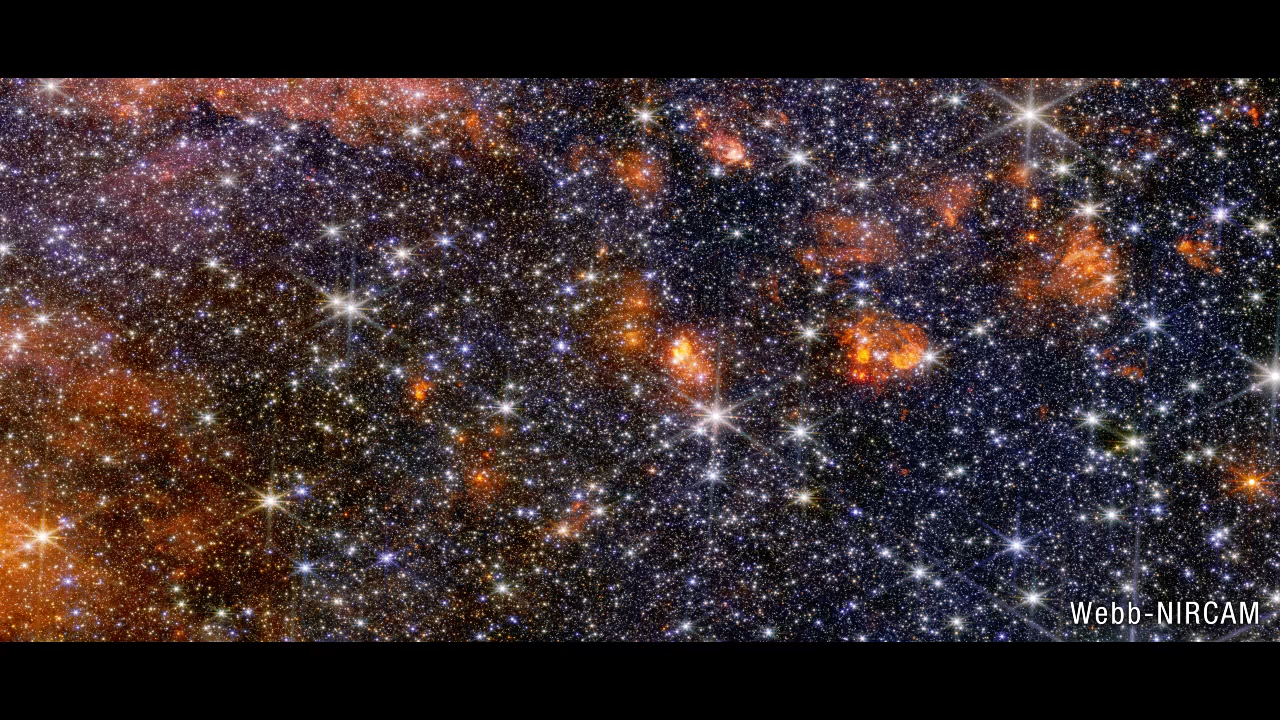
Stars, gas and cosmic dust in the Sagittarius B2 molecular cloud glow in near-infrared light, captured by Webb’s NIRCam instrument. Full image and caption below.
Credits: Image: NASA, ESA, CSA, STScI, Adam Ginsburg (University of Florida), Nazar Budaiev (University of Florida), Taehwa Yoo (University of Florida); Image Processing: Alyssa Pagan (STScI)
NASA’s James Webb Space Telescope has revealed a colorful array of massive stars and glowing cosmic dust in the Sagittarius B2 molecular cloud, the most massive and active star-forming region in our Milky Way galaxy.
“Webb’s powerful infrared instruments provide detail we’ve never been able to see before, which will help us to understand some of the still-elusive mysteries of massive star formation and why Sagittarius B2 is so much more active than the rest of the galactic center,” said astronomer Adam Ginsburg of the University of Florida, principal investigator of the program.
Image A: Sagittarius B2 (NIRCam Image)
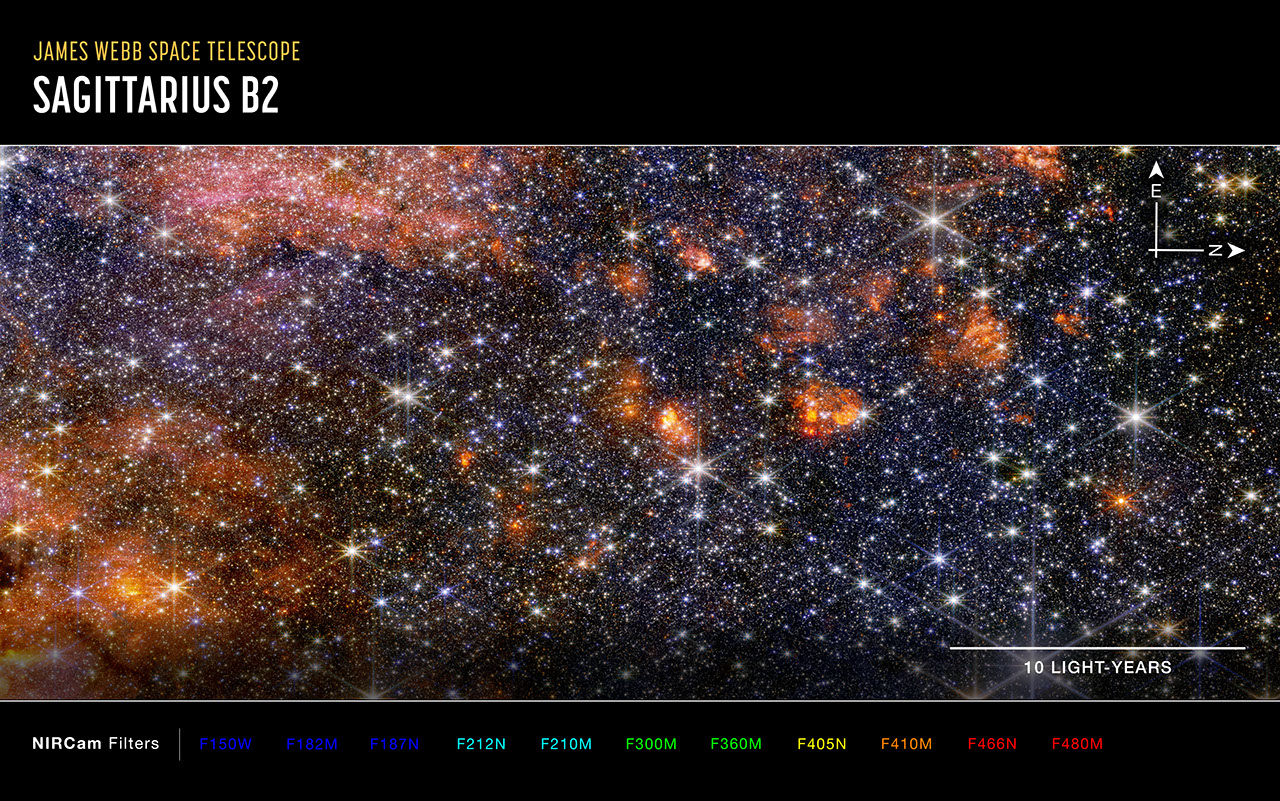
Stars, gas and cosmic dust in the Sagittarius B2 molecular cloud glow in near-infrared light, captured by Webb’s NIRCam instrument. The darkest areas of the image are not empty space but are areas where stars are still forming inside dense clouds that block their light.
Image: NASA, ESA, CSA, STScI, Adam Ginsburg (University of Florida), Nazar Budaiev (University of Florida), Taehwa Yoo (University of Florida); Image Processing: Alyssa Pagan (STScI)
Sagittarius B2 is located only a few hundred light-years from the supermassive black hole at the heart of the galaxy called Sagittarius A*, a region densely packed with stars, star-forming clouds, and complex magnetic fields. The infrared light that Webb detects is able to pass through some of the area’s thick clouds to reveal young stars and the warm dust surrounding them.
However, one of the most notable aspects of Webb’s images of Sagittarius B2 are the portions that remain dark. These ironically empty-looking areas of space are actually so dense with gas and dust that even Webb cannot see through them. These thick clouds are the raw material of future stars and a cocoon for those still too young to shine.
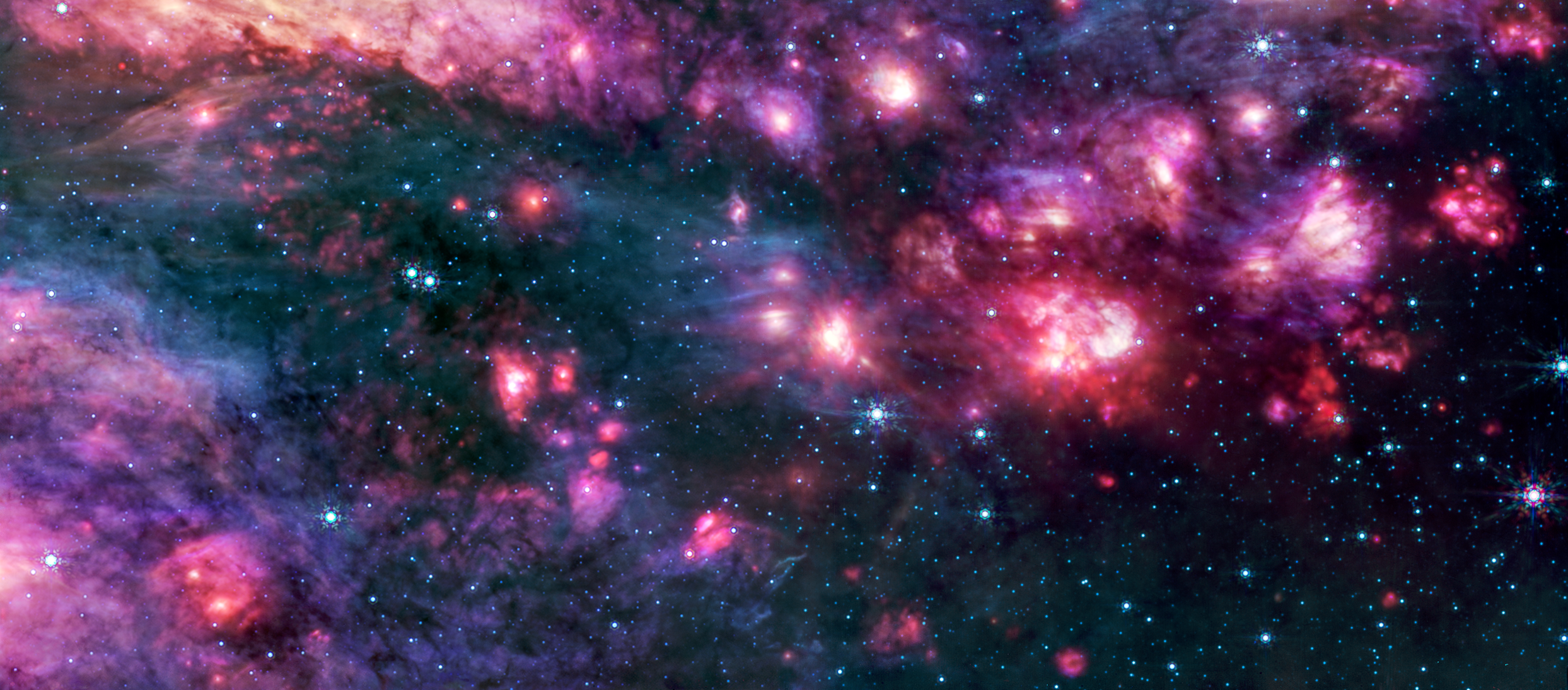
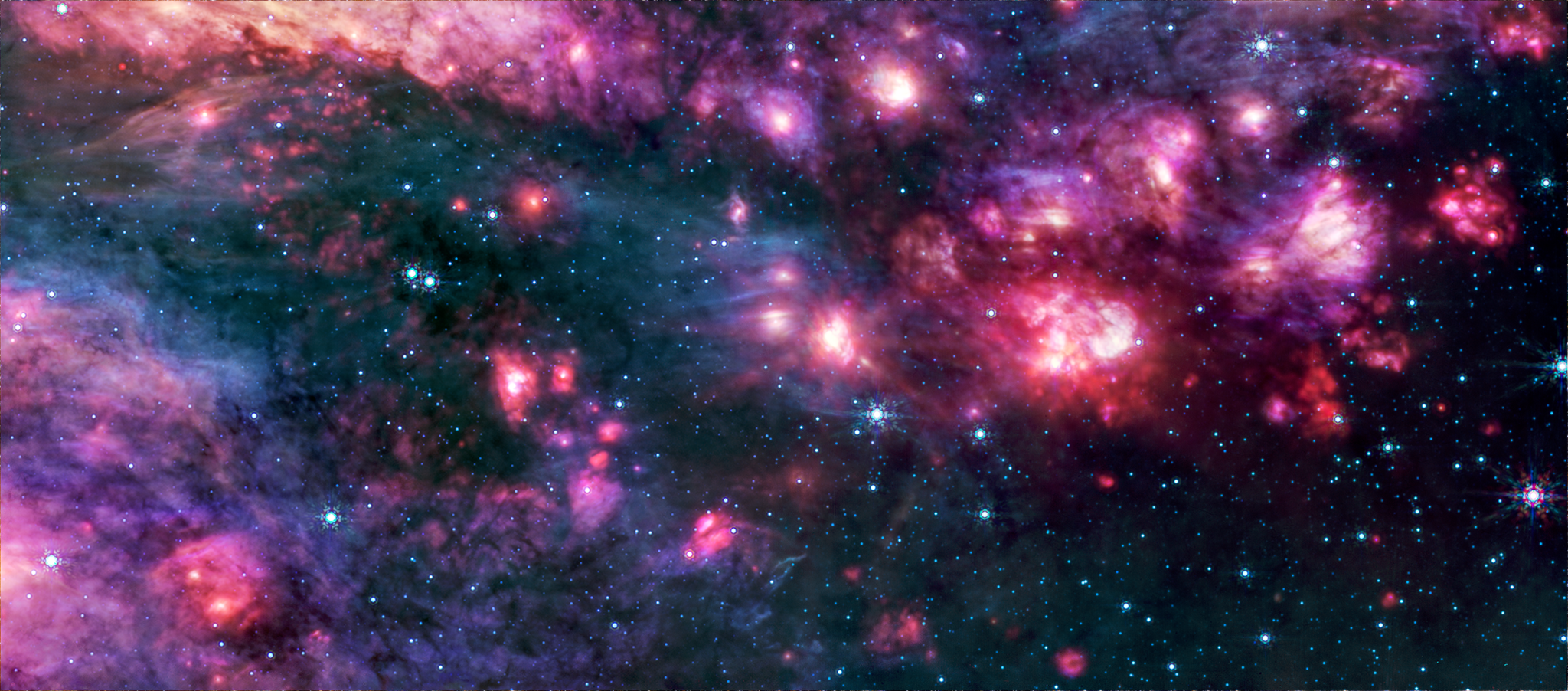
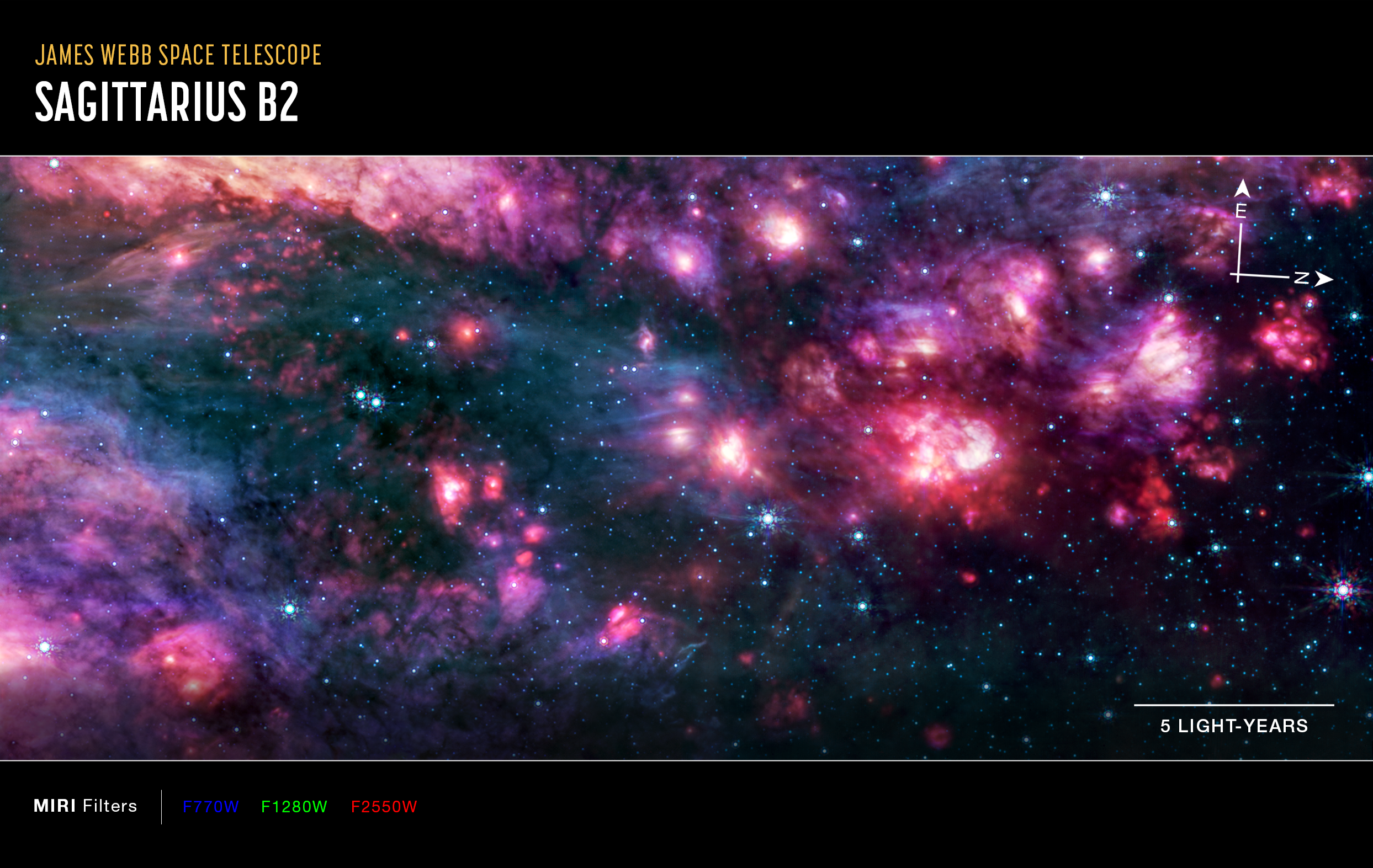
The high resolution and mid-infrared sensitivity of Webb’s MIRI (Mid-Infrared Instrument) revealed this region in unprecedented detail, including glowing cosmic dust heated by very young massive stars. The reddest area on the right half of MIRI’s image, known as Sagittarius B2 North, is one of the most molecularly rich regions known, but astronomers have never seen it with such clarity. (Note: North is to the right in these Webb images.)
Image B: Sagittarius B2 (MIRI Image)
Webb’s MIRI instrument shows the Sagittarius B2 region in mid-infrared light, with warm dust glowing brightly. Only the brightest stars emit strongly enough to appear through the dense clouds as blue pinpoints.
Image: NASA, ESA, CSA, STScI, Adam Ginsburg (University of Florida), Nazar Budaiev (University of Florida), Taehwa Yoo (University of Florida); Image Processing: Alyssa Pagan (STScI)
The difference longer wavelengths of light make, even within the infrared spectrum, are stark when comparing the images from Webb’s MIRI and NIRCam (Near-Infrared Camera) instruments. Glowing gas and dust appear dramatically in mid-infrared light, while all but the brightest stars disappear from view.
In contrast to MIRI, colorful stars steal the show in Webb’s NIRCam image, punctuated occasionally by bright clouds of gas and dust. Further research into these stars will reveal details of their masses and ages, which will help astronomers better understand the process of star formation in this dense, active galactic center region. Has it been going on for millions of years? Or has some unknown process triggered it only recently?
Image C: Compare NIRCam and MIRI Images of Sagittarius B2
NIRCam
MIRI
Stars, gas and cosmic dust in the Sagittarius B2 molecular cloud glow in near-infrared light, captured by Webb’s NIRCam instrument. The darkest areas of the image are not empty space but are areas where stars are still forming inside dense clouds that block their light.
Image: NASA, ESA, CSA, STScI, Adam Ginsburg (University of Florida), Nazar Budaiev (University of Florida), Taehwa Yoo (University of Florida); Image Processing: Alyssa Pagan (STScI)
Stars, gas and cosmic dust in the Sagittarius B2 molecular cloud glow in near-infrared light, captured by Webb’s NIRCam instrument. The darkest areas of the image are not empty space but are areas where stars are still forming inside dense clouds that block their light.
Image: NASA, ESA, CSA, STScI, Adam Ginsburg (University of Florida), Nazar Budaiev (University of Florida), Taehwa Yoo (University of Florida); Image Processing: Alyssa Pagan (STScI)
NIRCam
MIRI
Compare NIRCam and MIRI Images of Sagittarius B2
Slide between these images from Webb to see what different wavelengths of infrared light reveal and conceal. Near-infrared light, which is nearest to visible red, comes from some gas and an abundance of colorful stars. The longer wavelengths of mid-infrared light are emitted by warm dust and only the brightest stars. Credits: Image: NASA, ESA, CSA, STScI, Adam Ginsburg (University of Florida), Nazar Budaiev (University of Florida), Taehwa Yoo (University of Florida); Image Processing: Alyssa Pagan (STScI)
Astronomers hope Webb will shed light on why star formation in the galactic center is so disproportionately low. Though the region is stocked with plenty of gaseous raw material, on the whole it is not nearly as productive as Sagittarius B2. While Sagittarius B2 has only 10 percent of the galactic center’s gas, it produces 50 percent of its stars.
“Humans have been studying the stars for thousands of years, and there is still a lot to understand,” said Nazar Budaiev, a graduate student at the University of Florida and the co-principal investigator of the study. “For everything new Webb is showing us, there are also new mysteries to explore, and it’s exciting to be a part of that ongoing discovery.”
The James Webb Space Telescope is the world’s premier space science observatory. Webb is solving mysteries in our solar system, looking beyond to distant worlds around other stars, and probing the mysterious structures and origins of our universe and our place in it. Webb is an international program led by NASA with its partners, ESA (European Space Agency) and CSA (Canadian Space Agency).
Stars, gas and cosmic dust in the Sagittarius B2 molecular cloud glow in near-infrared light, captured by Webb’s NIRCam instrument. The darkest areas of the image are not empty space but are areas where stars are still forming inside dense clouds that block their light
Sagittarius B2 (MIRI Image)
Webb’s MIRI instrument shows the Sagittarius B2 region in mid-infrared light, with warm dust glowing brightly. Only the brightest stars emit strongly enough to appear through the dense clouds as blue pinpoints.
Sagittarius B2 (NIRCam Compass Image)
This image of the Sagittarius B2 (Sgr B2) molecular cloud, captured by the NIRCam (Near-Infrared Camera) instrument on NASA’s James Webb Space Telescope includes compass arrows, scale bar, and color key for reference.
Sagittarius B2 (MIRI Compass Image)
This image of the Sagittarius B2 (Sgr B2) molecular cloud, captured by MIRI (Mid-Infrared Instrument) on NASA’s James Webb Space Telescope includes compass arrows, scale bar, and color key for reference.
Sagittarius B2 NIRCam to MIRI Fade
See what different wavelengths of infrared light reveal and conceal. Near-infrared light, which is nearest to visible red, comes from some gas and an abundance of colorful stars. The longer wavelengths of mid-infrared light are emitted by warm dust and only the brightest stars….
This NASA/ESA Hubble Space Telescope image features the central region of spiral galaxy Messier 82.
ESA/Hubble & NASA, W. D. Vacca
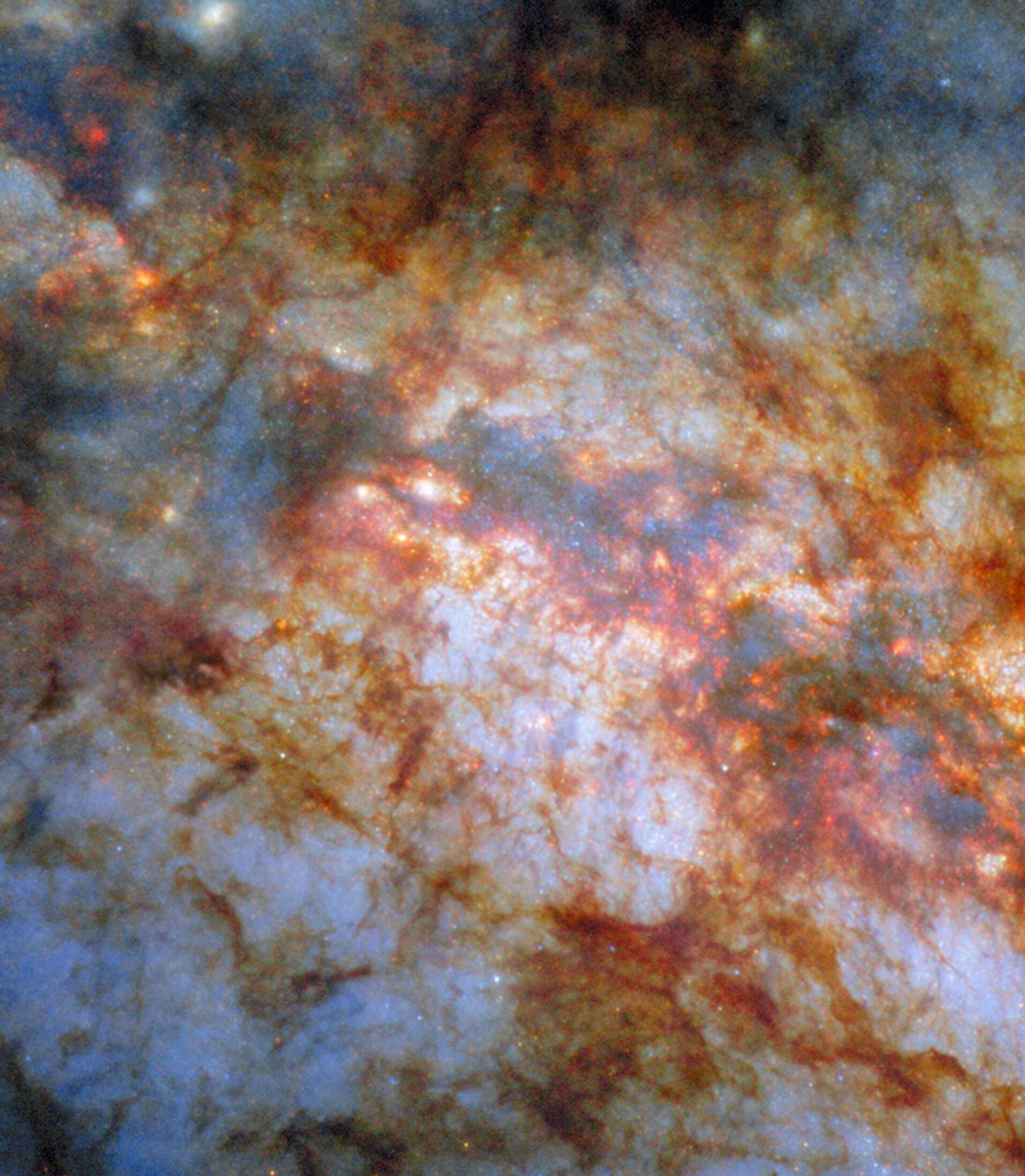
This NASA/ESA Hubble Space Telescope image reveals new details in Messier 82 (M82), home to brilliant stars whose light is shaded by sculptural clouds made of clumps and streaks of dust and gas. This image features the star-powered heart of the galaxy, located just 12 million light-years away in the constellation Ursa Major (the Great Bear). Popularly known as the Cigar Galaxy, M82 is considered a nearby galaxy.
It’s no surprise that M82 is packed with stars. The galaxy forms stars 10 times faster than the Milky Way. Astronomers call it a starburst galaxy. The intense starbirth period that grips this galaxy gave rise to super star clusters in the galaxy’s heart. Each of these super star clusters holds hundreds of thousands of stars and is more luminous than a typical star cluster. Researchers used Hubble to home in on these massive clusters and reveal how they form and evolve.
Hubble’s previous views of the galaxy captured ultraviolet and visible light in 2012 and near-infrared and visible light in 2006 to celebrate Hubble’s 16th anniversary. NASA’s Chandra X-ray Observatory and Spitzer Space Telescope also imaged this starburst galaxy. Combining the visible and near-infrared light Hubble data with Chandra’s x-ray and Spitzer’s deeper infrared view provides a detailed look at the galaxy’s stars, along with the dust and gas from which stars form. More recently the NASA/ESA/CSA James Webb Space Telescope turned its eye toward the galaxy, producing infrared images in 2024 and earlier this year. These multiple views at different wavelengths of light provide us with a more accurate and complete picture of this galaxy so that we can better understand its environment. Each of these NASA observatories delivers unique and complementary information about the galaxy’s physical processes. Combining their data yields insights that enhance our understanding in a way that no single observatory could accomplish alone. This image features something not seen in previously released Hubble images of the galaxy: data from the High Resolution Channel of the Advanced Camera for Surveys.
An artist’s concept of a supermassive black hole, a surrounding disk of material falling towards the black hole and a jet containing particles moving away at close to the speed of light. This black hole represents a recently-discovered quasar powered by a black hole. New Chandra observations indicate that the black hole is growing at a rate that exceeds the usual limit for black holes, called the Eddington Limit. Credit: NASA/CXC/SAO/M. Weiss
A black hole is growing at one of the fastest rates ever recorded, according to a team of astronomers. This discovery from NASA’s Chandra X-ray Observatory may help explain how some black holes can reach enormous masses relatively quickly after the big bang.
The black hole weighs about a billion times the mass of the Sun and is located about 12.8 billion light-years from Earth, meaning that astronomers are seeing it only 920 million years after the universe began. It is producing more X-rays than any other black hole seen in the first billion years of the universe.
The black hole is powering what scientists call a quasar, an extremely bright object that outshines entire galaxies. The power source of this glowing monster is large amounts of matter funneling around and entering the black hole.
While the same team discovered it two years ago, it took observations from Chandra in 2023 to discover what sets this quasar, RACS J0320-35, apart. The X-ray data reveal that this black hole appears to be growing at a rate that exceeds the normal limit for these objects.
“It was a bit shocking to see this black hole growing by leaps and bounds,” said Luca Ighina of the Center for Astrophysics | Harvard & Smithsonian in Cambridge, Massachusetts, who led the study.
When matter is pulled toward a black hole it is heated and produces intense radiation over a broad spectrum, including X-rays and optical light. This radiation creates pressure on the infalling material. When the rate of infalling matter reaches a critical value, the radiation pressure balances the black hole’s gravity, and matter cannot normally fall inwards any more rapidly. That maximum is referred to as the Eddington limit.
Scientists think that black holes growing more slowly than the Eddington limit need to be born with masses of about 10,000 Suns or more so they can reach a billion solar masses within a billion years after the big bang — as has been observed in RACS J0320-35. A black hole with such a high birth mass could directly result from an exotic process: the collapse of a huge cloud of dense gas containing unusually low amounts of elements heavier than helium, conditions that may be extremely rare.
If RACS J0320-35 is indeed growing at a high rate — estimated at 2.4 times the Eddington limit — and has done so for a sustained amount of time, its black hole could have started out in a more conventional way, with a mass less than a hundred Suns, caused by the implosion of a massive star.
“By knowing the mass of the black hole and working out how quickly it’s growing, we’re able to work backward to estimate how massive it could have been at birth,” said co-author Alberto Moretti of INAF-Osservatorio Astronomico di Brera in Italy. “With this calculation we can now test different ideas on how black holes are born.”
To figure out how fast this black hole is growing (between 300 and 3,000 Suns per year), the researchers compared theoretical models with the X-ray signature, or spectrum, from Chandra, which gives the amounts of X-rays at different energies. They found the Chandra spectrum closely matched what they expected from models of a black hole growing faster than the Eddington limit. Data from optical and infrared light also supports the interpretation that this black hole is packing on weight faster than the Eddington limit allows.
“How did the universe create the first generation of black holes?” said co-author Thomas of Connor, also of the Center for Astrophysics. “This remains one of the biggest questions in astrophysics and this one object is helping us chase down the answer.”
Another scientific mystery addressed by this result concerns the cause of jets of particles that move away from some black holes at close to the speed of light, as seen in RACS J0320-35. Jets like this are rare for quasars, which may mean that the rapid rate of growth of the black hole is somehow contributing to the creation of these jets.
The quasar was previously discovered as part of a radio telescope survey using the Australian Square Kilometer Array Pathfinder, combined with optical data from the Dark Energy Camera, an instrument mounted on the Victor M. Blanco 4-meter Telescope at the Cerro Tololo Inter-American Observatory in Chile. The U.S. National Science Foundation National Optical-Infrared Astronomy Research Laboratory’s Gemini-South Telescope on Cerro Pachon, Chile was used to obtain the accurate distance of RACS J0320-35.
A paper describing these results has been accepted for publication in The Astrophysical Journal and is available here.
NASA’s Marshall Space Flight Center in Huntsville, Alabama, manages the Chandra program. The Smithsonian Astrophysical Observatory’s Chandra X-ray Center controls science operations from Cambridge, and flight operations from Burlington, Massachusetts.
This release features a quasar located 12.8 billion light-years from Earth, presented as an artist’s illustration and an X-ray image from NASA’s Chandra X-ray Observatory.
In the artist’s illustration, the quasar, RACS J0320-35, sits at our upper left, filling the left side of the image. It resembles a spiraling, motion-blurred disk of orange, red, and yellow streaks. At the center of the disk, surrounded by a glowing, sparking, brilliant yellow light, is a black egg shape. This is a black hole, one of the fastest-growing black holes ever detected. The black hole is also shown in a small Chandra X-ray image inset at our upper right. In that depiction, the black hole appears as a white dot with an outer ring of neon purple.
The artist’s illustration also highlights a jet of particles blasting away from the black hole at the center of the quasar. The streaked silver beam starts at the core of the distant quasar, near our upper left, and shoots down toward our lower right. The blurry beam of energetic particles appears to widen as it draws closer and exits the image.

 Login
Login