Over the many years Apple Computer have been in operation, they have made a success of nearly-seamlessly transitioning multiple times between both operating systems and their underlying architecture. There have been many overlapping versions, but there’s always a point at which a certain OS won’t run on newer hardware. Now [Jubadub] has pushed one of those a little further than Apple intended, by persuading classic Mac System 7 to run on a G4.
System 7 was the OS your Mac would have run some time in the mid ’90s, whether it was a later 68000 machine or a first-gen PowerMac. In its day it gave Windows 3.x and even 95 a run for their money, but it relied on an older Mac ROM architecture than the one found on a G4. The hack here lies in leaked ROMS, hidden backwards compatibility, and an unreleased but preserved System 7 version originally designed for the ’90s Mac clone programme axed by Steve Jobs. It’s not perfect, but they achieved the impossible.
As to why, it seems there’s a significant amount of software that needs 7 to run, something mirrored in the non-Mac retrocomputing world. Even this hack isn’t the most surprising System 7 one we’ve seen recently, as an example someone even made a version for x86 machines.
Probably most people know that when organic matter such as kitchen waste rots, it can produce flammable methane. As a source of free energy it’s attractive, but making a biogas plant sounds difficult, doesn’t it? Along comes [My engines] with a well-thought-out biogas plant that seems within the reach of most of us.
It’s based around a set of plastic barrels and plastic waste pipe, and he shows us the arrangement of feed pipe and residue pipe to ensure a flow through the system. The gas produced has CO2 and H2s as undesirable by-products, both of which can be removed with some surprisingly straightforward chemistry. The home-made gas holder meanwhile comes courtesy of a pair of plastic drums one inside the other.
Perhaps the greatest surprise is that the whole thing can produce a reasonable supply of gas from as little as 2 KG of organic kitchen waste daily. We can see that this is a set-up for someone with the space and also the ability to handle methane safely, but you have to admit from watching the video below, that it’s an attractive idea. Who knows, if the world faces environmental collapse, you might just need it.
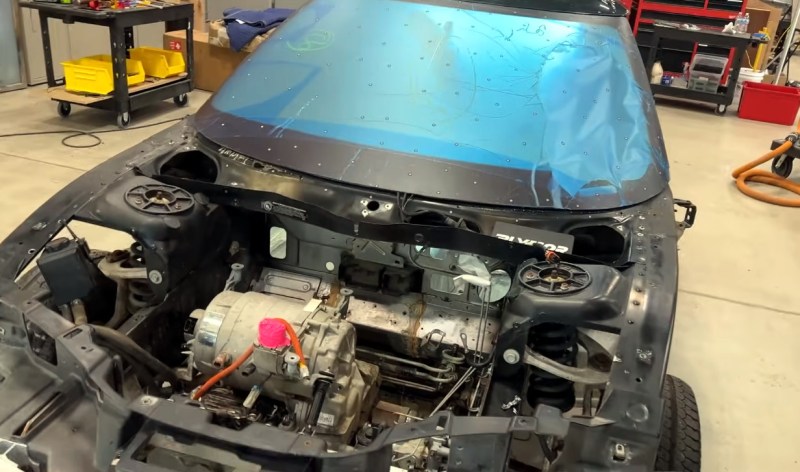
Probably the biggest story in the world of old cars over the past couple of weeks has been the surfacing of a GM EV1 electric car for sale from an auto salvage yard. This was the famous electric car produced in small numbers by the automaker in the 1990s, then only made available for lease before being recalled. The vast majority were controversially crushed with a few units being donated to museums and universities in a non-functional state.
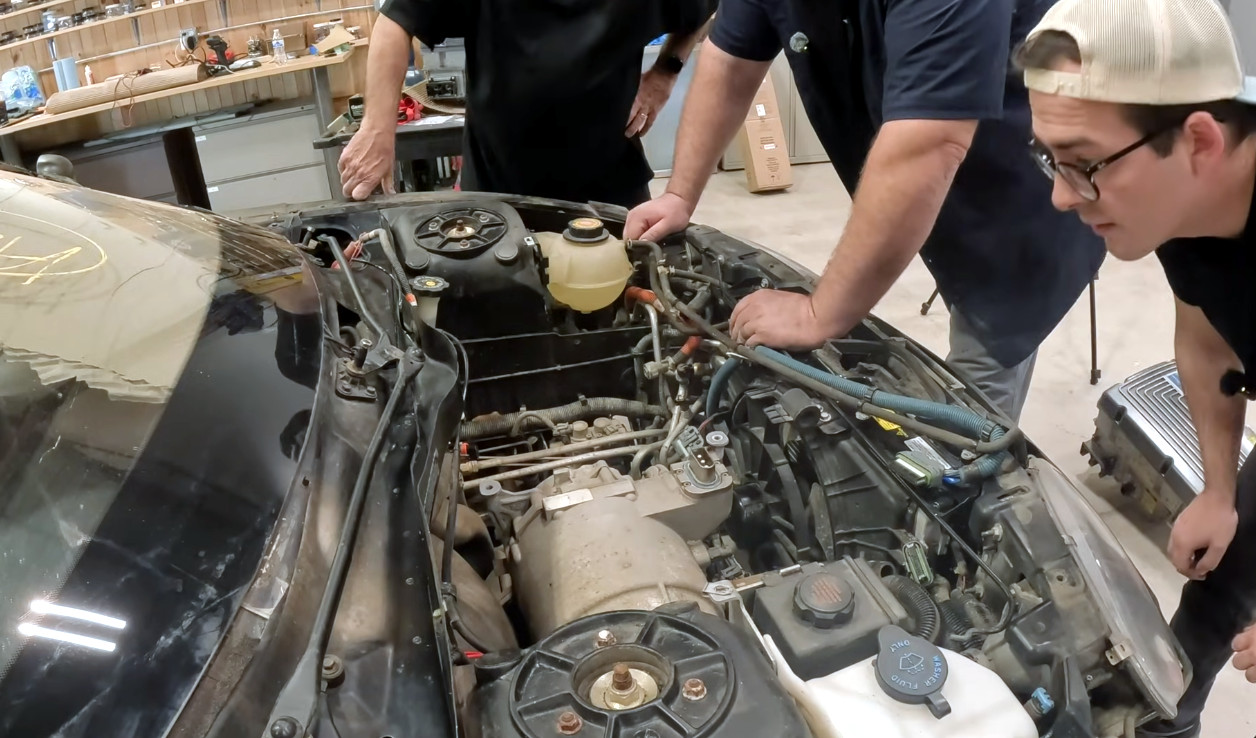
Finding an old car isn’t really a Hackaday story in itself, but now it’s landed in [The Questionable Garage]. It’s being subjected to a teardown as a prelude to its restoration, offering a unique opportunity to look at the state of the art in 1990s electric automotive technology.
The special thing about this car is that by a murky chain of events it ended up as an abandoned vehicle. GM’s legal net covers the rest of the surviving cars, but buying this car as an abandoned vehicle gives the owner legal title over it and frees him from their restrictions. The video is long, but well worth a watch as we see pieces of automotive tech never before shown in public. As we understand it the intention is to bring it to life using parts from GM’s contemporary S10 electric pickup truck — itself a rare vehicle — so we learn quite a bit about those machines too.
Along the way they find an EV1 charger hiding among a stock of pickup chargers, take us through the vehicle electronics, and find some galvanic corrosion in the car’s structure due to water ingress. The windscreen has a huge hole, which they cover with a plastic wrap in order to 3D scan so they can create a replacement.
This car will undoubtedly become a star of the automotive show circuit due to its unique status, so there will be plenty of chances to look at it from the outside in future. Seeing it this close up in parts though is as unique an opportunity as the car itself. We’ve certainly seen far more crusty conventional cars restored to the road, but without the challenge of zero parts availability and no donor cars. Keep an eye out as they bring it closer to the road.
An unlikely hit of the last few months’ consumer hardware has been a power bank branded by the German confectionery company Haribo. It first gained attention in backpacking circles because of its high capacity for a reasonable weight, and since then has been selling like the proverbial hot cakes. Now Amazon have withdrawn it from their store over “A potential safety or quality issue”. The industrial imaging company Lumafield have taken a look at the power bank with a CT scanner, to find out why.
As you might imagine, the power bank is all battery inside, with pouch type lithium ion cells taking up all of the space. Immediately a clue appears as to why Amazon withdrew them, as the individual layers of the cells are misaligned, laying open a risk of failure. They also take a look at a set of earbuds from the same source and find something even more concerning — torn electrodes. Thus neither device can be regarded as safe, and the backpackers will have to haul around a little bit more in the future.
You’ll not find the Wrencher on a power bank, but you can be sure if you did, we’d make sure there was an element of quality control at play. Meanwhile we feel slightly sorry for the branding executive responsible at Haribo, who we are guessing has had a bad day. We’ve featured Lumafield’s work here before quite a few times, most recently looking at similar defects in 18650 cells.
The Pebble was the smartwatch darling of the early 2010s, a glimpse of the future in the form of a microcontroller and screen strapped to your wrist. It was snapped up by Fitbit and canned, which might have been the end of it all were it not for the dedication of the Pebble community. Google open-sourced the OS back in January this year, and since then a new set of Pebble products have appeared under the guidance of Pebble creator [Eric Migicovsky]. Now he’s announced the full open-sourcing of the current Pebble hardware and software stack. As he puts it, “Yesterday, Pebble watch software was ~95% open source. Today, it’s 100% open source”.
If you’re curious it can all be found in repositories under the Core Devices GitHub account. Building your own Pebble clone sounds cool, but perhaps the real value lies instead in giving the new Pebbles something the original never had, an assured future. If you buy one of the new watches then you’ll know that it will remain fixable, and since you have the full set of files you can create new parts for it, or update its software. We think that’s the right way to keep a personal electronic device relevant.
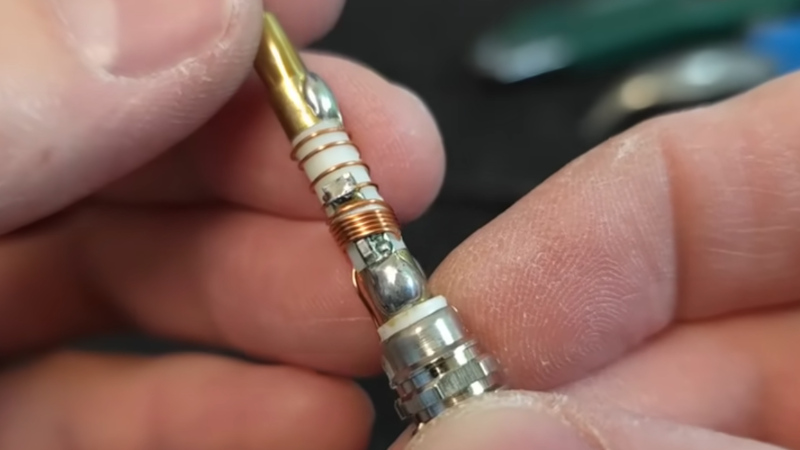
If you own a handheld transceiver of any type then the chances are it will come with a “rubber duck” style antenna. These flexible rubber-coated antennas are a compromise in performance, being significantly smaller than a wavelength at their frequency of operation. [OM40ET] has an interesting video in which he investigates this by tearing down a cheap rubber duck antenna and an even cheaper fake.
These antennas usually have a flexible upper section and a bulge at the bottom over the connector. The fake one has nothing in the bulge except the antenna wire and thus has a very high SWR, while the “real” one has a loading coil. This coil is an interesting design, because it’s designed such that the antenna has two resonant points at the 2 metre and 70 centimetre amateur bands. On paper it’s a tapped coil fed at the tap through a capacitor for matching, but a more detailed appraisal will tell you that the two halves of the coil are designed to return those two resonances. It’s still a not-very-good antenna, but the fact that it works at all is something.
If you want something better at VHF and haven’t got much space, all is not lost. We recently featured a VHF magnetic loop.
The hoverboard, one of the teen crazes of the last decade, is both a marvel of technology and a source of hacker parts that have appeared in so many projects on these pages. It contains an accelerometer or similar, along with a microcontroller and a pair of motor controllers to drive its in-wheel motors. That recipe is open to interpretation of course and we’ve seen a few in our time, but perhaps not quite like this steampunk design from [Skrubis]. It claims a hoverboard design with no modern electronics, only relays, mercury switches, and neon bulbs.
The idea is that it’s a hoverboard from 1884 using parts available in that era, hence there’s talk of telegraph relays and galvanomic piles. The write-up is presented in steampunk-style language which if we’re honest makes our brain hurt, but the premise is intriguing enough to persevere. As far as we can see it uses a pair of relays and a transformer to make an oscillator, from which can be derived the drive for a 3-phase motor. This drive is sent to the motors by further relays operating under the influence of mercury tilt switches.
There are a full set of hardware designs once you wade past the language, but as yet it has no evidence of a prototype. We admit we kinda want it to work because the idea is preposterous enough to be cool if it ran, but we’d be lying if we said we didn’t harbor some doubts. Perhaps you our readers can deliver a verdict, after all presenting you with entertainment is what it’s all about. If a working prototype surfaces we’ll definitely be featuring it, after all it would be cool as heck.
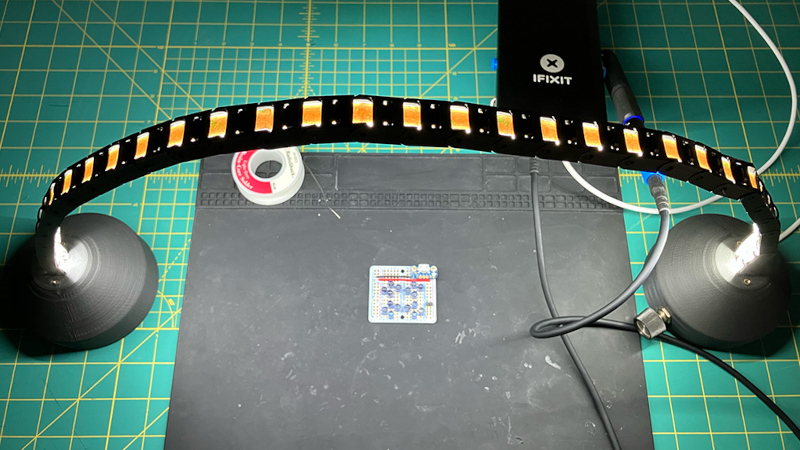
The IKEA SMÅSNÖRE is a flexible silicone rod with an embedded LED strip, attached at each end to a base. It’s eye-catching enough, and it has the useful property of providing a diffuse light from multiple angles that makes it a promising candidate for a work lamp. That’s enough for [Daniel James] to create his own lamp on a similar vein.
The electronics of his lamp are straightforward enough: a 12 volt LED strip whose brightness is controlled by a Pi Pico in response to a potentiometer as a brightness control. It’s not quite stiff enough to form the arch itself, so he’s created a 3D printed chain that forms the structure of the lamp. Similar to a bicycle chain in the way it’s constructed, it has individual links that slot together and pivot. The electronics are in the printed base at one end.
We like this lamp a lot, for the light it gives on the bench and for the ingenuity of the printed chain. We might even make one for ourselves.
It’s been twenty-three years since the day Phoenix was released, the web browser that eventually became Firefox. I downloaded it on the first day and installed it on my trusty HP Omnibook 800 laptop, and until this year I’ve used it ever since. Yet after all this time, I’m ready to abandon it for another browser. In the previous article in this series I went into my concerns over the direction being taken by Mozilla with respect to their inclusion of AI features and my worries about privacy in Firefox, and I explained why a plurality of browser engines is important for the Web. Now it’s time to follow me on my search for a replacement, and you may be surprised by one aspect of my eventual choice.
Where Do I Go From Here?
It’s Hackaday, in Ladybird! (Ooof, that font.)
Happily for my own purposes, there are a range of Firefox alternatives which fulfill my browser needs without AI cruft and while allowing me to be a little more at peace with my data security and privacy. There’s Chromium of course even if it’s still way too close to Google for my liking, and there are a host of open-source WebKit and Blink based browsers too numerous to name here.
In the Gecko world that should be an easier jump for a Firefox escapee there are also several choices, for example LibreWolf, and Waterfox. In terms of other browser engines there’s the extremely promising but still early in development Ladybird, and the more mature Servo, which though it is available as a no-frills browser, bills itself as an embedded browser engine. I have not considered some other projects that are either lightweight browser engines, or ones not under significant active development.
It’s Hackaday, in Servo!
Over this summer and autumn then I have tried a huge number of different browsers. Every month or so I build the latest Ladybird and Servo; while I am hugely pleased to see progress they’re both still too buggy for my purposes. Servo is lightning-fast but sometimes likes to get stuck in mobile view, while Ladybird is really showing what it’s going to be but remains for now slow-as-treacle. These are ones to watch, and support.
I gave LibreWolf and Waterfox the most attention over the summer, both of which after the experience I’d describe as like Firefox but with mildly annoying bugs. The inability to video conference reliably is a show-stopper in my line of work, and since my eyesight is no longer what it once was I like my browsers to remember when I have zoomed in on a tab. Meanwhile Waterfox on Android is a great mobile browser, right up until it needs to open a link in another app, and fails. I’m used to the quirks of open-source software after 30+ years experimenting with Linux, but when it comes to productivity I can’t let my software disrupt the flow of Hackaday articles.
The Unexpected Choice
It’s Hackaday, in Vivaldi!
It might surprise you after all this open-source enthusiasm then, to see the browser I’ve ended up comfortable with. Vivaldi may be driven by the open-source Blink engine from Chromium and Chrome, but its proprietary front end doesn’t have an open-source licence.
It’s freeware, or free-as-in-beer, and I think the only such software I use. Why, I hear you ask? It’s an effort to produce a browser like Opera used to be in the old days, it’s European which is a significant consideration when it comes to data protection law, and it has (so far) maintained a commitment to privacy while not being evil in the Google motto sense.
It’s quick, I like its interface once the garish coloured default theme has been turned off, and above all, it Just Works. I have my browser back, and I can get on with writing. Should they turn evil I can dump them without a second thought, and hope by then Ladybird has matured enough to suit my needs.
It may not be a trend many of us particularly like, but here in 2025 there’s a sense that the browser has reduced our computers almost to the status of a terminal. It’s thus perhaps the most important piece of software on the device, and in that light I hope you can understand some of the concerns levelled in this series. If you’re reading this from Firefox HQ I’d implore you to follow my advice and go back to what made Firefox so great back in the day, but for the rest of you I’d like to canvass your views on my choice of a worthy replacement. As always, the comments are waiting.
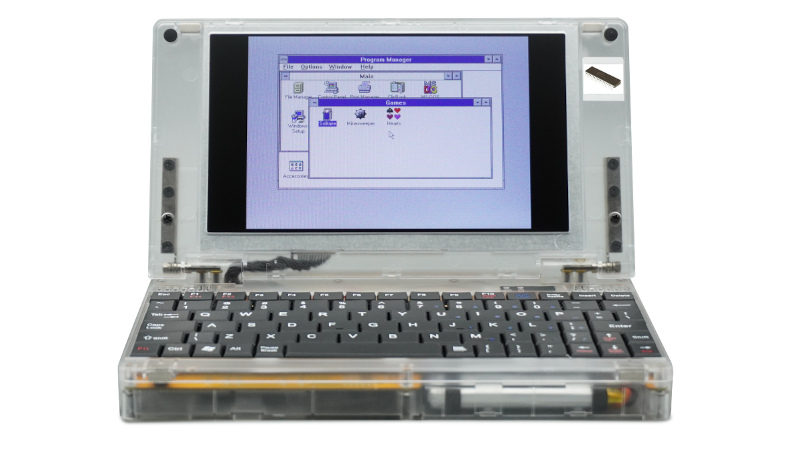
An interesting trend over the last year or two has been the emergence of modern retrocomputer PCs, recreations of classic PC hardware from back in the day taking advantage of modern parts alongside the venerable processors. These machines are usually very well specified for a PC from the 1980s, and represent a credible way to run your DOS or early Windows software on something close to the original. [CNX Software] has news of a couple of new ones from the same manufacturer in China, one sporting a 386sx and the other claiming it can take either an 8088 or an 8086.
Both machines use the same see-through plastic case, screen, and keyboard, and there are plenty of pictures to examine the motherboard. There are even downloadable design files, which is an interesting development. They come with a removable though proprietary looking VGA card bearing a Tseng Labs ET4000, a CF card interface, a USB port which claims to support disk drives, a sound card, the usual array of ports, and an ISA expansion for which a dock is sold separately. The battery appears to be a LiPo pouch cell of some kind.
If you would like one they can be found through the usual channels for a not-outrageous price compared to similar machines. We can see the attraction, though maybe we’ll stick with an emulator for now. If you’d like to check out alternatives we’ve reported in the past on similar 8088 and 386sx computers.
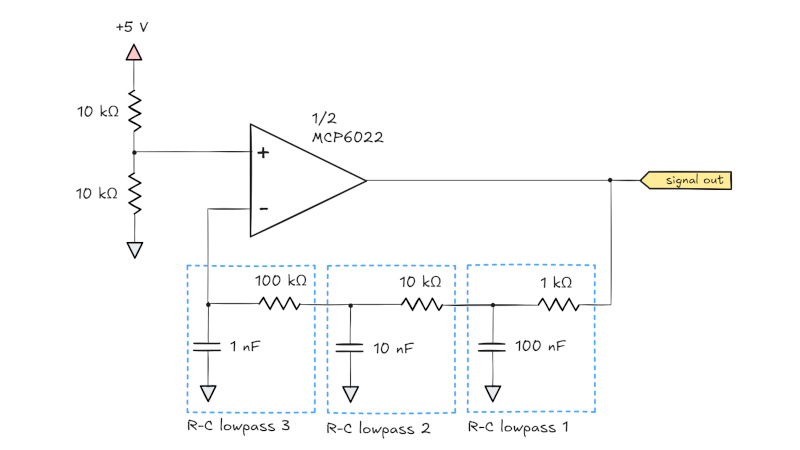
There’s more to making an oscillator than meets the eye, and [lcamtuf] is here with a good primer on the subject. It starts with the old joke that if you need an oscillator it’s best to try to make an amplifier instead, but of course the real point here is to learn how to make not just a mere oscillator, but a good oscillator.
He does this by taking the oscillator back to first principles and explaining positive feedback on an amplifier, before introducing the Schmitt trigger, an RC circuit to induce a delay, and then phase shift. These oscillators are not complex circuits by any means, so understanding their principles should allow you to unlock the secrets of oscillation in a less haphazard way than just plugging in values and hoping.
The original Xbox was different from the consoles that had gone before, in that its hardware shared much with a PC of the day. It was found to be hackable, and one of the most successful projects to take advantage of it was a media centre. You know it as Kodi, but its previous name was XBMC, for Xbox Media Centre. The last version that still ran on an original Xbox saw the light of day in 2016, so it’s definitely a surprise that a new version has appeared.
XBMC version 4.0 brings a host of new features to the venerable platform, including the Estuary user interface that will be famniliar to users of more recent Kodi versions, a better games library,, and more. The plugin system has been revamped too, and while it retains the Python 2 version from back in the day it’s promised that a Python 3 update is in the works. That’s right, it sounds as though there will be more releases. Get them from the GitHub repository.
We’re not sure how many of you have early Xbox hardware along with the inclination to use it as a media centre, after all Kodi runs so well on a lot of very accessible hardware. But we’re impressed that the developers of this release have managed so much within the confines of a machine with a 2000s-era spec, and have released it at all.
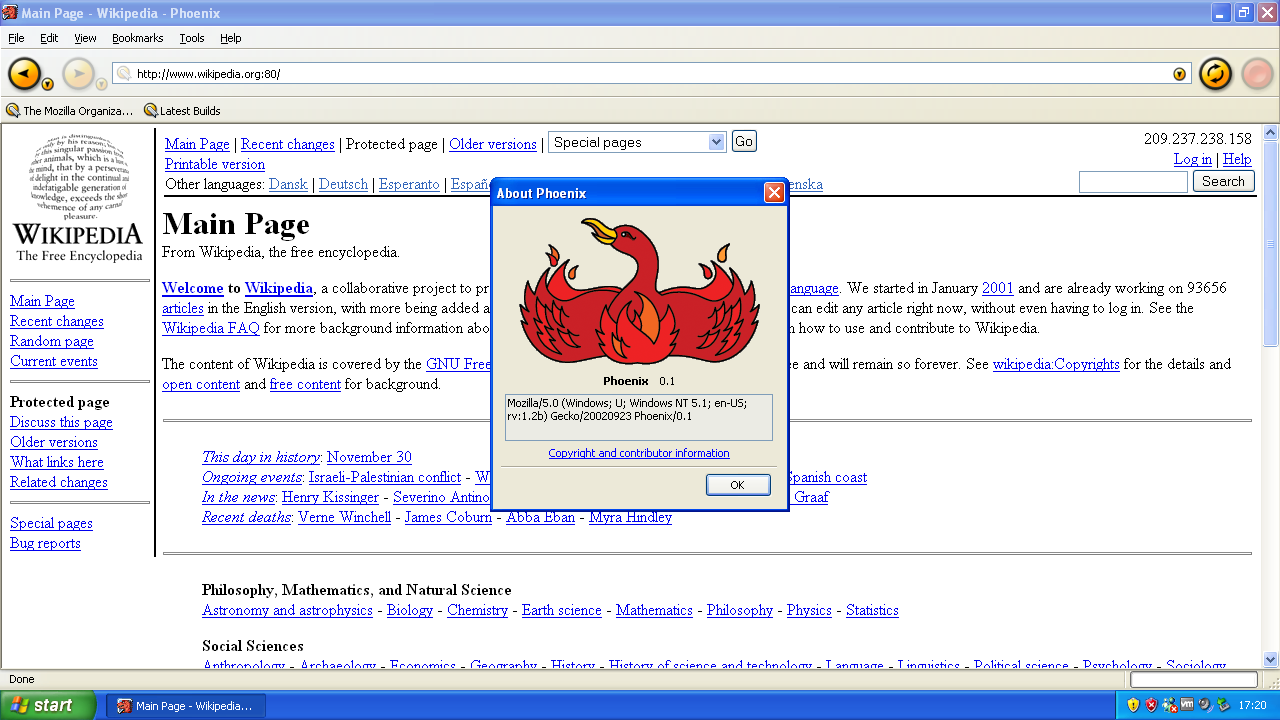
It’s likely that Hackaday readers have among them a greater than average number of people who can name one special thing they did on September 23rd, 2002. On that day a new web browser was released, Phoenix version 0.1, and it was a lightweight browser-only derivative of the hugely bloated Mozilla suite. Renamed a few times to become Firefox, it rose to challenge the once-mighty Microsoft Internet Explorer, only to in turn be overtaken by Google’s Chrome.
Now in 2025 it’s a minority browser with an estimated market share just over 2%, and it’s safe to say that Mozilla’s take on AI and the use of advertising data has put them at odds with many of us who’ve kept the faith since that September day 23 years ago. Over the last few months I’ve been actively chasing alternatives, and it’s with sadness that in November 2025, I can finally say I’m Firefox-free.
Just What Went Wrong?
Browser market share, 2009 to 2025. Statcounter, CC BY-SA 3.0.
It was perhaps inevitable that Firefox would lose market share when faced with a challenger from a player with the economic muscle of Google. Chrome is everywhere, it’s the default browser in Android and ChromeOS, and when stacked up against the Internet Explorer of fifteen years or so ago it’s not difficult to see why it made for an easy switch. Chrome is good, it’s fast and responsive, it’s friendly, and the majority of end users either don’t care or don’t know enough to care that it’s Google’s way in to your data. When it first appeared, they still had the “Don’t be evil” aura to them, even if perhaps behind the warm and fuzzy feeling it had already worn away in the company itself.
If Firefox were destined to become a minority player then it could still be a successful one; after all, 2% of the global browser market still represents a huge number of users whose referrals to search engines return a decent income. But the key to being a success in any business is to know your customers, and sitting in front of this particular screen it’s difficult to escape the conclusion that Mozilla have lost touch with theirs. To understand this it’s necessary for all of us to look in the mirror and think for a moment about who uses Firefox.
Somewhere, A Group Of Users Are Being Ignored
Blink, and its name will change: Phoenix version 0.1. Mozilla Foundation; Microsoft, Inc., CC BY-SA 4.0.
A quick straw poll in my hackerspace revealed a majority of Firefox users, while the same straw poll among another group of my non-hackerspace friends revealed none. The former used Firefox because of open-source vibes, while the latter used Edge or Safari because it came with their computer, or Chrome on their phone and on their desktop because of Google services. Hackaday is not a global polling organisation, but we think it’s likely that the same trend would reveal itself more widely. If you’re in the technology space you might use Firefox, but if you aren’t you may not even have heard of it in 2025. It’s difficult to see that changing any time soon, to imagine some killer feature that would make those Chrome, Safari, and Edge users care enough to switch to Firefox.
To service and retain this loyal userbase then, you might imagine that Mozilla would address their needs and concerns with what made Phoenix a great first version back in 2002. A lightweight and versatile standards-compliant and open-source web browser with acceptable privacy standards, and without any other non-browser features attached to it. Just a browser, only a browser, and above all, a fast browser.
Instead, Mozilla appear to be following a course calculated to alarm rather than retain these users. Making themselves an AI-focused organisation, neglecting their once-unbeatable developer network, and trying to sneak data gathering into their products. They appear now to think of themselves as a fad-driven Valley startup rather than the custodians of a valuable open-source package, and unsurprisingly this is concerning to those of us who know something about what a browser does behind the scenes.
Why Is This Important?
If you have ever had to write code like this, you will know. Bret Taylor, CC-BY 2.5.
It is likely that I am preaching to the choir here, but it’s important that there be a plurality of browsers in the world. And by that I mean not just a plurality of front-ends, but a plurality of browser engines. One of the reasons Phoenix appeared all those years ago was to challenge the dominance of Microsoft Internet Explorer, the tool by which the Redmond software company were trying to shape the online world to their tune. If you remember the browser wars of that era, you’ll have tales of incompatibilities seemingly baked in on purpose to break the chances of an open Web, and we were all poorer for it. Writing Javascript with a range of sections to deal with the quirks of different browser families is now largely a thing of the past, and for that you have the people who stuck with Firefox in the 2000s to thank.
The fear is that here in 2025 we are in an analogous situation to the early 2000s, with Google replacing Microsoft. Such is the dominance of Google Chrome and the WebKit-derived Blink engine which powers it, that in effect, Google have immense power to shape the Web just as Microsoft did back in the day. Do you trust them to live up to their now-retired mission statement and not be evil? We can’t say we do. Thus Firefox’s Gecko browser engine is of crucial importance, representing as it does the only any-way serious challenger to Blink and WebKit’s near-monopoly. That it is now tied to a Mozilla leadership treating it in so cavalier a manner does not bode well for the future of the Web.
So I’ve set out my stand here, that after twenty-three years, I’m ready to abandon Firefox. It’s not a decision that has been easy, because it’s important for all of us that there be a plurality of browsers, but such is the direction being taken by Mozilla that I am not anxious to sit idly by and constantly keep an eye out for new hidden privacy and AI features to turn off with obscure checkboxes. In the following piece I’ll take a look at my hunt for alternatives, and you may be surprised by the one I eventually picked.
They make the point that an electric coffee pot requires at least 300 W to work, so what’s the secret? In this case, insulation, as a standard moka pot is placed within a nichrome heating element set in mortar and surrounded by cork. On the outside are tiles, though they appear largely ornamental and the write-up suggests you could experiment with other materials to serve as an enclosure.
It appears to be an effective coffee maker, with the significant caveat that it’s hardly fast. In full sunlight the first pot takes over an hour to brew, with subsequent ones once it’s up to temperature being somewhat faster. But you can’t argue with the idea of free power, even if your favourite caffeinated beverage may now take a while to appear.
We like this idea, despite its slow brewing. We’ve featured Low Tech Magazine before, not least in their solar powered oven.
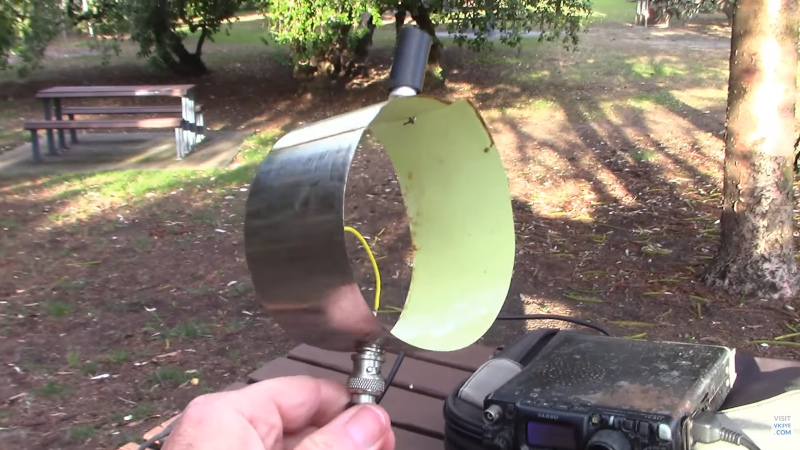
The magnetic loop antenna is a familiar sight in radio amateur circles as a means to pack a high performance HF antenna into a small space. It takes the form of a large single-turn coil made into a tuned circuit with a variable capacitor, and it provides the benefits of good directionality and narrow bandwidth at the cost of some scary RF voltages and the need for constant retuning. As [VK3YE] shows us though, magnetic loops are not limited to HF — he’s made a compact VHF magnetic loop using a tin can.
It’s a pretty simple design; a section from the can it cut out and made into a C shape, with a small variable capacitor at the gap. The feed comes in at the bottom, with the feed point about 20 % of the way round the loop for matching. The bandwidth is about 100 MHz starting from the bottom of the FM broadcast band, and he shows us it receiving broadcast, Airband, and 2 meter signals. It can be used for transmitting too and we see it on 2 meter WSPR, but we would have to wonder whether the voltages induced by higher power levels might be a little much for that small capacitor.
He’s at pains to point out that there are many better VHF antennas as this one has no gain to speak of, but we can see a place for it. It’s tiny, if you’re prepared to fiddle with the tuning its high Q gets rid of interference, and its strong side null means it can also reduce unwanted signals on the same frequency. We rather like it, and we hope you will too after watching the video below.

 Login
Login