❌

Reading view

There are new articles available, click to refresh the page.

That Power Bank Isn’t Quite So Sweet

An unlikely hit of the last few months’ consumer hardware has been a power bank branded by the German confectionery company Haribo. It first gained attention in backpacking circles because of its high capacity for a reasonable weight, and since then has been selling like the proverbial hot cakes. Now Amazon have withdrawn it from their store over β€œA potential safety or quality issue”. The industrial imaging company Lumafield have taken a look at the power bank with a CT scanner, to find out why.

As you might imagine, the power bank is all battery inside, with pouch type lithium ion cells taking up all of the space. Immediately a clue appears as to why Amazon withdrew them, as the individual layers of the cells are misaligned, laying open a risk of failure. They also take a look at a set of earbuds from the same source and find something even more concerning β€” torn electrodes. Thus neither device can be regarded as safe, and the backpackers will have to haul around a little bit more in the future.

You’ll not find the Wrencher on a power bank, but you can be sure if you did, we’d make sure there was an element of quality control at play. Meanwhile we feel slightly sorry for the branding executive responsible at Haribo, who we are guessing has had a bad day. We’ve featured Lumafield’s work here before quite a few times, most recently looking at similar defects in 18650 cells.
Expensive Batteries Hide Cheap Tricks

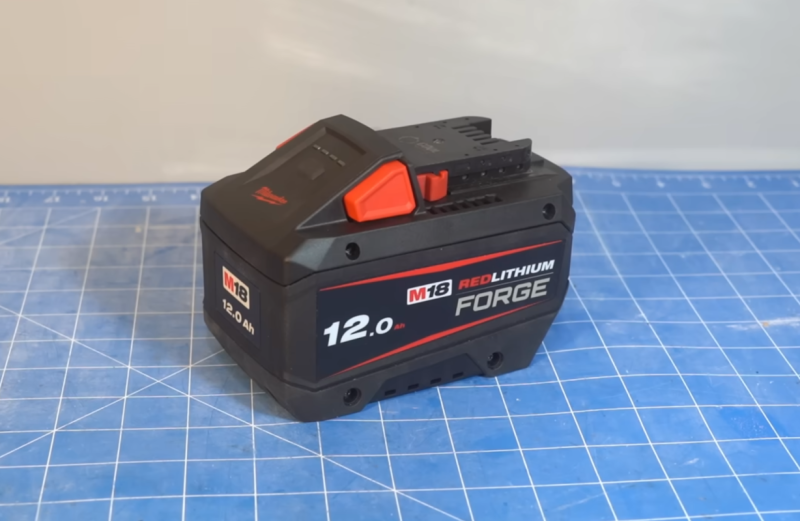
In our modern world full of planned obsolescence helping to fuel cycles of consumerism, the thing that really lets companies dial this up to the max is locked-down electronics and software. We all know the key players in this game whether it’s an automotive manufacturer, video game console producer, smart phone developer, or fruit-based computer company of choice, but there are some lesser known players desperately trying to make names for themselves in this arena too. Many power tool manufacturers like Milwaukee build sub-par battery packs that will wear out prematurely as [Tool Scientist] shows in this video.

Determining that these packs don’t actually balance their cells isn’t as straightforward as looking for leads going to the positive terminal of each. The microcontrollers running the electronics in these packs are hooked up, but it seems like it’s only to communicate status information about the batteries and not perform any balancing. [Tool Scientist] tested this hypothesis through a number of tests after purposefully adding an imbalance to a battery pack, first by monitoring i2c communications, measuring across a resistor expected to show a voltage drop during balancing, let a battery sit 21 days on a charger, and then performing a number of charge and discharge cycles. After all of that the imbalance was still there, leading to a conclusion that Milwaukee still doesn’t balance their battery packs.

Giving them the benefit of the doubt, it could be that most packs will be just fine after years without balancing, so the added cost of this feature isn’t worth it. This video was put out nearly a year ago, so it’s possible Milwaukee has made improvements since then. But a more realistic take, especially in a world dominated by subscription services and other methods of value extraction, is that Milwaukee is doing this so that users will end up having to buy more batteries. They already make user serviceability fairly difficult, so this would be in line with other actions they’ve taken. Or it could be chalked up to laziness, similar to the Nissan Leaf and its lack of active thermal management in its battery systems.

Thanks to [Polykit] for the tip!

Charge NiMH Batteries with Style, Panache and an RP2040

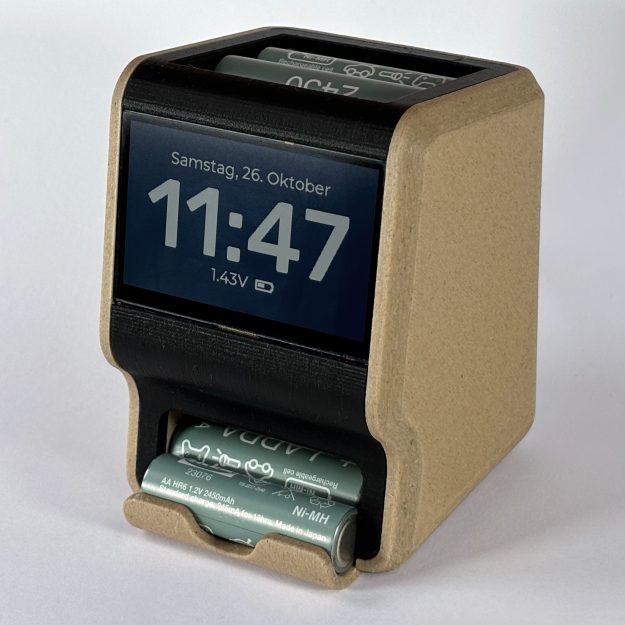
The increasing dominance of lithium cells in the market place leave our trusty NiMH cells in a rough spot. Sure, you can still get a chargers for the AAs in your life, but it’s old tech and not particularly stylish. That’s where [Maximilian Kern] comes in, whose SPINC project was recently featured in IEEE Spectrumβ€” so you know it has to be good.

With the high-resolution LCD, the styling of this device reminds us a little bit of the Pi-Mac-Nanoβ€” and anything that makes you think of a classic Macintosh gets automatic style points. There’s something reminiscent of an ammunition clip in the way batteries are fed into the top and let out the bottom of the machine.

[Maximilian] thought of the, ah, less-detail-oriented amongst us with this one, as the dedicated charging IC he chose (why reinvent the wheel?) is connected to an H-bridge to allow the charger to be agnostic as to orientation. That’s a nice touch. An internal servo grabs each battery in turn to stick into the charging circuit, and deposits it into the bottom of the device once it is charged. The LCD screen lets you monitor the status of the battery as it charges, while doubling as a handy desk clock (that’s where the RP2040 comes in). It is, of course powered by a USB-C port as all things are these days, but [Maximilian] is just drawing from the 5V line instead of making proper use of USB-C Power Delivery. (An earlier draft of this article asserted incorrectly that the device used USB-C-PD.)Β  Fast-charging upto 1A is enabled, but you might want to go slower to keep your cells lasting as long as possible. Firmware, gerbers and STLs are available on GitHub under a GPL-3.0 license– so if you’re still using NiCads or want to bring this design into the glorious lithium future, you can consider yourself welcome to.

We recently featured a AA rundown, and for now, it looks like NiMH is still the best bang for your buck, which means this project will remain relevant for a few years yet. Of course, we didn’t expect the IEEE to steer us wrong.

Thanks to [George Graves] for the tip.

❌