
Reading view

There are new articles available, click to refresh the page.

The Top 5 Cybersecurity Vulnerabilities for Government Agencies in 2022

Government agencies are faced with cybersecurity challenges from all sides. Digital transformation initiatives can expose weak points in an attack surface, putting pressure on agencies’ IT teams to get it just right. And from insider threats to persistent vulnerabilities within networks and operating systems, public sector leaders feel the urgency to obtain a clear picture of what’s most at-risk.

As we kick off 2023, the Synack Red Team reviewed the most common vulnerabilities found in 2022. Each of these vulnerabilities have the potential to pose significant threats to large organizations—governments and beyond—and will continue to be monitored as we move through 2023.

Here are the top 5 vulnerability categories found by Synack in government accounts in 2022:

#5: Remote Execution

Remote Code Execution refers to a vulnerability where an unauthenticated attacker can remotely execute commands to place malware or malicious code on your network or hardware.

#4: Brute Force

In a brute force attack, attackers utilize exhaustive key searches to constantly search and systematically check possible passwords or passphrases until the correct one is found. This can lead to successful phishing attacks and more.

#3: SQL Injection

This attack style consists of insertion or injection of a SQL query via the input data from client to application. A successful exploit of this style can read and even modify sensitive data, execute admin functions (including shutting down systems), and in some cases, issue commands to an operating system.

 

 #2: Authorization Permissions

The second most common vulnerability found in 2022 relates to improper authorizations. With authorizations, a user’s right to “access a given resource [is] based on the user’s privileges and any permissions or other access-control specifications that apply to the resource.” In this case, unauthorized users may gain access to resources or initiate unwanted actions that they should not be allowed to perform, potentially leading to data exposures, DoS, or arbitrary code execution.

#1: Cross Site Scripting XSS 

The most found vulnerability among Synack’s government missions in 2022 was cross-site scripting (XSS). According to NIST, this vulnerability “allows attackers to inject malicious code into an otherwise benign website. These scripts acquire the permissions of scripts generated by the target website and can therefore compromise the confidentiality and integrity of data transfers between website and client. Websites are vulnerable if they display user-supplied data from requests or forms without sanitizing the data so that it is not executable.”

Government organizations need to stay on top of these and countless other vulnerabilities, and mandates are pushing security teams to address this head on by adopting a zero trust model. At a high level, a Zero Trust Architecture provides a framework and structural guidance to ensure that only the individuals and systems who need access, have access. Dedicated and continuous application security testing programs are a critical piece to achieving a zero trust paradigm, and investment in security testing is critical to ensuring agencies in the United States have minimized known vulnerabilities and are adhering to Executive Order 14028 and Memorandum 22-09.

How can my team reduce found vulnerabilities?

  • Understand your attack surface. Ensure you have a clear picture of your dynamic assets and that your attack surface is defined. This is key to managing cyber risk. 
  • Set your vulnerability alerts. Stay aware of the latest active exploits, vulnerabilities and security issues affecting government and industry-specific verticals by signing up for alerts from CISA.
  • TEST! Does your security testing plan include testing for the 5 common vulnerabilities above? Synack can help. Chat with a Synack public sector representative today to learn how the Synack platform empowers in-house teams to scale and protect your mission continuously in a FedRAMP Moderate In Process environment.
  • Double down on Vulnerability Management. Make sure you are prioritizing vulnerabilities according to their criticality, patching them and then independently verifying that those patches have worked.
  • Orchestrate. Your SOAR has defensive security data from logging, alerting, threat intel and more. You should also integrate Synack continuous penetration testing data to automate your offensive security practices within the SOC. Such an integration will enable continuous, defensive improvements so you can truly grade and improve your security posture.

Additional Resources

READ: Our Guide to Zero Trust
WATCH: Webinar with HHS’ Matthew Shallbetter
LEARN: Synack’s FedRAMP Moderate In Process Certification

The post The Top 5 Cybersecurity Vulnerabilities for Government Agencies in 2022 appeared first on Synack.
Worry-free Pentesting: Continuous Oversight In Offensive Security Testing

In your cybersecurity practice, do you ever worry that you’ve left your back door open and an intruder might sneak inside? If you answered yes, you’re not alone. The experience can be a common one, especially for security leaders of large organizations with multiple layers of tech and cross-team collaboration to accomplish live, continuous security workflows.

At Synack, the better way to pentest is one that’s always on, can scale to test for urgent vulnerabilities or compliance needs, and provides transparent, thorough reporting and coverage insight.

Know what’s being tested, where it’s happening and how often it’s occurring 

With Synack365, our Premier Security Testing Platform, you can find relief in the fact that we’re always checking for unlocked doors. To provide better testing oversight, we maintain reports that list all web assets being tested, which our customers have praised. Customer feedback indicated that adding continuous oversight into host assets would also help to know which host or web assets are being tested, when and where they’re being tested, and how much testing has occurred. 

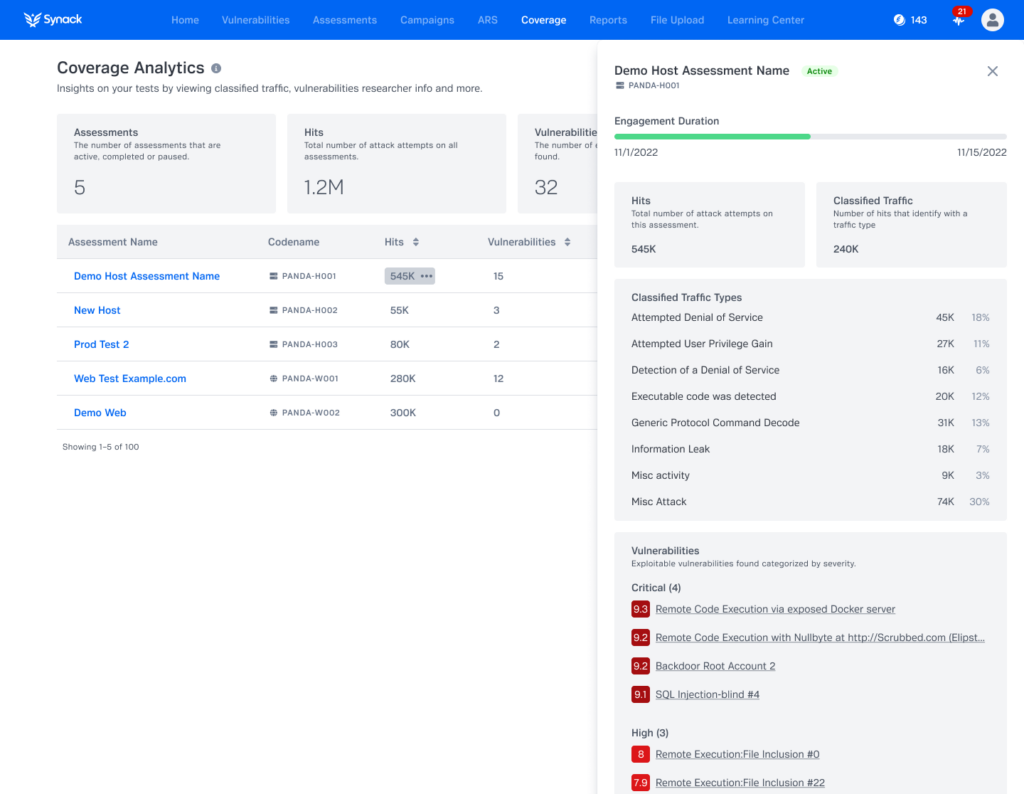
Synack’s expanded Coverage Analytics tells you all that and more for host assets, in addition to our previous coverage details on web applications and API endpoints, all found within the Synack platform. With Coverage Analytics, Synack customers are able to identify which web or host assets have been tested and the nature of the testing performed. This is helpful for auditing purposes and provides proof of testing activity, not just that an asset is in scope. Additionally, Coverage Analytics gives customers an understanding of areas that haven’t been tested as heavily for vulnerabilities and can provide internal red team leaders with direction for supplemental testing and prioritization. 

Unmatched Oversight of Coverage 

Other forms of security testing are unable to provide the details and information Synack Coverage Analytics does. Bug bounty testing typically goes through the untraceable public internet or via tagged headers, which require security researcher cooperation. The number of researchers and hours that they are testing are not easily trackable via these methods, if at all. Traditional penetration testing doesn’t have direct measurement capabilities. Our LaunchPoint infrastructure stands between the Synack Red Team, our community of 1,500 security researchers, and customer assets, so customers have better visibility of the measurable traffic during a test. More and more frequently, we hear that customers are required to provide this kind of information to their auditors in financial services and other industries. 

A look at the Classified Traffic & Vulnerabilities view in Synack’s Coverage Analytics. Sample data has been used for illustration purposes.

Benefits of Coverage Analytics 

  • Know what’s being tested within your web and host assets: where, when and how much 
  • View the traffic generated by the Synack Red Team during pentesting
  • Take next steps with confidence; identify where you may need supplemental testing and how to prioritize such testing

Starting today, security leaders can reduce their teams’ fears of pentesting in the dark by knowing what’s being tested, where and how much at any time across both web and host assets. Coverage Analytics makes sharing findings with executive leaders, board members or auditors simple and painless.

Current Synack customers can log in to the Synack Platform to explore Coverage Analytics today. If you have questions or are interested in learning more about Coverage Analytics, part of Synack’s Better Way to Pentest, don’t hesitate to contact us today!

The post Worry-free Pentesting: Continuous Oversight In Offensive Security Testing appeared first on Synack.

Accelerated Decision-making in Cybersecurity Requires Actionable Vulnerability Intelligence

Cybersecurity officers tasked with finding and mitigating vulnerabilities in government organizations are already operating at capacity—and it’s not getting any easier.

First, the constant push for fast paced, develop-test-deploy cycles continuously introduces risk of new vulnerabilities. Then there are changes in mission at the agency level, plus competing priorities to develop while simultaneously trying to secure everything (heard of DevSecOps?). Without additional capacity, it’s difficult to find exploitable critical vulnerabilities, remediate at scale and execute human-led offensive testing of the entire attack surface. 

The traditional remedy for increased security demands has been to increase penetration testing in the tried and true fashion: hire a consulting firm or a single (and usually junior) FTE to pentest the assets that are glaring red. That method worked for most agencies, through 2007 anyway. In 2022, however, traditional methodology isn’t realistic. It doesn’t address the ongoing deficiencies in security testing capacity or capability. It’s also too slow and doesn’t scale for government agencies.

So in the face of an acute cybersecurity talent shortage, what’s a mission leader’s best option if they want to improve and expand their cybersecurity testing program, discover and mitigate vulnerabilities rapidly, and incorporate findings into their overall intelligence collection management framework? 

Security leaders should ask themselves the following questions as they look to scale their offensive and vulnerability intelligence programs:

  • Do we have continuous oversight into which assets are being tested, where and how much? 
  • Are we assessing vulnerabilities based on the Cybersecurity Infrastructure Security Agency’s (CISA) Known Exploited Vulnerabilities Catalog, or are we assessing vulnerabilities using the Common Vulnerability Scoring System (CVSS) calculator
  • Are we operationalizing penetration test results by integrating them into our SIEM/SOAR and security ops workflow, so we can visualize the big picture of vulnerabilities across our various assets? 
  • Are we prioritizing and mitigating the most critical vulnerabilities to our mission expediently? 

There is a way to kick-start a better security testing experience—in a FedRAMP Moderate environment with a diverse community of security researchers that provide scale to support the largest of directorates with global footprints. The Synack Platform pairs the talents of the Synack Red Team, a group of elite bug hunters, with continuous scanning and reporting capabilities.

Together, this pairing empowers cybersecurity officers to know what’s being tested, where it’s happening, and how much testing is being done with vulnerability intelligence. Correlated with publicly available information (PAI) and threat intelligence feeds, the blend of insights can further enhance an agency’s offensive cybersecurity stance and improve risk reduction efforts.

Synack helps government agencies mitigate cybersecurity hiring hurdles and the talent gap by delivering the offensive workforce needed quickly and at scale to ensure compliance and reduce risk. And we’re trusted by dozens of government agencies. By adding Synack Red Team mission findings into workflows for vulnerability assessment, security operations teams are given the vulnerability data needed to make faster and more informed decisions.

Intrigued? Let’s set up an intelligent demo. If you’re attending the Intelligence & National Security Summit at the Gaylord in National Harbor, Md., next week, we’ll be there attending sessions and chatting with officers at Kiosk 124. We hope to see you there! 

Luke Luckett is Senior Product Marketing Manager at Synack.

The post Accelerated Decision-making in Cybersecurity Requires Actionable Vulnerability Intelligence appeared first on Synack.

❌