
❌

Reading view

There are new articles available, click to refresh the page.

Fixing a Milltronics ML15 CNC Lathe Despite the Manufacturer’s Best Efforts

When you’re like [Wes] fromΒ Watch Wes Work fame, you don’t have a CNC machine hoarding issue, you just have a healthy interest in going down CNC machine repair rabbit holes. Such too was the case with a recently acquired 2001 Milltronics ML15 lathe, that at first glance appeared to be in pristine condition. Yet despite – or because of – living a cushy life at a college’s workshop, it had a number of serious issues, with a busted Z-axis drive board being the first to be tackled.

The Glentek servo board that caused so much grief. (Credit: Watch Wes Work, YouTube)

The identical servo control board next to it worked fine, so it had to be an issue on the board itself.Β  A quick test showed that the H-bridge IGBTs had suffered the typical fate that IGBTs suffer, violently taking out another IC along with them. Enjoyably, this board by one Glentek Inc. did the rebranding thing of components like said IGBTs, which made tracking down suitable replacements an utter pain that was eased only by the desperate communications on forums which provided some clues. Of course, desoldering and testing one of the good IGBTs on the second board showed the exact type of IGBT to get.

After replacing said IGBTs, as well as an optocoupler and other bits and pieces, the servo board was good as new. Next, the CNC lathe also had a busted optical encoder, an unusable tool post and a number of other smaller and larger issues that required addressing. Along the way the term β€˜pin-to-pin compatible’ for a replacement driver IC was also found to mean that you still have to read the full datasheet.

Of the whole ordeal, the Glentek servo board definitely caused the most trouble, with the manufacturer providing incomplete schematics, rebranding parts to make generic replacements very hard to find and overall just going for a design that’s interesting but hard to diagnose and fix. To help out anyone else who got cursed with a Glentek servo board like this, [Wes] has made the board files and related info available in a GitHub repository.
Using the Pyroelectric Effect to Identify Broken MLCC Capacitors

Vintage computer hardware can fail in a variety of fascinating ways, with [Bits und Bolts] dealing with an interesting failure mode, in the form of degraded MLCC capacitors on Voodoo 2 graphics cards. These little marvels of miniaturized surface-mount technology enable the placement of ceramic capacitors with very little space required, but as they degrade over time or due to physical damage, they can cause big issues in a circuit.

In the case of the two Voodoo 2 GPUs that [Bits und Bolts] was trying to fix, the clue that something was wrong was graphical glitches, which seemed to be related to something dragging down the 5V rail. Using the standard β€˜inject voltage and see what gets hot’ method, he discovered a couple of dead MLCCs and replaced them. But something was still dragging the rail down. Unfortunately, whatever it was wasn’t enough to heat up the part in question, and no sane person wants to desolder hundreds or even thousands of MLCCs on a PCB and see whether it makes a difference.

Ultimately, the pyroelectric effect was used to hunt down the culprit, saving countless hours of work. This is a property of certain naturally electrically polarized crystals, in which the material generates a voltage when heated or cooled. Materials like that used in MLCCs, for example.

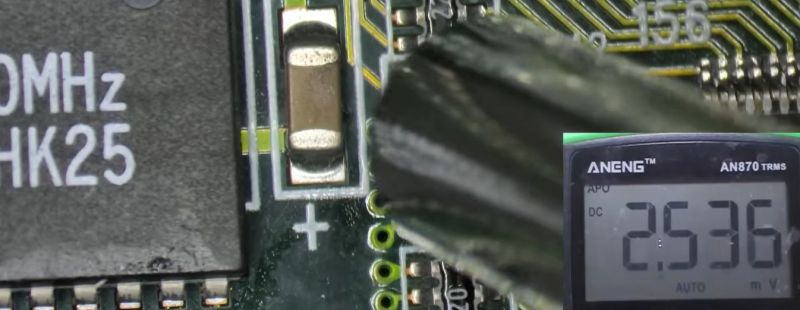
With a hot air gun set to 200 Β°C and aimed at a specific MLCC, it was possible to measure changes not only in resistivity but also in voltage between the 5V rail and ground. The voltage spike was relatively minor for the smaller MLCCs, but the larger ones showed a significant voltage swing of around 2.5mV.

The culprit turned out to be a large MLCC, which showed only a weak pyroelectric effect and a resistivity that didn’t drop as quickly as that of similar MLCCs on the same board. After replacement, the faulty MLCC did indeed measure as faulty, and the card’s 5V rail now showed a healthy resistance level to ground.

In addition to knowing what kind of resistivity you should measure on a PCB’s voltage rails relative to ground, this method provides a fairly painless way to quickly find a dodgy MLCC. Just make sure not to try this method on electrolytic or tantalum. Heating those up won’t go well.

We often treat decoupling capacitors as more art than science, but of course, we shouldn’t. MLCCs can even exhibit the piezoelectric effect, too.

❌