 Login
LoginTrump’s New Plan to Cut Energy Costs: Use Walmart’s Backup Generators

Well, it's *an* idea.


A bipartisan bill that would end the Trump administration’s rollback of collective bargaining rights for most federal employees is guaranteed to get a full House vote, now that a majority of lawmakers support it.
As of Monday, 218 House lawmakers signed onto a discharge petition, forcing the House to vote on the Protect America’s Workforce Act.
The bill, led by Reps. Brian Fitzpatrick (R-Pa.) and Jared Golden (D-Maine) would restore collective bargaining rights for tens of thousands of federal employees, if approved by Congress.
President Donald Trump signed an executive order in March that barred unions from bargaining on behalf of federal employees at many agencies, on the grounds that those agencies work primarily in national security. In August, he signed another executive order that expanded the list of agencies barred from negotiations with federal employee unions.
Lawmakers estimate the executive order impacts about 67% of the federal workforce. The Trump administration’s policy has barred unions from representing employees at the departments of Defense, State, Veterans Affairs, Justice and Energy.
A group of six unions led by the American Federation of Government Employees sued the Trump administration over its rollback of collective bargaining rights, arguing that the administration has taken an overly broad view of agencies that work primarily in national security.
A federal judge blocked the administration from enforcing the executive order in April, but an appeals court stayed that decision this summer and allowed agencies to keep canceling collective bargaining agreements that cover broad swaths of the federal workforce. Since the appeals court’s ruling, several agencies have rescinded their collective bargaining rights with unions.
Reps. Mike Lawler (R-N.Y.) and Nick Lalota (R-N.Y.) contributed the last two signatures for the discharge petition on Monday. Lawler said in a statement that “restoring collective bargaining rights strengthens our federal workforce and helps deliver more effective, accountable service to the American people.”
“Every American deserves the right to have a voice in the workplace, including those who serve their country every single day. Supporting workers and ensuring good government are not opposing ideas. They go hand in hand,” Lawler said.
Everett Kelley, national president of the American Federation of Government Employees, applauded Republican lawmakers for supporting the bill, and called on the House to quickly vote on it.
“Collective bargaining gives employees a fundamental voice in making the government work better for the American people, and we thank Congressman Lawler for recognizing that America functions best when labor and management cooperate toward common goals,” Kelley said.
AFGE’s National VA Council recently filed a lawsuit challenging the VA’s selective enforcement of the administration’s executive order. The complaint states that VA Secretary Doug Collins scrapped collective bargaining agreements with unions opposed to the Trump administration’s federal workforce polices, but spared labor contracts for unions that represent VA police, security guards and firefighters.
Meanwhile, another bipartisan group of lawmakers is also leading a bill that would restore collective bargaining rights for VA employees. Sens. Richard Blumenthal (D-Conn.), Lisa Murkowski (R-Alaska), Chuck Schumer (D-N.Y.), and Rep. Delia Ramirez (D-Ill.) are leading that bill.
The National Treasury Employees Union, as well as the National Weather Service Employees Organization and the Patent Office Professional Association, are also suing the Trump administration over its collective bargaining rollback. Federal courts in D.C. will hold proceedings in both cases next month.
The post House majority forces vote on bill to restore collective bargaining for most federal employees first appeared on Federal News Network.
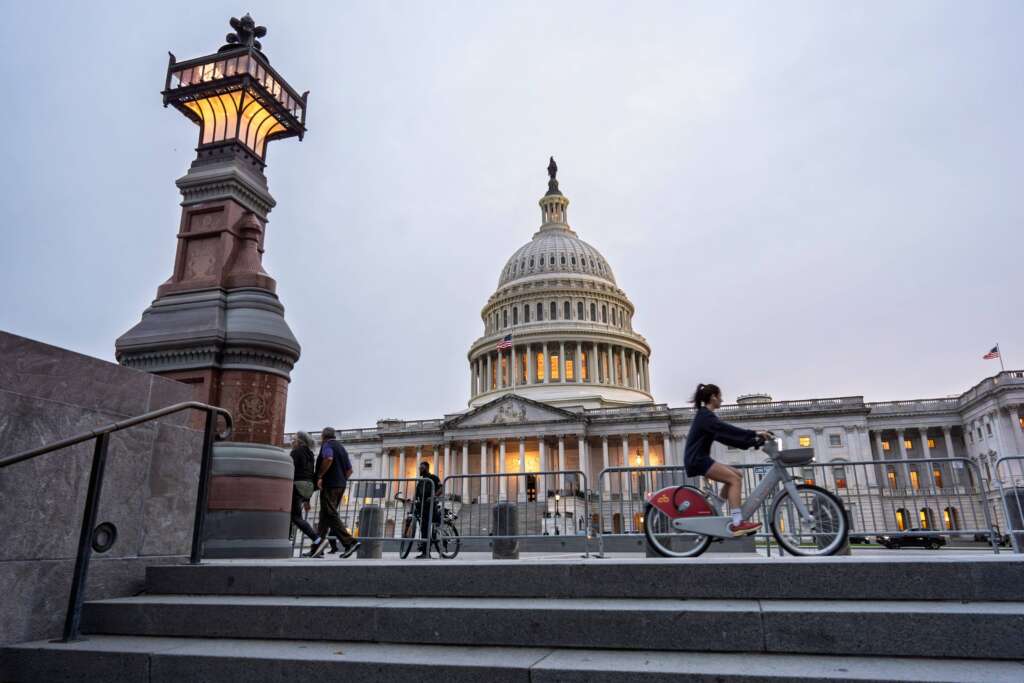
© AP Photo/J. Scott Applewhite
Following the longest shutdown in U.S. history, the federal workforce is now trying to get back to at least some sense of normalcy.
While federal employees who have been furloughed for the last 43 days return to work Thursday, the Office of Personnel Management is setting expectations for agencies as they begin to update pay, leave and benefits for those impacted by the lapse in appropriations.
In new guidance, OPM said it is “is committed to ensuring that retroactive pay is provided as soon as possible.” Compensation will be provided for both furloughed and excepted federal employees, as the spending agreement that was enacted Wednesday evening reaffirmed. A 2019 law previously called for retroactive compensation for all federal employees impacted by a shutdown.
A senior Trump administration official said the White House “has urged agencies to get employee paychecks out expeditiously and accurately to not leave anyone waiting longer than necessary.”
But the timing of employees receiving their back pay varies, depending on what payroll provider an agency uses, and the different pay schedules across the federal workforce.
Sending out retroactive payments to employees involves working across agency HR offices, federal payroll providers and shared service centers. Agency HR offices, for instance, have to submit timecards for federal employees, which are then processed by the government’s various payroll providers.
According to the senior administration official, employees from the General Services Administration and OPM will be among the first to receive their retroactive paychecks, with an expected deposit date set for Saturday.
Employees at the departments of Veterans Affairs, Energy, and Health and Human Services, as well as civilian employees from the Defense Department, will receive their deposits shortly after that — this Sunday.
On Monday, affected employees from the departments of Education, State, Interior and Transportation, as well as the Environmental Protection Agency, National Science Foundation, Nuclear Regulatory Commission, Social Security Administration and NASA, are all expected to receive their back pay.
Then on Wednesday, employees from the departments of Agriculture, Commerce, Treasury, Labor and Justice, along with the Department of Homeland Security, the Department of Housing and Urban Development and the Small Business Administration, are projected to get their paychecks. The timing of the retroactive payments for feds was first reported by Semafor.
The National Finance Center, a payroll provider housed under the Agriculture Department, confirmed that employees at agencies using NFC’s services should expect a payroll deposit by the middle of next week.
“In order to provide backpay for employees as quickly as possible, the National Finance Center will be expediting pay processing for pay period 22 and backpay for pay periods 19 (October 1-4), 20 (October 5-18), and 21 (October 19-November 1),” USDA wrote in an all-staff email Wednesday evening, obtained by Federal News Network.
Federal News Network has reached out to several other federal payroll providers requesting details on the timeline for processing retroactive payments.
The National Treasury Employees Union urged immediate back pay for all federal employees who have been going without compensation for the last six weeks.
“This is an emergency for federal employees across the country, and they should not have to wait another minute longer for the paychecks they lost during the longest government shutdown in history,” NTEU National President Doreen Greenwald said. “We call on all federal agencies to process the back pay immediately.”
In its new guidance, OPM also noted that to make payments as quickly as possible, payroll providers may need to “make some adjustments.” That could mean, for instance, that the initial retroactive payments employees receive might not reflect the exact calculations of their pay and leave hours.
“Payroll providers will work with agencies to make any necessary adjustments as soon as practicable,” OPM said.
Furloughed employees will receive their “standard rate of pay” for the hours they would have worked if the government shutdown hadn’t occurred, OPM said in its guidance Wednesday evening.
But there are some exceptions to that. If a furloughed employee, for example, had been scheduled for overtime hours that would have occurred during the shutdown, OPM said they should be paid their premium rate for those hours.
Additionally, OPM said that allowances, differentials and other types of payments, like administratively uncontrollable overtime pay or law enforcement availability pay, should be paid as if the furloughed employee continued to work.
Although most employees impacted by the shutdown are ensured back pay, there are some smaller exceptions carved out where employees may not receive retroactive pay, OPM added.
If a furloughed employee was in a non-pay status before the shutdown began, for instance, then they are not entitled to receive back pay.
Excepted employees who were considered “absent without leave” (AWOL) — or in other words, took unapproved time off — will also not receive back pay for that time.
Although excepted employees are not required to use paid leave for taking time off during the shutdown — and can instead enter a “furlough” period — there may still have been some instances where excepted employees took leave during the funding lapse, OPM wrote in its guidance.
In those cases, excepted employees who were approved to take paid leave during the shutdown will be charged for the hours from their leave bank, OPM said.
Agencies are also expected to begin adjusting leave accrual for furloughed employees. Now that the shutdown is over, furloughed employees should be placed in a “pay status” for the time they would have otherwise spent working during the funding lapse. That means accrual of annual and sick leave will be retroactively adjusted as if the employees were in a pay status, OPM said.
Excepted employees continued to accrue leave during the shutdown, which should be reflected in their leave banks, OPM said.
On top of reaffirming back pay, the spending bill that was enacted Wednesday evening also rescinds the roughly 4,000 reductions in force that have occurred since Oct. 1. Federal employees will be temporarily protected from additional RIFs, at least until the end of January.
Agencies have five days to inform federal employees who received RIF notices in October that those actions are rescinded.
“Agencies should issue those notices and confirm to OPM the rescissions have been issued,” OPM’s guidance states.
At least 670,000 federal employees have been furloughed, and 730,000 employees have been working without pay during the shutdown. Agencies have been putting plans in the works to return all furloughed federal employees to their duties as of Thursday.
OPM also said agencies “may consider” providing flexibility for employees who might not be able to return to work immediately, such as by approving personal leave or adjusting individual work schedules.
The post Post-shutdown, here’s how soon federal employees can expect back pay first appeared on Federal News Network.
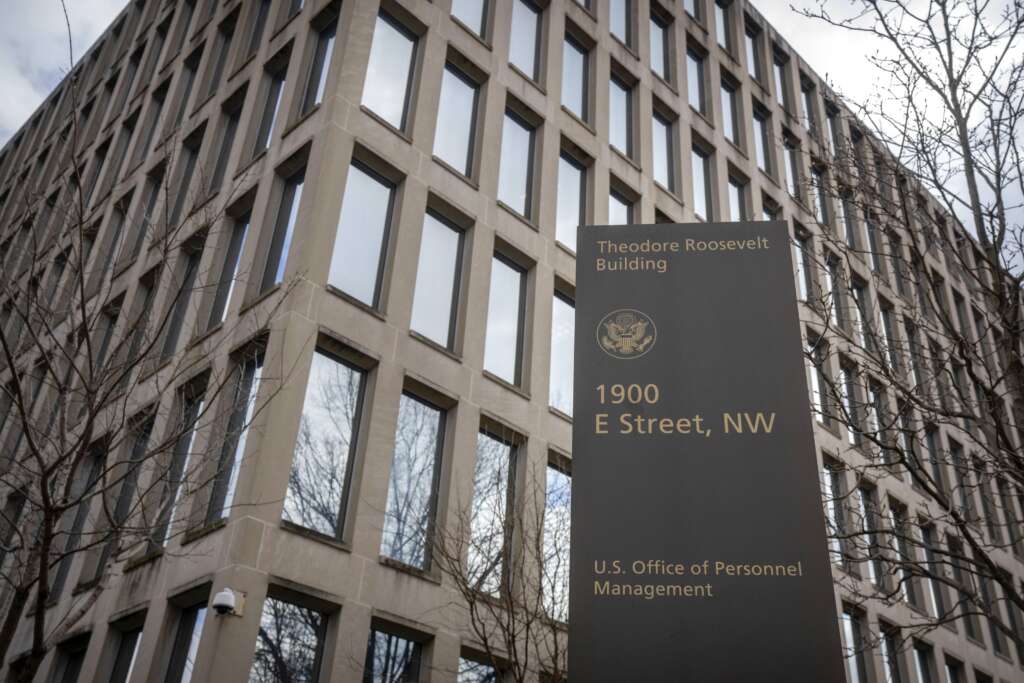
© AP Photo/Mark Schiefelbein
