Reading view

There are new articles available, click to refresh the page.

Fed Turns On The Liquidity Hose, XRP Ready To Ignite, Investor Claims

Reports have disclosed that the US Federal Reserve has ended its Quantitative Tightening program and has put cash back into markets. According to sources, the Fed injected more than $13 billion through overnight repo operations, the largest such move in years.

Crypto investor and author Paul Barron said that coins like XRP could “bring the fire” now that more liquidity is flowing back into the system. He believes that when the Fed starts easing up, assets with clear utility often react faster than the rest of the market.

Barron added that stronger liquidity usually pulls traders toward tokens that can move money quickly and cheaply, which is why he thinks XRP may see more attention if this trend continues.

Markets reacted quickly. Bitcoin rose about 4% in a 24-hour span to reach $93,800. XRP climbed more than 8%, touching $2.18 as demand picked up.

🔥 THE FED JUST DOUSED THE FLAMES: $13.5B repo injection, 2nd-largest since C@#$D After months of burning through liquidity (QT), they’re flooding the system again. Here’s the pattern: When the Fed brings water, $BTC, $ETH, $XRP brings the FIRE. Risk assets don’t cool down when…

— PaulBarron (@paulbarron) December 2, 2025

Liquidity Push Fuels Market Moves

According to analysts, this type of liquidity shift often lifts risk assets, including crypto. Tom Lee of BitMine said on TV that Bitcoin gained nearly 20% in the weeks following the last time the Fed shifted away from QT.

He noted that the same setup might lead to more upside before the year ends. Many traders are watching how much money returns to markets because it can shape short-term sentiment.

ETF Flows And Long-Term Views

According to reports, new XRP ETFs have already attracted more than $800 million in inflows. Supporters say these inflows can change how investors view XRP, although they don’t remove all uncertainty.

Some hedge fund managers also weighed in, pointing out that over the past 16 years the Fed added close to $9 trillion in liquidity while only removing $3.2 trillion before reversing course.

Utility Tokens May Get More Attention

Some community voices argue that tokens built for payments or settlement may see stronger demand if liquidity continues to rise. One XRP supporter said XRP was made to move money at scale and claimed the market will focus more on assets with real use cases.

Adoption remains mixed. Some companies that previously used Ripple’s tools have stepped back, while others still rely on parts of its payment network. The XRP Ledger is being used, but not always in the same way it was during earlier partnerships.

Outlook For The Market

With Bitcoin holding steady at the $93,000 level, and XRP at $2.22, the market is clearly reacting to the Fed’s change of direction. Liquidity helps drive rallies, but it also creates quick pullbacks and shaky moments.

Barron’s line — that coins like XRP could “bring the fire” — hangs over the market: renewed liquidity may be the spark that helps XRP ignite fresh momentum. But fire can spread fast or fizzle out; traders should stay alert, manage risk, and not get burned if the rally cools as quickly as it heats up.

Featured image from Unsplash, chart from TradingView

Fed Cut Doesn’t Scare Bitcoin, Which Holds Its Ground—Investor

Kevin O’Leary pushed back on what many traders are betting on, saying he does not expect the US Federal Reserve to cut rates in December and that such a move would not rock Bitcoin’s price.

The well-known investor/entrepreneur said he is not investing as if the Fed will ease policy, and he thinks Bitcoin will likely drift within 5% of its current level.

Fed Cut Odds Skyrocketing

According to the CME FedWatch Tool, markets are now pricing in an 89% chance of a December rate cut, a big swing from just weeks earlier when odds were far lower. This shift in expectations has been a main driver of recent moves in risk assets, including crypto.

LATEST 🚨

Kevin O’Leary just said a December Fed rate cut is unlikely because inflation is still too high!

He also said “It’s not going to make a difference to Bitcoin.”

Do you agree? 🤔 pic.twitter.com/lJBrW4Z2kA

— That Martini Guy ₿ (@MartiniGuyYT) December 3, 2025

Bitcoin Reacts To Shift In Sentiment

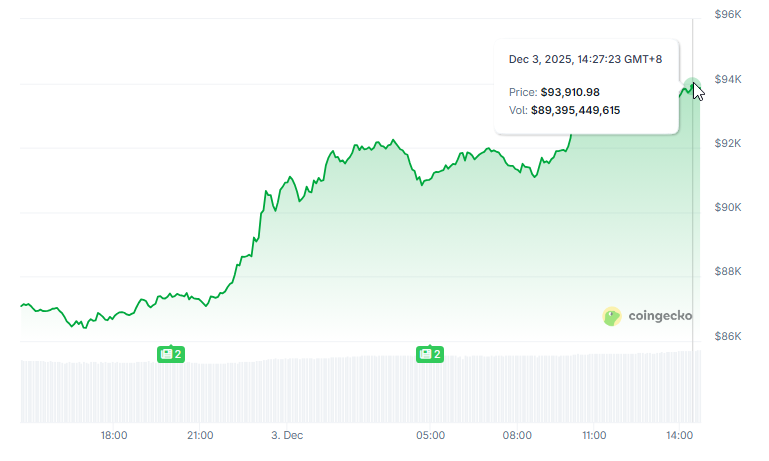
Based on reports from market trackers, Bitcoin climbed after a recent dip, recovering from a low near $83,000 to trade around $93,700 in early trading sessions. Coingecko listed the price roughly in the $92,700–$92,800 band during morning trade.

Traders point to support at $90,000 and resistance near $92,500, and some desk notes say a clean break above that could open a run toward $94K–$95K.

Why O’Leary Is Skeptical

O’Leary has flagged higher prices in the economy and sticky input costs as reasons the Fed might hold off. Reports show US consumer prices rose at a 3% annual rate in September, the fastest since January, a datapoint he cited to argue inflation still matters. The inflation numbers are being watched closely by policymakers weighing the trade-off between jobs and prices.

Liquidity Moves Add Fuel

Reports have disclosed that the Fed quietly put more than $13 billion of liquidity into short-term funding, a move some analysts say has helped restore liquidity in money markets and supported risk assets.

That liquidity boost, together with the pause in Quantitative Tightening, has been flagged by quant desks as one reason bullish momentum returned to crypto.

Market Reaction

O’Leary’s take is at odds with the market odds and with several analysts who see easier monetary policy as a tailwind for assets like Bitcoin. He is not alone in warning against reading too much into a single Fed decision, but many traders have already positioned for easing and that positioning has moved prices.

What Traders Are Watching Now

Traders say $90,000 is the key line for buyers, while $92,500 is the line sellers must yield for a higher move. A clean climb above $92,500 could point toward $94K and $95K, according to market desk notes. Liquidity flows and official Fed signals this week will likely determine whether those levels hold.

Featured image from Unsplash, chart from TradingView

US Fed Has Ended Quantitative Tightening, But Why Is The Bitcoin Price Still Below $100,000?

The Federal Reserve has officially brought its multi-year quantitative tightening program to a close, freezing its balance sheet at about $6.57 trillion after draining more than $2.3 trillion from the system since 2022. 

The Federal Reserve’s decision to formally end quantitative tightening has created a sense of anticipation across the crypto market. Liquidity inflows have shaped every major crypto cycle, and removing the multi-year drain on liquidity is expected to set the stage for healthier crypto market conditions and see the Bitcoin price push above $100,000 in the coming days.

Policy Shift Meets A Market Still Searching For Direction

The Fed has frozen its balance sheet at roughly $6.57 trillion after three years of balance-sheet reduction. Treasury runoff has stopped on December 1, though mortgage-backed securities will continue declining slowly. 

Ending QT means that the Fed is stepping away from the rapid balance-sheet reduction that tightened financial conditions throughout 2023 and 2024. The move comes after bank reserves fell to levels that threatened short-term funding stability, and the Fed made the move to halt any further liquidity drain.

Crypto investors are expecting the end of QT to relieve some of the selling pressure that has contributed to the crypto industry in recent months. This is due to historical comparisons of how the industry played out in previous ends to QT. 

In 2019, when the Fed last ended QT, digital assets bottomed within weeks and then entered a strong recovery phase. That period represented a decisive low for altcoins and preceded Bitcoin’s rise from roughly $3,800 to $29,000 over the next year and a half.

Interestingly, the entire crypto market’s short-term behavior is starting to show signs of bullishness. Particularly, the entire market is up by 7.2% in the past 24 hours, with Bitcoin leading the charge. However, cryptocurrencies are facing a different macro environment today, and the outlook is whether Bitcoin and other cryptocurrencies can go on another extended bullish rally in the coming months.

Why Is Bitcoin’s Reaction Delayed?

Ending QT is a meaningful turning point, but it does not automatically flood the system with fresh liquidity. Benjamin Cowen, founder of IntoTheCryptoverse, offers one of the clearest explanations for what to expect. 

He noted that in 2019, the Fed announced QT would end on August 1, but the balance sheet continued falling through mid-August because previously scheduled Treasury maturities had not yet settled. It wasn’t until early 2020 that Bitcoin started to experience explosive gains. According to Cowen, the same dynamic applies now. 

Therefore, the Federal Reserve’s balance sheet could continue edging lower for a few more weeks, meaning the first meaningful uptick in liquidity may not show up until early 2026. This delay suggests that traders hoping for an immediate boost or a quick return of Bitcoin above $100,000 are simply ahead of the cycle. The tightening phase has ended, but the actual recovery in liquidity has yet to begin.

Bitcoin

This Subwave Says Bitcoin Price Is Headed For A 50% Crash To $42,000

Crypto analyst Tony Severino has revealed a historical bearish pattern that could send the Bitcoin price to as low as $42,000. This bearish outlook for BTC comes amid a rebound for the flagship crypto, with a recent surge above the psychological $90,000 level. 

Bitcoin Price Risks 50% Drop To $42,000 Based On This Pattern

In an X post, Severino stated that the Bitcoin price likes to retrace to subwave 3/4 of wave 3/4 of its impulse. Based on this, the analyst indicated that BTC could crash to as low as $42,000 on wave C of this move to the downside. His accompanying chart showed that this decline could happen sometime at the start of next year. 

This bearish Bitcoin price prediction comes amid BTC’s rebound above $90,000 following the end of quantitative tightening (QT) by the U.S. Federal Reserve. The flagship crypto has also rebounded amid optimism of another rate cut at this month’s FOMC meeting. CME FedWatch data shows there is almost a 90% chance that the Fed will lower rates again this month. 

Bitcoin

However, despite these macro positives for the Bitcoin price, analysts such as Tony Severino have suggested that BTC is in a bear market and is likely to trend lower in the coming months. In an X post, he highlighted the BTC monthly chart, suggesting it showed a subtle volume breakout that confirmed a “not-so-subtle” trendline breakdown.  

Meanwhile, market technician JT described statements that the QT ending is bullish for the Bitcoin price as being a “fallacy.” He alluded to the possibility that the Bank of Japan (BOJ) may hike rates this month as one of the stressors to liquidity beyond QT.  

Peter Brandt Predicts Drop To Mid $40ks

In an X post, veteran trader and analyst Peter Brandt predicted that the Bitcoin price could drop to mid $40,000. He stated that the upper boundary of the lower green zone starts below $70,000 and that the lower support boundary is in the mid $40,000. Notably, Brandt had previously predicted that BTC could drop to around $50,000 before it then rallies to around $200,000 in the next bull market. 

The veteran analyst noted that there have been five major bull market cycles for the Bitcoin price since its inception. He further stated that in all previous cycles, the violation of the dominant parabolic advance has been followed by a 75% plus correction with no exception. As such, he expects BTC to undergo another significant correction in this cycle, potentially dropping below $50,000. 

At the time of writing, the Bitcoin price is trading at around $93,000, up almost 7% in the last 24 hours, according to data from CoinMarketCap.

Bitcoin

Bitcoin And The 2026 Fed Shift: Expert Says Markets Aren’t Ready

Macro strategist Alex Krüger is tying Bitcoin’s next macro chapter directly to the coming reshuffle at the Federal Reserve, warning that investors are underpricing how far US rates could fall under a Trump-aligned central bank.

In a long X post titled “2026: The Year of the Fed’s Regime Change,” he argues that “the Federal Reserve as we know it ends in 2026” and that the most important driver of asset returns will be a new, much more dovish Fed led by Kevin Hassett. His base case is that this shift becomes a key driver for risk assets broadly and Bitcoin in particular in 2026, even if crypto markets are currently trading as if nothing fundamental has changed.

Why The Federal Reserve Will Dramatically Change

Krüger’s scenario is anchored in personnel. He notes that prediction platform Kalshi put the odds of Hassett becoming chair at 70% as of 2 December, and describes him as a supply-side loyalist who “champions a ‘growth-first’ philosophy, arguing that with the inflation war largely won, maintaining high real rates is an act of political obstinacy rather than economic prudence.”

A few hours after Krüger’s thread, Trump himself added fuel, telling reporters at the White House that he would announce his Fed pick “early next year” and explicitly teasing National Economic Council Director Kevin Hassett as a possible choice, after saying the search had been narrowed down to one candidate.

To explain how this would translate into policy, Krüger reconstructs Hassett’s stance from his own 2024 comments. On 21 November, Hassett said “the only way to explain a Fed decision not to cut in December would be due to anti-Trump partisanship.” Earlier he argued, “If I’m at the FOMC, I’m more likely to move to cut rates, while Powell is less likely,” adding, “I agree with Trump that rates can be a lot lower.” Across the year he endorsed expected rate cuts as merely “a start,” called for the Fed to “keep cutting rates aggressively,” and supported “much lower rates,” leading Krüger to place him at 2 on a 1–10 dove–hawk scale, with 1 being the most dovish.

Institutionally, Krüger maps a concrete path: Hassett would first be nominated as a Fed governor to replace Stephen Miran when his short term expires in January, then elevated to chair when Powell’s term ends in May 2026. Powell, he assumes, follows precedent by resigning his remaining Board seat after pre-announcing his departure, opening a slot for Kevin Warsh, whom Krüger treats not as a rival but as a like-minded ally who has been “campaigning” for a structural overhaul and arguing that an AI-driven productivity boom is inherently disinflationary. In that configuration, Hassett, Warsh, Christopher Waller and Michelle Bowman form a solidly dovish core, with six other officials seen as movable votes and only two clear hawks on the committee.

The main institutional tail risk, in Krüger’s view, is that Powell does not resign his governor seat. He warns that this would be “extremely bearish,” because it would prevent Warsh’s appointment and leave Powell as a “shadow chair,” a rival focal point for FOMC loyalty outside Hassett’s inner circle. He also stresses that the Fed chair has no formal tie-breaking vote; repeated 7–5 splits on 50-basis-point cuts would look “institutionally corrosive,” while a 6–6 tie or a 4–8 vote against cuts “would be a catastrophe,” turning the publication of FOMC minutes into an even more potent market event.

On rates, Krüger argues that both the official dot plot and market pricing understate how far policy could be pushed lower. The September median projection of 3.4% for December 2026 is, he says, “a mirage,” because it includes non-voting hawks; by re-labeling dots based on public statements, he estimates the true voters’ median closer to 3.1%. Substituting Hassett and Warsh for Powell and Miran, and using Miran and Waller as proxies for an aggressive-cuts stance, he finds a bimodal distribution with a dovish cluster around 2.6%, where he “anchors” the new leadership, while noting that Miran’s preferred “appropriate rate” of 2.0%–2.5% suggests an even lower bias.

As of 2 December, Krüger notes, futures price December 2026 fed funds at about 3.02%, implying roughly 40 basis points of additional downside if his path is realized. If Hassett’s supply-side view is right and AI-driven productivity pushes inflation below consensus forecasts, Krüger expects pressure for deeper cuts to avoid “passive tightening” as real rates rise. He frames the likely outcome as a “reflationary steepening”: front-end yields collapsing as aggressive easing is priced in, while the long end stays elevated on higher nominal growth and lingering inflation risk.

What This Means For Bitcoin

That mix, he argues, is explosive for risk assets like Bitcoin. Hassett “would crush the real discount rate,” fueling a multiple-expansion “melt-up” in growth equities, at the cost of a possible bond-market revolt if long yields spike in protest. A politically aligned Fed that explicitly prioritizes growth over inflation targeting is, in Krüger’s words, textbook bullish for hard assets such as gold, which he expects to outperform Treasuries as investors hedge the risk of a 1970s-style policy error.

Bitcoin, in Krüger’s telling, should be the cleanest expression of this shift but is currently trapped in its own psychology. Since what he calls the “10/10 shock,” he says Bitcoin has developed “a brutal downside skew,” fading macro rallies and crashing on bad news amid “4-year cycle” top fears and an “identity crisis.” Even so, he concludes that the combination of a Hassett-led Fed and Trump’s deregulation agenda would “override the dominant self-fulfilling bearish psychology, in 2026” — a macro repricing he insists “markets aren’t ready” for yet.

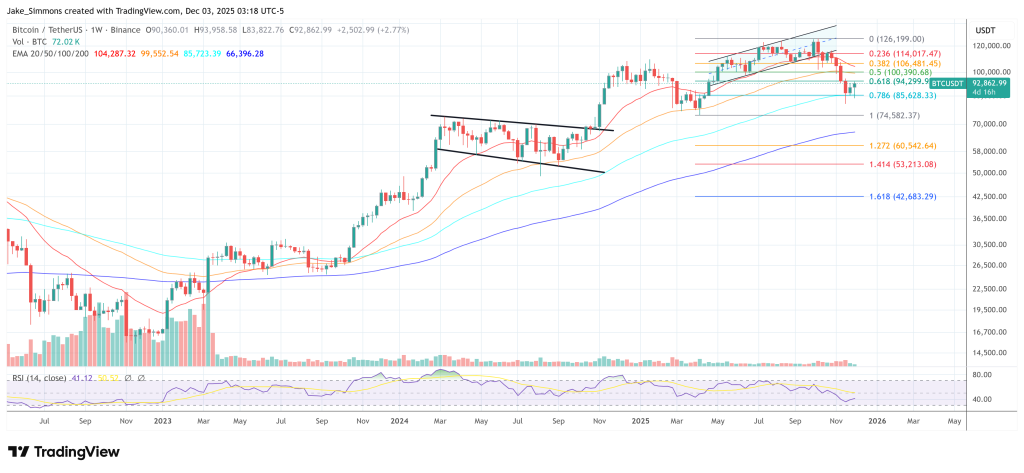
At press time, Bitcoin traded at $92,862

Bitcoin price

$93K And Climbing: Analysts Say Bitcoin’s Push To $100K Has Begun

Bitcoin jumped back above key levels on Wednesday, with prices climbing past $93,000 after dipping to $84,400 earlier this month.

The move followed a sharp sell-off that removed about $8,000 from the price late over the weekend, and traders pushed the coin to a 24-hour peak of $93,910 on Coingecko.

Bitcoin Climbs Above Key Levels

According to MN Fund founder Michaël van de Poppe, regaining ground above $93,000 is important for momentum. He said that if the price holds and breaks higher, a run toward $100,000 becomes more likely.

Other analysts echoed the call: Nick Ruck of LVRG Research pointed to macro factors and fresh ETF flows as drivers that could help Bitcoin test six figures in the coming months.

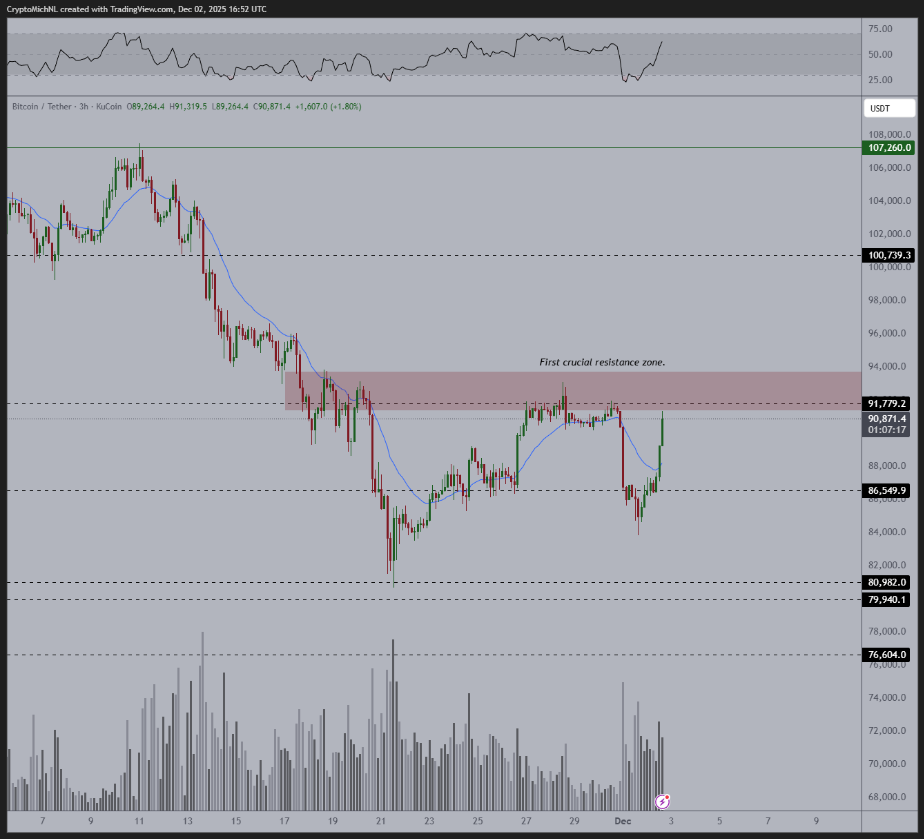
This is what you’d want to see. $BTC coming back up again, after a weird move down on the 1st of this month.

Now, again, breaking the $92K area is crucial.

If that breaks, then I’m sure we’ll start to see a new all-time high and a test at $100K.

A great day on the markets. pic.twitter.com/uy6WPabnQ8

— Michaël van de Poppe (@CryptoMichNL) December 2, 2025

ETF Activity And Market Moves

Reports have disclosed that ETF-related trading helped lift the market. BlackRock’s IBIT recorded over $1.8 billion in volume within two hours after Vanguard reversed a previous stance, and total spot Bitcoin ETF volume topped $5.1 billion on the day.

Market stats showed the broader crypto capitalization rose close to 7% to $3.13 trillion, with BTC dominance climbing to nearly 60%. Bitcoin itself jumped by about 8% after the US market opened, giving larger markets a clear lift.

Support Zone Holds Focus

Analysts had been watching the $86,000 to $88,000 band as a critical area of support. Based on reports from active market watchers, that range had been tested dozens of times in recent months and holding above it signaled reduced selling pressure. One analyst argued that a break below would likely lead some big players to change tack, moving from buying to selling behavior.

Liquidations And Net Inflows Changed The Day

Other market observers reported heavy turnover in derivatives and spot markets: over $360 billion in short positions were liquidated, while more than $160 billion was reportedly added back into crypto markets within a 24-hour span. Those figures, if accurate, helped explain the speed of the rebound and the large single-day gains.

What Comes Next For Prices

Short-term traders will watch how Bitcoin behaves around $92,000 and whether it can hold above the $86,000–$88,000 floor. Some commentators warned that sudden ETF-driven demand can cause sharp spikes that may not last.

Others pointed to possible policy shifts, such as renewed talk of US interest-rate cuts, as reasons why money might flow into major crypto assets in the months ahead.

For now, prices sit a little above $92,700 at the time of writing. The market is clearly volatile. Investors and traders will likely need to balance the bullish signs against the risk that a fresh round of selling could wipe gains quickly.

Featured image from Gemini, chart from TradingView

Would A 30% Bitcoin Price Crash Be Devastating For Tether’s USDT? Here’s The Truth

Tether, the issuer of USDT, has long been considered one of the most stable assets in the crypto market, but a recent report suggests that a crash in the Bitcoin price could jeopardize the stablecoin’s solvency. Arthur Hayes, co-founder and CIO of BitMEX, has revealed that a portion of USDT’s reserves is allocated to BTC, potentially exposing it to heightened market volatility. 

Bitcoin Price Crash To Threaten Tether USDT Stability 

In a recent report shared on X earlier this week, Hayes outlined market risks that could have a devastating impact on Tether’s USDT. The BitMEX founder explained that the stablecoin issuer has been executing a large-scale interest rate trade, likely betting on a Federal Reserve (FED) rate cut

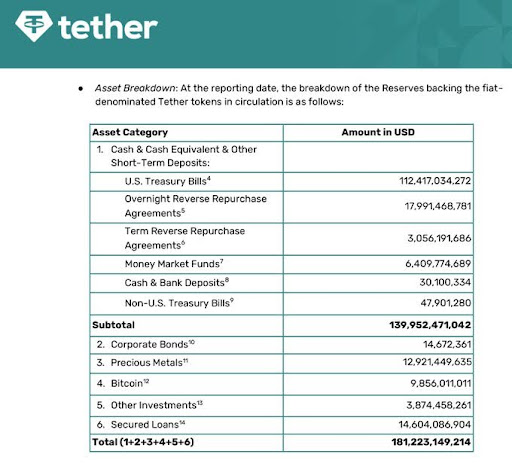
He stated that the stablecoin issuer has accumulated significant positions in Bitcoin and gold to hedge against falling interest income. As a result, Hayes has warned that if Tether’s positions in both gold and Bitcoin were to decline by roughly 30%, it could wipe out its entire equity, theoretically putting USDT at risk of insolvency

Since stablecoins are typically backed by the US dollar, the crypto founder has stated that a severe drop in Tether’s reserve value could trigger panic amongst USDT holders and crypto exchanges. In such a scenario, they might demand immediate insight into the stablecoin issuer’s balance sheet to gauge solvency risk. Hayes has also suggested that the mainstream media could further amplify the concerns, creating widespread market alarm.  

Analyst Fires Back Against Hayes’ USDT Claims

Following Hayes’ statements on X, Tether’s USDT has come under scrutiny, with crypto analysts debating the resilience of its reserves. A former Citi Research lead, Joseph Ayoub, challenged Hayes’ claims, arguing that even if Bitcoin and gold prices were to crash 30%, a USDT insolvency remains highly unlikely. 

He highlighted that the BitMEX co-founder had missed three key points in his post. Ayoub noted that Tether’s publicly disclosed assets do not represent the entirety of its corporate holdings. According to him, when Tether issues USDT, it maintains a separate equity balance sheet that is not publicly reported. The reserve numbers that are eventually disclosed are intended to show how USDT is backed. At the same time, the company maintains a balance sheet for equity investments, mining operations, corporate reserves, possibly more Bitcoin, and the rest distributed as dividends to shareholders.

Ayoub also described Tether’s core operations as highly profitable and efficient. He stated that the company holds over $100 billion in interest-yielding treasuries, generating roughly $10 billion in liquid profit annually while operating a relatively small team. The former Citi research lead estimated that the stablecoin issuer’s equity is likely valued at between $50 billion and $100 billion, providing it with a substantial cushion against losses in its crypto and gold holdings

Finally, Ayoub disclosed that Tether operates like traditional banks, maintaining only 5-10% of deposits in liquid assets, while the remaining 85% are held in longer-term investments. He also noted that the stablecoin issuer is significantly better collateralized than banks, adding that with their ability to print money, bankruptcy is virtually impossible.

Bitcoin

Tether Makes Bold Reserve Pivot Toward Bitcoin And Gold As Treasury Holdings Decline

In a strategic move, Tether has shifted its reserve strategy, reducing its exposure to treasuries while increasing allocations to Bitcoin and gold. The USDT issuer has shown a notable reduction in government debt exposure, paired with an expanded position in hard assets known for durability and independence from traditional financial systems. 

Treasury Exposure Drops Amid Changing Macro And Regulatory Landscape

Stablecoin giant, Tether, has reduced its US Treasury holdings and increased its Gold and Bitcoin reserves. CryptosRus reported on X that Tether is quietly repositioning itself for what the company expects to be the Federal Reserve’s (FED) next round of rate cuts.

Related Reading: Rumble At The Core: How Tether Plans To Dominate The US Stablecoin Market

According to BitMex founder Arthur Hayes, Tether’s latest reserve update shows a clear shift away from the US treasuries and deeper into BTC and gold, a sign that the company is positioning for a changing macro environment. Furthermore, the Standard & Poor (S&P) Global noted that Tether is now leaning more heavily into assets with larger price swings in value, warning that this mix could expose USDT if markets turn volatile. Meanwhile, the current S&P Global rating on Tether remains weak.

Bitcoin

Thus, Tether CEO Paolo Ardoino has pushed back, saying that the company holds no toxic assets. He claims that its rapid growth reflects a broader shift towards new financial systems that operate outside the traditional banking world.

Why Attempts To Break Tether Are Difficult In Practice

Crypto analyst Ted Pillows has also offered insight into the Tether Fear Uncertainty and Doubt (FUD) as it is making its usual rounds again. The narrative is latching onto the company’s latest attestation, showing a notable shift into Gold and Bitcoin to offset declining interest income. Meanwhile, if these risk assets drop by 30%, Tether’s equity buffer could evaporate, creating an environment where Tether will be insolvent, and panic will kick in.

Related Reading: Tether Targets $500 Billion Valuation In New Equity Offering Amid US Expansion Plans

However, Ted is steadfast and believes that Tether has been through a decade of this same FUD, and USDT is still sitting at $1.00. They’re fully liquid, but they operate on a fractional-reserve model, much like traditional banks. As long as redemptions remain normal, everything will work smoothly. A problem will only arise if there’s an irrational panic, and then liquidity stress could hit quickly. 

According to Ted, the USDT isn’t fully backed by cash, but it’s backed by a diverse portfolio that includes the US treasuries, yield-generating assets, and some risk assets. This is all scaled to a massive $174 billion stablecoin. “If someone wants to kill USDT, it’s possible, but I highly doubt it,” Ted noted.

Bitcoin

Domino-Effect Sell-Off: Analysts Reveal The Spark Behind Bitcoin’s Flash Crash

Bitcoin slid sharply on Sunday after failing to push above a key ceiling near $91,000, dropping almost 6% in a matter of hours and touching $85,800 on Coingecko. The sell-off came after the market posted a positive weekly close — the first after a run of four losing weeks — which briefly looked like a turning point before the rapid move lower.

Liquidations And Trader Losses

Based on CoinGlass data, more than 180,000 traders were wiped out in the last 24 hours, with total liquidations hitting close to $540 million. Almost 90% of that value came from long bets, concentrated in Bitcoin and Ether.

Reports have disclosed that a sudden surge of selling volume triggered a chain reaction, where forced exits multiplied the price fall as margin positions were closed.

Some market commentators pointed to technical quirks as well. The CME gap that traders watch had been filled, and analysts said roughly $400 million of long positions were taken already, adding that downside liquidity was cleared first — a move he described as a useful clean-up for the market.

Crypto’s liquidity issue:

As seen countless times this year, Friday night and Sunday night often come with LARGE crypto moves.

Just now, we saw Bitcoin fall -$4,000 in a matter of minutes without ANY news at all.

Why? Liquidity is thin.

Then, add this to the fact that… https://t.co/BTRNPV8Y5a

— The Kobeissi Letter (@KobeissiLetter) December 1, 2025

The Kobeissi Letter noted the slide arrived without an obvious news trigger and said the pattern has been repeated many times this year, especially around late Friday and Sunday trading windows.

Macro Signals And Volatility

The broader backdrop also weighed on sentiment. Investors are watching possible shifts in Federal Reserve policy, and the prospect of higher interest rates tends to pressure risk assets like Bitcoin.

The token’s intraday range showed a low of $85,400 and a high of $90,600, highlighting how quickly prices are swinging. Average True Range (ATR) sits at 4,423, a sign of elevated day-to-day volatility, while the Relative Strength Index (RSI) is a little over 38, moving toward oversold readings.

November proved rough. Reports show Bitcoin ended the month down 18%, its worst November since 2018, when prices fell 35% that same month.

Still, the asset has gained 10% year-to-date, giving some traders faith that recent weakness is more mechanical than fundamental.

Market Voices And What They Say

According to CoinGlass and analysts quoted online, the majority of recent liquidations were long positions — a factor that magnified the drop.

Kobeissi argued this episode was structural, tied to crowded positions being unwound, and explicitly stated they did not view it as a fundamental decline. Some analysts remained upbeat, calling the move a positive reset for the month. On social platforms, debate is active about whether this shakeout clears the way for fresh accumulation.

Binance’s CEO Richard Teng has urged diversification during whipping markets, a reminder echoed across trading desks. Policymakers remain the key macro variable: a hawkish Fed tone could extend selling pressure, while a more dovish stance might steady prices.

Traders will watch liquidity levels, open interest, and whether large long squeezes subside, because those factors are likely to dictate near-term direction.

Featured image from Pexels, chart from TradingView

Bitcoin Price Craters to $107,000 as Fed Turns Cautious, Traders React to Trump–Xi Meeting

Bitcoin Magazine

Bitcoin Price Craters to $107,000 as Fed Turns Cautious, Traders React to Trump–Xi Meeting

Bitcoin price tumbled sharply Thursday morning, falling to the low $107,000s as traders digested cautious remarks from Federal Reserve Chair Jerome Powell and mixed signals from the latest Trump–Xi meeting. 

The bitcoin price drop erased last week’s rebound and extended the bitcoin’s weak October performance, weighed down by macro headwinds and China-U.S. trade relations.

The world’s largest cryptocurrency was down to $107,472 by early Thursday, according to Bitcoin Magazine Pro data, after briefly plunging to $107,925 overnight.

Bitcoin price reacts to Jerome Powell’s comments

The move followed the Fed’s 25-basis-point rate cut on Wednesday — its second of 2025 — bringing the target range to 3.75%–4%. While the cut was widely anticipated, Powell’s message was clear: further easing this year is far from guaranteed.

There were “strongly differing views among policymakers,” Powell said during his post-meeting press conference, adding that the Fed might “wait a cycle” before considering another reduction. 

The remarks rattled markets that had been pricing in a December cut, with CME FedWatch data showing probabilities for another move dropping from 90% to just 71% after his comments.

Risk assets broadly weakened yesterday. The S&P 500 finished flat, the Dow Jones Industrial Average slipped 0.2%, and the Nasdaq Composite managed a modest 0.6% gain. As of writing, markets for Thursday look bleak as well. 

Bitcoin, which traded near $116,000 earlier in the week, sank as Powell spoke, briefly touching $109,000 in a sharp sell-off before stabilizing near $111,000 overnight.

The Fed’s tone also overshadowed what had appeared to be a positive outcome from the Trump–Xi summit. Following the meeting, President Trump said China would “immediately resume soybean purchases” and that “all rare-earth issues have been resolved.” 

Still, it looks like traders remained cautious, focusing instead on the Fed’s hawkish pivot and the ongoing U.S. government shutdown, now entering its fourth week.

Institutional demand also showed early signs of weakness. U.S.-listed spot Bitcoin ETFs saw $470.7 million in outflows on Wednesday, ending a four-day inflow streak and marking the largest daily outflow since October 16, per Bitcoin Magazine Pro data.  

Will the bitcoin price react to Quantitative Tightening ending? 

Powell did confirm that the Fed is nearing the end of its Quantitative Tightening (QT) program — a move that could eventually boost liquidity in risk assets. 

Since 2022, QT has drained nearly $1 trillion from the Fed’s balance sheet by allowing Treasury and mortgage holdings to mature without reinvestment. 

Powell said the process could conclude by December but warned that future decisions remain data-dependent. Despite the sharp correction, analysts remain divided on Bitcoin’s near-term direction.

This post Bitcoin Price Craters to $107,000 as Fed Turns Cautious, Traders React to Trump–Xi Meeting first appeared on Bitcoin Magazine and is written by Micah Zimmerman.

Federal Reserve Cuts Interest Rates by 25 Basis Points, Ends Quantitative Tightening

Bitcoin Magazine

Federal Reserve Cuts Interest Rates by 25 Basis Points, Ends Quantitative Tightening

The Federal Reserve cuts its benchmark interest rate by 0.25% today to 3.75%-4% The last time the Federal Reserve cut rates was in September 2025.

The cut in September was their first rate cut of the year, following a period of rate holds.  

In general, the Fed lowers borrowing costs for consumers and businesses, aiming to stimulate spending and investment. At the same time, some feel that a rate cut signals underlying economic weakness.

Yesterday, Bitcoin was trading at $116,000 yesterday but since slumped down to under $111,000 earlier today. Bitcoin’s price slightly jumped to the high $111,000s as the news came out. It is currently trading at $111,470.

Historically, bitcoin responds to monetary‑policy shifts. For example, after the Fed’s emergency cuts in March 2020, Bitcoin plunged nearly 39 % before rebounding strongly. 

More recently, when the Fed cut rates in September 2025, Bitcoin’s reaction was muted, suggesting markets may have priced in the move.

Federal Reserve to stop Quantitative Tightening 

Chair Powell also said that the central bank is approaching the end of its Quantitative Tightening (QT) program, a move that could provide a boost to risk assets, including bitcoin. The Fed said they will stop QT by December, according to reports. 

While Powell has previously flagged that the Fed is nearing this stage, uncertainty from the ongoing government shutdown complicated the outlook. With QT concluding, markets should respond positively.

JUST IN: 🇺🇸 Federal Reserve announces it will stop shrinking it's balance sheet on December 1 👀 pic.twitter.com/1SYilnW1cA

— Bitcoin Magazine (@BitcoinMagazine) October 29, 2025

Quantitative Tightening is the Federal Reserve’s tool for shrinking its balance sheet and reducing liquidity in financial markets. It operates in contrast to Quantitative Easing (QE), which expands the Fed’s balance sheet to stimulate economic activity. 

QT typically involves selling government bonds or allowing them to mature without reinvestment, actions that increase bond supply, push yields higher, and raise borrowing costs for consumers and businesses. 

Higher interest rates generally reduce spending and borrowing, helping control inflation and prevent the economy from overheating.

A related process, tapering, slows the pace of QE asset purchases but does not actively shrink the balance sheet. 

The Fed notably implemented QT in 2022, letting nearly $1 trillion in securities mature to curb inflation after prior QE programs had massively expanded the balance sheet. While effective at cooling inflation, QT carries risks, including market volatility and potential economic instability.

The end of QT halts the draining of liquidity from the market, which could free up capital to flow into risk-sensitive assets, like bitcoin and other crypto.

This post Federal Reserve Cuts Interest Rates by 25 Basis Points, Ends Quantitative Tightening first appeared on Bitcoin Magazine and is written by Micah Zimmerman.

Bitcoin Holds Its Breath as Fed Looks to Cut Rates

Bitcoin Magazine

Bitcoin Holds Its Breath as Fed Looks to Cut Rates

Bitcoin price’s recent rally yesterday ran into resistance just above $116,000, settling under $113,000 at the time of writing, as traders weigh broader macroeconomic signals ahead of today’s Federal Reserve announcement. 

The cryptocurrency market’s total capitalization has retreated 1.4% over the past 24 hours to $3.81 trillion, according to Bitcoin Magazine Pro data, even as U.S. equities continue to reach fresh highs.

Attention, both in the bitcoin and broader markets, is squarely on the Federal Open Market Committee (FOMC) rate decision coming later today, widely expected to deliver a 25-basis-point cut to the benchmark interest rate. 

Cooler-than-expected consumer price inflation last week and a slowing labor market have fueled expectations for this reduction, with markets seeming to be pricing in nearly two more cuts by year-end. 

Lower interest rates historically boost risk appetite, including demand for bitcoin, by reducing yields on cash and bonds and increasing liquidity in financial markets.

However, the immediate impact of today’s rate cut may be muted, as it may be already priced in. 

Investors will be scrutinizing Fed Chair Jerome Powell’s press conference for guidance on the future trajectory of monetary policy. 

A key question remains whether the Fed will signal an end to its Quantitative Tightening program, a dovish move that could inject further upside momentum into risk assets. Powell has previously indicated that the Fed is nearing this stage, though uncertainty from the ongoing government shutdown could cloud the outlook. If Quantitative Tightening ends, bitcoin should react positively.

Complicating matters, the U.S. labor market exhibits signs of weakness despite low unemployment, with average job search durations remaining historically long and hiring activity subdued. 

Inflation remains above the Fed’s 2% target, partly due to lingering tariffs. 

Institutional Bitcoin demand

Institutional demand for bitcoin remains supportive. BTC ETFs have recorded consistent net inflows, with $202.4 million added on Tuesday alone, reflecting growing confidence in the asset among professional investors. 

On the technical side, bitcoin continues to hold above a rising trendline dating back to May, with immediate resistance at $114,500 and support at $112,000.

A break above the former could target $120,000, while a slip below the latter may see a pullback toward $106,500.

As the Fed’s decision approaches, bitcoin remains at the crossroads of macroeconomic policy, technical positioning, and investor sentiment. 

At the time of writing, bitcoin is trading at $111,200.

This post Bitcoin Holds Its Breath as Fed Looks to Cut Rates first appeared on Bitcoin Magazine and is written by Micah Zimmerman.

Bitcoin Closes at $114,530 Amid FOMC Volatility: Bulls Eye $117,600 Resistance

Bitcoin Magazine

Bitcoin Closes at $114,530 Amid FOMC Volatility: Bulls Eye $117,600 Resistance

Bitcoin Price Weekly Outlook

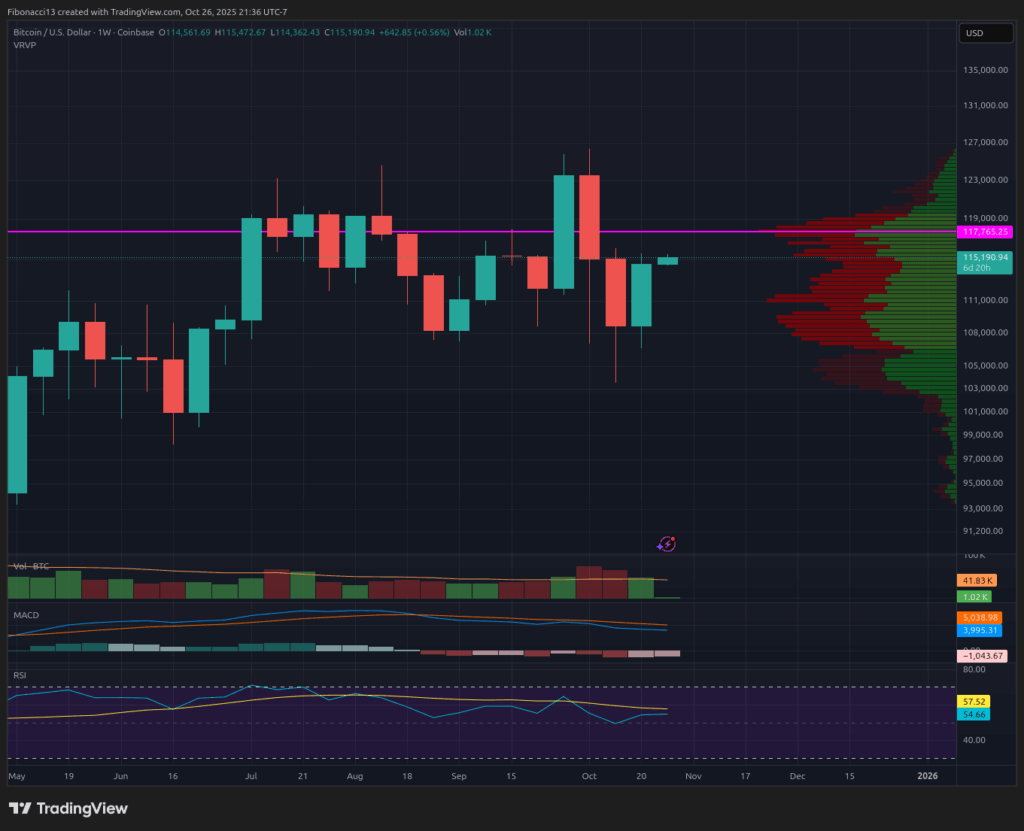
Bitcoin’s price action was rather subdued last week, keeping traders guessing whether or not we would see another large drop in price entering the weekend. Price held above the lows, however, slowly plodding a little bit higher to close out the week at $114,530. Bulls should not be overly disappointed with this price action, as they did reclaim the $112,200 resistance level, and are now closing in on conquering the next resistance level at $115,500. The bears are still sitting comfortably in control, though, with stronger resistance levels hanging overhead that the bulls have yet to challenge. This may be an interesting and volatile week ahead, with the FOMC meeting on Wednesday and a slough of large companies reporting third-quarter earnings.

Bitcoin Holds $114,530 Amid FOMC Volatility: Bulls Eye $117,600 Resistance

Key Support and Resistance Levels Now

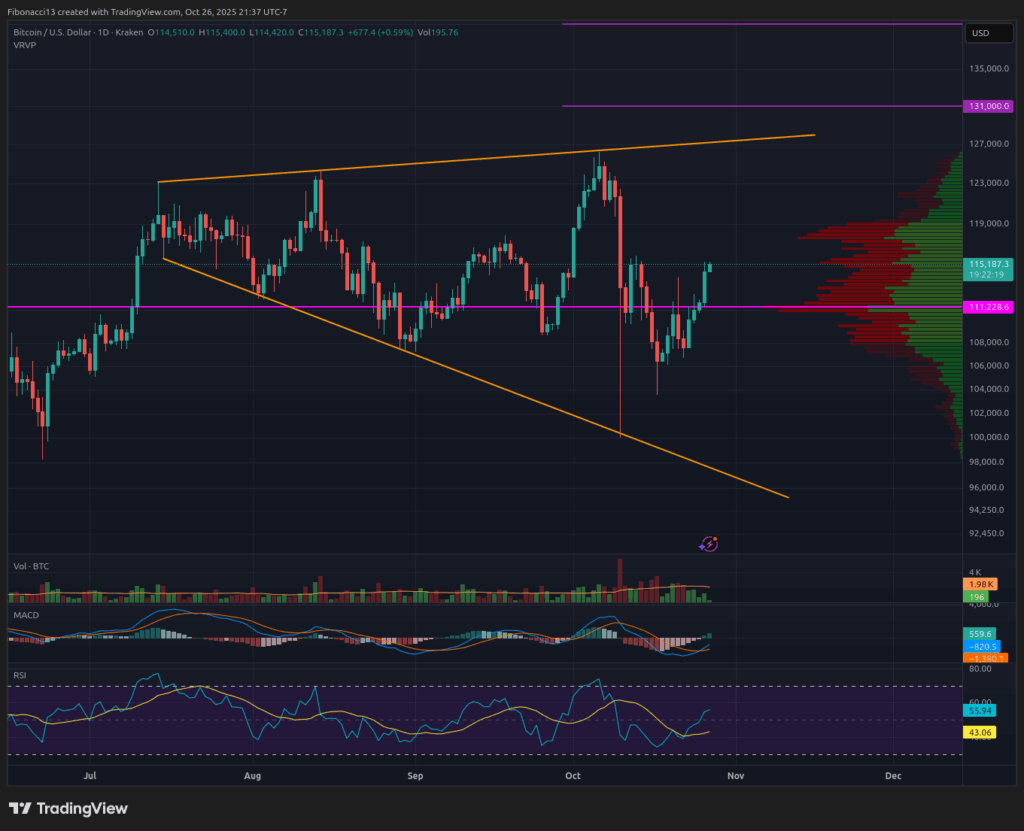
Nothing has materially changed from last week’s resistance levels as the bulls have made little progress. Heavy resistance is still sitting at $117,600 and $122,000 above there, so the bears aren’t feeling any real pressure yet. If by chance this week gets above $122,000, we will look to the upper boundary of our broadening wedge pattern at $128,000.

Holding above the prior week’s low is a positive sign for the bulls, while they managed to maintain price above the key short-term support of $106,900 last week as well. This level must hold going forward, as closing below $106,900 opens the door back down to the $105,000 to $102,000 support zone that has already been tested twice. A third test of this support zone would be more likely to break it than to hold it. $96,000 is the long-term bull market support below here, a do-or-die support level if the price were to slide down and test it.

Bitcoin Holds $114,530 Amid FOMC Volatility: Bulls Eye $117,600 Resistance

Outlook For This Week

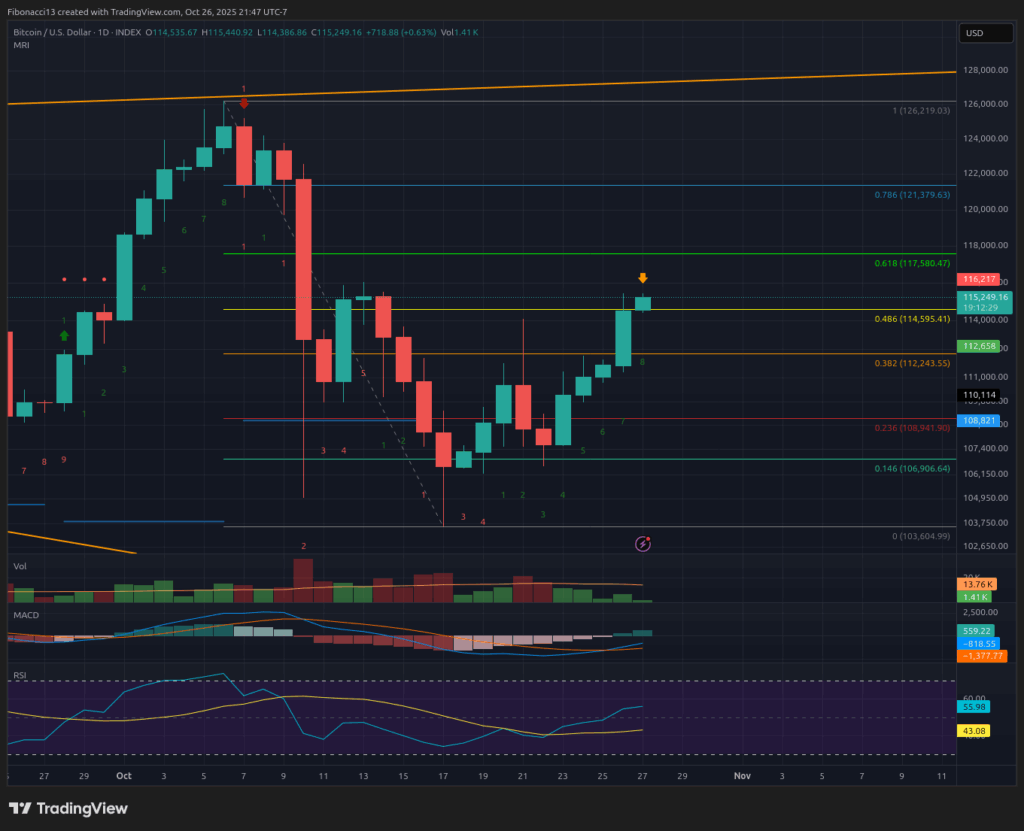
Expect significant volatility this week, especially on Wednesday, as we have the Federal Reserve’s interest rate decision and ensuing Powell speech, followed by major earnings reports from Microsoft, Meta, and Google after market close. Bulls will look to hold $109,000 as a floor into this week, as doing so would position them to maintain upward momentum. Looking at the Momentum Reversal Indicator, we are currently sitting on an 8-count entering Monday. This is a warning candle that we may see momentum begin to fade. Tuesday should bring the 9-count at which point we should expect at least a pause on upward momentum and a 1 to 4 day correction in price. So if bulls can push price up to the 0.618 Fibonacci Retracement at $117,600 by Monday night or Tuesday morning, we should expect to see a rejection ther,e and we can re-assess after Wednesday’s FOMC and earnings reports play out.

Bitcoin Holds $114,530 Amid FOMC Volatility: Bulls Eye $117,600 Resistance

Market mood: Bearish – While the bulls gained some ground last week, the bears remain stoic and strong. The bulls must push the price past $122,000 to take back control.

The next few weeks
If bulls can manage to survive through this week, there are still some potential headwinds on the horizon. The US-China tariff dispute may or may not be resolved by the end of next week; a negative outcome will likely send all markets lower. Additionally, the US courts’ ruling on the legality of Trump’s tariffs is expected by November 5th. If these tariffs are reinstated, we should expect markets to head lower to price this impact in.

Terminology Guide:

Bulls/Bullish: Buyers or investors expecting the price to go higher.

Bears/Bearish: Sellers or investors expecting the price to go lower.

Support or support level: A level at which the price should hold for the asset, at least initially. The more touches on support, the weaker it gets and the more likely it is to fail to hold the price.

Resistance or resistance level: Opposite of support.  The level that is likely to reject the price, at least initially. The more touches at resistance, the weaker it gets and the more likely it is to fail to hold back the price.

Fibonacci Retracements and Extensions: Ratios based on what is known as the golden ratio, a universal ratio pertaining to growth and decay cycles in nature. The golden ratio is based on the constants Phi (1.618) and phi (0.618).

Broadening Wedge: A chart pattern consisting of an upper trend line acting as resistance and a lower trend line acting as support. These trend lines must diverge away from each other in order to validate the pattern. This pattern is a result of expanding price volatility, typically resulting in higher highs and lower lows.

Momentum Reversal Indicator (MRI): A proprietary indicator created by Tone Vays. The MRI indicator tracks buyer and seller momentum and exhaustion, providing signals to indicate when to expect momentum to fade and accelerate.

This post Bitcoin Closes at $114,530 Amid FOMC Volatility: Bulls Eye $117,600 Resistance first appeared on Bitcoin Magazine and is written by Ethan Greene - Feral Analysis and Juan Galt.

Federal Reserve Enters a ‘New Era’ in Payments, Waller Welcomes Crypto to the Table

Bitcoin Magazine

Federal Reserve Enters a ‘New Era’ in Payments, Waller Welcomes Crypto to the Table

Federal Reserve Governor Christopher Waller says the central bank is entering a “new era” in payments — one that openly embraces decentralized finance (DeFi), distributed ledgers, and digital asset innovation as part of the mainstream financial system.

Speaking Tuesday at the Fed’s first-ever Payments Innovation Conference in Washington, Waller said the central bank intends to play an “active role” in the crypto revolution transforming the global payments landscape. 

The conference is ongoing, but Bitcoin’s price reacted positively after a rough night. When the conference started, Bitcoin’s price was around $108,000 but has now jumped to $110,321, at the time of writing. 

Waller’s sentiment is a pretty striking departure from the caution and skepticism that have long defined U.S. regulators’ stance toward crypto.

“The DeFi industry is not viewed with suspicion or scorn,” Waller told attendees. “Rather, today, you are welcomed to the conversation on the future of payments in the United States — on our home field.”

According to Waller, distributed ledgers and crypto assets are now “woven into the fabric of the payment and financial systems.” 

The Fed, he added, is studying new models for integrating emerging financial technologies with the legacy banking infrastructure — including a potential prototype for a new “payment account” framework that would expand central bank access to innovators in the space.

A “skinny” master account

Waller described the idea as a “skinny master account,” designed to give legally eligible institutions — particularly fintechs and payment firms focused on digital assets — limited but direct access to the Federal Reserve’s payment rails. 

These accounts would not pay interest, would have balance caps, and would exclude overdraft privileges or discount window access, but they would allow payment-focused entities to settle transactions directly with the Fed rather than through partner banks.

“This payment account concept would be targeted to provide basic Federal Reserve payment services to legally eligible institutions that right now conduct payment services primarily through a third-party bank,” Waller explained. “Payments innovation moves fast, and the Federal Reserve needs to keep up.”

From crypto resistance to engagement

Waller’s tone towards crypto is a massive policy shift in Washington. Over the past year, the central bank has quietly withdrawn restrictive guidance on crypto and stablecoin activity that discouraged banks from participating in digital asset markets. 

It also removed “reputational risk” considerations from its supervisory programs — a long-criticized tool that many in the industry said was used to justify debanking crypto companies.

This post Federal Reserve Enters a ‘New Era’ in Payments, Waller Welcomes Crypto to the Table first appeared on Bitcoin Magazine and is written by Micah Zimmerman.

❌