
❌

Reading view

There are new articles available, click to refresh the page.

NASA’s Moon Rocket Celebrates 250 Years of American Innovation
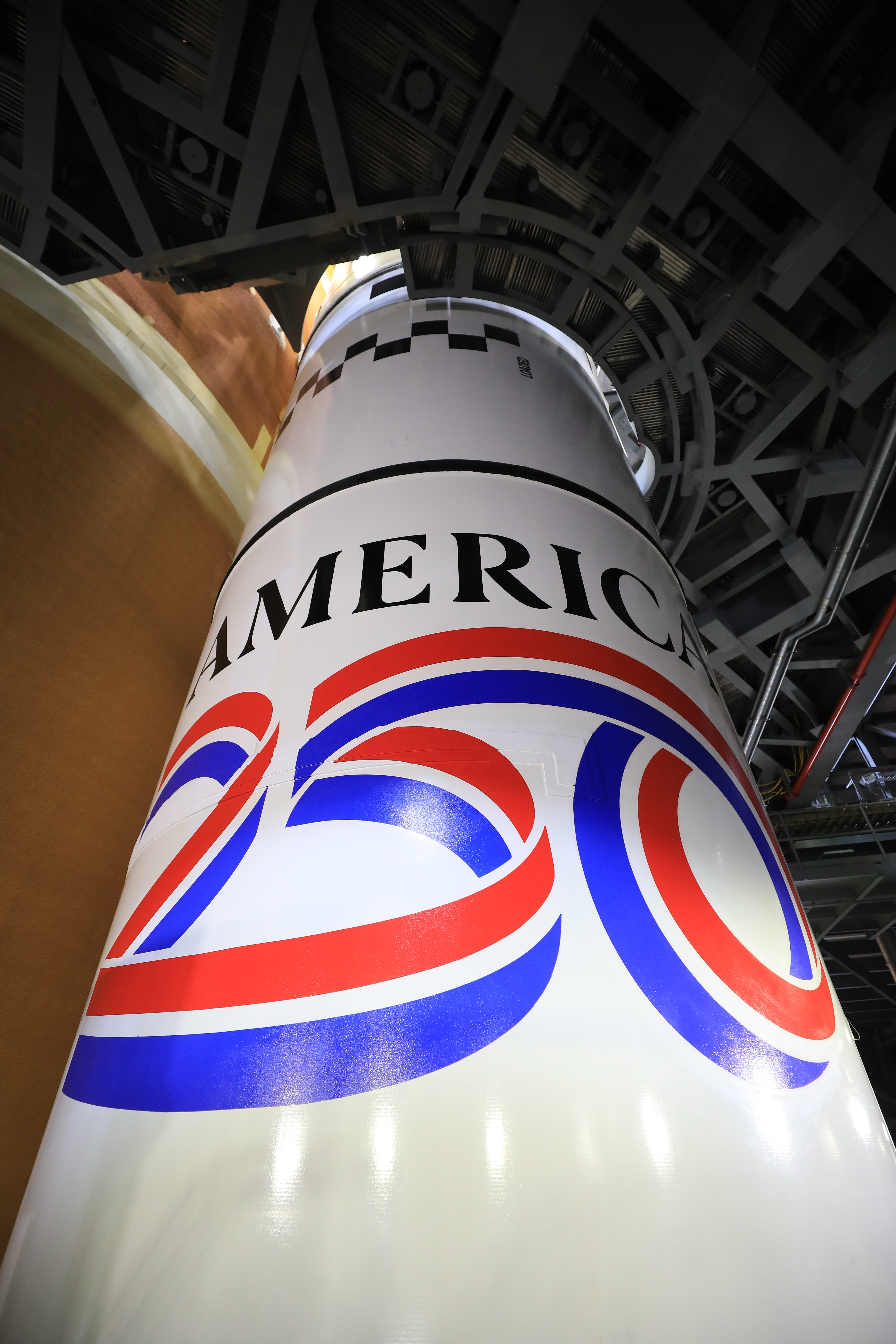
Image shows the America 250 logo in black, red, blue colors painted on the white solid rocket boosters of NASA's SLS (Space Launch System) rocket at NASA's Kennedy Space Center in Florida on Dec. 1, 2025.

NASA is marking America’s 250th year with a bold new symbol of the nation’s relentless drive to explore.

The America 250 emblem is now on the twin solid rocket boosters of the SLS (Space Launch System) rocket for Artemis II β€” the powerhouse that will launch a crew of four around the Moon next year. Unveiled Tuesday, the design echoes the America 250 Commission’s Spirit of Innovation theme, honoring a country that has never stopped pushing the horizon forward.

At NASA’s Kennedy Space Center in Florida, technicians spent recent weeks carefully applying the emblem on the rocket inside the Vehicle Assembly Building β€” the same place where rockets for Apollo once stood. Engineers are running final tests on SLS and the Orion spacecraft as preparations intensify for Artemis II.

The roughly 10-day Artemis II journey around the Moon will mark a defining moment in this new era of American exploration β€” paving the way for U.S. crews to land on the lunar surface and ultimately push onward to Mars.

America’s spirit of discovery is alive, and Artemis is carrying it to the Moon and beyond.

Image credit: NASA/Ben Smegelsky
NASA Rideshares Integrated Ahead of Launch

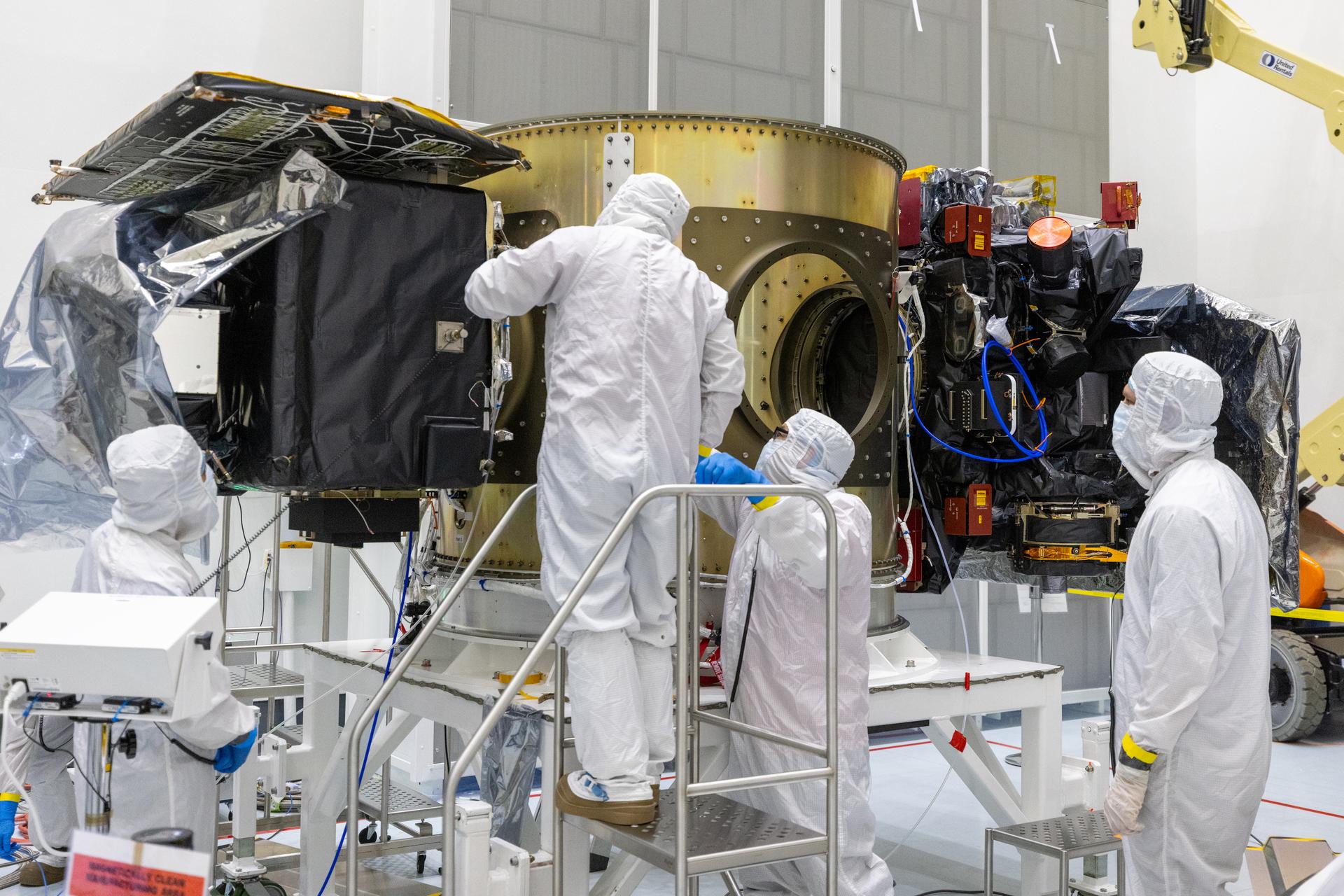
Image shows four people wearing white protective suits, commonly known as bunny suits, standing around NASA’s Carruthers Geocorona Observatory and the National Oceanic and Atmospheric Administration’s (NOAA) Space Weather Follow-On Lagrange 1 (SWFO-L1) satellite spacecraft's set to launch with NASA's IMAP (Interstellar Mapping and Acceleration Probe) observatory at NASA's Kennedy Space Center in Florida.

Technicians completed integrating NASA’s Carruthers Geocorona Observatory and the National Oceanic and Atmospheric Administration’s (NOAA) Space Weather Follow-On Lagrange 1 (SWFO-L1) satellite to an Evolved Expendable Launch Vehicle Secondary Payload Adapter ring at the Astrotech Space Operations Facility near NASA’s Kennedy Space Center in Florida on Sept. 4.

Integrating the rideshares to the ring precedes the next prelaunch launch milestone: attaching NASA’s IMAP (Interstellar Mapping and Acceleration Probe) heliosphere mapping observatory to a payload adapter that connects to the ring. This configuration allows all three spacecraft to launch atop a single SpaceX Falcon 9 rocket, maximizing efficiency by sharing the ride to space.

The Carruthers observatory will capture light from Earth’s geocorona, the part of the outer atmosphere that emits ultraviolet light. The observations will advance our understanding of space weather, planetary atmospheric evolution, and the long-term history of water on Earth.

The SWFO-L1 satellite will keep a watchful eye on the Sun and the near-Earth environment for space weather activity. It is the first NOAA satellite designed specifically for and fully dedicated to continuous space weather observations. It will serve as an early warning beacon for destructive space weather events that could impact our technological dependent infrastructure and industries.

The spacecraft will launch together aboard a SpaceX Falcon 9 rocket no earlier than 7:32 a.m. EDT on Tuesday, Sept. 23, from Launch Complex 39A at NASA Kennedy.

Image credit: NASA/Frank Michaux

❌