Reading view

There are new articles available, click to refresh the page.

Customer satisfaction with federal benefits and services sees a two-decade high

  • Customer satisfaction with benefits and services provided by the federal government is higher than it’s been in nearly two decades. That’s despite a tumultuous year where agencies have seen a major downsizing of the federal workforce. Scores are higher on average, but the latest scorecard from the American Customer Satisfaction Index does show a few agencies are seeing lower scores. The Office of Personnel Management and the Department of Homeland Security are among the agencies with lower customer experience scores.
  • More information may soon come to light on how agencies are implementing some of President Donald Trump’s executive orders. OPM said it will conduct studies to find out the latest on the administration’s return-to-office policy. It’s also going to look into agencies’ removal of diversity, equity, inclusion and accessibility programs. OPM is asking all agencies to respond by the end of today with a point of contact who can provide further information for the studies.
  • A new audit found that the Defense Department is falling short in catching potential fraud, misuse and abuse of its government travel charge card program. The Pentagon’s office of inspector general said the department is not effectively using Citi’s Electronic Access System, the main tool to flag suspicious activity. Officials often could not or did not use the mandatory reports as required by regulations for oversight of the travel program due to unclear policies and inadequate training. As a result, thousands of travel card accounts were not closed or transferred when personnel left or changed units. The inspector general warned that until the Defense Travel Management Office improves the travel program controls, oversight officials will continue to miss opportunities to identify misuse or abuse within the program.
  • Operation Homefront distributed holiday meals to D.C. Guard members and their families as food-related assistance requests surge. As part of their Holiday Meals for Military program, the organization provided families with all the fixings for a traditional Thanksgiving dinner, as well as Harris Teeter gift cards so families could purchase their protein of choice. With grocery prices rising and many service members still feeling the financial strain of the recent shutdown, the organization said demand for assistance has surged. Food requests alone are up 57% this year. “Our case work is up quadruple what it was 30 days ago," Operation Homefront said.
  • A Postal Service contractor has agreed to pay more than $1 million to settle allegations that it violated the False Claims Act. The Justice Department said Sky Lease falsely reported how quickly it was moving mail from domestic, Defense and State Department facilities to other locations around the world. Half the settlement amount is for restitution to the Postal Service.
  • After reports that it was wrapping things up early, the Department of Government Efficiency said that's not the case. A DOGE spokesperson told Federal News Network that DOGE and its longer-term, tech-aligned counterpart, the U.S. DOGE Service, both remain and that the latter organization is moving ahead with a full slate of modernization projects. The spokesman also confirmed that Amy Gleason remains the acting administrator of USDS. Reuters published a story on Monday claiming that DOGE no longer exists. That’s about eight months ahead of the schedule set by President Trump.
  • OPM said about 317,000 employees have left federal service so far in 2025, going beyond the Trump administration’s workforce reduction goals. Those departures compare to just 68,000 new hires during the same timeframe. OPM Director Scott Kupor also shared insight on newly required governmentwide headcount plans, which President Trump ordered as part of an initiative to make sure four employees leave federal service for every one that joins.
  • The Trump administration is telling agencies to rethink how many senior executives they really need. Agencies have until Dec. 19 to tell the Office of Personnel Management if they want to lower, or raise, how many staffing spots they’ll allocate for senior-level positions. A new memo from OPM said this headcount review is especially important, considering the major reductions to the federal workforce that have occurred this year. That may result in a corresponding need to reduce agency spots for senior executives, according to OPM.
    (Call for agency review of executive allocations - Office of Personnel Management)

The post Customer satisfaction with federal benefits and services sees a two-decade high first appeared on Federal News Network.

© AP Photo/Manuel Balce Ceneta

FILE - In this Feb. 25, 2015 file photo, the Homeland Security Department headquarters in northwest Washington. (AP Photo/Manuel Balce Ceneta, File)

FCC to vote on reversing cyber rules adopted after Salt Typhoon hack

The Federal Communications Commission is set this week to vote on reversing cybersecurity rules for telecommunications providers that were put forward following the sweeping “Salt Typhoon” hacks.

The FCC’s meeting on Thursday includes plans to consider an order to rescind a ruling and proposed rules published in the waning days of the Biden administration. The January ruling requires telecom operators to secure their networks under Section 105 of the Communications Assistance for Law Enforcement Act.

But current FCC Chairman Brendan Carr argues that ruling “exceeded the agency’s authority and did not present an effective or agile response to the relevant cybersecurity threats.”

The proposed order would rescind the January ruling and withdraw proposed cybersecurity rules for telecom operators.

Instead, the FCC “should instead continue to pursue an agile and collaborative approach to cybersecurity through federal-private partnerships that protect and secure communications networks and more targeted, legally sound rulemaking and enforcement,” according to a factsheet on the order of reconsideration.

‘Worst’ hack ever

The Salt Typhoon campaign was revealed in 2024. It involved penetrating hacks into U.S. telecom networks and others across the globe. The hackers were reportedly able to target the communications of political figures and government officials, including then-candidate Donald Trump and running mate JD Vance.

U.S. officials have said Chinese-government sponsored hackers are behind the campaign. Senate Intelligence Committee Ranking Member Mark Warner (D-Va.) has described it as “the worst telecommunications hack in our nation’s history.”

The Cybersecurity and Infrastructure Security Agency has since said the Salt Typhoon campaign overlapped with global threat activities targeting multiple sectors, including telecommunications, government, transportation, lodging, and military infrastructure networks.

“While these actors focus on large backbone routers of major telecommunications providers, as well as provider edge (PE) and customer edge (CE) routers, they also leverage compromised devices and trusted connections to pivot into other networks,” CISA wrote in a September advisory. “These actors often modify routers to maintain persistent, long-term access to networks.”

In rolling out the January rules, Biden administration officials argued they represented a “critical step to require U.S. telecoms to improve cybersecurity to meet today’s nation state threats, including those from China’s well-resourced and sophisticated offensive cyber program.”

However, the FCC’s current leadership says the rules misinterpreted the law and “unnecessarily raised and purported to resolve issues that were not appropriate for consideration in the absence of public input.” The FCC’s factsheet also references the commission’s “recent engagement with providers and their agreement to take extensive steps to protect national security interests.”

In an October letter to the FCC, lawyers representing several telecom associations argued that the January ruling “would significantly undermine” public-private partnerships. They argued that telecom providers had voluntarily collaborated with federal agencies to investigate Salt Typhoon and adopted stronger cybersecurity measures.

Warner and Sen. Ron Wyden (D-Ore.) are also pressing the Department of Homeland Security to release an unclassified 2022 report on security vulnerabilities in the U.S. telecom sector. They argue that by not releasing the report, DHS is undermining public debate over how to best secure telecom networks in the wake of Salt Typhoon.

“The Salt Typhoon compromise represents one of the most serious espionage campaigns against the communications of U.S. government leaders in history, and highlighted important gaps in our nation’s communications security – in some cases, with providers ignoring basic security precautions such as credential re-use across network appliances and failure to adopt multi-factor authentication for highly privileged network administrator accounts,” Warner and Wyden wrote in a recent letter to DHS and the Office of the Director of National Intelligence.

Meanwhile, the House on Monday passed the “Strengthening Cyber Resilience Against State-Sponsored Threats Act.” The bill would establish a joint interagency task force to address China-linked cyber threats, including Salt Typhoon. The task force would be led by CISA, with involvement from the Justice Department, the FBI and several sector-risk management agencies.

The post FCC to vote on reversing cyber rules adopted after Salt Typhoon hack first appeared on Federal News Network.

© AP Photo/Andrew Harnik

FILE - This June 19, 2015, file photo, shows the Federal Communications Commission building in Washington. The Federal Communications Commission has issued a $6 million fine against the political consultant who sent AI-generated robocalls mimicking President Joe Biden’s voice to voters ahead of New Hampshire’s presidential primary. Steve Kramer also faces two dozen criminal charges in New Hampshire. Kramer has admitted orchestrating the message sent to thousands of voters. (AP Photo/Andrew Harnik, File)

Immigration courts understaffed and overwhelmed, as Trump administration surges enforcement hiring

The Trump administration is looking to hire thousands of federal law enforcement personnel, as part of expanded immigration enforcement efforts.

But the courts handling these cases aren’t seeing the same surge in resources. Several immigration judges recently fired by the Justice Department say the court system is losing staff, and is unable to address a multi-million case backlog.

Immigration and Customs Enforcement has intensified operations across the country, and detention facilities are full of individuals waiting for their cases to be heard.

The One Big, Beautiful Bill Act passed this summer gave the Department of Homeland Security billions of dollars to hire 10,000 new ICE agents, as well as 5,000 customs officers and 3,000 Border Patrol agents.

The legislation bill also authorized DOJ to hire about 100 new immigration judges, bringing their total headcount to about 800 nationwide.

But the total number of immigration judges is dwindling under the Trump administration, according to data tracked by the International Federation of Professional and Technical Engineers and its affiliate, the National Association of Immigration Judges.

According to the unions, the total number of immigration judges this year has dropped from 700 to 600. The Trump administration terminated more than 80 immigration judges since taking office, while others have retired or accepted voluntary separation incentives.

Recently terminated immigration judges say their colleagues still on the job don’t have the resources needed to address a backlog of about 3.4 million cases.

Before he was fired in September, Ted Doolittle, a former immigration judge at the immigration court in Hartford, Connecticut, was one of two judges handling about 46,000 cases.

Doolittle said he received his termination email one afternoon, as he was preparing for a docket of 57 cases the next day.

“The caseload is crushing. I think it’s probably one of the most overburdened court systems,” Doolittle said Thursday at an event at the National Press Club.

In order for the Justice Department to meaningfully address the backlog, Doolittle said the department needs about 2,000 or 3,000 immigration judges — not the few hundred currently working.

“That’s what’s going away, is the right of these people to have their cases heard fairly,” he said.

Emmett Soper, a former immigration judge in Virginia, who was fired in August after serving nine years on the job, said the widespread terminations are leading to a “chaotic situation,” where courts are scrambling to reassign cases to remaining judges.

“Each immigration judge is responsible for hundreds or thousands of these cases, and every time the administration unlawfully fires an immigration judge, they’re no longer there. Their cases have to be redistributed to the judges who remain at the court,” Soper said. “This is not a fair way to run a court system.”

Anam Petit, former immigration judge in Virginia, who was fired in September, said judges are hearing, at a minimum, 25 cases a day — sometimes 50 or more cases — in multiple languages.

“You can have a docket with five different languages,” she said.

Matt Biggs, president of the International Federation of Professional and Technical Engineers, said that the “lion’s share” of firings have been targeted at immigration judges who were hired during the Biden administration.

“Immigrants in this country are entitled to due process, and by firing these judges, you’re denying them their due process,” Biggs said.

To address the backlog, DOJ is training hundreds of military lawyers to temporarily serve as immigration judges. But Biggs said most of these don’t have a background in immigration law.

“We appreciate their service to our nation, and it’s no disrespect to them, but they should not be in these positions,” he said.

Federal News Network reached out to DOJ and DHS for comment.

The former judges said defendants are also failing to show up for court dates this year, because they are afraid of being detained by ICE agents afterward. Petit said that it was a “daily occurrence” for defendants in her courtroom.

“It has a huge chilling effect,” she said. “People are afraid to come to court because they’re seeing people get detained in the hallways.”

Defendants who don’t appear for their court date automatically receive a removal order, and have no legal avenue to appeal that decision.

Doolittle said ICE agents prefer making arrests in courthouses, because individuals have gone through security and been screened for weapons. He recalled that toward the end of his tenure, ICE agents repeatedly tased a suspect in the court’s lobby before bringing him into custody.

“Many of the court staff lost sleep — like physically, weren’t able to sleep for a period afterwards. And of course, it makes them question whether that’s a job they want to continue,” he said.

The post Immigration courts understaffed and overwhelmed, as Trump administration surges enforcement hiring first appeared on Federal News Network.

© The Associated Press

FILE - A U.S. Immigration and Customs Enforcement agent is seen in Park Ridge, Ill., Sept. 19, 2025. (AP Photo/Erin Hooley, File)

DHS announces $10K shutdown bonuses for some TSA officers

The Department of Homeland Security is giving $10,000 bonuses to transportation security officers who demonstrated “exemplary service” through the government shutdown.

Homeland Security Secretary Kristi Noem announced the bonuses during a press conference in Houston, Texas, today. She highlighted the “tens of thousands of individuals who stepped up and continued to serve” at the Transportation Security Administration despite receiving no pay through the 43-day shutdown.

Asked whether she was referring to those who did not call out sick or stay home, Noem said, “that’s not necessarily the parameters.”

“We’re going to look at every individual that did exceptional service during this period of time when there were so many hardships,” Noem said.

DHS did not immediately respond to questions about who qualifies for the bonuses. TSA employs approximately 50,000 transportation security officers, meaning a bonus for every officer would cost roughly $500 million.

In a press release, DHS said it’s paying for the bonuses using carryover funds from fiscal 2025.

Disruptions to air travel began to grow in the final weeks of the shutdown. Security lines began to grow longer as some TSA officers called out. Meanwhile, flight delays and cancellations grew as air traffic controllers at the Federal Aviation Administration began calling out of work amid multiple missed paychecks.

Noem’s announcement comes after a Truth Social post by President Donald Trump earlier this week, in which he raged at air traffic controllers who took time off during the shutdown. Trump also announced $10,000 bonuses for controllers who “didn’t take any time off for the ‘Democrat Shutdown Hoax.’”

Transportation Secretary Sean Duffy said he agreed with Trump’s idea for a $10,000 bonus for air traffic controllers who had no missed days of work. But Duffy also offered a reprieve for some employees who missed days during the shutdown.

“We have some controllers who were put in a very difficult position,” Duffy told a Wisconsin TV station on Tuesday. “They’re young. They don’t make a lot of money when they first start out. They can make some good money later in their careers, but when they start out, they’re not making a lot. They may be the sole source of income, and they were confronted with a real problem.

However, Duffy also vowed to target “continual bad actors” during the shutdown.

“If they started to take time off because the shutdown was an excuse for them, we’ll take a look at those people, and we’ll work with the union and see what an appropriate response from the FAA will be,” he said.

The post DHS announces $10K shutdown bonuses for some TSA officers first appeared on Federal News Network.

© AP Photo/Manuel Balce Ceneta

Homeland Security TSA Union

Post-shutdown, here’s how soon federal employees can expect back pay

Following the longest shutdown in U.S. history, the federal workforce is now trying to get back to at least some sense of normalcy.

While federal employees who have been furloughed for the last 43 days return to work Thursday, the Office of Personnel Management is setting expectations for agencies as they begin to update pay, leave and benefits for those impacted by the lapse in appropriations.

In new guidance, OPM said it is “is committed to ensuring that retroactive pay is provided as soon as possible.” Compensation will be provided for both furloughed and excepted federal employees, as the spending agreement that was enacted Wednesday evening reaffirmed. A 2019 law previously called for retroactive compensation for all federal employees impacted by a shutdown.

A senior Trump administration official said the White House “has urged agencies to get employee paychecks out expeditiously and accurately to not leave anyone waiting longer than necessary.”

But the timing of employees receiving their back pay varies, depending on what payroll provider an agency uses, and the different pay schedules across the federal workforce.

Sending out retroactive payments to employees involves working across agency HR offices, federal payroll providers and shared service centers. Agency HR offices, for instance, have to submit timecards for federal employees, which are then processed by the government’s various payroll providers.

According to the senior administration official, employees from the General Services Administration and OPM will be among the first to receive their retroactive paychecks, with an expected deposit date set for Saturday.

Employees at the departments of Veterans Affairs, Energy, and Health and Human Services, as well as civilian employees from the Defense Department, will receive their deposits shortly after that — this Sunday.

On Monday, affected employees from the departments of Education, State, Interior and Transportation, as well as the Environmental Protection Agency, National Science Foundation, Nuclear Regulatory Commission, Social Security Administration and NASA, are all expected to receive their back pay.

Then on Wednesday, employees from the departments of Agriculture, Commerce, Treasury, Labor and Justice, along with the Department of Homeland Security, the Department of Housing and Urban Development and the Small Business Administration, are projected to get their paychecks. The timing of the retroactive payments for feds was first reported by Semafor.

The National Finance Center, a payroll provider housed under the Agriculture Department, confirmed that employees at agencies using NFC’s services should expect a payroll deposit by the middle of next week.

“In order to provide backpay for employees as quickly as possible, the National Finance Center will be expediting pay processing for pay period 22 and backpay for pay periods 19 (October 1-4), 20 (October 5-18), and 21 (October 19-November 1),” USDA wrote in an all-staff email Wednesday evening, obtained by Federal News Network.

Federal News Network has reached out to several other federal payroll providers requesting details on the timeline for processing retroactive payments.

The National Treasury Employees Union urged immediate back pay for all federal employees who have been going without compensation for the last six weeks.

“This is an emergency for federal employees across the country, and they should not have to wait another minute longer for the paychecks they lost during the longest government shutdown in history,” NTEU National President Doreen Greenwald said. “We call on all federal agencies to process the back pay immediately.”

In its new guidance, OPM also noted that to make payments as quickly as possible, payroll providers may need to “make some adjustments.” That could mean, for instance, that the initial retroactive payments employees receive might not reflect the exact calculations of their pay and leave hours.

“Payroll providers will work with agencies to make any necessary adjustments as soon as practicable,” OPM said.

Who receives back pay, and how much?

Furloughed employees will receive their “standard rate of pay” for the hours they would have worked if the government shutdown hadn’t occurred, OPM said in its guidance Wednesday evening.

But there are some exceptions to that. If a furloughed employee, for example, had been scheduled for overtime hours that would have occurred during the shutdown, OPM said they should be paid their premium rate for those hours.

Additionally, OPM said that allowances, differentials and other types of payments, like administratively uncontrollable overtime pay or law enforcement availability pay, should be paid as if the furloughed employee continued to work.

Although most employees impacted by the shutdown are ensured back pay, there are some smaller exceptions carved out where employees may not receive retroactive pay, OPM added.

If a furloughed employee was in a non-pay status before the shutdown began, for instance, then they are not entitled to receive back pay.

Excepted employees who were considered “absent without leave” (AWOL) — or in other words, took unapproved time off — will also not receive back pay for that time.

Guidance on leave, post-shutdown

Although excepted employees are not required to use paid leave for taking time off during the shutdown — and can instead enter a “furlough” period — there may still have been some instances where excepted employees took leave during the funding lapse, OPM wrote in its guidance.

In those cases, excepted employees who were approved to take paid leave during the shutdown will be charged for the hours from their leave bank, OPM said.

Agencies are also expected to begin adjusting leave accrual for furloughed employees. Now that the shutdown is over, furloughed employees should be placed in a “pay status” for the time they would have otherwise spent working during the funding lapse. That means accrual of annual and sick leave will be retroactively adjusted as if the employees were in a pay status, OPM said.

Excepted employees continued to accrue leave during the shutdown, which should be reflected in their leave banks, OPM said.

What happens to RIFs of federal employees?

On top of reaffirming back pay, the spending bill that was enacted Wednesday evening also rescinds the roughly 4,000 reductions in force that have occurred since Oct. 1. Federal employees will be temporarily protected from additional RIFs, at least until the end of January.

Agencies have five days to inform federal employees who received RIF notices in October that those actions are rescinded.

“Agencies should issue those notices and confirm to OPM the rescissions have been issued,” OPM’s guidance states.

At least 670,000 federal employees have been furloughed, and 730,000 employees have been working without pay during the shutdown. Agencies have been putting plans in the works to return all furloughed federal employees to their duties as of Thursday.

OPM also said agencies “may consider” providing flexibility for employees who might not be able to return to work immediately, such as by approving personal leave or adjusting individual work schedules.

The post Post-shutdown, here’s how soon federal employees can expect back pay first appeared on Federal News Network.

© AP Photo/Mark Schiefelbein

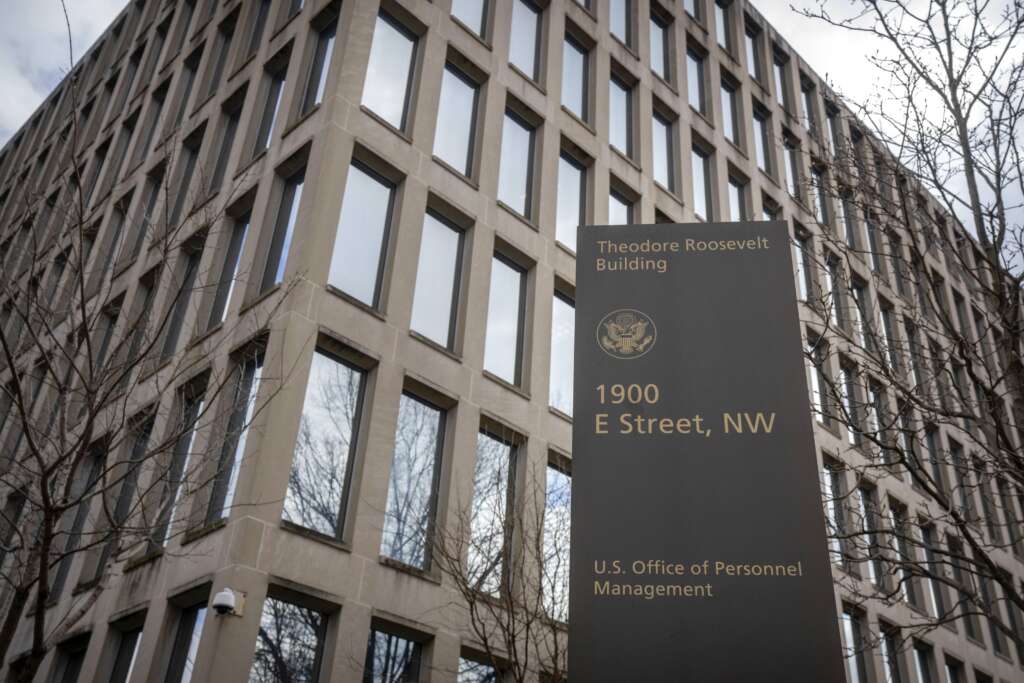
The Theodore Roosevelt Building, location of the U.S. Office of Personnel Management, on Tuesday, Feb. 13, 2024, in Washington. Former President Donald Trump has plans to radically reshape the federal government if he returns to the White House, from promising to deport millions of immigrants in the U.S. illegally to firing tens of thousands of government workers. (AP Photo/Mark Schiefelbein)

Yeske helped change what complying with zero trust means

The Cybersecurity and Infrastructure Security Agency developed a zero trust architecture that features five pillars.

The Defense Department’s zero trust architecture includes seven pillars.

The one the Department of Homeland Security is implementing takes the best of both architectures and adds a little more to the mix.

Don Yeske, who recently left federal service after serving for the last two-plus years as the director of national security in the cyber division at DHS, said the agency had to take a slightly different approach for several reasons.

Don Yeske is a senior solutions architect federal at Virtu and a former director of national security in the cyber division at the Homeland Security Department.

“If you look at OMB [memo] M-22-09 it prescribes tasks. Those tasks are important, but that itself is not a zero trust strategy. Even if you do everything that M-22-09 told us to do — and by the way, those tasks were due at the beginning of this year — even if you did it all, that doesn’t mean, goal achieved. We’re done with zero trust. Move on to the next thing,” Yeske said during an “exit” interview on Ask the CIO. “What it means is you’re much better positioned now to do the hard things that you had to do and that we hadn’t even contemplated telling you to do yet. DHS, at the time that I left, was just publishing this really groundbreaking architecture that lays out what the hard parts actually are and begins to attack them. And frankly, it’s all about the data pillar.”

The data pillar of zero trust is among the toughest ones. Agencies have spent much of the past two years focused on other parts of the architecture, like improving their cybersecurity capabilities in the identity and network pillars.

Yeske, who now is a senior solutions architect federal at Virtru, said the data pillar challenge for DHS is even bigger because of the breadth and depth of its mission. He said between the Coast Guard, FEMA, Customs and Border Protection and CISA alone, there are multiple data sources, requirements and security rules.

“What’s different about it is we viewed the problem of zero trust as coming in broad phases. Phase one, where you’re just beginning to think about zero trust, and you’re just beginning to adjust your approach, is where you start to take on the idea that my network boundary can’t be my primary, let alone sole line of defense. I’ve got to start shrinking those boundaries around the things that I’m trying to protect,” he said. “I’ve got to start defending within my network architecture, not just from the outside, but start viewing the things that are happening within my network with suspicion. Those are all building on the core tenants of zero trust.”

Capabilities instead of product focused

He said initial zero trust strategy stopped there, segmenting networks and protecting data at rest.

But to get to this point, he said agencies too often are focused on implementing specific products around identity or authentication and authorization processes.

“It’s a fact that zero trust is something you do. It’s not something you buy. In spite of that, federal architecture has this pervasive focus on product. So at DHS, the way we chose to describe zero trust capability was as a series of capabilities. We chose, without malice or forethought, to measure those capabilities at the organization, not at the system, not at the component, not as a function of design,” Yeske said. “Organizations have capabilities, and those capabilities are comprised of three big parts: People. Who’s responsible for the thing you’re describing within your organization? Process. How have you chosen to do the thing that you’re describing at your organization and products? What helps you do that?”

Yeske said the third part is technology, which, too often, is intertwined with the product part.

He said the DHS architecture moved away from focusing on product or technology, and instead tried to answer the simple, yet complex, questions: What’s more important right now? What are the things that I should spend my limited pool of dollars on?

“We built a prioritization mechanism, and we built it on the idea that each of those capabilities, once we understand their inherent relationships to one another, form a sort of Maslow’s hierarchy of zero trust. There are things that are more basic, that if you don’t do this, you really can’t do anything else, and there are things that are really advanced, that once you can do basically everything else you can contemplate doing this. And there are a lot of things in between,” he said. “We took those 46 capabilities based on their inherent logical relationships, and we came up with a prioritization scheme so that you could, if you’re an organization implementing zero trust, prioritize the products, process and technologies.”

Understanding cyber tool dependencies

DHS defined those 46 capabilities based on the organization’s ability to perform that function to protect its data, systems or network.

Yeske said, for example, with phishing-resistant, multi-factor authentication, DHS didn’t specify the technology or product needed, but just the end result of the ability to authenticate users using multiple factors that are resistant to phishing.

“We’re describing something your organization needs to be able to do because if you can’t do that, there are other things you need to do that you won’t be able to do. We just landed on 46, but that’s not actually all that weird. If you look at the Defense Department’s zero trust roadmap, it contains a similar number of things they describe as capability, which are somewhat different,” said Yeske, who spent more than 15 years working for the Navy and Marine Corps before coming to DHS. “We calculated a 92% overlap between the capabilities we described in our architecture and the ones DoD described. And the 8% difference is mainly because the DHS one is brand new. So just understanding that the definition of each of these capabilities also includes two types of relationships, a dependency, which is where you can’t have this capability unless you first had a different one.”

Yeske said before he left DHS in July, the zero trust architecture and framework had been approved for use and most of the components had a significant number of cyber capabilities in place.

He said the next step was assessing the maturity of those capabilities and figuring out how to move them forward.

If other agencies are interested in this approach, Yeske said the DHS architecture should be available for them to get a copy of.

The post Yeske helped change what complying with zero trust means first appeared on Federal News Network.

© Getty Images/design master

Lawmakers ramp up scrutiny of ICE oversight staff furloughs

Democrats in Congress are pressing Immigration and Customs Enforcement to restore oversight staff who were furloughed at the start of the government shutdown.

In a Nov. 6 letter to Homeland Security Secretary Kristi Noem, the lawmakers said that staff at the Office of Detention Oversight are crucial to ensuring safety at ICE detention centers. Staff at ODO were furloughed at the outset of the shutdown.

“Without ODO staff actively performing these duties, there is a heightened risk that detention facilities fail to meet required standards, compromising detainee safety, access to medical care, and legal protections,” the lawmakers wrote to Noem.

The lawmakers also point out that the Department of Homeland Security’s shutdown contingency plan includes exceptions for the safety of human life and protection of property.

“This is not hypothetical – ICE has publicly reported that at least twenty people have died in its custody since January,” they added.

The letter points to reports of overcrowding and other unsafe conditions at ICE detention facilities, as immigration enforcement operations have continued through the shutdown.

“Given these developments, we are deeply concerned about the health and safety of detainees and staff at ICE facilities during the ongoing lapse in appropriations,” the letter states. “The decision to furlough the entire ODO is a clear attempt to sabotage oversight into the conditions of ICE facilities and the wellbeing of detainees.”

The letter was led by Rep. James Walkinshaw (D-Va.) and also signed by Sen. Mark Warner (D-Va.) and Reps. Don Beyer (D-Va.) and Suhas Subramanyam (D-Va.).

In a separate Oct. 31 letter to Noem and acting ICE Director Todd Lyons, Rep. Maxine Dexter (D-Ore.) pointed out that ICE furloughed ODO staff despite receiving an influx of funding under the One Big Beautiful Bill Act.

“I recognize that certain nonessential functions must pause during a lapse in appropriations,” Dexter wrote. “However, a lack of funding cannot be used as justification to strip away any measure of accountability. To safeguard the health, safety, and dignity of my constituents, I urge you to reinstate necessary staff for the Office of Detention Oversight, immediately restore communication channels between ICE and congressional offices, and ensure Members of Congress have access to all ICE facilities.”

In an Oct. 17 letter, Rep. Raja Krishnamoorthi (D-Ill.) said DHS furloughing ODO employees while retaining all press and communications staffers raises “serious questions about the department’s priorities during this shutdown.”

“ODO’s inspectors are responsible for ensuring that facilities meet federal health, safety, and humane treatment standards,” Krishnamoorthi wrote. “With detention levels now among the highest in more than a decade, suspending this critical oversight function while enforcement operations proceed uninterrupted is indefensible and represents a profound failure of priorities.”

The ODO furloughs come as the number of ICE detainees reach record high levels. As of Sept. 21, there were nearly 60,000 people in ICE custody.

ODO was created in 2009 to inspect ICE detention facilities. The office conducts a separate set of inspections independent from inspections run by ICE Enforcement and Removal Operations’ Custody Management Division.

The furloughs at ODO come after DHS also fired most staff at several oversight offices earlier this year.

The reductions-in-force at those offices – the Office for Civil Rights and Civil Liberties, the Office of the Immigration Detention Ombudsman, and the Office of the Citizenship and Immigration Services Ombudsman – are now at issue in an ongoing lawsuit.

The post Lawmakers ramp up scrutiny of ICE oversight staff furloughs first appeared on Federal News Network.

© AP Photo/Stephen Smith

The Department of Homeland Security’s ICE detention facility is shown in Jena, La., on Friday, March 21, 2025. (AP Photo/Stephen Smith)
❌