Reading view

There are new articles available, click to refresh the page.

‘Stablecoins Are Here To Stay’: IMF Calls For Global Cooperation To Prevent Financial Risks

As stablecoins continue to gain worldwide momentum, the International Monetary Fund (IMF) has called for global cooperation to avert potential macro financial stability risks related to the rapidly growing sector and to turn the industry “into a force for good.”

Stablecoins To Foster Innovation, Financial Inclusion

On Thursday, the IMF released a 56-page report discussing the growing influence of stablecoins, their potential use cases in mainstream financial markets, and the risks associated with the sector’s varying oversight.

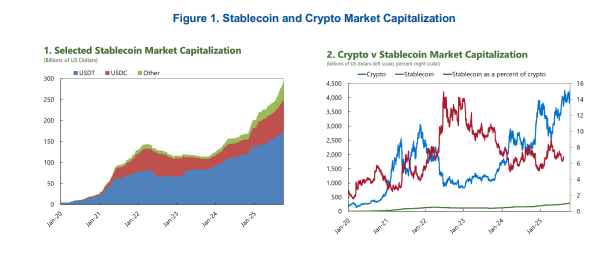
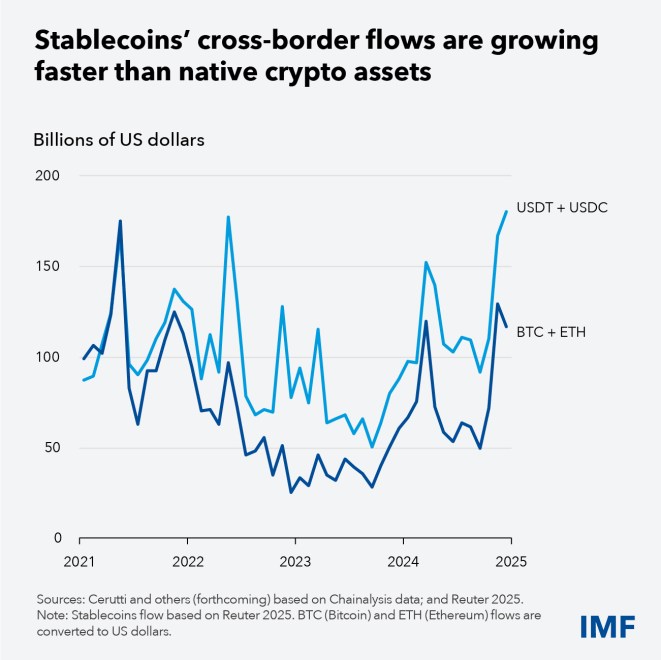
Amid the sector’s rapid growth, the organization highlighted that the two largest stablecoins, USDT and USDC, have tripled their market capitalization since 2023, reaching a combined $260 billion. Meanwhile, their trading volume has increased by around 90% to $23 trillion in 2024, with Asia surpassing North America in stablecoin activity volume.
stablecoins

The IMF noted two major potential benefits from stablecoins. First, they could enable faster and cheaper cross-border payments, especially for remittances, which can cost 20% of the amount being sent and face some delays.

However, “being a single source of information, blockchains can greatly simplify the processes linked with cross-border payments and reduce costs,” the Fund’s economists explained in a blog post.

Second, stablecoins could expand financial access, driving innovation by increasing competition with established payment service providers, therefore, making retail digital payments more accessible to underserved customers.

They could facilitate digital payments in areas where it is costly or not profitable for banks to serve customers. Many developing countries are already leapfrogging traditional banking with the expansion of mobile phones and different forms of digital and tokenized money.

Notably, competition with already established providers could lower costs and lead to enhanced product diversity, “leveraging synergies between digital payments and other digital services.”

IMF Warns Of Fragmented Oversight

Despite their potential benefits, stablecoins also carry significant risks, the IMF explained, including de-pegging and collapsing if the underlying assets lose value or if users lose confidence in the ability to cash out. Per the report, this could also trigger fire sales of the reserve assets and disrupt financial markets.

Stablecoins could also accelerate a “currency substitution” dynamic, where individuals and companies abandon their national currency in favor of a foreign one, like US dollars or euros, due to instability or high inflation.

The organization noted that the dynamic decreases a country’s central bank’s ability to control its monetary policy and serve as the lender of last resort, damaging the financial sovereignty of affected nations.

In addition, the potential to reduce cross-border frictions and make faster and cheaper transactions could be undermined by a lack of interoperability if various networks are unable to connect or are restricted by different regulations and other hurdles.

“Stablecoin regulation is in its infancy, so the ability to mitigate these risks remains uneven across countries,” the organization affirmed, noting that “the IMF and the Financial Stability Board have issued recommendations to safeguard against currency substitution, maintain capital flow controls, address fiscal risks, ensure clear legal treatment and robust regulation, implement financial integrity standards, and strengthen global cooperation.”

As reported by Bitcoinist, the FSB vowed in October to address the evolving threats from private finance and the growing use of stablecoins, promising to increase the global watchdog’s policy response and overhaul its surveillance system to make it more flexible and quicker.

Nonetheless, major jurisdictions have taken different stances in key areas, as the IMF detailed, which could result in the exploitation of gaps between jurisdictions and issuers to locate where oversight is weaker.

All this underscores the need for strong international cooperation to mitigate macrofinancial and spillover risks (…). Tokenization and stablecoins are here to stay. But their future adoption and the outlook for this technology are still mostly unknown.

The organization concluded that “improving the existing global financial infrastructure might be easier than replacing it. Achieving the best possible balance will require close cooperation among policymakers, regulators, and the private sector.”
stablecoins, bitcoin, btc, btcusdt

Bitcoin Adoption Is Just Getting Started — 200x Growth Possible, Tom Lee Says

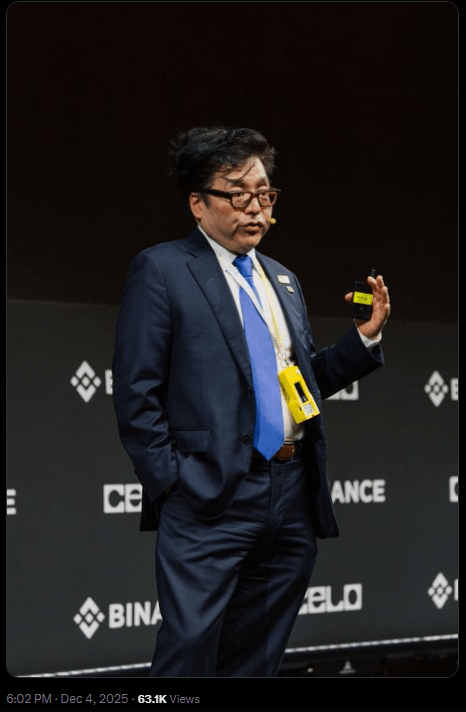
Fundstrat’s Tom Lee told attendees at Binance Blockchain Week that he believes the worst leg of the recent crypto slump is likely over and that markets may be ready for a gradual recovery. He pointed to weakening selling pressure and growing underlying activity as reasons for cautious optimism.

Market Sentiment May Be Near A Turning Point

According to Lee, mood on the street turned darker after October, with many investors showing fatigue after steady losses. He said the current selling looks closer to exhaustion than to the start of another major decline. Trading desks have cut back. Volume has thinned. Sentiment is low. Lee argued that often, when pessimism peaks, conditions for a reversal begin to form.

Bitcoin Drawdowns Are Not Uncommon

Based on reports, Bitcoin has fallen about 36% from its all-time high in the recent retreat. That size of drop has happened in prior cycles, including 2017 and 2021, and has been followed by rallies that reached new records.

“Crypto prices likely bottomed. The best years of growth are still ahead: there is 200x adoption to come.” – Tom Lee, Chairman of Bitmine pic.twitter.com/fPWbWdaosO

— Binance (@binance) December 4, 2025

Lee pointed to long-term returns for bitcoin and ether compared with some traditional assets over the last decade, saying crypto’s gains were larger. He used that history to support the idea that patient holders have been rewarded after past stress.

Tokenization Could Be A Major Story In 2026

Lee also presented tokenization as a key theme for the future. He said large institutions are preparing to move more financial products on-chain and that, if real estate joins the shift, close to a quadrillion dollars in assets could eventually be tokenized.

Stablecoins were cited as an early example of why tokenized instruments can attract demand. He suggested that a broader institutional push could add steady interest to the market over time.

BlackRock’s Bitcoin ETF Was Highlighted As A Signal

Reports have disclosed that BlackRock’s bitcoin ETF has become one of the firm’s top fee-earning products, a fact Lee used to show growing involvement from legacy finance. That kind of institutional participation, he argued, points to deeper engagement from big players who were previously on the sidelines.

Adoption Gap Suggests Large Upside

According to Lee, only 4.4 million bitcoin wallets hold more than $10,000 in BTC, while nearly 900 million people globally have more than $10,000 in retirement savings.

He said that gap shows how early the market still is and argued that if just a fraction of those savers put money into bitcoin, adoption could expand by as much as 200 times. The figure is speculative, he acknowledged, but he used it to show the potential scale for future demand.

What This Means For Investors Now

Lee questioned whether the old four-year cycle should be used as a strict guide. He suggested recent moves were driven more by de-leveraging and structural shifts than by the halving rhythm that shaped earlier cycles.

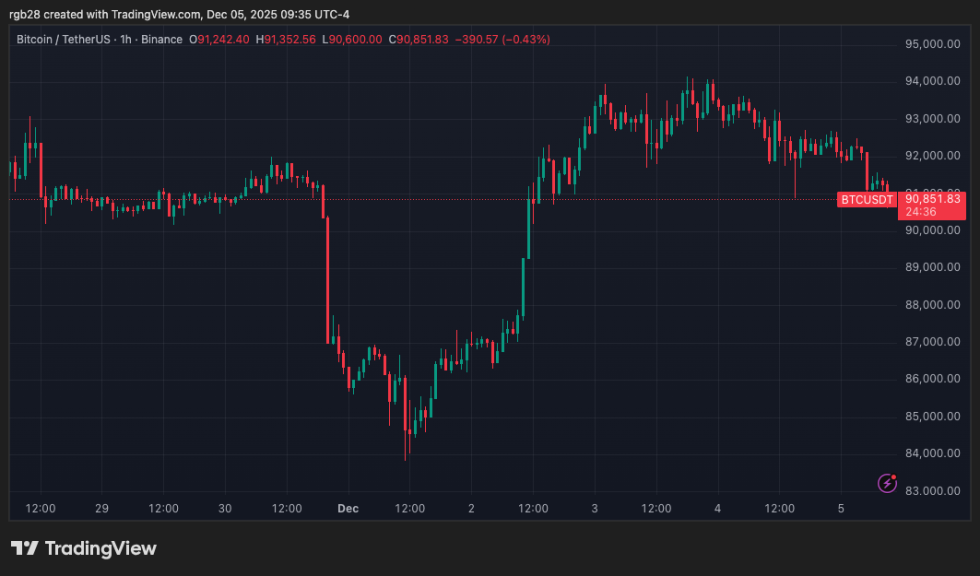
Featured image from Unsplash, chart from TradingView

Binance Founder Crushes Bitcoin Critic In Game-Changing BTC Vs. Gold Debate

The Binance Blockchain Week event in Dubai became the center of a high-stakes showdown between traditional and digital innovation, with Bitcoin and gold going head-to-head. Investors, tech enthusiasts, and financial experts watched closely as Binance founder Changpeng Zhao expertly debated renowned Bitcoin critic Peter Schiff, making a compelling argument for why Bitcoin is better than gold. 

Binance Founder Dominates Bitcoin And Gold Debate

During the Binance Blockchain Week in Dubai, Schiff and CZ faced off in a high-profile debate over the value of Bitcoin versus Gold. Schiff defended gold as a safe, stable, and tangible asset while the Binance founder made a compelling case for Bitcoin’s adoption, utility, value, and global reach. 

Throughout the debate, which lasted over an hour, CZ consistently demonstrated the practical advantages of Bitcoin, leaving Schiff’s gold argument largely on the defensive. The Binance founder emphasized Bitcoin’s transparent and predictable supply and its role in the modern financial systems. He pointed to hundreds of millions of users who rely on Bitcoin for payments, savings, and transfers. 

Schiff argued that Bitcoin lacks inherent value and is mainly driven by hype and faith that its price will rise. He stated that gold remains tangible, centuries old, scarce, and valuable in industry, making it superior to BTC. He further asserted that “nobody needs” Bitcoin and that the cryptocurrency is “backed by nothing.”

Practical demonstrations played a key role in the debate between Schiff and CZ. The Binance founder explained how Bitcoin and crypto payments already improve financial efficiency, especially in emerging markets. Schiff questioned whether these transactions truly count as money, since merchants ultimately receive traditional currency. CZ’s response highlighted the importance of adoption and network effects, noting that people who use BTC directly for payments give it real-world significance.

The debate also considered the preferences of younger generations. CZ asked Schiff whether millennials and Gen Z favoured Bitcoin or gold. The Bitcoin critic responded sharply, suggesting that they would choose gold. He pointed out that, with many young investors losing money on BTC, gold offers a safer, more appealing alternative. The Binance founder countered that younger people understand digital value more intuitively and prefer mobile, borderless, and censorship-resistant assets. 

Digital Value And The Future Of Money

The debate between CZ and Schiff also highlighted the changing definition of money. Bitcoin functions as a decentralized network that enables instant settlement and transparent verification. Its adoption has also helped evolve the financial economy, facilitating faster and more seamless cross-border payments. Schiff argued that gold’s scarcity and industrial demand preserve its value and make it a reliable hedge against economic uncertainty. 

Tokenization also became a point of agreement during the discussion, with Schiff emphasizing that gold can be digitized and tokenized for easier ownership and distribution without moving the physical metal. CZ contended that Bitcoin offers similar advantages while also enabling global financial inclusion. They also discussed the supply of both assets, with the Binance founder noting that Bitcoin has a visible supply, while gold doesn’t. 

They also talked about the performance of both assets over the years. Schiff argued that gold had outperformed BTC over the past four years. CZ contended that Bitcoin has far outpaced gold over the last 8 years, and since its launch in 2009, it has skyrocketed from a few cents to an ATH above $126,000. He concluded his debate, predicting that Bitcoin’s growth will outpace gold over time.

Bitcoin

XRP ETFs Are About To Hit $1 Billion – Here’s How Much Is Flowing In Daily

XRP ETFs are on the verge of hitting a significant milestone, with total Assets Under Management (AUM) approaching the $1 billion milestone. Since the launch of its ETF last month, hundreds of millions of dollars have been flowing in daily, making XRP the most successful new ETF entrant of 2025. 

XRP ETFs Close In On $1 Billion

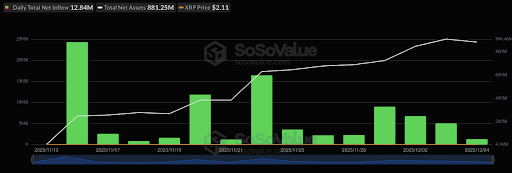
XRP ETFs have continued to experience skyrocketing growth and institutional demand, now rapidly closing in on the $1 billion inflow milestone. Over the past two weeks, all five XRP ETFs have recorded over $984.54 million in cumulative net inflows, just $15.46 million away from $1 billion. This explosive, accelerated growth has effectively solidified XRP’s position as the third-largest crypto ETF, behind Bitcoin and Ethereum.

Data from Sosovalue reports 15 consecutive days of positive flow, with the XRP ETF recording its highest single-day inflow on November 14 at $243.05 million. Over the last two weeks, all five XRP ETFs, including REX-Osprey, have seen notable inflows, reflecting growing institutional interest and demand. 

XRP

According to crypto enthusiast @NADZOE93 on X, XRP has become the third cryptocurrency ever to surpass the $800 million ETF inflow threshold. She noted that while Spot Bitcoin ETFs reached this cap in just two days after their launch, Ethereum ETFs took 95 days. This officially positions XRP as the second-fastest crypto to hit the $800 million inflow mark. 

Notably, strong inflows in the XRP ETF began on November 13 with the launch of Canary Capitals XRPC. A week later, Bitwise introduced its own XRP ETF, followed shortly by Grayscale and Franklin Templeton debuting their funds. Since then, investments have continued to pour in, with $26.17 million flowing in just yesterday alone, bringing the total to $887.12 million after 15 days of positive flow. 

Crypto market analyst Neil Tolbert shared additional insights on the XRP ETF performance on X this week. He noted that five spot XRP ETFs are currently trading, with a combined $995 million in Assets Under Management. Canary Capital’s XRPC stands at the top of the market with $358.88 million, followed by Grayscale’s GXRP with $211.07 million, Bitwise’s ETF at $184.87 million, Franklin Templeton’s XRPZ at $132.3 million, and REX-Osprey at $108 million. 

Tolbert has stated that more ETFs are reportedly in the pipeline, with institutional demand set to grow as traditional finance takes notice of XRP. With the race to a $1 billion inflow milestone heating up, XRP ETFs have already surpassed those of Solana and Dogecoin

Institutions Accumulate Over 400 Million XRP Through ETFs

Institutional demand for XRP is reaching new heights as data from ETF tracker XRP Insights show that a whopping 425.76 million tokens have been officially locked. This surge in accumulation comes as the five currently launched XRP ETFs collectively reach $984.54 million in AUM.

This large amount of XRP held in ETFs shows how quickly institutions are adopting, as investors increasingly seek regulated, transparent ways to gain exposure to cryptocurrencies. Analysts have also warned that if ETFs continue to absorb XRP at such a rapid pace, it could trigger a supply shock as the number of tokens in circulation declines.

XRP

BlackRock’s Bitcoin ETF Bleeds $2.7B in Longest Outflow Streak Since Launch

By: Amin Ayan

BlackRock’s iShares Bitcoin Trust has logged its longest stretch of weekly withdrawals since the fund launched in January 2024, marking a sharp turn in institutional sentiment toward Bitcoin even as prices steady.

Key Takeaways:

  • BlackRock’s iShares Bitcoin Trust has entered its longest outflow streak to date, with over $2.7 billion withdrawn in five weeks.
  • The reversal follows October’s sharp crypto-market liquidation, which erased more than $1 trillion in value and halted IBIT’s months of steady inflows.
  • Analysts warn the trend signals weakening institutional appetite.

Investors pulled more than $2.7 billion from the fund over the five weeks ending Nov. 28, according to data from SoSoValue.

Redemptions continued on Thursday with an additional $113 million, putting the ETF on track for a sixth consecutive week of outflows.

IBIT Faces Reversal as Crypto Wipeout Ends Months of Steady Inflows

IBIT, which manages more than $71 billion in assets, has been the flagship vehicle for traditional investors seeking regulated exposure to Bitcoin.

However, flows have reversed direction since early October, when a violent liquidation across crypto markets triggered a sell-off that erased more than $1 trillion in digital-asset value.

The shift stands in contrast to the steady inflows that helped propel Bitcoin higher earlier in the year.

Last week, speaking in São Paulo, BlackRock business development director Cristiano Castro said the company’s Bitcoin ETFs had become one of its strongest revenue engines, calling their rapid ascent “a big surprise” as investor allocations surged throughout the year.

Castro also downplayed outflow concerns, noting that “ETFs are very liquid and powerful instruments.”

“What we’ve been seeing is perfectly normal; any asset that starts to experience compression usually has this effect, especially in an instrument that is heavily controlled by retail investors,” he added.

$ETH ETF outflow of $41,500,000 🔴 yesterday.

BlackRock bought $28,400,000 in Ethereum. pic.twitter.com/LudLAdu0rg

— Ted (@TedPillows) December 5, 2025

Bitcoin has clawed back some losses this week, but analysts say ETF flows paint a clearer picture of institutional caution.

In a recent report, Glassnode wrote that the outflow streak “marks a clear reversal from the persistent inflow regime that supported price earlier in the year, and reflects a cooling of new capital allocation into the asset.”

The firm noted that investor positioning has become more defensive as volatility and funding pressure remain elevated.

Despite the turbulence, Bitcoin traded around $92,000 in London on Friday morning, still down 27% from its October peak.

Spot Chainlink ETF Pulls $41M on First Day

As reported, Grayscale’s first US spot exchange-traded fund tied to Chainlink opened with solid demand, adding another data point to the debate over whether appetite for altcoins can survive a cooling crypto market.

The product ended its debut session with $41 million in net inflows and about $13 million in trading volume.

The figures placed Chainlink among the stronger ETF launches this year and suggested that, at least for some investors, regulated vehicles remain the preferred route into higher-risk digital assets.

The new Chainlink ETF comes amid the rollout of a wave of new altcoin ETFs.

Over the past month, issuers have launched products tied to Solana, XRP, and Dogecoin, with more XRP and Dogecoin funds set to list next week.

The Canary Capital XRP ETF (XRPC) debuted with $58 million in net inflows, the highest opening-day haul for any ETF this year, edging out the Bitwise Solana Staking ETF (BSOL), which launched with $57 million.

The post BlackRock’s Bitcoin ETF Bleeds $2.7B in Longest Outflow Streak Since Launch appeared first on Cryptonews.

U.S. Army signs $272M contract for Air Force training bombs

The United States Army Contracting Command at Rock Island Arsenal has awarded Allied Metal Tech LLC of Greenville, Wisconsin, a contract valued at $272 million for the production of bomb dummy unit-50 (BDU-50) cast ductile iron devices with material handling pallets in support of the U.S. Air Force and potential Foreign Military Sales (FMS) requirements. […]

A Tale of Two Tenderloins: Beef Vs. Pork

It was the best of times, it was the worst of times….

The best of times if you happen to be an AI billionaire.

The worst of times if you look at how much your grocery bills have increased since 2024.

Which brings us to holiday roasts, and in particular, one of the most prized roasts of all: tenderloin. This is the little-used muscle that runs near the spine of pigs and cattle. In both animals, it’s lean, tender, and versatile with the potential to be the meaty star of your holiday table.

But the current difference in price is stupefying: A price check at a local supermarket revealed pork tenderloin was $2.99 per pound while beef tenderloin was $26.99!

Beef and Pork Tenderloin

Once trimmed of fat and silverskin, beef tenderloin can be cut into individual steaks (filets mignon) or grilled whole, then sliced. Pork tenderloin can be treated the same way, though when sliced crosswise, the cuts are known as medallions. Grilling tenderloins whole is our preferred method of cooking to ensure the meat remains juicy and tender.

Feeling indulgent this holiday season? Here is one of our favorite recipes for beef tenderloin. It uses the reverse-sear method of cooking—a very effective way to treat this exceptionally lean cut of meat. Serve as a main course with Three Hots Horseradish Sauce, or slice thinly and serve on cocktail breads as an appetizer.

Alternatively, take a financially conservative approach with Coffee-Crusted Pork Tenderloins with Redeye Barbecue Sauce. A new holiday tradition is born!

Related Blogs

Check out our 1000+ Recipes section here on Barbecue Bible.Com

Also, sign up for our Up in Smoke newsletter so you don't miss any blogs and receive some special offers! PLUS get Raichlen's Burgers! PDF for free!

Follow Steven on Facebook, Instagram, YouTube, TikTok, Reddit, and Pinterest!

Check out our store powered by BBQGuys!

The post A Tale of Two Tenderloins: Beef Vs. Pork appeared first on Barbecuebible.com.

“Backed by nothing?” inside the epic Bitcoin battle between Changpeng Zhao and Peter Schiff

CZ and Peter Schiff spar over Bitcoin and tokenized gold, exposing a deeper fight about utility, trust, and what really backs the money of the future. Binance’s latest headline debate is not really about metal versus code or Bitcoin. It…

💾

CZ and Peter Schiff spar over Bitcoin and tokenized gold, exposing a deeper fight about utility, trust, and what really backs the money of the future.

IMF warns dollar stablecoins risk eroding monetary sovereignty

The IMF says large dollar stablecoins can accelerate currency substitution, weaken monetary control in fragile economies, and require strict, globally coordinated regulation and reserves. The International Monetary Fund published a paper warning that large foreign-currency stablecoins can accelerate currency substitution…

XRP ETFs Record 13-Day Streak As SOL Funds See Largest Outflows Since Launch

As institutional demand intensifies and the crypto market recovers, US spot XRP Exchange-Traded Funds (ETFs) continue to lead the sector with a 13-day streak and over $200 million in positive net flows this week, outshining Solana (SOL) ETFs, which recorded their third day of outflows in seven days.

XRP Funds Lead Crypto ETF Inflows

Spot XRP exchange-traded funds have extended their record-breaking streak after registering their thirteenth consecutive day of positive net flows, with $50.27 million in inflows on December 3.

The investment products have seen a remarkable performance since the launch of Canary Capital’s XRPC, the first single-token XRP spot ETF, on November 13, positioning the funds as the fastest-growing altcoin-based category.

Notably, XRPC surpassed all initial expectations and debuted on Nasdaq with a total volume of $58 million, recording around $357.54 million in positive net flows in 13 days. Last week, the second group of XRP funds went live, becoming the largest US ETF launches of 2025 with over $60 million in net inflows each during their first day.

Moreover, the category, led by Grayscale’s GXRP and Franklin Templeton’s XRPZ, surpassed other major ETFs in single-day inflows, including those based on the largest cryptocurrencies by market capitalization, Solana, Bitcoin (BTC), and Ether (ETH).

Amid this week’s market recovery, XRP ETFs saw $89.65 million on Monday, $67.7 million the following day, and an additional $50.27 million on Wednesday, for a cumulative net inflow of $207.66 million during the first three days of December.

As a result, the leading category surpassed both Bitcoin ETFs’ $52.4 million and Ethereum ETFs’ $51.3 million positive net flows, respectively, during the same three-day period.

With a total of $874.28 million in inflows in 13 days, spot XRP ETFs have surpassed the $618.62 million total inflows of SOL ETFs, which held the record among the second wave of altcoin-based investment products.

Solana ETFs Demand Loses Steam

While XRP ETFs take the spotlight, Solana funds’ momentum has slowed, seeing their largest days of outflows this week. According to SoSovalue data, the investment products recorded $32.9 million in outflows on December 3, marking their third negative net flows day since the category debuted on October 28.

Despite pulling out positive net flows, Bitwise’s BSOL, Fidelity’s FSOL, and Grayscale’s GSOL were unable to absorb 21Shares’ TSOL $41.8 million in outflows. This performance also marks the fourth negative day for TSOL over the past week.

As reported by NewsBTC, Solana ETFs experienced a record performance in November despite the market correction, with $613 million in inflows during their 22 consecutive day positive streak.

However, the remarkable streak ended a week ago when TSOL registered negative net flows for the first time, and the category was unable to absorb them, recording outflows of $8.1 million.

SOL-based investment products started December with outflows worth $13.5 million, which were followed by strong inflows worth $45.77 million on Tuesday. On December 3, the funds registered $32.19 million in outflows, amounting to a negative net flow of $700,000 for the first half of the week, despite the altcoin’s recent price recovery.

XRP, XRPUSDT

IMF Warns: Fragmented Stablecoin Rules Create “Roadblocks” – New Guidelines Released

The International Monetary Fund on Thursday released a new global assessment of the stablecoin market, warning that fragmented regulatory frameworks across countries are now creating structural “roadblocks” that threaten financial stability, weaken oversight, and slow the development of cross-border payments.

In its report titled “Understanding Stablecoins,” the IMF reviewed how major economies, including the United States, the United Kingdom, the European Union, and Japan, regulate stablecoins and found that national approaches remain widely inconsistent.

Stablecoins have the potential to reshape cross-border payments and capital flows. They offer opportunities, but also bring new risks—financial integrity, regulatory oversight, consumer protection, capital flow management, monetary sovereignty, and more. Learn more:… pic.twitter.com/cOlZKuqLDF

— IMF (@IMFNews) December 4, 2025

While some countries treat stablecoins as securities, others regulate them as payment instruments, permit only bank-issued tokens, or leave large parts of the market unregulated.

Stablecoins Are Moving Faster Than Regulators Can Track, IMF Warns

The IMF said this regulatory patchwork allows stablecoins to move across borders faster than oversight can follow.

Issuers can operate from lightly regulated jurisdictions while serving users in stricter markets, limiting authorities’ ability to monitor reserves, redemptions, liquidity management, and anti-money laundering controls.

The fund warned that this creates regulatory arbitrage and weakens global supervision.

The report also pointed to technical fragmentation. Stablecoins increasingly operate across different blockchains and exchanges that are not always interoperable.

According to the IMF, this lack of coordination raises transaction costs, slows market development, and creates barriers to efficient global payments.

Differences in national regulatory treatment further complicate cross-border usage and settlement.

Source: IMF

Stablecoins remain dominated by U.S. dollar-denominated tokens. The IMF said the global stablecoin market is now worth more than $300 billion. Tether’s USDT and Circle’s USDC make up the majority of that supply. About 40% of USDC’s reserves are held in short-term U.S. treasuries, while roughly 75% of USDT’s reserves are in short-term treasuries, with another 5% held in Bitcoin.

The concentration of reserves in government debt markets links stablecoins directly to traditional financial systems

Widespread use of foreign-currency stablecoins can weaken domestic monetary control, lower demand for local currency, and accelerate digital dollarization. Stablecoins also make it easier to bypass capital controls through unhosted wallets and offshore platforms.

In addition to monetary concerns, the fund cited broader financial stability concerns. Large-scale redemptions could force rapid sales of Treasury bills and repo assets, potentially disrupting short-term funding markets that are critical for monetary policy transmission.

The IMF also noted that the increasing interconnection between stablecoin issuers, banks, custodians, crypto exchanges, and funds also increases the risk of contagion spreading from digital markets into the wider financial system.

IMF Urges Unified Stablecoin Regulation as Cross-Border Risks Grow

To address these risks, the IMF released new global policy guidelines intended to reduce fragmentation. It called for harmonized definitions of stablecoins, consistent rules for reserve assets, and shared cross-border monitoring frameworks.

The fund said issuers should be subject to the principle of “same activity, same risk, same regulation,” regardless of whether the issuer is a bank, fintech company, or crypto platform.

The IMF also said stablecoins should be backed only by high-quality liquid assets such as short-term government securities, with strict limits on risky holdings. Issuers must guarantee full one-to-one redemption at par, on demand, at all times.

Strong international coordination on anti-money laundering enforcement, licensing, and supervision of large global stablecoin arrangements was also included in the new guidance.

The IMF’s warning comes as regulatory pressure is rising worldwide. In Europe, the European Central Bank recently warned that stablecoins, despite their small footprint in the euro area, now pose spillover risks due to their growing ties to U.S. Treasury markets.

🇪🇺 The ECB warns that stablecoins are growing fast, now topping $280B, with rising spillover risks as USDT and USDC dominate 90% of the market. #Stablecoins #ECBhttps://t.co/ef16HZzqYL

— Cryptonews.com (@cryptonews) November 24, 2025

The European Systemic Risk Board has also called for urgent safeguards against cross-border stablecoin structures operating under the EU’s MiCA framework.

In China, the central bank has described stablecoins as a threat to financial stability and monetary sovereignty, while the Bank of England and Basel regulators are reassessing how banks should hold capital against stablecoin exposure as usage expands.

The IMF concluded that without consistent global regulation, stablecoins could bypass national safeguards, destabilize vulnerable economies, and transmit financial shocks across borders at high speed.

The post IMF Warns: Fragmented Stablecoin Rules Create “Roadblocks” – New Guidelines Released appeared first on Cryptonews.

Grayscale’s Spot Chainlink ETF Pulls $41M on Debut Despite Market Uncertainty

By: Amin Ayan

Grayscale’s first US spot exchange-traded fund tied to Chainlink opened with solid demand, adding another data point to the debate over whether appetite for altcoins can survive a cooling crypto market.

Key Takeaways:

  • Bloomberg’s Eric Balchunas says the Chainlink ETF opened with $41M in inflows and $13M in volume.
  • The debut beat Solana’s launch, but trailed XRP’s $243M Day-1 inflow reported by SosoValue.
  • ETF analyst James Seyffart cautioned it wasn’t a blockbuster.

Despite a pullback across major tokens in recent weeks, the new fund attracted sizable capital on its first trading day.

Chainlink ETF Debut Draws $41M, Signaling Demand for Regulated Altcoins

According to Bloomberg ETF analyst Eric Balchunas, the product ended its debut session with $41 million in net inflows and about $13 million in trading volume.

The figures placed Chainlink among the stronger ETF launches this year and suggested that, at least for some investors, regulated vehicles remain the preferred route into higher-risk digital assets.

The showing stands well above the opening day for the Solana ETF, which recorded just $8.2 million in volume based on data from Farside Investors.

Still, the XRP ETF remains the category’s heavyweight, registering $243 million in first-day inflows, according to SosoValue.

Even so, analysts urged restraint. James Seyffart said the launch was not a “blockbuster,” though he noted that the fund quickly reached about $64 million in assets under management, including an $18 million seed allocation.

“Chainlink shows that less liquid products can still attract attention in an ETF wrapper,” he wrote, pointing to the role exchange-traded funds can play in widening market access.

So, $GLNK took in ~$42 million on day 1. Not "blockbuster" success but very good for a new launch. Volume was strong. The fund currently sits at $64 million in assets. Chainlink showing that longer tail assets can find success in the ETF wrapper too. https://t.co/CgVCxlykGr

— James Seyffart (@JSeyff) December 3, 2025

For Chainlink itself, the debut offered little immediate relief. The LINK token is up nearly 10% over the past week but remains down more than 39% over the past year, according to price data cited by Cointelegraph.

Chainlink’s appeal lies in its infrastructure role. The network supplies on-chain applications with external data, enabling price feeds, cross-chain transfers and tokenized assets to function reliably.

As demand for decentralized finance and real-world asset tokenization grows, investors appear willing to give even second-tier tokens a closer look.

New Altcoin ETFs Steal Spotlight as Bitcoin Funds Struggle

The new Chainlink ETF comes amid the rollout of a wave of new altcoin ETFs.

Over the past month, issuers have launched products tied to Solana, XRP, and Dogecoin, with more XRP and Dogecoin funds set to list next week.

The Canary Capital XRP ETF (XRPC) debuted with $58 million in net inflows, the highest opening-day haul for any ETF this year, edging out the Bitwise Solana Staking ETF (BSOL), which launched with $57 million.

BSOL has quickly become one of the early success stories of 2025, accumulating over $660 million in assets within three weeks and avoiding a single day of outflows.

As reported, the New York Stock Exchange has approved the listing of Grayscale’s XRP and Dogecoin exchange-traded funds, clearing both products to begin trading on Monday.

NYSE Arca, the exchange’s ETF-focused subsidiary, filed certifications on Friday confirming the listing and registration of the Grayscale XRP Trust ETF Shares and the Grayscale Dogecoin Trust ETF Shares under the Securities Exchange Act of 1934.

Bitwise Asset Management has also unveiled the Bitwise Dogecoin ETF as investor appetite for altcoin exposure continues to increase.

The post Grayscale’s Spot Chainlink ETF Pulls $41M on Debut Despite Market Uncertainty appeared first on Cryptonews.

❌