Crypto firm Ripple recently announced its mission to be the one-stop shop for crypto infrastructure. This came as the firm highlighted the acquisitions it made this year in a bid to achieve this mission.
Ripple Unveils One-Stop Shop For Digital Asset Infrastructure
In a blog post, Ripple touted itself as the one-stop for crypto infrastructure. The firm noted that it had invested almost $4 billion into the crypto ecosystem through strategic investments and acquisitions. It added that 2025 marked its most ambitious year yet with four major acquisitions pointing toward one mission of being the one-stop infrastructure provider for moving value the way information moves today.
Ripple stated that some acquisitions will plug directly into Ripple payments to give its customers a unified, seamless operating environment with even more capabilities and currencies. Meanwhile, others will operate independently while benefiting from shared infrastructure. The firm noted that together, these companies will bring it closer to owning the full financial plumbing behind global value movement.
Furthermore, the company noted that businesses are operating in real time, but their financial infrastructure still isn’t. The firm believes that its unified offering gives companies the ability to bring their money management and movement up to the expectations of the digital world. It then went on to highlight how its newest acquisitions are critical to powering this change.
Highlighting The Role Of Its Latest Acquisitions
The firm stated that its now-closed acquisition of GTreasury marks a significant expansion into the multi-trillion-dollar corporate finance arena, a market that it noted many predict will lead the next phase of crypto adoption. The firm further remarked that through access to the global repo market via Ripple Prime and Ripple Payments’ real-time cross-border rails, corporate treasury teams can unlock idle capital, move money instantly, and open up new growth opportunities.
Ripple then highlighted its $200 million acquisition of Rail, which it stated will make the firm’s Payments the market’s most comprehensive end-to-end stablecoin payments solution. The firm said that it is compliantly connecting the best of fiat and crypto assets so that businesses can move money faster, save costs, and build to grow.
Ripple stated that its acquisition of Palisade broadens the range of customer use cases for custody, which is one of its central product strategies. It noted that Palisade’s “wallet-as-a-service” technology extends the company’s Custody’s inherent appeal to banks and financial institutions that carry out high-frequency transactions.
Lastly, the payment firm highlighted its acquisition of Hidden Road, which is now Ripple Prime. It stated that this completes the liquidity and execution layer of its one-stop shop vision. The Prime offers institutional-grade prime brokerage, clearing, and financing. This enables clients to execute OTC spot trades for major crypto assets, including XRP and RLUSD. While Palisade custodies assets and Rail moves them, Ripple noted that its brokerage business ensures that they can be traded efficiently, financed responsibly, and accessed through regulated channels.
Industry leader Tom Lee has shared how the Ethereum price could reach $12,000 within the next few months. He based his prediction on the Bitcoin price action and how ETH could match the flagship crypto on a potential run to the upside.
Tom Lee Explains How The Ethereum Price Could Rally To $12,000
Speaking at the Binance Blockchain Week, Tom Lee predicted that the Ethereum price could reach $12,000 as Bitcoin rallies to $250,000 within the next few months. He explained that ETH can reach the $12,000 target if the ETH/BTC ratio returns to its eight-year average of 0.0479. Lee described this potential rally to $12,000 as a “huge move.”
Tom Lee further predicted that the Ethereum price could reach $22,000 if the ETH/BTC ratio gets to its 2021 high of 0.0873. He added that he believes Ethereum will become the future of finance and the payment rails. As such, Lee predicted that the ETH/BTC ratio could reach 0.2500, sparking an Ethereum rally to as high as $62,500. In line with this, the expert declared that ETH at $3,000 is “grossly undervalued.”
Tom Lee also remarked that the bigger the base, the bigger the breakout for the Ethereum price. He noted that ETH spent years building a similar base to its current price action before the move from $90 to its previous all-time high (ATH) of $4,866. The expert added that if the pattern plays out again, the next leg could be larger than what people expect.
It is worth noting that Tom Lee is the chairman of BitMine, which is the largest Ethereum treasury company. According to Strategic ETH Reserve data, the company currently holds 3.73 million ETH, which is just over 3% of the altcoin’s total supply. Lee remains bullish on the Ethereum price, despite his company holding an unrealized loss of $3.3 billion of their ETH investment.
A Rally To $62,000 Is “Ambitious”
Market commentator Milk Road described Tom Lee’s Ethereum price prediction of $62,000 in a few months as being ambitious. The platform stated that an ETH/BTC ratio of 0.25 has never happened. The highest it has ever gone is 0.15, and that was during the 2017 supercycle, which makes it less likely now, given that market conditions have changed.
Tom Lee had based his Ethereum prediction on Bitcoin hitting $250,000, which Milk Road also described as an issue. The market commentator noted that BTC would need to surge 177% from current prices to reach this target. The last time this happened was in 2020 when it surged from $7,000 to $19,000 during the “peak mania.” Notably, BTC didn’t record a 100% gain even when the Bitcoin ETFs launched last year.
At the time of writing, the Ethereum price is trading at around $3,000, down over 4% in the last 24 hours, according to data from CoinMarketCap.
This is today’s edition of The Download, our weekday newsletter that provides a daily dose of what’s going on in the world of technology.
AI chatbots can sway voters better than political advertisements
The news: Chatting with a politically biased AI model is more effective than political ads at nudging both Democrats and Republicans to support presidential candidates of the opposing party, new research shows.
The catch: The chatbots swayed opinions by citing facts and evidence, but they were not always accurate—in fact, the researchers found, the most persuasive models said the most untrue things. The findings are the latest in an emerging body of research demonstrating the persuasive power of LLMs. They raise profound questions about how generative AI could reshape elections. Read the full story.
—Michelle Kim
The era of AI persuasion in elections is about to begin
—Tal Feldman is a JD candidate at Yale Law School who focuses on technology and national security. Aneesh Pappu is a PhD student and Knight-Hennessy scholar at Stanford University who focuses on agentic AI and technology policy.
The fear that elections could be overwhelmed by AI-generated realistic fake media has gone mainstream—and for good reason.
But that’s only half the story. The deeper threat isn’t that AI can just imitate people—it’s that it can actively persuade people. And new research published this week shows just how powerful that persuasion can be. AI chatbots can shift voters’ views by a substantial margin, far more than traditional political advertising tends to do.
In the coming years, we will see the rise of AI that can personalize arguments, test what works, and quietly reshape political views at scale. That shift—from imitation to active persuasion—should worry us deeply. Read the full story.
The ads that sell the sizzle of genetic trait discrimination
—Antonio Regalado, senior editor for biomedicine
One day this fall, I watched an electronic sign outside the Broadway-Lafayette subway station in Manhattan switch seamlessly between an ad for makeup and one promoting the website Pickyourbaby.com, which promises a way for potential parents to use genetic tests to influence their baby’s traits, including eye color, hair color, and IQ.
Inside the station, every surface was wrapped with more of its ads—babies on turnstiles, on staircases, on banners overhead. “Think about it. Makeup and then genetic optimization,” exulted Kian Sadeghi, the 26-year-old founder of Nucleus Genomics, the startup running the ads.
The day after the campaign launched, Sadeghi and I had briefly sparred online. He’d been on X showing off a phone app where parents can click through traits like eye color and hair color. I snapped back that all this sounded a lot like Uber Eats—another crappy, frictionless future invented by entrepreneurs, but this time you’d click for a baby.
This story first appeared in The Checkup, MIT Technology Review’s weekly biotech newsletter. To receive it in your inbox every Thursday, and read articles like this first, sign up here.
The must-reads
I’ve combed the internet to find you today’s most fun/important/scary/fascinating stories about technology.
1 The metaverse’s future looks murkier than ever OG believer Mark Zuckerberg is planning deep cuts to the division’s budget. (Bloomberg $) + However some of that money will be diverted toward smart glasses and wearables. (NYT $) + Meta just managed to poach one of Apple’s top design chiefs. (Bloomberg $)
2 Kids are effectively AI’s guinea pigs And regulators are slowly starting to take note of the risks. (The Economist $) + You need to talk to your kid about AI. Here are 6 things you should say. (MIT Technology Review)
3 How a group of women changed UK law on non-consensual deepfakes It’s a big victory, and they managed to secure it with stunning speed. (The Guardian) + But bans on deepfakes take us only so far—here’s what else we need. (MIT Technology Review) + An AI image generator startup just leaked a huge trove of nude images. (Wired $)
4 OpenAI is acquiring an AI model training startup Its researchers have been impressed by the monitoring and de-bugging tools built by Neptune. (NBC) + It’s not just you: the speed of AI deal-making really is accelerating. (NYT $)
5 Russia has blocked Apple’s FaceTime video calling feature It seems the Kremlin views any platform it doesn’t control as dangerous. (Reuters $) + How Russia killed its tech industry. (MIT Technology Review)
6 The trouble with AI browsers This reviewer tested five of them and found them to be far more effort than they’re worth. (The Verge $) + AI means the end of internet search as we’ve known it. (MIT Technology Review)
7 An anti-AI activist has disappeared Sam Kirchner went AWOL after failing to show up at a scheduled court hearing, and friends are worried. (The Atlantic$)
8 Taiwanese chip workers are creating a community in the Arizona desert A TSMC project to build chip factories is rapidly transforming this corner of the US. (NYT $)
9 This hearing aid has become a status symbol Rich people with hearing issues swear by a product made by startup Fortell. (Wired $) + Apple AirPods can be a gateway hearing aid. (MIT Technology Review)
10 A plane crashed after one of its 3D-printed parts melted Just because you can do something, that doesn’t mean you should. (BBC)
Quote of the day
“Some people claim we can scale up current technology and get to general intelligence…I think that’s bullshit, if you’ll pardon my French.”
—AI researcher Yann LeCun explains why he’s leaving Meta to set up a world-model startup, Sifted reports.
One more thing
ILLUSTRATION SOURCES: NATIONAL HUMAN GENOME RESEARCH INSTITUTE
What to expect when you’re expecting an extra X or Y chromosome
Sex chromosome variations, in which people have a surplus or missing X or Y, occur in as many as one in 400 births. Yet the majority of people affected don’t even know they have them, because these conditions can fly under the radar.
As more expectant parents opt for noninvasive prenatal testing in hopes of ruling out serious conditions, many of them are surprised to discover instead that their fetus has a far less severe—but far less well-known—condition.
And because so many sex chromosome variations have historically gone undiagnosed, many ob-gyns are not familiar with these conditions, leaving families to navigate the unexpected news on their own. Read the full story.
—Bonnie Rochman
We can still have nice things
A place for comfort, fun and distraction to brighten up your day. (Got any ideas? Drop me a line or skeet ’em at me.)
Chettinad Milagai Chutney is a spicy side dish made using dry chillies, garlic, small onion, tamarind and few basic spices. This milagai chutney recipe is Chettinad style perfect to relish with paniyaram, idli, dosa, uttapam etc. Chettinad Dry Chilli Chutney is simple and quick to make in minutes.
This chutney follows Chettinad style, so the flavor is bit stronger than the usual milagai chutney we make often. It lifts even a plain idli and makes it feel special. It tastes too good with paniyaram also because the spicy-sour taste balances well with the soft batter.
[feast_advanced_jump_to]
About Vara Milagai Chutney
Vara Milagai Chutney is a classic and popular red chilli chutney known for its bright color and simple rustic taste. This chutney is traditionally served wihVella Paniyaram in Chettinad homes. The dry chili, onion garlic paste is kept little coarse, so the texture feels more natural. The bright red color comes mostly from the mix of chillies. It cooks fast also, so it really helps on busy mornings.
It tastes bold, has good flavor, and goes well with almost any South Indian tiffin we make often. As it cooks, the raw smell slowly fades and the chutney becomes a deep red mix. Some versions add garlic or skip tomato, but the taste stays close to the traditional one only.
There are version using tomatoes in this chutney but the traditionally tomatoes are not used. But it is your preference if you want to reduce the heat then you can add tomatoes while grinding and make this chutney too.
You can adjust this chutney based on what you like. For a brighter color, add few more Kashmiri chillies. For sharper taste, increase regular chillies little. A pinch of jaggery also balances heat if you prefer mild. Small changes bring slightly new taste but the main chilli flavor stays the hero.
I usually make this chutney whenever we plan dosa or idli for brunch. It needs very little chopping and comes together so quick If you like chutneys with small punch but still homely, this one fits daily meals nicely.
Vara Milagai Chutney is one of those quick chutneys I make when I don't want to spend too much time in kitchen but still need something tasty for dosa or idli. We love it with soft hot idlis.
Chettinad Milagai Chutney Video
Vara Milagai Chutney Ingredients
Red chillies - I have used these for heat since they give that sharp spicy taste. You can reduce it if you want milder chutney.
Kashmiri red chillies - I added this mainly for color because it gives a nice deep red look. You can use only regular chillies also, but then the color comes a bit darker.
Small onion - I have used this for the base flavor, it gives a mild sweetness and blends well with the chillies. You can add regular onion if you don't have small ones.
Garlic - This adds great taste and flavor.
Tamarind - I added a small piece for slight tanginess which balance the spice nicely. You can add little more if you like extra sour taste.
Gingelly oil - I used this for tempering since it gives a lovely aroma and that usual traditional taste. If you don't have it, you can add little coconut oil also.
Mustard seeds - This is added for tempering and gives a light nuttiness when it splutters. You can skip if you don't like mustard flavor.
Curry leaves - This gives a fresh smell and blends so well with gingelly oil. You can add more leaves if you like stronger flavor.
How to make Chettinad Milagai Chutney Step by Step
1.To a mixer jar add 10 kashmiri red chilies along with 5 regular red chilies.
2.Add 15 small onion.
3.Add 10 garlic cloves.
4.Add rock salt to taste.
5.Add 1 teaspoon tamarind.
6.Add little water and grind it slightly coarse.
7.Heat 1 tablespoon sesame oil - add 1 teaspoon mustard seeds let it splutter then add few curry leaves, let it splutter.
8.Add the prepared chili paste.
9.Saute well.
10.Cook for 5-7 minutes or until raw smell leaves.
11.Finally add 1 tablespoon sesame oil.
12.Mix it well and switch off.
Chettinad style raw milagai chutney is ready.
Expert Tips
Grind texture - I grind the mixture slightly coarse as it gives better taste and rustic feel. Smooth grinding changes the flavor.
Oil quantity - I usually add little extra gingelly oil because this chutney tastes better when oil shows up. Try not to reduce it too much.
Cooking time - I cook till the raw smell goes fully, otherwise the chutney tastes harsh. Let it simmer slowly.
Chilli mix - Try mixing both regular and Kashmiri chillies as it gives the right color and heat. Only regular chillies make it too spicy.
Storage - Keep the chutney a little thick if you want to store it, thinner consistency doesn't stay fresh for long.
Balance - Add 1 teaspoon sugar for a tangy taste and balance.
Serving and Storage
Serve this chutney hot with idli, dosa, uthappam or even kuzhi paniyaram. It also goes nice with curd dosa or even chapathi if you enjoy a spicy side. Store the chutney in a tight jar and keep it in fridge. It stays good for around two days. You can warm it a bit before serving, just don't heat too much otherwise the color turns little dark.
FAQS
1.Can I add tomato?
Yes, you can add 1 tomato while grinding but chutney becomes less spcy. Traditionally tomatoes are not used for this chutney.
2.Can I make with Kashmiri chillies alone?
Yes you can, but then the chutney won't be much spicy, so adjust it how you like.
3.Can I add big onion?
Yes, you can add big onion but small onion adds more taste.
4.Can I make this chutney in advance?
Yes, it keeps well in fridge for two days. Just reheat a little before using.
5.Why sesame oil?
It gives the best flavor for this chutney, and it matches the chili taste so well.
If you have any more questions about this Milagai Chutney Recipe do mail me at sharmispassions@gmail.com. In addition, follow me on Instagram, Facebook, Pinterest ,Youtube and Twitter .
Tried this Milagai Chutney Recipe? Do let me know how you liked it. Also tag us on Instagram @sharmispassions and hash tag it on #sharmispassions.
Chettinad Milagai Chutney is a spicy side dish made using dry chillies, garlic, small onion, tamarind and few basic spices. This milagai chutney recipe is Chettinad style perfect to relish with paniyaram, idli, dosa, uttapam
etc. Chettinad Dry Chilli Chutney is simple and quick to make in minutes.
Course Side Dish
Cuisine Indian
Keyword 30 mins recipes, chettinad, chilli recipes, chutney recipes, dosa sidedish, idli side dish, oothapam kara chutney, Side Dish
Prep Time 5 minutesminutes
Cook Time 10 minutesminutes
Total Time 15 minutesminutes
Servings 4
Calories 150kcal
Author Sharmilee J
Ingredients
1tablespoonsesame oil
10kashmiri red chilies
5red chilies
15small onion
10garlic
1teaspoontamarind
rock salt to taste
To temper:
1tablespoonsesame oil
1teaspoonmustard seeds
few curry leaves
Instructions
To a mixer jar add 10 kashmiri red chilies along with 5 regular red chilies.
Add 15 small onion.
Add 10 garlic cloves.
Add rock salt to taste.
Add 1 teaspoon tamarind.
Add little water and grind it slightly coarse.
Heat 1 tablespoon sesame oil - add 1 teaspoon mustard seeds let it splutter then add few curry leaves, let it splutter.
Add the prepared chili paste.
Saute well.
Cook for 5-7 minutes or until raw smell leaves.
Finally add 1 tablespoon sesame oil.
Mix it well and switch off.
Chettinad style raw milagai chutney is ready.
Video
Notes
Grind texture - I grind the mixture slightly coarse as it gives better taste and rustic feel. Smooth grinding changes the flavor.
Oil quantity - I usually add little extra gingelly oil because this chutney tastes better when oil shows up. Try not to reduce it too much.
Cooking time - I cook till the raw smell goes fully, otherwise the chutney tastes harsh. Let it simmer slowly.
Chilli mix - Try mixing both regular and Kashmiri chillies as it gives the right color and heat. Only regular chillies make it too spicy.
Storage - Keep the chutney a little thick if you want to store it, thinner consistency doesn't stay fresh for long.
Balance - Add 1 teaspoon sugar for a tangy taste and balance.
This is today’s edition of The Download, our weekday newsletter that provides a daily dose of what’s going on in the world of technology.
OpenAI has trained its LLM to confess to bad behavior
What’s new: OpenAI is testing a new way to expose the complicated processes at work inside large language models. Researchers at the company can make an LLM produce what they call a confession, in which the model explains how it carried out a task and (most of the time) own up to any bad behavior.
Why it matters: Figuring out why large language models do what they do—and in particular why they sometimes appear to lie, cheat, and deceive—is one of the hottest topics in AI right now. If this multitrillion-dollar technology is to be deployed as widely as its makers hope it will be, it must be made more trustworthy. OpenAI sees confessions as one step toward that goal. Read the full story. —Will Douglas Heaven
How AI is uncovering hidden geothermal energy resources
Sometimes geothermal hot spots are obvious, marked by geysers and hot springs on Earth’s surface. But in other places, they’re obscured thousands of feet underground. Now AI could help uncover these hidden pockets of potential power.
A startup company called Zanskar announced today that it’s used AI and other advanced computational methods to uncover a blind geothermal system—meaning there aren’t signs of it on the surface—in the western Nevada desert. The company says it’s the first blind system that’s been identified and confirmed to be a commercial prospect in over 30 years. Read the full story.
—Casey Crownhart
Why the grid relies on nuclear reactors in the winter
In the US, nuclear reactors follow predictable seasonal trends. Summer and winter tend to see the highest electricity demand, so plant operators schedule maintenance and refueling for other parts of the year.
This scheduled regularity might seem mundane, but it’s quite the feat that operational reactors are as reliable and predictable as they are. Now we’re seeing a growing pool of companies aiming to bring new technologies to the nuclear industry. Read the full story.
—Casey Crownhart
This article is from The Spark, MIT Technology Review’s weekly climate newsletter. To receive it in your inbox every Wednesday, sign up here.
The must-reads
I’ve combed the internet to find you today’s most fun/important/scary/fascinating stories about technology.
1 Donald Trump has scrapped Biden’s fuel efficiency requirements It’s a major blow for green automobile initiatives. (NYT $) + Trump maintains that getting rid of the rules will drive down the price of cars. (Politico)
2 RFK Jr’s vaccine advisers may delay hepatitis B vaccines for babies The shots are a key part in combating acute cases of the infection. (The Guardian) + Former FDA commissioners are worried by its current chief’s vaccine views. (Ars Technica) + Meanwhile, a fentanyl vaccine is being trialed in the Netherlands. (Wired $)
3 Amazon is exploring building its own US delivery network Which could mean axing its long-standing partnership with the US Postal Service. (WP $)
4 Republicans are defying Trump’s orders to block states from passing AI laws They’re pushing back against plans to sneak the rule into an annual defense bill. (The Hill)+ Trump has been pressuring them to fall in line for months. (Ars Technica) + Congress killed an attempt to stop states regulating AI back in July. (CNN)
5 Wikipedia is exploring AI licensing deals It’s a bid to monetize AI firms’ heavy reliance on its web pages. (Reuters) + How AI and Wikipedia have sent vulnerable languages into a doom spiral. (MIT Technology Review)
6 OpenAI is looking to the stars—and beyond Sam Altman is reportedly interested in acquiring or partnering with a rocket company. (WSJ $)
7 What we can learn from wildfires This year’s Dragon Bravo fire defied predictive modelling. But why? (New Yorker $) + How AI can help spot wildfires. (MIT Technology Review)
8 What’s behind America’s falling birth rates? It’s remarkably hard to say. (Undark)
9 Researchers are studying whether brain rot is actually real Including whether its effects could be permanent. (NBC News)
10 YouTuber Mr Beast is planning to launch a mobile phone service Beast Mobile, anyone? (Insider $) + The New York Stock Exchange could be next in his sights. (TechCrunch)
Quote of the day
“I think there are some players who are YOLO-ing.”
—Anthropic CEO Dario Amodei suggests some rival AI companies are veering into risky spending territory, Bloomberg reports.
One more thing
The quest to show that biological sex matters in the immune system
For years, microbiologist Sabra Klein has painstakingly made the case that sex—defined by biological attributes such as our sex chromosomes, sex hormones, and reproductive tissues—can influence immune responses.
Klein and others have shown how and why male and female immune systems respond differently to the flu virus, HIV, and certain cancer therapies, and why most women receive greater protection from vaccines but are also more likely to get severe asthma and autoimmune disorders.
Klein has helped spearhead a shift in immunology, a field that long thought sex differences didn’t matter—and she’s set her sights on pushing the field of sex differences even further. Read the full story.
—Sandeep Ravindran
We can still have nice things
A place for comfort, fun and distraction to brighten up your day. (Got any ideas? Drop me a line or skeet ’em at me.)
+ Digital artist Beeple’s latest Art Basel show features Elon Musk, Jeff Bezos and Mark Zuckerberg robotic dogs pooping out NFTs + If you’ve always dreamed of seeing the Northern Lights, here’s your best bet at doing so. + Check out this fun timeline of fashion’s hottest venues. + Why monkeys in ancient Roman times had pet piglets
The collaboration follows the launch of the Monad mainnet in November 2025.
Chorus One secures more than $3.5 billion across 30 blockchains.
More than $6 million was staked during the first week of the programme.
Chorus One has partnered with cryptocurrency exchange Bitget to expand access to Monad staking at a global scale.
The collaboration focuses on simplifying how users interact with the Monad network, which launched its mainnet in November 2025.
The move places emphasis on infrastructure growth, user access, and the broader shift toward staking services.
Both companies confirmed that Bitget’s more than 120 million users will be able to access staking tools through Chorus One’s platform, creating new pathways for participation in the growing staking economy.
Validator expansion
The Monad network is a layer one blockchain that emphasises high throughput.
It supports Ethereum contracts without requiring any code changes, according to its technical documentation.
The focus of the integration between Bitget and Chorus One is to support a validator environment that can grow with decentralisation, geographic diversity, and long-term stability.
Chorus One already secures assets across more than 30 blockchains and reports securing over $3.5 billion in staked assets.
The platform also holds ISO 27001 certification, which is a standard used to assess security practices.
This places the partnership inside a broader trend where staking providers with stronger compliance frameworks are becoming central to blockchain infrastructure.
User access
Monad allows users to unstake assets in around 5.5 hours. Chorus One’s staking model supports flexible terms, which means both institutional and retail users on Bitget can stake or restake Monad tokens based on their preferences.
The partnership creates a direct path for Bitget users to enter the Monad ecosystem.
Within the first week of the staking programme launch, Chorus One released figures showing that more than $6 million worth of assets had been staked on the network.
The rapid participation signals interest in Monad’s performance-focused design and the integration with a major exchange ecosystem, reflecting a wider demand for accessible staking opportunities worldwide.
Market expansion
Bitget operates in several regions, including the Asia Pacific and African markets.
The platform’s presence in these regions gives the new staking programme a wider reach, especially in places where digital asset demand is growing.
Chorus One has already worked with the Avalanche Foundation to expand validator infrastructure across Africa, which positions the company to contribute to similar regional development for the Monad network.
The companies stated that the partnership aims to support cryptocurrency adoption in emerging markets by providing tools that reduce entry barriers and increase access to blockchain-based services.
With the expansion of new networks such as Monad, staking options are becoming a way for users in developing regions to take part in blockchain activity without needing a complex technical setup or advanced hardware.
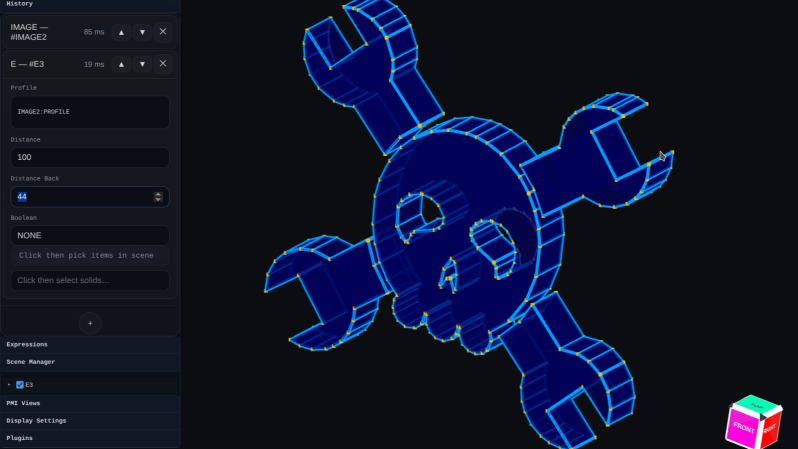
Who’s interested in a brand new, from-scratch boundary representation (BREP) kernel? How about one that has no topological naming problem, a web-native parametric CAD front end to play with, and has CAD-type operations making friends with triangle meshes? If you’re intrigued, check out [mmiscool]’s BREP project.
Functioning (let alone feature-filled, or efficient) CAD systems are not a software project we see a whole lot of. Ones that represent models as genuine BREP structures but cleverly use mesh-based operations where it makes sense? Even less so.
In theory, CAD programs are simple: allow a user to define features, keep track of what they are and how they relate to one another, and perform operations on them as requested. In practice, it’s significant work. Chains of operations and dependencies easily become complex, volatile things and there is really no room for error.
Read [Arya Voronova]’s best practices for using FreeCAD to get a few hints as to what goes on behind the scenes in a modern CAD program, and the kinds of challenges the back end has to deal with, like the topological naming problem (TNP). A problem [mmiscool]’s implementation completely avoids, by the way.
There is a live demo at BREP.io which acts as a playground for the state of the project. You can get started by clicking the + button towards the top on the left panel to add features and operations to the history (like add a cube, then add chamfers or fillets, or extrude a face, and so on).
[mmiscool] points out that all computation is done client-side; even complex operations like fillets, lofts, and multi-body booleans execute directly in the browser with no need to be offloaded to a back end. BREP’s development is being documented on Hackaday.io and there is a video embedded below that gives an overview. Why don’t you give it a spin?
On Friday, Vinay Prasad—the Food and Drug Administration’s chief medical and scientific officer and its top vaccine regulator—emailed a stunning memo to staff that quickly leaked to the press. Without evidence, Prasad claimed COVID-19 vaccines have killed 10 children in the US, and, as such, he announced unilateral, sweeping changes to the way the agency regulates and approves vaccines, including seasonal flu shots.
On Wednesday evening, a dozen former FDA commissioners, who collectively oversaw the agency for more than 35 years, responded to the memo with a scathing rebuke. Uniting to publish their response in the New England Journal of Medicine, the former commissioners said they were “deeply concerned” by Prasad’s memo, which they framed as a “threat” to the FDA’s work and a danger to Americans’ health.
In his memo, Prasad called for abandoning the FDA’s current framework for updating seasonal flu shots and other vaccines, such as those for COVID-19. Those updates currently involve studies that measure well-characterized immune responses (called immunobridging studies). Prasad dismissed this approach as insufficient and, instead, plans to require expensive randomized trials, which can take months to years for each vaccine update.
Apple has today made the first iOS 26.2 Release Candidate available for download by developers ahead of a final release to the public. That public release is expected to take place within a week or so assuming no further issues are identified.
This is today’s edition of The Download, our weekday newsletter that provides a daily dose of what’s going on in the world of technology.
Everything you need to know about AI and coding
AI has already transformed how code is written, but a new wave of autonomous systems promise to make the process even smoother and less prone to making mistakes.
Amazon Web Services has just revealed three new “frontier” AI agents, its term for a more sophisticated class of autonomous agents capable of working for days at a time without human intervention. One of them, called Kiro, is designed to work independently without the need for a human to constantly point it in the right direction. Another, AWS Security Agent, scans a project for common vulnerabilities: an interesting development given that many AI-enabled coding assistants can end up introducing errors.
To learn more about the exciting direction AI-enhanced coding is heading in, check out our team’s reporting:
+ A string of startups are racing to build models that can produce better and better software. Read the full story.
+ Anthropic’s cofounder and chief scientist Jared Kaplan on 4 ways agents will improve. Read the full story.
+ How AI assistants are already changing the way code gets made. Read the full story.
The must-reads
I’ve combed the internet to find you today’s most fun/important/scary/fascinating stories about technology.
1 Amazon’s new agents can reportedly code for days at a time They remember previous sessions and continuously learn from a company’s codebase. (VentureBeat) + AWS says it’s aware of the pitfalls of handing over control to AI. (The Register) + The company faces the challenge of building enough infrastructure to support its AI services. (WSJ $)
2 Waymo’s driverless cars are getting surprisingly aggressive The company’s goal to make the vehicles “confidently assertive” is prompting them to bend the rules. (WSJ $) + That said, their cars still have a far lower crash rate than human drivers. (NYT $)
3 The FDA’s top drug regulator has stepped down After only three weeks in the role. (Ars Technica)+ A leaked vaccine memo from the agency doesn’t inspire confidence. (Bloomberg $)
4 Maybe DOGE isn’t entirely dead after all Many of its former workers are embedded in various federal agencies. (Wired $)
5 A Chinese startup’s reusable rocket crash-landed after launch It suffered what it called an “abnormal burn,” scuppering hopes of a soft landing. (Bloomberg $)
6 Startups are building digital clones of major sites to train AI agents From Amazon to Gmail, they’re creating virtual agent playgrounds. (NYT $)
7 Half of US states now require visitors to porn sites to upload their ID Missouri has become the 25th state to enact age verification laws. (404 Media)
8 AGI truthers are trying to influence the Pope They’re desperate for him to take their concerns seriously.(The Verge) + How AGI became the most consequential conspiracy theory of our time. (MIT Technology Review)
9 Marketers are leaning into ragebait ads But does making customers annoyed really translate into sales? (WP $)
10 The surprising role plant pores could play in fighting drought At night as well as daytime. (Knowable Magazine) + Africa fights rising hunger by looking to foods of the past. (MIT Technology Review)
Quote of the day
“Everyone is begging for supply.”
—An anonymous source tells Reuters about the desperate measures Chinese AI companies take to secure scarce chips.
One more thing
The case against humans in space
Elon Musk and Jeff Bezos are bitter rivals in the commercial space race, but they agree on one thing: Settling space is an existential imperative. Space is the place. The final frontier. It is our human destiny to transcend our home world and expand our civilization to extraterrestrial vistas.
This belief has been mainstream for decades, but its rise has been positively meteoric in this new gilded age of astropreneurs.
But as visions of giant orbital stations and Martian cities dance in our heads, a case against human space colonization has found its footing in a number of recent books, from doubts about the practical feasibility of off-Earth communities, to realism about the harsh environment of space and the enormous tax it would exact on the human body. Read the full story.
—Becky Ferreira
We can still have nice things
A place for comfort, fun and distraction to brighten up your day. (Got any ideas? Drop me a line or skeet ’em at me.)
When the federal vaccine committee hand-picked by anti-vaccine Health Secretary Robert F. Kennedy Jr. meets again this week, it will have yet another new chairperson to lead its ongoing work of dismantling the evidence-based vaccine recommendations set by the Centers for Disease Control and Prevention.
On Monday, the Department of Health and Human Services announced that the chairperson who has been in place since June—when Kennedy fired all 17 expert advisors on the committee and replaced them with questionably qualified allies—is moving to a senior role in the department. Biostatistician Martin Kulldorff will now be the chief science officer for the Office of the Assistant Secretary for Planning and Evaluation (ASPE), HHS said. As such, he’s stepping down from the vaccine committee, the Advisory Committee on Immunization Practices (ACIP).
Kulldorff gained prominence amid the COVID-19 pandemic, criticizing public health responses to the crisis, particularly lockdowns and COVID-19 vaccines. He was a co-author of the Great Barrington Declaration that advocated for letting the deadly virus spread unchecked through the population, which was called unethical by health experts.
This is today’s edition of The Download, our weekday newsletter that provides a daily dose of what’s going on in the world of technology.
The State of AI: Welcome to the economic singularity
—David Rotman and Richard Waters
Any far-reaching new technology is always uneven in its adoption, but few have been more uneven than generative AI. That makes it hard to assess its likely impact on individual businesses, let alone on productivity across the economy as a whole.
At one extreme, AI coding assistants have revolutionized the work of software developers. At the other extreme, most companies are seeing little if any benefit from their initial investments.
That has provided fuel for the skeptics who maintain that—by its very nature as a probabilistic technology prone to hallucinating—generative AI will never have a deep impact on business. To students of tech history, though, the lack of immediate impact is normal. Read the full story.
If you’re an MIT Technology Review subscriber, you can join David and Richard, alongside our editor in chief, Mat Honan, for an exclusive conversation digging into what’s happening across different markets live on Tuesday, December 9 at 1pm ET. Register here!
The State of AI is our subscriber-only collaboration between the Financial Times and MIT Technology Review examining the ways in which AI is reshaping global power. Sign up to receive future editions every Monday.
The must-reads
I’ve combed the internet to find you today’s most fun/important/scary/fascinating stories about technology.
1 DeepSeek has unveiled two new experimental AI models DeepSeek-V3.2 is designed to match OpenAI’s GPT-5’s reasoning capabilities. (Bloomberg $) + Here’s how DeepSeek slashes its models’ computational burden. (VentureBeat) + It’s achieved these results despite its limited access to powerful chips. (SCMP $)
2 OpenAI has issued a “code red” warning to its employees It’s a call to arms to improve ChatGPT, or risk being overtaken. (The Information $) + Both Google and Anthropic are snapping at OpenAI’s heels. (FT $) + Advertising and other initiatives will be pushed back to accommodate the new focus. (WSJ $)
3 How to know when the AI bubble has burst These are the signs to look out for. (Economist $) + Things could get a whole lot worse for the economy if and when it pops. (Axios) + We don’t really know how the AI investment surge is being financed. (The Guardian)
4 Some US states are making it illegal for AI to discriminate against you California is the latest to give workers more power to fight algorithms. (WP $)
5 This AI startup is working on a post-transformer future Transformer architecture underpins the current AI boom—but Pathway is developing something new. (WSJ $) + What the next frontier of AI could look like. (IEEE Spectrum)
6 India is demanding smartphone makers install a government app Which privacy advocates say is unacceptable snooping. (FT $) + India’s tech talent is looking for opportunities outside the US. (Rest of World)
7 College students are desperate to sign up for AI majors AI is now the second-largest major at MIT behind computer science. (NYT $) + AI’s giants want to take over the classroom. (MIT Technology Review)
8 America’s musical heritage is at serious risk Much of it is stored on studio tapes, which are deteriorating over time. (NYT $) + The race to save our online lives from a digital dark age. (MIT Technology Review)
9 Celebrities are increasingly turning on AI That doesn’t stop fans from casting them in slop videos anyway. (The Verge)
10 Samsung has revealed its first tri-folding phone But will people actually want to buy it? (Bloomberg $) + It’ll cost more than $2,000 when it goes on sale in South Korea. (Reuters)
Quote of the day
“The Chinese will not pause. They will take over.”
—Michael Lohscheller, chief executive of Swedish electric car maker Polestar, tells the Guardian why Europe should stick to its plan to ban the production of new petrol and diesel cars by 2035.
One more thing
Inside Amsterdam’s high-stakes experiment to create fair welfare AI
Amsterdam thought it was on the right track. City officials in the welfare department believed they could build technology that would prevent fraud while protecting citizens’ rights. They followed these emerging best practices and invested a vast amount of time and money in a project that eventually processed live welfare applications. But in their pilot, they found that the system they’d developed was still not fair and effective. Why?
Lighthouse Reports, MIT Technology Review, and the Dutch newspaper Trouw have gained unprecedented access to the system to try to find out. Read about what we discovered.
—Eileen Guo, Gabriel Geiger & Justin-Casimir Braun
We can still have nice things
A place for comfort, fun and distraction to brighten up your day. (Got any ideas? Drop me a line or skeet ’em at me.)
Guava salad recipe – Easy to make Guava salad recipe with easily available ingredients – Guava salad recipe with a short YouTube video
Guava | கொய்யாப் பழம் in Tamil, is a tropical fruit rich in fiber, Vitamin C, and antioxidants. Salads are a favorite at home. As we enjoy guava fruit as it is, I thought of trying out a salad made with the fruit. I used semi-ripe ( more on the raw side) guava for making this guava salad.
I have used feta cheese in this salad; it is completely optional. However, I highly recommend adding feta cheese as it elevates the taste to a different level. After I posted the video on Instagram, many of my readers tried it and sent me pictures. It was a super hit at everyone’s home.
If you are a person who doesn’t like eating fruits as it is, do try this interesting version of guava salad.
Add salt, chaat masala, 1 finely chopped green chili, red chili powder and lemon juice.
Mix everything well
Add thinly sliced carrot, guava, boiled chickpeas and mix well.
Add 2 tbsp feta cheese (optional)
Mix well
Guava salad is ready
Video
Notes
1. You can add thinly sliced cucumber to the salad2. During non-guava season, you can use thinly sliced apple or pineapple also3. Feta cheese gives a nice taste to the guava salad
[Slant 3D] has a useful video explaining some thoughtful CAD techniques for designing 3D printed pins that don’t break and the concepts can be extended to similar features.
Sure, one can make pins stronger simply by upping infill density or increasing the number of perimeters, but those depend on having access to the slicer settings. If someone else is printing a part, that part’s designer has no actual control over these things. So how can one ensure sturdier pins without relying on specific print settings? [Slant 3D] covers two approaches.
The first approach includes making a pin thick, making it short (less leverage for stress), and adding a fillet to the sharp corner where the pin meets the rest of the part. Why? Because a rounded corner spreads stress out, compared to a sharp corner.
Microfeatures can ensure increased strength in a way that doesn’t depend on slicer settings.
Those are general best practices, but there’s even more that can be done with microfeatures. These are used to get increased strength as a side effect of how a 3D printer actually works when making a part.
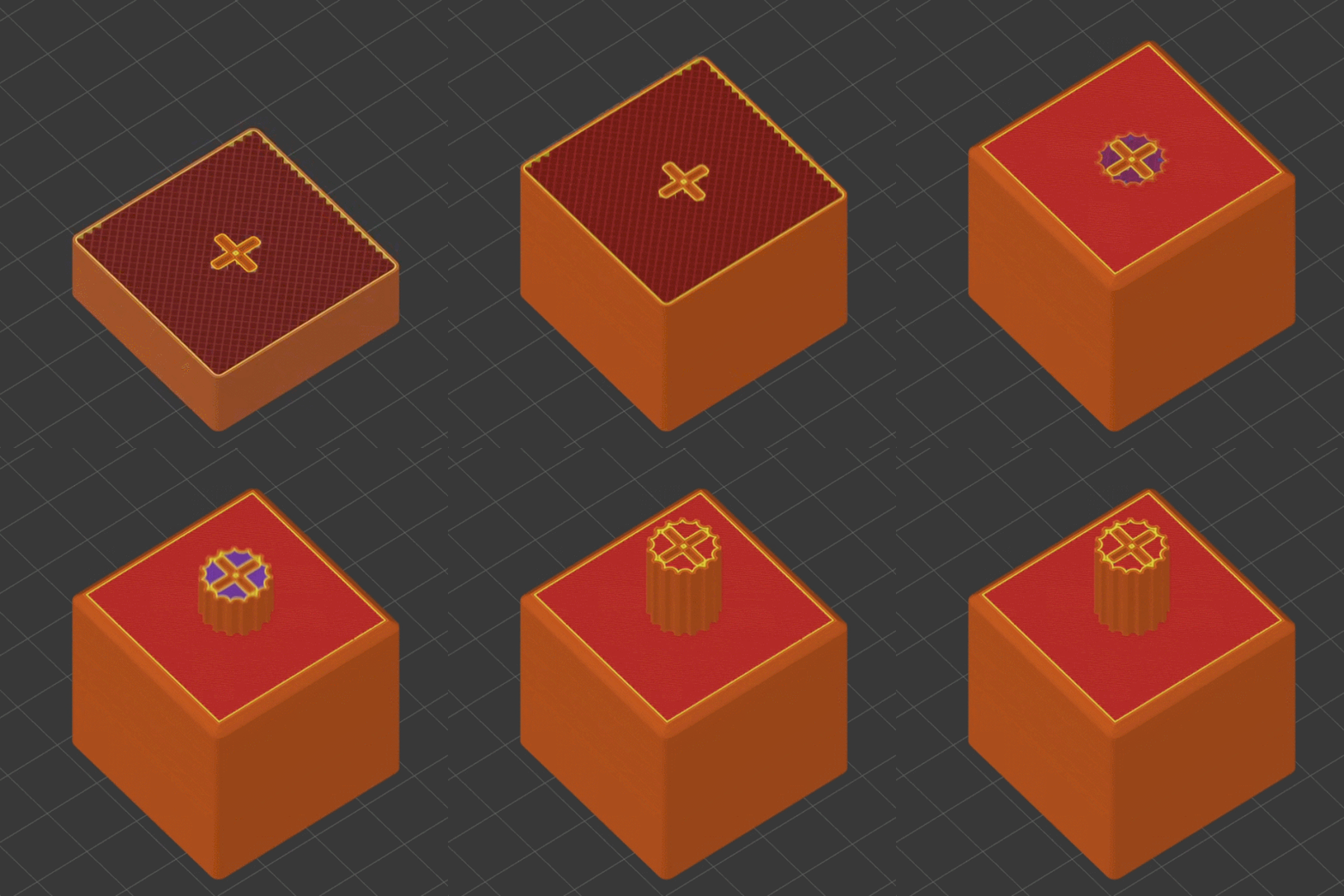
One type of microfeature is to give the pin a bunch of little cutouts, making the cross-section look like a gear instead of a circle. The little cutouts don’t affect how the pin works, but increase the surface area of each layer, making the part stronger.
A denser infill increases strength, too. Again, instead of relying on slicer settings, one can use microfeatures for a similar result. Small slots extending down through the pin (and going into the part itself) don’t affect how the part works, but make the part sturdier. Because of how filament-based 3D printing works, these sorts of features are more or less “free” and don’t rely on specific printer or slicer settings.
[Slant 3D] frequently shares design tips like this, often focused on designing parts that are easier and more reliable to print. For example, while printers are great at generating useful support structures, sometimes it’s better and easier in the long run to just design supports directly into the part.
This is today’s edition of The Download, our weekday newsletter that provides a daily dose of what’s going on in the world of technology.
An AI model trained on prison phone calls now looks for planned crimes in those calls
A US telecom company trained an AI model on years of inmates’ phone and video calls and is now piloting that model to scan their calls, texts, and emails in the hope of predicting and preventing crimes.
Securus Technologies president Kevin Elder told MIT Technology Review that the company began building its AI tools in 2023, using its massive database of recorded calls to train AI models to detect criminal activity. It created one model, for example, using seven years of calls made by inmates in the Texas prison system, but it has been working on models for other states and counties.
However, prisoner rights advocates say that the new AI system enables a system of invasive surveillance, and courts have specified few limits to this power. Read the full story.
—James O’Donnell
Nominations are now open for our global 2026 Innovators Under 35 competition
We have some exciting news: Nominations are now open for MIT Technology Review’s 2026 Innovators Under 35 competition. This annual list recognizes 35 of the world’s best young scientists and inventors, and our newsroom has produced it for more than two decades.
I’ve combed the internet to find you today’s most fun/important/scary/fascinating stories about technology.
1 New York is cracking down on personalized pricing algorithms A new law forces retailers to declare if their pricing is informed by users’ data. (NYT $) + The US National Retail Federation tried to block it from passing. (TechCrunch)
2 The White House has launched a media bias tracker Complete with a “media offender of the week” section and a Hall of Shame. (WP $) + The Washington Post is currently listed as the site’s top offender. (The Guardian) + Donald Trump has lashed out at several reporters in the past few weeks. (The Hill)
3 American startups are hooked on open-source Chinese AI models They’re cheap and customizable—what’s not to like? (NBC News) + Americans also love China’s cheap goods, regardless of tariffs. (WP $) + The State of AI: Is China about to win the race? (MIT Technology Review)
4 How police body cam footage became viral YouTube content Recent arrestees live in fear of ending up on popular channels. (Vox) + AI was supposed to make police bodycams better. What happened? (MIT Technology Review)
5 Construction workers are cashing in on the data center boom Might as well enjoy it while it lasts. (WSJ $) + The data center boom in the desert. (MIT Technology Review)
6 China isn’t convinced by crypto Even though bitcoin mining is quietly making a (banned) comeback. (Reuters) + The country’s central bank is no fan of stablecoins. (CoinDesk)
7 A startup is treating its AI companions like characters in a novel Could that approach make for better AI companions? (Fast Company $) + Gemini is the most empathetic model, apparently. (Semafor) + The looming crackdown on AI companionship. (MIT Technology Review)
8 Ozempic is so yesterday New weight-loss drugs are tailored to individual patients. (The Atlantic $) + What we still don’t know about weight-loss drugs. (MIT Technology Review)
9 AI is upending how consultants work For the third year in a row, big firms are freezing junior workers’ salaries. (FT $)
10 Behind the scenes of Disney’s AI animation accelerator What took five months to create has been whittled down to under five weeks. (CNET) + Director supremo James Cameron appears to have changed his mind about AI. (TechCrunch) + Why are people scrolling through weirdly-formatted TV clips? (WP $)
Quote of the day
“[I hope AI] comes to a point where it becomes sort of mental junk food and we feel sick and we don’t know why.”
—Actor Jenna Ortega outlines her hopes for AI’s future role in filmmaking, Variety reports.
One more thing
The weeds are winning
Since the 1980s, more and more plants have evolved to become immune to the biochemical mechanisms that herbicides leverage to kill them. This herbicidal resistance threatens to decrease yields—out-of-control weeds can reduce them by 50% or more, and extreme cases can wipe out whole fields.
At worst, it can even drive farmers out of business. It’s the agricultural equivalent of antibiotic resistance, and it keeps getting worse. Weeds have evolved resistance to 168 different herbicides and 21 of the 31 known “modes of action,” which means the specific biochemical target or pathway a chemical is designed to disrupt.
Agriculture needs to embrace a diversity of weed control practices. But that’s much easier said than done. Read the full story.
—Douglas Main
We can still have nice things
A place for comfort, fun and distraction to brighten up your day. (Got any ideas? Drop me a line or skeet ’em at me.)
The Layer 1 blockchain Monad has grabbed the headlines in the past few days following its successful launch earlier last week. MON, its native token, enjoyed a significant 80% surge on the back of the launch, hitting an all-time high of 0.048 on Wednesday, November 26.
While the Monad protocol has enjoyed significant attention since going live, it appears that not everyone is confident in its potential adoption. Most notably, BitMEX co-founder Arthur Hayes has put forward a pessimistic outlook for the project, saying its token value could fall as much as 99%.
Monad Has No Real Use Case: Hayes
In a YouTube interview with Altcoin Daily, Hayes stated that any other Layer 1 blockchain besides Ethereum and Solana is “zero” and is not going to do very well. Using Monad as an example, the former BitMEX CEO described the protocol’s coin as another “high FDV, low-float” token.
Hayes said that Monad is going to be the new “Berachain” and expects its native token’s value to fall by 99% after the initial jump. Berachain, which launched in February 2025, has its native token BERA trading beneath $1, nearly 94% beneath its all-time high of $14.83.
As of this writing, the Monad token is valued at around $0.0285, reflecting an over 40% decline since hitting its all-time high on Wednesday.
Hayes highlighted that every new project’s token often enjoys an early price spike before facing a deep correction, as there is usually no real use case to back up the initial growth. The crypto founder noted that it is a classic case of FOMO (fear of missing out), especially after the massive success of Ethereum.
Hayes said in the interview:
Every coin gets their first pump and people want to believe in the new L1. Everybody wants to invest in the new Ethereum like they would have in 2014 when everyone missed it. Me included. But again, that doesn’t mean it [Monad] is going to actually have any real use case.
Moving forward, Hayes went on to pick a “magnificent five” of protocols currently in the cryptocurrency space, including Bitcoin, Ethereum, Solana, ZCash, and Ethena.
If Not Layer 1s, What Next?
It is little surprise that ZCash made it to the BitMEX co-founder’s list of top blockchain protocols. According to Hayes, ZCash and other privacy-focused coins—like Monero—will dominate the crypto narrative even more in the coming year.
Additionally, Hayes mentioned that Zero Knowledge (ZK) proofs and quantum resistance are other crypto narratives to watch out for in 2026. Specifically, the crypto founder noted that the next winner in the crypto market over the next one to two years would come from the ZK space.
Crypto analyst ChartNerd has predicted that the XRP price could rally 10x if a specific trend repeats. The analyst also revealed what needs to happen for the altcoin to invalidate this potential parabolic rally.
XRP Price Could Rally 10x If This 2017 Pattern Plays Out
In an X post, ChartNerd predicted that the XRP price could rally 1,000% if a bullish pattern from the 2017 bull cycle plays out. The analyst noted that during the 2017 euphoric run, the altcoin had a 3-month cool-off period where it successfully dropped towards its 3-month 20-EMA for a retest before a 25x move to the upside.
ChartNerd revealed that the XRP price has now witnessed the exact same set-up in this 2025 bull cycle. The altcoin recorded a huge breakout last year and is now seeing a 3-month cool-off period towards a 3-month 20-EMA retest. The analyst stated that if history is set to repeat, XRP could see a 10x upside move, signaling a blow-off top.
The analyst also alluded to the 2021 lower high, which he noted ties up with both the monthly candle close highs from 2017 and also the SEC lawsuit, which is believed to have suppressed the XRP price during the 2021 cycle. ChartNerd added that to invalidate this potential rally, XRP will need to close below its 3-month 20-EMA at $1.20. Until then, he noted that the bulls remain in control.
Meanwhile, ChartNerd outlined $8, $13, and $27 as the potential top-out points for the XRP price. Notably, a rally to any of these price targets will mark a new all-time high (ATH) for the altcoin. Crypto analyst Egrag Crypto had also previously predicted that XRP could reach $27 in this bull run if it mirrors the 2017 price action.
XRP Could Be The Next Crypto To Record A Major Run
Market commentator Milk Road suggested in an X post that the XRP price could soon record a major run. The platform cited bullish fundamentals for the altcoin, including the fact that RLUSD crossed $1 billion in market cap in record time. The run to this milestone is said to be faster than almost any stablecoin Ripple has ever pushed.
Furthermore, Milk Road noted that Abu Dhabi’s ADGM has opened the door for institutions to use RLUSD as real collateral, which is also bullish for the XRP price. The market commentator stated that global liquidity with regulated on-ramps could mean the kind of flows that crypto hasn’t seen in months. It is also worth noting that XRP is seeing significant flows into its ecosystem through the U.S. spot ETFs.
At the time of writing, the XRP price is trading at around $2.18, down in the last 24 hours, according to data from CoinMarketCap.
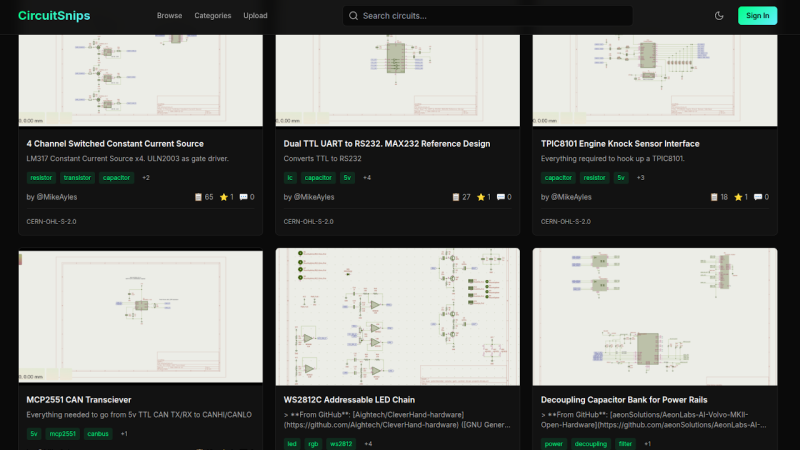
In the desktop 3D printing world, we’re fortunate to have multiple online repositories of models that anyone can load up on their machine. Looking to create a similar experience but for electronic projects, [Mike Ayles] created CircuitSnips — a searchable database of ready-to-use KiCad schematics available under open source licenses.
Looking for reference designs for LiPo chargers? CircuitSnips has you covered. Want to upload your own design so others can utilize it? Even better. Currently, there are over four thousand circuits on CircuitSnips, although not all have been put there purposely. To get the project off the ground, [Mike] scrapped GitHub for open source KiCad projects. While this doesn’t run afoul of the licensing, there’s a mechanism in place for anyone who wants to have their project removed from the repository.
To scrape the depths of GitHub, [Mike] had to simplify the text expression for the KiCad projects using a tool he’s since released. For anyone so inclined, he’s even put the entire site on GitHub for anyone who wants to try their hand at running it locally.
This is today’s edition of The Download, our weekday newsletter that provides a daily dose of what’s going on in the world of technology.
What we still don’t know about weight-loss drugs
Weight-loss drugs have been back in the news this week. First, we heard that Eli Lilly, the company behind Mounjaro and Zepbound, became the first healthcare company in the world to achieve a trillion-dollar valuation.
But we also learned that, disappointingly, GLP-1 drugs don’t seem to help people with Alzheimer’s disease. And that people who stop taking the drugs when they become pregnant can experience potentially dangerous levels of weight gain. On top of that, some researchers worry that people are using the drugs postpartum to lose pregnancy weight without understanding potential risks.
This article first appeared in The Checkup, MIT Technology Review’s weekly biotech newsletter. To receive it in your inbox every Thursday, and read articles like this first, sign up here.
If you’re interested in weight loss drugs and how they affect us, take a look at:
+ GLP-1 agonists like Wegovy, Ozempic, and Mounjaro might benefit heart and brain health—but research suggests they might also cause pregnancy complications and harm some users. Read the full story.
+ We’ve never understood how hunger works. That might be about to change. Read the full story.
+ This vibrating weight-loss pill seems to work—in pigs. Read the full story.
What we know about how AI is affecting the economy
There’s a lot at stake when it comes to understanding how AI is changing the economy right now. Should we be pessimistic? Optimistic? Or is the situation too nuanced for that?
Hopefully, we can point you towards some answers. Mat Honan, our editor in chief, will hold a special subscriber-only Roundtables conversation with our editor at large David Rotman, and Richard Waters, Financial Times columnist, exploring what’s happening across different markets. Register here to join us at 1pm ET on Tuesday December 9.
The event is part of the Financial Times and MIT Technology Review “The State of AI” partnership, exploring the global impact of artificial intelligence. Over the past month, we’ve been running discussions between our journalists—sign up here to receive future editions every Monday.
The must-reads
I’ve combed the internet to find you today’s most fun/important/scary/fascinating stories about technology.
1 Tech billionaires are gearing up to fight AI regulation By amassing multi-million dollar war chests ahead of the 2026 US midterm elections. (WSJ $) + Donald Trump’s “Manhattan Project” for AI is certainly ambitious. (The Information $)
2 The EU wants to hold social media platforms liable for financial scams New rules will force tech firms to compensate banks if they fail to remove reported scams. (Politico)
3 China is worried about a humanoid robot bubble Because more than 150 companies there are building very similar machines. (Bloomberg $) + It could learn some lessons from the current AI bubble. (CNN)+ Why the humanoid workforce is running late. (MIT Technology Review)
4 A Myanmar scam compound was blown up But its residents will simply find new bases for their operations. (NYT $) + Experts suspect the destruction may have been for show. (Wired $) + Inside a romance scam compound—and how people get tricked into being there. (MIT Technology Review)
5 Navies across the world are investing in submarine drones They cost a fraction of what it takes to run a traditional manned sub. (The Guardian) + How underwater drones could shape a potential Taiwan-China conflict. (MIT Technology Review)
6 What to expect from China’s seemingly unstoppable innovation drive Its extremely permissive regulators play a big role. (Economist $) + Is China about to win the AI race? (MIT Technology Review)
7 The UK is waging a war on VPNs Good luck trying to persuade people to stop using them. (The Verge)
8 We’re learning more about Jeff Bezos’ mysterious clock project He’s backed the Clock of the Long Now for years—and construction is amping up. (FT $) + How aging clocks can help us understand why we age—and if we can reverse it. (MIT Technology Review)
9 Have we finally seen the first hints of dark matter? These researchers seem to think so. (New Scientist $)
10 A helpful robot is helping archaeologists reconstruct Pompeii Reassembling ancient frescos is fiddly and time-consuming, but less so if you’re a dextrous machine. (Reuters)
Quote of the day
“We do fail… a lot.”
—Defense company Anduril explains its move-fast-and-break-things ethos to the Wall Street Journal in response to reports its systems have been marred by issues in Ukraine.
One more thing
How to build a better AI benchmark
It’s not easy being one of Silicon Valley’s favorite benchmarks.
SWE-Bench (pronounced “swee bench”) launched in November 2024 as a way to evaluate an AI model’s coding skill. It has since quickly become one of the most popular tests in AI. A SWE-Bench score has become a mainstay of major model releases from OpenAI, Anthropic, and Google—and outside of foundation models, the fine-tuners at AI firms are in constant competition to see who can rise above the pack.
Despite all the fervor, this isn’t exactly a truthful assessment of which model is “better.” Entrants have begun to game the system—which is pushing many others to wonder whether there’s a better way to actually measure AI achievement. Read the full story.
—Russell Brandom
We can still have nice things
A place for comfort, fun and distraction to brighten up your day. (Got any ideas? Drop me a line or skeet ’em at me.)
+ Aww, these sharks appear to be playing with pool toys. + Strange things are happening over on Easter Island (even weirder than you can imagine) + Very cool—archaeologists have uncovered a Roman tomb that’s been sealed shut for 1,700 years. + This Japanese mass media collage is making my eyes swim, in a good way.

 Login
Login