Reading view

There are new articles available, click to refresh the page.

Saylor Changes Strategy: New $1.44 Billion USD Reserve Unveiled

Strategy has announced a new $1.44 billion US Dollar (USD) reserve, signaling a major shift for the Bitcoin-focused treasury company.

Strategy Establishes New USD Reserve

In a new post on X, Strategy co-founder and chairman Michael Saylor has revealed the formation of a USD reserve for the firm. Worth $1.44 billion, the reserve has been established using sales of class A common stock under the company’s at-the-market (ATM) offering program.

Since pivoting to being a Bitcoin treasury company back in 2020, Strategy has focused on expanding its BTC holdings, so this USD reserve reflects a shift for the company.

The current goal for Strategy is to maintain a USD reserve that can fund at least twelve months of dividends and interest payments (collectively referred to as just “Dividends”). Eventually, the firm intends to cover 24 or more months with the dollar reserve.

According to Phong Le, the treasury company’s president and CEO, the newly established USD reserve can currently cover 21 months of Dividends. “We intend to use this reserve to pay our Dividends and grow it over time,” noted Le.

Strategy has established this reserve as Bitcoin has witnessed a bearish transition recently, with its price dropping into the low $80,000 levels from a high of $126,000 in October.

Saylor noted:

Establishing a USD Reserve to complement our BTC Reserve marks the next step in our evolution, and we believe it will better position us to navigate short-term market volatility while delivering on our vision of being the world’s leading issuer of Digital Credit.

Strategy has also updated its year-end target for Bitcoin, slashing down its $150,000 assumption to a range between $85,000 and $110,000. The update in assumption is to reflect a range more consistent with recent BTC prices, the company said in the press release.

While the USD reserve is a fresh change for the firm, it hasn’t stopped buying Bitcoin. Alongside the same announcement, Strategy has also unveiled a new BTC acquisition.

With this new purchase, the company has added 130 BTC to its treasury, spending $89,960 per token, or $11.7 million in aggregate. A relatively modest buy; in fact, the smallest acquisition by the firm since March 2025.

Strategy now holds 650,000 BTC, equivalent to 3.1% of the total Bitcoin supply cap. The company used a total of $48.38 billion to assemble these holdings, putting its cost basis per token at $74,436. At the current BTC price, the treasury is still in a profit of about 13.65%.

Saylor’s firm is by far the largest Bitcoin corporate treasury in the world, outweighing the second-placed MARA Holdings by nearly 600,000 BTC.
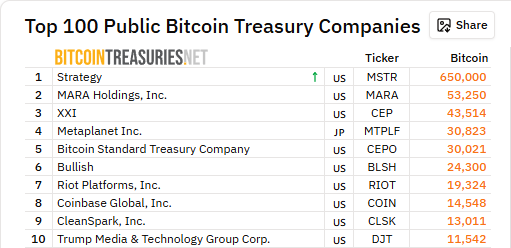
Bitcoin Treasuries Tracker

Bitcoin Has Plunged To $84,500

The past day has been quite bearish for Bitcoin as its price has gone through a decline of almost 8% and has erased much of its recent recovery. Initially, BTC fell toward $86,000, but it has seen another leg down to $84,500 after the Strategy USD reserve announcement, a sign that investors have taken the news negatively.


Bitcoin Price Chart

Bitcoin Price Trades Near $93,000 as Strategy (MSTR) Adds 8,178 BTC in Largest Purchase Since July

Bitcoin Magazine

Bitcoin Price Trades Near $93,000 as Strategy (MSTR) Adds 8,178 BTC in Largest Purchase Since July

Bitcoin price traded around $93,000 on Monday after Strategy disclosed it acquired 8,178 BTC for approximately $835.6 million over the past week, its largest buy since mid-summer.

According to an SEC filing and a Michael Saylor post on X, the purchases were made at an average price of $102,171 per bitcoin. The company now holds 649,870 BTC acquired for roughly $48.37 billion at an average cost of $74,433 per coin. Strategy said its bitcoin yield has reached 27.8% year-to-date.

At the time of the announcement, Bitcoin was trading near $94,000 and Strategy’s stock ($MSTR) was trading down 2% at $195.86 in premarket trading. 

The acquisition was funded primarily through preferred stock issuance. The company raised about $715 million earlier this month through its new euro-denominated preferred series, STRE (“Steam”), which expanded its high-yield offerings to European investors.

It also generated another $131.4 million from sales of its STRC (“Stretch”) preferred shares, according to Monday’s filing.

The move marks a return to large-scale accumulation by Strategy. Strategy’s recent bitcoin purchases had been smaller and more incremental amid a sharp drop in the company’s stock price. 

MSTR shares have fallen roughly 56% over the past four months, reducing the firm’s ability to issue common stock without diluting existing shareholders. 

BREAKING: 🇺🇸 STRATEGY BUYS ANOTHER 8,178 #BITCOIN FOR $835.6 MILLION pic.twitter.com/d6WW2RNKBM

— Bitcoin Magazine (@BitcoinMagazine) November 17, 2025

At Monday’s ~$199 share price, Strategy’s enterprise value now sits only slightly above the value of its bitcoin reserves.

Bitcoin traded at $94,500 Monday morning, little changed from Friday. The latest purchase suggests Michael Saylor is doubling down on the firm’s bitcoin-as-treasury model despite the recent market decline. 

Strategy’s ‘zoom out’ fundamentals 

Bitcoin has dropped nearly 30% from its early-October highs, challenging assumptions that increased institutional participation and regulatory clarity would stabilize prices.

Strategy has increasingly turned to preferred stock as its mNAV premium compressed. Last week, the company closed a €620 million ($716.8 million) euro-denominated perpetual preferred offering, doubling its original size. The 10% Series A “Stream” preferred raised $703.9 million in net proceeds after fees.

Michael Saylor moved quickly last Friday to shut down rumors that Strategy was selling its bitcoin holdings, calling the reports “false” and reaffirming that the company is aggressively buying.

In an interview with CNBC, the Executive Chairman said, “We are buying bitcoin,” adding that Strategy is “accelerating [its] purchases” and will disclose new activity on Monday. He hinted that investors may be “pleasantly surprised” by what the company has done in recent days.

Saylor dismissed concerns that outflows from company wallets signaled liquidation, emphasizing that “there is no truth to this rumor.” He urged investors to “zoom out,” arguing that the company remains fundamentally strong despite volatility. He said Strategy has built a “strong base of support” and expressed confidence in the firm’s positioning.

Saylor also stressed that Strategy’s balance sheet is “pretty stable” and only lightly leveraged, with no near-term debt pressure. He reiterated his belief that bitcoin is “always a good investment” for those with a multi-year horizon, contrasting long-term “digital capital” accumulation with short-term trading strategies.

Earlier this year, Saylor outlined a plan to build a trillion-dollar Bitcoin-backed balance sheet and eventually issue over-collateralized credit products.

Strategy

In a conversation with Bitcoin Magazine, Strategy co-founder Michael Saylor outlined an ambitious “endgame”: amassing a trillion-dollar bitcoin balance sheet and using it to help reinvent global credit.

Saylor said the goal is to reach $1 trillion in BTC and compound it 20–30% annually, leveraging Bitcoin’s long-term appreciation. At a scale of that magnitude, he believes Strategy — and similar future treasury firms — could use their holdings to issue bitcoin-backed credit with yields far better than those in the fiat system.

Over the weekend, Bitcoin was trading below $92,000 at times, according to Bitcoin Magazine Pro data.

This post Bitcoin Price Trades Near $93,000 as Strategy (MSTR) Adds 8,178 BTC in Largest Purchase Since July first appeared on Bitcoin Magazine and is written by Micah Zimmerman.

S&P Assigns ‘B-’ Rating to Strategy (MSTR), Citing Bitcoin Exposure and Liquidity Risk

Bitcoin Magazine

S&P Assigns ‘B-’ Rating to Strategy (MSTR), Citing Bitcoin Exposure and Liquidity Risk

S&P Global Ratings assigned a ‘B-’ issuer credit rating to bitcoin-juggernaut Strategy, reflecting the company’s heavy concentration in bitcoin and limited dollar liquidity. The outlook is stable.

S&P said the rating reflects Strategy’s “high bitcoin concentration, narrow business focus, weak risk-adjusted capitalization, and low U.S. dollar liquidity.” The company reported $8.1 billion in pre-tax earnings in the first half of 2025, almost entirely from appreciation in the value of its bitcoin holdings.

The firm said in their release that while Strategy’s balance sheet is dominated by bitcoin, its management has prudently staggered debt maturities and maintained flexibility by financing primarily with equity.

In other words, this rating means Strategy can meet debt obligations for now but faces significant default risk if market conditions worsen.

Strategy — now effectively a bitcoin treasury company — raises capital through equity and debt issuances to purchase and hold bitcoin. Its securities give investors varying exposure to bitcoin across its capital structure. 

Just today, founder and former CEO Michael Saylor announced a purchase of 390 BTC between October 20 and October 26, spending approximately $43.4 million at an average price of $111,053 per Bitcoin. The firm still operates a small AI-powered analytics business, though it remains roughly breakeven.

JUST IN: S&P Global Ratings has rated a #Bitcoin treasury company for the first time — Michael Saylor’s Strategy 👀 pic.twitter.com/oP4j5UIJlj

— Bitcoin Magazine (@BitcoinMagazine) October 27, 2025

A Strategy first

This S&P rating is the first-ever rating of a Bitcoin Treasury Company by a major credit rating agency.

According to S&P, Strategy’s risk-adjusted capital ratio was significantly negative as of June 30, 2025, because the agency deducts bitcoin assets from equity in its calculation. 

Strategy reported $8.1 billion in pre-tax earnings in the first half of 2025. Operating cash flow during the period was negative $37 million.

The agency cited several key risks, including a currency mismatch between Strategy’s bitcoin-denominated assets and dollar-denominated obligations such as interest, debt principal, and preferred dividends. 

S&P also pointed to cybersecurity risks given the company’s reliance on custodians to safeguard its bitcoin.

Strategy holds bitcoin valued at roughly $70 billion, against $8 billion in convertible debt, much of which matures beginning in 2028. Annual preferred dividends total about $640 million, which the company plans to fund through additional stock and preferred equity issuance.

While Strategy’s access to capital markets remains a core strength, S&P warned that a sharp decline in bitcoin prices or loss of investor confidence could impede its ability to refinance debt or pay dividends, potentially leading to bitcoin sales “at severely depressed prices.”

S&P said the rating could be downgraded if access to markets weakens or debt management risks rise. An upgrade is unlikely unless the company improves its U.S. dollar liquidity or reduces reliance on convertible debt.

Strategy’s trillion-dollar endgame

Earlier this year, Michael Saylor laid out an ambitious plan to reshape global finance through Bitcoin.

In an interview with Bitcoin Magazine, Saylor described an “endgame” in which Strategy accumulates a trillion-dollar bitcoin balance sheet, growing 20–30% annually, and uses it as the foundation for a new global credit system.

At the core of his vision is scale: with enough BTC on corporate balance sheets, the long-term appreciation of Bitcoin — historically around 21% annually — would supercharge the capital base.

On top of that, Saylor sees an opportunity to issue bitcoin-backed credit at yields significantly higher than traditional fiat-based debt, potentially two to four percentage points above corporate or sovereign rates.

He argued that over-collateralization could make this system safer than even AAA-rated debt, while simultaneously fueling broader financial growth.

Saylor’s vision extends beyond credit markets. As Bitcoin becomes embedded in corporations, banks, insurers, and sovereign wealth funds, public equity indexes could gradually become indirect bitcoin vehicles.

This, he says, would benefit equity markets and corporate balance sheets while introducing higher yields and greater transparency into financial products.

The implications are broad: savings accounts could yield 8–10% instead of near-zero, money market funds could be denominated in bitcoin, and insurance products could be reimagined around bitcoin collateral.

This post S&P Assigns ‘B-’ Rating to Strategy (MSTR), Citing Bitcoin Exposure and Liquidity Risk first appeared on Bitcoin Magazine and is written by Micah Zimmerman.

❌